PYUSD dans la main gauche, Open USD dans la main droite : La couverture des risques stablecoin de PayPal

Odaily星球日报Published on 2026-08-13Last updated on 2026-08-13

Abstract

PayPal a publié des résultats du deuxième trimestre supérieurs aux attentes, avec un chiffre d'affaires de 8,68 milliards de dollars et un volume de paiements total en hausse de 10 %. Cependant, sa marge bénéficiaire GAAP a diminué, en partie à cause d'une perte de 81 millions de dollars liée à des actifs cryptographiques. L'entreprise a réorganisé sa structure, créant un nouveau département "Payment Services & Crypto" et positionnant son stablecoin PYUSD comme un pilier central de sa plateforme PayPal World pour les paiements commerciaux. Malgré une expansion initiale rapide sur neuf blockchains et un pic de capitalisation à 4,2 milliards de dollars en mars, la circulation de PYUSD a depuis chuté d'environ 31 % pour atteindre environ 2,7 milliards de dollars. Cela révèle un défi : la demande organique sans incitations reste à prouver, et PYUSD est encore loin derrière USDC en termes de taille. Parallèlement, l'annonce d'Open USD, un nouveau stablecoin soutenu par un consortium de plus de 140 entreprises (dont PayPal lui-même), introduit une concurrence structurelle. Son modèle de gouvernance partagée et de répartition des revenus parmi les partenaires contraste avec le modèle à émetteur unique de PYUSD. Face à cette incertitude, PayPal adopte une stratégie de couverture, en pariant à la fois sur son propre PYUSD et en participant au consortium Open USD. L'avenir de PYUSD dépendra de sa capacité à transformer son réseau de distribution en une demande durable, sans dépendre...

Original | Odaily Planet Daily (@OdailyChina)

Auteur | jk
Récemment, le géant des paiements PayPal a publié ses résultats financiers du deuxième trimestre : des revenus de 8,68 milliards de dollars, dépassant les attentes du marché, et un volume total de paiements de 4 864 milliards de dollars, en hausse de 10% par rapport à l'année précédente.

De plus, PayPal positionne le PYUSD (PayPal USD) comme le « principal facilitateur / facteur clé » (major enabler) de la plateforme PayPal World, et souligne son rôle central en tant que stablecoin « commerce-first » (priorité au commerce) destinée aux scénarios grand public et marchands.

Sur le marché férocement concurrentiel des stablecoins, le PYUSD reste tiède. Quelles sont ses perspectives de développement futur ? Et PayPal peut-il vraiment en supporter le coût ?

Résultats du T2 : Où se situe le PYUSD ?

Les revenus de PayPal ce trimestre s'élèvent à 8,68 milliards de dollars, en hausse d'environ 5% par rapport à l'année précédente, dépassant les attentes des analystes de 8,68 milliards de dollars contre 8,47 milliards de dollars anticipés ; le bénéfice ajusté par action est de 1,38 $, également meilleur que les 1,28 $ attendus par le marché. Le bénéfice par action GAAP est de 1,26 $, légèrement inférieur aux attentes. Le volume total de paiements atteint 4 864 milliards de dollars, en hausse de 10% par rapport à l'année précédente, et en hausse de 9% en termes neutres sur le plan monétaire. L'orientation annuelle du bénéfice ajusté par action a été relevée à environ 5,38 $.

Seuls ces indicateurs clés, il s'agit de résultats légèrement supérieurs aux attentes.
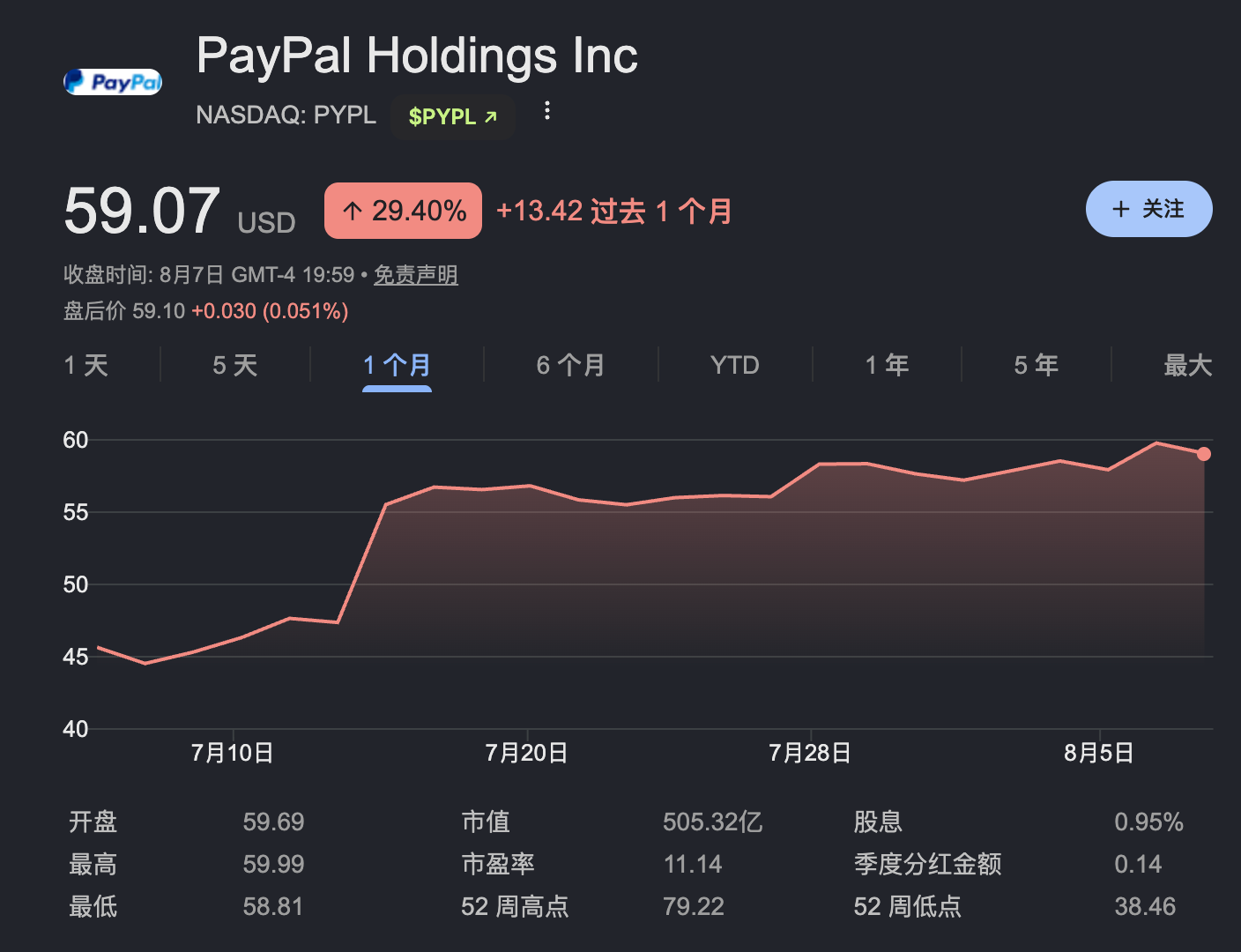
Le cours de l'action a augmenté au cours du mois dernier. Source : Google

Mais l'autre côté de la marge raconte une histoire différente. La marge GAAP est passée de 18,1% à 16,4% par rapport à l'année précédente. La société attribue une perte nette de 81 millions de dollars aux investissements stratégiques et aux actifs cryptographiques détenus à des fins d'investissement, les excluant de ses résultats non-GAAP. En d'autres termes, les actifs cryptographiques exercent déjà une certaine pression sur la rentabilité comptable de PayPal. Mais il est encore difficile de dire si cette perte n'est qu'une perte temporaire due à la baisse du marché, ou si l'entreprise assume activement des coûts pour favoriser l'expansion de ces activités.

Parallèlement, PayPal a créé ce trimestre un nouveau département « Payment Services & Crypto », regroupant le PYUSD et les services de traitement pour marchands sous une même entité. Le PDG Enrique Lores a déclaré lors de la conférence téléphonique sur les résultats que l'entreprise prévoyait de lancer davantage de produits marchands alimentés par le PYUSD et par les paiements par agents IA (agentic payments). Le PYUSD a été intégré au cœur du système de paiement marchand de PayPal, n'étant plus seulement un projet d'innovation relativement indépendant. Par rapport aux déclarations verbales de la direction sur sa « valeur stratégique », cette réorganisation reflète mieux le positionnement réel de PayPal vis-à-vis du PYUSD.

Cependant, l'entreprise n'a toujours pas divulgué séparément la contribution spécifique du PYUSD aux revenus, à la fidélisation des marchands ou aux marges de transaction. Les investisseurs ne peuvent qu'inférer, à partir des données globales et des déclarations de la direction, dans quelle mesure ce stablecoin stimule réellement les performances, ce qui constitue la lacune d'information la plus importante à suivre au cours des prochains trimestres.

La signification stratégique du PYUSD pour PayPal : Le récit de l'expansion et l'offre qui se contracte

Depuis son émission en août 2023, le PYUSD a connu une phase d'expansion et de contraction au gré des cycles haussiers et baissiers.

En mars dernier, l'entreprise a étendu sa couverture à 70 marchés, et son offre a atteint un pic d'environ 4,2 milliards de dollars, avec un taux de croissance annuel approchant 680%, en faisant le plus rapide des principaux stablecoins. À ce jour, le PYUSD a été déployé sur neuf blockchains publiques, notamment Ethereum, Solana, Arbitrum, Stellar, Avalanche, Aptos, Sei, Tron et Abstract. En février, PayPal a également désigné Solana comme son réseau de traitement des paiements par défaut.

Le 9 juillet, le PYUSD a été lancé de manière native via l'Open Money Stack de Polygon, intégrant portefeuille, canaux d'entrée de fonds en monnaie fiduciaire, outils de conformité et capacités de règlement en chaîne, ciblant clairement les scénarios transfrontaliers de paiement de niveau entreprise. Le cadre PYUSDx, lancé en partenariat avec MoonPay, permet aux développeurs d'émettre des stablecoins dédiés à une application basés sur les réserves de PYUSD, tentant de faire du PYUSD une infrastructure sur laquelle d'autres peuvent construire, et pas seulement un produit de consommation finale. Kraken a récemment annoncé qu'il prendrait également en charge les dépôts et retraits de PYUSD sur le réseau Stellar, élargissant davantage son adoption côté échanges.

Toutes ces actions combinées esquissent le récit que PayPal veut raconter : Le PYUSD évolue d'un outil de solde pour les utilisateurs de PayPal vers une infrastructure de paiement de base qui peut être directement utilisée par des portefeuilles tiers, des échanges et des développeurs.

En d'autres termes, à l'avenir, lorsqu'une entreprise envisagera des recettes mondiales, elle pourra directement utiliser ou développer ses propres outils de recouvrement basés sur le PYUSD pour percevoir des fonds dans le monde entier, sans avoir besoin de subir les longs processus de douane et de traitement des devises comme pour les monnaies fiduciaires, ni de se limiter aux utilisateurs liés à la cryptographie comme pour d'autres stablecoins. C'est un scénario dont rêvent tous les acteurs du commerce extérieur : tous les fonds sont reçus en temps réel, les frais sont inférieurs à avant, et l'utilisateur payant n'en a pratiquement pas conscience. La monnaie fiduciaire délivrée par le payeur est convertie en PYUSD en arrière-plan, puis reconvertie en une autre monnaie fiduciaire chez le bénéficiaire, l'ensemble du processus étant rapide et pratique.

Et c'est aussi la raison pour laquelle les résultats de PayPal l'associent à l'IA. L'entreprise déclare utiliser l'apprentissage automatique pour optimiser la détection des fraudes, réduire les coûts de traitement et prendre en charge la conversion automatique entre les devises fiduciaires et les stablecoins en fonction des taux de change et du comportement des utilisateurs.

Mais les données sur la chaîne sont moins encourageantes : après avoir atteint un pic de 4,2 milliards de dollars en mars, l'offre de PYUSD a reculé d'environ 31% à la fin du deuxième trimestre, pour atteindre environ 2,7 milliards de dollars. C'est la première baisse significative depuis son émission, principalement due à une réduction des incitations et à une rotation des capitaux vers d'autres actifs. Début août, l'offre en circulation du PYUSD est d'environ 2,7 milliards de tokens, pour une capitalisation d'environ 2,72 milliards de dollars, se classant autour de la 32e position dans le classement des stablecoins de CoinGecko.
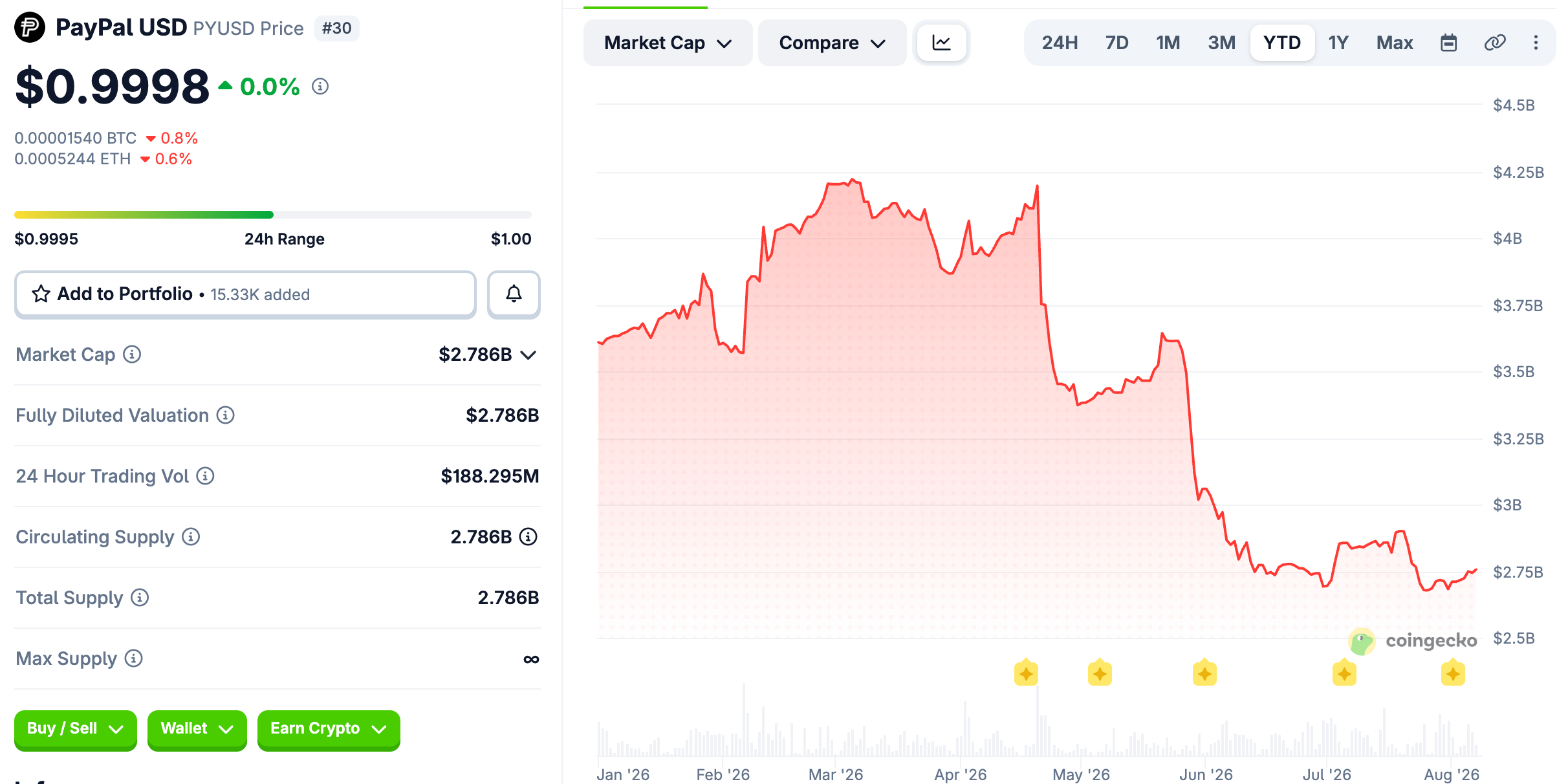
L'échelle du PYUSD est en baisse. Source : Coingecko

Cela signifie que tandis que le récit des résultats souligne l'étendue de la couverture et de l'intégration en chaîne, la taille réelle de la circulation s'est contractée d'environ un tiers sur la même période. Le récit de l'expansion et l'offre qui se contracte coexistent, reflétant une réalité très dure : l'unicité de la part de marché et du statut réglementaire (le PYUSD est le premier stablecoin en dollars émis par une entité réglementée au niveau fédéral, Paxos, un statut consolidé fin 2025 lorsque Paxos est passé sous la supervision de l'OCC) ne se traduit pas nécessairement par une demande continue de détention. Lorsque les mesures incitatives ont disparu, le volume initial ne s'est pas transformé en une utilisation stable, et la concurrence avec l'USDC a encore un long chemin à parcourir. Si les subventions, comme les méthodes des premières années de la crypto, ne fonctionnent pas, le gâteau actuel du PYUSD ne pourra plus être agrandi.

PYUSD et Open USD : Pourquoi le PYUSD est-il plus ancien mais moins influent ?

Si le PYUSD représente un stablecoin au modèle d'émetteur unique, l'Open USD, apparu le 30 juin, représente une voie structurellement différente, et ce timing tombe juste moins d'un mois avant la publication des résultats du T2 de PayPal.

L'Open USD est géré par une nouvelle société indépendante, Open Standard, dont le PDG fondateur est Zach Abrams, co-fondateur de Bridge, une filiale de Stripe. Les partenaires signataires sont plus de 140, couvrant pratiquement toute la liste des têtes de file de l'industrie des paiements et de la finance : les réseaux de paiement comme Visa, Mastercard ; l'infrastructure de paiement comme Stripe, Shopify ; la gestion d'actifs et les banques comme BlackRock, BNY, Standard Chartered ; les plateformes technologiques comme Google, IBM ; et le camp crypto natif avec Coinbase, Solana, Aave. Le projet devrait être lancé au second semestre 2026 et n'a pas encore été officiellement émis.

La différence la plus fondamentale entre Open USD et PYUSD réside dans la structure économique et le mode de gouvernance : Pour faire simple, seul PayPal tire profit du PYUSD, tandis que tout le monde bénéficie de l'Open USD.

Le PYUSD est émis par Paxos en tant qu'émetteur unique, qui détient les actifs de réserve et génère des revenus flottants. PayPal, en tant que propriétaire de la marque, dirige la feuille de route produit et la stratégie de marché. C'est le modèle classique utilisé jusqu'à présent par l'USDT et l'USDC. L'Open USD fait l'inverse : la création et le rachat sont entièrement gratuits et sans limite de montant pour les partenaires ; les revenus générés par les actifs de réserve, après déduction de frais de gestion minimes, sont reversés aux institutions partenaires participantes, et non monopolisés par un seul émetteur ; le pouvoir de gouvernance est également confié à un conseil d'administration composé d'institutions partenaires, et non dicté par une seule entreprise. Selon les commentaires du secteur, cela se rapproche davantage de la logique de gouvernance des réseaux de compensation interbancaire comme ACH ou SWIFT, et non de celle de l'USDC ou de l'USDT d'aujourd'hui.

Un détail souvent négligé mais crucial pour comprendre la situation de PayPal est que PayPal lui-même fait partie des plus de 140 signataires de l'Open USD, même si le PYUSD continuera d'exister en tant qu'actif émis indépendamment. Cela signifie que PayPal ne s'est pas entièrement engagé sur le seul navire du PYUSD, mais occupe simultanément une position dans les deux types de stablecoins, en continuant à miser sur le PYUSD en tant qu'actif de marque propre, tout en se réservant une place dans l'éventuel paysage sectoriel via sa signature à l'Open USD.

En revanche, Circle et Tether ne figurent pas sur la liste des partenaires de l'Open USD. Le cours de l'action de Circle a chuté de plus de 16% le jour de l'annonce. Jeremy Allaire, PDG de Circle, a ensuite répondu publiquement, soulignant les effets de réseau et la profondeur de distribution de l'USDC, et citant en exemple le stablecoin USDG de Paxos, également de type consortium, dont l'offre n'a atteint qu'environ 3 milliards de dollars après plus de deux ans de lancement, loin des attentes optimistes initiales.

En mettant ces trois acteurs côte à côte, le paysage concurrentiel auquel PayPal est confronté devient plus complexe. Le PYUSD, grâce à son avantage du premier entrant, a déjà établi une certaine notoriété de marque et une base de déploiement multi-chaînes, mais son volume absolu ne représente qu'environ un vingtième de celui de l'USDC, et des signes récents de contraction de l'offre sont apparus. Si l'Open USD se concrétise avec succès, sa véritable menace ne réside pas dans le fait de prendre les utilisateurs actuels du PYUSD, mais dans sa tentative de redéfinir l'économie de distribution de toute l'industrie. Si même des distributeurs de l'envergure de Stripe, Visa et Mastercard peuvent partager les revenus des réserves via un modèle de consortium, le modèle de stablecoin à émetteur unique pourrait être complètement remplacé.

Le choix de PayPal de miser sur les deux tableaux est, dans une certaine mesure, une reconnaissance de cette incertitude. Plutôt que de parier sur la victoire d'un seul modèle, il préfère conserver une place dans les deux. Pour le PYUSD, ce qu'il devra prouver au cours des prochains trimestres n'est pas le nombre de marchés ou de blockchains couverts, mais sa capacité, une fois les incitations disparues, à transformer le réseau de distribution déjà établi en une demande soutenue indépendante des subventions. S'il n'arrive finalement pas à emprunter cette voie, alors 2,7 milliards pourraient bien être le pic actuel du PYUSD.


Trending Cryptos

Related Questions

QSelon l'article, quelle est la signification stratégique du PYUSD pour PayPal et comment son récit de croissance contraste-t-il avec ses données réelles ?

ALe PYUSD est positionné par PayPal comme un "moteur principal" et une monnaie stable "axée sur le commerce" pour ses scénarios de paiement grand public. Son récit stratégique est celui d'une expansion en tant qu'infrastructure de paiement de base accessible aux développeurs tiers et aux entreprises pour les paiements transfrontaliers. Cependant, les données en chaîne montrent une contraction significative, l'offre en circulation étant passée d'un pic de 4,2 milliards de dollars en mars à environ 2,7 milliards de dollars fin juin, révélant un écart entre le récit d'expansion et la réalité d'une offre en contraction.

QQuels sont les principaux éléments différenciant le PYUSD de l'Open USD, selon l'analyse présentée dans l'article ?

ALe PYUSD suit le modèle classique d'un émetteur unique, où PayPal (via Paxos) contrôle l'émission et la stratégie, et bénéficie des revenus des actifs de réserve. L'Open USD propose un modèle de consortium où la frappe et le rachat sont gratuits pour les partenaires, les revenus des réserves sont largement redistribués aux institutions partenaires, et la gouvernance est confiée à un conseil composé de ces partenaires. L'article note également que PayPal est lui-même partenaire de l'Open USD, adoptant ainsi une stratégie de couverture en soutenant les deux modèles.

QComment le rapport financier du deuxième trimestre de PayPal a-t-il traité l'impact des actifs cryptographiques, et quelle réorganisation structurelle liée au PYUSD a été mentionnée ?

ALe rapport a enregistré une perte nette de 81 millions de dollars attribuée aux investissements stratégiques et aux actifs cryptographiques détenus à des fins d'investissement, ce qui a exercé une pression sur la marge bénéficiaire GAAP. Parallèlement, PayPal a créé un nouveau département "Payment Services & Crypto" qui intègre le PYUSD et les activités de traitement des marchands, indiquant son intégration plus profonde dans le cœur de l'écosystème de paiement de l'entreprise plutôt qu'un projet d'innovation isolé.

QQuel défi majeur le PYUSD doit-il surmonter pour prouver sa viabilité à long terme, d'après la conclusion de l'article ?

ALe défi majeur pour le PYUSD est de transformer le réseau de distribution qu'il a construit (présence sur plusieurs blockchains, partenariats) en une demande soutenue et organique qui ne dépende pas des incitations financières ou des subventions. Si le PYUSD ne parvient pas à générer une utilité et une adoption indépendantes des récompenses, son pic de 4,2 milliards de dollars pourrait rester son maximum, et sa croissance future serait limitée face à des concurrents comme l'USDC et la menace potentielle de modèles alternatifs comme l'Open USD.

QQuelle était la position de PayPal par rapport à l'Open USD, et que cela révèle-t-il sur sa stratégie face à l'évolution du marché des stablecoins ?

APayPal figure parmi les plus de 140 organisations partenaires ayant signé pour l'Open USD, tout en continuant à développer son propre stablecoin, le PYUSD. Cette double implication révèle une stratégie de couverture des risques ("hedging"). Plutôt que de miser exclusivement sur le succès de son propre modèle à émetteur unique, PayPal se réserve une option dans le modèle de consortium émergent de l'Open USD, reconnaissant ainsi l'incertitude quant à la structure dominante future du marché des stablecoins.

Related Reads

Michael Saylor Compares Bitcoin and Gold!

Michael Saylor, founder of MicroStrategy, argues that Bitcoin fundamentally changes how wealth is stored and transferred by transforming digital scarcity into economic value. He describes Bitcoin as the first digital monetary network, combining computers, digital networks, and cryptography. It digitizes monetary assets, allowing their supply to be controlled by public protocols rather than institutions, thus converting economic value into information transmissible over global networks. Comparing Bitcoin to gold, Saylor states that while increasing Bitcoin's supply is harder, its integration with software and transfer is easier. He highlights Bitcoin's proof-of-work mechanism, which ties it to the physical world by consuming real energy to secure the ledger, making past transactions immutable. This creates a shared security system involving miners, energy companies, and investors. Saylor suggests "digital monetary energy" is a more accurate term than "digital gold." He emphasizes that the Bitcoin network is an adaptive ecosystem of miners, nodes, developers, and users. Its core design is intentionally simple, focused on maintaining a secure ledger for scarce digital assets, with complex functionalities built in higher-layer applications. This architecture allows Bitcoin to serve as a foundation for transmitting value and fostering innovation in payments and financial services. Saylor notes Bitcoin's deeper impact lies in creating digital sovereignty, where private keys give individuals permissionless control over their economic power, with ownership verified mathematically, not by institutions. He concludes that while gold's physical scarcity makes it money, Bitcoin's digital scarcity does the same, characterizing Bitcoin as the monetary energy of the digital age.

cryptonews.ru1h ago

Michael Saylor Compares Bitcoin and Gold!

cryptonews.ru1h ago

Trading

Spot

Hot Articles

What is SONIC

Sonic: Pioneering the Future of Gaming in Web3 Introduction to Sonic In the ever-evolving landscape of Web3, the gaming industry stands out as one of the most dynamic and promising sectors. At the forefront of this revolution is Sonic, a project designed to amplify the gaming ecosystem on the Solana blockchain. Leveraging cutting-edge technology, Sonic aims to deliver an unparalleled gaming experience by efficiently processing millions of requests per second, ensuring that players enjoy seamless gameplay while maintaining low transaction costs. This article delves into the intricate details of Sonic, exploring its creators, funding sources, operational mechanics, and the timeline of significant events that have shaped its journey. What is Sonic? Sonic is an innovative layer-2 network that operates atop the Solana blockchain, specifically tailored to enhance the existing Solana gaming ecosystem. It accomplishes this through a customised, VM-agnostic game engine paired with a HyperGrid interpreter, facilitating sovereign game economies that roll up back to the Solana platform. The primary goals of Sonic include: Enhanced Gaming Experiences: Sonic is committed to offering lightning-fast on-chain gameplay, allowing players and developers to engage with games at previously unattainable speeds. Atomic Interoperability: This feature enables transactions to be executed within Sonic without the need to redeploy Solana programmes and accounts. This makes the process more efficient and directly benefits from Solana Layer1 services and liquidity. Seamless Deployment: Sonic allows developers to write for Ethereum Virtual Machine (EVM) based systems and execute them on Solana’s SVM infrastructure. This interoperability is crucial for attracting a broader range of dApps and decentralised applications to the platform. Support for Developers: By offering native composable gaming primitives and extensible data types - dining within the Entity-Component-System (ECS) framework - game creators can craft intricate business logic with ease. Overall, Sonic's unique approach not only caters to players but also provides an accessible and low-cost environment for developers to innovate and thrive. Creator of Sonic The information regarding the creator of Sonic is somewhat ambiguous. However, it is known that Sonic's SVM is owned by the company Mirror World. The absence of detailed information about the individuals behind Sonic reflects a common trend in several Web3 projects, where collective efforts and partnerships often overshadow individual contributions. Investors of Sonic Sonic has garnered considerable attention and support from various investors within the crypto and gaming sectors. Notably, the project raised an impressive $12 million during its Series A funding round. The round was led by BITKRAFT Ventures, with other notable investors including Galaxy, Okx Ventures, Interactive, Big Brain Holdings, and Mirana. This financial backing signifies the confidence that investment foundations have in Sonic’s potential to revolutionise the Web3 gaming landscape, further validating its innovative approaches and technologies. How Does Sonic Work? Sonic utilises the HyperGrid framework, a sophisticated parallel processing mechanism that enhances its scalability and customisability. Here are the core features that set Sonic apart: Lightning Speed at Low Costs: Sonic offers one of the fastest on-chain gaming experiences compared to other Layer-1 solutions, powered by the scalability of Solana’s virtual machine (SVM). Atomic Interoperability: Sonic enables transaction execution without redeployment of Solana programmes and accounts, effectively streamlining the interaction between users and the blockchain. EVM Compatibility: Developers can effortlessly migrate decentralised applications from EVM chains to the Solana environment using Sonic’s HyperGrid interpreter, increasing the accessibility and integration of various dApps. Ecosystem Support for Developers: By exposing native composable gaming primitives, Sonic facilitates a sandbox-like environment where developers can experiment and implement business logic, greatly enhancing the overall development experience. Monetisation Infrastructure: Sonic natively supports growth and monetisation efforts, providing frameworks for traffic generation, payments, and settlements, thereby ensuring that gaming projects are not only viable but also sustainable financially. Timeline of Sonic The evolution of Sonic has been marked by several key milestones. Below is a brief timeline highlighting critical events in the project's history: 2022: The Sonic cryptocurrency was officially launched, marking the beginning of its journey in the Web3 gaming arena. 2024: June: Sonic SVM successfully raised $12 million in a Series A funding round. This investment allowed Sonic to further develop its platform and expand its offerings. August: The launch of the Sonic Odyssey testnet provided users with the first opportunity to engage with the platform, offering interactive activities such as collecting rings—a nod to gaming nostalgia. October: SonicX, an innovative crypto game integrated with Solana, made its debut on TikTok, capturing the attention of over 120,000 users within a short span. This integration illustrated Sonic’s commitment to reaching a broader, global audience and showcased the potential of blockchain gaming. Key Points Sonic SVM is a revolutionary layer-2 network on Solana explicitly designed to enhance the GameFi landscape, demonstrating great potential for future development. HyperGrid Framework empowers Sonic by introducing horizontal scaling capabilities, ensuring that the network can handle the demands of Web3 gaming. Integration with Social Platforms: The successful launch of SonicX on TikTok displays Sonic’s strategy to leverage social media platforms to engage users, exponentially increasing the exposure and reach of its projects. Investment Confidence: The substantial funding from BITKRAFT Ventures, among others, emphasizes the robust backing Sonic has, paving the way for its ambitious future. In conclusion, Sonic encapsulates the essence of Web3 gaming innovation, striking a balance between cutting-edge technology, developer-centric tools, and community engagement. As the project continues to evolve, it is poised to redefine the gaming landscape, making it a notable entity for gamers and developers alike. As Sonic moves forward, it will undoubtedly attract greater interest and participation, solidifying its place within the broader narrative of blockchain gaming.

2.4k Total ViewsPublished 2024.04.04Updated 2024.12.03

What is SONIC

What is $S$

Understanding SPERO: A Comprehensive Overview Introduction to SPERO As the landscape of innovation continues to evolve, the emergence of web3 technologies and cryptocurrency projects plays a pivotal role in shaping the digital future. One project that has garnered attention in this dynamic field is SPERO, denoted as SPERO,$$s$. This article aims to gather and present detailed information about SPERO, to help enthusiasts and investors understand its foundations, objectives, and innovations within the web3 and crypto domains. What is SPERO,$$s$? SPERO,$$s$ is a unique project within the crypto space that seeks to leverage the principles of decentralisation and blockchain technology to create an ecosystem that promotes engagement, utility, and financial inclusion. The project is tailored to facilitate peer-to-peer interactions in new ways, providing users with innovative financial solutions and services. At its core, SPERO,$$s$ aims to empower individuals by providing tools and platforms that enhance user experience in the cryptocurrency space. This includes enabling more flexible transaction methods, fostering community-driven initiatives, and creating pathways for financial opportunities through decentralised applications (dApps). The underlying vision of SPERO,$$s$ revolves around inclusiveness, aiming to bridge gaps within traditional finance while harnessing the benefits of blockchain technology. Who is the Creator of SPERO,$$s$? The identity of the creator of SPERO,$$s$ remains somewhat obscure, as there are limited publicly available resources providing detailed background information on its founder(s). This lack of transparency can stem from the project's commitment to decentralisation—an ethos that many web3 projects share, prioritising collective contributions over individual recognition. By centring discussions around the community and its collective goals, SPERO,$$s$ embodies the essence of empowerment without singling out specific individuals. As such, understanding the ethos and mission of SPERO remains more important than identifying a singular creator. Who are the Investors of SPERO,$$s$? SPERO,$$s$ is supported by a diverse array of investors ranging from venture capitalists to angel investors dedicated to fostering innovation in the crypto sector. The focus of these investors generally aligns with SPERO's mission—prioritising projects that promise societal technological advancement, financial inclusivity, and decentralised governance. These investor foundations are typically interested in projects that not only offer innovative products but also contribute positively to the blockchain community and its ecosystems. The backing from these investors reinforces SPERO,$$s$ as a noteworthy contender in the rapidly evolving domain of crypto projects. How Does SPERO,$$s$ Work? SPERO,$$s$ employs a multi-faceted framework that distinguishes it from conventional cryptocurrency projects. Here are some of the key features that underline its uniqueness and innovation: Decentralised Governance: SPERO,$$s$ integrates decentralised governance models, empowering users to participate actively in decision-making processes regarding the project’s future. This approach fosters a sense of ownership and accountability among community members. Token Utility: SPERO,$$s$ utilises its own cryptocurrency token, designed to serve various functions within the ecosystem. These tokens enable transactions, rewards, and the facilitation of services offered on the platform, enhancing overall engagement and utility. Layered Architecture: The technical architecture of SPERO,$$s$ supports modularity and scalability, allowing for seamless integration of additional features and applications as the project evolves. This adaptability is paramount for sustaining relevance in the ever-changing crypto landscape. Community Engagement: The project emphasises community-driven initiatives, employing mechanisms that incentivise collaboration and feedback. By nurturing a strong community, SPERO,$$s$ can better address user needs and adapt to market trends. Focus on Inclusion: By offering low transaction fees and user-friendly interfaces, SPERO,$$s$ aims to attract a diverse user base, including individuals who may not previously have engaged in the crypto space. This commitment to inclusion aligns with its overarching mission of empowerment through accessibility. Timeline of SPERO,$$s$ Understanding a project's history provides crucial insights into its development trajectory and milestones. Below is a suggested timeline mapping significant events in the evolution of SPERO,$$s$: Conceptualisation and Ideation Phase: The initial ideas forming the basis of SPERO,$$s$ were conceived, aligning closely with the principles of decentralisation and community focus within the blockchain industry. Launch of Project Whitepaper: Following the conceptual phase, a comprehensive whitepaper detailing the vision, goals, and technological infrastructure of SPERO,$$s$ was released to garner community interest and feedback. Community Building and Early Engagements: Active outreach efforts were made to build a community of early adopters and potential investors, facilitating discussions around the project’s goals and garnering support. Token Generation Event: SPERO,$$s$ conducted a token generation event (TGE) to distribute its native tokens to early supporters and establish initial liquidity within the ecosystem. Launch of Initial dApp: The first decentralised application (dApp) associated with SPERO,$$s$ went live, allowing users to engage with the platform's core functionalities. Ongoing Development and Partnerships: Continuous updates and enhancements to the project's offerings, including strategic partnerships with other players in the blockchain space, have shaped SPERO,$$s$ into a competitive and evolving player in the crypto market. Conclusion SPERO,$$s$ stands as a testament to the potential of web3 and cryptocurrency to revolutionise financial systems and empower individuals. With a commitment to decentralised governance, community engagement, and innovatively designed functionalities, it paves the way toward a more inclusive financial landscape. As with any investment in the rapidly evolving crypto space, potential investors and users are encouraged to research thoroughly and engage thoughtfully with the ongoing developments within SPERO,$$s$. The project showcases the innovative spirit of the crypto industry, inviting further exploration into its myriad possibilities. While the journey of SPERO,$$s$ is still unfolding, its foundational principles may indeed influence the future of how we interact with technology, finance, and each other in interconnected digital ecosystems.

400 Total ViewsPublished 2024.12.17Updated 2024.12.17

What is $S$

What is AGENT S

Agent S: The Future of Autonomous Interaction in Web3 Introduction In the ever-evolving landscape of Web3 and cryptocurrency, innovations are constantly redefining how individuals interact with digital platforms. One such pioneering project, Agent S, promises to revolutionise human-computer interaction through its open agentic framework. By paving the way for autonomous interactions, Agent S aims to simplify complex tasks, offering transformative applications in artificial intelligence (AI). This detailed exploration will delve into the project's intricacies, its unique features, and the implications for the cryptocurrency domain. What is Agent S? Agent S stands as a groundbreaking open agentic framework, specifically designed to tackle three fundamental challenges in the automation of computer tasks: Acquiring Domain-Specific Knowledge: The framework intelligently learns from various external knowledge sources and internal experiences. This dual approach empowers it to build a rich repository of domain-specific knowledge, enhancing its performance in task execution. Planning Over Long Task Horizons: Agent S employs experience-augmented hierarchical planning, a strategic approach that facilitates efficient breakdown and execution of intricate tasks. This feature significantly enhances its ability to manage multiple subtasks efficiently and effectively. Handling Dynamic, Non-Uniform Interfaces: The project introduces the Agent-Computer Interface (ACI), an innovative solution that enhances the interaction between agents and users. Utilizing Multimodal Large Language Models (MLLMs), Agent S can navigate and manipulate diverse graphical user interfaces seamlessly. Through these pioneering features, Agent S provides a robust framework that addresses the complexities involved in automating human interaction with machines, setting the stage for myriad applications in AI and beyond. Who is the Creator of Agent S? While the concept of Agent S is fundamentally innovative, specific information about its creator remains elusive. The creator is currently unknown, which highlights either the nascent stage of the project or the strategic choice to keep founding members under wraps. Regardless of anonymity, the focus remains on the framework's capabilities and potential. Who are the Investors of Agent S? As Agent S is relatively new in the cryptographic ecosystem, detailed information regarding its investors and financial backers is not explicitly documented. The lack of publicly available insights into the investment foundations or organisations supporting the project raises questions about its funding structure and development roadmap. Understanding the backing is crucial for gauging the project's sustainability and potential market impact. How Does Agent S Work? At the core of Agent S lies cutting-edge technology that enables it to function effectively in diverse settings. Its operational model is built around several key features: Human-like Computer Interaction: The framework offers advanced AI planning, striving to make interactions with computers more intuitive. By mimicking human behaviour in tasks execution, it promises to elevate user experiences. Narrative Memory: Employed to leverage high-level experiences, Agent S utilises narrative memory to keep track of task histories, thereby enhancing its decision-making processes. Episodic Memory: This feature provides users with step-by-step guidance, allowing the framework to offer contextual support as tasks unfold. Support for OpenACI: With the ability to run locally, Agent S allows users to maintain control over their interactions and workflows, aligning with the decentralised ethos of Web3. Easy Integration with External APIs: Its versatility and compatibility with various AI platforms ensure that Agent S can fit seamlessly into existing technological ecosystems, making it an appealing choice for developers and organisations. These functionalities collectively contribute to Agent S's unique position within the crypto space, as it automates complex, multi-step tasks with minimal human intervention. As the project evolves, its potential applications in Web3 could redefine how digital interactions unfold. Timeline of Agent S The development and milestones of Agent S can be encapsulated in a timeline that highlights its significant events: September 27, 2024: The concept of Agent S was launched in a comprehensive research paper titled “An Open Agentic Framework that Uses Computers Like a Human,” showcasing the groundwork for the project. October 10, 2024: The research paper was made publicly available on arXiv, offering an in-depth exploration of the framework and its performance evaluation based on the OSWorld benchmark. October 12, 2024: A video presentation was released, providing a visual insight into the capabilities and features of Agent S, further engaging potential users and investors. These markers in the timeline not only illustrate the progress of Agent S but also indicate its commitment to transparency and community engagement. Key Points About Agent S As the Agent S framework continues to evolve, several key attributes stand out, underscoring its innovative nature and potential: Innovative Framework: Designed to provide an intuitive use of computers akin to human interaction, Agent S brings a novel approach to task automation. Autonomous Interaction: The ability to interact autonomously with computers through GUI signifies a leap towards more intelligent and efficient computing solutions. Complex Task Automation: With its robust methodology, it can automate complex, multi-step tasks, making processes faster and less error-prone. Continuous Improvement: The learning mechanisms enable Agent S to improve from past experiences, continually enhancing its performance and efficacy. Versatility: Its adaptability across different operating environments like OSWorld and WindowsAgentArena ensures that it can serve a broad range of applications. As Agent S positions itself in the Web3 and crypto landscape, its potential to enhance interaction capabilities and automate processes signifies a significant advancement in AI technologies. Through its innovative framework, Agent S exemplifies the future of digital interactions, promising a more seamless and efficient experience for users across various industries. Conclusion Agent S represents a bold leap forward in the marriage of AI and Web3, with the capacity to redefine how we interact with technology. While still in its early stages, the possibilities for its application are vast and compelling. Through its comprehensive framework addressing critical challenges, Agent S aims to bring autonomous interactions to the forefront of the digital experience. As we move deeper into the realms of cryptocurrency and decentralisation, projects like Agent S will undoubtedly play a crucial role in shaping the future of technology and human-computer collaboration.

1.1k Total ViewsPublished 2025.01.14Updated 2025.01.14

What is AGENT S

Discussions

Welcome to the HTX Community. Here, you can stay informed about the latest platform developments and gain access to professional market insights. Users' opinions on the price of S (S) are presented below.

活动图片