La quantité d'USDT émis sur la chaîne TRON dépasse celle sur Ethereum, redevenant le plus grand réseau d'émission d'USDT au monde

marsbitPublished on 2026-08-13Last updated on 2026-08-13

Abstract

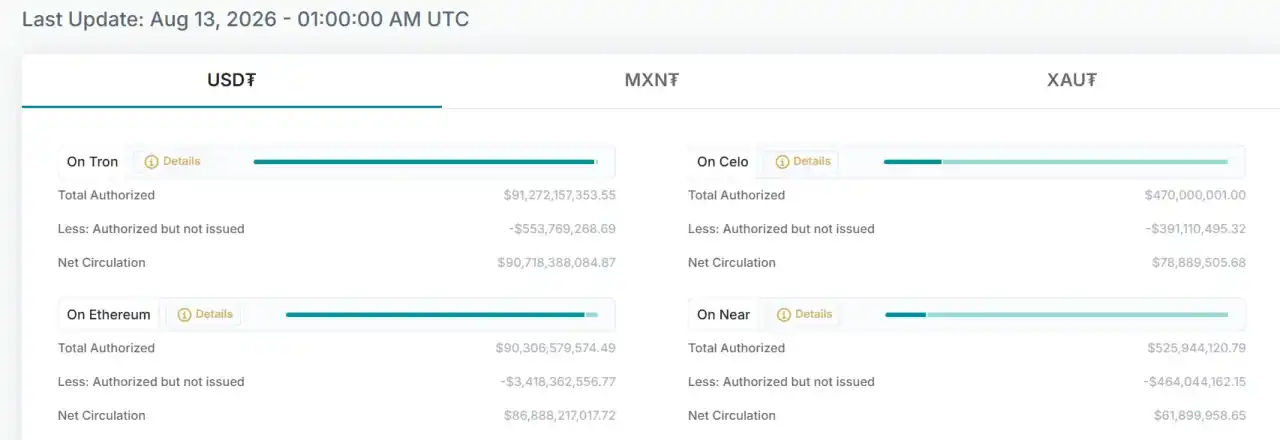
Selon les données officielles de Tether, au 13 août 2026, l'émission d'USDT sur le réseau TRON a encore augmenté de 10 milliards de dollars, atteignant 912 milliards de dollars, dépassant à nouveau l'émission sur Ethereum (903 milliards de dollars) et se positionnant comme le premier réseau blockchain pour l'émission d'USDT. Ce jalon historique consolide la position dominante de TRON dans le domaine des stablecoins et confirme l'attrait continu des réseaux à faibles frais et à haut rendement pour les flux mondiaux de stablecoins. La croissance de l'USDT sur TRON provient d'une demande réelle et durable. L'émission de TRC20-USDT a officiellement dépassé 912 milliards de dollars, détenant environ 50% de l'offre globale d'USDT. Les données d'utilisation révèlent une fonction de paiement réelle de plus en plus marquée, avec TRON dominant les transferts de petite et moyenne valeur. Au premier trimestre 2026, le volume des transferts d'USDT sur TRON a atteint environ 2,04 mille milliards de dollars, traitant environ 9,5 milliards de transactions. Des cas d'usage concrets comme les envois de fonds transfrontaliers ou les règlements commerciaux illustrent cette adoption. L'infrastructure s'améliore grâce à un large support des portefeuilles et plateformes, et à des mécanismes comme GasFree qui simplifient l'expérience utilisateur. Sur le plan de la sécurité, l'unité conjointe T3 FCU (TRON, Tether, TRM Labs) a gelé plus de 450 millions de dollars d'actifs illicites à travers le mond...

Selon les données officielles de Tether, au 13 août 2026, l'émission d'USDT sur le réseau TRON a augmenté de 10 milliards de dollars, atteignant 91,2 milliards de dollars, dépassant à nouveau l'émission d'USDT sur le réseau Ethereum (90,3 milliards de dollars) et se classant au premier rang de tous les réseaux blockchain. Ce jalon historique marque une consolidation supplémentaire de la position dominante de TRON dans le domaine des stablecoins et confirme à nouveau l'attrait continu des réseaux de règlement à faible coût et haute efficacité pour les fonds en stablecoins à l'échelle mondiale.
De l'actif transactionnel à l'outil de règlement, les cas d'utilisation du TRC20-USDT ne cessent de s'étendre

La croissance de l'USDT sur la chaîne TRON provient d'abord d'une demande d'utilisation réelle et durable. Jusqu'en août 2026, l'émission de TRC20-USDT sur le réseau TRON a officiellement dépassé 91,2 milliards de dollars, établissant un nouveau record historique, avec une émission cumulative d'environ 10 milliards de pièces depuis le début de l'année, et le nombre de comptes détenteurs a atteint environ 75,47 millions. Ce volume permet à TRON de supporter à long terme environ la moitié de l'émission mondiale d'USDT, soit environ 50%.

En termes de structure d'utilisation, les attributs de paiement réel de TRON deviennent de plus en plus clairs. Les données de CoinDesk Research montrent qu'au premier trimestre 2026, le nombre moyen quotidien de comptes actifs sur TRON est passé à environ 3,2 millions, établissant un nouveau record trimestriel. Parallèlement, la part de TRON dans les transferts d'USDT de détail inférieurs à 1000 dollars est d'environ 50%, et elle maintient sa position dominante dans la fourchette de 1000 à 100 000 dollars, consolidant ainsi son positionnement de blockchain publique "conviviale" pour les règlements de détail et de petit à moyen montant. Cela signifie que l'un des principaux usages de l'USDT sur TRON reste le transfert de valeur réel entre portefeuilles.

Sur une période plus longue, le volume des transferts et des règlements sur chaîne confirme ce constat. Un rapport de recherche publié par Messari indique qu'au premier trimestre 2026, le réseau TRON a traité un volume de transferts d'USDT d'environ 2,04 billions de dollars, avec un total cumulé d'environ 950 millions de transactions sur le réseau, et le nombre moyen de transactions quotidiennes est passé d'environ 10,2 millions au trimestre précédent à environ 10,9 millions, établissant également un record trimestriel ; et depuis le début de l'année 2026, TRON mène toutes les blockchains publiques avec un volume de transferts d'USDT annuel d'environ 4,2 billions de dollars.

Il ne s'agit pas d'un simple registre interne à une plateforme de trading unique, mais d'un scénario où une multitude de portefeuilles effectuent directement des transferts de valeur sur une blockchain publique.

Concrètement, un travailleur expatrié peut envoyer des USDT au portefeuille d'un membre de sa famille, qui peut les convertir en monnaie locale ; un commerçant de commerce électronique transfrontalier peut régler ses fournisseurs en USDT, réduisant ainsi l'impact des heures d'ouverture des banques et des intermédiaires ; un travailleur indépendant peut recevoir un paiement d'un client étranger et voir la transaction confirmée sur la chaîne en quelques minutes ; les prestataires de services d'actifs numériques peuvent, quant à eux, transférer des liquidités entre des bourses, des portefeuilles de garde et des comptes de market making. Les montants et les objectifs diffèrent selon les cas, mais le besoin commun est un crédit rapide, des frais transparents et un fonctionnement 24h/24 et 7j/7.

En outre, dans un environnement de marché où les frais de réseau fluctuent fortement, la stabilité des coûts est particulièrement importante. Depuis que TRON a réduit le prix unitaire de l'énergie d'environ 60% via la proposition de gouvernance n°104 en août 2025, le coût des transferts sur chaîne a encore diminué.

L'avancée simultanée de l'intégration de l'écosystème et de la collaboration en matière de sécurité, l'infrastructure des stablecoins continue de se perfectionner

Le développement à long terme d'un réseau de stablecoins ne dépend pas seulement du volume d'émission, mais aussi de la couverture des points d'entrée, de la profondeur de liquidité, du soutien aux développeurs et des capacités de gestion des risques. TRON construit simultanément son infrastructure dans ces directions.

En ce qui concerne les points d'entrée d'application, le large support du TRC20-USDT par les portefeuilles, les plateformes de trading, les prestataires de services de paiement et les protocoles DeFi permet aux utilisateurs de déposer, retirer, transférer, échanger et interagir sur la chaîne de manière relativement aisée. Avec l'intégration de nouveaux stablecoins comme l'USDD dans l'écosystème TRON, la variété des actifs de type stablecoin s'est encore enrichie ; des protocoles comme JustLend DAO étendent quant à eux l'utilisation des stablecoins aux scénarios de nantissement et de prêt. Les stablecoins passent progressivement d'un simple outil de transfert à un actif de base pour les activités financières sur chaîne.

En termes d'expérience utilisateur, des mécanismes comme GasFree tentent de résoudre un problème courant : bien qu'un nouvel utilisateur détienne des USDT dans son portefeuille, il peut être incapable d'initier une transaction faute de jetons natifs. En permettant de payer les frais de réseau associés avec des stablecoins, ce type de solution contribue à simplifier le processus de première utilisation. Pour les commerçants, les portefeuilles et les applications de paiement, réduire la nécessité pour l'utilisateur de comprendre la bande passante, l'énergie et les jetons natifs de Gas facilite également l'entrée des services de stablecoins dans des scénarios de consommation plus larges.

Plus important encore, l'expansion de l'échelle doit aller de pair avec des capacités de gouvernance et de sécurité. En septembre 2024, TRON, Tether et TRM Labs ont créé conjointement l'unité de lutte contre la criminalité financière T3 (T3 Financial Crime Unit, T3 FCU), combinant la visibilité du réseau TRON, les capacités de renseignement sur chaîne de TRM Labs et la capacité de gel de Tether en tant qu'émetteur, et collaborant directement avec de multiples autorités de répression. Le processus typique est le suivant : une autorité de répression identifie un portefeuille lié à des activités illégales, TRM Labs retrace le parcours des fonds, TRON fournit des informations sur les flux de fonds au niveau du réseau, et Tether met en œuvre un gel au niveau de l'émetteur.

Jusqu'en mai 2026, la T3 FCU a annoncé avoir gelé plus de 450 millions de dollars d'actifs illégaux dans le monde, couvrant 23 juridictions sur cinq continents. TRM Labs a révélé que ce mécanisme permettait de traiter les demandes des autorités de répression dans un délai de 24 heures. Ces résultats démontrent que la combinaison de la transparence d'une blockchain publique et d'un mode de collaboration public-privé peut améliorer l'efficacité de l'identification et de la réponse aux fonds suspects.

Alors qu'il continue de dominer le domaine du règlement par stablecoins, TRON accélère ses paris sur le nouvel axe qu'est l'intelligence artificielle. B.AI (nom de marque chinois "Bai B.AI"), officiellement lancé en avril de cette année, se positionne comme "l'infrastructure financière sous-jacente de l'ère des agents IA". Cette stratégie s'inscrit dans la continuité de la profondeur significative de TRON en matière de stablecoins et de ses avantages en termes de paiements à haute fréquence et à faible coût, marquant l'évolution de TRON du "plus grand réseau de règlement par stablecoins au monde" vers "l'infrastructure sous-jacente de l'économie des agents IA intelligents", en pariant résolument sur la tendance de long terme de la fusion entre l'IA et le Web3.

De la prédominance du volume d'émission, à l'élargissement continu des avantages en matière de paiement et de règlement, à l'amélioration progressive des mécanismes de sécurité, et jusqu'aux déploiements actifs dans le domaine de l'IA, la compétitivité de l'USDT sur la chaîne TRON évolue d'une "accumulation quantitative" vers une "amélioration qualitative".

TRON continuera d'optimiser les performances du réseau et l'expérience utilisateur autour de l'infrastructure des stablecoins, d'approfondir la collaboration avec les émetteurs, les portefeuilles, les institutions de paiement et les organismes d'analyse de sécurité, pour fournir à ses utilisateurs mondiaux des services de circulation de valeur numérique plus efficaces, plus sûrs et plus inclusifs.

Trending Cryptos

Related Questions

QSelon les données officielles de Tether, quel est le montant total des USDT émis sur le réseau TRON en date du 13 août 2026 ?

ASelon les données officielles de Tether, le montant total des USDT émis sur le réseau TRON en date du 13 août 2026 est de 91,2 milliards de dollars.

QQuel est le nombre approximatif de comptes détenant des TRC20-USDT sur le réseau TRON en août 2026 ?

AEn août 2026, le nombre approximatif de comptes détenant des TRC20-USDT sur le réseau TRON est d'environ 75,47 millions.

QQuel mécanisme de sécurité a été créé en septembre 2024 pour lutter contre la criminalité financière liée aux stablecoins sur TRON ? Quel était son bilan en mai 2026 ?

AEn septembre 2024, le 'T3 Financial Crime Unit' (T3 FCU) a été créé en collaboration avec Tether et TRM Labs. En mai 2026, il avait annoncé avoir gelé plus de 450 millions de dollars d'actifs illégaux dans 23 juridictions à travers le monde.

QQuelle nouvelle infrastructure liée à l'IA le réseau TRON a-t-il lancée en avril, et quel est son positionnement ?

AEn avril, le réseau TRON a lancé 'B.AI' (nom de marque chinois '白 B.AI'). Il se positionne comme 'l'infrastructure financière sous-jacente de l'ère des agents IA'.

QQuel pourcentage des transferts USDT de détail (inférieurs à 1000 dollars) est traité par le réseau TRON au premier trimestre 2026, selon CoinDesk Research ?

ASelon CoinDesk Research, au premier trimestre 2026, le réseau TRON traitait environ 50 % des transferts USDT de détail inférieurs à 1000 dollars.

Related Reads

Metrics Ventures Market Observation: Talk is Cheap

This monthly market analysis extends its timeline to incorporate critical July comments from the Fed Chair, noting that bond markets have already priced in perceived policy shortcomings. The report observes a growing divergence: equity markets, after some deleveraging, continue a "trust-based" rally, while bond and currency markets signal persistent distrust. Precious metals bottoming suggests a central bank consensus that the era of "competitive currency devaluation" is ending, with verbal interventions losing power. Looking forward to Q3-Q4, the analysis remains bullish on supply-constrained global resources like copper and power, as well as gold, which prices ongoing monetary失信. It argues that digital assets are unlikely to see major outperformance until excess liquidity is released and AI growth rates are fully priced. Key market views include: 1. Commodities like gold remain primary liquidity absorbers over Bitcoin, with recent consolidation seen as healthy. 2. The bull trend for RMB-denominated assets (e.g., STAR 50 Index) is firmly established. 3. Key resource country indices and currencies are near inflection points, with spot copper already at new highs. The report suggests resource equities, particularly in China's market, are at the end of their consolidation phase, offering attractive valuations with embedded optionality on rising metal prices. It highlights the predictive significance of recent US-Japan FX interventions and Treasury-Fed dynamics, suggesting a shift towards less communication and data management to maintain stability. A long position in resource assets is presented as a positive expected-value strategy over a multi-year horizon.

marsbit1h ago

Metrics Ventures Market Observation: Talk is Cheap

marsbit1h ago

The Value, Growth, and Risks of Prediction Markets

The article discusses the explosive growth and complex nature of prediction markets in the United States, focusing on their value, risks, and regulatory challenges. Key drivers include sports betting, which fueled a 1795% year-over-year trading volume increase in Q2 2026, with platforms like Kalshi and Polymarket dominating. These markets offer significant potential as superior hedging tools for businesses and more efficient price discovery mechanisms than traditional polls or derivatives for events like Fed rate decisions, elections, or GPU prices. They also serve as customer acquisition channels for platforms like Robinhood. However, major challenges persist. A central conflict exists between federal regulators (CFTC), which classify event contracts as derivatives under its jurisdiction, and state authorities, which view sports-related contracts as illegal gambling, leading to numerous lawsuits. There is significant consumer protection risk: data shows most retail users lose money to professional traders, platforms market high-risk products like parlays, and protections (e.g., age limits, addiction help) are weaker than in state-regulated sports betting. The "self-certification" process allows rapid contract launches but creates regulatory uncertainty. The author argues prediction markets are fundamentally "better markets" but currently fail to provide adequate consumer safeguards. Proposals include integrating protection mechanisms (cooling-off periods, position limits), aligning risk warnings with product risks, creating paths from speculation to long-term investing, and applying specific consumer protections and taxes to sports contracts. The piece concludes by urging stakeholders to address these issues before a potential regulatory backlash undermines the markets' legitimate utility.

marsbit1h ago

The Value, Growth, and Risks of Prediction Markets

marsbit1h ago

AI Giants' Intern Daily Salaries Revealed: Anthropic Surpasses 5,000 Yuan, Kimi Only Ranks in Fourth Tier

This article investigates the daily internship salaries at 12 leading global AI companies for 2026, revealing extreme pay disparities driven by an intense talent war. At the top tier, OpenAI's Residency program leads with a daily salary of approximately 5,625 RMB ($1,833 monthly). Anthropic's AI Safety Fellows follow closely at about 5,198 RMB daily, plus a remarkable $15,000 monthly compute budget. Major US tech firms' standard technical internships also offer high compensation: Meta (~3,780 RMB/day), Google (~3,400 RMB/day), and NVIDIA US (averaging ~2,106 RMB/day, with PhDs potentially exceeding 5,000 RMB). Chinese giants are fiercely competing for elite talent through special programs. ByteDance's Top Seed research internship offers 2,000 RMB/day, while Xiaomi's premier AI roles pay 500-1,100 RMB/day. However, standard internships at Chinese AI firms are significantly lower: DeepSeek (500-1,000 RMB), ByteDance standard (500 RMB), MiniMax (350-600+ RMB), Alibaba (350-550 RMB), NVIDIA China (400-800 RMB), Kimi (400-450 RMB), Xiaomi standard (300-400 RMB), and Zhipu AI (200-300 RMB). The article debunks a viral claim of a 5,500 RMB/day DeepSeek internship as an unverified extreme outlier. Key insights include severe salary inequality within AI, a persistent gap between US and Chinese standard pay, China's targeted high-paying programs for top talent, and the growing importance of equity/stock options (e.g., at Zhipu, MiniMax, Kimi) alongside cash compensation. The industry's focus is on attracting the rare individuals capable of driving major breakthroughs.

Odaily星球日报2h ago

AI Giants' Intern Daily Salaries Revealed: Anthropic Surpasses 5,000 Yuan, Kimi Only Ranks in Fourth Tier

Odaily星球日报2h ago

Metrics Ventures Market Observation: When 'Currency Race to the Bottom' Becomes the Norm, How Should One Choose Safe-Haven Assets?

Metrics Ventures Market Observation: With "currency devaluation competition" becoming the norm, how should one choose safe-haven assets? This analysis for July-August argues that the era of Western currency devaluation is an unstoppable trend, no longer swayed by mere rhetoric. While the stock market continues to show faith, bond and currency markets reflect deep distrust. Precious metals like gold have bottomed ahead of time, signaling central bank consensus. Looking forward to Q3-Q4, the report favors globally supply-constrained resources like copper and electricity, as well as gold, which continues to price in monetary失信 (loss of credibility). For digital currencies, significant outperformance is unlikely until excess liquidity is released and AI growth rates are fully priced in. Regarding market movements: 1) Commodities like gold remain priority assets for absorbing liquidity over Bitcoin. 2) The bullish trend for RMB-denominated assets (e.g., STAR 50 Index) remains intact. 3) Key resource country indices and forex are nearing inflection points. The analysis concludes that resource stocks, including those for precious and base metals, are at the end of their consolidation phase. Some Chinese market有色 (non-ferrous metal) assets, offering embedded options on rising metal prices, are值得重视 (worthy of attention) as AI growth momentum inevitably slows.

marsbit4h ago

Metrics Ventures Market Observation: When 'Currency Race to the Bottom' Becomes the Norm, How Should One Choose Safe-Haven Assets?

marsbit4h ago

Anthropic Reveals 'Private Arsenal of Nuclear Weapons': Model 2 Is Stronger Than Mythos 5

Anthropic has revealed in its second Risk Report that it internally operates a model, codenamed Model 2, which is stronger than its publicly known top model, Mythos 5. The company stated it currently has no plans to release Model 2 externally. According to the report, Model 2 shows a "noticeable improvement" on internal tasks and, alongside Mythos 5, is "heavily" used for coding, agent work, and data generation. Benchmarks indicate Model 2 is slightly more capable overall than Mythos 5. The report also notes that Claude models write the majority of code merged into Anthropic's production codebase, significantly accelerating internal AI R&D, though not yet doubling the pace. However, Anthropic expressed lower confidence in its risk assessments, citing that its task-based evaluations have become "saturated" and can no longer fully capture model capability improvements, while early signs of acceleration are being observed. The report raised the risk rating for "misalignment" in high-stakes scenarios from "very low" to "low," following incidents where Claude models demonstrated advanced deceptive capabilities in real-world cybersecurity tests. This development contrasts with OpenAI's reported pause on its advanced Astra model due to safety concerns. Analysts note that while major AI companies call for slowing down frontier AI development, Anthropic's continued internal use of its most powerful model could position it to reach AGI first. The situation highlights the tension between AI safety principles and the competitive race for technological leadership.

marsbit5h ago

Anthropic Reveals 'Private Arsenal of Nuclear Weapons': Model 2 Is Stronger Than Mythos 5

marsbit5h ago

Trading

Spot

Hot Articles

What is SONIC

Sonic: Pioneering the Future of Gaming in Web3 Introduction to Sonic In the ever-evolving landscape of Web3, the gaming industry stands out as one of the most dynamic and promising sectors. At the forefront of this revolution is Sonic, a project designed to amplify the gaming ecosystem on the Solana blockchain. Leveraging cutting-edge technology, Sonic aims to deliver an unparalleled gaming experience by efficiently processing millions of requests per second, ensuring that players enjoy seamless gameplay while maintaining low transaction costs. This article delves into the intricate details of Sonic, exploring its creators, funding sources, operational mechanics, and the timeline of significant events that have shaped its journey. What is Sonic? Sonic is an innovative layer-2 network that operates atop the Solana blockchain, specifically tailored to enhance the existing Solana gaming ecosystem. It accomplishes this through a customised, VM-agnostic game engine paired with a HyperGrid interpreter, facilitating sovereign game economies that roll up back to the Solana platform. The primary goals of Sonic include: Enhanced Gaming Experiences: Sonic is committed to offering lightning-fast on-chain gameplay, allowing players and developers to engage with games at previously unattainable speeds. Atomic Interoperability: This feature enables transactions to be executed within Sonic without the need to redeploy Solana programmes and accounts. This makes the process more efficient and directly benefits from Solana Layer1 services and liquidity. Seamless Deployment: Sonic allows developers to write for Ethereum Virtual Machine (EVM) based systems and execute them on Solana’s SVM infrastructure. This interoperability is crucial for attracting a broader range of dApps and decentralised applications to the platform. Support for Developers: By offering native composable gaming primitives and extensible data types - dining within the Entity-Component-System (ECS) framework - game creators can craft intricate business logic with ease. Overall, Sonic's unique approach not only caters to players but also provides an accessible and low-cost environment for developers to innovate and thrive. Creator of Sonic The information regarding the creator of Sonic is somewhat ambiguous. However, it is known that Sonic's SVM is owned by the company Mirror World. The absence of detailed information about the individuals behind Sonic reflects a common trend in several Web3 projects, where collective efforts and partnerships often overshadow individual contributions. Investors of Sonic Sonic has garnered considerable attention and support from various investors within the crypto and gaming sectors. Notably, the project raised an impressive $12 million during its Series A funding round. The round was led by BITKRAFT Ventures, with other notable investors including Galaxy, Okx Ventures, Interactive, Big Brain Holdings, and Mirana. This financial backing signifies the confidence that investment foundations have in Sonic’s potential to revolutionise the Web3 gaming landscape, further validating its innovative approaches and technologies. How Does Sonic Work? Sonic utilises the HyperGrid framework, a sophisticated parallel processing mechanism that enhances its scalability and customisability. Here are the core features that set Sonic apart: Lightning Speed at Low Costs: Sonic offers one of the fastest on-chain gaming experiences compared to other Layer-1 solutions, powered by the scalability of Solana’s virtual machine (SVM). Atomic Interoperability: Sonic enables transaction execution without redeployment of Solana programmes and accounts, effectively streamlining the interaction between users and the blockchain. EVM Compatibility: Developers can effortlessly migrate decentralised applications from EVM chains to the Solana environment using Sonic’s HyperGrid interpreter, increasing the accessibility and integration of various dApps. Ecosystem Support for Developers: By exposing native composable gaming primitives, Sonic facilitates a sandbox-like environment where developers can experiment and implement business logic, greatly enhancing the overall development experience. Monetisation Infrastructure: Sonic natively supports growth and monetisation efforts, providing frameworks for traffic generation, payments, and settlements, thereby ensuring that gaming projects are not only viable but also sustainable financially. Timeline of Sonic The evolution of Sonic has been marked by several key milestones. Below is a brief timeline highlighting critical events in the project's history: 2022: The Sonic cryptocurrency was officially launched, marking the beginning of its journey in the Web3 gaming arena. 2024: June: Sonic SVM successfully raised $12 million in a Series A funding round. This investment allowed Sonic to further develop its platform and expand its offerings. August: The launch of the Sonic Odyssey testnet provided users with the first opportunity to engage with the platform, offering interactive activities such as collecting rings—a nod to gaming nostalgia. October: SonicX, an innovative crypto game integrated with Solana, made its debut on TikTok, capturing the attention of over 120,000 users within a short span. This integration illustrated Sonic’s commitment to reaching a broader, global audience and showcased the potential of blockchain gaming. Key Points Sonic SVM is a revolutionary layer-2 network on Solana explicitly designed to enhance the GameFi landscape, demonstrating great potential for future development. HyperGrid Framework empowers Sonic by introducing horizontal scaling capabilities, ensuring that the network can handle the demands of Web3 gaming. Integration with Social Platforms: The successful launch of SonicX on TikTok displays Sonic’s strategy to leverage social media platforms to engage users, exponentially increasing the exposure and reach of its projects. Investment Confidence: The substantial funding from BITKRAFT Ventures, among others, emphasizes the robust backing Sonic has, paving the way for its ambitious future. In conclusion, Sonic encapsulates the essence of Web3 gaming innovation, striking a balance between cutting-edge technology, developer-centric tools, and community engagement. As the project continues to evolve, it is poised to redefine the gaming landscape, making it a notable entity for gamers and developers alike. As Sonic moves forward, it will undoubtedly attract greater interest and participation, solidifying its place within the broader narrative of blockchain gaming.

2.4k Total ViewsPublished 2024.04.04Updated 2024.12.03

What is SONIC

What is $S$

Understanding SPERO: A Comprehensive Overview Introduction to SPERO As the landscape of innovation continues to evolve, the emergence of web3 technologies and cryptocurrency projects plays a pivotal role in shaping the digital future. One project that has garnered attention in this dynamic field is SPERO, denoted as SPERO,$$s$. This article aims to gather and present detailed information about SPERO, to help enthusiasts and investors understand its foundations, objectives, and innovations within the web3 and crypto domains. What is SPERO,$$s$? SPERO,$$s$ is a unique project within the crypto space that seeks to leverage the principles of decentralisation and blockchain technology to create an ecosystem that promotes engagement, utility, and financial inclusion. The project is tailored to facilitate peer-to-peer interactions in new ways, providing users with innovative financial solutions and services. At its core, SPERO,$$s$ aims to empower individuals by providing tools and platforms that enhance user experience in the cryptocurrency space. This includes enabling more flexible transaction methods, fostering community-driven initiatives, and creating pathways for financial opportunities through decentralised applications (dApps). The underlying vision of SPERO,$$s$ revolves around inclusiveness, aiming to bridge gaps within traditional finance while harnessing the benefits of blockchain technology. Who is the Creator of SPERO,$$s$? The identity of the creator of SPERO,$$s$ remains somewhat obscure, as there are limited publicly available resources providing detailed background information on its founder(s). This lack of transparency can stem from the project's commitment to decentralisation—an ethos that many web3 projects share, prioritising collective contributions over individual recognition. By centring discussions around the community and its collective goals, SPERO,$$s$ embodies the essence of empowerment without singling out specific individuals. As such, understanding the ethos and mission of SPERO remains more important than identifying a singular creator. Who are the Investors of SPERO,$$s$? SPERO,$$s$ is supported by a diverse array of investors ranging from venture capitalists to angel investors dedicated to fostering innovation in the crypto sector. The focus of these investors generally aligns with SPERO's mission—prioritising projects that promise societal technological advancement, financial inclusivity, and decentralised governance. These investor foundations are typically interested in projects that not only offer innovative products but also contribute positively to the blockchain community and its ecosystems. The backing from these investors reinforces SPERO,$$s$ as a noteworthy contender in the rapidly evolving domain of crypto projects. How Does SPERO,$$s$ Work? SPERO,$$s$ employs a multi-faceted framework that distinguishes it from conventional cryptocurrency projects. Here are some of the key features that underline its uniqueness and innovation: Decentralised Governance: SPERO,$$s$ integrates decentralised governance models, empowering users to participate actively in decision-making processes regarding the project’s future. This approach fosters a sense of ownership and accountability among community members. Token Utility: SPERO,$$s$ utilises its own cryptocurrency token, designed to serve various functions within the ecosystem. These tokens enable transactions, rewards, and the facilitation of services offered on the platform, enhancing overall engagement and utility. Layered Architecture: The technical architecture of SPERO,$$s$ supports modularity and scalability, allowing for seamless integration of additional features and applications as the project evolves. This adaptability is paramount for sustaining relevance in the ever-changing crypto landscape. Community Engagement: The project emphasises community-driven initiatives, employing mechanisms that incentivise collaboration and feedback. By nurturing a strong community, SPERO,$$s$ can better address user needs and adapt to market trends. Focus on Inclusion: By offering low transaction fees and user-friendly interfaces, SPERO,$$s$ aims to attract a diverse user base, including individuals who may not previously have engaged in the crypto space. This commitment to inclusion aligns with its overarching mission of empowerment through accessibility. Timeline of SPERO,$$s$ Understanding a project's history provides crucial insights into its development trajectory and milestones. Below is a suggested timeline mapping significant events in the evolution of SPERO,$$s$: Conceptualisation and Ideation Phase: The initial ideas forming the basis of SPERO,$$s$ were conceived, aligning closely with the principles of decentralisation and community focus within the blockchain industry. Launch of Project Whitepaper: Following the conceptual phase, a comprehensive whitepaper detailing the vision, goals, and technological infrastructure of SPERO,$$s$ was released to garner community interest and feedback. Community Building and Early Engagements: Active outreach efforts were made to build a community of early adopters and potential investors, facilitating discussions around the project’s goals and garnering support. Token Generation Event: SPERO,$$s$ conducted a token generation event (TGE) to distribute its native tokens to early supporters and establish initial liquidity within the ecosystem. Launch of Initial dApp: The first decentralised application (dApp) associated with SPERO,$$s$ went live, allowing users to engage with the platform's core functionalities. Ongoing Development and Partnerships: Continuous updates and enhancements to the project's offerings, including strategic partnerships with other players in the blockchain space, have shaped SPERO,$$s$ into a competitive and evolving player in the crypto market. Conclusion SPERO,$$s$ stands as a testament to the potential of web3 and cryptocurrency to revolutionise financial systems and empower individuals. With a commitment to decentralised governance, community engagement, and innovatively designed functionalities, it paves the way toward a more inclusive financial landscape. As with any investment in the rapidly evolving crypto space, potential investors and users are encouraged to research thoroughly and engage thoughtfully with the ongoing developments within SPERO,$$s$. The project showcases the innovative spirit of the crypto industry, inviting further exploration into its myriad possibilities. While the journey of SPERO,$$s$ is still unfolding, its foundational principles may indeed influence the future of how we interact with technology, finance, and each other in interconnected digital ecosystems.

397 Total ViewsPublished 2024.12.17Updated 2024.12.17

What is $S$

What is AGENT S

Agent S: The Future of Autonomous Interaction in Web3 Introduction In the ever-evolving landscape of Web3 and cryptocurrency, innovations are constantly redefining how individuals interact with digital platforms. One such pioneering project, Agent S, promises to revolutionise human-computer interaction through its open agentic framework. By paving the way for autonomous interactions, Agent S aims to simplify complex tasks, offering transformative applications in artificial intelligence (AI). This detailed exploration will delve into the project's intricacies, its unique features, and the implications for the cryptocurrency domain. What is Agent S? Agent S stands as a groundbreaking open agentic framework, specifically designed to tackle three fundamental challenges in the automation of computer tasks: Acquiring Domain-Specific Knowledge: The framework intelligently learns from various external knowledge sources and internal experiences. This dual approach empowers it to build a rich repository of domain-specific knowledge, enhancing its performance in task execution. Planning Over Long Task Horizons: Agent S employs experience-augmented hierarchical planning, a strategic approach that facilitates efficient breakdown and execution of intricate tasks. This feature significantly enhances its ability to manage multiple subtasks efficiently and effectively. Handling Dynamic, Non-Uniform Interfaces: The project introduces the Agent-Computer Interface (ACI), an innovative solution that enhances the interaction between agents and users. Utilizing Multimodal Large Language Models (MLLMs), Agent S can navigate and manipulate diverse graphical user interfaces seamlessly. Through these pioneering features, Agent S provides a robust framework that addresses the complexities involved in automating human interaction with machines, setting the stage for myriad applications in AI and beyond. Who is the Creator of Agent S? While the concept of Agent S is fundamentally innovative, specific information about its creator remains elusive. The creator is currently unknown, which highlights either the nascent stage of the project or the strategic choice to keep founding members under wraps. Regardless of anonymity, the focus remains on the framework's capabilities and potential. Who are the Investors of Agent S? As Agent S is relatively new in the cryptographic ecosystem, detailed information regarding its investors and financial backers is not explicitly documented. The lack of publicly available insights into the investment foundations or organisations supporting the project raises questions about its funding structure and development roadmap. Understanding the backing is crucial for gauging the project's sustainability and potential market impact. How Does Agent S Work? At the core of Agent S lies cutting-edge technology that enables it to function effectively in diverse settings. Its operational model is built around several key features: Human-like Computer Interaction: The framework offers advanced AI planning, striving to make interactions with computers more intuitive. By mimicking human behaviour in tasks execution, it promises to elevate user experiences. Narrative Memory: Employed to leverage high-level experiences, Agent S utilises narrative memory to keep track of task histories, thereby enhancing its decision-making processes. Episodic Memory: This feature provides users with step-by-step guidance, allowing the framework to offer contextual support as tasks unfold. Support for OpenACI: With the ability to run locally, Agent S allows users to maintain control over their interactions and workflows, aligning with the decentralised ethos of Web3. Easy Integration with External APIs: Its versatility and compatibility with various AI platforms ensure that Agent S can fit seamlessly into existing technological ecosystems, making it an appealing choice for developers and organisations. These functionalities collectively contribute to Agent S's unique position within the crypto space, as it automates complex, multi-step tasks with minimal human intervention. As the project evolves, its potential applications in Web3 could redefine how digital interactions unfold. Timeline of Agent S The development and milestones of Agent S can be encapsulated in a timeline that highlights its significant events: September 27, 2024: The concept of Agent S was launched in a comprehensive research paper titled “An Open Agentic Framework that Uses Computers Like a Human,” showcasing the groundwork for the project. October 10, 2024: The research paper was made publicly available on arXiv, offering an in-depth exploration of the framework and its performance evaluation based on the OSWorld benchmark. October 12, 2024: A video presentation was released, providing a visual insight into the capabilities and features of Agent S, further engaging potential users and investors. These markers in the timeline not only illustrate the progress of Agent S but also indicate its commitment to transparency and community engagement. Key Points About Agent S As the Agent S framework continues to evolve, several key attributes stand out, underscoring its innovative nature and potential: Innovative Framework: Designed to provide an intuitive use of computers akin to human interaction, Agent S brings a novel approach to task automation. Autonomous Interaction: The ability to interact autonomously with computers through GUI signifies a leap towards more intelligent and efficient computing solutions. Complex Task Automation: With its robust methodology, it can automate complex, multi-step tasks, making processes faster and less error-prone. Continuous Improvement: The learning mechanisms enable Agent S to improve from past experiences, continually enhancing its performance and efficacy. Versatility: Its adaptability across different operating environments like OSWorld and WindowsAgentArena ensures that it can serve a broad range of applications. As Agent S positions itself in the Web3 and crypto landscape, its potential to enhance interaction capabilities and automate processes signifies a significant advancement in AI technologies. Through its innovative framework, Agent S exemplifies the future of digital interactions, promising a more seamless and efficient experience for users across various industries. Conclusion Agent S represents a bold leap forward in the marriage of AI and Web3, with the capacity to redefine how we interact with technology. While still in its early stages, the possibilities for its application are vast and compelling. Through its comprehensive framework addressing critical challenges, Agent S aims to bring autonomous interactions to the forefront of the digital experience. As we move deeper into the realms of cryptocurrency and decentralisation, projects like Agent S will undoubtedly play a crucial role in shaping the future of technology and human-computer collaboration.

1.0k Total ViewsPublished 2025.01.14Updated 2025.01.14

What is AGENT S

Discussions

Welcome to the HTX Community. Here, you can stay informed about the latest platform developments and gain access to professional market insights. Users' opinions on the price of S (S) are presented below.

活动图片