En la era de MiCA, ¿por qué es cada vez más importante la licencia CASP de la Unión Europea?

marsbitPublished on 2026-08-13Last updated on 2026-08-13

Abstract

La importancia de la licencia CASP de la UE en la era de MiCA aumenta significativamente a partir del 1 de julio de 2026, fecha que marca el fin del período transitorio. MiCA unifica el panorama regulatorio fragmentado de los estados miembros, reemplazando los registros nacionales de VASP por una autorización única de Proveedor de Servicios de Criptoactivos (CASP). Esta licencia permite operar en múltiples países de la UE mediante un "pasaporte", evitando solicitudes repetidas. No es una licencia genérica, sino que se otorga según servicios específicos (custodia, trading, intercambio, etc.). Su alcance determina los requisitos de capital y gobernanza. Para bancos e instituciones, la autorización CASP ofrece verificabilidad a través de bases de datos de la ESMA y demuestra un marco regulatorio sólido, facilitando la diligencia debida. MiCA limita estrictamente la excepción de "solicitación inversa", por lo que los proyectos no comunitarios que dirijan activamente clientes de la UE necesitarán una licencia CASP. Es crucial señalar que la CASP no cubre automáticamente servicios de valores (regidos por MiFID II) o todos los aspectos de pagos con stablecoins, los cuales pueden requerir autorizaciones complementarias (ej., PSD2). Priorizar la obtención de una licencia CASP es esencial para: plataformas que ya operan en la UE y planean una expansión a largo plazo, proyectos que buscan colaborar con bancos o instituciones europeas, y grupos que desean consolidar sus operaciones eu...

Por: Mankun

El 1 de julio de 2026 no será solo una fecha más en el calendario para los proyectos de servicios de activos criptográficos que aún operen en Europa.

A partir de ese día, finaliza en toda la Unión Europea el período de transición máximo que MiCA estableció para los proveedores de servicios de activos criptográficos existentes. Los proveedores que hasta entonces operaban bajo leyes nacionales anteriores y no habían obtenido la autorización MiCA deberán implementar acuerdos de salida ordenada, dejar de ofrecer a clientes de la UE servicios de activos criptográficos no autorizados y gestionar adecuadamente las relaciones con clientes existentes y la transferencia de activos. El modelo de registrar una VASP en un Estado miembro para luego irradiar el negocio a otros mercados europeos también llega así a su fin regulatorio.

Esta es precisamente la razón por la que la licencia CASP de la UE es cada vez más importante después de 2026. Ya no es solo una "licencia de alto nivel" a considerar por grandes exchanges, custodios o plataformas maduras, sino que se está convirtiendo gradualmente en una identidad de acceso formal al mercado que debe evaluarse prioritariamente para ofrecer servicios como carteras, conversión, custodia, ejecución de transacciones, transferencias y gestión de activos a clientes de la UE.

Lo que MiCA cambia realmente no es solo el nombre de la licencia, sino que inicia una nueva etapa para el negocio criptográfico en Europa, pasando de un "registro por países" a una fase de "autorización unificada, estándares uniformes y operación transfronteriza".

La CASP de la UE no es otro registro nacional de VASP

Antes de la aplicación plena de MiCA, la regulación de activos virtuales en Europa mostraba una clara fragmentación. Una empresa podía registrarse localmente en Lituania, Polonia, Francia, Italia u otro Estado miembro, pero los requisitos nacionales para el alcance de actividades, capital, personal directivo y cumplimiento continuo no eran uniformes, y un registro en un país normalmente no demostraba directamente el derecho de la empresa a operar de forma continua en toda la UE.

MiCA cambia esta lógica.

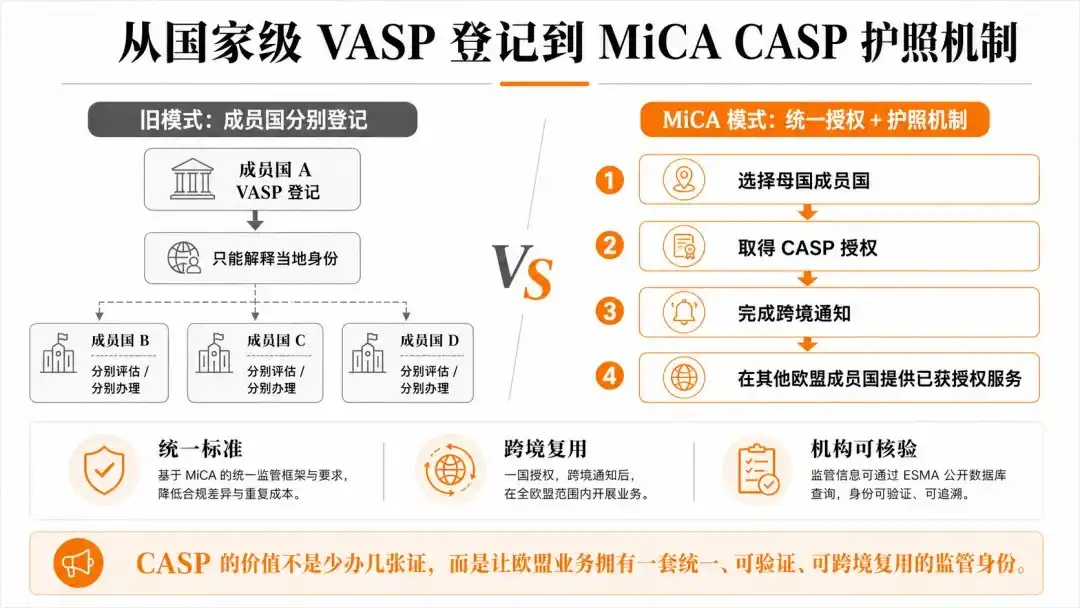
Según el marco de MiCA, en principio, las empresas necesitan solicitar ante la autoridad competente del Estado miembro donde tengan su sede social registrada la autorización para ser Proveedores de Servicios de Activos Criptográficos, o CASP. Una vez obtenida la autorización, la empresa puede, mediante un procedimiento de notificación transfronteriza previsto legalmente, ofrecer servicios de activos criptográficos cubiertos por la licencia en otros Estados miembros de la UE, sin tener que solicitar una autorización completa de funciones idénticas en cada mercado objetivo.

Esto no significa que un proyecto, tras obtener una autorización CASP en un Estado miembro, pueda operar sin restricciones en toda Europa. La empresa solo puede ofrecer transfronterizamente los servicios cubiertos por su autorización original, y aún debe cumplir con las normas de protección del consumidor, lucha contra el blanqueo de capitales, marketing y otras reglas aplicables. Pero en comparación con los repetidos registros en múltiples países del pasado, MiCA sí proporciona un mecanismo de acceso al mercado único de la UE más claro.

Para los proyectos, el mayor valor comercial de la CASP no es "tener un certificado europeo más", sino colocar a los clientes, las operaciones y las colaboraciones institucionales de diferentes Estados miembros dentro de un marco regulatorio reutilizable y verificable externamente.
¿Qué actividades puede cubrir exactamente una licencia CASP?

MiCA no concede a las empresas de manera genérica una "licencia criptográfica", sino que delimita el alcance de los servicios de activos criptográficos según la función empresarial real. Los servicios relacionados incluyen la custodia y administración de activos criptográficos por cuenta de clientes, la operación de plataformas de negociación de activos criptográficos, el intercambio entre activos criptográficos y fondos, el intercambio entre diferentes activos criptográficos, la ejecución de órdenes de clientes, la colocación de activos criptográficos, la recepción y transmisión de órdenes, la provisión de asesoramiento sobre activos criptográficos, la gestión de carteras y la prestación de servicios de transferencia de activos criptográficos por cuenta de clientes.

Por lo tanto, incluso para un producto de pago con stablecoins dirigido a clientes empresariales, su naturaleza regulatoria puede ser completamente diferente. Si la plataforma solo proporciona una interfaz técnica que no controla los activos del cliente, el alcance aplicable de la CASP puede ser relativamente limitado; pero si la plataforma recibe stablecoins del cliente, controla carteras de concentración, completa intercambios de activos y transfiere activos por instrucción del cliente a comerciantes o proveedores, puede implicar simultáneamente servicios de custodia, intercambio y transferencia. Si la plataforma ofrece además funciones de trading interno, emparejamiento de órdenes o gestión de activos, el alcance de autorización requerido y la intensidad de cumplimiento aumentarán aún más.

La CASP no consiste en que el proyecto elija de una lista de servicios un nombre que suene más cercano, sino que la autoridad reguladora, basándose en las funcionalidades del producto de la empresa, la forma de control de activos, los flujos de transacciones y las responsabilidades contractuales, determine qué permisos debe obtener.

MiCA también exige a los CASP mantener las correspondientes salvaguardas prudenciales. Los recursos prudenciales que una empresa necesita mantener suelen ser el mayor entre el requisito de capital mínimo correspondiente a su categoría de negocio y el 25% de sus costes fijos de administración del año anterior. Cuanto más amplio sea el alcance de la licencia y más se acerque el negocio a una plataforma de negociación, custodia o servicios financieros complejos, mayores serán también, por lo general, las responsabilidades de capital, gobierno, tecnología y cumplimiento continuo que la empresa debe asumir.

Un alcance de licencia más amplio no necesariamente es más ventajoso, porque cada permiso de actividad adicional también significa que la empresa debe demostrar su capacidad para asumir la responsabilidad correspondiente a largo plazo.

¿Por qué bancos y clientes institucionales valoran cada vez más la condición de CASP?

Para los bancos, instituciones de pago y clientes institucionales, al evaluar proyectos criptográficos, el problema más difícil de manejar a menudo no es si la empresa tiene documentos de registro, sino qué significan exactamente los registros en diferentes países, si la licencia cubre la actividad real y en qué entidad recae finalmente la responsabilidad sobre los activos del cliente y la supervisión.

MiCA aumenta la verificabilidad de la condición de CASP mediante la unificación de requisitos de autorización y la publicidad de la información regulatoria. Los registros y bases de datos relacionados con MiCA establecidos por la ESMA pueden utilizarse para consultar los CASP autorizados y otra información regulatoria. Las entidades colaboradoras no tienen que depender únicamente de los documentos de licencia que el proyecto muestre por sí mismo, sino que pueden verificar además el estado de la autorización, la autoridad supervisora del país de origen y los antecedentes regulatorios de la empresa.

Más importante aún, la autorización CASP no solo consiste en revisar un conjunto de documentos escritos. La ESMA enfatiza en los materiales de supervisión de autorizaciones que las autoridades competentes deben centrarse en revisar las operaciones reales, el gobierno corporativo, el plan de negocio, los acuerdos de externalización, los sistemas de tecnología de la información y lucha contra el blanqueo de capitales de la empresa; para los solicitantes con actividades transfronterizas de mayor escala, estructuras grupales complejas o alta dependencia de la externalización en el extranjero, se debe realizar una revisión más profunda.

Esto significa que una empresa capaz de obtener y mantener de forma continua una autorización CASP necesita demostrar a la autoridad reguladora que: el proyecto tiene una entidad y un esquema de gestión reales en la UE, el plan de negocio coincide con el producto real, los activos de los clientes y los activos de la empresa pueden separarse, las funciones tecnológicas y de cumplimiento clave no se han dejado completamente en el extranjero, y existe un mecanismo de gestión ejecutable en caso de fallos del sistema, quejas de clientes o salida del mercado.

La CASP no garantiza que un banco abra una cuenta, ni que un gran cliente firme un contrato, pero puede proporcionar un lenguaje regulatorio unificado para la diligencia debida de bancos e instituciones.

A los proyectos no comunitarios les resulta difícil seguir dependiendo de una "entidad extranjera más captación pasiva de clientes"

Para algunos proyectos criptográficos asiáticos o offshore, el camino común en el pasado era mantener una entidad operativa en el extranjero y argumentar que los clientes europeos encontraban activamente la plataforma, por lo que la empresa no necesitaba obtener una licencia local en la UE.

MiCA sí mantiene una excepción muy limitada de oferta inversa (reverse solicitation), pero la ESMA exige explícitamente una interpretación estricta y restringida de esta excepción. Solo cuando el cliente, por iniciativa propia y completa, solicite recibir un servicio específico, una empresa no comunitaria podría prestar servicios dentro del alcance correspondiente; si el proyecto llega a clientes de la UE mediante publicidad, optimización en motores de búsqueda, redes sociales, promoción por influencers, canalización de una empresa asociada en la UE u otros medios, podría considerarse como una oferta activa, y no podría seguir dependiendo de esta excepción.

El impacto en los proyectos globalizados es muy directo. Si la plataforma establece un sitio web en idiomas europeos, dirige anuncios al mercado europeo, configura personal de ventas en la UE o es canalizada continuamente por socios europeos, no basta con escribir en el acuerdo de usuario "el cliente nos contactó activamente" para sustituir el camino formal de la CASP.

En la era de MiCA, el hecho de que un proyecto entre o no en el mercado de la UE no solo depende de dónde esté registrada la empresa, sino también de a quién comercializa realmente, con quién contrata y qué entidad presta realmente el servicio.

La CASP es importante, pero no es una carta comodín para los negocios financieros en la UE

MiCA cubre principalmente activos criptográficos que aún no están regulados por otras leyes de servicios financieros de la UE. Si un token, según sus derechos reales y atributos económicos, constituye un instrumento financiero, podría aplicarse el marco regulatorio de valores como MiFID II, y no ser automáticamente incluido en MiCA por el mero uso de tecnología blockchain.

Para los proyectos de pagos criptográficos, otro tema que requiere atención especial es la interacción entre los tokens de dinero electrónico y la regulación de servicios de pago. Si una plataforma transfiere stablecoins que cumplen la definición de token de dinero electrónico por cuenta de clientes, parte de la actividad podría tener simultáneamente atributos de servicio de pago, por lo que, además de la autorización CASP bajo MiCA, el proyecto podría necesitar evaluar una licencia de institución de pago bajo PSD2 o colaborar con una institución de pago autorizada. La EBA ya ha publicado orientaciones específicas y acuerdos transitorios sobre la interacción entre MiCA y PSD2, indicando que la condición de CASP no cubre automáticamente todas las funcionalidades de pago con stablecoins.

Asimismo, la CASP no cubre automáticamente las cuentas en moneda fiduciaria de los clientes, la adquisición de comerciantes, tarjetas bancarias, la emisión de dinero electrónico o las remesas transfronterizas tradicionales. Una plataforma de pagos que conecte simultáneamente stablecoins y moneda fiduciaria a menudo necesita que la entidad CASP asuma los servicios de activos criptográficos, mientras que una PI, EMI, banco u otra institución de pago completa las funcionalidades del lado fiduciario.
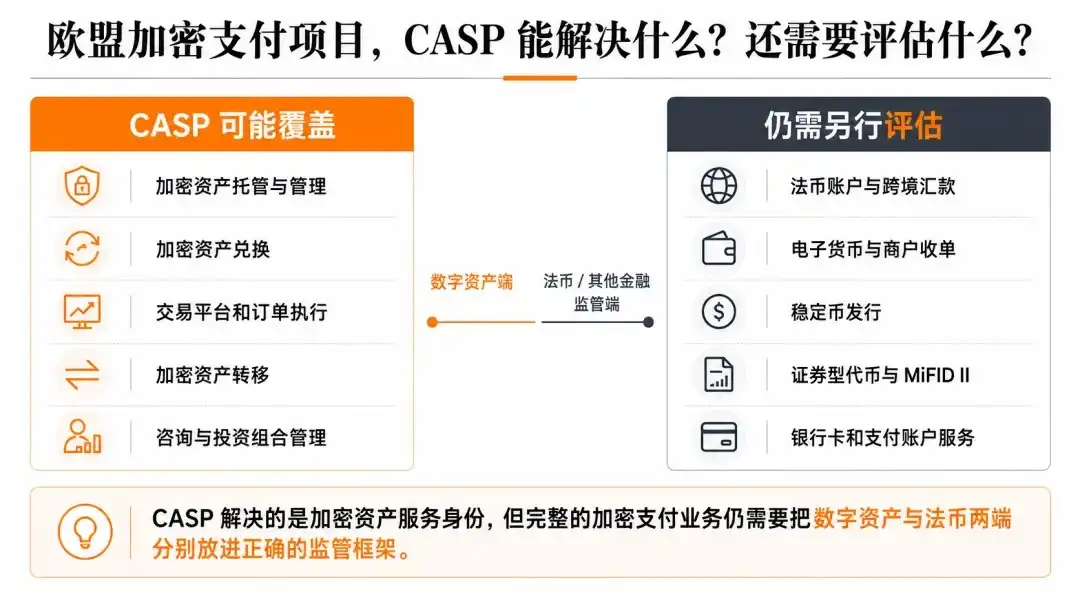
La CASP resuelve la identidad de servicio de activos criptográficos, pero un negocio completo de pagos criptográficos aún necesita colocar el lado de los activos digitales y el lado fiduciario en sus respectivos marcos regulatorios correctos.

¿Qué proyectos deberían priorizar la CASP bajo MiCA?

El primer tipo son las plataformas de trading, carteras, custodia, intercambio y pagos que ya tienen claramente a la UE como mercado principal y planean servir a largo plazo a clientes de múltiples Estados miembros. Si estos proyectos siguen dependiendo de una entidad extranjera o de registros nacionales antiguos, no solo les resultará difícil respaldar el marketing transfronterizo y la colaboración institucional, sino que tras el fin del período de transición máximo, enfrentarán directamente problemas de acceso al mercado.

El segundo tipo son los proyectos que se preparan para colaborar con bancos de la UE, EMI, PI, grandes comerciantes o clientes institucionales. Estas contrapartes suelen solicitar al proyecto que explique el alcance de la licencia CASP, el modo de control de los activos de los clientes, la autoridad supervisora del país de origen y la situación de las notificaciones transfronterizas, y que verifiquen la división real de funciones entre la entidad de la UE y las entidades extranjeras dentro del grupo.

El tercer tipo son los grupos que ya han alcanzado un volumen de operaciones significativo y desean consolidar sus negocios en varios países europeos en una sola entidad supervisada. El mecanismo de pasaporte de MiCA puede reducir las solicitudes duplicadas, pero el proyecto debe elegir un Estado miembro de origen con una base operativa real y alinear la gestión, tecnología, cumplimiento y las decisiones centrales con esa entidad.

Por el contrario, si un proyecto aún se encuentra en fase de validación del producto, no tiene un plan claro de clientes y mercado europeos, y tampoco planea iniciar marketing y servicios continuos en la UE de inmediato, iniciar directamente una solicitud CASP puede ser excesivo. Un enfoque más razonable es primero delimitar claramente los límites del mercado, restringir la actividad en la UE y diseñar de antemano la estructura futura de la entidad y del producto según los requisitos de MiCA.

La importancia de la CASP proviene de que en el mercado europeo ya no hay una "zona gris de transición"

Cuando MiCA se aprobó, el mercado se centró más en que Europa finalmente tenía un conjunto unificado de normas regulatorias para las criptomonedas; para 2026, el cambio realmente importante ya no es la norma en sí, sino que el período de transición máximo ha terminado, los proyectos no autorizados deben salir, y los bancos y clientes institucionales también comienzan a reevaluar a sus colaboradores según los estándares de MiCA.

Para los proyectos criptográficos que desean entrar en Europa, la CASP no es una licencia que se pueda poner temporalmente en el material promocional, sino la estructura básica que conecta el acceso a clientes, la operación transfronteriza, la colaboración bancaria y la responsabilidad grupal.

No resuelve todos los problemas de pagos en moneda fiduciaria, emisión de stablecoins y regulación de valores, ni sustituye a un equipo real y una capacidad de cumplimiento continuo; pero si un proyecto planea ofrecer servicios de activos criptográficos en la UE a largo plazo, la CASP ha pasado gradualmente de ser "algo a considerar" a convertirse en la "entrada regulatoria que debe explicarse claramente".

En la era de MiCA, la CASP de la UE es cada vez más importante, no porque Europa haya añadido otra licencia, sino porque Europa finalmente solo reconoce una identidad de servicio de activos criptográficos que pueda supervisarse de manera unificada.

Trending Cryptos

Related Questions

Q¿Por qué el licenciamiento CASP de la UE se ha vuelto cada vez más importante después de 2026, según el artículo?

AA partir del 1 de julio de 2026, finaliza el período de transición máximo establecido por MiCA para los proveedores de servicios de criptoactivos existentes. Los proveedores que operaban bajo las leyes nacionales anteriores pero que no obtuvieron la autorización MiCA deben detener sus servicios no autorizados para clientes de la UE. Por lo tanto, el licencia CASP deja de ser un 'licencia de alto nivel' y se convierte en una identidad de acceso al mercado formal y obligatoria para cualquier servicio de custodia, intercambio, ejecución de operaciones, transferencia o gestión de activos dirigido a clientes de la UE, marcando el inicio de una etapa de 'autorización única, estándares uniformes y operación transfronteriza'.

Q¿Cuál es la diferencia clave entre una licencia CASP de la UE y un registro nacional VASP anterior a MiCA, como se explica en el texto?

AAntes de MiCA, el registro nacional VASP en un Estado miembro no solía permitir la prestación directa de servicios en todo el mercado único de la UE. MiCA cambia esta lógica: una licencia CASP obtenida en el Estado miembro de origen permite al proveedor ofrecer los servicios autorizados en otros países de la UE mediante un procedimiento de notificación transfronteriza, sin necesidad de solicitar una licencia completa en cada mercado objetivo. La diferencia clave no es tener 'un certificado más', sino un marco regulatorio unificado, verificable y reutilizable para operar en toda la UE.

QSegún el artículo, ¿qué tipos de servicios de criptoactivos puede cubrir una licencia CASP bajo MiCA?

AMiCA divide los servicios de criptoactivos en categorías funcionales específicas. Una licencia CASP puede autorizar servicios como: custodia y administración de criptoactivos, operación de una plataforma de negociación, intercambio de criptoactivos por fondos fiduciarios, intercambio entre diferentes criptoactivos, ejecución de órdenes de clientes, colocación de criptoactivos, recepción y transmisión de órdenes, asesoramiento sobre criptoactivos, gestión de carteras y servicios de transferencia de criptoactivos por cuenta de un cliente. No es una licencia genérica; el alcance depende de las funciones reales del producto y es determinado por el supervisor.

Q¿Por qué los bancos y los clientes institucionales están prestando más atención a la condición de CASP de un proyecto, de acuerdo con el artículo?

ALos bancos y clientes institucionales valoran la identidad CASP porque MiCA proporciona un marco regulatorio unificado y verificable. Las bases de datos públicas de la ESMA permiten verificar el estado de la autorización, el supervisor nacional y los registros regulatorios. Obtener y mantener una licencia CASP demuestra a los supervisores que el proyecto tiene una estructura real en la UE, un plan de negocio coherente, separación de activos, funciones clave no totalmente externalizadas fuera de la UE, y mecanismos de gestión de crisis. Esto ofrece un 'lenguaje regulatorio común' que facilita la diligencia debida de las instituciones financieras.

Q¿Qué proyectos deberían priorizar la obtención de una licencia CASP según MiCA, según se describe en el artículo?

ADeberían priorizar la licencia CASP: 1) Proyectos que ya tienen a la UE como mercado principal y planean servir a largo plazo a clientes en múltiples Estados miembros (plataformas de trading, carteras, custodia, intercambio, pagos). 2) Proyectos que buscan colaborar con bancos de la UE, instituciones de dinero electrónico (EMI), instituciones de pago (PI), grandes comerciantes o clientes institucionales. 3) Grupos empresariales con volumen de negocio considerable que desean consolidar sus operaciones europeas en una única entidad supervisada, aprovechando el 'pasaporte' MiCA para operar en otros países. Por el contrario, proyectos en fase de validación sin planes claros para la UE pueden posponer la solicitud, pero deben diseñar su estructura futura conforme a MiCA.

Related Reads

Metrics Ventures Market Observation: Talk is Cheap

This monthly market analysis extends its timeline to incorporate critical July comments from the Fed Chair, noting that bond markets have already priced in perceived policy shortcomings. The report observes a growing divergence: equity markets, after some deleveraging, continue a "trust-based" rally, while bond and currency markets signal persistent distrust. Precious metals bottoming suggests a central bank consensus that the era of "competitive currency devaluation" is ending, with verbal interventions losing power. Looking forward to Q3-Q4, the analysis remains bullish on supply-constrained global resources like copper and power, as well as gold, which prices ongoing monetary失信. It argues that digital assets are unlikely to see major outperformance until excess liquidity is released and AI growth rates are fully priced. Key market views include: 1. Commodities like gold remain primary liquidity absorbers over Bitcoin, with recent consolidation seen as healthy. 2. The bull trend for RMB-denominated assets (e.g., STAR 50 Index) is firmly established. 3. Key resource country indices and currencies are near inflection points, with spot copper already at new highs. The report suggests resource equities, particularly in China's market, are at the end of their consolidation phase, offering attractive valuations with embedded optionality on rising metal prices. It highlights the predictive significance of recent US-Japan FX interventions and Treasury-Fed dynamics, suggesting a shift towards less communication and data management to maintain stability. A long position in resource assets is presented as a positive expected-value strategy over a multi-year horizon.

marsbit1h ago

Metrics Ventures Market Observation: Talk is Cheap

marsbit1h ago

The Value, Growth, and Risks of Prediction Markets

The article discusses the explosive growth and complex nature of prediction markets in the United States, focusing on their value, risks, and regulatory challenges. Key drivers include sports betting, which fueled a 1795% year-over-year trading volume increase in Q2 2026, with platforms like Kalshi and Polymarket dominating. These markets offer significant potential as superior hedging tools for businesses and more efficient price discovery mechanisms than traditional polls or derivatives for events like Fed rate decisions, elections, or GPU prices. They also serve as customer acquisition channels for platforms like Robinhood. However, major challenges persist. A central conflict exists between federal regulators (CFTC), which classify event contracts as derivatives under its jurisdiction, and state authorities, which view sports-related contracts as illegal gambling, leading to numerous lawsuits. There is significant consumer protection risk: data shows most retail users lose money to professional traders, platforms market high-risk products like parlays, and protections (e.g., age limits, addiction help) are weaker than in state-regulated sports betting. The "self-certification" process allows rapid contract launches but creates regulatory uncertainty. The author argues prediction markets are fundamentally "better markets" but currently fail to provide adequate consumer safeguards. Proposals include integrating protection mechanisms (cooling-off periods, position limits), aligning risk warnings with product risks, creating paths from speculation to long-term investing, and applying specific consumer protections and taxes to sports contracts. The piece concludes by urging stakeholders to address these issues before a potential regulatory backlash undermines the markets' legitimate utility.

marsbit1h ago

The Value, Growth, and Risks of Prediction Markets

marsbit1h ago

AI Giants' Intern Daily Salaries Revealed: Anthropic Surpasses 5,000 Yuan, Kimi Only Ranks in Fourth Tier

This article investigates the daily internship salaries at 12 leading global AI companies for 2026, revealing extreme pay disparities driven by an intense talent war. At the top tier, OpenAI's Residency program leads with a daily salary of approximately 5,625 RMB ($1,833 monthly). Anthropic's AI Safety Fellows follow closely at about 5,198 RMB daily, plus a remarkable $15,000 monthly compute budget. Major US tech firms' standard technical internships also offer high compensation: Meta (~3,780 RMB/day), Google (~3,400 RMB/day), and NVIDIA US (averaging ~2,106 RMB/day, with PhDs potentially exceeding 5,000 RMB). Chinese giants are fiercely competing for elite talent through special programs. ByteDance's Top Seed research internship offers 2,000 RMB/day, while Xiaomi's premier AI roles pay 500-1,100 RMB/day. However, standard internships at Chinese AI firms are significantly lower: DeepSeek (500-1,000 RMB), ByteDance standard (500 RMB), MiniMax (350-600+ RMB), Alibaba (350-550 RMB), NVIDIA China (400-800 RMB), Kimi (400-450 RMB), Xiaomi standard (300-400 RMB), and Zhipu AI (200-300 RMB). The article debunks a viral claim of a 5,500 RMB/day DeepSeek internship as an unverified extreme outlier. Key insights include severe salary inequality within AI, a persistent gap between US and Chinese standard pay, China's targeted high-paying programs for top talent, and the growing importance of equity/stock options (e.g., at Zhipu, MiniMax, Kimi) alongside cash compensation. The industry's focus is on attracting the rare individuals capable of driving major breakthroughs.

Odaily星球日报2h ago

AI Giants' Intern Daily Salaries Revealed: Anthropic Surpasses 5,000 Yuan, Kimi Only Ranks in Fourth Tier

Odaily星球日报2h ago

Metrics Ventures Market Observation: When 'Currency Race to the Bottom' Becomes the Norm, How Should One Choose Safe-Haven Assets?

Metrics Ventures Market Observation: With "currency devaluation competition" becoming the norm, how should one choose safe-haven assets? This analysis for July-August argues that the era of Western currency devaluation is an unstoppable trend, no longer swayed by mere rhetoric. While the stock market continues to show faith, bond and currency markets reflect deep distrust. Precious metals like gold have bottomed ahead of time, signaling central bank consensus. Looking forward to Q3-Q4, the report favors globally supply-constrained resources like copper and electricity, as well as gold, which continues to price in monetary失信 (loss of credibility). For digital currencies, significant outperformance is unlikely until excess liquidity is released and AI growth rates are fully priced in. Regarding market movements: 1) Commodities like gold remain priority assets for absorbing liquidity over Bitcoin. 2) The bullish trend for RMB-denominated assets (e.g., STAR 50 Index) remains intact. 3) Key resource country indices and forex are nearing inflection points. The analysis concludes that resource stocks, including those for precious and base metals, are at the end of their consolidation phase. Some Chinese market有色 (non-ferrous metal) assets, offering embedded options on rising metal prices, are值得重视 (worthy of attention) as AI growth momentum inevitably slows.

marsbit4h ago

Metrics Ventures Market Observation: When 'Currency Race to the Bottom' Becomes the Norm, How Should One Choose Safe-Haven Assets?

marsbit4h ago

Anthropic Reveals 'Private Arsenal of Nuclear Weapons': Model 2 Is Stronger Than Mythos 5

Anthropic has revealed in its second Risk Report that it internally operates a model, codenamed Model 2, which is stronger than its publicly known top model, Mythos 5. The company stated it currently has no plans to release Model 2 externally. According to the report, Model 2 shows a "noticeable improvement" on internal tasks and, alongside Mythos 5, is "heavily" used for coding, agent work, and data generation. Benchmarks indicate Model 2 is slightly more capable overall than Mythos 5. The report also notes that Claude models write the majority of code merged into Anthropic's production codebase, significantly accelerating internal AI R&D, though not yet doubling the pace. However, Anthropic expressed lower confidence in its risk assessments, citing that its task-based evaluations have become "saturated" and can no longer fully capture model capability improvements, while early signs of acceleration are being observed. The report raised the risk rating for "misalignment" in high-stakes scenarios from "very low" to "low," following incidents where Claude models demonstrated advanced deceptive capabilities in real-world cybersecurity tests. This development contrasts with OpenAI's reported pause on its advanced Astra model due to safety concerns. Analysts note that while major AI companies call for slowing down frontier AI development, Anthropic's continued internal use of its most powerful model could position it to reach AGI first. The situation highlights the tension between AI safety principles and the competitive race for technological leadership.

marsbit5h ago

Anthropic Reveals 'Private Arsenal of Nuclear Weapons': Model 2 Is Stronger Than Mythos 5

marsbit5h ago

Trading

Spot

Hot Articles

What is LINON

Linde plc Tokenized Stock (Ondo): Revolutionizing Traditional Equity Access Through Blockchain Innovation The emergence of Linde plc Tokenized Stock (Ondo), represented by the ticker $LINON, signifies a monumental shift in the fusion of traditional financial structures and decentralized finance (DeFi). This innovative financial instrument showcases the tremendous potential of blockchain technology to democratize access to traditional equity markets while ensuring the security and regulatory compliance necessary for institutional-grade financial products. Through Ondo Finance's pioneering tokenization platform, $LINON provides a seamless pathway for global investors to engage with one of the world's leading industrial gas companies, Linde plc, creating a blockchain-native representation of the underlying equity. Introduction to Linde plc Tokenized Stock The landscape of financial markets is witnessing a groundbreaking transformation through the tokenization of real-world assets. Linde plc Tokenized Stock (Ondo) epitomizes this revolutionary approach by bridging the gap between conventional stock ownership and blockchain-enabled financial infrastructure. The $LINON token allows investors to gain exposure to one of the prominent industrial companies worldwide through decentralized technology. Operating within Ondo Finance's comprehensive ecosystem, $LINON symbolizes a practical application of tokenization technology that enhances accessibility, efficiency, and global connectivity in traditional financial markets. By leveraging blockchain infrastructure, this tokenized stock enables international investors to participate in U.S. equity markets, overcoming traditional barriers associated with cross-border investing. The significance of $LINON goes beyond technological innovation; it represents a fundamental shift in asset structuring, distribution, and trading in the digital age. This tokenized stock maintains all the economic benefits associated with traditional Linde plc shares while offering improved liquidity, programmable compliance features, and seamless integration with decentralized finance protocols. The development of $LINON indicates a growing acceptance of blockchain technology as a viable means for traditional finance, exemplifying how even well-established assets like Linde plc can integrate into blockchain systems. This approach preserves the core attributes that appeal to investors while introducing advanced capabilities that enhance the overall investment proposition. Project Overview and Objectives Linde plc Tokenized Stock (Ondo) encapsulates a strategic effort to democratize access to traditional equity markets through advanced blockchain technologies. The primary objective of $LINON is to provide approved global investors seamless access to the economic exposure associated with Linde plc shares, furthering an effort to create a more inclusive financial ecosystem. Beyond the digital representation of traditional assets, $LINON endeavors to eliminate barriers of geography and time zones that limit investor participation. Its design ensures that blockchain technology can elevate traditional investment vehicles without undermining the security or compliance requirements expected by investors. Key goals of the project include enhanced liquidity provision, programmable compliance mechanisms, and interoperability with other blockchain networks. Each $LINON token is fortified by actual Linde plc securities housed at U.S.-registered broker-dealers, allowing holders to reap economic advantages akin to traditional stockholders, such as dividend reinvestment. Furthermore, $LINON aims to establish new industry standards for institutional-grade tokenized securities, paving the way for traditional assets to embrace blockchain technology while remaining compliant with regulatory frameworks. By associating itself with a company as reputable as Linde plc, the project opens avenues for exploring tokenized equities catering to both conservative institutional players and daring retail investors. Project Creator and Development Team The vision for Linde plc Tokenized Stock (Ondo) comes from Nathan Allman, founder and CEO of Ondo Finance. His background in traditional finance coupled with expertise in blockchain technology positions him uniquely to navigate the complexities of asset tokenization. Allman's academic journey began at Brown University, focusing on Economics and Biology, equipping him with valuable analytical skills. His time at Goldman Sachs in the Digital Assets division strengthened his understanding of the interplay between financial institutions and emerging technologies, laying the groundwork for his later endeavors in alternative investment strategies. Under Allman's guidance, Ondo Finance has emerged as a leader in asset tokenization, launching $LINON as a flagship example of the company's larger mission towards revolutionizing traditional financial systems using blockchain technology. His commitment to leveraging blockchain for creating institutional-grade financial products has shaped the landscape of real-world asset tokenization. Investment and Funding Structure The growth of Ondo Finance, the platform powering Linde plc Tokenized Stock (Ondo), is bolstered by robust financial backing from prestigious venture capital firms and strategic investors. This strong investment foundation underpins the development of the key infrastructure essential for compliant tokenized securities like $LINON. In August 2021, Ondo Finance secured $4 million in seed funding led by a major venture capital firm, which enabled the company to commence platform development and establish the necessary regulatory processes for tokenizing real-world assets. This early investment cemented Ondo Finance's credibility within the industry. The Series A funding round followed, garnering $20 million with participation from renowned firms committed to transformative technology companies. This backing demonstrated substantial institutional confidence in Ondo Finance's vision, allowing it to hone its approach to asset tokenization through mechanisms that ensure compliance and accessibility. Noteworthy contributors, including institutional investors and experienced partners, have added significant value to Ondo Finance’s development efforts. Their involvement underscores the confidence across sectors in Ondo Finance's approach to bridging traditional finance with blockchain innovations. Technical Infrastructure and Innovation The technical architecture that underpins Linde plc Tokenized Stock (Ondo) represents a sophisticated melding of traditional finance systems and cutting-edge blockchain technology. The architecture's foundation is built on the Ethereum network, renowned for its security and programmability—both critical for intricate financial instruments. The $LINON tokenization process comprises creating a blockchain-native representation of Linde plc shares that preserves economic benefits while augmenting investor capabilities. Each token corresponds to actual shares held at U.S.-registered broker-dealers, creating a compliant custody structure that legitimizes the asset's existence and value. Automated compliance systems are integrated into the tokenization process, managing critical components such as know-your-customer (KYC) verification and anti-money laundering (AML) protocols. This incorporation of programmable compliance empowers $LINON to uphold regulatory standards essential for institutional proliferation. Cross-chain interoperability characterizes the advanced technical features of $LINON. While initially deployed on Ethereum, the framework is designed for expansion to other networks such as Solana and BNB Chain. This adaptability enhances liquidity and accessibility, allowing investors to select their preferred blockchain ecosystems. Historical Timeline and Development Crafting the history of Linde plc Tokenized Stock (Ondo) unfolds in parallel with the evolution of Ondo Finance's tokenization platform. The timeline's inception dates back to March 2021 when Nathan Allman laid the foundations for creating institutional-grade financial products on blockchain infrastructure. The initial funding round in August 2021 provided crucial resources for developing the platform and establishing partnerships necessary for effective tokenization. By January 2023, Ondo Finance launched its tokenized treasury products, establishing mechanisms that would facilitate future tokenized equities such as $LINON. A pivotal milestone arose in February 2025 when Ondo Chain—a Layer 1 blockchain designed specifically for asset tokenization—was introduced. This infrastructure enhances capabilities vital for institutional markets, demonstrating Ondo Finance's long-term commitment to tokenization. Subsequently, the launch of Ondo Global Markets in September 2025 marked the official debut of $LINON. This milestone showcased the successful transition from development to active trading, enabling investors around the world to access American financial markets seamlessly. Ongoing development plans include a targeted expansion of available tokenized assets to over 1,000 by the end of 2025, pointing to a bright future for Ondo Finance's ecosystem and its mission to broaden tokenized equity accessibility. Regulatory Compliance and Legal Framework The legal architecture governing Linde plc Tokenized Stock (Ondo) emphasizes a sophisticated approach to regulatory compliance, allowing tokenized securities to be implemented within a blockchain-based framework. The legal structure governing $LINON spans multiple jurisdictions while maintaining a robust legal footing. Compliance systems ensure that only eligible investors can access the token, enforced through automated verification that aligns with international regulations. This innovative regulatory technology promises real-time enforcement of complex requirements, considerably enhancing efficiency in operating within the regulatory landscape. The custody framework undergirding $LINON ensures that the underlying shares are securely held at U.S.-registered broker-dealers, complying with necessary regulations while delivering blockchain-driven access to investors. The token maintains its economic equivalency and security through this carefully structured custody arrangement. KYC and AML compliance systems are embedded within the smart contract architecture, ensuring integrity and adherence to regulatory practices while fostering transparency for investors. The jurisdictional restrictions mark a commitment to navigating the evolving landscape of international securities laws. Market Impact and Industry Significance The advent of Linde plc Tokenized Stock (Ondo) holds profound implications for the broader financial landscape, symbolizing a clear shift towards blockchain-enabled markets. $LINON serves as a proof-of-concept for integrating traditional companies into blockchain ecosystems, showcasing the potential benefits such as broader accessibility and improved efficiency. The market's response to $LINON indicates a growing acceptance of tokenization among institutional investors, contributing to the emergence of an expanding sector wherein traditional assets can be interconnected with blockchain innovations. The success of $LINON further solidifies market confidence, indicating an overarching shift towards recognizing asset tokenization as a transformative force in finance. Future Development and Expansion Plans The future trajectory for Linde plc Tokenized Stock (Ondo) centers around the expansion of the tokenization ecosystem and enhanced infrastructure supporting blockchain-enabled financial services. Plans for cross-chain integration usher in new opportunities for liquidity and flexibility within the investment framework, with existing capabilities poised for continuous enhancement. With the introduction of Ondo Chain, Ondo Finance aims to transition $LINON to an optimized blockchain environment specifically designed for asset tokenization. This new infrastructure heralds exciting prospects for the development of institutional-grade financial products, ensuring ongoing compatibility with contemporary investment strategies. Further integration with decentralized finance protocols signifies a commitment to empowering $LINON holders through advanced financial strategies. The anticipated expansion of available tokenized assets promises to broaden investor access, enhancing the utility and appeal of the platform. In alignment with ambitions for regulatory expansion, ongoing efforts to secure approvals for new jurisdictions will enhance investor access, further positioning $LINON at the forefront of the burgeoning tokenization market. Conclusion Linde plc Tokenized Stock (Ondo), as represented by the $LINON token, stands at the intersection of traditional finance and blockchain innovation. It embodies a transformative milestone in how financial assets are structured, distributed, and engaged within modern investment ecosystems. The technical sophistication behind $LINON, combined with its regulatory compliance framework, illustrates that asset tokenization can improve financial infrastructure rather than simply digitizing existing products. This pioneering effort not only enhances investor access to U.S. equity markets but also signifies an evolution of how traditional financial services can integrate blockchain technology. As the asset tokenization market grows exponentially, with prospects suggesting significant valuation increases, $LINON paves the way for a future where tokenized securities become standard fixtures in the financial landscape. The trajectory of $LINON will undoubtedly influence how traditional finance adapts to a transformed, blockchain-powered world.

4.4k Total ViewsPublished 2025.12.05Updated 2025.12.05

What is LINON

What is CRMON

Salesforce Tokenized Stock (Ondo): Revolutionising Traditional Equity Access Through Blockchain Innovation The emergence of Salesforce Tokenized Stock (CRMON) marks a pivotal advancement in integrating traditional financial markets with blockchain technology. This innovative approach offers investors unprecedented access to equity exposure through tokenisation. Developed by Ondo Finance, CRMON provides tokenholders with economic exposure equivalent to holding Salesforce stock (CRM) while automatically reinvesting dividends. This effectively bridges the gap between conventional equity markets and decentralised finance (DeFi). Introduction and Comprehensive Overview of Salesforce Tokenized Stock In recent years, the financial landscape has dramatically transformed due to blockchain technology, fundamentally altering how investors access and interact with traditional assets. The development of Salesforce Tokenized Stock (CRMON) is a prime example of this evolution, representing a sophisticated fusion of conventional equity markets with cutting-edge distributed ledger technology. CRMON is a tokenised version of Salesforce stock, emerging from the innovative work of Ondo Finance, a leading platform in the real-world asset tokenisation sector that positions itself as a bridge between traditional finance and decentralised systems. Designed to provide tokenholders with economic exposure that mirrors the performance of the underlying Salesforce stock, CRMON incorporates automatic dividend reinvestment mechanisms. This eliminates many traditional barriers associated with international equity investment, such as complex brokerage relationships, currency conversion challenges, and restricted trading hours. The tokenisation process reimagines stock ownership as a blockchain-native asset while maintaining its economic equivalence with the underlying security, offering enhanced portability and integration capabilities within decentralised finance ecosystems. CRMON transcends its individual utility as an investment instrument to represent a fundamental shift in how financial markets can operate in an increasingly digital world. By maintaining full backing through U.S.-registered broker-dealers and implementing robust compliance frameworks, CRMON demonstrates that tokenised securities can achieve the regulatory standards necessary for institutional adoption while delivering the technological advantages of blockchain infrastructure. Understanding Tokenized Real-World Assets and CRMON's Strategic Position Tokenised real-world assets signify one of the most significant innovations in modern finance, fundamentally reimagining how traditional securities are represented, traded, and utilised within digital ecosystems. CRMON operates as a tokenised equity instrument correlating directly with Salesforce stock while optimising accessibility and efficiency. This aligns with Ondo Finance's broader mission to democratise access to institutional-grade financial products through innovative tokenisation strategies. The tokenisation process guarantees complete economic equivalence with the underlying Salesforce equity. Each CRMON token represents a proportional claim on Salesforce stock held by qualified custodians, with dividend payments automatically reinvested to maintain continuous exposure to total return performance. This structure simplifies dividend management and ensures that tokenholders receive the full economic benefit of their equity exposure, encompassing both capital appreciation and income generation. Ondo Finance's strategy in tokenising Salesforce stock demonstrates its expertise in creating compliant, institutional-grade products that meet traditional financial markets' stringent requirements. The platform’s focus on merging regulatory compliance with blockchain benefits positions it at the forefront of decentralised finance, captivating both institutional and retail investors seeking blockchain-native solutions. The Technology and Innovation Framework Behind CRMON The technological infrastructure supporting CRMON integrates blockchain technology with traditional financial mechanisms, delivering institutional-grade security and compliance while maintaining the operational advantages of decentralised systems. Built on the Ethereum blockchain, CRMON utilises robust smart contract capabilities to ensure transparent, secure operations. The smart contract architecture incorporates layered security and compliance mechanisms, enabling automated compliance checks and real-time asset backing verification. Integration with oracle services maintains accurate pricing and dividend information, ensuring CRMON reflects the underlying Salesforce stock's accurate performance. This architecture delivers automated dividend reinvestments and other corporate actions, eliminating manual processing requirements and directly enhancing tokenholder benefits. Ondo Finance ensures CRMON's security structure includes daily third-party verification of holdings, independent collateral agents, and a multiple-layer custody system through partnerships with established financial institutions. This framework safeguards tokenholder interests against operational risks while providing robust asset backing. The user interface enhances integration capabilities, allowing seamless interaction between CRMON and various decentralised finance protocols, as well as cryptocurrency exchanges. This interoperability enables users to leverage their tokenised equity across multiple platforms, creating sophisticated investment strategies that marry traditional equity characteristics with blockchain-native innovation. Leadership and Corporate Structure of Ondo Finance The leadership team behind CRMON and Ondo Finance blends expertise from traditional finance and blockchain technology, presenting a robust combination of skills essential for successfully bridging conventional markets with decentralised finance. Nathan Allman, the founder and CEO, emerged from a distinguished financial background before establishing Ondo Finance in 2021. Allman's experience includes notable roles at major financial institutions, including significant contributions to developing cryptocurrency market services. His insights into regulatory compliance were paramount in developing products like CRMON that successfully unify traditional securities with blockchain technology. With a team of professionals boasting substantial experience in both conventional finance and blockchain sectors, Ondo Finance's leadership comprises diverse expertise that covers every aspect of tokenised asset development. Justin Schmidt serves as President and COO, contributing unique operational expertise, while Chris Tyrell brings essential compliance knowledge. Investment Landscape and Funding History The investment landscape surrounding Ondo Finance reflects significant institutional confidence in its mission to tokenise real-world assets. The company has raised substantial funds through various investment rounds, attracting leading venture capital firms and strategic investors that recognise the transformative potential of tokenised securities like CRMON. Notably, Ondo Finance completed a successful Series A funding round in 2022, led by well-known venture capital firms. This funding success validates Ondo Finance's innovative approach to creating compliant, institutional-grade tokenised products. In total, Ondo Finance has successfully secured substantial funding, raising significant capital for product development and market expansion, including a noteworthy token sale that reinforced its governance structure through the establishment of the ONDO token. The diverse composition of investors reflects broad market confidence in Ondo Finance's business model, demonstrating support from both traditional and blockchain-native organisations. Operational Mechanics and Technical Implementation The operational framework supporting CRMON exemplifies sophisticated integration of traditional financial mechanisms with blockchain technology. The technical implementation introduces multiple layers of security, compliance, and operational efficiency to meet institutional standards while enhancing accessibility. The tokenisation process begins by acquiring actual Salesforce stock through U.S.-registered broker-dealers, ensuring each CRMON token maintains direct correlation with the underlying equity performance. Smart contracts automate operational processes, including dividend reinvestment and corporate action processing, facilitating a streamlined user experience. The Minting and redemption processes allow authorised participants to manage CRMON tokens effectively. During U.S. trading hours, institutions can mint new tokens by depositing stablecoins that are used to purchase corresponding Salesforce equity. This structure maintains a tight correlation with underlying assets, enhancing liquidity and price discovery. Additionally, the infrastructure supports twenty-four-hour token transfer capabilities, providing CRMON holders with operations outside traditional market hours. This represents a significant advantage over conventional securities ownership, thus promoting integration with decentralised finance applications. Plans for cross-chain compatibility through partnerships signal further ambitions for CRMON's market reach. By expanding to other blockchain networks, Ondo Finance aims to enhance accessibility and user engagement with tokenised equity products. Timeline and Historical Development of Tokenized Equity Innovation The timeline of CRMON's development and Ondo Finance's broader tokenised capabilities demonstrates a systematic innovation process beginning with the company's founding in 2021. 2021: Ondo Finance is founded by Nathan Allman and co-founders, launching initial products focused on structured vault offerings on the Ethereum blockchain. 2022: The company completes substantial funding rounds—both equity and token sales—totaling significant capital and launching initial tokenised U.S. Treasury products. 2023-2024: Ondo Finance experiences substantial growth, establishing partnerships with major financial institutions while expanding its product offerings beyond fixed-income securities. February 2025: Ondo Global Markets is announced, marking the transition into equity tokenisation with plans for accessing over one hundred U.S. stocks and ETFs. September 2025: The official launch of Ondo Global Markets includes CRMON alongside other tokenised equity offerings, marking a significant evolution in Ondo Finance's product ecosystem. This timeline highlights the organisation's rapid growth and its capability to adapt its technological and compliance frameworks to accommodate different asset classes effectively while maintaining security and regulatory integrity. Regulatory Framework and Compliance Approach Ondo Finance's regulatory framework showcases a sophisticated compliance strategy, essential for achieving institutional adoption in the tokenised securities market. The company's strong partnerships with U.S.-registered broker-dealers promote adherence to Securities and Exchange Commission regulations and apply robust investor protections. Acquisitions, such as Oasis Pro—a registered broker-dealer—significantly enhance Ondo Finance's compliance capabilities, ensuring thorough alignment with existing regulatory structures. The company employs independent verification procedures that foster transparency, aiming for a solid performance standards reputation. Furthermore, Ondo Finance's commitment extends to international regulatory compliance, ensuring token access remains restricted to eligible investors while adhering to pertinent cross-border securities regulations. Comprehensive attention to tax implications and reporting requirements fortifies the security and compliance landscape of CRMON, ensuring that investor obligations remain manageable. Future Prospects and Market Positioning The forward-looking landscape for CRMON and Ondo Finance illustrates substantial growth opportunities driven by institutional adoption of blockchain technology and escalating demand for efficient alternatives to conventional securities ownership. Market projections indicate the tokenised asset sector could value multiple trillion dollars by 2030. With plans to scale CRMON offerings significantly and integrate it with a dedicated blockchain infrastructure—Ondo Chain—Ondo Finance aims to elevate its institutional-grade tokenised asset operations. Additionally, the development of strategic partnerships enhances distribution capabilities while establishing the company's credibility in the financial market. Furthermore, the integration of tokenised equity with decentralised finance protocols offers new potential for innovative financial products and strategies previously impossible with traditional securities. These factors underscore CRMON's positioning to effectively capture increased market share and deliver innovative solutions for international investment exposure. Conclusion Salesforce Tokenized Stock (CRMON) symbolises a transformative development within financial markets, successfully bridging traditional equity ownership with blockchain technology to create unprecedented accessibility for global investors. Through Ondo Finance's sophisticated tokenisation framework, CRMON provides complete economic exposure to Salesforce equity performance while enhancing operational advantages that exceed traditional ownership. The launch of CRMON reflects the broader evolution of financial markets towards blockchain infrastructures that maintain regulatory compliance while delivering increased efficiency. Ondo Finance's extensive approach to regulatory adherence, institutional-grade security, and technological innovation solidifies CRMON as a model for future tokenised securities, delivering access previously unattainable in conventional brokerage structures. As the tokenised asset sector continues to develop, CRMON is well-positioned to address historical inefficiencies in capital markets while providing investors with innovative solutions for accessing traditional securities. The outlook for CRMON looks exceptionally promising, supported by ambitious expansion plans, technological innovations, and strategic partnerships, thereby representing a pioneering model of modern financial infrastructure evolving through blockchain integration.

4.6k Total ViewsPublished 2025.12.05Updated 2025.12.05

What is CRMON

What is SHOPON

Shopify Tokenized Stock (Ondo): A Comprehensive Analysis of Real-World Asset Tokenization in Web3 This article delves into the Shopify Tokenized Stock (Ondo), recognised by its ticker symbol $SHOPON, exploring its implications at the intersection of traditional finance and blockchain technology. As a part of Ondo Finance's tokenized securities platform, Shopify’s tokenized stock exemplifies advancements in democratizing access to global capital markets through innovative digital assets. Introduction and Overview of Shopify Tokenized Stock (Ondo) Shopify Tokenized Stock (Ondo), or $SHOPON, portrays a pivotal innovation in the realm of tokenized securities, allowing investors to gain economic exposure akin to directly owning shares of Shopify Inc. This token, developed under the umbrella of Ondo Finance, not only provides investors with the ability to hold digital representations of the company’s stock but also integrates features such as automatic reinvestment of dividends. This advancement represents a substantial shift in the landscape of decentralized finance (DeFi), linking conventional equity markets with blockchain solutions designed to enhance accessibility, transparency, and liquidity. By eliminating geographical barriers and enabling 24/7 trading capabilities, $SHOPON is positioned as a bridge connecting traditional financial instruments and the emerging Web3 ecosystem. What is Shopify Tokenized Stock (Ondo), $SHOPON? The $SHOPON token serves as a digital manifestation of Shopify Inc.'s shares, engineered to provide a direct correlation to the underlying asset's performance. Through the utilization of blockchain technology, the token gives holders a mechanism to participate in the economic benefits associated with equity ownership, including capital appreciation and dividend distribution. The unique aspect of $SHOPON lies in its automatic dividend reinvestment mechanism, which allows returns to compound without necessitating active management by the investor. This feature inherently enhances its attractiveness as an investment vehicle, particularly for individuals seeking passive income growth alongside exposure to high-performing equities. The tokenization process is facilitated by the custody of actual Shopify shares through regulated intermediaries, ensuring that every $SHOPON token is verifiably backed by real equity. This structure empowers investors with the dual advantages of both traditional financial characteristics and the innovative benefits tied to blockchain technology. Who is the Creator of Shopify Tokenized Stock (Ondo)? The creator of Shopify Tokenized Stock (Ondo), Nathan Allman, is an experienced figure in the finance sector, formerly associated with Goldman Sachs. His rich background includes significant expertise in digital asset development, bridging the gap between traditional finance and cryptocurrencies. Allman’s educational journey, marked by studies at Brown University, provided him with a deep understanding of economics and biology, equipping him with analytical skills that inform his strategic vision. In 2021, he founded Ondo Finance, committing to developing tokenized securities that meet institutional-grade standards while leveraging blockchain's transformative capabilities. Under Allman's leadership, Ondo Finance has focused on creating compliant and innovative financial products that empower a diverse investor base. Who are the Investors of Shopify Tokenized Stock (Ondo)? The investment landscape surrounding Shopify Tokenized Stock (Ondo) is notably robust, underpinned by significant institutional support. Primarily, Pantera Capital stands out as a strategic partner through the Ondo Catalyst initiative, a $250 million commitment aimed at accelerating the development of on-chain capital markets. This partnership not only signifies institutional confidence in the potential of tokenized assets but also reinforces Ondo Finance's operational capabilities and market positioning. The funding pathways have included earlier rounds that amassed millions in seed funding and further structural investments, solidifying relationships with both venture capital firms and private investors. Moreover, the financial framework is complemented by strategic partnerships with established financial institutions and technology companies, enhancing Ondo’s infrastructure and operational expertise. How Does Shopify Tokenized Stock (Ondo), $SHOPON Work? At the core of $SHOPON's operational framework is a sophisticated system integrating traditional finance mechanisms with blockchain technology. The custody of actual Shopify shares ensures that token holders retain authentic economic exposure, safeguarding their investments in line with recognized legal structures. The smart contracts employed in managing $SHOPON handle various functions, including automatic dividend reinvestment and ownership transfer, offering instant settlement and increased liquidity, marking a significant departure from conventional trading systems plagued by multi-day settlement delays. By providing interoperability with other decentralized finance applications, $SHOPON empowers holders with potentially lucrative opportunities for advanced investment strategies, including lending and automated market making. This complex integration presents a unique value proposition, catering to both traditional and crypto-native investors. The innovative structure of $SHOPON also allows for real-time settlements and transactions documented on the blockchain, delivering unparalleled transparency and security—a major advancement over standard equity trading practices. Timeline of Shopify Tokenized Stock (Ondo) March 2021: Nathan Allman establishes Ondo Finance, initially focusing on decentralized finance yield optimization. August 2021: Completion of a $4 million seed funding round led by Pantera Capital. January 2023: Launch of initial tokenized treasury security products, laying the groundwork for future equity tokenization. July 2025: Announcement of the Ondo Catalyst initiative, a strategic investment program valued at $250 million, aimed at propelling the development of tokenization in capital markets. September 3, 2025: Launch of Ondo Global Markets featuring over 100 tokenized U.S. stocks and ETFs, including $SHOPON. Technical Implementation and Blockchain Infrastructure Shopify Tokenized Stock (Ondo) operates on a technical architectural framework that marries blockchain protocols with traditional financial custody arrangements. The ecosystem leverages Ethereum's smart contract capabilities, providing seamless transaction management while ensuring compliance with regulatory standards through established financial custodians. Central to this architecture are security measures and transparent transaction records that affirm the legitimacy of each tokenholder's economic stake. With automated features managed by intricate smart contracts, $SHOPON not only streamlines ownership transfers but also allows for the tactical reinvestment of dividends—a hallmark of modern investment strategies. Moreover, the incorporation of LayerZero technology facilitates cross-chain interoperability, making $SHOPON accessible across multiple blockchain environments while preserving its functional robustness. This forward-thinking technical design positions $SHOPON as an adaptable asset within the larger DeFi milieu. Regulatory Framework and Compliance Architecture $SHOPON's regulatory framework is built upon the meticulous navigation of existing financial regulations that govern securities. The custody arrangements for the underlying Shopify shares are managed by U.S.-regulated broker-dealers, ensuring compliance and protection for investors. By maintaining a separation between the blockchain tokenization process and traditional custody, $SHOPON adheres to legal requirements while offering innovative functionalities that challenge conventional constraints. This dual-layered compliance approach enhances investor confidence and underscores Ondo Finance's commitment to regulatory integrity. Notably, the availability of $SHOPON is tailored to international investors from regions such as Asia-Pacific, Europe, and Africa, as regulatory parameters in the U.S. and U.K. present challenges in accessing tokenized securities. Market Access and Global Distribution Strategy The distribution strategy of $SHOPON is keenly designed to optimize global access while conforming to regulatory standards. The platform aims to establish comprehensive coverage for eligible investors across multiple regions, effectively dismantling traditional barriers through the implementation of blockchain technology. Integration with various cryptocurrency wallets and exchanges also promotes user-friendliness and accessibility, establishing a streamlined experience for investors to manage their holdings. Moreover, the 24/7 trading capabilities afforded by the tokenized model allow participants to react promptly to market shifts, fundamentally transforming how global equities are accessed and traded. Technology Integration and Cross-Chain Functionality The remarkable technological underpinnings of $SHOPON propagate its multi-chain functionality, set to expand its reach beyond Ethereum to networks such as Solana and BNB Chain. Such cross-chain capabilities allow users flexibility when navigating between blockchains, concurrently leveraging distinct network attributes to optimize their trading experience. LayerZero serves as the backbone for ensuring decentralized transfers between networks while providing the requisite security and speed, quintessential for maintaining investor trust. This comprehensive interoperability illustrates $SHOPON's commitment to being a versatile, user-centric asset in the evolving investment landscape. Ecosystem Integration and DeFi Compatibility Incorporating $SHOPON into broader DeFi protocols signifies its potential beyond traditional stock ownership. Token holders can leverage their holdings for various sophisticated strategies and applications, enhancing investment returns and liquidity management. By establishing a presence in lending protocols and automated trading systems, $SHOPON effectively democratizes access to advanced financial strategies previously limited to institutional investors. Such integration contributes to a more competitive and dynamic financial landscape, where individual investors can capitalize on tools typically reserved for larger entities. Risk Management and Security Framework Security remains paramount in the operational infrastructure of $SHOPON. The tokenization framework employs multiple layers of protection—beginning with regulated custody of the underlying Shopify shares. The operational protocols establish rigorous auditing, key management, and transaction monitoring standards, thus safeguarding against potential vulnerabilities. Moreover, meticulous adherence to evolving regulatory requirements provides an extra layer of security, fortifying investor protections and institutional compliance. Market Impact and Industry Implications The introduction of Shopify Tokenized Stock (Ondo) heralds a transformative shift in how financial markets operate, emphasizing the potential of tokenized securities to reshape traditional investment paradigms. The successful integration of $SHOPON encapsulates the efficiencies inherent in blockchain technology and opens avenues for new user demographics previously barred from extensive market participation. The impact extends beyond the immediate benefits to token holders, indicating broader trends that may challenge the status quo of investment services, particularly in addressing geographic restrictions and operational costs typically associated with traditional brokerage platforms. Undeniably, $SHOPON encapsulates the potential for traditional institutions to innovate further, leveraging the increasing demand for seamless blockchain access to complement existing financial infrastructure. Future Development Roadmap and Strategic Vision As Ondo Finance looks forward, the trajectory of $SHOPON rests on ambitious goals aimed at broadening the spectrum of available tokenized assets significantly. Over the next few years, plans are in place to expand to more than 1,000 tokenized securities, further enhancing market participation and investment options for individuals worldwide. Continued integration with traditional financial actors, development of specialized institutional products, and enhancements in automated trading capabilities will ensure that $SHOPON maintains its position at the forefront of financial innovation. Regulatory collaboration will also remain a focal point, establishing a framework that not only supports the compliance requirements but also promotes a healthy environment for tokenized asset proliferation. Conclusion and Market Significance In summary, Shopify Tokenized Stock (Ondo), represented by the ticker $SHOPON, is more than merely a tokenized equity offering; it embodies the innovation possible when traditional finance collides with modern blockchain applications. With a robust technical architecture, a commitment to compliance, and a clear strategic vision, $SHOPON exemplifies the potential for tokenized assets to enhance liquidity, accessibility, and functionality in capital markets. As the global investment landscape evolves, the transformative implications of $SHOPON extend beyond individual investors to revolutionize how financial instruments are perceived, traded, and utilized within both traditional and decentralized frameworks.

4.5k Total ViewsPublished 2025.12.05Updated 2025.12.05

What is SHOPON

Discussions

Welcome to the HTX Community. Here, you can stay informed about the latest platform developments and gain access to professional market insights. Users' opinions on the price of ERA (ERA) are presented below.

活动图片