Solana Nearly Halted Finalization Due to an Outage

cryptonews.ruPublished on 2026-08-12Last updated on 2026-08-12

Abstract

On August 12th, a routing failure at infrastructure provider TeraSwitch caused approximately 90 Solana validators, representing 28.83% of staked SOL, to go offline simultaneously. This brought the network dangerously close to the 33.34% threshold at which transaction finality would halt, stopping the blockchain. The incident, highlighted by Marinade Finance, lasted about 33 minutes before routing was restored. The affected validators missed out on roughly 333 SOL in rewards during the downtime. The event underscored significant risks from infrastructure concentration, as TeraSwitch alone managed validators with 27.34% of the total staked SOL prior to the outage. Marinade Finance stated it would revise limits on validator distribution across autonomous systems and data centers to improve resilience. Some major operators, like Coinbase, already distribute infrastructure across multiple providers with backup servers to mitigate such single points of failure. The incident echoes a 2022 event where provider Hetzner, hosting ~40% of validators, disconnected nodes, though the network remained operational.

On August 12, due to a routing failure at infrastructure provider TeraSwitch, validators accounting for 28.83% of staked $SOL went offline simultaneously. This brought the network close to the 33.34% threshold at which it would have stopped finalizing transactions. This was reported by the Marinade Finance project team.

1/ Solana got 86% of the way to a halt this morning and it barely registered anywhere.
28.83% of staked $SOL went delinquent. Finality stops at 33.34%.
We added up the rewards lost across all 90 affected validators. 333 $SOL. pic.twitter.com/EEC2gYwQgz

— Marinade 🛡️ (@MarinadeFinance) August 12, 2026

The incident affected about 90 validators. The autonomous system TeraSwitch AS20326 accounted for 118.9 million $SOL, or 27.34% of the network's total stake. During the outage, 94% of that amount went offline simultaneously.

The critical level was ultimately not reached. Routing was restored after approximately 33 minutes, and the validators returned to the network. During the downtime, they missed out on about 333 $SOL in rewards.

Outage Highlights a Significant Problem

Marinade called the incident an example of infrastructure concentration risk. The project will review the limitations on distributing validators across autonomous systems, data centers, and backup infrastructure.

The problem existed even before this incident. As of July 22, TeraSwitch served validators with approximately 27.1% of staked Solana tokens. It was followed by UAB Cherry Servers (12.7%) and Latitude.sh (11%).
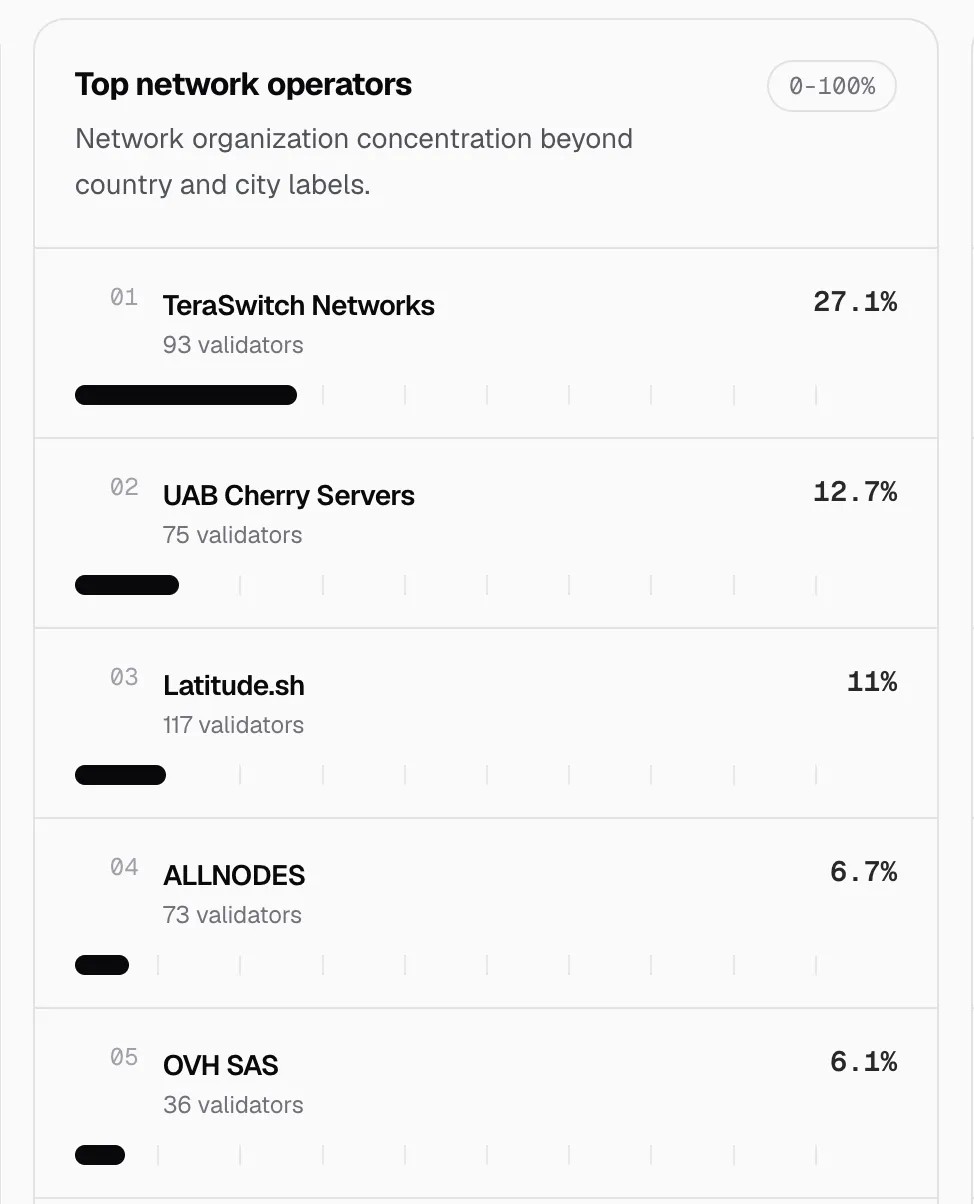
Source: Validators Solutions.

Some major operators already distribute their infrastructure across multiple providers. In its Q1 report, the Coinbase exchange stated that 13 of its validators operate via TeraSwitch, with another 10 via Latitude.

For each, the company also uses a backup server in a different location. The trading platform's team explained such a setup as necessary to limit the impact of a single provider's failure.

Recall that in November 2022, German hosting provider Hetzner turned off servers with Solana nodes. At that time, its infrastructure supported about 40% of validators with roughly 20% of the total staked coins. The network continued to operate.

In January 2026, the number of active Solana validators dropped to 800 — the lowest level since 2021. At the peak in 2023, there were over 2,500.

end-content

Trending Cryptos

Related Questions

QWhat happened to the Solana network on August 12th, and what was the critical threshold almost reached?

AOn August 12th, a routing failure at infrastructure provider TeraSwitch caused approximately 90 validators with 28.83% of staked $SOL to go offline simultaneously. This brought the network close to the 33.34% delinquency threshold, beyond which transaction finality would have stopped.

QWho reported the incident, and what financial impact did it have on the affected validators?

AThe incident was reported by the Marinade Finance team. The affected validators lost an estimated 333 $SOL in staking rewards during the approximately 33 minutes of downtime.

QWhat core issue within Solana's infrastructure did this incident highlight according to Marinade Finance?

AAccording to Marinade Finance, the incident highlighted the risk of infrastructure concentration. They plan to review limits on validator distribution across autonomous systems, data centers, and backup infrastructure.

QWhat was the market share of TeraSwitch in Solana staking before the incident, and who were the next largest providers?

AAs of July 22nd, TeraSwitch hosted validators with approximately 27.1% of staked Solana tokens. The next largest providers were UAB Cherry Servers (12.7%) and Latitude.sh (11%).

QHow does Coinbase mitigate the risk of a single infrastructure provider failure for its Solana validators?

ACoinbase mitigates this risk by distributing its validators across multiple providers (e.g., 13 via TeraSwitch and 10 via Latitude) and operating a backup server in a different location for each validator.

Related Reads

Explosion in Deep Sea Robots, the Hardest Series A Round Emerges

Deep-sea robotics startup Deepsea Zhiren has secured over 5 billion yuan in its Series A funding, a landmark deal backed by prominent investors including GGV Capital, Dachen Capital, Genesis Capital, Everbright Capital, China Life Insurance Investment, CETC Investment, and the energy tech fund managed by Cathay Capital with TotalEnergies as the cornerstone LP. Existing investors also participated significantly. The company, founded by industry veteran Ma Yiming, specializes in developing heavy-duty work-class ROVs for extreme deep-sea environments up to 6,000 meters, used in oil and gas, offshore wind, and subsea cable operations. Its product line includes models like "Taurus" (1,000m), "Phoenix 600" (3,000m), and "Singularity" (6,000m). A key achievement is securing multi-million dollar orders from UAE's telecom giant Etisalat, marking a breakthrough for Chinese-made deep-sea robotics in the international market. Deepsea Zhiren differentiates itself through full-stack in-house R&D—from pressure-resistant structures to control systems and AI—and a modular hardware approach. It has built a comprehensive internal standard system aligned with top global offshore specifications. The company is now advancing its "Deep Matrix" initiative, an unmanned, AI-powered, multi-robot cluster system designed for permanent seabed operations. This system aims to drastically reduce reliance on support vessels and human operators, potentially cutting costs in offshore oil field operations by billions over their lifecycle. The funding round signals strong market confidence in the deep-sea tech sector, recently highlighted in China's national policy. With the global subsea services market valued at around 1.5 trillion yuan and growing over 20% annually, Deepsea Zhiren aims to redefine deep-sea development through integrated hardware and embodied AI systems, positioning itself as a global pioneer in ocean robotics.

marsbit15m ago

Explosion in Deep Sea Robots, the Hardest Series A Round Emerges

marsbit15m ago

1confirmation: 5 Consumer Crypto Sectors Worth Revisiting

In the article "1confirmation: 5 Consumer Crypto Sectors Worth Revisiting," the author argues that the next breakthrough consumer crypto application may emerge from ideas that previously failed but are now ripe due to better infrastructure and timing. The five revisited sectors are: 1. **Internet-Native Assets**: Instead of tokenizing real-world assets (RWA), the bigger opportunity lies in creating unique crypto-native assets that don’t exist offline, moving beyond memecoins and NFTs to capture cultural moments or attention meaningfully. 2. **X-to-Earn**: Projects like STEPN and Axie Infinity introduced earning crypto without an initial purchase. The lesson is not that earning models are flawed, but that unsustainable token emissions failed. Future models need a compelling reason for users to earn and hold the assets. 3. **The Metaverse**: Past attempts focused on digitally replicating the real world (e.g., Decentraland). The core mistake was assuming virtual worlds must resemble physical ones. The real opportunity is reimagining next-generation online social experiences. 4. **DAOs**: While still existing, DAOs fell short of their potential by overemphasizing governance. The simpler, powerful use case demonstrated by ConstitutionDAO is collective funding for shared goals (e.g., buying artifacts, funding projects) by internet communities. 5. **People as Markets**: Past SocialFi/creator economy projects (Friend.tech, BitClout) tried to build markets around individuals but often made the person the product. The concept isn't wrong, but implementations failed. The challenge is creating markets around people without requiring them to be tradable assets. The conclusion emphasizes that successful consumer crypto apps will likely come from old ideas revisited, as timing and infrastructure finally align.

marsbit20m ago

1confirmation: 5 Consumer Crypto Sectors Worth Revisiting

marsbit20m ago

Popular Interactions Compilation | predict.fun Launches Dota 2 Special Event; Soar Early Whitelist Application (August 13th)

Here is a summary of key information from today's crypto and Web3 ecosystem: **predict.fun Launches Dota 2 Prediction Event** The BNB Chain-based prediction market platform predict.fun has launched a special event for The International Dota 2 Championship. Users can predict outcomes for matches starting from the group stages on August 13th. The total prize pool is $100,000 USD and 5 million platform points (PP). The event is split into two phases with separate rewards. To participate, users must lock a minimum of 20 shares on their chosen team before a match begins. **CheomaYield: Stablecoin Yield Protocol on GIWA Chain** CheomaYield is a new stablecoin yield protocol built on the GIWA Chain, an Ethereum L2 by Korean exchange Upbit. It has released its tokenomics for the fixed 1 billion CHEOMA token supply, with 30% allocated for airdrops. The protocol is currently on testnet. Users can interact by first claiming GIWA testnet tokens and then test USDC on the CheomaYield platform to earn points. **Soar: Pre-IPO Trading Platform Waitlist** Soar is a platform that allows users to gain exposure to pre-IPO companies like OpenAI and SpaceX by taking long or short positions on their valuations, without requiring accredited investor status. The platform has opened early access, and users can join a waitlist by registering their email on the official website.

Odaily星球日报20m ago

Popular Interactions Compilation | predict.fun Launches Dota 2 Special Event; Soar Early Whitelist Application (August 13th)

Odaily星球日报20m ago

Trading

Spot

Hot Articles

Discussions

Welcome to the HTX Community. Here, you can stay informed about the latest platform developments and gain access to professional market insights. Users' opinions on the price of SOL (SOL) are presented below.

活动图片