Sui Co-founder Develops Quantum-Resistant Hardware Wallets Priced at $10

cryptonews.ruPublished on 2026-08-12Last updated on 2026-08-12

Abstract

Kostas "Kryptos" Chalkias, co-founder and chief cryptographer at Mysten Labs behind the Sui blockchain, announced he is working on developing affordable, quantum-resistant hardware wallets for around $10. He revealed that over the past year, he rented a specialized facility to mass-produce these quantum-safe wallets. The goal is a keycard costing less than $10 and achieving quantum signature generation via NFC in 1-2 seconds, with Chalkias even considering sponsoring cards for users who cannot afford them. He directly referenced the recent Coldcard hardware wallet vulnerability as motivation for his project, emphasizing that such a failure would never happen with his solution. The Coldcard incident, involving a firmware flaw that compromised private key generation, led to estimated losses of around 2,055 BTC (~$130 million). While not a quantum attack, the Coldcard case highlighted the fundamental risk of cryptographic failures in hardware wallets, which Chalkias aims to preempt. His wallet project builds on Sui's broader quantum security roadmap. The Sui protocol plans to integrate two NIST-approved post-quantum signature schemes, one for everyday accounts and another for high-value Move-based vaults. Existing Sui accounts will be able to upgrade to a quantum-safe key derived from their current recovery phrase without requiring a full wallet migration, a flexibility Chalkias cites as a structural advantage over chains needing hard forks for similar upgrades.

Kostas “Kryptos” Chalkias, co-founder and chief cryptographer at Mysten Labs—the company behind the Sui blockchain—shared that he is working on creating affordable quantum two-factor authentication (2FA) cards for Sui, adding:

“Last year, with the help of a few friends, I rented a specialized factory at a secret location to mass-produce quantum-safe wallets.”

He set a target: the cost per key for the quantum card should be under $10, with a quantum signature formation time via NFC of 1–2 seconds. Chalkias noted that he is working on this project in his spare time and that he might even get to the point of sponsoring cards for users who cannot afford them.

Furthermore, he directly referenced the recent Coldcard hardware wallet catastrophe as an additional motivator for his current mission, writing:

“What happened to Coldcard will NEVER happen to my people.”

Coinkite, the maker of the popular Coldcard hardware wallet, reported in late July that a firmware vulnerability introduced after a 2021 update allowed bypassing the dedicated hardware random number generator chip when creating keys, replacing it with a predictable software process, in some cases tied to values such as device serial numbers.

Bad actors began draining funds on July 30, with losses growing in waves: approximately 594 $BTC in the first wave, around 1,082 $BTC by August 1, and an estimated 2,055 $BTC worth roughly $130 million from over 7,700 addresses as the vulnerability spread. Alex Thorn, head of research at Galaxy Research, stated that at least 15 distinct bad actors were working with the remaining vulnerable wallets.

And while the Coldcard vulnerability was not a quantum attack, it demonstrated the same fundamental risk that Chalkias is trying to get ahead of: hardware wallets that fail silently at a cryptographic level become potential attack vectors until funds start moving.

Sui's Broader Quantum Security Roadmap

The $10 wallet project builds upon work already underway at the protocol level. Sui stated that it plans to add two National Institute of Standards and Technology (NIST)-approved post-quantum signature schemes: one for everyday accounts and a second for high-value, Move-based vaults.

Existing Sui accounts will be able to transition to a quantum-safe key derived from their existing recovery phrase, rather than requiring a full migration to a new wallet. Chalkias emphasized Sui's ability to adopt new authentication methods, including post-quantum cryptography, as a structural advantage over chains that would require a more radical hard fork to implement similar changes.

end-content

Trending Cryptos

Related Questions

QWho is developing affordable quantum-resistant 2FA cards for Sui, and what is his main role?

AKostas "Kryptos" Chalkias, the co-founder and chief cryptographer of Mysten Labs, the company behind the Sui blockchain, is developing them.

QWhat is Kostas Chalkias's target cost and signature time for the quantum-resistant wallet cards?

AHis target is for a quantum card key to cost less than $10 and for the quantum signature time via NFC to be 1-2 seconds.

QWhat recent event involving the Coldcard hardware wallet did Chalkias reference as motivation for his project?

AHe referenced the recent Coldcard firmware vulnerability that allowed attackers to bypass the hardware random number generator, leading to the theft of an estimated 2,055 BTC (~$130M) from vulnerable wallets.

QWhat core vulnerability risk, common to both the Coldcard incident and future threats, is Chalkias's project trying to address?

AThe project aims to address the risk of hardware wallets failing silently at the cryptographic level, which creates potential attack vectors until funds begin to move.

QHow does Sui plan to achieve broader quantum resistance at the protocol level, and what is the stated advantage for its users?

ASui plans to add two NIST-approved quantum-resistant signature schemes for everyday accounts and high-value vaults. Existing users can upgrade to a quantum-safe key derived from their existing recovery phrase, avoiding a full wallet migration. Chalkias highlights this as a structural advantage over chains that would require a hard fork for similar changes.

Related Reads

Bitcoin Price Drops to $62,470 as Sellers Retest $63,000 Support Level

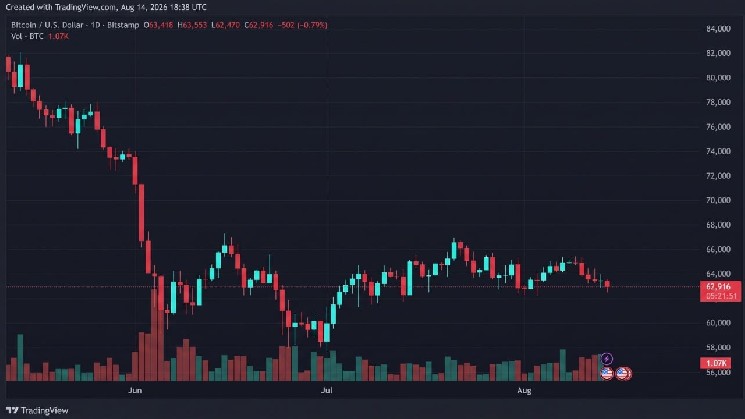
Bitcoin's price fell below $63,000 for a second consecutive day on Friday, hitting an intraday low of $62,470. The cryptocurrency later recovered to trade just above $63,000, leaving it nearly flat for the past 24 hours and for August overall, with a weekly loss of 2.6%. The volatility triggered significant liquidations, with $26 million of leveraged long Bitcoin positions liquidated over 24 hours. Market sentiment was further dampened by data showing over $131 million in outflows from spot Bitcoin ETFs for a second straight day, signaling a potential pullback by institutional investors. Adding to the negative pressure, index provider MSCI has proposed new criteria for "non-operating companies" in its global indexes, which could lead to the exclusion of firms holding significant digital assets like Bitcoin on their balance sheets. Companies such as Strategy and Metaplanet could be affected, potentially forcing index-tracking funds to sell their shares. Strategy publicly criticized the proposal, arguing digital assets are legitimate assets and index providers should not dictate what companies can own. Public consultations on MSCI's proposal end September 30, with a final decision expected by October 16. If approved, exclusions could begin in November, potentially triggering sustained institutional selling and damaging a key bridge for Bitcoin adoption in the corporate sector.

cryptonews.ru4h ago

Bitcoin Price Drops to $62,470 as Sellers Retest $63,000 Support Level

cryptonews.ru4h ago

Trading

Spot

Hot Articles

How to Buy SUI

Welcome to HTX.com! We've made purchasing SUI Network (SUI) simple and convenient. Follow our step-by-step guide to embark on your crypto journey.Step 1: Create Your HTX AccountUse your email or phone number to sign up for a free account on HTX. Experience a hassle-free registration journey and unlock all features.Get My AccountStep 2: Go to Buy Crypto and Choose Your Payment MethodCredit/Debit Card: Use your Visa or Mastercard to buy SUI Network (SUI) instantly.Balance: Use funds from your HTX account balance to trade seamlessly.Third Parties: We've added popular payment methods such as Google Pay and Apple Pay to enhance convenience.P2P: Trade directly with other users on HTX.Over-the-Counter (OTC): We offer tailor-made services and competitive exchange rates for traders.Step 3: Store Your SUI Network (SUI)After purchasing your SUI Network (SUI), store it in your HTX account. Alternatively, you can send it elsewhere via blockchain transfer or use it to trade other cryptocurrencies.Step 4: Trade SUI Network (SUI)Easily trade SUI Network (SUI) on HTX's spot market. Simply access your account, select your trading pair, execute your trades, and monitor in real-time. We offer a user-friendly experience for both beginners and seasoned traders.

10.0k Total ViewsPublished 2024.03.29Updated 2026.06.02

How to Buy SUI

Discussions

Welcome to the HTX Community. Here, you can stay informed about the latest platform developments and gain access to professional market insights. Users' opinions on the price of SUI (SUI) are presented below.

活动图片