NFT Sales Tumble 29% This Week, Searches for Metaverse-Related Terms Plunge

newsbtcPublished on 2022-03-06Last updated on 2022-03-21

Abstract

The past week’s non-fungible token (NFT) sales have dropped again, following the last few weeks of diminishing volumes.

The past week’s non-fungible token (NFT) sales have dropped again, following the last few weeks of diminishing volumes. Across 14 blockchains that support NFTs, sales have slipped 29.46% lower than the week prior. Despite the drop in NFT sales volume, NFT sales stemming from the Arbitrum network spiked by 97.53% this week.

NFT Interest and Sales Nosedive

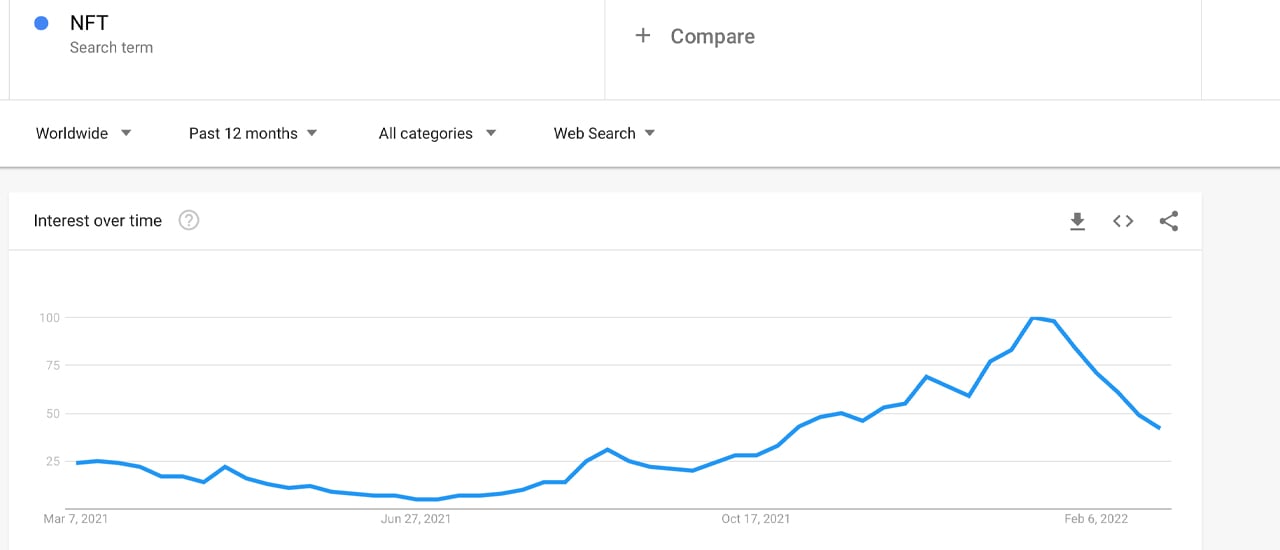
According to Google Trends (GT) data, interest in NFTs has dive-bombed, as the search query for the term “NFT” slid from a score of 100 on GT during the first month of 2022, to this week’s score of 42.

Statistics for the search query term “metaverse” show interest there has also slid significantly, sliding from January’s high score of 88 to today’s GT score of 32. While NFT interest is sliding, sales volume has dipped a great deal as well.
NFT Sales Tumble 29% This Week, Searches for Metaverse-Related Terms Plunge

“Interest over time” stats from Google Trends (GT) data show searches for the terms “NFT” and “metaverse” have dropped considerably.

Over the last seven days, NFT sales have dropped 29.46% lower than last week’s sales volume. Metrics from cryptoslam.io’s seven-day records show that the largest blockchain in terms of NFT sales, Ethereum, is down 32.13%.

Wax blockchain sales have dropped by 38.52% this past week, but Palm and Theta NFT sales lost the most. Palm-based NFT sales are down 73.36% since last week and Theta’s NFT sales are down 78.87%.

Bitcoin.com News reported on the Arbitrum NFT project Treasure DAO getting hacked and losing more than 100 NFTs. Despite the hack, Arbitrum NFT sales have jumped a great deal this week spiking 97.53% since the week prior.

The NFT collection that recorded the most NFT sales during the last seven days is Invisible Friends as the ETH-based NFTs have seen $46.9 million in sales, up 32.13% since the week prior. The Invisible Friends NFT compilation sales were followed by Wonderpals, Cryptopunks, Clonex, and Bored Ape Yacht Club (BAYC).

This week’s most expensive NFT sale was Meebit #1657 for 282 wrapped ether (WETH) or $844,069, followed by Ringers #376 for $800,941 in WETH. Those two pricey NFT sales were followed by Meebit #8475 ($753K), Meebit #18277 ($738K), Meebit #19564 ($723K), and Bored Ape #8386 for $600,609, or 200 wrapped ethereum.

Additionally, the “Topps Timeless Series” 1952 Mickey Mantle NFT card sold for 175 ether or $471K at the time of settlement on Opensea. The leading NFT marketplace Opensea posted the week’s top sales in terms of NFT sales volume, but sales are down 29.97% according to current dappradar.com stats. Opensea saw 220,223 NFT traders this week, but the number of traders is down 12.96% since the week before.


Related Reads

Uncovering the Truth About Agent Commerce, Payments, and Infrastructure

Decoding Agent Commerce, Payments, and Infrastructure: The Reality Over the past year, I've been building infrastructure for the Agent economy, engaging with major players like Stripe, Visa, Coinbase, Google, and dozens of startups. A clear conclusion emerges: true, large-scale demand does not yet exist. Startups face structural challenges. Data points illustrate this gap. Stripe's Agent commerce platform has over 1,000 merchants but only single-digit transacting agents. Visa's Agent payment token requires 9-month KYC and a $250M revenue threshold, accessible only to giants like Amazon. On-chain analysis reveals actual daily Agent transaction volume is around $17k, half of which are test transactions. The article analyzes four potential markets: **1. Agent-to-Merchant (A2M):** Current AI shopping UX is often inferior to traditional e-commerce for visual, comparison-heavy purchases (clothing, electronics). Chat interfaces are a step back. Real merchant interest is defensive "Agent Engine Optimization," fearing future obsolescence, not current demand. Potential exists in high-frequency, low-decision purchases (e.g., food delivery) or simplifying terrible UX (complex checkouts, non-native shoppers), but these require massive consumer distribution channels dominated by giants like DoorDash and Amazon. **2. Agent-to-API (A2A):** Developers already have subscriptions and billing for core APIs (compute, data). The argument for micro-payments via crypto for sub-dollar API calls is addressed by pre-paid balances today. The deeper issue is supplier resistance; major SaaS firms rely on enterprise contracts, not fractional cent pricing. Opportunity lies in the long tail of niche services, but this is a smaller market catering to developers, a historically low-paying group. **3. Agent-to-Agent (A2A):** This remains a theoretical long-term vision with near-zero current transaction volume. It involves unique challenges: discovery, trust, negotiation, dispute resolution. When it materializes, it will require a fundamentally new settlement infrastructure for high-speed, variable-value, multi-party transactions. It's a real long-term bet, but not the current market. **4. Agent-to-Finance (A2F):** This is the only category with existing, paying demand. Integrating AI into financial workflows (trading, portfolio management) is a natural evolution and enables new capabilities like autonomous rebalancing. However, competition favors incumbents with regulatory licenses, compliance infrastructure, and existing client relationships. **The Real Issue:** Why is infrastructure still being built? Incumbents can afford long-term bets, and payment companies see every problem as a nail for their payment hammer. However, payment is just one piece. The core challenge is *coordination*—orchestrating work between Agents and humans, verifying outcomes, and settling results. Payment is part of settlement, which is part of coordination. Companies that solve the coordination problem will subsume payments, not the other way around. Startups lack the infinite runway of giants and must find today's real market, which, after a year of exploration, lies outside these four categories—in an area with real, growing, and underserved activity.

marsbit2h ago

Uncovering the Truth About Agent Commerce, Payments, and Infrastructure

marsbit2h ago

Trading

Spot
Futures

Hot Articles

Discussions

Welcome to the HTX Community. Here, you can stay informed about the latest platform developments and gain access to professional market insights. Users' opinions on the price of ETH (ETH) are presented below.

活动图片