Un plan de acaparamiento de CRO de 6.400 millones de dólares de Trump Media Group fracasa

marsbitPublished on 2026-08-10Last updated on 2026-08-10

Abstract

Hace un año, Trump Media & Technology Group (DJT) y el intercambio de criptomonedas Crypto.com anunciaron una ambiciosa colaboración para crear una empresa pública que acumularía miles de millones de dólares en tokens CRO. Sin embargo, este plan de 6.400 millones de dólares se ha cancelado oficialmente, junto con otros proyectos relacionados como un mercado de predicciones y servicios de custodia para ETF. El núcleo del acuerdo era la creación de "Trump Media Group CRO Strategy", que pretendía adquirir unos 63.130 millones de CRO. Aunque se firmó un acuerdo marco en agosto de 2025, la empresa nunca se materializó, ya que requería la aprobación de la SEC. La única transacción que se completó fue la compra de CRO por valor de 105 millones de dólares por parte de DJT y la adquisición de acciones de DJT por 50 millones por parte de Crypto.com. La colaboración se basó en una creciente alineación política, ya que Crypto.com hizo importantes donaciones a causas afines a Trump antes de que la SEC cerrara una investigación sobre la empresa. Sin embargo, la caída del mercado ha hecho inviable el proyecto. El precio de CRO ha bajado un 70% en un año, y Bitcoin ha perdido casi la mitad de su valor desde sus máximos, enfriando el interés por las empresas que acumulan criptomonedas. Ante este fracaso, Trump Media está virando su estrategia hacia la energía limpia. En diciembre de 2025 anunció una fusión con la empresa de fusión nuclear TAE Technologies, con una valoración superior a los...

Autor original: angelilu, Foresight News

Hace un año, Trump Media & Technology Group (DJT) y el exchange de criptomonedas Crypto.com se asociaron con gran fanfarria, anunciando planes para crear una empresa cotizada cuyo tesoro acumularía miles de millones de dólares en CRO. En ese momento, esta empresa con fuertes vínculos políticos y un exchange líder del sector escenificaron un espectáculo con gran pompa. Un año después, este juego de capital ha llegado a un final silencioso.

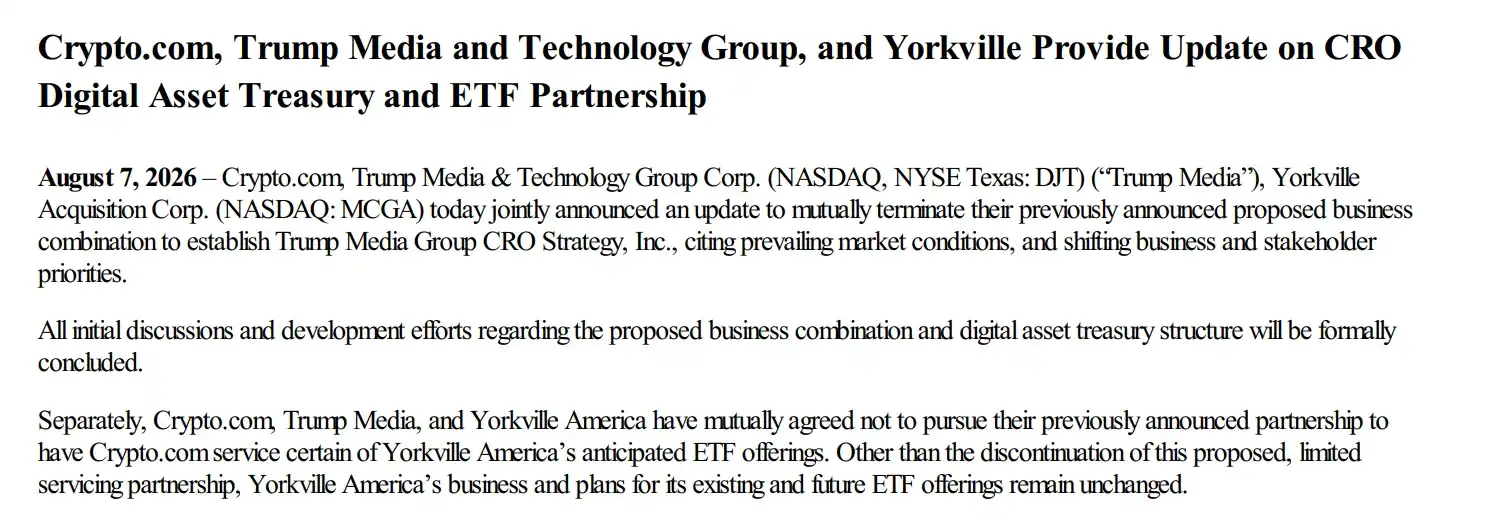
El 7 de agosto, DJT, Crypto.com y la empresa SPAC Yorkville anunciaron oficialmente la terminación de este plan, suspendiendo también los esquemas de cooperación previamente anunciados para mercados de predicción y custodia de ETF. Con el Bitcoin casi a la mitad de su máximo histórico y las empresas cotizadas del tipo "acumuladoras de monedas" en retirada colectiva, esta colaboración que comenzó con aproximaciones políticas finalmente no logró llegar a la etapa de implementación.
¿En qué punto se encontraba la colaboración cuando se detuvo?

La parte más sustancial de esta colaboración era la creación de otra empresa cotizada para acumular CRO. En agosto de 2025, las tres partes anunciaron con gran alharaca: Trump Media utilizaría la empresa SPAC Yorkville para establecer una compañía llamada Trump Media Group CRO Strategy, que pretendía ser la "primera y más grande empresa cotizada cuyo tesoro sea CRO", con planes de acumular aproximadamente 6.313 millones de CRO, cerca de una quinta parte de la oferta circulante de CRO en ese momento. El tamaño total de la empresa era de unos 6.420 millones de dólares, formado por 1.000 millones de dólares en CRO, 200 millones en efectivo, 220 millones en warrants y 5.000 millones en una línea de crédito accionarial.

Pero el ruido mediático era una cosa, y la realidad otra. Este plan de tesoro en realidad nunca llegó a materializarse. Lo anunciado en agosto de 2025 era solo un acuerdo marco; la cotización mediante SPAC aún requería pasar por todo el proceso de presentación y aprobación de la SEC, que de por sí tomaría la mayor parte de un año. Permaneció en estado de "pendiente de completar" hasta que fue directamente cancelado un año después, sin llegar a establecerse nunca.

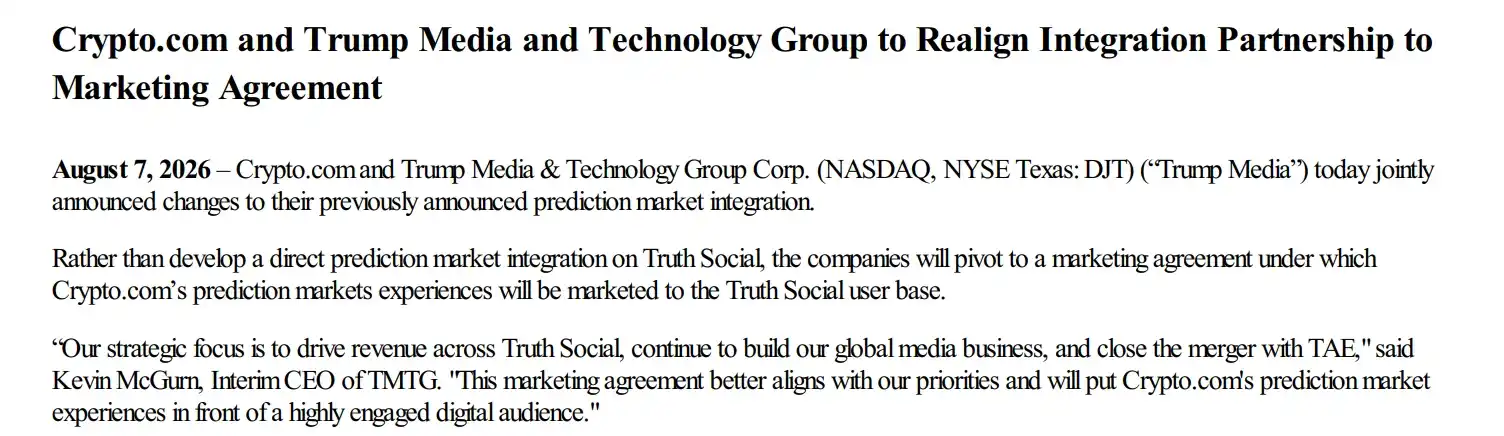
Junto con esto, también fracasaron dos elementos complementarios. El producto de mercado de predicciones Truth Predict, que originalmente se integraría en Truth Social para permitir a los usuarios apostar sobre política, economía o eventos deportivos, ahora se ha reducido a un acuerdo de marketing, donde Crypto.com simplemente promocionará su propio mercado de predicciones entre los usuarios de Truth Social. El acuerdo para que Crypto.com proporcionara custodia para los ETF de Trump Media también se ha abandonado.
Lo único que realmente se implementó y sigue vigente es otro acuerdo independiente. En agosto de 2025, Trump Media ya había comprado CRO por unos 105 millones de dólares para incluirlos en su balance, mientras que Crypto.com, a su vez, compró acciones de DJT por 50 millones de dólares. Esta transacción, con intercambio de bienes y dinero, no se vio afectada por esta terminación, convirtiéndose en el único vínculo que no se soltó en esta retirada.

Primero la aproximación política, luego la transacción comercial

Para entender por qué Crypto.com fue la elegida para este juego, hay que mirar atrás: fue el acercamiento político lo que allanó el camino comercial.

Alrededor de las elecciones estadounidenses de 2024, Crypto.com estuvo tendiendo puentes hacia el campo de Trump: donó 1 millón de dólares para la ceremonia de investidura, aportó 10 millones al comité de acción política pro-Trump MAGA Inc.; y el CEO Kris Marszalek incluso fue personalmente a Mar-a-Lago para hablar con Trump sobre políticas de criptomonedas. En marzo de 2025, la Comisión de Bolsa y Valores de EE.UU. (SEC) cerró su investigación sobre Crypto.com, poco después de que la agencia hubiera emitido una advertencia sobre posibles acciones coercitivas.

Con el terreno allanado, la colaboración comercial de agosto de 2025 fluyó naturalmente. Trump Media quería una historia relacionada con criptomonedas, una reserva de tokens para su balance y un custodio para ETF; Crypto.com quería el respaldo del nombre de Trump para su token nativo, CRO.

Precisamente por eso, este trato llevaba un aroma a conflicto de intereses desde el primer día: el propio gobierno de Trump tenía en sus manos el poder regulatorio sobre la industria cripto, mientras que una empresa asociada a su familia se vinculaba profundamente con un exchange que acababa de hacer donaciones y había sido exonerado por la SEC. La senadora Elizabeth Warren y otros solicitaron públicamente investigar si las decisiones de la SEC estaban influenciadas por factores políticos.

¿Por qué se retiraron? Ni el precio de la moneda ni el mercado dieron oportunidad

La declaración oficial fue bastante franca. El CEO de Crypto.com, Kris Marszalek, dijo en un comunicado: "Después de examinar estos ETF y DAT propuestos desde todos los ángulos, llegamos a la misma conclusión: proceder en el entorno de mercado actual no es razonable". También afirmó que la compañía redirigirá el CRO originalmente comprometido para el tesoro hacia otros usos, destinándolo a impulsar ingresos, demanda y valor ecológico. Según informes de The Block, personas cercanas a la transacción revelaron que este giro se debió más a cambios en el panorama competitivo que a los temores sobre la "incómoda situación de que una empresa vinculada a Trump sea regulada por el gobierno de Trump".

Pero el mercado ya había escrito la respuesta en el precio. Al momento de redactar este artículo, el CRO cotiza alrededor de 0.0616 dólares, una caída de aproximadamente el 70% en un año, en un descenso constante desde el anuncio de la colaboración el año pasado.
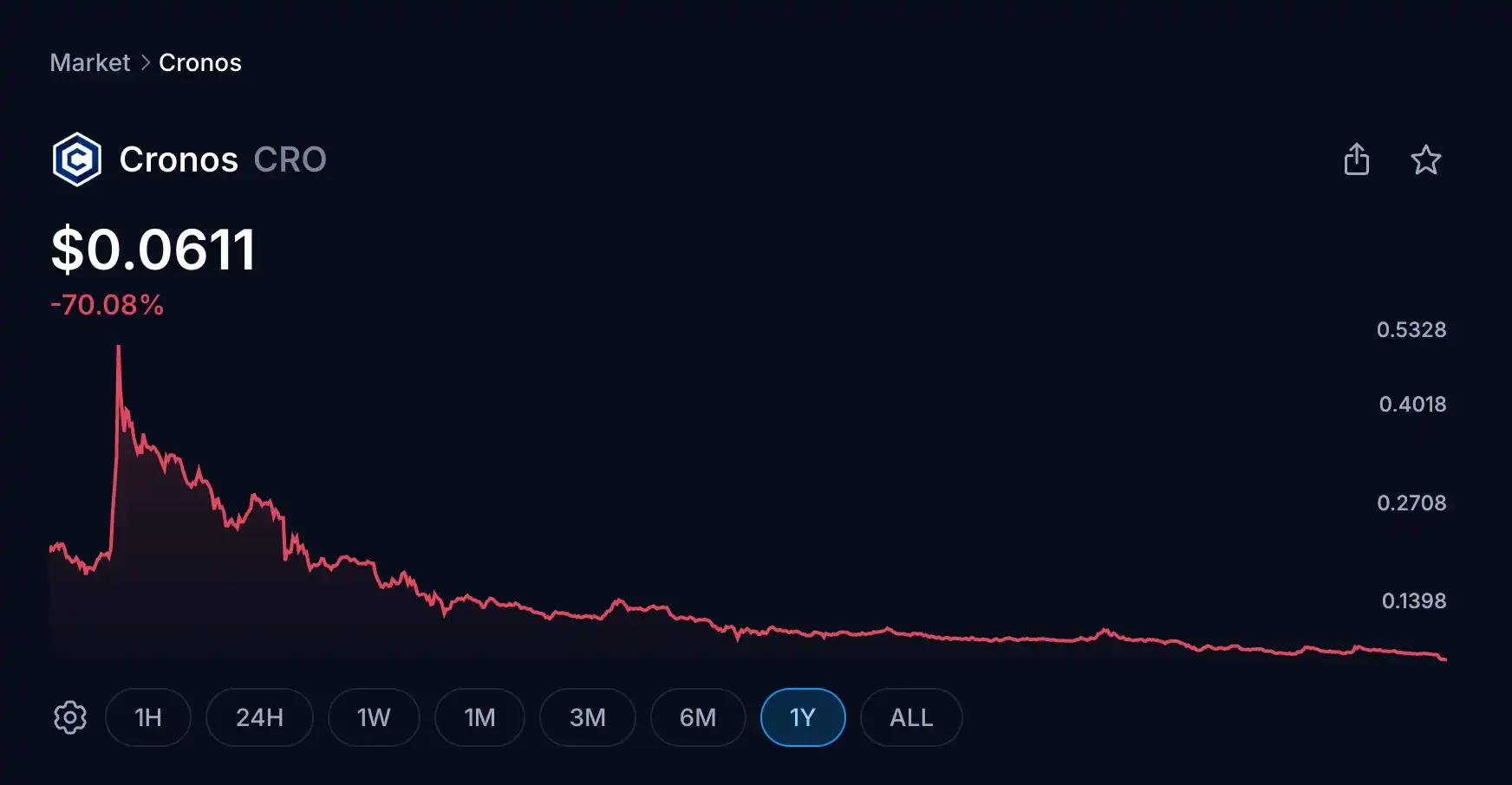
En una perspectiva más amplia, el Bitcoin ha caído desde un máximo de unos 126,000 dólares en octubre de 2025 hasta los actuales 65,000 dólares aproximadamente, casi reducido a la mitad. El fervor por las empresas cotizadas del tipo "acumuladoras de monedas" se está desvaneciendo en general; datos de principios de enero de 2026 muestran que al menos 37 de las 100 mayores DAT globales cotizan por debajo de su valor neto de activos (NAV) en monedas. Incluso el referente del sector, Strategy (anteriormente MicroStrategy), cotiza con descuento y ha comenzado a vender Bitcoin para pagar dividendos de acciones preferentes.

Cuando baja la marea, ¿quién quiere construir otro tesoro de miles de millones de dólares en CRO?

El próximo destino de Trump Media: virar hacia la fusión nuclear

Con la historia cripto apagada, Trump Media ya ha girado hacia una dirección que no tiene nada que ver con las criptomonedas. En diciembre de 2025, la compañía anunció una fusión total por acciones con la empresa de fusión nuclear TAE Technologies, con una valoración superior a 6.000 millones de dólares. Tras la transacción, los accionistas de ambas partes poseerían aproximadamente la mitad de las acciones cada uno, esperándose el cierre a mediados de 2026. Esta empresa de fusión nuclear, fundada en 1998, llegará al mercado de capitales a través de Trump Media, y el enfoque de la entidad fusionada claramente se desplaza desde las redes sociales y las criptomonedas hacia la energía limpia.

En otras palabras, la terminación del tesoro de CRO no es una retirada aislada, sino una parte de un redireccionamiento general de Trump Media: está ocupada reempaquetándose de "jugador cripto asociado a Trump" a una empresa que apuesta por la energía de vanguardia.


Trending Cryptos

Related Questions

Q¿Cuál fue el propósito principal del plan de cooperación anunciado entre Trump Media Tech Group y Crypto.com en agosto de 2025?

AEl propósito principal era crear la primera y más grande compañía pública de tesorería de CRO, llamada 'Trump Media Group CRO Strategy', que planeaba acumular aproximadamente 63.13 mil millones de tokens CRO, representando casi una quinta parte de la oferta circulante en ese momento, con una valoración total de alrededor de 64.2 mil millones de dólares.

Q¿Qué elementos de la cooperación entre DJT y Crypto.com finalmente se implementaron y siguen vigentes?

AEl único elemento que se implementó y sigue vigente es una transacción separada anunciada en agosto de 2025. En esta, Trump Media compró tokens CRO por aproximadamente 105 millones de dólares para incluirlos en su balance general, y Crypto.com compró acciones de DJT por valor de 50 millones de dólares.

QSegún el artículo, ¿cuáles fueron algunas de las acciones tomadas por Crypto.com para acercarse políticamente al entorno de Donald Trump antes de la cooperación comercial?

ACrypto.com donó 1 millón de dólares a la ceremonia de investidura presidencial, contribuyó con 10 millones de dólares al comité de acción política pro-Trump MAGA Inc., y su CEO, Kris Marszalek, se reunió en persona con Donald Trump en Mar-a-Lago para discutir políticas de criptomonedas.

Q¿Cuál es una de las razones clave, según el artículo, para la cancelación del plan de crear la compañía de tesorería de CRO?

AUna razón clave es el deterioro del entorno del mercado. El precio de CRO cayó aproximadamente un 70% en un año, y el precio de Bitcoin se redujo casi a la mitad desde su máximo. Este enfriamiento general del mercado hizo que avanzar con un plan de tesorería tan grande fuera poco atractivo.

Q¿Hacia qué nuevo sector está redirigiendo ahora Trump Media Tech Group su enfoque estratégico después de alejarse del negocio de las criptomonedas?

ATrump Media está redirigiendo su enfoque hacia el sector de la energía limpia, específicamente la fusión nuclear. En diciembre de 2025 anunció una fusión por acciones con la empresa de fusión TAE Technologies, con una valoración de más de 60 mil millones de dólares, buscando transformarse de una empresa asociada a las criptomonedas a una centrada en energía avanzada.

Related Reads

Treasury Secretary's Move to Suppress Treasury Yields Ignites 'Currency Debasement Trade'! Gold Hits Three-Month High, Bitcoin Surges Over 25% in a Single Week

US Treasury Secretary Besant's efforts to lower long-term Treasury yields by announcing expanded buybacks had only a brief market impact. However, this move fueled a "currency devaluation trade," weakening the US dollar while boosting both gold (to a three-month high) and Bitcoin (up over 25% for the week). Analysts attribute this reaction to deepening market concerns over the massive US fiscal deficit and structural pressures keeping long-term rates elevated, including fierce competition for capital from global government borrowing and massive AI sector financing. Despite the Treasury's actions, fundamental forces like growth, inflation, and capital demand are seen as limiting its ability to sustainably suppress yields. Bitcoin's strong positive correlation with gold has reinforced its narrative as a hedge against devaluation. While equity markets have shown resilience, some strategists warn that Treasury yields nearing 5% increase pressure on the dollar and high-leverage assets. Figures like Ray Dalio have advised reducing bond exposure in favor of gold and some Bitcoin, citing US debt risks. Market opinions are divided on the sustainability of the devaluation trade, with some noting the lack of a near-term catalyst for its next leg higher. The underlying tension between the Treasury's desire for lower borrowing costs and the Federal Reserve's focus on inflation and reducing market intervention remains a key theme. Upcoming events like Nvidia's earnings and the Jackson Hole symposium will test whether AI profits can continue supporting stocks and if the Fed aligns more with Washington's preference for easier financial conditions.

华尔街日报1h ago

Treasury Secretary's Move to Suppress Treasury Yields Ignites 'Currency Debasement Trade'! Gold Hits Three-Month High, Bitcoin Surges Over 25% in a Single Week

华尔街日报1h ago

Alexander Shokhin: Business Needs an Interest Rate Below 10% and the Dollar at 90-95 Rubles

Alexander Shokhin, head of the Russian Union of Industrialists and Entrepreneurs (RSPP), has advocated for potentially using "non-market" tools to keep the ruble within a target exchange rate corridor. This, he argues on August 21, would help avoid excessive volatility, though he called the topic a separate discussion. Shokhin had previously raised the idea of a currency corridor in late May, noting the ruble's current exchange rate is not fully market-driven due to a limited currency segment and reduced foreign currency demand. He stated that many business community colleagues propose fixing a corridor, even through non-market methods, to ensure predictability. The business community's key targets, as outlined by Shokhin in late December 2025, are a Central Bank key rate of 12%, inflation of 4–5%, and a US dollar exchange rate of 90–95 rubles by the end of 2026. A turning point for investment, he said, would be lowering the rate to 12% with 6% inflation, though truly comfortable business conditions would require a rate below 10%. He stressed the critical importance of currency predictability for corporate investment decisions. From a data analysis perspective, the idea of a ruble corridor is not new. A similar mechanism was used in Russia from 1995 to 1998, where the central bank held the dollar within fixed boundaries through regular interventions. This regime lasted three years before ending abruptly during the 1998 default, illustrating the fragility of rigid targets under external shocks. The macro-economic link is clear: stricter corridors require more reserves to defend against currency pressure. The key unresolved technical aspect is the specific sources and volume of such interventions given the current market's limited liquidity. Whether this discussion remains theoretical or leads to concrete corridor parameters will be seen in the coming months.

cryptonews.ru3h ago

Alexander Shokhin: Business Needs an Interest Rate Below 10% and the Dollar at 90-95 Rubles

cryptonews.ru3h ago

Trading

Spot

Hot Articles

What is G$

Understanding GoodDollar ($G$): A Blueprint for Decentralised Universal Basic Income Introduction In the ever-evolving landscape of cryptocurrency and blockchain technology, initiatives that seek to address pressing social issues have garnered increased attention. One such project is GoodDollar ($G$), a Web3-based universal basic income (UBI) solution. GoodDollar endeavours to tackle inequality and bridge the wealth gap by creating and distributing accessible economic resources to those most in need. Through its innovative use of decentralised finance (DeFi), GoodDollar presents a unique model that could potentially reshape the way financial assistance is perceived and delivered globally. What is GoodDollar ($G$)? GoodDollar is a cryptocurrency protocol that facilitates the issuance and distribution of digital tokens, referred to as $G$, to its registered users on a daily basis. These tokens function as a form of universal basic income, promoting financial empowerment for individuals from various backgrounds, especially those traditionally excluded from the financial system. Operating on the blockchain, GoodDollar utilises multiple chains, including Ethereum, Celo, and Fuse, ensuring broad access and usability. The fundamental goal of GoodDollar is to make cryptocurrency accessible and beneficial to everyone, irrespective of their economic starting point. The Creator of GoodDollar ($G$) Details concerning the creator of GoodDollar remain somewhat obscure. However, it is notably highlighted that the project has strong backing from eToro, a widely recognised investment platform that provided the initial funding and foundational support for GoodDollar's development. The vision behind the project is not solely profit-driven but leans heavily towards social entrepreneurship, aiming for a systemic change in economic accessibility. Investors of GoodDollar ($G$) GoodDollar enjoys the financial backing and operational support of eToro. This partnership has played a significant role in launching the protocol and its subsequent developments. While eToro was instrumental in establishing the foundation of the project, GoodDollar envisions transitioning towards a model funded by its community in the long run. This shift to community funding is in line with GoodDollar's commitment to decentralisation, allowing its users to have a direct stake in the project's future. How Does GoodDollar ($G$) Work? GoodDollar's operational framework relies heavily on DeFi principles to generate interest from staked cryptocurrencies. This mechanism allows the project to mint and distribute $G$ tokens as a digital basic income for users worldwide. Several key features contribute to GoodDollar's uniqueness and innovation: Universal Basic Income (UBI): Every day, registered users receive free tokens, establishing an automatic income stream intended to alleviate financial pressures. Sustainable Economic Model: The project’s tokenomics aim to balance supply and demand for $G$ tokens, ensuring that the value remains stable over time. Reserve-Backed Tokens: Each $G$ token is backed by a reserve of cryptocurrencies, providing it with inherent value and reliability, a crucial aspect for maintaining user trust. Decentralised Governance: GoodDollar incorporates a democratic approach to decision-making through token-powered decentralised governance. This allows community members to actively participate in the shaping of the project's trajectory, making it truly community-driven. Global Accessibility: GoodDollar has established a considerable community footprint, boasting over 640,000 members spanning 181 countries. Such widespread reach is instrumental in facilitating UBI on a global scale. Timeline of GoodDollar ($G$) The evolution of GoodDollar is marked by several significant milestones throughout its history: 2019: The launch of the GoodDollar wallet marked the first step in operationalising its vision of delivering UBI through cryptocurrency. 2020: Following the successful wallet rollout, the GoodDollar protocol officially debuted. This marked a crucial phase in its mission to provide daily distributed income. 2021: The project advanced further with the introduction of its Decentralised Autonomous Organization (DAO), fostering a greater level of community involvement and governance. 2022: GoodDollar unveiled its DeFi-friendly version 2 (V2), striving for enhanced user engagement and operational efficiency. The same year also saw the transition to a decentralised governance structure via GoodDAO. 2022: A new roadmap was conceptualised, focusing on initiatives like a grant program designed to promote $G$-related entrepreneurial ventures and an upgraded GoodDollar Marketplace. Key Features of GoodDollar ($G$) The GoodDollar project introduces numerous critical features aimed at redefining the landscape of basic income: Universal Basic Income: Delivering daily free tokens to its users fundamentally underscores its mission to eliminate economic precarity. Multi-Chain Operation: Leveraging multiple blockchain networks enhances accessibility and scalability, ensuring broader participation. Engagement with Decentralised Finance: The use of DeFi allows for sustainable funding of the UBI model, reinforcing its viability as an economic solution. Community Engagement and Governance: GoodDollar envisions a model where the community influences operations through democratic participation, fostering transparency and accountability. Global Community: Boasting a diverse global community enables the project to implement UBI solutions tailored to various cultural and economic contexts. Conclusion GoodDollar represents a transformative leap towards incorporating the principles of universal basic income through the innovative lens of blockchain technology. By harnessing decentralised finance, the project not only provides a solution to financial inequality but also actively engages users in its governance and operations. With a growing community and evolving roadmap, GoodDollar stands as a significant player in the intersection of cryptocurrency and social good, paving the way for a more equitable financial future. As it continues to evolve, GoodDollar’s journey may ultimately inspire other initiatives to consider similar models, furthering the cause of economic empowerment for all.

338 Total ViewsPublished 2024.04.05Updated 2024.12.03

What is G$

What is @G

Graphite Network, $@G: Bridging TradFi and Web3 Introduction to Graphite Network, $@G In the vibrant world of cryptocurrencies and web3 projects, Graphite Network emerges as a beacon of innovation. With its native token, $@G, this Layer-1, Proof-of-Authority (PoA) blockchain is tailored to bridge the gap between traditional finance (TradFi) and the rapidly evolving Web3 ecosystem. As digital currencies gain traction, Graphite Network strives to offer a blockchain platform that prioritises security, compliance, and speed, presenting itself as a facilitator of trust and accountability. What is Graphite Network, $@G? Graphite Network is not merely another blockchain project; it aims to redefine how decentralisation, security, and user accountability are perceived in the digital finance realm. The project boasts a series of distinctive features: Reputation-Based Blockchain: At its core, Graphite Network implements a one-user, one-account policy, fortified with integrated Know Your Customer (KYC) verification and scoring mechanisms. This design ensures a balance between user privacy and transparency—a critical aspect of financial operations in today’s digital world. Entry-Point Node Income: The network incentivises users to set up entry-point nodes, allowing operators to earn rewards from network transactions. This income generation model not only boosts user engagement but also reinforces network health and decentralisation. EVM Compatibility: With an Ethereum-compatible virtual machine (VM), Graphite Network enables seamless integration of existing Solidity decentralised applications (dApps) and smart contracts, thereby inviting developers to leverage its capabilities without extensive modifications. KYC Integration: In an era where compliance is paramount, the integrated KYC framework with multiple verification tiers enhances control over financial operations without mandatory participation, setting a precedent for user autonomy. Who is the Creator of Graphite Network, $@G? The Graphite Network is borne out of the endeavours of the Graphite Foundation, a non-profit organisation dedicated to the development, maintenance, and evolution of the Graphite Network. The foundation’s commitment underscores the project’s vision to create a secure and sustainable blockchain environment focused on genuine user engagement and compliance. Who are the Investors of Graphite Network, $@G? Currently, there is limited information available on the specific investors backing the Graphite Network initiative. The founding organisation, the Graphite Foundation, functions independently in fostering the project’s growth while seeking partnerships that resonate with its vision of a compliant and accessible blockchain platform. How Does Graphite Network, $@G Work? Graphite Network’s operation is grounded in its unique Proof-of-Authority consensus mechanism, which strikes an impressive balance between high throughput and decentralisation. Let's delve into the various components that define its operation: Transport Nodes: Serving as the entry-point nodes, these are critical to the ecosystem. Operators can earn revenue from transactions that traverse the network, which not only empowers individual users but also bolsters network decentralisation. Authorised Nodes: At the heart of the Graphite Network are core validators who undergo rigorous compliance tests, encompassing robust KYC verification along with technical assessments. This layer of trust is essential for ensuring that transactions within the network maintain a high level of integrity. Ticker System: Graphite Network employs a distinctive ticker system for its wrapped tokens, denoted as @G. This feature enhances clarity in asset integration, making user transactions comprehensible and straightforward. Graphite Network’s innovative approach reflects a significant step in addressing the crucial issues of digital finance, positioning itself favourably for the future as more users transition from traditional forms of finance into the world of decentralised applications. Timeline of Graphite Network, $@G To understand the progression and milestones of Graphite Network, it is beneficial to overview key events in its timeline: 2021: The inception of Graphite Network by the Graphite Foundation marks the commencement of a new chapter in blockchain development, focusing on compliance and user empowerment. Key Developments: Following its launch, the introduction of entry-point node income, the establishment of a reputation-based model, integrated KYC verification, and the provision of EVM compatibility represent significant advancements in the project. Recent Activities: The continuous development and nurturing efforts of the Graphite Foundation have focused on augmenting network features while fostering the ecosystem's growth, demonstrating a long-term commitment to sustainability and innovation. Additional Key Points Beyond its foundational components, Graphite Network encompasses several tools and features that bolster its usability: Graphite Wallet: A user-friendly Chrome extension that facilitates access to various network features and applications across Ethereum-compatible chains, enhancing user convenience. Graphite Bridge: This utility allows seamless transfers of Graphite assets across different networks, fostering an integrated and interoperable ecosystem. Graphite Explorer: Serving as an essential tool within the ecosystem, this feature enables users to view and verify smart contract source code, track transactions, and explore other vital information in real-time. Graphite Testnet: The project provides a robust testing environment for developers, allowing them to ensure stability and scalability prior to mainnet deployment. This initiative not only empowers developers but also enhances the reliability of the entire network. Conclusion Graphite Network, with its native token $@G, represents a significant stride toward bridging traditional finance and cutting-edge blockchain technology. By focusing on security, compliance, and decentralisation, this innovative platform is set to lead the transition into the Web3 era. As user engagement grows and more projects leverage its capabilities, Graphite Network is poised to make lasting contributions to the rapidly evolving digital landscape. In conclusion, Graphite Network stands as a testament to what can be achieved when innovative thinking meets the growing demands of modern finance and technology. As the world explores the potential of decentralised finance, Graphite Network will undoubtedly remain a noteworthy player in this arena.

102 Total ViewsPublished 2025.01.06Updated 2025.01.06

What is @G

Discussions

Welcome to the HTX Community. Here, you can stay informed about the latest platform developments and gain access to professional market insights. Users' opinions on the price of G (G) are presented below.

活动图片