Gold outperforms Bitcoin as a store of value as BTC drops below $40K

cryptoslatePublished on 2022-03-06Last updated on 2022-03-06

Abstract

As the weekend began BTC gave up the double-digit gains from earlier in the week to drop below a critical psychological marker of $40k.

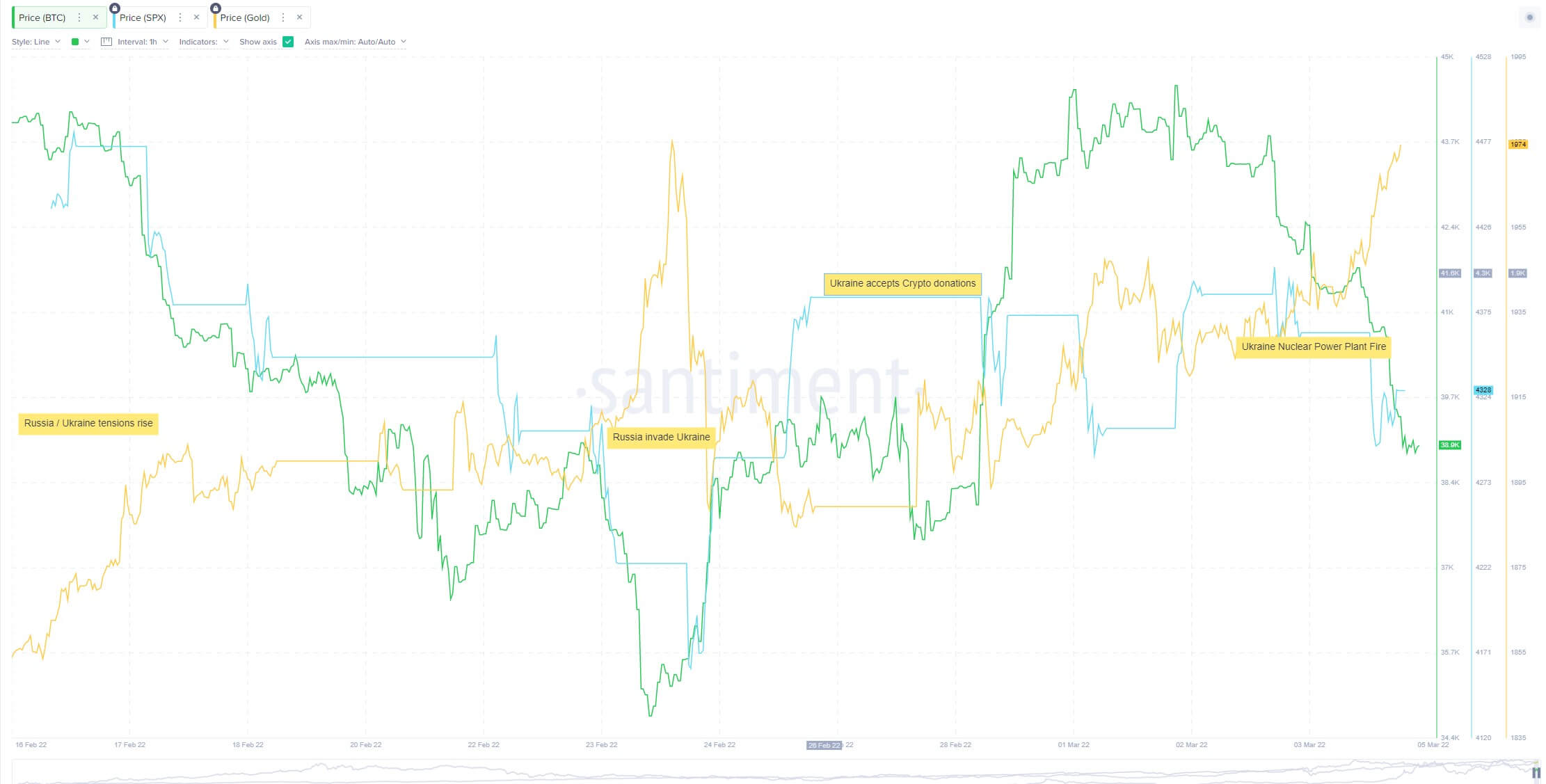
As the weekend began BTC gave up the double-digit gains from earlier in the week to drop below a critical psychological marker of $40k. Data from Santitment charts the contest between BTC and old as the premier store of value as the world continues to experience uncertainty.

By overlaying the charts, it is clear that, as the likelihood of war increased, both Bitcoin and the S&P fell, whilst gold rose by almost 4%.
Source: Santiment

Bitcoin vs Gold 2022

The moment Russia invaded Ukraine, the trend accelerated as gold rose to its highest price since August 2020. However, supposedly the superior store of value, Bitcoin, dropped 14% intraday.

The meteoric rise of gold and the fall of Bitcoin on February 24 was not the end of the story. Gold gave up its gains almost immediately, and Bitcoin rose over 17% as Ukraine announced that it would accept Bitcoin and Ethereum donations. The cryptocurrency donations to Ukraine have been instantly liquidated to transact in fiat. The government is not accumulating cryptocurrency. Instead, it sells the moment it receives the funds into its wallet. The need to fund the war effort creates sell pressure on the market.

The rollercoaster continues this weekend. Today, gold has overtaken Bitcoin as it climbs back towards the local high of $1,974. However, gold is just 5% off its all-time high, a marker that will likely act as a strong resistance level. Meanwhile, Bitcoin is trading closer to historic support levels of $37,700 and $35,254. What will happen next will be interesting to watch but does any of this genuinely affect the argument that Bitcoin is the foremost store of value?

Which is the superior store of value?

The argument between gold and Bitcoin as a store of value has raged for years. However, whilst the growth potential of Bitcoin clearly demonstrates that it has the ability to outperform gold, it has yet to be truly tested as an actual store of value through turbulent times.

Peter Schiff said yesterday:

“Bitcoin is far too risky to be used as a safe haven or a store of value. Bitcoin has failed its first major test.”

Is the famous Bitcoin critic correct? Could this be a pivotal moment for Bitcoin?

To look at microeconomic events on individual days to make claims regarding a long-term store of value is simply misguided. We have to zoom out and look at the pace at which the blockchain space is developing. We expect to reach a global market size of $67 billion in just four years. That is a compound annual growth rate of 68.4%. Further, Bitcoin can be sent to families, friends and charitable causes from anywhere in the world.

Whilst gold has been the global value store for millennia; We can transfer Bitcoin’s value to loved ones within minutes. You can’t send physical gold to your family via your mobile phone.

This opens up the debate about what makes a store of value in 2022? If a store of value protects us from the day to day volatility of markets, then the above chart shows that neither gold nor Bitcoin passes the test. On the other hand, if a store of value is something that retains or increases over a long enough timeline, well, I don’t think Bitcoin has failed this test quite yet.

Isn’t a digital store of value the most sensible option in an ever-increasingly digital world?

Related Reads

When Google Also 'Prints Stocks' to Build AI, Whose Narrative is Shattering the High Valuations of Neocloud?

Google has announced its first equity financing since 2005, a series of moves totaling $80 billion that signal a strategic challenge to Nvidia's GPU dominance in the AI compute market. This impacts "Neocloud" companies like CoreWeave, Nebius, and IREN, whose valuations are heavily tied to Nvidia's perceived uniqueness. Google's three-part strategy involves: launching new TPU chips (TPU 8t/8i) and selling them to third parties for the first time; forming a $25 billion compute-as-a-service joint venture with Blackstone; and raising ~$50 billion in new equity (part of an $80B package) to fund AI infrastructure, underscoring the massive capital demands even for tech giants. This marks a divergence from Microsoft's path. Microsoft, lacking a mature in-house AI chip, relies heavily on outsourcing to Neocloud providers using Nvidia GPUs. Google, with its proprietary TPU, is pursuing vertical integration—building its own data centers, selling chips, and competing directly with Neocloud services. While Neocloud firms have strong near-term revenue from locked-in Nvidia GPU contracts (e.g., CoreWeave's ~$100B backlog), Google's moves undermine their long-term valuation narrative based on Nvidia's sole supremacy and perpetual supply shortage. TPU performance claims and adoption by firms like Anthropic add credibility to Google's alternative. The AI compute market is transitioning from a uniform seller's market to a layered one: top AI labs are diversifying their hardware stacks; hyperscalers are pursuing different chip strategies; and financing costs will become a critical differentiator, favoring players like Google with lower capital costs. Key metrics to watch include the progress of the Google-Blackstone JV, expansion of the TPU customer base beyond Anthropic, and potential shifts in Microsoft's sourcing strategy. If Google succeeds on these fronts, the Neocloud investment thesis will require significant reassessment.

marsbit1h ago

When Google Also 'Prints Stocks' to Build AI, Whose Narrative is Shattering the High Valuations of Neocloud?

marsbit1h ago

Trading

Spot
Futures

Hot Articles

What is $BITCOIN

DIGITAL GOLD ($BITCOIN): A Comprehensive Analysis Introduction to DIGITAL GOLD ($BITCOIN) DIGITAL GOLD ($BITCOIN) is a blockchain-based project operating on the Solana network, which aims to combine the characteristics of traditional precious metals with the innovation of decentralized technologies. While it shares a name with Bitcoin, often referred to as “digital gold” due to its perception as a store of value, DIGITAL GOLD is a separate token designed to create a unique ecosystem within the Web3 landscape. Its goal is to position itself as a viable alternative digital asset, although specifics regarding its applications and functionalities are still developing. What is DIGITAL GOLD ($BITCOIN)? DIGITAL GOLD ($BITCOIN) is a cryptocurrency token explicitly designed for use on the Solana blockchain. In contrast to Bitcoin, which provides a widely recognized value storage role, this token appears to focus on broader applications and characteristics. Notable aspects include: Blockchain Infrastructure: The token is built on the Solana blockchain, known for its capacity to handle high-speed and low-cost transactions. Supply Dynamics: DIGITAL GOLD has a maximum supply capped at 100 quadrillion tokens (100P $BITCOIN), although details regarding its circulating supply are currently undisclosed. Utility: While precise functionalities are not explicitly outlined, there are indications that the token could be utilized for various applications, potentially involving decentralized applications (dApps) or asset tokenization strategies. Who is the Creator of DIGITAL GOLD ($BITCOIN)? At present, the identity of the creators and development team behind DIGITAL GOLD ($BITCOIN) remains unknown. This situation is typical among many innovative projects within the blockchain space, particularly those aligning with decentralized finance and meme coin phenomena. While such anonymity may foster a community-driven culture, it intensifies concerns about governance and accountability. Who are the Investors of DIGITAL GOLD ($BITCOIN)? The available information indicates that DIGITAL GOLD ($BITCOIN) does not have any known institutional backers or prominent venture capital investments. The project seems to operate on a peer-to-peer model focused on community support and adoption rather than traditional funding routes. Its activity and liquidity are primarily situated on decentralized exchanges (DEXs), such as PumpSwap, rather than established centralized trading platforms, further highlighting its grassroots approach. How DIGITAL GOLD ($BITCOIN) Works The operational mechanics of DIGITAL GOLD ($BITCOIN) can be elaborated on based on its blockchain design and network attributes: Consensus Mechanism: By leveraging Solana’s unique proof-of-history (PoH) combined with a proof-of-stake (PoS) model, the project ensures efficient transaction validation contributing to the network's high performance. Tokenomics: While specific deflationary mechanisms have not been extensively detailed, the vast maximum token supply implies that it may cater to microtransactions or niche use cases that are still to be defined. Interoperability: There exists the potential for integration with Solana’s broader ecosystem, including various decentralized finance (DeFi) platforms. However, the details regarding specific integrations remain unspecified. Timeline of Key Events Here is a timeline that highlights significant milestones concerning DIGITAL GOLD ($BITCOIN): 2023: The initial deployment of the token occurs on the Solana blockchain, marked by its contract address. 2024: DIGITAL GOLD gains visibility as it becomes available for trading on decentralized exchanges like PumpSwap, allowing users to trade it against SOL. 2025: The project witnesses sporadic trading activity and potential interest in community-led engagements, although no noteworthy partnerships or technical advancements have been documented as of yet. Critical Analysis Strengths Scalability: The underlying Solana infrastructure supports high transaction volumes, which could enhance the utility of $BITCOIN in various transaction scenarios. Accessibility: The potential low trading price per token could attract retail investors, facilitating wider participation due to fractional ownership opportunities. Risks Lack of Transparency: The absence of publicly known backers, developers, or an audit process may yield skepticism regarding the project's sustainability and trustworthiness. Market Volatility: The trading activity is heavily reliant on speculative behavior, which can result in significant price volatility and uncertainty for investors. Conclusion DIGITAL GOLD ($BITCOIN) emerges as an intriguing yet ambiguous project within the rapidly evolving Solana ecosystem. While it attempts to leverage the “digital gold” narrative, its departure from Bitcoin's established role as a store of value underscores the need for a clearer differentiation of its intended utility and governance structure. Future acceptance and adoption will likely depend on addressing the current opacity and defining its operational and economic strategies more explicitly. Note: This report encompasses synthesised information available as of October 2023, and developments may have transpired beyond the research period.

363 Total ViewsPublished 2025.05.13Updated 2025.05.13

What is $BITCOIN

Discussions

Welcome to the HTX Community. Here, you can stay informed about the latest platform developments and gain access to professional market insights. Users' opinions on the price of BTC (BTC) are presented below.

活动图片