Ethereum researchers and developers have proposed gradually burning validator rewards as staking grows.
The burning will reach 100% when approximately 60.25 million $ETH (about half of the total supply) is staked, which will zero out net issuance and potentially enhance $ETH's long-term scarcity and valuation, limiting further dilution for existing holders.
Staking is a method for securing Ethereum. Holders lock up $ETH and run software that validates transactions, and the network pays them for it by creating new $ETH. These participants are validators, and the newly created $ETH is the reward. Burning means permanently destroying the coins, not paying them out.
Every 6.4 minutes, at the end of what Ethereum calls an epoch, a portion of each validator's reward is deducted and destroyed, not redirected elsewhere, with this share increasing linearly to 100% as staking approaches the saturation point.
Validators will still get paid for the same work, and they will keep all transaction fees and tips earned from block creation. Only the newly created $ETH is burned. The deduction from validator rewards will occur gradually, phased in over 18 months, with about 6 months before that for the upgrade to propagate, meaning roughly two years for adaptation.
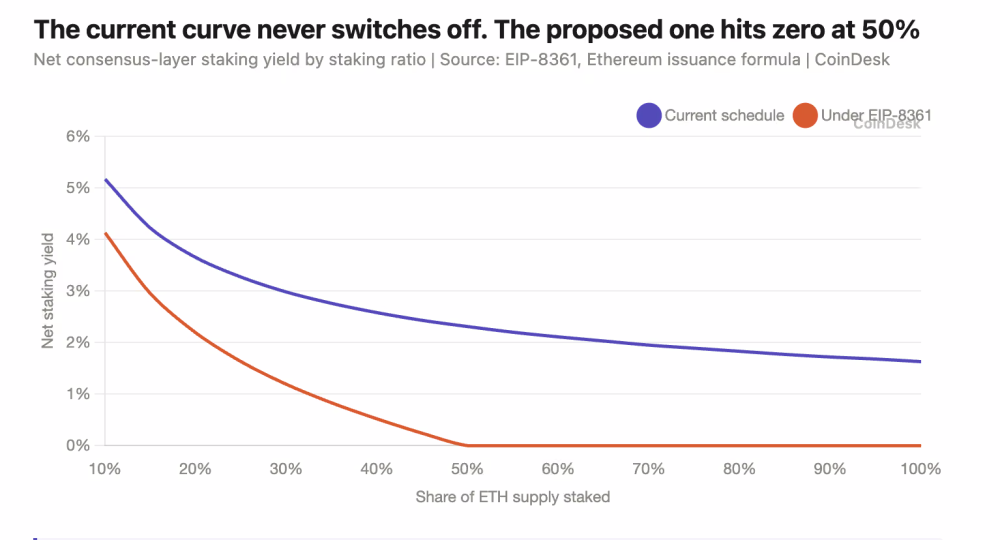
Figure 1. The current curve never ends. The proposed curve reaches zero at the 50% mark. Source: Shaurya Malwa.
The proposal was signed by 6 researchers, including Justin Drake of the Ethereum Foundation. It was published just days before the deadline for considering minor changes to Hegotá, the next Ethereum Network upgrade.
According to the authors, the problem is that staking never stops being profitable. Even if every $ETH were staked, the yield would still be around 1.5%, so there is always a reason to add more.
Jérôme de Tychey, one of the proposal's authors, predicts that over 70 million $ETH will be staked by January 2028 if nothing changes. The proposal states that beyond a certain level, additional staking will begin to make Ethereum less secure, as $ETH ultimately ends up with exchanges and staking service providers rather than its owners, while small individual stakers get pushed out.
Today, about 41 million $ETH, or about 34% of the total supply, is staked. According to tracking data, another 2.5 million are in the queue for activation, waiting 6 weeks or more, and no one is in line to exit.
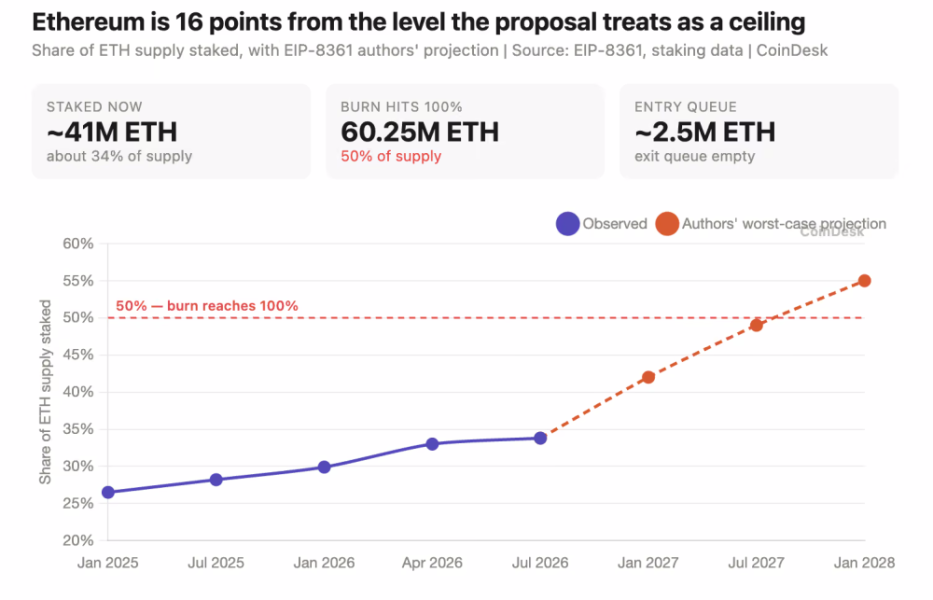
Figure 2. Ethereum is 16 percentage points away from the level considered a ceiling in the proposal. Source: Shaurya Malwa.
Ethereum limits the rate at which validators can join and leave, so both directions form a straight line. The limit exists to prevent a large block from entering or exiting quickly enough to destabilize the network. The entry queue consists of $ETH waiting to start staking, the exit queue consists of $ETH waiting to stop. Currently, about 57,600 $ETH can be activated per day.
The proposal has divided Ethereum developers and market participants.
Aave Labs CEO Stani Kulechov stated in his blog that driving staking rewards toward zero would largely render $ETH borrowing strategies unviable. As data shows, most $ETH borrowed on Aave is used to purchase more $ETH for staking, which is only beneficial while staking yield exceeds the borrowing cost.
Mike Silagadze, founder of the liquid staking protocol ether.fi, objects both to the process itself and its substance.
"The EIP draft was published with a 48-hour notice for comments," he wrote on X, calling it "a major change to network economics with far-reaching consequences for all of DeFi." He added that this change "obviously will push out solo stakers who are not subsidized by EF or others," and leave staking to "large centralized entities with zero cost of capital," and that "7 out of the top 10 DeFi protocols" would face capital outflows.
Silagadze was more forthright about the proposal's impact on prices. "People who lock $ETH in staking are not selling it," he wrote, arguing the proposal "will stop new $ETH from being staked" and could return over $10 billion worth of $ETH to circulation.
The more important question is whether this proposal will make it into the Hegotá upgrade, scheduled for Q3-Q4 2026, which will focus on structural optimization, censorship resistance, and state size reduction.
The fundamental change to Ethereum's monetary policy—gradually reducing and eventually zeroing out consensus-layer staking rewards after 50% of the supply is staked—comes just days before the Hegotá inclusion deadline of August 6. It is accompanied by only a rough implementation draft of about 300 lines and a lack of consensus among validators and stakers whose income will be reduced.
This combination of factors makes it much more likely to be skipped for Hegotá and moved to a later fork than implemented. The authors themselves note that each month of delay allows the staking ratio to grow by about 1.5 percentage points.
end-content