Author: ChandlerZ, Foresight News
"The mission of this role is to achieve step-function / breakthrough growth, not to drive organic or marginal growth."
These words are written in the job description for the Head of Stablecoins position that the Solana Foundation posted on the recruitment platform Ashby on August 3rd. The Foundation is a non-profit organization registered in Zug, Switzerland, whose nominal duties are to promote the adoption, decentralization, and security of the Solana network. It doesn't typically use such sales-team-like language in its job postings.
Four other senior positions were released in the same batch, including Head of AI Ecosystem, Head of Institutional Growth for Greater China, Head of Institutional Growth for Japan, and Head of DeFi Growth, all listed under the growth team responsible for connecting with enterprises, financial institutions, and regulators.
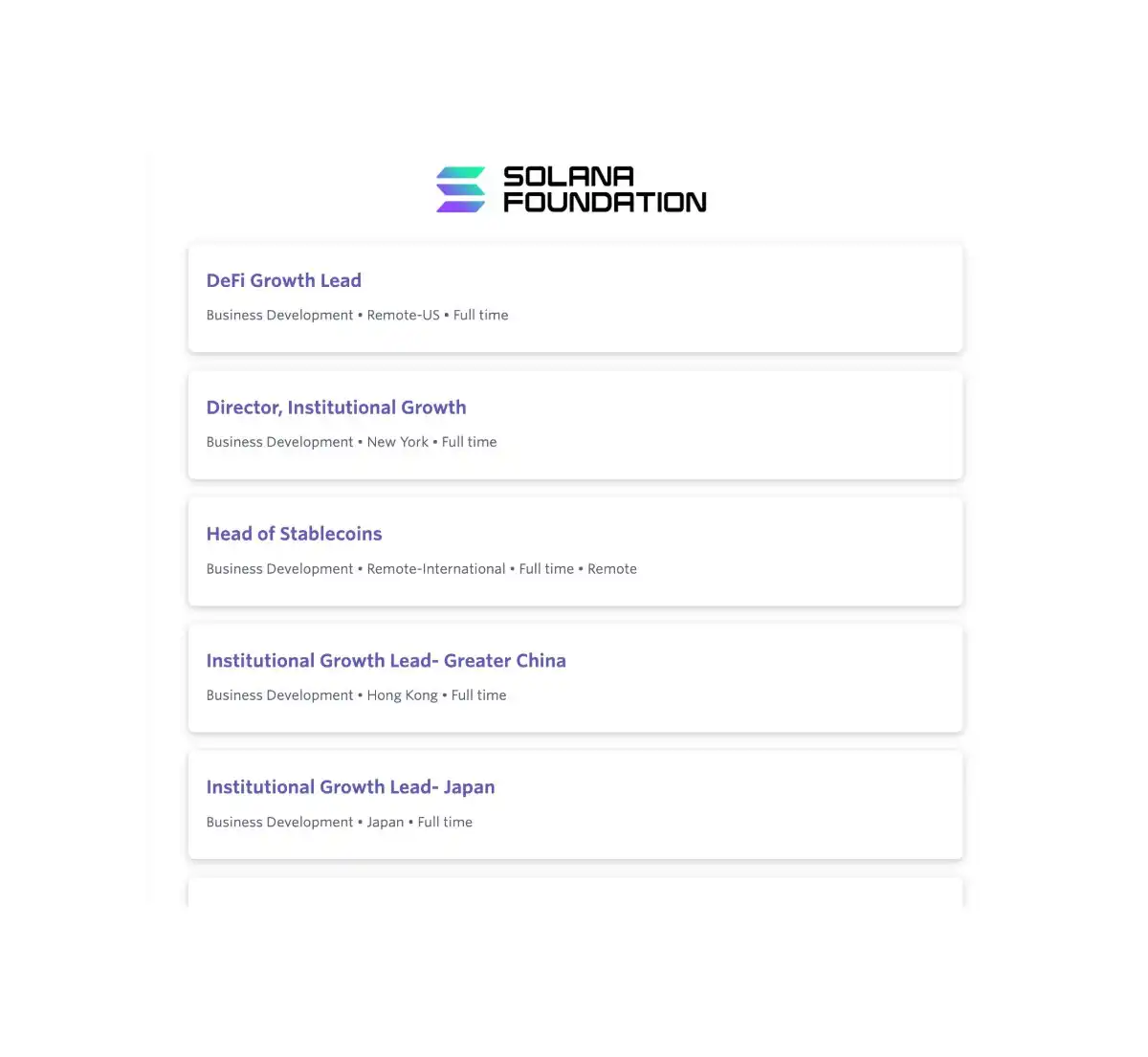
Regarding the details of each role: the Japan position requires fluency in Japanese and the ability to directly build relationships with executives at megabanks, regulators, and large payment companies. The Greater China role, while geographically titled, covers the entire Asia-Pacific region including Japan, China, and Singapore in the description, requiring 7 to 12 years of experience and established executive-level connections. The Stablecoins position expects candidates to already have relationships with major issuers, custodians, and market makers, and to be able to design commercial terms and liquidity incentives.
Five positions, covering stablecoins, AI, Asian institutions, and DeFi in four directions, yet none related to Memes. And Memes are precisely what have sustained on-chain activity on Solana over the past two years. This recruitment round signals a strategic shift in focus towards AI, stablecoins, and the Asian institutional market. To understand what an organization is truly anxious about, looking at its roadmap is far less revealing than examining its job postings.
So the question becomes: What is the Foundation anxious about?
The Ledger Ranked Fourth in Full-Chain Revenue
According to the Solana Q2 2026 Token Holder Report released by Blockworks, the chain's real economic value in Q2 was $51 million, down 43% quarter-on-quarter, with $18.6 million in April, $18.1 million in May, and $14.3 million in June, showing a monthly decline. Application layer revenue was $228.4 million, down 31% quarter-on-quarter, the lowest quarter since Q1 2024.
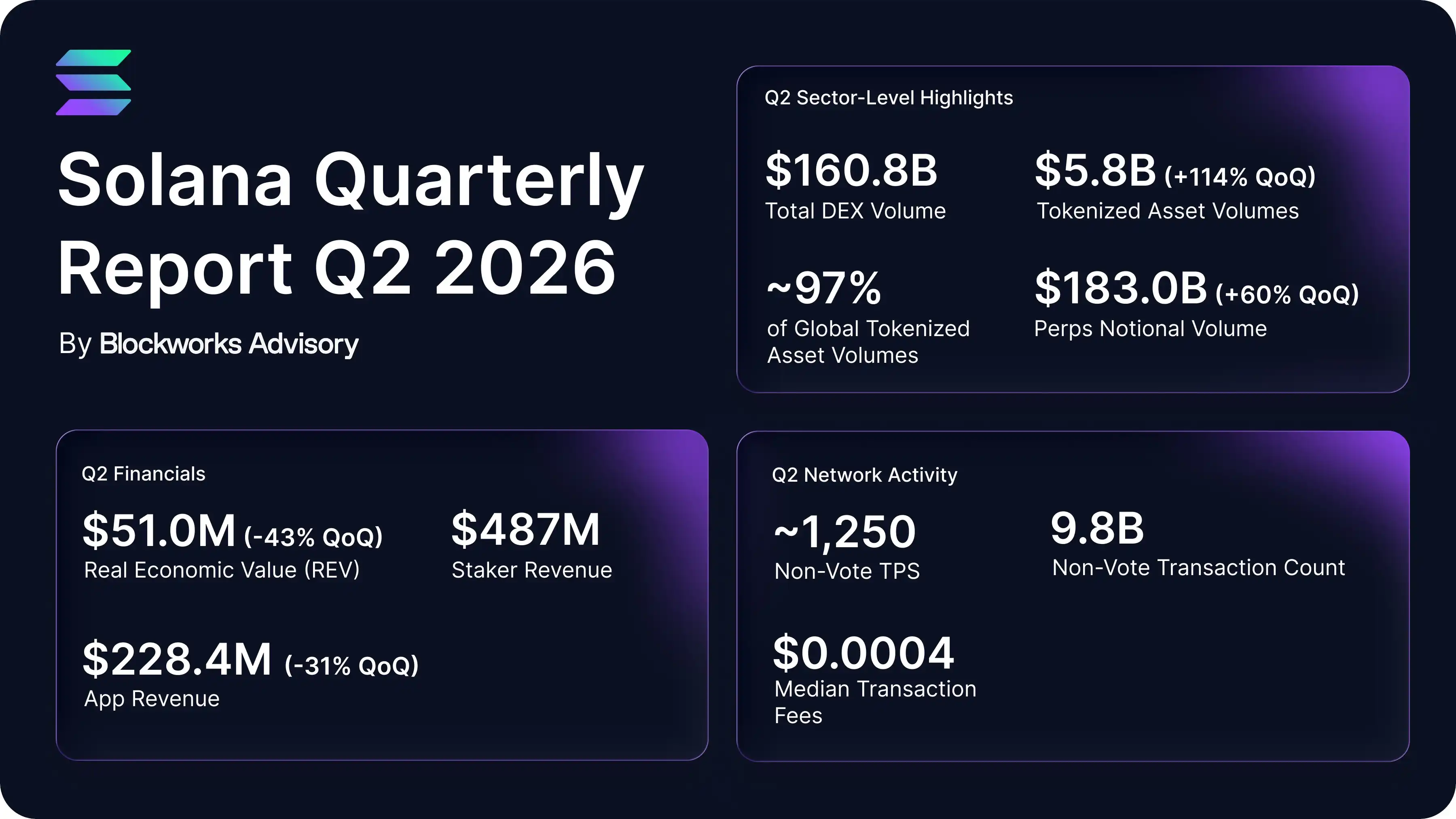
Worse than the decline is the ranking. In terms of single-chain quarterly revenue, Solana ranked fourth with a 12% share, behind Hyperliquid's $141.4 million (33%), Tron's $89.8 million (21%), and Ethereum's $63.3 million (15%). For comparison, Solana's share was 18% in Q1.
The composition of revenue is as problematic as the total amount. The top application revenue earner in Q2 was the Meme launch platform Pump.fun, with $90.1 million, accounting for 39% of all application revenue. However, the report also points out that Pump.fun's revenue share hit a new high precisely because the rest of the market shrank even faster. The entire launchpad category generated $63.9 million in revenue, with Pump.fun alone accounting for 97% of that.
On July 18th, Solana's daily network revenue surpassed all other blockchains, returning to the top of the DeFiLlama chart, which SolanaFloor called the first time in nearly five months. On that day's fee leaderboard, Pump.fun led with $2.04 million, more than double its daily revenue from the June lows of around $800,000. Solana's base layer transaction fees were only $568,000.
At this point, the story seems to be the familiar one: Memes recede, the public chain bleeds, and the Foundation hires to find new growth.
New Demand Has Emerged
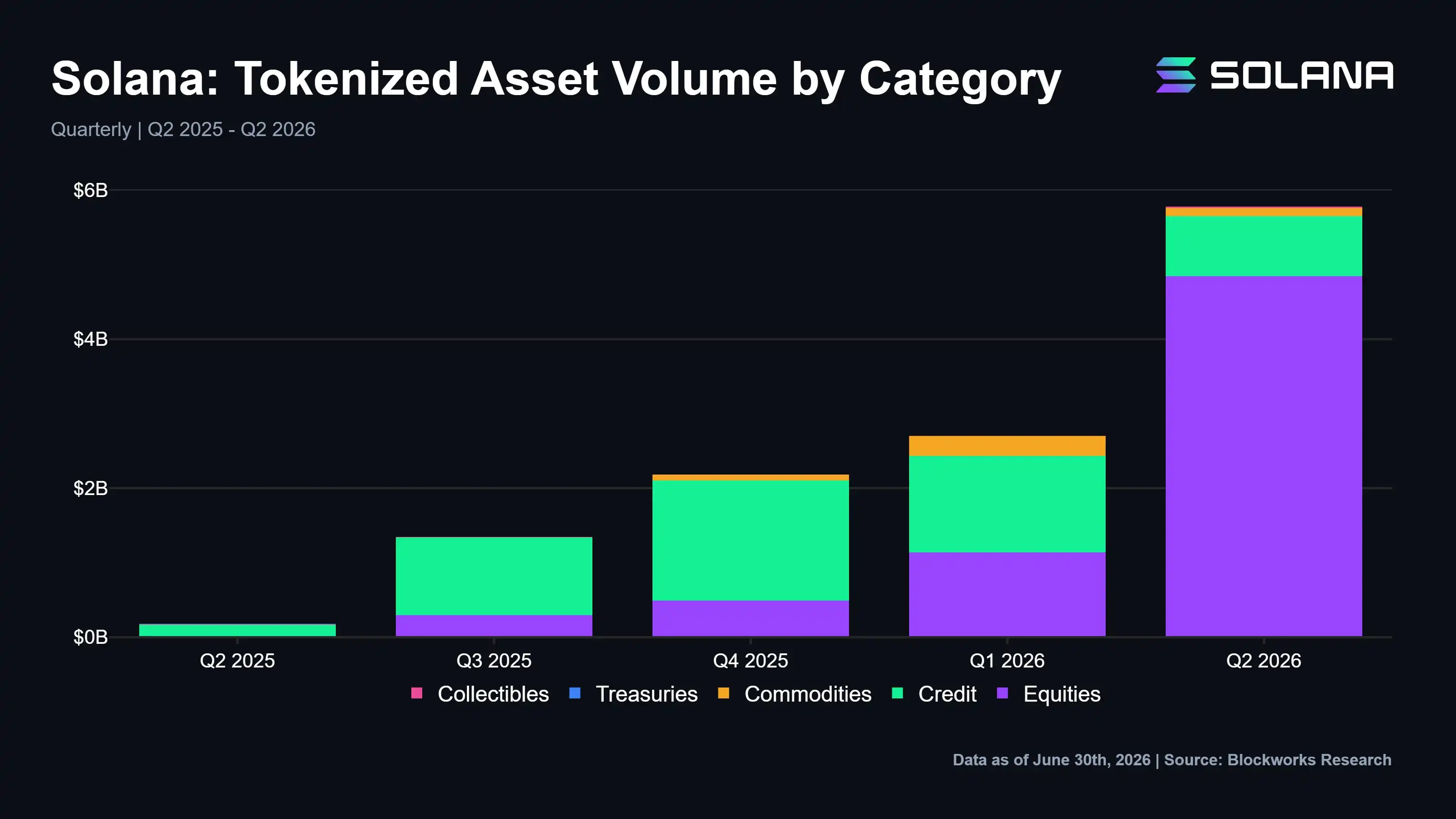
In the same quarter, the trading volume of tokenized assets on Solana reached a record high of $5.8 billion, up 114% quarter-on-quarter, with tokenized stocks accounting for $4.8 billion—over four times the $1.1 billion in Q1. Growth was concentrated at the end of the quarter: $670 million in April, $871 million in May, and a single-month volume of $3.3 billion in June. The direct trigger was the SpaceX IPO on June 12th; the tokenized SPCX, issued via Sunrise and distributed by Backpack, contributed approximately $770 million that month. About 97% of all cross-chain tokenized stock trading occurred on Solana.
Cross-chain DEX volume rebounded 26% month-on-month in June. Blockworks specifically noted that what drove this rebound was tokenized assets, not Memes.
On the institutional side, 7 out of 29 global systemically important banks have launched Solana-related services. JPMorgan handles tokenization and DvP settlement, BNY Mellon handles SOL custody and USDC minting/burning, Morgan Stanley offers custody, spot trading, and lending, Societe Generale issues stablecoins, and State Street manages money market funds. In Q2, SOL spot ETPs saw net inflows of $120 million, while Bitcoin spot ETPs saw net outflows of $3.7 billion and Ethereum outflows of $500 million in the same period. Attracting funds against the trend in a broadly declining market is some hard evidence of real demand.
But trading volume is increasing, user structure is improving, institutions are entering, yet revenue dropped by forty-three percent. The reason lies in the rankings of the revenue chart. The top five applications by revenue in Q2 were Pump.fun ($90.1 million), trading card marketplace Collector Crypt ($32.2 million), Pacifica ($20 million), Jupiter ($15.3 million), and wallet Phantom ($11.9 million). The $4.8 billion in tokenized stock trading did not see any related application break into the top five.
In other words, Solana's transformation is already visible in trading volume but has yet to manifest clearly in the revenue table. Tokenized stocks are handled by proprietary AMMs operated by professional market makers, which account for about half of the tokenized asset trading volume. They profit from spreads, taking far less in fees compared to the priority fees and tips common in Meme trading.
Five Positions Plugging the Same Gap
Looking back at the job postings with this contradiction in mind, the logic behind the five positions becomes complete. They are all searching for monetizable forms for non-speculative demand.
Stablecoins are the first piece to move because they are the capital layer for all on-chain financial activities and also the area where Solana has been stagnant the longest. At the end of Q2, the supply of stablecoins on Solana was $16.3 billion, up only 2% quarter-on-quarter, essentially flat against a backdrop of declining activity for four consecutive quarters. Transfer volume was $1.5 trillion, down 29% quarter-on-quarter.
Meanwhile, in DefiLlama's cross-chain data for the same period, Ethereum carried about $154 billion, Tron about $90 billion—Solana is an order of magnitude behind. The harsh phrase "step-function growth" is aimed precisely at this number that is both lagging and not growing. In a quarter where lending balances generally declined, the yield-bearing stablecoin market is the only clear new source of funds. The Head of DeFi Growth picks up the latter half of this line; money sitting in a wallet generates no revenue; it only starts accruing fees when it flows into lending, trading, and market making.
The two Asian institutional positions correspond to the source of volume. The 7 systemically important banks have merely opened a door; expanding that door into a channel requires someone to be stationed year-round in Tokyo and Hong Kong, negotiating with regulators and bank executives. The technical bargaining chips are also ready. The consensus layer upgrade Alpenglow is scheduled to go live around August with Agave v4.2, compressing transaction confirmation time to 150 milliseconds—an improvement of about 100 times over the current state. Millisecond-level settlement is something that can be put on the negotiating table. The timing of these two positions is likely not a coincidence.
The Head of AI Ecosystem seems most like trend-chasing but is actually the position closest to revenue in this batch. Google Cloud and the Solana Foundation jointly launched Pay.sh in Q2, a pay-as-you-go stablecoin payment channel for AI agents. Amazon Web Services also launched a stablecoin system for metering AI traffic. Blockworks called this direction "the biggest new frontier" for payment services that quarter.
As of publication, the Solana Foundation has not issued a public statement regarding the overall strategic intent behind this recruitment round. Among them, the AI Ecosystem position has shown as no longer accepting applications on some aggregated recruitment sites; the actual status should be verified on the Foundation's official job page.
Summary
Blockworks, at the end of its report, splits Solana in two: revenue tied to speculative velocity is being repriced, while demand tied to settlement is growing in the same environment.
The Q3 report will be the first scorecard. There's only one number to watch: whether Pump.fun's 39% share of application revenue is declining. Among the three lines of tokenized stocks, stablecoin payments, and AI agent payments, will a project appear for the first time with its own name in the top five of the revenue chart?
Until then, "step-function growth" remains just words on a recruitment webpage.