Les États-Unis et le Japon unissent leurs forces de manière rare depuis près de 30 ans, marquant la fin de l'ère de l'arbitrage sur le yen

marsbitPublished on 2026-08-03Last updated on 2026-08-03

Abstract

Les États-Unis et le Japon ont mené une intervention coordonnée rare sur le marché des changes pour soutenir le yen, suite à la chute de la devise à son plus bas niveau depuis 40 ans, proche de 164 yens pour un dollar. Cette action conjointe, confirmée par les deux gouvernements, a provoqué un rebond rapide du yen vers 155-156 yens par dollar. L’élément marquant est la participation active des États-Unis, passant du soutien verbal à une coordination pratique, comme en témoigne une note du secrétaire au Trésor américain évoquant l’achat de 5 à 10 milliards de dollars de yens. Cette intervention modifie le calcul risque-rendement pour les investisseurs qui spéculaient sur la baisse du yen, en introduisant la possibilité de nouvelles actions coordonnées. Bien que l’écart de taux d’intérêt entre les États-Unis et le Japon reste favorable au dollar, rendant la stratégie de « carry trade » toujours attrayante, l’intervention augmente les risques pour les vendeurs à découvert. Les autorités utilisent notamment l’outil de prêt FIMA de la Fed pour fournir des liquidités en dollars sans vendre massivement des obligations américaines, limitant ainsi l’impact sur les marchés obligataires. À moyen terme, la trajectoire du yen dépendra surtout de l’évolution des taux directeurs de la Banque du Japon et de la Réserve fédérale américaine. Si l’intervention permet de gagner du temps et de réduire la spéculation excessive, elle ne constitue pas un équivalent moderne des « accords du Plaza »...

Les signaux d'une intervention conjointe américano-japonaise sur le yen ont pris rapidement de l'ampleur autour du 3 août.

Le ministre japonais des Finances, Sakudoki Katayama, a confirmé que le ministère des Finances du Japon avait coordonné l'achat de yens avec le département du Trésor américain. Le président américain Donald Trump et le secrétaire au Trésor Scott Bessent ont également confirmé la participation des États-Unis, indiquant qu'une nouvelle action conjointe n'était pas exclue. Suite aux déclarations officielles, le dollar américain par rapport au yen est tombé rapidement d'un niveau proche de 164 la semaine dernière, plus haut depuis 40 ans, pour atteindre près de 155,20 ; le taux de change enregistré par AP en début de séance le 3 août était d'environ 156,34.

Rencontre des ministres des Finances américain et japonais

Le changement le plus important de cette période de marché n'est pas seulement que le Japon ait à nouveau vendu des dollars et acheté des yens, mais que les États-Unis soient passés d'un soutien verbal à une coordination pratique.

Pour les traders qui parient à long terme sur la baisse du yen, la logique existante n'a pas complètement disparu : les taux d'intérêt américains restent nettement supérieurs à ceux du Japon, et détenir des actifs en dollars permet toujours de réaliser des gains de différentiel de taux. Mais la structure de risque de cette transaction a changé. Auparavant, le marché évaluait principalement l'ampleur et la durée de l'intervention unilatérale du Japon ; désormais, il doit également prendre en compte la participation des États-Unis, la répétition possible des opérations bilatérales et la possibilité que les autorités établissent une ligne de défense politique à des niveaux spécifiques.

L'intervention conjointe américano-japonaise se concrétise, le yen rebondit rapidement

Le dollar chute rapidement face au yen, passant de 164

La vitesse du rebond du yen est en soi la preuve la plus directe de l'impact d'une intervention coordonnée sur les anticipations du marché.

Fin juillet, le dollar américain par rapport au yen s'est brièvement approché de 164, le yen tombant à son niveau le plus bas depuis environ 40 ans. Un yen faible peut augmenter les bénéfices à l'exportation des entreprises japonaises calculés en yen, mais il augmente également le coût des importations d'énergie, de denrées alimentaires et de matières premières, alourdissant ainsi davantage le coût de la vie des ménages et la pression sur les entreprises. Alors que le taux de change dépassait continuellement les seuils précédemment considérés comme sensibles de 150 et 160, la tolérance politique du gouvernement japonais envers la dépréciation a nettement diminué.

Le Japon était également intervenu seul pour acheter des yens, mais le taux de change ne rebondissait souvent qu'à court terme. Le scénario familier du marché était le suivant : le ministère des Finances intervient, les vendeurs à découvert couvrent temporairement leurs positions, puis l'écart de taux d'intérêt entre les États-Unis et le Japon attire à nouveau les capitaux vers les actifs en dollars.

Cette fois, le marché ne fait plus face au même scénario.

Le ministère des Finances japonais a explicitement utilisé l'expression « intervention coordonnée », et Bessent a déclaré que le département du Trésor américain continuerait de communiquer avec la partie japonaise et « n'hésiterait pas » à participer à nouveau à une action conjointe. Les autorités ne doivent pas nécessairement injecter continuellement des sommes d'argent colossales ; il suffit que les traders croient qu'une nouvelle intervention bilatérale est possible lorsque le dollar approche de 164 par rapport au yen pour que le risque de queue supporté en continuant à parier contre le yen augmente significativement.

Un signal de 5 à 10 milliards de dollars exposé, les États-Unis passent du soutien verbal à la participation effective

Une photo prise par Reuters le 31 juillet montre que le carnet de notes de Bessent lors d'une réunion du cabinet à Camp David indiquait : « À faire : Acheter des yens japonais (JPY) 5-10 milliards de dollars », c'est-à-dire acheter pour 5 à 10 milliards de dollars de yens.
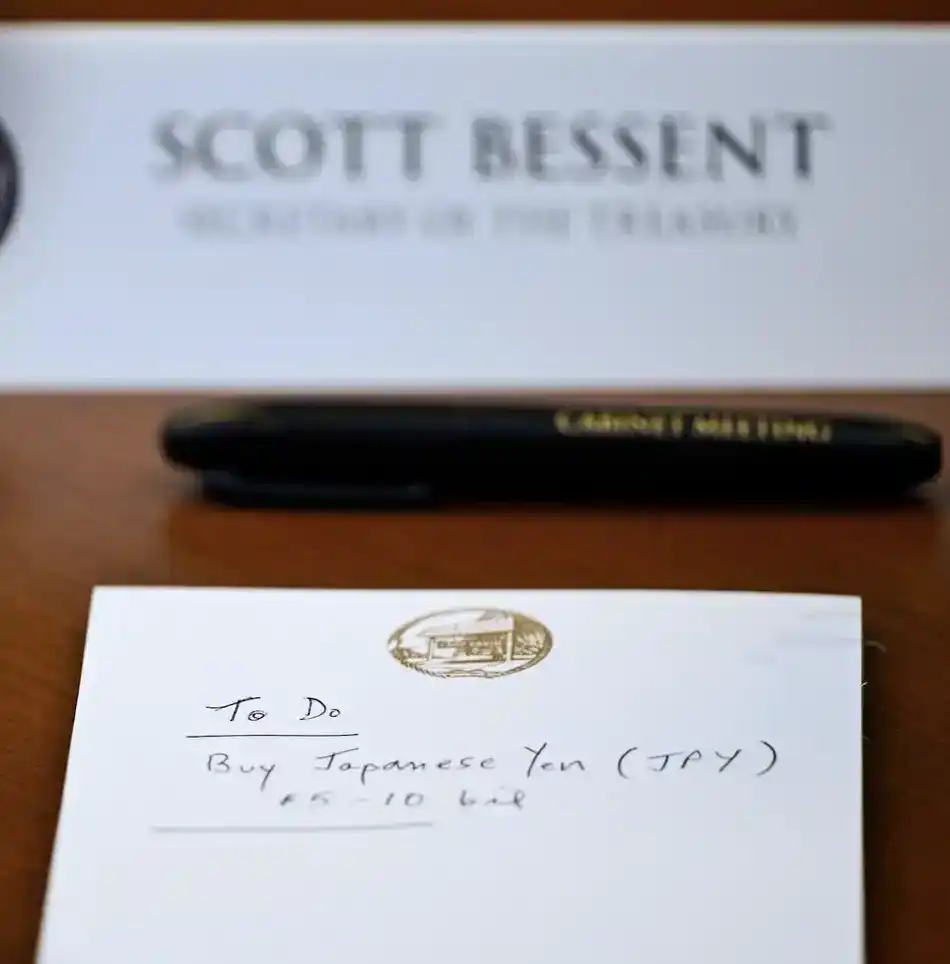
Reuters a publié une photo du carnet de notes posé devant Bessent lors de la réunion du cabinet de vendredi. Sous le titre « À faire », Bessent avait écrit « Acheter 5 à 10 milliards de dollars de yens japonais (JPY) ».

Ce carnet de notes ne prouve pas combien de yens les États-Unis ont finalement achetés. Au moment de la diffusion de la photo, le département du Trésor américain n'avait pas encore confirmé le montant exact. L'information clé qu'il apporte est que le département du Trésor américain a au moins sérieusement envisagé une opération d'achat de yens d'une certaine ampleur, au-delà du simple soutien diplomatique au Japon.

Ensuite, la confirmation officielle de l'intervention conjointe par les deux pays a accru encore plus la signification de cette photo pour le marché. Bessent a également déclaré publiquement que les États-Unis étaient prêts à répéter l'action si nécessaire. 5 à 10 milliards de dollars ne suffisent peut-être pas à modifier durablement l'offre et la demande sur le marché mondial des changes, mais c'est suffisant pour que les vendeurs à découvert sur le yen fortement endettés recalculent leurs points de stop-loss et la taille de leurs positions.

La manière dont l'intervention fonctionne réellement ne se limite pas non plus à ce que les fonds officiels poussent directement le taux de change.

Lorsque le dollar baisse rapidement face au yen, les investisseurs qui ont emprunté des yens pour acheter des actifs en dollars subissent des pertes de change. Certains comptes fortement endettés doivent compléter leurs marges, certaines transactions de tendance et positions d'options déclenchent des stops. Le processus de liquidation oblige les investisseurs à vendre des dollars et à racheter des yens, amplifiant ainsi les hausses à court terme du yen.

Ainsi, la chute rapide de la zone des 164 vers la zone des 155-156 inclut à la fois des transactions officielles et probablement un désendettement concentré des positions d'arbitrage et de tendance.
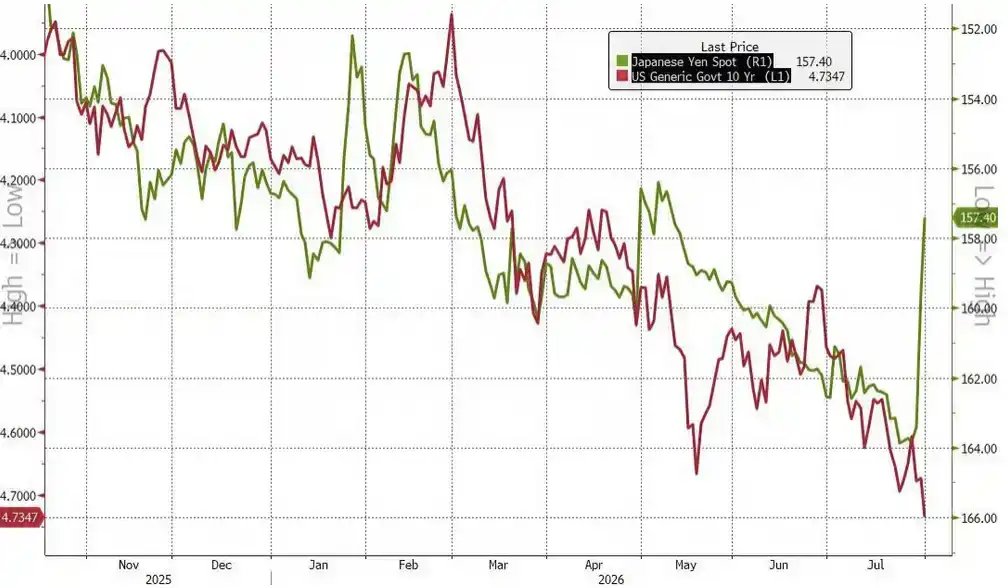
Les vendeurs à découvert sur le yen commencent à se retirer, le risque se propage aux actifs mondiaux

L'arbitrage sur le yen n'a pas pris fin, mais le rapport risque/rendement de la transaction a changé

Des affirmations sur « la fin des transactions d'arbitrage sur le yen » sont apparues sur le marché, mais cette conclusion est encore prématurée.

La Réserve fédérale américaine a maintenu le taux des fonds fédéraux entre 3,50 % et 3,75 % le 29 juillet, tandis que la Banque du Japon a maintenu son taux directeur à court terme à 1 % le 31 juillet. Même sans tenir compte des coûts de couverture, les taux d'intérêt américains à court terme restent nettement supérieurs à ceux du Japon, et le rendement de base obtenu en empruntant des yens pour investir dans des actifs en dollars n'a pas disparu.

L'intervention coordonnée modifie le ratio risque/rendement de cette transaction.

Par le passé, les investisseurs pouvaient penser que l'intervention unilatérale du Japon ne provoquait que de brèves fluctuations, et étaient donc prêts à rétablir des positions vendeuses après un rebond du yen. Désormais, ils doivent également payer une prime de risque plus élevée pour la possibilité que les États-Unis interviennent à nouveau, que les autorités augmentent la fréquence des interventions et que la Banque du Japon relève ses taux plus tôt.

Par conséquent, les vendeurs à découvert sur le yen pourraient réduire leur levier, diminuer la taille de leurs positions ou acheter plus de protection par des options, mais cela ne signifie pas que les capitaux ont complètement abandonné les transactions sur les différentiels de taux. Tant que l'écart de taux entre les États-Unis et le Japon reste élevé, chaque rebond du yen pourrait encore faire face à de nouvelles pressions vendeuses.

Une conclusion plus précise est la suivante : l'intervention coordonnée réduit la marge de manœuvre en termes de levier des vendeurs à découvert sur le yen, mais n'a pas encore éliminé les bases macroéconomiques de la vente à découvert du yen.

Les obligations américaines présentent un risque de contagion, mais le mode de transmission a changé

L'impact mondial de l'intervention sur le yen ne concerne pas seulement le marché des changes, mais aussi la manière dont le Japon se procure les fonds en dollars nécessaires à l'achat de yens.

Les données TIC du département du Trésor américain montrent qu'à fin mai 2026, le Japon détenait environ 1,143 billion de dollars d'obligations américaines, étant le plus grand détenteur étranger. Les données TIC, influencées par des facteurs tels que l'appartenance des comptes de dépôt, ne reflètent pas avec précision la propriété ultime, mais l'énorme portefeuille d'obligations américaines du Japon reste un indicateur important pour observer le risque de contagion de l'intervention.

La chaîne opérationnelle traditionnelle est la suivante : le ministère des Finances japonais utilise ses réserves de change pour vendre des dollars et acheter des yens sur le marché. Si les liquidités en dollars existantes sont insuffisantes, il peut en théorie vendre des actifs en dollars, y compris des obligations américaines. Des ventes importantes et continues d'obligations américaines pourraient augmenter l'offre sur le marché, exerçant une pression à la hausse sur les rendements à long terme américains.

Mais cette chaîne de transmission n'est pas inévitable.

Bessent a révélé que l'outil de pension FIMA de la Réserve fédérale, destiné aux banques centrales étrangères et aux autorités monétaires internationales, avait joué un rôle dans cette opération. Cet outil permet aux institutions officielles étrangères d'utiliser temporairement les obligations américaines déposées à la Fed de New York comme garantie pour obtenir des prêts en dollars, obtenant ainsi les liquidités en dollars nécessaires à l'intervention sans avoir à vendre directement les obligations américaines. Bessent a également proposé d'élargir à l'avenir la taille de cet outil.

Cela signifie que l'un des objectifs de la coordination américano-japonaise pourrait être précisément de permettre au Japon de soutenir le yen tout en évitant dans la mesure du possible des ventes massives d'obligations américaines qui feraient grimper les coûts de financement américains.

Le risque lié aux obligations américaines doit donc être compris à deux niveaux : à court terme, l'outil FIMA peut amortir la pression des ventes forcées ; si l'ampleur de l'intervention continue de s'élargir et sa durée de s'allonger, le Japon pourrait toujours ajuster l'allocation de ses actifs en dollars, et le marché des obligations américaines ferait alors face à un impact d'offre plus marqué.

L'intervention modifie le rapport risque/rendement à court terme, l'écart de taux détermine la tendance à long terme

Le ministère des Finances peut gagner du temps, la banque centrale détermine la tendance

Une intervention coordonnée peut modifier les positions à court terme, mais elle a du mal à déterminer seule la direction du yen à moyen et long terme.

La Banque du Japon a progressivement mis fin à sa politique ultra-accommodante, portant son taux directeur à 1 %, mais le rythme de son resserrement reste contraint par l'économie nationale, les coûts de financement du gouvernement et la stabilité du marché des obligations d'État japonaises. Le 31 juillet, la Banque du Japon a décidé à 8 voix contre 1 de maintenir les taux inchangés, un seul membre plaidant pour une hausse immédiate à 1,25 %.

Cela place la politique japonaise face à une tension évidente.

Le ministère des Finances souhaite empêcher une dépréciation trop rapide du yen, réduisant ainsi l'inflation importée et la pression politique ; la Banque du Japon, quant à elle, ne peut relever rapidement ses taux pour le taux de change, car cela pourrait pousser à la hausse les rendements des obligations d'État japonaises, alourdissant le fardeau de financement du gouvernement, des entreprises et des ménages.

L'intervention dans ce processus ressemble davantage à un gain de temps : en créant une volatilité bidirectionnelle et en forçant les vendeurs à découvert à réduire leur levier, elle crée une fenêtre pour que la Banque du Japon normalise progressivement sa politique.

Mais la tendance du taux de change dépend finalement des fondamentaux. Si la Banque du Japon continue de relever ses taux et que les rendements américains baissent, réduisant l'écart de taux entre les États-Unis et le Japon, le rebond du yen serait plus susceptible de se poursuivre ; si l'écart de taux reste élevé à long terme, les gains après l'intervention pourraient encore être progressivement effacés.

On est encore loin d'un « nouvel accord du Plaza »

Des récits grandioses comme « nouvel accord du Plaza » ou « fin de l'ère de l'arbitrage sur le yen » sont déjà apparus sur le marché, mais les faits actuels ne suffisent pas encore à étayer ces affirmations.

L'accord du Plaza de 1985 était une action concertée de plusieurs grandes économies pour favoriser une dépréciation ordonnée du dollar, impliquant une coordination politique plus large et une restructuration des taux de change mondiaux. L'action actuelle est plus limitée, visant directement à freiner la dépréciation excessive et désordonnée du yen, et à éviter la propagation des fluctuations des marchés des changes et des obligations vers le système financier mondial.

À ce stade, on peut confirmer que les États-Unis et le Japon ont conjointement acheté des yens, que le carnet de notes de Bessent montre que la partie américaine a envisagé une opération de 5 à 10 milliards de dollars, et que les deux parties ont explicitement gardé la possibilité d'une nouvelle intervention. Le dollar américain par rapport au yen est ensuite tombé rapidement de près de 164 à la zone des 155-156.

Cela suffit à modifier les transactions à court terme, mais ne prouve pas encore que le yen est entré dans un cycle de hausse à long terme.

Les trois éléments à observer réellement par la suite sont les suivants : les États-Unis participeront-ils à nouveau à des transactions effectives ? La Banque du Japon accélérera-t-elle le rythme de relèvement de ses taux ? L'outil FIMA permettra-t-il au Japon d'obtenir durablement des liquidités en dollars sans impacter significativement le marché des obligations américaines ?

Tant que ces questions n'auront pas reçu de réponse, les vendeurs à découvert sur le yen ne disparaîtront pas complètement. Mais ils auront beaucoup plus de mal qu'auparavant à parier facilement que l'intervention du Japon n'est qu'un vent passager.


Trending Cryptos

Related Questions

QQuelle a été la principale action conjointe des États-Unis et du Japon concernant le yen, et à quel niveau clé le dollar par rapport au yen (USD/JPY) a-t-il réagi ?

ALes États-Unis et le Japon ont coordonné une intervention conjointe sur le marché des changes pour acheter des yens, marquant un passage du soutien verbal américain à une participation active. Suite aux déclarations officielles, le taux de change USD/JPY, qui approchait le niveau de 164 (un plus haut depuis 40 ans), a rapidement reculé pour atteindre environ 155,20.

QComment le carnet du secrétaire américain au Trésor, Scott Bessent, a-t-il influencé la perception du marché concernant l'intervention ?

AUne photo du carnet de Scott Bessent, montrant une note 'A faire : Acheter des yens japonais (JPY) pour 5 à 10 milliards de dollars', a été publiée par Reuters. Cela a révélé que le Trésor américain envisageait sérieusement une intervention monétaire d'une certaine ampleur, renforçant la crédibilité de la menace d'une action conjointe et incitant les vendeurs à découvert de yen à réévaluer leurs risques.

QSelon l'article, pourquoi l'idée d'une 'fin du carry trade sur le yen' est-elle considérée comme prématurée ?

AL'idée d'une fin du carry trade est prématurée car l'écart de taux d'intérêt entre les États-Unis (taux directeurs à 3,50%-3,75%) et le Japon (taux à 1%) reste substantiel. Cet écart continue de fournir un gain de base pour les investisseurs qui empruntent en yen pour acheter des actifs en dollars. L'intervention a principalement modifié le ratio risque/rendement de cette transaction en augmentant le risque de volatilité future.

QQuel outil a été utilisé pour aider le Japon à financer son intervention sans vendre massivement des obligations américaines, et quel est son objectif ?

AL'outil FIMA (Foreign and International Monetary Authorities) de la Réserve fédérale américaine a été utilisé. Il permet aux autorités étrangères comme le Japon d'obtenir des prêts en dollars en utilisant leurs bons du Trésor américain détenus en garantie auprès de la Fed de New York. L'objectif est de fournir les liquidités en dollars nécessaires à l'intervention tout en évitant des ventes forcées d'obligations d'État américaines qui pourraient faire monter les taux d'emprunt aux États-Unis.

QQuelle est, selon l'article, la différence fondamentale entre l'action conjointe récente et l'Accord du Plaza de 1985 ?

ALa récente action conjointe est plus limitée dans son objectif. Alors que l'Accord du Plaza de 1985 était un accord multilatéral visant à déprécier de manière ordonnée le dollar américain et à réorganiser les taux de change mondiaux, l'action actuelle vise principalement à contenir la dépréciation 'excessive et désordonnée' du yen et à empêcher la contagion de la volatilité vers les marchés financiers mondiaux, sans implication d'un changement de régime de change plus large.

Related Reads

On the Eve of Circle's Earnings Report, Wall Street Shows Major Divergence in CRCL Valuation

On the eve of Circle (CRCL) releasing its quarterly earnings report, Wall Street analysts are deeply divided over the company's valuation. Morgan Stanley downgraded Circle from "Equal Weight" to "Underweight," slashing its price target from $106 to $38. Analyst James Faucette argues the market overestimates the growth potential of Circle's core USDC stablecoin, noting its circulation hasn't increased since Q3 2025 and new use cases beyond remittances and card spending are limited. He warns that slowing USDC growth could pressure the crucial "reserve income" and shift revenue toward lower-margin transaction fees. In stark contrast, TD Cowen initiated coverage with a "Buy" rating and an $82 price target. Analyst Bryan Bergin believes the market underestimates Circle's potential to evolve from a stablecoin issuer into a broader digital financial infrastructure platform. He forecasts a ~31% annual growth rate for USDC through 2030 and expects faster growth in fee-based revenue from services like payments, RWA tokenization, and its Arc network. A key external factor adding uncertainty is the stalled progress of the CLARITY Act in the US Senate, whose delay could dampen institutional adoption expectations for stablecoins. The core disagreement lies in whether Circle's future hinges on USDC circulation growth or a successful platform-based transformation. The upcoming earnings report is keenly awaited for insights into reserve income trends and the progress of newer business verticals.

marsbit1h ago

On the Eve of Circle's Earnings Report, Wall Street Shows Major Divergence in CRCL Valuation

marsbit1h ago

Hong Kong Stock Market in July: Super IPOs Coexist with Wave of Breakings, Hard Tech Still the Main Theme

The Hong Kong IPO market in July presented a "two-tiered" scenario characterized by both a mega-IPO and a significant wave of new stock listings falling below their issue price ("breaking issue"). The highlight was Zhongji Innolight's (stock code: 03308.HK) listing on July 30, which raised approximately HK$53.41 billion. This marked the largest IPO on the Hong Kong exchange in nearly seven years since Alibaba's secondary listing. A prominent trend was the continued dominance of A+H listings, with companies like Luxshare (02475.HK) and others contributing significantly to the total monthly fundraising of around HK$116 billion. In stark contrast, the market saw a sharp rise in "broken issues." Out of 17 new listings for the month, 7 broke issue on their debut, with the rate climbing to 47% by month-end. Factors contributing to this included an intense concentration of listings (15 in one week), profit-taking by investors, and a market reassessment of valuations, particularly for companies with unclear commercial prospects. Despite the sell-off, hard tech remained the core theme, accounting for over 70% of July's listings. Key sectors were semiconductors and AI/autonomous driving. However, market enthusiasm became highly selective, with extreme over-subscription for certain niche players while others were heavily sold off. This signals a shift from speculative fervor towards a more value-driven assessment. Looking ahead, recent listing reforms by the Hong Kong Exchanges are expected to attract more tech firms. With a large pipeline of over 350 companies awaiting listing, including potential large offerings like SHEIN, the market is poised for continued activity. Analysts view July's correction not as a downturn but as a healthy valuation reset, emphasizing the need for investors to carefully discern company fundamentals.

marsbit1h ago

Hong Kong Stock Market in July: Super IPOs Coexist with Wave of Breakings, Hard Tech Still the Main Theme

marsbit1h ago

Wall Street Shows Sharp Divergence in CRCL Valuation on the Eve of Circle's Earnings Report

On the eve of its earnings report on August 5th, significant divergence emerged on Wall Street regarding the valuation of Circle (CRCL). Morgan Stanley downgraded Circle from "Equal Weight" to "Underweight," slashing its target price from $106 to $38. Analyst James Faucette argues that the market has overestimated the growth potential of USDC, noting stagnant circulation since Q3 2025 and a lack of major new use cases beyond remittances and card spending. He warns that slower USDC growth could pressure Circle's core "reserve income" and shift its revenue mix toward lower-margin transaction fees, making current valuations excessive. In contrast, TD Cowen initiated coverage with a "Buy" rating and an $82 target price. Analyst Bryan Bergin believes the market underestimates Circle's potential to evolve from a stablecoin issuer into a broader digital financial infrastructure platform. He focuses on future services like payments, asset management, RWA tokenization, and blockchain infrastructure, forecasting a ~31% CAGR for USDC circulation through 2030 and faster growth in fee-based revenues. A key external variable is the delayed progress of the CLARITY Act, whose uncertainty may pressure market sentiment by slowing regulatory clarity for stablecoins. Ultimately, the split centers on whether Circle's value hinges on USDC growth or its platform transformation. The upcoming earnings report will be scrutinized for details on reserve income, payment services, and RWA initiatives.

Odaily星球日报1h ago

Wall Street Shows Sharp Divergence in CRCL Valuation on the Eve of Circle's Earnings Report

Odaily星球日报1h ago

Trading

Spot

Hot Articles

What is SONIC

Sonic: Pioneering the Future of Gaming in Web3 Introduction to Sonic In the ever-evolving landscape of Web3, the gaming industry stands out as one of the most dynamic and promising sectors. At the forefront of this revolution is Sonic, a project designed to amplify the gaming ecosystem on the Solana blockchain. Leveraging cutting-edge technology, Sonic aims to deliver an unparalleled gaming experience by efficiently processing millions of requests per second, ensuring that players enjoy seamless gameplay while maintaining low transaction costs. This article delves into the intricate details of Sonic, exploring its creators, funding sources, operational mechanics, and the timeline of significant events that have shaped its journey. What is Sonic? Sonic is an innovative layer-2 network that operates atop the Solana blockchain, specifically tailored to enhance the existing Solana gaming ecosystem. It accomplishes this through a customised, VM-agnostic game engine paired with a HyperGrid interpreter, facilitating sovereign game economies that roll up back to the Solana platform. The primary goals of Sonic include: Enhanced Gaming Experiences: Sonic is committed to offering lightning-fast on-chain gameplay, allowing players and developers to engage with games at previously unattainable speeds. Atomic Interoperability: This feature enables transactions to be executed within Sonic without the need to redeploy Solana programmes and accounts. This makes the process more efficient and directly benefits from Solana Layer1 services and liquidity. Seamless Deployment: Sonic allows developers to write for Ethereum Virtual Machine (EVM) based systems and execute them on Solana’s SVM infrastructure. This interoperability is crucial for attracting a broader range of dApps and decentralised applications to the platform. Support for Developers: By offering native composable gaming primitives and extensible data types - dining within the Entity-Component-System (ECS) framework - game creators can craft intricate business logic with ease. Overall, Sonic's unique approach not only caters to players but also provides an accessible and low-cost environment for developers to innovate and thrive. Creator of Sonic The information regarding the creator of Sonic is somewhat ambiguous. However, it is known that Sonic's SVM is owned by the company Mirror World. The absence of detailed information about the individuals behind Sonic reflects a common trend in several Web3 projects, where collective efforts and partnerships often overshadow individual contributions. Investors of Sonic Sonic has garnered considerable attention and support from various investors within the crypto and gaming sectors. Notably, the project raised an impressive $12 million during its Series A funding round. The round was led by BITKRAFT Ventures, with other notable investors including Galaxy, Okx Ventures, Interactive, Big Brain Holdings, and Mirana. This financial backing signifies the confidence that investment foundations have in Sonic’s potential to revolutionise the Web3 gaming landscape, further validating its innovative approaches and technologies. How Does Sonic Work? Sonic utilises the HyperGrid framework, a sophisticated parallel processing mechanism that enhances its scalability and customisability. Here are the core features that set Sonic apart: Lightning Speed at Low Costs: Sonic offers one of the fastest on-chain gaming experiences compared to other Layer-1 solutions, powered by the scalability of Solana’s virtual machine (SVM). Atomic Interoperability: Sonic enables transaction execution without redeployment of Solana programmes and accounts, effectively streamlining the interaction between users and the blockchain. EVM Compatibility: Developers can effortlessly migrate decentralised applications from EVM chains to the Solana environment using Sonic’s HyperGrid interpreter, increasing the accessibility and integration of various dApps. Ecosystem Support for Developers: By exposing native composable gaming primitives, Sonic facilitates a sandbox-like environment where developers can experiment and implement business logic, greatly enhancing the overall development experience. Monetisation Infrastructure: Sonic natively supports growth and monetisation efforts, providing frameworks for traffic generation, payments, and settlements, thereby ensuring that gaming projects are not only viable but also sustainable financially. Timeline of Sonic The evolution of Sonic has been marked by several key milestones. Below is a brief timeline highlighting critical events in the project's history: 2022: The Sonic cryptocurrency was officially launched, marking the beginning of its journey in the Web3 gaming arena. 2024: June: Sonic SVM successfully raised $12 million in a Series A funding round. This investment allowed Sonic to further develop its platform and expand its offerings. August: The launch of the Sonic Odyssey testnet provided users with the first opportunity to engage with the platform, offering interactive activities such as collecting rings—a nod to gaming nostalgia. October: SonicX, an innovative crypto game integrated with Solana, made its debut on TikTok, capturing the attention of over 120,000 users within a short span. This integration illustrated Sonic’s commitment to reaching a broader, global audience and showcased the potential of blockchain gaming. Key Points Sonic SVM is a revolutionary layer-2 network on Solana explicitly designed to enhance the GameFi landscape, demonstrating great potential for future development. HyperGrid Framework empowers Sonic by introducing horizontal scaling capabilities, ensuring that the network can handle the demands of Web3 gaming. Integration with Social Platforms: The successful launch of SonicX on TikTok displays Sonic’s strategy to leverage social media platforms to engage users, exponentially increasing the exposure and reach of its projects. Investment Confidence: The substantial funding from BITKRAFT Ventures, among others, emphasizes the robust backing Sonic has, paving the way for its ambitious future. In conclusion, Sonic encapsulates the essence of Web3 gaming innovation, striking a balance between cutting-edge technology, developer-centric tools, and community engagement. As the project continues to evolve, it is poised to redefine the gaming landscape, making it a notable entity for gamers and developers alike. As Sonic moves forward, it will undoubtedly attract greater interest and participation, solidifying its place within the broader narrative of blockchain gaming.

2.2k Total ViewsPublished 2024.04.04Updated 2024.12.03

What is SONIC

What is $S$

Understanding SPERO: A Comprehensive Overview Introduction to SPERO As the landscape of innovation continues to evolve, the emergence of web3 technologies and cryptocurrency projects plays a pivotal role in shaping the digital future. One project that has garnered attention in this dynamic field is SPERO, denoted as SPERO,$$s$. This article aims to gather and present detailed information about SPERO, to help enthusiasts and investors understand its foundations, objectives, and innovations within the web3 and crypto domains. What is SPERO,$$s$? SPERO,$$s$ is a unique project within the crypto space that seeks to leverage the principles of decentralisation and blockchain technology to create an ecosystem that promotes engagement, utility, and financial inclusion. The project is tailored to facilitate peer-to-peer interactions in new ways, providing users with innovative financial solutions and services. At its core, SPERO,$$s$ aims to empower individuals by providing tools and platforms that enhance user experience in the cryptocurrency space. This includes enabling more flexible transaction methods, fostering community-driven initiatives, and creating pathways for financial opportunities through decentralised applications (dApps). The underlying vision of SPERO,$$s$ revolves around inclusiveness, aiming to bridge gaps within traditional finance while harnessing the benefits of blockchain technology. Who is the Creator of SPERO,$$s$? The identity of the creator of SPERO,$$s$ remains somewhat obscure, as there are limited publicly available resources providing detailed background information on its founder(s). This lack of transparency can stem from the project's commitment to decentralisation—an ethos that many web3 projects share, prioritising collective contributions over individual recognition. By centring discussions around the community and its collective goals, SPERO,$$s$ embodies the essence of empowerment without singling out specific individuals. As such, understanding the ethos and mission of SPERO remains more important than identifying a singular creator. Who are the Investors of SPERO,$$s$? SPERO,$$s$ is supported by a diverse array of investors ranging from venture capitalists to angel investors dedicated to fostering innovation in the crypto sector. The focus of these investors generally aligns with SPERO's mission—prioritising projects that promise societal technological advancement, financial inclusivity, and decentralised governance. These investor foundations are typically interested in projects that not only offer innovative products but also contribute positively to the blockchain community and its ecosystems. The backing from these investors reinforces SPERO,$$s$ as a noteworthy contender in the rapidly evolving domain of crypto projects. How Does SPERO,$$s$ Work? SPERO,$$s$ employs a multi-faceted framework that distinguishes it from conventional cryptocurrency projects. Here are some of the key features that underline its uniqueness and innovation: Decentralised Governance: SPERO,$$s$ integrates decentralised governance models, empowering users to participate actively in decision-making processes regarding the project’s future. This approach fosters a sense of ownership and accountability among community members. Token Utility: SPERO,$$s$ utilises its own cryptocurrency token, designed to serve various functions within the ecosystem. These tokens enable transactions, rewards, and the facilitation of services offered on the platform, enhancing overall engagement and utility. Layered Architecture: The technical architecture of SPERO,$$s$ supports modularity and scalability, allowing for seamless integration of additional features and applications as the project evolves. This adaptability is paramount for sustaining relevance in the ever-changing crypto landscape. Community Engagement: The project emphasises community-driven initiatives, employing mechanisms that incentivise collaboration and feedback. By nurturing a strong community, SPERO,$$s$ can better address user needs and adapt to market trends. Focus on Inclusion: By offering low transaction fees and user-friendly interfaces, SPERO,$$s$ aims to attract a diverse user base, including individuals who may not previously have engaged in the crypto space. This commitment to inclusion aligns with its overarching mission of empowerment through accessibility. Timeline of SPERO,$$s$ Understanding a project's history provides crucial insights into its development trajectory and milestones. Below is a suggested timeline mapping significant events in the evolution of SPERO,$$s$: Conceptualisation and Ideation Phase: The initial ideas forming the basis of SPERO,$$s$ were conceived, aligning closely with the principles of decentralisation and community focus within the blockchain industry. Launch of Project Whitepaper: Following the conceptual phase, a comprehensive whitepaper detailing the vision, goals, and technological infrastructure of SPERO,$$s$ was released to garner community interest and feedback. Community Building and Early Engagements: Active outreach efforts were made to build a community of early adopters and potential investors, facilitating discussions around the project’s goals and garnering support. Token Generation Event: SPERO,$$s$ conducted a token generation event (TGE) to distribute its native tokens to early supporters and establish initial liquidity within the ecosystem. Launch of Initial dApp: The first decentralised application (dApp) associated with SPERO,$$s$ went live, allowing users to engage with the platform's core functionalities. Ongoing Development and Partnerships: Continuous updates and enhancements to the project's offerings, including strategic partnerships with other players in the blockchain space, have shaped SPERO,$$s$ into a competitive and evolving player in the crypto market. Conclusion SPERO,$$s$ stands as a testament to the potential of web3 and cryptocurrency to revolutionise financial systems and empower individuals. With a commitment to decentralised governance, community engagement, and innovatively designed functionalities, it paves the way toward a more inclusive financial landscape. As with any investment in the rapidly evolving crypto space, potential investors and users are encouraged to research thoroughly and engage thoughtfully with the ongoing developments within SPERO,$$s$. The project showcases the innovative spirit of the crypto industry, inviting further exploration into its myriad possibilities. While the journey of SPERO,$$s$ is still unfolding, its foundational principles may indeed influence the future of how we interact with technology, finance, and each other in interconnected digital ecosystems.

297 Total ViewsPublished 2024.12.17Updated 2024.12.17

What is $S$

What is AGENT S

Agent S: The Future of Autonomous Interaction in Web3 Introduction In the ever-evolving landscape of Web3 and cryptocurrency, innovations are constantly redefining how individuals interact with digital platforms. One such pioneering project, Agent S, promises to revolutionise human-computer interaction through its open agentic framework. By paving the way for autonomous interactions, Agent S aims to simplify complex tasks, offering transformative applications in artificial intelligence (AI). This detailed exploration will delve into the project's intricacies, its unique features, and the implications for the cryptocurrency domain. What is Agent S? Agent S stands as a groundbreaking open agentic framework, specifically designed to tackle three fundamental challenges in the automation of computer tasks: Acquiring Domain-Specific Knowledge: The framework intelligently learns from various external knowledge sources and internal experiences. This dual approach empowers it to build a rich repository of domain-specific knowledge, enhancing its performance in task execution. Planning Over Long Task Horizons: Agent S employs experience-augmented hierarchical planning, a strategic approach that facilitates efficient breakdown and execution of intricate tasks. This feature significantly enhances its ability to manage multiple subtasks efficiently and effectively. Handling Dynamic, Non-Uniform Interfaces: The project introduces the Agent-Computer Interface (ACI), an innovative solution that enhances the interaction between agents and users. Utilizing Multimodal Large Language Models (MLLMs), Agent S can navigate and manipulate diverse graphical user interfaces seamlessly. Through these pioneering features, Agent S provides a robust framework that addresses the complexities involved in automating human interaction with machines, setting the stage for myriad applications in AI and beyond. Who is the Creator of Agent S? While the concept of Agent S is fundamentally innovative, specific information about its creator remains elusive. The creator is currently unknown, which highlights either the nascent stage of the project or the strategic choice to keep founding members under wraps. Regardless of anonymity, the focus remains on the framework's capabilities and potential. Who are the Investors of Agent S? As Agent S is relatively new in the cryptographic ecosystem, detailed information regarding its investors and financial backers is not explicitly documented. The lack of publicly available insights into the investment foundations or organisations supporting the project raises questions about its funding structure and development roadmap. Understanding the backing is crucial for gauging the project's sustainability and potential market impact. How Does Agent S Work? At the core of Agent S lies cutting-edge technology that enables it to function effectively in diverse settings. Its operational model is built around several key features: Human-like Computer Interaction: The framework offers advanced AI planning, striving to make interactions with computers more intuitive. By mimicking human behaviour in tasks execution, it promises to elevate user experiences. Narrative Memory: Employed to leverage high-level experiences, Agent S utilises narrative memory to keep track of task histories, thereby enhancing its decision-making processes. Episodic Memory: This feature provides users with step-by-step guidance, allowing the framework to offer contextual support as tasks unfold. Support for OpenACI: With the ability to run locally, Agent S allows users to maintain control over their interactions and workflows, aligning with the decentralised ethos of Web3. Easy Integration with External APIs: Its versatility and compatibility with various AI platforms ensure that Agent S can fit seamlessly into existing technological ecosystems, making it an appealing choice for developers and organisations. These functionalities collectively contribute to Agent S's unique position within the crypto space, as it automates complex, multi-step tasks with minimal human intervention. As the project evolves, its potential applications in Web3 could redefine how digital interactions unfold. Timeline of Agent S The development and milestones of Agent S can be encapsulated in a timeline that highlights its significant events: September 27, 2024: The concept of Agent S was launched in a comprehensive research paper titled “An Open Agentic Framework that Uses Computers Like a Human,” showcasing the groundwork for the project. October 10, 2024: The research paper was made publicly available on arXiv, offering an in-depth exploration of the framework and its performance evaluation based on the OSWorld benchmark. October 12, 2024: A video presentation was released, providing a visual insight into the capabilities and features of Agent S, further engaging potential users and investors. These markers in the timeline not only illustrate the progress of Agent S but also indicate its commitment to transparency and community engagement. Key Points About Agent S As the Agent S framework continues to evolve, several key attributes stand out, underscoring its innovative nature and potential: Innovative Framework: Designed to provide an intuitive use of computers akin to human interaction, Agent S brings a novel approach to task automation. Autonomous Interaction: The ability to interact autonomously with computers through GUI signifies a leap towards more intelligent and efficient computing solutions. Complex Task Automation: With its robust methodology, it can automate complex, multi-step tasks, making processes faster and less error-prone. Continuous Improvement: The learning mechanisms enable Agent S to improve from past experiences, continually enhancing its performance and efficacy. Versatility: Its adaptability across different operating environments like OSWorld and WindowsAgentArena ensures that it can serve a broad range of applications. As Agent S positions itself in the Web3 and crypto landscape, its potential to enhance interaction capabilities and automate processes signifies a significant advancement in AI technologies. Through its innovative framework, Agent S exemplifies the future of digital interactions, promising a more seamless and efficient experience for users across various industries. Conclusion Agent S represents a bold leap forward in the marriage of AI and Web3, with the capacity to redefine how we interact with technology. While still in its early stages, the possibilities for its application are vast and compelling. Through its comprehensive framework addressing critical challenges, Agent S aims to bring autonomous interactions to the forefront of the digital experience. As we move deeper into the realms of cryptocurrency and decentralisation, projects like Agent S will undoubtedly play a crucial role in shaping the future of technology and human-computer collaboration.

962 Total ViewsPublished 2025.01.14Updated 2025.01.14

What is AGENT S

Discussions

Welcome to the HTX Community. Here, you can stay informed about the latest platform developments and gain access to professional market insights. Users' opinions on the price of S (S) are presented below.

活动图片