AS-Jepang Bersatu Langka dalam 30 Tahun Terakhir, Era Arbitrase Yen Jepang Berakhir

marsbitPublished on 2026-08-03Last updated on 2026-08-03

Abstract

Sinyal intervensi bersama AS-Jepang terhadap yen menyebar cepat sekitar 3 Agustus. Menteri Keuangan Jepang mengonfirmasi koordinasi dengan Departemen Keuangan AS untuk membeli yen, didukung pernyataan dari Presiden Trump dan Menteri Keuangan AS Scott Bessent. USD/JPY, yang sempat mendekati level 164 (terendah 40 tahun), dengan cepat merosot ke kisaran 155-156. Perubahan kunci bukan hanya intervensi Jepang, tetapi partisipasi nyata AS. Catatan "To Do" Bessent yang terbuka menunjukkan pertimbangan membeli yen senilai $5-10 miliar. Koordinasi ini mengubah struktur risiko bagi trader yang memanfaatkan selisih suku bunga (carry trade) yen. Meski suku bunga AS masih lebih tinggi, risiko intervensi berulang oleh kedua negara membuat posisi short yen menjadi lebih berisiko. Intervensi bersama memicu koreksi cepat, diduga karena penutupan posisi leverage. Namun, dasar makro carry trade belum hilang selama selisih suku bunga tetap lebar. Intervensi terutama mengubah rasio risiko-imbalan jangka pendek dan memberi waktu bagi Bank of Japan (BOJ) untuk menormalkan kebijakan secara bertahap. Untuk mendanai intervensi, AS menyebutkan peran alat repo FIMA Fed, yang memungkinkan Jepang memperoleh dolar dengan menggadaikan obligasi AS, mengurangi tekanan jual langsung di pasar treasury. Ini menunjukkan upaya meminimalkan dampak global. Kesimpulannya, intervensi berhasil meredam pelemahan berlebihan dan memaksa pelaku pasar menghitung ulang risiko, tetapi tren jangka panjang yen akan tetap d...

Sinyal intervensi bersama AS-Jepang untuk yen dengan cepat berkembang sekitar 3 Agustus.

Menteri Keuangan Jepang Kata Yama Satsuki mengonfirmasi bahwa Kementerian Keuangan Jepang telah mengoordinasikan pembelian yen dengan Departemen Keuangan AS. Presiden AS Donald Trump dan Menteri Keuangan Scott Bessent juga secara berurutan mengonfirmasi keterlibatan AS dan menyatakan tidak menutup kemungkinan untuk mengambil tindakan bersama lagi. Setelah pernyataan resmi dirilis, dolar AS terhadap yen turun dengan cepat dari level mendekati 164, tertinggi dalam 40 tahun pada pekan lalu, sempat jatuh ke sekitar 155.20; kurs yang dicatat AP pada sesi pagi 3 Agustus sekitar 156.34.

Pertemuan Menteri Keuangan AS-Jepang

Perubahan terpenting dalam pergerakan ini bukan hanya karena Jepang kembali menjual dolar dan membeli yen, tetapi karena AS telah bergerak dari dukungan verbal menuju koordinasi nyata.

Bagi para trader yang telah lama bertaruh pada pelemahan yen, logika lama belum sepenuhnya hilang: suku bunga AS masih jauh lebih tinggi daripada Jepang, memegang aset dolar masih bisa menghasilkan selisih bunga. Namun, struktur risiko transaksi ini telah berubah. Dulu, pasar terutama menilai skala dan durasi intervensi sepihak Jepang; sekarang, mereka juga harus mempertimbangkan keterlibatan AS, operasi berulang oleh kedua belah pihak, serta kemungkinan pembentukan garis pertahanan kebijakan pada level tertentu oleh otoritas.

Intervensi Bersama AS-Jepang Terwujud, Yen Cepat Membalik

Dolar AS terhadap Yen Turun Cepat dari 164

Kecepatan yen membalik itu sendiri adalah bukti paling langsung bagaimana intervensi terkoordinasi mempengaruhi ekspektasi pasar.

Akhir Juli, dolar AS terhadap yen sempat mendekati 164, yen jatuh ke level terendah dalam sekitar 40 tahun. Yen yang lemah dapat meningkatkan keuntungan luar negeri perusahaan ekspor Jepang jika dihitung dalam yen, tetapi juga dapat mendorong biaya impor energi, makanan, dan bahan baku, semakin memberatkan biaya hidup rumah tangga dan tekanan operasional perusahaan. Seiring kurs terus menembus di bawah 150 dan 160 yang sebelumnya dianggap sebagai zona sensitif, toleransi politik pemerintah Jepang terhadap depresiasi jelas menurun.

Jepang sebelumnya juga pernah turun ke pasar secara terpisah untuk membeli yen, tetapi kurs seringkali hanya rebound dalam waktu singkat. Naskah yang familiar bagi pasar adalah: Kementerian Keuangan Jepang bertindak, posisi short sementara ditutup, kemudian selisih bunga AS-Jepang kembali menarik aliran dana ke aset dolar.

Kali ini, pasar tidak lagi menghadapi naskah yang sama.

Kementerian Keuangan Jepang secara eksplisit menggunakan istilah 'intervensi terkoordinasi', sementara Bessent menyatakan bahwa Departemen Keuangan AS akan terus berkomunikasi dengan pihak Jepang dan 'tidak akan ragu' untuk kembali berpartisipasi dalam aksi bersama. Otoritas tidak perlu terus menerus menggelontorkan dana besar; selama trader percaya bahwa dolar AS terhadap yen mendekati 164 mungkin akan kembali mengalami intervensi bilateral, risiko ekor yang harus ditanggung untuk terus memburu posisi short yen akan meningkat secara signifikan.

Sinyal 5-10 Miliar Dolar Terungkap, AS Bergerak dari Dukungan Verbal ke Partisipasi Nyata

Foto yang diambil Reuters pada 31 Juli menunjukkan, buku catatan Bessent dalam rapat kabinet di Camp David bertuliskan: 'To Do: Buy Japanese Yen (JPY) $5-10 bil.', yaitu membeli yen senilai 5 hingga 10 miliar dolar AS.
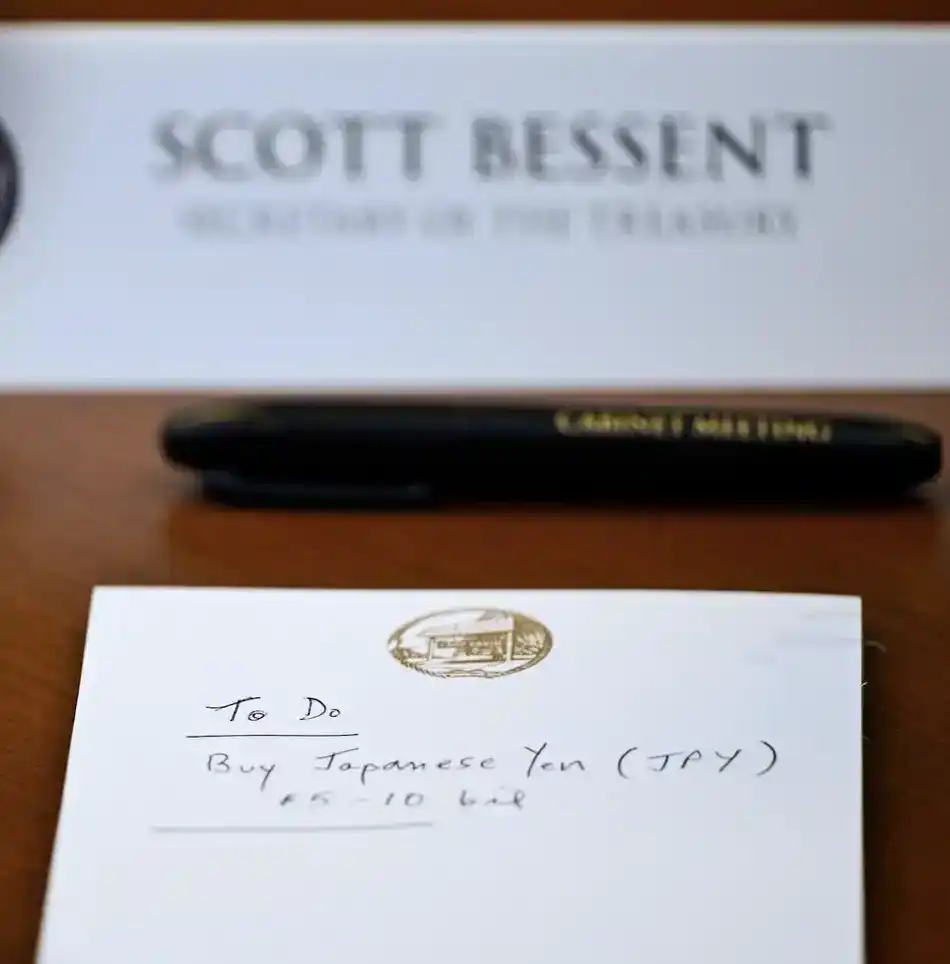
Reuters menerbitkan foto yang menunjukkan buku catatan di hadapan Bessent pada rapat kabinet Jumat. Di bawah judul 'Hal yang Harus Dilakukan', Bessent menulis 'Beli 5 hingga 10 miliar dolar AS yen (JPY)'.

Buku catatan ini tidak dapat membuktikan berapa banyak yen yang akhirnya dibeli oleh AS. Saat foto ini terungkap, Departemen Keuangan AS belum mengonfirmasi jumlah spesifiknya. Informasi kunci yang diberikannya adalah bahwa Departemen Keuangan AS setidaknya serius mempertimbangkan operasi pembelian yen dengan skala nyata, bukan hanya mendukung Jepang dengan pernyataan diplomatik.

Kemudian, konfirmasi resmi intervensi bersama oleh AS dan Jepang semakin meningkatkan signifikansi foto ini bagi pasar. Bessent juga secara terbuka menyatakan bahwa jika diperlukan, AS bersedia mengulangi aksi tersebut. 5 hingga 10 miliar dolar AS mungkin tidak cukup untuk mengubah hubungan permintaan dan penawaran pasar valas global dalam jangka panjang, tetapi cukup untuk membuat short yen berleverage tinggi menghitung ulang titik stop loss dan skala posisi mereka.

Cara intervensi benar-benar berfungsi juga bukan hanya dengan dana resmi secara langsung mendorong kurs.

Saat dolar AS terhadap yen turun dengan cepat, investor yang meminjam yen dan membeli aset dolar akan mengalami kerugian konversi mata uang. Beberapa akun berleverage tinggi perlu menambah margin, beberapa posisi perdagangan tren dan opsi akan memicu stop loss. Proses penutupan posisi mengharuskan investor menjual dolar dan membeli kembali yen, sehingga memperbesar kenaikan yen jangka pendek.

Oleh karena itu, penurunan cepat dari sekitar 164 ke zona 155 hingga 156, mencakup baik transaksi resmi maupun kemungkinan deleverage terpusat dari posisi arbitrase dan posisi tren.
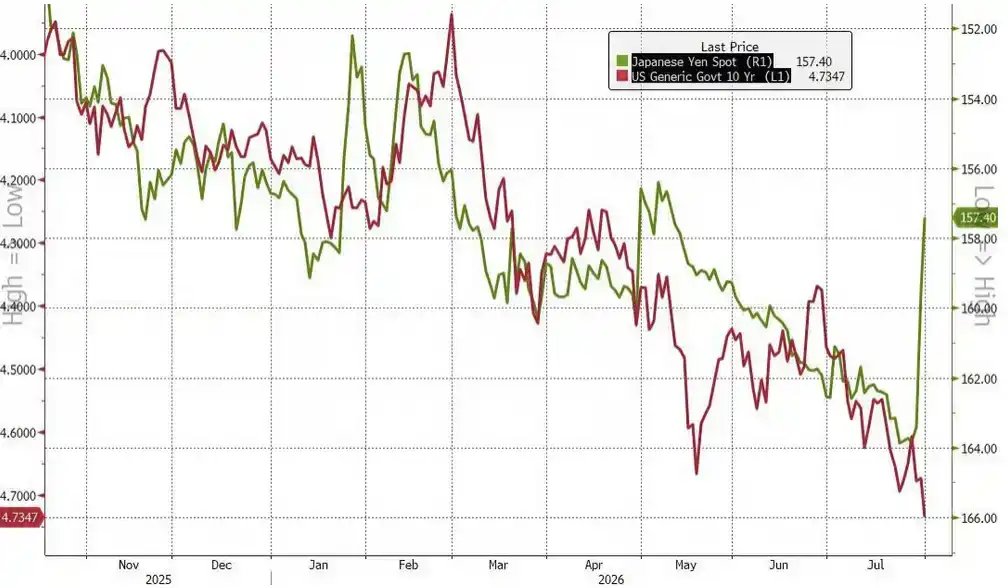
Short Yen Mulai Mundur, Risiko Menyebar ke Aset Global

Arbitrase Yen Belum Berakhir, Tetapi Rasio Imbalan Risiko Transaksi Telah Berubah

Ada pernyataan di pasar tentang 'akhirnya transaksi arbitrase yen', tetapi penilaian ini masih terlalu dini.

The Fed pada 29 Juli mempertahankan target kisaran suku bunga dana federal pada 3.50% hingga 3.75%, sementara Bank of Japan (BOJ) pada 31 Juli mempertahankan suku bunga kebijakan jangka pendek pada 1%. Bahkan tanpa mempertimbangkan biaya lindung nilai, suku bunga jangka pendek AS masih jauh lebih tinggi daripada Jepang, keuntungan dasar dari meminjam yen dan mengalokasikan aset dolar belum hilang.

Intervensi terkoordinasi mengubah rasio risiko-imbalan transaksi ini.

Dulu, investor mungkin menganggap intervensi sepihak Jepang hanya membawa volatilitas singkat, sehingga bersedia membangun kembali posisi short setelah yen rebound. Sekarang, mereka juga harus membayar premi risiko yang lebih tinggi untuk kemungkinan AS masuk kembali, otoritas meningkatkan frekuensi intervensi, serta kemungkinan BOJ menaikkan suku bunga lebih awal.

Oleh karena itu, short yen mungkin mengurangi leverage, memperkecil ukuran posisi, atau membeli lebih banyak perlindungan opsi, tetapi ini tidak berarti dana telah sepenuhnya meninggalkan transaksi selisih bunga. Selama selisih bunga AS-Jepang tetap berada pada level tinggi, setiap rebound yen masih mungkin menghadapi tekanan jual baru.

Penilaian yang lebih akurat adalah: intervensi terkoordinasi mempersempit ruang leverage short yen, tetapi belum menghilangkan dasar makro untuk short yen.

Obligasi AS Ada Risiko Luapan, Tetapi Cara Penyalurannya Telah Berubah

Dampak global intervensi yen tidak hanya di pasar valas, tetapi juga menyangkut bagaimana Jepang mengumpulkan dana dolar yang digunakan untuk membeli yen.

Data TIC Departemen Keuangan AS menunjukkan, hingga akhir Mei 2026, Jepang memegang sekitar 1.143 triliun dolar AS obligasi pemerintah AS, menjadi pemegang terbesar di luar negeri. Data TIC dipengaruhi oleh faktor-faktor seperti kepemilikan rekening kustodian, sehingga tidak mencerminkan kepemilikan akhir secara tepat, namun posisi obligasi AS Jepang yang besar tetap menjadi indikator penting untuk mengamati risiko luapan intervensi.

Rantai operasi tradisional adalah, Kementerian Keuangan Jepang menggunakan cadangan devisa, menjual dolar dan membeli yen di pasar. Jika uang tunai dolar yang ada tidak mencukupi, secara teori dapat menjual aset dolar termasuk obligasi AS. Penjualan obligasi AS dalam skala besar dan berkelanjutan dapat meningkatkan pasokan pasar, memberikan tekanan naik pada imbal hasil jangka panjang AS.

Tetapi rantai penularan ini tidak selalu terjadi.

Bessent mengungkapkan, alat repo FIMA (Foreign and International Monetary Authorities) Federal Reserve yang ditujukan untuk bank sentral asing dan otoritas moneter internasional berperan dalam aksi kali ini. Alat ini memungkinkan lembaga resmi asing untuk menggunakan sementara obligasi AS yang disimpan di Federal Reserve Bank of New York sebagai jaminan, untuk memperoleh pinjaman dolar, sehingga mendapatkan likuiditas dolar yang diperlukan untuk intervensi, tanpa harus langsung menjual obligasi AS. Bessent juga mengusulkan agar alat ini diperluas di masa depan.

Ini berarti, salah satu tujuan koordinasi AS-Jepang mungkin adalah memungkinkan Jepang mendukung yen sambil sebisa mungkin menghindari penjualan terpusat obligasi AS yang mendorong biaya pendanaan AS naik.

Oleh karena itu, risiko obligasi AS perlu dipahami dalam dua lapisan: dalam jangka pendek, alat FIMA dapat menyangga tekanan penjualan terpaksa; jika skala intervensi terus diperluas dan jangka waktunya diperpanjang, Jepang masih mungkin menyesuaikan alokasi aset dolar, barulah pasar obligasi AS akan menghadapi dampak pasokan yang lebih jelas.

Intervensi Mengubah Rasio Imbalan Risiko Jangka Pendek, Selisih Bunga Menentukan Tren Jangka Panjang

Kementerian Keuangan Dapat Membeli Waktu, Bank Sentral Menentukan Tren

Intervensi terkoordinasi dapat mengubah posisi jangka pendek, tetapi sulit untuk sendiri menentukan arah yen jangka menengah-panjang.

BOJ telah secara bertahap keluar dari kebijakan ultra-longgar, suku bunga kebijakan naik menjadi 1%, namun kecepatan pengetatannya masih dibatasi oleh ekonomi domestik, biaya pendanaan pemerintah, dan stabilitas pasar obligasi pemerintah Jepang (JGB). Pada 31 Juli, BOJ dengan hasil voting 8 banding 1 mempertahankan suku bunga tidak berubah, hanya satu anggota komite yang mengusulkan untuk segera menaikkan suku bunga menjadi 1.25%.

Hal ini membuat kebijakan Jepang menghadapi tarik-menarik yang jelas.

Kementerian Keuangan ingin menghentikan depresiasi yen yang terlalu cepat, mengurangi inflasi impor dan tekanan politik; sementara BOJ tidak bisa menaikkan suku bunga dengan cepat hanya untuk nilai tukar, karena dapat mendorong imbal hasil JGB naik, memberatkan beban pendanaan pemerintah, perusahaan, dan rumah tangga.

Intervensi dalam proses ini lebih seperti membeli waktu: dengan menciptakan volatilitas dua arah dan memaksa short yen mengurangi leverage, menciptakan jendela bagi BOJ untuk menormalkan kebijakan secara bertahap.

Tetapi tren nilai tukar pada akhirnya tetap ditentukan oleh fundamental. Jika BOJ terus menaikkan suku bunga, imbal hasil AS turun, selisih bunga AS-Jepang menyempit, rebound yen akan lebih mudah berlanjut; jika selisih bunga tetap tinggi dalam jangka panjang, kenaikan setelah intervensi masih mungkin berangsur-angsur terhapus kembali.

Jarak dengan 'Perjanjian Plaza Baru' Masih Jauh

Pasar sudah muncul narasi besar seperti 'Perjanjian Plaza Baru' dan 'Akhirnya Era Arbitrase Yen', tetapi fakta saat ini belum cukup mendukung penilaian ini.

Perjanjian Plaza 1985 adalah dorongan bersama beberapa ekonomi utama untuk depresiasi dolar AS secara teratur, melibatkan koordinasi kebijakan yang lebih luas dan restrukturisasi nilai tukar global. Cakupan aksi kali ini lebih sempit, target langsungnya adalah menahan depresiasi yen yang berlebihan dan tidak teratur, serta menghindari volatilitas pasar nilai tukar dan obligasi menyebar ke sistem keuangan global.

Pada tahap ini dapat dikonfirmasi bahwa AS dan Jepang telah bersama-sama membeli yen, buku catatan Bessent menunjukkan pihak AS mempertimbangkan operasi skala 5 hingga 10 miliar dolar AS, kedua belah pihak juga secara eksplisit menyisakan kemungkinan untuk melakukan intervensi lagi. Dolar AS terhadap yen kemudian dengan cepat turun dari mendekati 164 ke zona 155 hingga 156.

Ini cukup untuk mengubah perdagangan jangka pendek, tetapi belum cukup untuk membuktikan yen telah memasuki siklus apresiasi jangka panjang.

Selanjutnya, yang benar-benar perlu diamati adalah tiga hal: apakah AS kembali berpartisipasi dalam transaksi nyata, apakah BOJ mempercepat langkah kenaikan suku bunga, dan apakah alat FIMA dapat memungkinkan Jepang terus mendapatkan likuiditas dolar tanpa berdampak signifikan pada pasar obligasi AS.

Sebelum pertanyaan-pertanyaan ini terjawab, short yen tidak akan hilang sepenuhnya. Namun, mereka sudah sulit lagi untuk seperti dulu, dengan mudah bertaruh bahwa intervensi Jepang hanyalah angin singkat yang berlalu.


Trending Cryptos

Related Questions

QApa yang menyebabkan dolar AS terhadap yen Jepang turun dari level mendekati 164 ke kisaran 155-156?

APenurunan tajam ini disebabkan oleh intervensi terkoordinasi yang langka oleh pemerintah AS dan Jepang. Kedua negara secara terbuka mengonfirmasi mereka telah membeli yen bersama-sama. Tindakan ini mengubah ekspektasi pasar, menyebabkan pelaku pasar yang sebelumnya memegang posisi jual yen (short) mulai menutup posisi mereka dengan membeli kembali yen, sehingga mendorong apresiasi yen.

QMengapa intervensi bersama AS-Jepang kali ini dianggap lebih signifikan dibanding intervensi unilateral Jepang sebelumnya?

AIntervensi ini lebih signifikan karena untuk pertama kalinya dalam hampir 30 tahun, Amerika Serikat tidak hanya memberikan dukungan verbal tetapi juga berpartisipasi secara aktif dan terkoordinasi dalam membeli yen. Hal ini mengubah struktur risiko bagi para pedagang yang mempertaruhkan pelemahan yen. Sekarang, mereka harus mempertimbangkan kemungkinan intervensi berulang dari kedua negara, bukan hanya kapasitas dan durasi intervensi unilateral Jepang.

QApa peran alat FIMA Repo Federal Reserve dalam intervensi ini, dan mengapa hal ini penting?

AAlat FIMA (Foreign and International Monetary Authorities) Repo memungkinkan otoritas asing, seperti Kementerian Keuangan Jepang, untuk meminjam dolar AS dengan menggunakan obligasi pemerintah AS yang mereka pegang sebagai jaminan. Ini penting karena memberikan likuiditas dolar yang dibutuhkan Jepang untuk intervensi tanpa harus secara langsung menjual obligasi AS dalam jumlah besar di pasar, yang berpotensi mendorong naik suku bunga AS dan menyebabkan gejolak di pasar obligasi global.

QApakah intervensi ini menandai berakhirnya era carry trade yen Jepang?

ATidak sepenuhnya. Dasar carry trade—yaitu selisih suku bunga yang signifikan antara AS (lebih tinggi) dan Jepang (lebih rendah)—masih ada. Intervensi bersama ini terutama mengubah rasio risiko-imbalan dari perdagangan tersebut. Risiko intervensi berulang dan potensi kenaikan suku bunga Bank of Japan yang lebih cepat telah meningkat, memaksa pedagang untuk mengurangi leverage atau mengambil perlindungan lebih. Ini mempersulit carry trade, tetapi belum menghilangkan landasan makroekonominya selama selisih suku bunga tetap besar.

QFaktor mendasar apa yang akan menentukan tren nilai tukar yen jangka panjang, mengingat intervensi hanya bersifat sementara?

ATren jangka panjang yen pada akhirnya akan ditentukan oleh perbedaan suku bunga fundamental (interest rate differential) antara Amerika Serikat dan Jepang. Intervensi valuta asing dapat membeli waktu dan menciptakan volatilitas jangka pendek, tetapi jika selisih suku bunga AS-Jepang tetap lebar, tekanan pelemahan yen dapat kembali. Perubahan tren berkelanjutan memerlukan konvergensi kebijakan moneter, seperti percepatan kenaikan suku bunga oleh Bank of Japan atau penurunan suku bunga oleh Federal Reserve AS.

Related Reads

XRP Ledger Active Users Approach 200,000

The number of daily active users on the XRP Ledger is approaching 200,000, one of the highest levels in recent months. Despite XRP continuing to trade below key technical resistance, on-chain data shows accelerated network activity, suggesting growing ecosystem usage even as price momentum remains subdued. The increase to roughly 190,800 daily active users has been sustained through late July, marking a significant recovery from levels around 100,000 during the broader market correction. This rise indicates user return driven by sustained engagement rather than just speculative trading. Higher address activity typically reflects broader blockchain adoption and can boost transaction counts, payment volumes, and dApp liquidity—considered healthier indicators than price fluctuations. However, XRP's price has not mirrored this network improvement, currently trading near $1.07 and struggling to break resistance at $1.10. It remains below its 50-day and 100-day moving averages, with a recent attempt to break out of a symmetrical triangle losing momentum. The technical outlook remains mixed; while blockchain activity shows improving fundamentals, price action lacks confirmation of a broader recovery. A decisive break above the 200-day moving average near $1.21 is needed to strengthen the long-term technical outlook. Momentum indicators like the RSI, around 47, show a balanced forecast with reduced selling pressure. In conclusion, XRP Ledger user activity nears a yearly high despite the asset's price being below major technical barriers. Sustained user growth, coupled with a price recovery above key moving averages, could begin to align the technical structure with the strengthening on-chain fundamentals.

cryptonews.ru46m ago

XRP Ledger Active Users Approach 200,000

cryptonews.ru46m ago

ZEC Price Just Surpassed $490 — Here's What Fueled the Rally

ZEC Surges Past $490, Key Drivers Behind the Rally On August 3, the privacy-focused cryptocurrency Zcash (ZEC) surged nearly 5%, climbing over $20 in a six-hour rally to a session high near $494. This move helped ZEC's market cap reclaim $8 billion, solidifying its position as the most valuable privacy coin and marking an almost 8% gain for the month. While benefiting from a broader market uptrend, ZEC's outperformance was driven by significant fundamental catalysts. The primary driver was the integration by privacy infrastructure project Nym of Zcash's new shielded pool, Ironwood. This enables direct, end-to-end private payments in ZEC for network services, a landmark development for privacy-first decentralized finance. The rally coincides with renewed industry focus on privacy as digital assets mature. Industry observers note privacy is becoming the "next frontier," evolving from Bitcoin's proof-of-concept to Ethereum's programmability and Solana's scalability. Commentary highlighted that true privacy, via zero-knowledge (ZK) technology which is now production-ready, was a foundational goal for early crypto pioneers. Further momentum came from Zcash's progress in decentralized governance, launching a retroactive grant funding (RetroPGF-like) program. This shifts treasury fund distribution from closed committees to direct coin holder voting, pioneering a privacy-native funding mechanism. ZEC's surge helped push the total market capitalization of privacy-focused coins above $30 billion. Other notable gainers included NEAR, ZK, and NOCK. However, losses in coins like ZANO, ZBT, and a significant drop in last week's leader COTI partially offset the sector's overall gains.

cryptonews.ru1h ago

ZEC Price Just Surpassed $490 — Here's What Fueled the Rally

cryptonews.ru1h ago

Trading

Spot

Hot Articles

What is SONIC

Sonic: Pioneering the Future of Gaming in Web3 Introduction to Sonic In the ever-evolving landscape of Web3, the gaming industry stands out as one of the most dynamic and promising sectors. At the forefront of this revolution is Sonic, a project designed to amplify the gaming ecosystem on the Solana blockchain. Leveraging cutting-edge technology, Sonic aims to deliver an unparalleled gaming experience by efficiently processing millions of requests per second, ensuring that players enjoy seamless gameplay while maintaining low transaction costs. This article delves into the intricate details of Sonic, exploring its creators, funding sources, operational mechanics, and the timeline of significant events that have shaped its journey. What is Sonic? Sonic is an innovative layer-2 network that operates atop the Solana blockchain, specifically tailored to enhance the existing Solana gaming ecosystem. It accomplishes this through a customised, VM-agnostic game engine paired with a HyperGrid interpreter, facilitating sovereign game economies that roll up back to the Solana platform. The primary goals of Sonic include: Enhanced Gaming Experiences: Sonic is committed to offering lightning-fast on-chain gameplay, allowing players and developers to engage with games at previously unattainable speeds. Atomic Interoperability: This feature enables transactions to be executed within Sonic without the need to redeploy Solana programmes and accounts. This makes the process more efficient and directly benefits from Solana Layer1 services and liquidity. Seamless Deployment: Sonic allows developers to write for Ethereum Virtual Machine (EVM) based systems and execute them on Solana’s SVM infrastructure. This interoperability is crucial for attracting a broader range of dApps and decentralised applications to the platform. Support for Developers: By offering native composable gaming primitives and extensible data types - dining within the Entity-Component-System (ECS) framework - game creators can craft intricate business logic with ease. Overall, Sonic's unique approach not only caters to players but also provides an accessible and low-cost environment for developers to innovate and thrive. Creator of Sonic The information regarding the creator of Sonic is somewhat ambiguous. However, it is known that Sonic's SVM is owned by the company Mirror World. The absence of detailed information about the individuals behind Sonic reflects a common trend in several Web3 projects, where collective efforts and partnerships often overshadow individual contributions. Investors of Sonic Sonic has garnered considerable attention and support from various investors within the crypto and gaming sectors. Notably, the project raised an impressive $12 million during its Series A funding round. The round was led by BITKRAFT Ventures, with other notable investors including Galaxy, Okx Ventures, Interactive, Big Brain Holdings, and Mirana. This financial backing signifies the confidence that investment foundations have in Sonic’s potential to revolutionise the Web3 gaming landscape, further validating its innovative approaches and technologies. How Does Sonic Work? Sonic utilises the HyperGrid framework, a sophisticated parallel processing mechanism that enhances its scalability and customisability. Here are the core features that set Sonic apart: Lightning Speed at Low Costs: Sonic offers one of the fastest on-chain gaming experiences compared to other Layer-1 solutions, powered by the scalability of Solana’s virtual machine (SVM). Atomic Interoperability: Sonic enables transaction execution without redeployment of Solana programmes and accounts, effectively streamlining the interaction between users and the blockchain. EVM Compatibility: Developers can effortlessly migrate decentralised applications from EVM chains to the Solana environment using Sonic’s HyperGrid interpreter, increasing the accessibility and integration of various dApps. Ecosystem Support for Developers: By exposing native composable gaming primitives, Sonic facilitates a sandbox-like environment where developers can experiment and implement business logic, greatly enhancing the overall development experience. Monetisation Infrastructure: Sonic natively supports growth and monetisation efforts, providing frameworks for traffic generation, payments, and settlements, thereby ensuring that gaming projects are not only viable but also sustainable financially. Timeline of Sonic The evolution of Sonic has been marked by several key milestones. Below is a brief timeline highlighting critical events in the project's history: 2022: The Sonic cryptocurrency was officially launched, marking the beginning of its journey in the Web3 gaming arena. 2024: June: Sonic SVM successfully raised $12 million in a Series A funding round. This investment allowed Sonic to further develop its platform and expand its offerings. August: The launch of the Sonic Odyssey testnet provided users with the first opportunity to engage with the platform, offering interactive activities such as collecting rings—a nod to gaming nostalgia. October: SonicX, an innovative crypto game integrated with Solana, made its debut on TikTok, capturing the attention of over 120,000 users within a short span. This integration illustrated Sonic’s commitment to reaching a broader, global audience and showcased the potential of blockchain gaming. Key Points Sonic SVM is a revolutionary layer-2 network on Solana explicitly designed to enhance the GameFi landscape, demonstrating great potential for future development. HyperGrid Framework empowers Sonic by introducing horizontal scaling capabilities, ensuring that the network can handle the demands of Web3 gaming. Integration with Social Platforms: The successful launch of SonicX on TikTok displays Sonic’s strategy to leverage social media platforms to engage users, exponentially increasing the exposure and reach of its projects. Investment Confidence: The substantial funding from BITKRAFT Ventures, among others, emphasizes the robust backing Sonic has, paving the way for its ambitious future. In conclusion, Sonic encapsulates the essence of Web3 gaming innovation, striking a balance between cutting-edge technology, developer-centric tools, and community engagement. As the project continues to evolve, it is poised to redefine the gaming landscape, making it a notable entity for gamers and developers alike. As Sonic moves forward, it will undoubtedly attract greater interest and participation, solidifying its place within the broader narrative of blockchain gaming.

2.2k Total ViewsPublished 2024.04.04Updated 2024.12.03

What is SONIC

What is $S$

Understanding SPERO: A Comprehensive Overview Introduction to SPERO As the landscape of innovation continues to evolve, the emergence of web3 technologies and cryptocurrency projects plays a pivotal role in shaping the digital future. One project that has garnered attention in this dynamic field is SPERO, denoted as SPERO,$$s$. This article aims to gather and present detailed information about SPERO, to help enthusiasts and investors understand its foundations, objectives, and innovations within the web3 and crypto domains. What is SPERO,$$s$? SPERO,$$s$ is a unique project within the crypto space that seeks to leverage the principles of decentralisation and blockchain technology to create an ecosystem that promotes engagement, utility, and financial inclusion. The project is tailored to facilitate peer-to-peer interactions in new ways, providing users with innovative financial solutions and services. At its core, SPERO,$$s$ aims to empower individuals by providing tools and platforms that enhance user experience in the cryptocurrency space. This includes enabling more flexible transaction methods, fostering community-driven initiatives, and creating pathways for financial opportunities through decentralised applications (dApps). The underlying vision of SPERO,$$s$ revolves around inclusiveness, aiming to bridge gaps within traditional finance while harnessing the benefits of blockchain technology. Who is the Creator of SPERO,$$s$? The identity of the creator of SPERO,$$s$ remains somewhat obscure, as there are limited publicly available resources providing detailed background information on its founder(s). This lack of transparency can stem from the project's commitment to decentralisation—an ethos that many web3 projects share, prioritising collective contributions over individual recognition. By centring discussions around the community and its collective goals, SPERO,$$s$ embodies the essence of empowerment without singling out specific individuals. As such, understanding the ethos and mission of SPERO remains more important than identifying a singular creator. Who are the Investors of SPERO,$$s$? SPERO,$$s$ is supported by a diverse array of investors ranging from venture capitalists to angel investors dedicated to fostering innovation in the crypto sector. The focus of these investors generally aligns with SPERO's mission—prioritising projects that promise societal technological advancement, financial inclusivity, and decentralised governance. These investor foundations are typically interested in projects that not only offer innovative products but also contribute positively to the blockchain community and its ecosystems. The backing from these investors reinforces SPERO,$$s$ as a noteworthy contender in the rapidly evolving domain of crypto projects. How Does SPERO,$$s$ Work? SPERO,$$s$ employs a multi-faceted framework that distinguishes it from conventional cryptocurrency projects. Here are some of the key features that underline its uniqueness and innovation: Decentralised Governance: SPERO,$$s$ integrates decentralised governance models, empowering users to participate actively in decision-making processes regarding the project’s future. This approach fosters a sense of ownership and accountability among community members. Token Utility: SPERO,$$s$ utilises its own cryptocurrency token, designed to serve various functions within the ecosystem. These tokens enable transactions, rewards, and the facilitation of services offered on the platform, enhancing overall engagement and utility. Layered Architecture: The technical architecture of SPERO,$$s$ supports modularity and scalability, allowing for seamless integration of additional features and applications as the project evolves. This adaptability is paramount for sustaining relevance in the ever-changing crypto landscape. Community Engagement: The project emphasises community-driven initiatives, employing mechanisms that incentivise collaboration and feedback. By nurturing a strong community, SPERO,$$s$ can better address user needs and adapt to market trends. Focus on Inclusion: By offering low transaction fees and user-friendly interfaces, SPERO,$$s$ aims to attract a diverse user base, including individuals who may not previously have engaged in the crypto space. This commitment to inclusion aligns with its overarching mission of empowerment through accessibility. Timeline of SPERO,$$s$ Understanding a project's history provides crucial insights into its development trajectory and milestones. Below is a suggested timeline mapping significant events in the evolution of SPERO,$$s$: Conceptualisation and Ideation Phase: The initial ideas forming the basis of SPERO,$$s$ were conceived, aligning closely with the principles of decentralisation and community focus within the blockchain industry. Launch of Project Whitepaper: Following the conceptual phase, a comprehensive whitepaper detailing the vision, goals, and technological infrastructure of SPERO,$$s$ was released to garner community interest and feedback. Community Building and Early Engagements: Active outreach efforts were made to build a community of early adopters and potential investors, facilitating discussions around the project’s goals and garnering support. Token Generation Event: SPERO,$$s$ conducted a token generation event (TGE) to distribute its native tokens to early supporters and establish initial liquidity within the ecosystem. Launch of Initial dApp: The first decentralised application (dApp) associated with SPERO,$$s$ went live, allowing users to engage with the platform's core functionalities. Ongoing Development and Partnerships: Continuous updates and enhancements to the project's offerings, including strategic partnerships with other players in the blockchain space, have shaped SPERO,$$s$ into a competitive and evolving player in the crypto market. Conclusion SPERO,$$s$ stands as a testament to the potential of web3 and cryptocurrency to revolutionise financial systems and empower individuals. With a commitment to decentralised governance, community engagement, and innovatively designed functionalities, it paves the way toward a more inclusive financial landscape. As with any investment in the rapidly evolving crypto space, potential investors and users are encouraged to research thoroughly and engage thoughtfully with the ongoing developments within SPERO,$$s$. The project showcases the innovative spirit of the crypto industry, inviting further exploration into its myriad possibilities. While the journey of SPERO,$$s$ is still unfolding, its foundational principles may indeed influence the future of how we interact with technology, finance, and each other in interconnected digital ecosystems.

295 Total ViewsPublished 2024.12.17Updated 2024.12.17

What is $S$

What is AGENT S

Agent S: The Future of Autonomous Interaction in Web3 Introduction In the ever-evolving landscape of Web3 and cryptocurrency, innovations are constantly redefining how individuals interact with digital platforms. One such pioneering project, Agent S, promises to revolutionise human-computer interaction through its open agentic framework. By paving the way for autonomous interactions, Agent S aims to simplify complex tasks, offering transformative applications in artificial intelligence (AI). This detailed exploration will delve into the project's intricacies, its unique features, and the implications for the cryptocurrency domain. What is Agent S? Agent S stands as a groundbreaking open agentic framework, specifically designed to tackle three fundamental challenges in the automation of computer tasks: Acquiring Domain-Specific Knowledge: The framework intelligently learns from various external knowledge sources and internal experiences. This dual approach empowers it to build a rich repository of domain-specific knowledge, enhancing its performance in task execution. Planning Over Long Task Horizons: Agent S employs experience-augmented hierarchical planning, a strategic approach that facilitates efficient breakdown and execution of intricate tasks. This feature significantly enhances its ability to manage multiple subtasks efficiently and effectively. Handling Dynamic, Non-Uniform Interfaces: The project introduces the Agent-Computer Interface (ACI), an innovative solution that enhances the interaction between agents and users. Utilizing Multimodal Large Language Models (MLLMs), Agent S can navigate and manipulate diverse graphical user interfaces seamlessly. Through these pioneering features, Agent S provides a robust framework that addresses the complexities involved in automating human interaction with machines, setting the stage for myriad applications in AI and beyond. Who is the Creator of Agent S? While the concept of Agent S is fundamentally innovative, specific information about its creator remains elusive. The creator is currently unknown, which highlights either the nascent stage of the project or the strategic choice to keep founding members under wraps. Regardless of anonymity, the focus remains on the framework's capabilities and potential. Who are the Investors of Agent S? As Agent S is relatively new in the cryptographic ecosystem, detailed information regarding its investors and financial backers is not explicitly documented. The lack of publicly available insights into the investment foundations or organisations supporting the project raises questions about its funding structure and development roadmap. Understanding the backing is crucial for gauging the project's sustainability and potential market impact. How Does Agent S Work? At the core of Agent S lies cutting-edge technology that enables it to function effectively in diverse settings. Its operational model is built around several key features: Human-like Computer Interaction: The framework offers advanced AI planning, striving to make interactions with computers more intuitive. By mimicking human behaviour in tasks execution, it promises to elevate user experiences. Narrative Memory: Employed to leverage high-level experiences, Agent S utilises narrative memory to keep track of task histories, thereby enhancing its decision-making processes. Episodic Memory: This feature provides users with step-by-step guidance, allowing the framework to offer contextual support as tasks unfold. Support for OpenACI: With the ability to run locally, Agent S allows users to maintain control over their interactions and workflows, aligning with the decentralised ethos of Web3. Easy Integration with External APIs: Its versatility and compatibility with various AI platforms ensure that Agent S can fit seamlessly into existing technological ecosystems, making it an appealing choice for developers and organisations. These functionalities collectively contribute to Agent S's unique position within the crypto space, as it automates complex, multi-step tasks with minimal human intervention. As the project evolves, its potential applications in Web3 could redefine how digital interactions unfold. Timeline of Agent S The development and milestones of Agent S can be encapsulated in a timeline that highlights its significant events: September 27, 2024: The concept of Agent S was launched in a comprehensive research paper titled “An Open Agentic Framework that Uses Computers Like a Human,” showcasing the groundwork for the project. October 10, 2024: The research paper was made publicly available on arXiv, offering an in-depth exploration of the framework and its performance evaluation based on the OSWorld benchmark. October 12, 2024: A video presentation was released, providing a visual insight into the capabilities and features of Agent S, further engaging potential users and investors. These markers in the timeline not only illustrate the progress of Agent S but also indicate its commitment to transparency and community engagement. Key Points About Agent S As the Agent S framework continues to evolve, several key attributes stand out, underscoring its innovative nature and potential: Innovative Framework: Designed to provide an intuitive use of computers akin to human interaction, Agent S brings a novel approach to task automation. Autonomous Interaction: The ability to interact autonomously with computers through GUI signifies a leap towards more intelligent and efficient computing solutions. Complex Task Automation: With its robust methodology, it can automate complex, multi-step tasks, making processes faster and less error-prone. Continuous Improvement: The learning mechanisms enable Agent S to improve from past experiences, continually enhancing its performance and efficacy. Versatility: Its adaptability across different operating environments like OSWorld and WindowsAgentArena ensures that it can serve a broad range of applications. As Agent S positions itself in the Web3 and crypto landscape, its potential to enhance interaction capabilities and automate processes signifies a significant advancement in AI technologies. Through its innovative framework, Agent S exemplifies the future of digital interactions, promising a more seamless and efficient experience for users across various industries. Conclusion Agent S represents a bold leap forward in the marriage of AI and Web3, with the capacity to redefine how we interact with technology. While still in its early stages, the possibilities for its application are vast and compelling. Through its comprehensive framework addressing critical challenges, Agent S aims to bring autonomous interactions to the forefront of the digital experience. As we move deeper into the realms of cryptocurrency and decentralisation, projects like Agent S will undoubtedly play a crucial role in shaping the future of technology and human-computer collaboration.

962 Total ViewsPublished 2025.01.14Updated 2025.01.14

What is AGENT S

Discussions

Welcome to the HTX Community. Here, you can stay informed about the latest platform developments and gain access to professional market insights. Users' opinions on the price of S (S) are presented below.

活动图片