Bank of Italy Finds No Systemic Advantages of Stablecoins in Transfers

cryptonews.ruPublished on 2026-08-02Last updated on 2026-08-02

Abstract

A study by the Bank of Italy found that stablecoins do not offer a consistent advantage in cost or speed for cross-border money transfers. The research compared sending 200 USDC in 10 bilateral corridors (Italy to Brazil, Argentina, Japan, UAE, and South Africa) against standard money transfer services. While the final cost of stablecoin transfers ranged from 0.3% to nearly 9%, and were often cheaper than the global average cost of 6.65%, they only outperformed services like Wise in three out of seven comparable corridors. Key costs and delays were attributed to fees for converting to and from fiat currency and the quality of local payment infrastructure, not blockchain fees. Transfer times varied from under 20 minutes in corridors with instant payment systems to one or two business days where such infrastructure was lacking. The authors concluded that stablecoins' benefits would be more significant if they could be spent directly without conversion and noted that overly restrictive regulations complicate retail use without eliminating demand.

A study by the Bank of Italy has shown that stablecoins do not provide a sustained advantage in terms of price and speed for money transfers. All benefits are lost on fees for depositing and withdrawing into fiat currency and in the processes of local payment infrastructure operations.

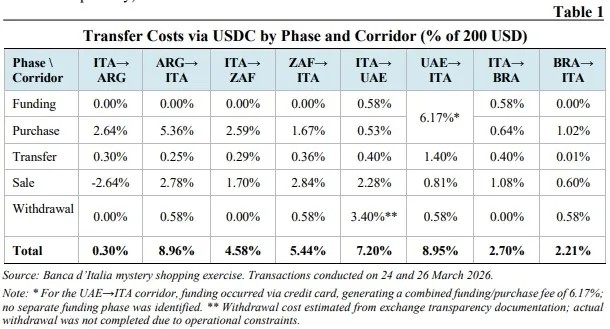
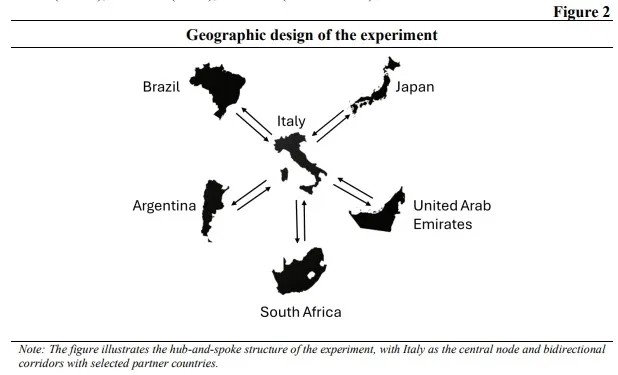
The authors compared transfers of 200 USDC across 10 bilateral corridors between Italy and Brazil, Argentina, Japan, the UAE, and South Africa. Metrics—total cost and settlement times—were compared with standard money transfer services.

Source: Bank of Italy.

The final cost of stablecoin transfers ranged from 0.3% to nearly 9%, depending on the direction. In corridors where instant payment systems operated, settlements took less than 20 minutes. Where such infrastructure was absent, timelines stretched to one to two business days.

Source: Bank of Italy.

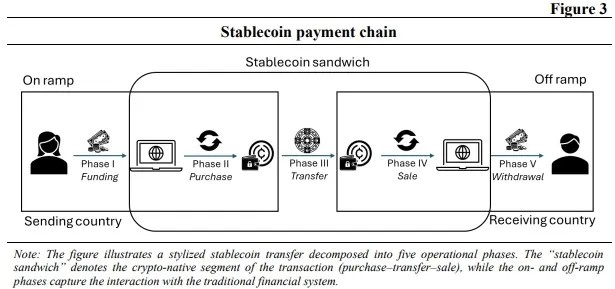
The researchers linked key costs and delays to currency exchange and conversion, as well as the quality of local infrastructure. Blockchain fees, they estimated, were not the main factor.

Source: Bank of Italy.

The global average cost of remittances, according to World Bank data, is 6.65%. In most of the corridors studied, stablecoins were cheaper than this level, but compared to Wise, the advantage was only in three out of seven comparable directions.

The authors believe the effect would be more noticeable if stablecoins could be spent directly on goods and services without back-conversion to local currency.

They also noted that prohibitive regulatory regimes do not eliminate the demand for "stable coins," and overly strict rules complicate the use of such tools by retail clients.

Recall that in July, the total market capitalization of stablecoins fell by more than $10 billion from the May peak—to ~$310 billion. The outflow was the largest monthly drop since the Terra collapse in May 2022.

Trending Cryptos

Related Questions

QWhat was the main finding of the Bank of Italy's research regarding stablecoins?

AThe Bank of Italy's research found that stablecoins do not provide a sustainable advantage in price and speed for money transfers. All benefits are lost on fees for converting to/from fiat currency and within local payment infrastructure processes.

QWhat were the cost and time results for stablecoin transfers in corridors with instant payment systems?

AIn corridors where instant payment systems were operational, settlements took less than 20 minutes. The final cost of stablecoin transfers ranged from 0.3% to almost 9%, depending on the direction.

QWhat did the researchers identify as the key sources of cost and delay in stablecoin transfers?

AThe researchers linked the key costs and delays to currency exchange and conversion processes, as well as the quality of local infrastructure. They noted that blockchain fees were not the main factor.

QHow did the cost of stablecoin transfers compare to the global average cost of remittances and to the service Wise?

AThe global average cost for money transfers is 6.65%. Stablecoins were cheaper than this level in most corridors studied. However, compared to Wise, stablecoins were cheaper in only three out of seven comparable directions.

QAccording to the researchers, what two factors could improve the effectiveness of stablecoins for payments?

AThe researchers believe the effect would be more noticeable if stablecoins could be spent directly on goods and services without conversion back to local currency. They also noted that overly restrictive regulations complicate the use of such tools for retail clients without eliminating demand.

Related Reads

Meme Traders Rush to Meme Token Cyberleek Amid GTA VI Leak Controversy

Memecoin traders are targeting the Solana-based meme token CYBERLEEK amid the controversy over recent GTA VI leaks. The token was launched by the same anonymous source, using the alias CyberLeek, who has been posting stolen GTA VI development footage online since around August 18th. Blockchain trackers show the token's address was embedded within the leaked images. While Rockstar Games has been issuing copyright takedowns, the CYBERLEEK token rapidly gained traction, reportedly raising $3.6 million shortly after launch. Its current market cap exceeds $14 million, though its price has been volatile. CyberLeek presents the campaign as a protest against digital-only sales, paid single-player DLC, and games becoming unplayable after server shutdowns, claiming token sale proceeds will fund infrastructure and a "special project." However, no roadmap or details have been confirmed. The activist group Stop Killing Games has publicly disavowed any connection to the leaks, stating the motive appears to be memecoin promotion. Take-Two Interactive, Rockstar's parent company, is reportedly investigating the source, including issuing subpoenas to platforms like Discord. Analysts and trackers label CYBERLEEK a highly speculative asset with no functional history or verified ties to Rockstar, warning of potential fraud. GTA VI is officially scheduled for release on November 19th for PS5 and Xbox Series X|S.

cryptonews.ru26m ago

Meme Traders Rush to Meme Token Cyberleek Amid GTA VI Leak Controversy

cryptonews.ru26m ago

Trading

Spot

Hot Articles

What is $BANK

Bank AI: A Revolutionary Step in the Future of Banking Introduction In an era marked by rapid advancements in technology, Bank AI stands at the intersection of artificial intelligence (AI) and banking services. This innovative project seeks to redefine the financial landscape, enhancing operational efficiency, security measures, and customer experiences through the power of AI. As we embark on this exploration of Bank AI, we will delve into what the project entails, its operational dynamics, its historical context, and significant milestones. What is Bank AI? At its core, Bank AI represents a transformative initiative aimed at integrating artificial intelligence into various banking operations. This project harnesses the capabilities of AI to automate processes, improve risk management protocols, and enhance customer interaction through personalised services. The primary objectives of Bank AI include: Automation of Banking Functions: By leveraging AI technologies, Bank AI aims to automate routine tasks, reducing the burden on human resources and enhancing efficiency. Enhanced Risk Management: The project utilises AI algorithms to predict and identify risks, thereby fortifying security measures against fraud and other threats. Personalisation of Banking Services: Bank AI focuses on offering tailored financial products and services by analysing customer data and behaviours. Improving Customer Experience: The implementation of AI-driven solutions, such as chatbots and virtual assistants, aims to provide users with more human-like interactions, revolutionising the way customers engage with banks. With these goals, Bank AI positions itself as a crucial player in rendering banking more efficient, secure, and user-centric. Who is the Creator of Bank AI? Details regarding the creator of Bank AI remain unknown. As such, no specific individual or organisation has been identified in the available information. The anonymity surrounding the project's inception raises questions but does not detract from its ambitious vision and objectives. Who are the Investors of Bank AI? Similar to the project's creator, specific information regarding the investors or supporting organisations of Bank AI has not been disclosed. Without this information, it is challenging to outline the financial backing and institutional support that might be propelling the project forward. Nevertheless, the importance of having a robust investment foundation is pivotal for sustaining development in such an innovative field. How Does Bank AI Work? Bank AI operates on several innovative fronts, focusing on unique factors that differentiate it from traditional banking frameworks. Below are key operational features: Automation: By applying machine learning algorithms, Bank AI automates various manual processes within banks. This results in reduced operational costs and allows human workers to redirect their efforts towards more strategic activities. Advanced Risk Management: The integration of AI into risk management practices equips banks with tools to accurately predict potential threats such as fraud, ensuring that customer information and assets remain secure. Tailored Financial Recommendations: Through continuous learning from customer interactions, the AI systems develop a nuanced understanding of user needs, enabling them to offer tailored advice on financial decisions. Enhanced Customer Interactions: Utilizing chatbots and virtual assistants powered by AI, Bank AI enables a more engaging customer experience, allowing users to have their queries resolved quickly, thus reducing wait times and improving satisfaction levels. Together, these operational features position Bank AI as a pioneer in the banking sector, establishing new benchmarks for service delivery and operational excellence. Timeline of Bank AI Understanding the trajectory of Bank AI requires a look at its historical context. Below is a timeline highlighting important milestones and developments: Early 2010s: The conceptualisation of AI integration into banking services began to gain attention as banking institutions recognised the potential benefits. 2018: A marked increase in the implementation of AI technologies occurred when banks started using AI tools like chatbots for basic customer service and risk management systems for improved security handling. 2023: The sophistication of AI continued to advance, with generative AI being introduced for more complex tasks such as document processing and real-time investment analysis. This year marked a significant leap in the capabilities afforded to banks by AI technology. 2024-Current Status: As of this year, Bank AI is on an upward trajectory, with ongoing research and developments poised to further enhance capabilities in banking operations. Continued exploration of AI applications hints at exciting developments yet to come. Key Points About Bank AI Integration of AI in Banking: Bank AI focuses on adopting artificial intelligence to streamline banking processes and improve user experiences. Automation and Risk Management Focus: The project strongly emphasises these areas, aiming to shift the burden of routine tasks while enhancing security frameworks through predictive analytics. Personalised Banking Solutions: By harnessing customer data, Bank AI enables tailored banking services that cater to individual user needs. Commitment to Development: Bank AI remains committed to ongoing research and development efforts, ensuring its adaptability and ongoing relevance as technology continues to evolve. Conclusion In summary, Bank AI exemplifies a crucial step forward in the banking industry, leveraging artificial intelligence to reshape operational paradigms, enhance security, and promote customer satisfaction. Despite gaps in information surrounding the creator and investors, the clear objectives and functional mechanisms of Bank AI provide a strong foundation for its ongoing evolution. As AI technology continues to advance and merge with the banking sector, Bank AI is well-positioned to significantly impact the future of financial services, enhancing the way we understand and interact with banking.

418 Total ViewsPublished 2024.04.06Updated 2024.12.03
What is $BANK

Discussions

Welcome to the HTX Community. Here, you can stay informed about the latest platform developments and gain access to professional market insights. Users' opinions on the price of BANK (BANK) are presented below.

活动图片