Les ETF Bitcoin enregistrent un flux net positif pour la première fois depuis avril

cryptonews.ruPublished on 2026-08-01Last updated on 2026-08-01

Abstract

Les ETF spot américains sur Bitcoin ont enregistré un afflux net de 172,4 millions de dollars en juillet, mettant fin à deux mois consécutifs de sorties de fonds, selon SoSoValue. Ce résultat positif a été obtenu malgré une fin de mois volatile, avec une sortie record de 265,4 millions de dollars rien que le 31 juillet. Cependant, depuis début 2026, ces ETF Bitcoin affichent toujours un retrait net cumulé d'environ 5,29 milliards de dollars. Seuls mars, avril et juillet ont été positifs. Depuis leur lancement, ces produits ont attiré 51,32 milliards de dollars d'investissements. Les ETF spot sur Ethereum ont réalisé une meilleure performance en juillet, avec un afflux net de 365,2 millions de dollars, marquant ainsi quatre semaines consécutives de croissance. Néanmoins, leur résultat cumulé depuis janvier reste négatif. Les produits liés au XRP ont également suscité un intérêt constant, attirant 27,3 millions de dollars en juillet. Les ETF sur Solana ont, quant à eux, reçu 14,6 millions de dollars.

En juillet, les fonds négociés en bourse (ETF) américains au comptant basés sur la première cryptomonnaie ont attiré 172,4 millions de dollars, mettant fin à une série de deux mois de sorties de capitaux. C'est ce que révèlent les données de SoSoValue.
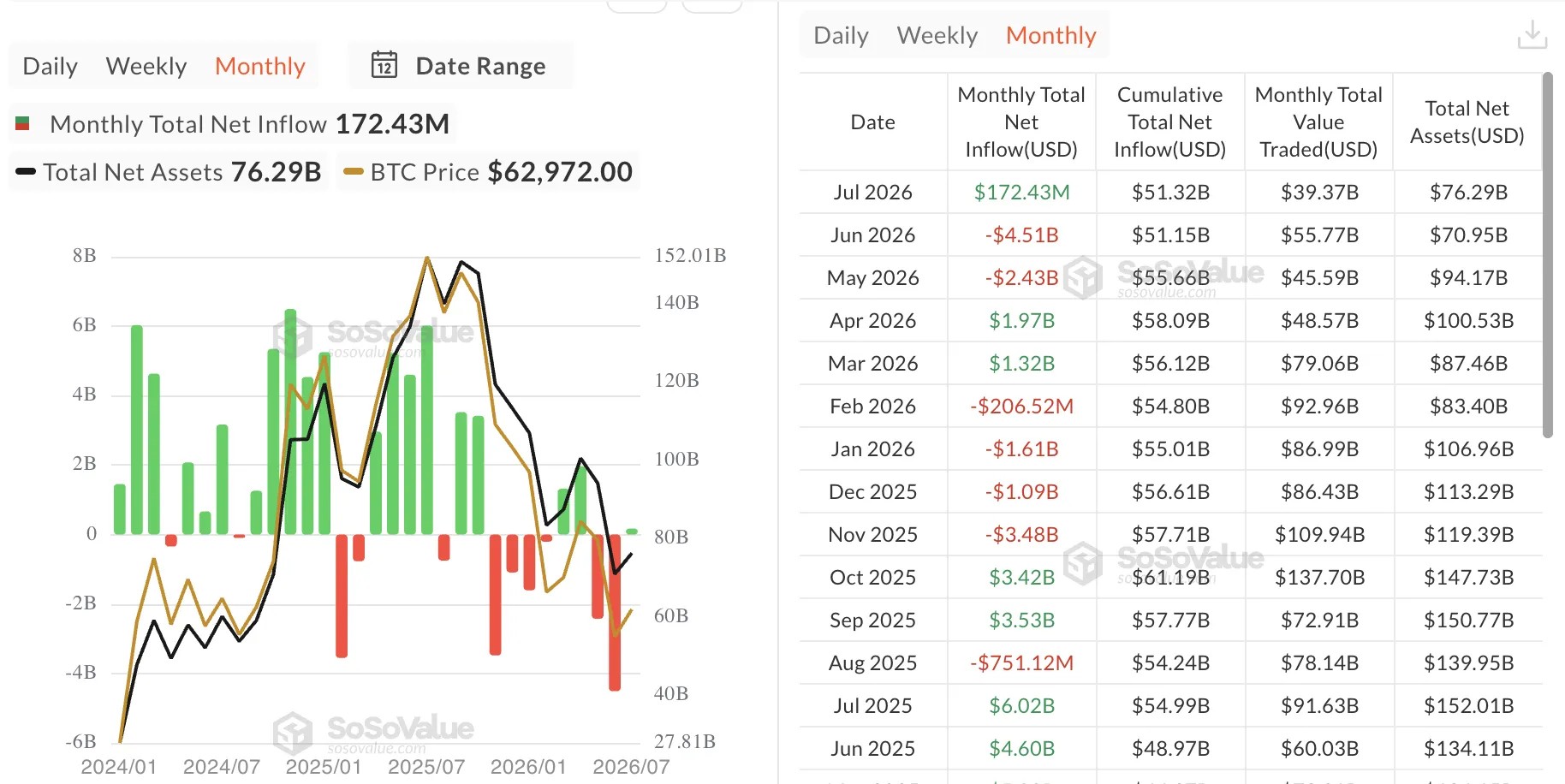
Source : SoSoValue.

Ce résultat positif s'est formé malgré une fin de mois volatile. Vendredi 31 juillet, les ETF ont perdu 265,4 millions de dollars, ce qui constitue la plus importante sortie quotidienne depuis le 13 juillet. La dernière semaine a également été négative : la sortie nette s'est élevée à 61,53 millions de dollars.

Le retour des entrées a changé la donne après près de 7 milliards de dollars retirés des produits au cours des deux mois précédents. Le principal impact est survenu en juin, lorsque la sortie nette a atteint 4,5 milliards de dollars – le pire résultat mensuel depuis le lancement des produits en janvier 2024.

Les fonds restent dans le rouge depuis le début de l'année

Malgré le résultat de juillet, la sortie nette cumulée des ETF américains au comptant sur Bitcoin depuis début 2026 s'élève à environ 5,29 milliards de dollars.

Seuls trois mois – mars, avril et juillet – ont affiché une dynamique positive, apportant collectivement 3,46 milliards de dollars aux fonds. Les mois de janvier, février, mai et juin ont quant à eux subi environ 8,75 milliards de dollars de sorties de capitaux.

Pendant toute leur période d'activité, ces produits ont attiré 51,32 milliards de dollars d'investissements. L'actif net total des ETF Bitcoin fin juillet était évalué à 76,29 milliards de dollars.

Les ETF Ethereum enregistrent le meilleur résultat mensuel

Les ETF au comptant sur Ethereum ont terminé juillet avec une entrée nette de 365,2 millions de dollars, enregistrant quatre semaines consécutives de dynamique positive.
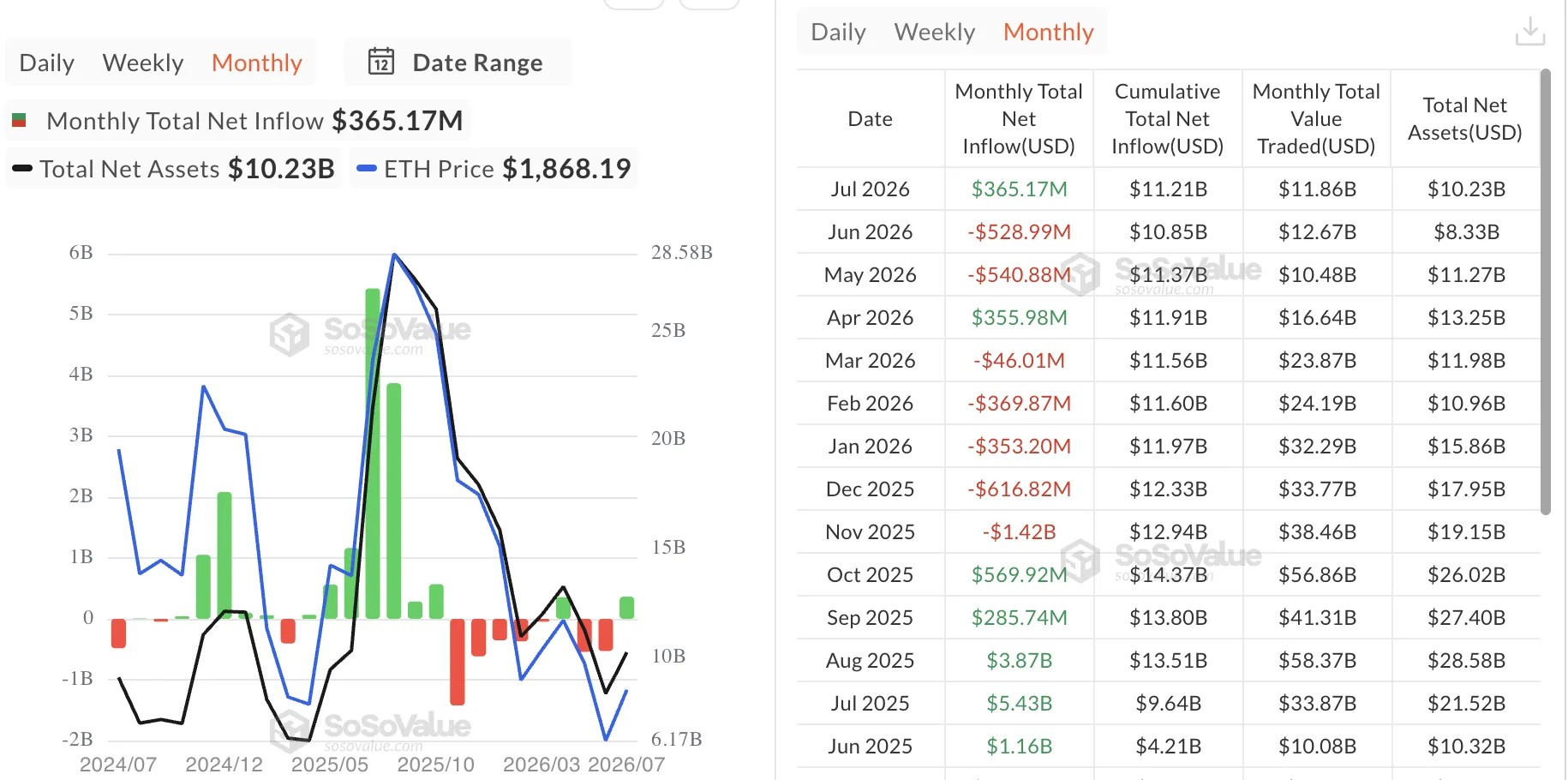
Source : SoSoValue.

Pour ces produits, le mois a été le deuxième rentable depuis le début de l'année – le précédent était avril avec un indicateur de 356 millions de dollars. Le résultat cumulé des fonds basés sur la principale altcoin reste négatif et s'élève à environ 1,1 milliard de dollars.

Une demande soutenue s'est également maintenue pour les structures XRP, qui ont attiré 27,3 millions de dollars. Depuis début 2024, ces produits ont reçu environ 343 millions de dollars – l'un des meilleurs indicateurs parmi les ETF cryptographiques. Les instruments basés sur Solana ont quant à eux bénéficié d'injections de 14,6 millions de dollars sur le mois.

Rappelons qu'à la fin du mois de juillet, les volumes d'échange sur le marché des actifs numériques se sont approchés de leur plus bas niveau depuis novembre 2023.

end-content

Trending Cryptos

Related Questions

QAprès combien de mois de sorties nettes les ETF spot américains sur Bitcoin ont-ils enregistré un mois d'afflux net de capitaux en juillet ?

AAprès deux mois consécutifs de sorties nettes (mai et juin).

QQuel a été l'afflux net approximatif dans les ETF spot Bitcoin américains au mois de juillet 2026, selon les données de SoSoValue ?

AL'afflux net a été de 172,4 millions de dollars.

QQuel a été le résultat cumulé (afflux ou sortie nette) des ETF spot Bitcoin américains depuis le début de l'année 2026 jusqu'à fin juillet ?

ALe résultat cumulé est une sortie nette d'environ 5,29 milliards de dollars.

QQuelle catégorie d'ETF a enregistré le meilleur afflux net au mois de juillet, et quel était son montant approximatif ?

ALes ETF spot sur Ethereum ont enregistré le meilleur afflux net du mois, d'environ 365,2 millions de dollars.

QCombien de mois, depuis janvier 2026, ont montré une dynamique positive (afflux net) pour les ETF spot Bitcoin américains ? Citez-les.

ATrois mois ont montré une dynamique positive : mars, avril et juillet.

Related Reads

Bitcoin Boom in Full Swing: Saylor's Latest Statement Fuels Buying Speculation

MicroStrategy's Executive Chairman Michael Saylor has fueled speculation about a new Bitcoin purchase by posting "Bitcoin Drive engaged" on August 2, accompanied by the company's customary purchase tracker. This aligns with his pattern of hinting at treasury changes ahead of weekly reports. The accompanying report showed MicroStrategy's Bitcoin holdings at 843,775 BTC, with an average cost of $75,653 per coin and an unrealized loss of -$10.58B. A similar signal preceded the company's July 27 announcement, strengthening expectations for a treasury update on Monday. However, MicroStrategy's real-time ledger reflects two recent Bitcoin sales totaling 3,588 BTC, reducing holdings from 847,363 BTC to the current 843,775 BTC. The company stated these sales funded preferred stock dividends and replenished its U.S. dollar reserve. Recent reports indicate the company made no Bitcoin purchases the week ending July 26 while increasing its dollar reserve to approximately $3.75B. The company faces financial headwinds after reporting an $8.33B operating loss for Q2 2026, including an $8.32B unrealized loss on its digital assets. Management may sell up to $1.25B more in Bitcoin to meet cash obligations. The expected Monday update will reveal if the "Bitcoin Drive" signal marks a return to accumulation as MicroStrategy balances its massive Bitcoin stash against growing cash commitments.

cryptonews.ru28m ago

Bitcoin Boom in Full Swing: Saylor's Latest Statement Fuels Buying Speculation

cryptonews.ru28m ago

Trading

Spot

Hot Articles

What is $BITCOIN

DIGITAL GOLD ($BITCOIN): A Comprehensive Analysis Introduction to DIGITAL GOLD ($BITCOIN) DIGITAL GOLD ($BITCOIN) is a blockchain-based project operating on the Solana network, which aims to combine the characteristics of traditional precious metals with the innovation of decentralized technologies. While it shares a name with Bitcoin, often referred to as “digital gold” due to its perception as a store of value, DIGITAL GOLD is a separate token designed to create a unique ecosystem within the Web3 landscape. Its goal is to position itself as a viable alternative digital asset, although specifics regarding its applications and functionalities are still developing. What is DIGITAL GOLD ($BITCOIN)? DIGITAL GOLD ($BITCOIN) is a cryptocurrency token explicitly designed for use on the Solana blockchain. In contrast to Bitcoin, which provides a widely recognized value storage role, this token appears to focus on broader applications and characteristics. Notable aspects include: Blockchain Infrastructure: The token is built on the Solana blockchain, known for its capacity to handle high-speed and low-cost transactions. Supply Dynamics: DIGITAL GOLD has a maximum supply capped at 100 quadrillion tokens (100P $BITCOIN), although details regarding its circulating supply are currently undisclosed. Utility: While precise functionalities are not explicitly outlined, there are indications that the token could be utilized for various applications, potentially involving decentralized applications (dApps) or asset tokenization strategies. Who is the Creator of DIGITAL GOLD ($BITCOIN)? At present, the identity of the creators and development team behind DIGITAL GOLD ($BITCOIN) remains unknown. This situation is typical among many innovative projects within the blockchain space, particularly those aligning with decentralized finance and meme coin phenomena. While such anonymity may foster a community-driven culture, it intensifies concerns about governance and accountability. Who are the Investors of DIGITAL GOLD ($BITCOIN)? The available information indicates that DIGITAL GOLD ($BITCOIN) does not have any known institutional backers or prominent venture capital investments. The project seems to operate on a peer-to-peer model focused on community support and adoption rather than traditional funding routes. Its activity and liquidity are primarily situated on decentralized exchanges (DEXs), such as PumpSwap, rather than established centralized trading platforms, further highlighting its grassroots approach. How DIGITAL GOLD ($BITCOIN) Works The operational mechanics of DIGITAL GOLD ($BITCOIN) can be elaborated on based on its blockchain design and network attributes: Consensus Mechanism: By leveraging Solana’s unique proof-of-history (PoH) combined with a proof-of-stake (PoS) model, the project ensures efficient transaction validation contributing to the network's high performance. Tokenomics: While specific deflationary mechanisms have not been extensively detailed, the vast maximum token supply implies that it may cater to microtransactions or niche use cases that are still to be defined. Interoperability: There exists the potential for integration with Solana’s broader ecosystem, including various decentralized finance (DeFi) platforms. However, the details regarding specific integrations remain unspecified. Timeline of Key Events Here is a timeline that highlights significant milestones concerning DIGITAL GOLD ($BITCOIN): 2023: The initial deployment of the token occurs on the Solana blockchain, marked by its contract address. 2024: DIGITAL GOLD gains visibility as it becomes available for trading on decentralized exchanges like PumpSwap, allowing users to trade it against SOL. 2025: The project witnesses sporadic trading activity and potential interest in community-led engagements, although no noteworthy partnerships or technical advancements have been documented as of yet. Critical Analysis Strengths Scalability: The underlying Solana infrastructure supports high transaction volumes, which could enhance the utility of $BITCOIN in various transaction scenarios. Accessibility: The potential low trading price per token could attract retail investors, facilitating wider participation due to fractional ownership opportunities. Risks Lack of Transparency: The absence of publicly known backers, developers, or an audit process may yield skepticism regarding the project's sustainability and trustworthiness. Market Volatility: The trading activity is heavily reliant on speculative behavior, which can result in significant price volatility and uncertainty for investors. Conclusion DIGITAL GOLD ($BITCOIN) emerges as an intriguing yet ambiguous project within the rapidly evolving Solana ecosystem. While it attempts to leverage the “digital gold” narrative, its departure from Bitcoin's established role as a store of value underscores the need for a clearer differentiation of its intended utility and governance structure. Future acceptance and adoption will likely depend on addressing the current opacity and defining its operational and economic strategies more explicitly. Note: This report encompasses synthesised information available as of October 2023, and developments may have transpired beyond the research period.

1.4k Total ViewsPublished 2025.05.13Updated 2025.05.13

What is $BITCOIN

Discussions

Welcome to the HTX Community. Here, you can stay informed about the latest platform developments and gain access to professional market insights. Users' opinions on the price of BTC (BTC) are presented below.

活动图片














