BIS Project Agorá settles $1 million in tokenized cross-border payment trials

cointelegraphPublished on 2026-07-31Last updated on 2026-07-31

Abstract

The Bank for International Settlements (BIS) has announced the completion of initial real-value trials for Project Agorá, a tokenized cross-border payment system. The trials involved 28 central and commercial banks settling approximately $1 million (800,000 Swiss francs) across 17 different transaction scenarios. The system successfully used tokenized central bank reserves and commercial bank deposits to process payments in six major currencies, with average settlement times of around 80 seconds. Participants included major central banks such as the Bank of England and Bank of Japan, alongside global commercial institutions like JPMorgan Chase and Citi. Launched in 2024, Project Agorá aims to explore how tokenization can improve wholesale cross-border payments, with this phase marking a key milestone. The BIS confirmed testing will continue as the project develops.

The Bank for International Settlements (BIS) said Project Agorá completed real-value testing of tokenized wholesale cross-border payments, with 28 financial institutions and central banks settling about 800,000 Swiss francs (about $1 million) across 17 transaction scenarios.

The BIS said Thursday that the tests used tokenized central bank reserves and commercial bank deposits to settle payments in Swiss francs, euros, pounds sterling, Japanese yen, South Korean won and US dollars, with an average settlement time of about 80 seconds.

Participants included the Bank of England, Bank of France, Bank of Japan, Bank of Korea and the Swiss National Bank, alongside commercial banks including JPMorgan Chase, Citi, Deutsche Bank, BNP Paribas, UBS, Standard Chartered and MUFG.

Project Agorá is a BIS initiative launched in 2024 to explore how tokenized commercial bank deposits and central bank reserves can improve cross-border wholesale payments. In May, the project reported that its prototype demonstrated atomic settlement across multiple currencies and jurisdictions.

The BIS said the July trials marked an important milestone and that testing will continue as Project Agorá progresses.

Related: Former BIS chief softens stance on stablecoins, backs coexistence with fiat

Trending Cryptos

Related Questions

QWhat is the main achievement announced by the BIS regarding Project Agorá?

AProject Agorá successfully completed real-value testing of tokenized wholesale cross-border payments, settling about 800,000 Swiss francs (approximately $1 million) across 17 different transaction scenarios.

QWhich currencies were used in the settlement trials conducted by Project Agorá?

AThe trials settled payments using Swiss francs, euros, pounds sterling, Japanese yen, South Korean won, and US dollars.

QWhat was the average settlement time for the tokenized payments in the BIS trials?

AThe average settlement time for the tokenized payments was about 80 seconds.

QName some of the participating central banks and commercial banks in the Project Agorá trials.

ACentral banks included the Bank of England, Bank of France, Bank of Japan, Bank of Korea, and the Swiss National Bank. Commercial banks included JPMorgan Chase, Citi, Deutsche Bank, BNP Paribas, UBS, Standard Chartered, and MUFG.

QWhat is the primary goal of Project Agorá, launched by the BIS in 2024?

AProject Agorá aims to explore how tokenized commercial bank deposits and central bank reserves can improve cross-border wholesale payments.

Related Reads

CLARITY Act Support Reaches 1 Million 7 Days Before Senate Recess

Stand With Crypto announced that its supporters have contacted lawmakers 1 million times to urge the Senate to pass the CLARITY Act before its August 7 recess. The milestone comes amid ongoing Senate disagreements over enforcement powers, financial conflicts of interest, anti-money laundering measures, DeFi, asset custody, and stablecoin provisions. Supporters frame the bill as a regulatory framework for federal agencies, while critics argue it could hamper state-level investigations and leave ethics gaps. Institutional backing from firms like BlackRock and Fidelity has grown, but Galaxy Research lowered its 2026 passage odds from 50% to 30%, citing disputes, Senate voting hurdles, and a tight legislative calendar. New York Attorney General Letitia James called for stricter crypto oversight, warning the CLARITY Act might limit state action against fraud. Senate Republicans counter that the bill preserves federal anti-fraud powers and extends Bank Secrecy Act rules to crypto intermediaries. A Senate minority analysis concluded the bill's ethics provisions would not affect former President Donald Trump's existing crypto ventures, fueling Democratic calls for broader rules on officials' digital asset holdings. With the Senate's August break approaching, lawmakers must reconcile public and institutional pressure for the bill with demands for stronger state controls, consumer protections, and ethics rules. Passing major legislation requires 60 votes, making bipartisan support crucial ahead of the recess.

cryptonews.ru2m ago

CLARITY Act Support Reaches 1 Million 7 Days Before Senate Recess

cryptonews.ru2m ago

Saylor and Strategy Inc. Officially Endorse the CLARITY Act Bill Concerning Cryptocurrencies in the US

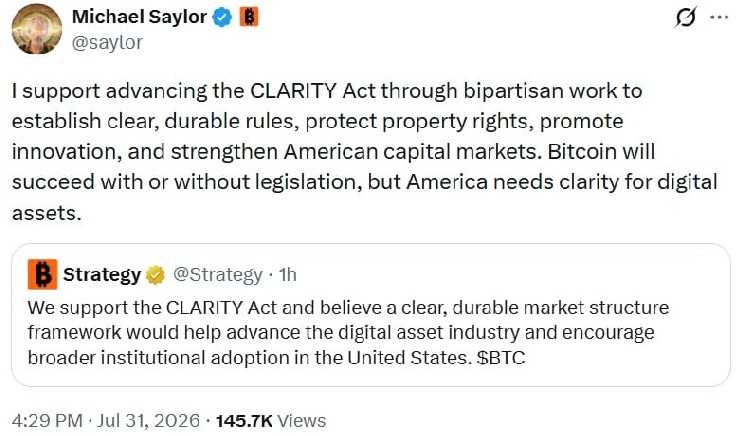
On July 31, Strategy Inc. (MSTR), the world's largest corporate holder of Bitcoin, announced its endorsement of the bipartisan CLARITY Act (Digital Asset Market Clarity Act). The company framed the bill as promoting market growth, institutional investor participation, consumer protection, and individuals' rights to own and control digital assets. Executive Chairman Michael Saylor added his influential voice, stating that while Bitcoin will succeed with or without regulation, America needs clarity for digital assets. The support comes as the Senate considers market structure legislation that would define regulatory roles for the SEC and CFTC and establish registration procedures for exchanges and custodians. The endorsement coincides with Strategy's Q2 report, which showed a significant net loss largely due to Bitcoin's volatility, underscoring the direct relevance of digital asset regulation to its shareholders and capital-raising strategy. Saylor's broader views link Bitcoin's long-term value to regulatory certainty and stable protocol rules. Political pressure is mounting as supporters have initiated nearly 1 million messages urging lawmakers to advance digital asset bills. However, legislative prospects remain uncertain, with one research firm lowering its passage probability estimate to 30%, even as crypto owners indicate the issue could influence their votes in the upcoming midterm elections.

cryptonews.ru12m ago

Saylor and Strategy Inc. Officially Endorse the CLARITY Act Bill Concerning Cryptocurrencies in the US

cryptonews.ru12m ago

Trading

Spot

Hot Articles

What is $BANK

Bank AI: A Revolutionary Step in the Future of Banking Introduction In an era marked by rapid advancements in technology, Bank AI stands at the intersection of artificial intelligence (AI) and banking services. This innovative project seeks to redefine the financial landscape, enhancing operational efficiency, security measures, and customer experiences through the power of AI. As we embark on this exploration of Bank AI, we will delve into what the project entails, its operational dynamics, its historical context, and significant milestones. What is Bank AI? At its core, Bank AI represents a transformative initiative aimed at integrating artificial intelligence into various banking operations. This project harnesses the capabilities of AI to automate processes, improve risk management protocols, and enhance customer interaction through personalised services. The primary objectives of Bank AI include: Automation of Banking Functions: By leveraging AI technologies, Bank AI aims to automate routine tasks, reducing the burden on human resources and enhancing efficiency. Enhanced Risk Management: The project utilises AI algorithms to predict and identify risks, thereby fortifying security measures against fraud and other threats. Personalisation of Banking Services: Bank AI focuses on offering tailored financial products and services by analysing customer data and behaviours. Improving Customer Experience: The implementation of AI-driven solutions, such as chatbots and virtual assistants, aims to provide users with more human-like interactions, revolutionising the way customers engage with banks. With these goals, Bank AI positions itself as a crucial player in rendering banking more efficient, secure, and user-centric. Who is the Creator of Bank AI? Details regarding the creator of Bank AI remain unknown. As such, no specific individual or organisation has been identified in the available information. The anonymity surrounding the project's inception raises questions but does not detract from its ambitious vision and objectives. Who are the Investors of Bank AI? Similar to the project's creator, specific information regarding the investors or supporting organisations of Bank AI has not been disclosed. Without this information, it is challenging to outline the financial backing and institutional support that might be propelling the project forward. Nevertheless, the importance of having a robust investment foundation is pivotal for sustaining development in such an innovative field. How Does Bank AI Work? Bank AI operates on several innovative fronts, focusing on unique factors that differentiate it from traditional banking frameworks. Below are key operational features: Automation: By applying machine learning algorithms, Bank AI automates various manual processes within banks. This results in reduced operational costs and allows human workers to redirect their efforts towards more strategic activities. Advanced Risk Management: The integration of AI into risk management practices equips banks with tools to accurately predict potential threats such as fraud, ensuring that customer information and assets remain secure. Tailored Financial Recommendations: Through continuous learning from customer interactions, the AI systems develop a nuanced understanding of user needs, enabling them to offer tailored advice on financial decisions. Enhanced Customer Interactions: Utilizing chatbots and virtual assistants powered by AI, Bank AI enables a more engaging customer experience, allowing users to have their queries resolved quickly, thus reducing wait times and improving satisfaction levels. Together, these operational features position Bank AI as a pioneer in the banking sector, establishing new benchmarks for service delivery and operational excellence. Timeline of Bank AI Understanding the trajectory of Bank AI requires a look at its historical context. Below is a timeline highlighting important milestones and developments: Early 2010s: The conceptualisation of AI integration into banking services began to gain attention as banking institutions recognised the potential benefits. 2018: A marked increase in the implementation of AI technologies occurred when banks started using AI tools like chatbots for basic customer service and risk management systems for improved security handling. 2023: The sophistication of AI continued to advance, with generative AI being introduced for more complex tasks such as document processing and real-time investment analysis. This year marked a significant leap in the capabilities afforded to banks by AI technology. 2024-Current Status: As of this year, Bank AI is on an upward trajectory, with ongoing research and developments poised to further enhance capabilities in banking operations. Continued exploration of AI applications hints at exciting developments yet to come. Key Points About Bank AI Integration of AI in Banking: Bank AI focuses on adopting artificial intelligence to streamline banking processes and improve user experiences. Automation and Risk Management Focus: The project strongly emphasises these areas, aiming to shift the burden of routine tasks while enhancing security frameworks through predictive analytics. Personalised Banking Solutions: By harnessing customer data, Bank AI enables tailored banking services that cater to individual user needs. Commitment to Development: Bank AI remains committed to ongoing research and development efforts, ensuring its adaptability and ongoing relevance as technology continues to evolve. Conclusion In summary, Bank AI exemplifies a crucial step forward in the banking industry, leveraging artificial intelligence to reshape operational paradigms, enhance security, and promote customer satisfaction. Despite gaps in information surrounding the creator and investors, the clear objectives and functional mechanisms of Bank AI provide a strong foundation for its ongoing evolution. As AI technology continues to advance and merge with the banking sector, Bank AI is well-positioned to significantly impact the future of financial services, enhancing the way we understand and interact with banking.

230 Total ViewsPublished 2024.04.06Updated 2024.12.03

What is $BANK

Discussions

Welcome to the HTX Community. Here, you can stay informed about the latest platform developments and gain access to professional market insights. Users' opinions on the price of BANK (BANK) are presented below.

活动图片