Trader des actions revient à "trader des crypto-monnaies", bienvenue de retour dans la famille d'origine

marsbitPublished on 2026-07-30Last updated on 2026-07-30

Abstract

**Résumé : De la Bourse au "Crypto-marché" : Le Retour à la Maison Mère** Le 13 juillet 2026, la bourse sud-coréenne (KOSPI) s'est effondrée de près de 9%, entraînant des liquidations massives de comptes sur marge, notamment parmi les jeunes investisseurs. Cette scène, autrefois typique du marché des cryptomonnaies, illustre une tendance plus large : la "cryptofication" des marchés boursiers mondiaux, en particulier des actions technologiques. Fin 2025, désillusionnés par le marché crypto en stagnation, de nombreux traders et influenceurs ont migré vers les actions américaines et asiatiques, emportant avec eux leurs méthodes : recherche de récits forts (comme l'IA), usage agressif de l'effet de levier et réactivité extrême aux signaux des réseaux sociaux. Des titres comme SK Hynix sont devenus des paris collectifs, amplifiés par des ETF à levier. L'ironie est que, lors de ce krach, certaines actions technologiques ont chuté deux fois plus vite que le Bitcoin. Des données montrent que la volatilité de ce dernier est désormais parfois inférieure à celle de titres comme Tesla ou Nvidia. Le Bitcoin, autrefois symbole de l'instabilité, devient paradoxalement un actif "relativement stable" face à la turbulence extrême de certaines actions. Le cœur du phénomène réside dans l'ancre de valorisation. Les cours sont désormais davantage dictés par des récits médiatiques ("l'IA va tout changer") que par les fondamentaux, une dynamique propagée à grande vitesse par les plateformes soci...

Auteur : Dou Wanle

13 juillet 2026, Séoul.

L'indice coréen KOSPI a plongé de 8,95 % en une journée, déclenchant son 7ème blocage de l'année. SK Hynix, considéré comme une "action de la destinée nationale" par les Coréens, a chuté de 15,37 % en une journée, une baisse aussi brutale n'avait pas été vue depuis près de vingt ans. Samsung Electronics a également perdu plus de 10 %.

Plus de 1,2 million de comptes sur marge ont reçu des notifications d'appel de marge, les systèmes des courtiers ont liquidé automatiquement entre 320 000 et 460 000 comptes. Plus douloureux encore, 62 % des personnes liquidées étaient des jeunes de 20 à 30 ans : certains ont perdu l'apport pour acheter un logement, d'autres ont fait des emprunts pour spéculer...

Un jeune homme d'une vingtaine d'années à Busan, ayant suivi les conseils d'un YouTuber boursier qui l'ont mené à des pertes, a poignardé l'influenceur.

Autrefois, ces termes auraient très probablement décrit les scènes après un krach dans l'univers des crypto-monnaies. Aujourd'hui, ils se répètent sur les marchés sud-coréen, américain et japonais, après le reflux des actions technologiques.

Les fortes hausses et baisses ne sont que l'apparence. Ce qui a vraiment changé, c'est la méthode de valorisation : le récit prime sur l'évaluation, l'effet de levier amplifie les émotions, et les médias sociaux poussent rapidement le consensus vers l'extrême.

Les marchés boursiers mondiaux, en particulier les actions technologiques, ressemblent de plus en plus à l'univers des crypto-monnaies.

Retour à la famille d'origine

"Bienvenue de retour dans la famille d'origine."

Après le krach, les traders du monde des crypto-monnaies qui s'étaient tournés vers les actions ont multiplié les récits de pertes sur les réseaux sociaux. Les commentaires ci-dessus étaient omniprésents.
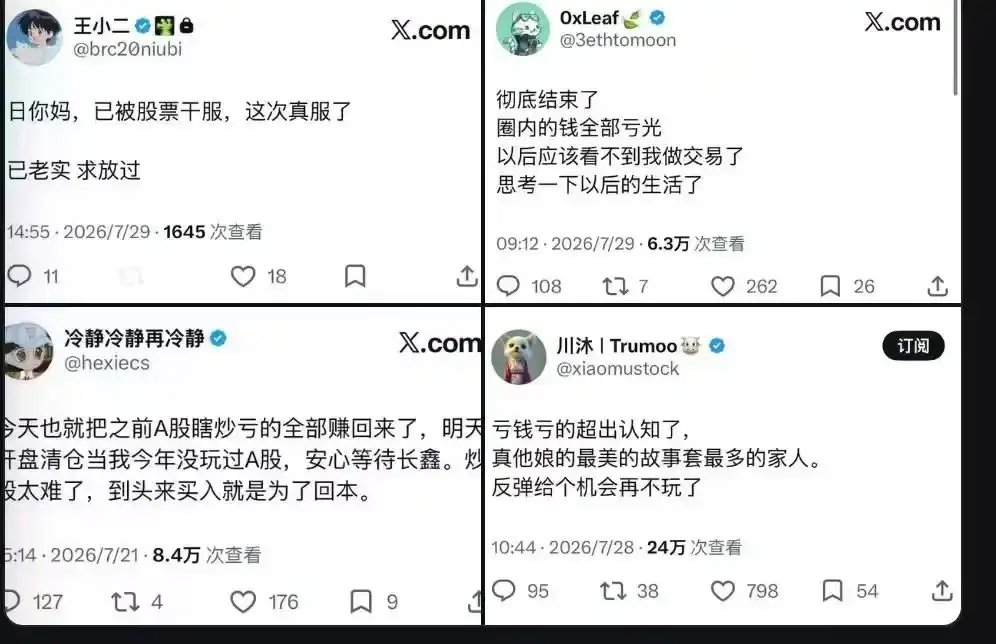
La "famille d'origine" désigne ici les crypto-monnaies. De la seconde moitié de 2025 au début de 2026, un grand spectacle de "fuite de la famille d'origine" s'est joué dans le monde des crypto-monnaies.

Un groupe de KOL et de joueurs expérimentés, rodés sur le marché des crypto-monnaies, a commencé à perdre confiance. Le Bitcoin évoluait latéralement avec des volumes faibles, les Meme coins arrachaient des gains couche après couche, beaucoup ont trouvé que "ce milieu n'avait plus d'intérêt" et ont commencé à reporter leur attention sur les actions américaines.

Ce choix semblait très raisonnable.

Les actions ont des revenus, des profits, des rapports financiers et sont régulées par la SEC. Comparé aux projets cryptographiques dépourvus de flux de trésorerie et valorisés uniquement par consensus, le marché américain semblait au moins un actif plus mature et plus sûr.

Les traders du monde crypto n'ont pas seulement emporté de la liquidité, ils ont aussi transféré leurs méthodes de trading.

Sur le marché crypto, ils étaient habitués à poursuivre de nouveaux récits, à rechercher des actifs à forte élasticité, à utiliser l'effet de levier et à changer rapidement de position en fonction de l'émotion sur les réseaux sociaux. En entrant sur le marché boursier, cette méthode n'a guère changé, seuls les actifs échangés sont passés des tokens à l'IA, aux puces mémoire et aux ETF à effet de levier, avec des résultats parfois spectaculaires.

Les actions du secteur de la mémoire sont rapidement devenues le nouveau consensus collectif.

La logique n'était pas compliquée : les serveurs d'IA nécessitent plus de mémoire haute bande passante (HBM), l'offre est insuffisante, les prix de la mémoire montent, Micron, Samsung Electronics et SK Hynix deviennent naturellement les "vendeurs de pelles". La phrase de Sun Ge, "la mémoire manquera toujours", est entrée dans les esprits.

De nombreux KOL crypto se sont métamorphosés, se mettant à parler des actions américaines, du cycle de la mémoire, des dépenses en capital de l'IA. Des produits comme les ETF à effet de levier 2x sur SK Hynix ont également été considérés comme des outils de pari "plus efficaces" que les actions ordinaires.

Jusqu'au renversement de tendance de juillet.

Le Bitcoin devient même un "actif à faible volatilité"

Combien de temps faut-il pour perdre la moitié de sa valeur depuis un sommet ?

Le Bitcoin a mis 268 jours, l'argent a réalisé un repli similaire en 169 jours.

En comparaison, SanDisk a chuté d'environ 55 % en seulement 36 jours, SK Hynix d'environ 53 % en seulement 34 jours.

Pour une même "division par deux", le Bitcoin a pris près de neuf mois, les actions du secteur de la mémoire à peine plus d'un mois.
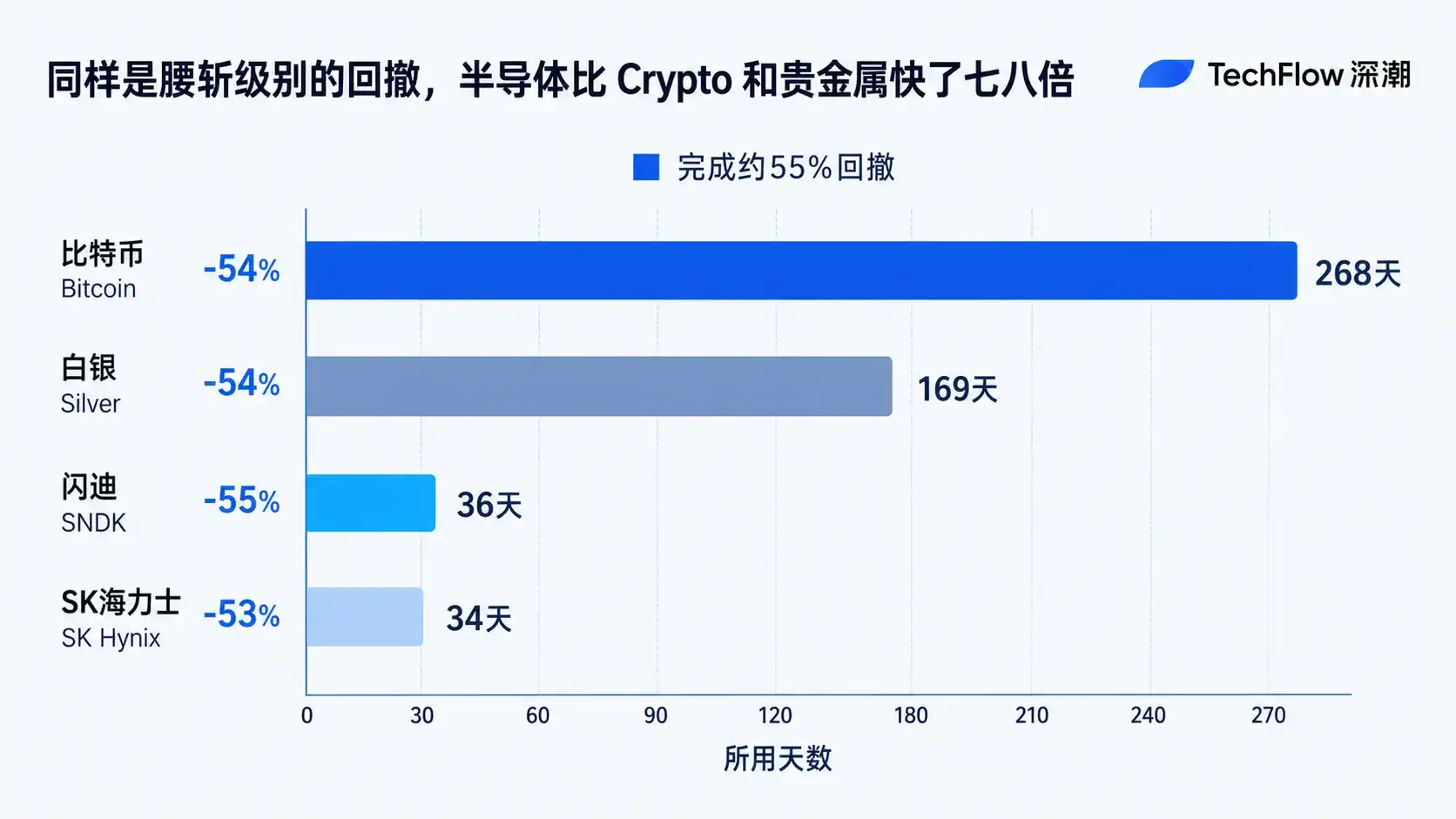
C'est précisément ce qui est déroutant dans cette tendance : auparavant, les investisseurs craignaient que le Bitcoin monte ou baisse vertigineusement en quelques jours, tandis que les actions s'ajustaient lentement en fonction des bénéfices et des valorisations ; aujourd'hui, certaines actions technologiques traversent un cycle complet d'éclatement de bulle en moins de temps que les crypto-monnaies.

Très contre-intuitif, comparé à certaines actions technologiques, le Bitcoin devient relativement stable.

Selon les statistiques de Charles Schwab, la volatilité historique du Bitcoin en 2025 était d'environ 42 %, avec un repli maximal d'environ 32 % ; sur la même période, celle de Tesla était d'environ 63 % avec un repli maximal de 48 %, et celle de NVIDIA d'environ 50 % avec un repli maximal de 37 %.

Le Bitcoin reste un actif à haut risque, mais certaines grandes actions technologiques sont encore plus volatiles.

Bitwise a même prédit dans ses perspectives 2026 que la volatilité globale du Bitcoin pourrait continuer à être inférieure à celle de NVIDIA.

La situation actuelle est donc assez absurde : le Bitcoin ressemble de plus en plus à une action technologique, mais les actions technologiques ressemblent de plus en plus au Bitcoin.

Quand le récit devient l'ancre de valorisation

Il y a un vieil adage dans le monde crypto : trader des cryptos, c'est trader un récit.

En 2026, les actions technologiques mondiales sont en train de faire de cet adage une réalité.

L'IA n'est bien sûr pas du vent. NVIDIA, Microsoft, Google et les grandes entreprises de cloud computing ont des revenus réels et investissent de l'argent réel dans la construction de centres de données.

Mais entre "l'IA créera bel et bien de la valeur" et "toute entreprise liée à l'IA mérite d'être achetée à n'importe quel prix", il y a un long chemin.

Aux moments les plus chauds du marché, ce chemin a été purement et simplement ignoré.

Serveurs d'IA, modules optiques, puces mémoire, centres de données, équipements électriques, même entreprises d'énergie nucléaire... Tout ce qui pouvait être intégré dans la chaîne d'approvisionnement de l'IA pouvait voir son cours s'envoler rapidement. Les activités étaient encore en phase de planification, les commandes pas encore passées, mais le marché anticipait déjà les meilleurs résultats possibles dans plusieurs années.

L'histoire en Corée du Sud était "la puce d'IA est une question de destinée nationale". Alors que le KOSPI atteignait de nouveaux sommets, de plus en plus de familles ont ouvert des comptes boursiers pour leurs enfants mineurs, offrant des actions populaires comme Samsung Electronics et SK Hynix en guise de cadeau à long terme.

Une concentration similaire est apparue sur le marché chinois (A-shares). Au premier semestre 2026, la capitalisation du secteur TMT (Technologie, Médias, Télécoms) a atteint 41,78 billions de yuans, représentant environ 31,45 % de la capitalisation totale du marché A. Certains jours, le volume des transactions dans le secteur technologique a atteint près de la moitié du volume total du marché.

Le marché américain, quant à lui, s'est longtemps construit autour de la valorisation de quelques grandes entreprises technologiques. Lorsque la hausse des indices dépend de plus en plus de quelques sociétés, lorsque les fonds, les options et les investisseurs individuels affluent vers les mêmes titres, des portefeuilles apparemment diversifiés parient en réalité sur la même histoire de l'IA.

Cela ressemble beaucoup à l'univers crypto d'autrefois. En 2021, le Dogecoin a bondi non pas à cause d'une percée technologique, mais parce qu'Elon Musk a posté un tweet. En 2026, les actions technologiques ont bondi non pas parce que toutes les entreprises ont connu une explosion de leurs résultats, mais parce que ChatGPT a convaincu tout le monde que "l'IA va tout réécrire".

Le fait qu'un récit puisse dominer le marché si rapidement est également lié aux changements dans les modes de diffusion de l'information.

Autrefois, l'information boursière provenait principalement des rapports financiers, des analyses des courtiers et des présentations aux institutions. Aujourd'hui, de plus en plus de gens basent leurs décisions d'investissement sur YouTube, X, les vidéos courtes et les communautés payantes.

L'analyse complexe d'une entreprise est réduite à quelques phrases : le temps prouvera la puissance de calcul et les modules optiques, la puissance de calcul de l'IA ne sera jamais suffisante...

Les algorithmes des médias sociaux ne récompensent pas non plus la prudence. Le rêve de s'enrichir rapidement reste le meilleur moyen d'obtenir du trafic : certains ont doublé leur mise avec des options, des employés ont réalisé l'indépendance financière en misant gros sur des actions de la mémoire, d'autres ont gagné plusieurs années de salaire en quelques mois avec des ETF à effet de levier.

Les graphiques en chandeliers sont la meilleure publicité. De nombreuses mères au foyer, des retraitées, ont commencé à sortir leurs économies pour investir, certaines ont même vendu leur logement pour spéculer, à l'instar des étudiants qui abandonnaient leurs études quelques années plus tôt pour se lancer à corps perdu dans le Web3...

Le carnaval de l'effet de levier

Ce qu'il y a de plus effrayant dans le monde crypto, ce n'est pas la volatilité, mais la combinaison mortelle de l'effet de levier et de la volatilité. En 2026, les marchés boursiers mondiaux reproduisent parfaitement ce schéma.

Le 27 mai 2026, la Bourse de Corée a approuvé la cotation de 16 ETF à effet de levier 2x sur des actions individuelles, liés précisément à Samsung Electronics et SK Hynix.

Les investisseurs individuels sont devenus fous. Entre l'approbation et la mi-juillet, les investisseurs individuels coréens ont acheté pour un total net de 14 000 milliards de wons (environ 640 milliards de yuans) d'ETF à effet de levier sur actions individuelles. Sur la même période, les investisseurs étrangers n'en ont acheté qu'environ 2 000 milliards de wons.

Ces ETF avaient plusieurs caractéristiques fatales.

Ces produits réajustent leur portefeuille quotidiennement. Plus les fluctuations sont importantes, plus la dépréciation de la valeur nette est marquée. Supposons qu'une action baisse d'abord de 10 %, puis augmente de 11,1 % : son prix revient au point de départ. Le produit à effet de levier 2x correspondant baisserait d'abord de 20 %, puis augmenterait de 22,2 %, pour finalement subir une perte d'environ 2,2 %.

En cas de baisse rapide, le problème est encore plus grave.

Pour maintenir l'effet de levier cible, le produit doit réduire passivement son exposition au risque après une baisse. La vente fait encore baisser le prix de l'actif sous-jacent, ce qui déclenche à son tour davantage de réductions de position, de ventes de couverture et de pression sur les marges.

Goldman Sachs a par la suite indiqué que la "désintégration rapide" de ces produits était la principale cause de la volatilité intrajournalière anormale du KOSPI, 62 % des ventes nettes des institutions provenant de liquidations liées aux ETF.

Deux mois plus tard, les régulateurs coréens ont suspendu en urgence toute nouvelle introduction d'ETF à effet de levier sur actions individuelles, et ont fortement relevé la marge minimale de 10 millions à 30 millions de wons, exigeant en outre qu'elle soit uniquement en espèces.

Mais il était trop tard : 2,3 billions de wons de montants de liquidation forcée, la richesse de dizaines de milliers de familles réduite à néant.

Même le marché américain, pourtant le plus profond au monde, subit les contrecoups de l'effet de levier.

Un analyste de JPMorgan a récemment indiqué que le marché américain avait encore une "marge de désendettement" et qu'il lui faudrait trois mois pour retrouver son niveau d'avril.

Le ratio entre la taille des ETF à effet de levier sur les actions du secteur de la mémoire et la capitalisation boursière de leurs sous-jacents est trois fois supérieur à la moyenne de tous les ETF sur actions. Même pour les ETF indiciels à effet de levier sur l'ensemble des actions, ce ratio est élevé par rapport à son historique.

Une régression

La "cryptofication" des marchés boursiers ne signifie pas que les actions sont devenues totalement identiques aux crypto-monnaies.

Derrière une action, il y a encore une entreprise, des actifs, des revenus et des flux de trésorerie, ainsi que des divulgations financières, des audits et une régulation. Même lorsque l'euphorie du marché retombe, une entreprise réellement rentable conserve une valeur qui peut être calculée.

Ce qui a vraiment changé, c'est la couche transactionnelle.

Autrefois, on achetait les bénéfices futurs d'une entreprise ; aujourd'hui, de plus en plus de gens négocient la popularité d'un thème.

La cryptofication de la bourse est, par essence, une révolution de dérationalisation.

La bourse traditionnelle regarde le PER, les flux de trésorerie ; la bourse cryptofée regarde le récit, l'imagination. La bourse traditionnelle considère une volatilité de 20 % comme élevée ; dans la bourse cryptofée, des fluctuations quotidiennes de 10 à 15 % pour une action individuelle deviennent la norme.

La bourse traditionnelle utilise l'effet de levier via le crédit de marge ; la bourse cryptofée via les ETF, les produits dérivés, les stratégies quantitatives. La bourse traditionnelle tire ses informations des rapports d'analyse, des états financiers ; la bourse cryptofée des tweets, des YouTubers, des communautés. La bourse traditionnelle valorise rationnellement via les institutions ; la bourse cryptofée voit les institutions se comporter comme des particuliers, les quantitatives suivant les hausses et vendant les baisses...

Ce qui est encore plus drôle, c'est que aujourd'hui, le Bitcoin s'efforce de ressembler à une action, via les ETF, l'institutionnalisation, la baisse de la volatilité, en train d'être progressivement accepté par la finance traditionnelle.

C'est un point de croisement absurde.

Ceux qui sont passés du monde crypto à la bourse finissent par découvrir qu'ils n'ont jamais vraiment quitté leur "famille d'origine" : c'est le même mécanisme qui se répète sans cesse : des histoires grandioses, des positions surchargées, un effet de levier facilement accessible, et la conviction de chacun qu'il pourra sortir avant les autres.

La phrase écrite par un investisseur individuel coréen sur un forum de trading mérite d'être retenue par tous : Je veux retourner aux jours d'avant que je ne trade des actions, et qu'on me rende mon argent.

Mais le marché ne rembourse jamais.

Trending Cryptos

Related Questions

QQuel événement majeur a déclenché la crise décrite dans l'article sur le marché sud-coréen en juillet 2026 ?

AL'indice composite coréen KOSPI a chuté de 8,95 % en une seule journée, déclenchant son 7e déclenchement de circuit-breaker de l'année. Des actions clés comme SK Hynix ont plongé de plus de 15 %, entraînant des appels de marge massifs et la liquidation de centaines de milliers de comptes sur marge.

QPourquoi l'article utilise-t-il l'expression 'retour à la famille d'origine' pour décrire certains traders ?

AL'expression 'retour à la famille d'origine' fait référence aux traders de crypto-monnaies qui, ayant perdu confiance dans le marché cryptographique vers 2025-2026, sont passés aux actions (notamment technologiques). Après le krach boursier de 2026, ils ont constaté que les méthodes de trading basées sur le récit, l'effet de levier et l'influence des médias sociaux qu'ils utilisaient en crypto se reproduisaient en bourse, les ramenant métaphoriquement à leur 'famille d'origine' qu'est l'environnement crypto.

QComment la volatilité du Bitcoin se compare-t-elle à celle de certaines actions technologiques selon l'article ?

AL'article note un renversement paradoxal : historiquement très volatil, le Bitcoin affiche désormais une volatilité relativement plus faible que certaines actions technologiques majeures. Par exemple, en 2025, la volatilité historique du Bitcoin était d'environ 42 %, tandis que celle de Tesla était d'environ 63 % et celle de Nvidia d'environ 50 %. De plus, une chute de 50 % a pris près de neuf mois au Bitcoin contre seulement un peu plus d'un mois pour des actions comme SK Hynix.

QQuel rôle les ETF à effet de levier sur actions individuelles ont-ils joué dans la crise du marché sud-coréen ?

ALes ETF à effet de levier 2x sur des actions individuelles comme Samsung Electronics et SK Hynix, approuvés en mai 2026, ont amplifié la crise. Ils ont attiré des achats massifs de particuliers mais leur mécanisme de rééquilibrage quotidien a causé une 'érosion de volatilité' et, lors de la chute des cours, a déclenché des déclassements forcés massifs pour maintenir l'effet de levier. Ces ventes automatiques ont accentué la baisse des prix, contribuant significativement à la volatilité extrême et aux liquidations à grande échelle, avant que leur commercialisation ne soit suspendue.

QQue signifie 'l'actionnisation de la crypto' selon la conclusion de l'article ?

ASelon la conclusion de l'article, 'l'actionnisation de la crypto' (ou 'la bourse qui devient comme la crypto') est un processus de dérationalisation du marché. Il ne s'agit pas que les actions deviennent identiques aux crypto-actifs (elles gardent des fondamentaux), mais que les *méthodes de trading* et la psychologie du marché évoluent : la valorisation par le récit (narratif) prime sur l'analyse fondamentale, la volatilité extrême se normalise, l'effet de levier via des produits complexes se généralise, et l'information/les décisions sont dictées par les médias sociaux plutôt que par les rapports traditionnels, créant un cycle spéculatif similaire à celui observé dans la crypto.

Related Reads

Bitcoin Withdrawals Continue: 8 Years of Storage in a Coldcard Cold Wallet Ended in Zero

Coldcard Hardware Wallet Hacked: Losses Mount Due to Vulnerable Seed Generation A critical vulnerability in Coldcard hardware wallets has led to a continued wave of fund thefts. According to Galaxy Research, the total stolen has reached 1,367.05 BTC (approx. $88.6 million) from 4,585 addresses, a significant increase from the initial 594.5 BTC reported on July 30, 2026. Most of the stolen funds remain on the attackers' addresses. The issue is not with the current firmware, which Coinkite has updated, but with seed phrases generated on vulnerable devices between March 2021 and the release of fixed firmware versions. Due to a programmer error, devices switched from using a hardware random number generator to the software-based Yasmarang generator, which was initialized with publicly accessible data like the chip's serial number. This made the seed phrases predictable through offline brute-force attacks, meaning wallets remain at risk until funds are moved to a new wallet generated with the patched firmware. Affected devices include Mk2/Mk3 with firmware 4.0.1–4.1.9 (and up to 5.0.3), Mk4/Mk5 up to version 5.6.0, and Q models up to 1.5.0Q. The only exceptions are seeds created with a high-entropy method like at least 50 independent dice rolls or a strong unique BIP-39 passphrase. All other owners must generate a new seed on the fixed firmware and transfer their assets. A case highlighting the human impact involves a 39-year-old long-term investor who lost 2 BTC (approx. $130,000) in minutes. He had accumulated the Bitcoin over eight years through physical labor, viewing it as a financial lifeline and a retirement plan in a country suffering from hyperinflation. His story underscores that even conservative "buy and hold in cold storage" strategies can be compromised by such underlying technical flaws. From a technical perspective, this incident echoes historical failures where weak random number generators undermined cryptographic security, challenging the assumption that offline storage is automatically foolproof.

cryptonews.ru5h ago

Bitcoin Withdrawals Continue: 8 Years of Storage in a Coldcard Cold Wallet Ended in Zero

cryptonews.ru5h ago

Trading

Spot

Hot Articles

What is LINON

Linde plc Tokenized Stock (Ondo): Revolutionizing Traditional Equity Access Through Blockchain Innovation The emergence of Linde plc Tokenized Stock (Ondo), represented by the ticker $LINON, signifies a monumental shift in the fusion of traditional financial structures and decentralized finance (DeFi). This innovative financial instrument showcases the tremendous potential of blockchain technology to democratize access to traditional equity markets while ensuring the security and regulatory compliance necessary for institutional-grade financial products. Through Ondo Finance's pioneering tokenization platform, $LINON provides a seamless pathway for global investors to engage with one of the world's leading industrial gas companies, Linde plc, creating a blockchain-native representation of the underlying equity. Introduction to Linde plc Tokenized Stock The landscape of financial markets is witnessing a groundbreaking transformation through the tokenization of real-world assets. Linde plc Tokenized Stock (Ondo) epitomizes this revolutionary approach by bridging the gap between conventional stock ownership and blockchain-enabled financial infrastructure. The $LINON token allows investors to gain exposure to one of the prominent industrial companies worldwide through decentralized technology. Operating within Ondo Finance's comprehensive ecosystem, $LINON symbolizes a practical application of tokenization technology that enhances accessibility, efficiency, and global connectivity in traditional financial markets. By leveraging blockchain infrastructure, this tokenized stock enables international investors to participate in U.S. equity markets, overcoming traditional barriers associated with cross-border investing. The significance of $LINON goes beyond technological innovation; it represents a fundamental shift in asset structuring, distribution, and trading in the digital age. This tokenized stock maintains all the economic benefits associated with traditional Linde plc shares while offering improved liquidity, programmable compliance features, and seamless integration with decentralized finance protocols. The development of $LINON indicates a growing acceptance of blockchain technology as a viable means for traditional finance, exemplifying how even well-established assets like Linde plc can integrate into blockchain systems. This approach preserves the core attributes that appeal to investors while introducing advanced capabilities that enhance the overall investment proposition. Project Overview and Objectives Linde plc Tokenized Stock (Ondo) encapsulates a strategic effort to democratize access to traditional equity markets through advanced blockchain technologies. The primary objective of $LINON is to provide approved global investors seamless access to the economic exposure associated with Linde plc shares, furthering an effort to create a more inclusive financial ecosystem. Beyond the digital representation of traditional assets, $LINON endeavors to eliminate barriers of geography and time zones that limit investor participation. Its design ensures that blockchain technology can elevate traditional investment vehicles without undermining the security or compliance requirements expected by investors. Key goals of the project include enhanced liquidity provision, programmable compliance mechanisms, and interoperability with other blockchain networks. Each $LINON token is fortified by actual Linde plc securities housed at U.S.-registered broker-dealers, allowing holders to reap economic advantages akin to traditional stockholders, such as dividend reinvestment. Furthermore, $LINON aims to establish new industry standards for institutional-grade tokenized securities, paving the way for traditional assets to embrace blockchain technology while remaining compliant with regulatory frameworks. By associating itself with a company as reputable as Linde plc, the project opens avenues for exploring tokenized equities catering to both conservative institutional players and daring retail investors. Project Creator and Development Team The vision for Linde plc Tokenized Stock (Ondo) comes from Nathan Allman, founder and CEO of Ondo Finance. His background in traditional finance coupled with expertise in blockchain technology positions him uniquely to navigate the complexities of asset tokenization. Allman's academic journey began at Brown University, focusing on Economics and Biology, equipping him with valuable analytical skills. His time at Goldman Sachs in the Digital Assets division strengthened his understanding of the interplay between financial institutions and emerging technologies, laying the groundwork for his later endeavors in alternative investment strategies. Under Allman's guidance, Ondo Finance has emerged as a leader in asset tokenization, launching $LINON as a flagship example of the company's larger mission towards revolutionizing traditional financial systems using blockchain technology. His commitment to leveraging blockchain for creating institutional-grade financial products has shaped the landscape of real-world asset tokenization. Investment and Funding Structure The growth of Ondo Finance, the platform powering Linde plc Tokenized Stock (Ondo), is bolstered by robust financial backing from prestigious venture capital firms and strategic investors. This strong investment foundation underpins the development of the key infrastructure essential for compliant tokenized securities like $LINON. In August 2021, Ondo Finance secured $4 million in seed funding led by a major venture capital firm, which enabled the company to commence platform development and establish the necessary regulatory processes for tokenizing real-world assets. This early investment cemented Ondo Finance's credibility within the industry. The Series A funding round followed, garnering $20 million with participation from renowned firms committed to transformative technology companies. This backing demonstrated substantial institutional confidence in Ondo Finance's vision, allowing it to hone its approach to asset tokenization through mechanisms that ensure compliance and accessibility. Noteworthy contributors, including institutional investors and experienced partners, have added significant value to Ondo Finance’s development efforts. Their involvement underscores the confidence across sectors in Ondo Finance's approach to bridging traditional finance with blockchain innovations. Technical Infrastructure and Innovation The technical architecture that underpins Linde plc Tokenized Stock (Ondo) represents a sophisticated melding of traditional finance systems and cutting-edge blockchain technology. The architecture's foundation is built on the Ethereum network, renowned for its security and programmability—both critical for intricate financial instruments. The $LINON tokenization process comprises creating a blockchain-native representation of Linde plc shares that preserves economic benefits while augmenting investor capabilities. Each token corresponds to actual shares held at U.S.-registered broker-dealers, creating a compliant custody structure that legitimizes the asset's existence and value. Automated compliance systems are integrated into the tokenization process, managing critical components such as know-your-customer (KYC) verification and anti-money laundering (AML) protocols. This incorporation of programmable compliance empowers $LINON to uphold regulatory standards essential for institutional proliferation. Cross-chain interoperability characterizes the advanced technical features of $LINON. While initially deployed on Ethereum, the framework is designed for expansion to other networks such as Solana and BNB Chain. This adaptability enhances liquidity and accessibility, allowing investors to select their preferred blockchain ecosystems. Historical Timeline and Development Crafting the history of Linde plc Tokenized Stock (Ondo) unfolds in parallel with the evolution of Ondo Finance's tokenization platform. The timeline's inception dates back to March 2021 when Nathan Allman laid the foundations for creating institutional-grade financial products on blockchain infrastructure. The initial funding round in August 2021 provided crucial resources for developing the platform and establishing partnerships necessary for effective tokenization. By January 2023, Ondo Finance launched its tokenized treasury products, establishing mechanisms that would facilitate future tokenized equities such as $LINON. A pivotal milestone arose in February 2025 when Ondo Chain—a Layer 1 blockchain designed specifically for asset tokenization—was introduced. This infrastructure enhances capabilities vital for institutional markets, demonstrating Ondo Finance's long-term commitment to tokenization. Subsequently, the launch of Ondo Global Markets in September 2025 marked the official debut of $LINON. This milestone showcased the successful transition from development to active trading, enabling investors around the world to access American financial markets seamlessly. Ongoing development plans include a targeted expansion of available tokenized assets to over 1,000 by the end of 2025, pointing to a bright future for Ondo Finance's ecosystem and its mission to broaden tokenized equity accessibility. Regulatory Compliance and Legal Framework The legal architecture governing Linde plc Tokenized Stock (Ondo) emphasizes a sophisticated approach to regulatory compliance, allowing tokenized securities to be implemented within a blockchain-based framework. The legal structure governing $LINON spans multiple jurisdictions while maintaining a robust legal footing. Compliance systems ensure that only eligible investors can access the token, enforced through automated verification that aligns with international regulations. This innovative regulatory technology promises real-time enforcement of complex requirements, considerably enhancing efficiency in operating within the regulatory landscape. The custody framework undergirding $LINON ensures that the underlying shares are securely held at U.S.-registered broker-dealers, complying with necessary regulations while delivering blockchain-driven access to investors. The token maintains its economic equivalency and security through this carefully structured custody arrangement. KYC and AML compliance systems are embedded within the smart contract architecture, ensuring integrity and adherence to regulatory practices while fostering transparency for investors. The jurisdictional restrictions mark a commitment to navigating the evolving landscape of international securities laws. Market Impact and Industry Significance The advent of Linde plc Tokenized Stock (Ondo) holds profound implications for the broader financial landscape, symbolizing a clear shift towards blockchain-enabled markets. $LINON serves as a proof-of-concept for integrating traditional companies into blockchain ecosystems, showcasing the potential benefits such as broader accessibility and improved efficiency. The market's response to $LINON indicates a growing acceptance of tokenization among institutional investors, contributing to the emergence of an expanding sector wherein traditional assets can be interconnected with blockchain innovations. The success of $LINON further solidifies market confidence, indicating an overarching shift towards recognizing asset tokenization as a transformative force in finance. Future Development and Expansion Plans The future trajectory for Linde plc Tokenized Stock (Ondo) centers around the expansion of the tokenization ecosystem and enhanced infrastructure supporting blockchain-enabled financial services. Plans for cross-chain integration usher in new opportunities for liquidity and flexibility within the investment framework, with existing capabilities poised for continuous enhancement. With the introduction of Ondo Chain, Ondo Finance aims to transition $LINON to an optimized blockchain environment specifically designed for asset tokenization. This new infrastructure heralds exciting prospects for the development of institutional-grade financial products, ensuring ongoing compatibility with contemporary investment strategies. Further integration with decentralized finance protocols signifies a commitment to empowering $LINON holders through advanced financial strategies. The anticipated expansion of available tokenized assets promises to broaden investor access, enhancing the utility and appeal of the platform. In alignment with ambitions for regulatory expansion, ongoing efforts to secure approvals for new jurisdictions will enhance investor access, further positioning $LINON at the forefront of the burgeoning tokenization market. Conclusion Linde plc Tokenized Stock (Ondo), as represented by the $LINON token, stands at the intersection of traditional finance and blockchain innovation. It embodies a transformative milestone in how financial assets are structured, distributed, and engaged within modern investment ecosystems. The technical sophistication behind $LINON, combined with its regulatory compliance framework, illustrates that asset tokenization can improve financial infrastructure rather than simply digitizing existing products. This pioneering effort not only enhances investor access to U.S. equity markets but also signifies an evolution of how traditional financial services can integrate blockchain technology. As the asset tokenization market grows exponentially, with prospects suggesting significant valuation increases, $LINON paves the way for a future where tokenized securities become standard fixtures in the financial landscape. The trajectory of $LINON will undoubtedly influence how traditional finance adapts to a transformed, blockchain-powered world.

4.0k Total ViewsPublished 2025.12.05Updated 2025.12.05

What is LINON

What is CRMON

Salesforce Tokenized Stock (Ondo): Revolutionising Traditional Equity Access Through Blockchain Innovation The emergence of Salesforce Tokenized Stock (CRMON) marks a pivotal advancement in integrating traditional financial markets with blockchain technology. This innovative approach offers investors unprecedented access to equity exposure through tokenisation. Developed by Ondo Finance, CRMON provides tokenholders with economic exposure equivalent to holding Salesforce stock (CRM) while automatically reinvesting dividends. This effectively bridges the gap between conventional equity markets and decentralised finance (DeFi). Introduction and Comprehensive Overview of Salesforce Tokenized Stock In recent years, the financial landscape has dramatically transformed due to blockchain technology, fundamentally altering how investors access and interact with traditional assets. The development of Salesforce Tokenized Stock (CRMON) is a prime example of this evolution, representing a sophisticated fusion of conventional equity markets with cutting-edge distributed ledger technology. CRMON is a tokenised version of Salesforce stock, emerging from the innovative work of Ondo Finance, a leading platform in the real-world asset tokenisation sector that positions itself as a bridge between traditional finance and decentralised systems. Designed to provide tokenholders with economic exposure that mirrors the performance of the underlying Salesforce stock, CRMON incorporates automatic dividend reinvestment mechanisms. This eliminates many traditional barriers associated with international equity investment, such as complex brokerage relationships, currency conversion challenges, and restricted trading hours. The tokenisation process reimagines stock ownership as a blockchain-native asset while maintaining its economic equivalence with the underlying security, offering enhanced portability and integration capabilities within decentralised finance ecosystems. CRMON transcends its individual utility as an investment instrument to represent a fundamental shift in how financial markets can operate in an increasingly digital world. By maintaining full backing through U.S.-registered broker-dealers and implementing robust compliance frameworks, CRMON demonstrates that tokenised securities can achieve the regulatory standards necessary for institutional adoption while delivering the technological advantages of blockchain infrastructure. Understanding Tokenized Real-World Assets and CRMON's Strategic Position Tokenised real-world assets signify one of the most significant innovations in modern finance, fundamentally reimagining how traditional securities are represented, traded, and utilised within digital ecosystems. CRMON operates as a tokenised equity instrument correlating directly with Salesforce stock while optimising accessibility and efficiency. This aligns with Ondo Finance's broader mission to democratise access to institutional-grade financial products through innovative tokenisation strategies. The tokenisation process guarantees complete economic equivalence with the underlying Salesforce equity. Each CRMON token represents a proportional claim on Salesforce stock held by qualified custodians, with dividend payments automatically reinvested to maintain continuous exposure to total return performance. This structure simplifies dividend management and ensures that tokenholders receive the full economic benefit of their equity exposure, encompassing both capital appreciation and income generation. Ondo Finance's strategy in tokenising Salesforce stock demonstrates its expertise in creating compliant, institutional-grade products that meet traditional financial markets' stringent requirements. The platform’s focus on merging regulatory compliance with blockchain benefits positions it at the forefront of decentralised finance, captivating both institutional and retail investors seeking blockchain-native solutions. The Technology and Innovation Framework Behind CRMON The technological infrastructure supporting CRMON integrates blockchain technology with traditional financial mechanisms, delivering institutional-grade security and compliance while maintaining the operational advantages of decentralised systems. Built on the Ethereum blockchain, CRMON utilises robust smart contract capabilities to ensure transparent, secure operations. The smart contract architecture incorporates layered security and compliance mechanisms, enabling automated compliance checks and real-time asset backing verification. Integration with oracle services maintains accurate pricing and dividend information, ensuring CRMON reflects the underlying Salesforce stock's accurate performance. This architecture delivers automated dividend reinvestments and other corporate actions, eliminating manual processing requirements and directly enhancing tokenholder benefits. Ondo Finance ensures CRMON's security structure includes daily third-party verification of holdings, independent collateral agents, and a multiple-layer custody system through partnerships with established financial institutions. This framework safeguards tokenholder interests against operational risks while providing robust asset backing. The user interface enhances integration capabilities, allowing seamless interaction between CRMON and various decentralised finance protocols, as well as cryptocurrency exchanges. This interoperability enables users to leverage their tokenised equity across multiple platforms, creating sophisticated investment strategies that marry traditional equity characteristics with blockchain-native innovation. Leadership and Corporate Structure of Ondo Finance The leadership team behind CRMON and Ondo Finance blends expertise from traditional finance and blockchain technology, presenting a robust combination of skills essential for successfully bridging conventional markets with decentralised finance. Nathan Allman, the founder and CEO, emerged from a distinguished financial background before establishing Ondo Finance in 2021. Allman's experience includes notable roles at major financial institutions, including significant contributions to developing cryptocurrency market services. His insights into regulatory compliance were paramount in developing products like CRMON that successfully unify traditional securities with blockchain technology. With a team of professionals boasting substantial experience in both conventional finance and blockchain sectors, Ondo Finance's leadership comprises diverse expertise that covers every aspect of tokenised asset development. Justin Schmidt serves as President and COO, contributing unique operational expertise, while Chris Tyrell brings essential compliance knowledge. Investment Landscape and Funding History The investment landscape surrounding Ondo Finance reflects significant institutional confidence in its mission to tokenise real-world assets. The company has raised substantial funds through various investment rounds, attracting leading venture capital firms and strategic investors that recognise the transformative potential of tokenised securities like CRMON. Notably, Ondo Finance completed a successful Series A funding round in 2022, led by well-known venture capital firms. This funding success validates Ondo Finance's innovative approach to creating compliant, institutional-grade tokenised products. In total, Ondo Finance has successfully secured substantial funding, raising significant capital for product development and market expansion, including a noteworthy token sale that reinforced its governance structure through the establishment of the ONDO token. The diverse composition of investors reflects broad market confidence in Ondo Finance's business model, demonstrating support from both traditional and blockchain-native organisations. Operational Mechanics and Technical Implementation The operational framework supporting CRMON exemplifies sophisticated integration of traditional financial mechanisms with blockchain technology. The technical implementation introduces multiple layers of security, compliance, and operational efficiency to meet institutional standards while enhancing accessibility. The tokenisation process begins by acquiring actual Salesforce stock through U.S.-registered broker-dealers, ensuring each CRMON token maintains direct correlation with the underlying equity performance. Smart contracts automate operational processes, including dividend reinvestment and corporate action processing, facilitating a streamlined user experience. The Minting and redemption processes allow authorised participants to manage CRMON tokens effectively. During U.S. trading hours, institutions can mint new tokens by depositing stablecoins that are used to purchase corresponding Salesforce equity. This structure maintains a tight correlation with underlying assets, enhancing liquidity and price discovery. Additionally, the infrastructure supports twenty-four-hour token transfer capabilities, providing CRMON holders with operations outside traditional market hours. This represents a significant advantage over conventional securities ownership, thus promoting integration with decentralised finance applications. Plans for cross-chain compatibility through partnerships signal further ambitions for CRMON's market reach. By expanding to other blockchain networks, Ondo Finance aims to enhance accessibility and user engagement with tokenised equity products. Timeline and Historical Development of Tokenized Equity Innovation The timeline of CRMON's development and Ondo Finance's broader tokenised capabilities demonstrates a systematic innovation process beginning with the company's founding in 2021. 2021: Ondo Finance is founded by Nathan Allman and co-founders, launching initial products focused on structured vault offerings on the Ethereum blockchain. 2022: The company completes substantial funding rounds—both equity and token sales—totaling significant capital and launching initial tokenised U.S. Treasury products. 2023-2024: Ondo Finance experiences substantial growth, establishing partnerships with major financial institutions while expanding its product offerings beyond fixed-income securities. February 2025: Ondo Global Markets is announced, marking the transition into equity tokenisation with plans for accessing over one hundred U.S. stocks and ETFs. September 2025: The official launch of Ondo Global Markets includes CRMON alongside other tokenised equity offerings, marking a significant evolution in Ondo Finance's product ecosystem. This timeline highlights the organisation's rapid growth and its capability to adapt its technological and compliance frameworks to accommodate different asset classes effectively while maintaining security and regulatory integrity. Regulatory Framework and Compliance Approach Ondo Finance's regulatory framework showcases a sophisticated compliance strategy, essential for achieving institutional adoption in the tokenised securities market. The company's strong partnerships with U.S.-registered broker-dealers promote adherence to Securities and Exchange Commission regulations and apply robust investor protections. Acquisitions, such as Oasis Pro—a registered broker-dealer—significantly enhance Ondo Finance's compliance capabilities, ensuring thorough alignment with existing regulatory structures. The company employs independent verification procedures that foster transparency, aiming for a solid performance standards reputation. Furthermore, Ondo Finance's commitment extends to international regulatory compliance, ensuring token access remains restricted to eligible investors while adhering to pertinent cross-border securities regulations. Comprehensive attention to tax implications and reporting requirements fortifies the security and compliance landscape of CRMON, ensuring that investor obligations remain manageable. Future Prospects and Market Positioning The forward-looking landscape for CRMON and Ondo Finance illustrates substantial growth opportunities driven by institutional adoption of blockchain technology and escalating demand for efficient alternatives to conventional securities ownership. Market projections indicate the tokenised asset sector could value multiple trillion dollars by 2030. With plans to scale CRMON offerings significantly and integrate it with a dedicated blockchain infrastructure—Ondo Chain—Ondo Finance aims to elevate its institutional-grade tokenised asset operations. Additionally, the development of strategic partnerships enhances distribution capabilities while establishing the company's credibility in the financial market. Furthermore, the integration of tokenised equity with decentralised finance protocols offers new potential for innovative financial products and strategies previously impossible with traditional securities. These factors underscore CRMON's positioning to effectively capture increased market share and deliver innovative solutions for international investment exposure. Conclusion Salesforce Tokenized Stock (CRMON) symbolises a transformative development within financial markets, successfully bridging traditional equity ownership with blockchain technology to create unprecedented accessibility for global investors. Through Ondo Finance's sophisticated tokenisation framework, CRMON provides complete economic exposure to Salesforce equity performance while enhancing operational advantages that exceed traditional ownership. The launch of CRMON reflects the broader evolution of financial markets towards blockchain infrastructures that maintain regulatory compliance while delivering increased efficiency. Ondo Finance's extensive approach to regulatory adherence, institutional-grade security, and technological innovation solidifies CRMON as a model for future tokenised securities, delivering access previously unattainable in conventional brokerage structures. As the tokenised asset sector continues to develop, CRMON is well-positioned to address historical inefficiencies in capital markets while providing investors with innovative solutions for accessing traditional securities. The outlook for CRMON looks exceptionally promising, supported by ambitious expansion plans, technological innovations, and strategic partnerships, thereby representing a pioneering model of modern financial infrastructure evolving through blockchain integration.

4.1k Total ViewsPublished 2025.12.05Updated 2025.12.05

What is CRMON

What is SHOPON

Shopify Tokenized Stock (Ondo): A Comprehensive Analysis of Real-World Asset Tokenization in Web3 This article delves into the Shopify Tokenized Stock (Ondo), recognised by its ticker symbol $SHOPON, exploring its implications at the intersection of traditional finance and blockchain technology. As a part of Ondo Finance's tokenized securities platform, Shopify’s tokenized stock exemplifies advancements in democratizing access to global capital markets through innovative digital assets. Introduction and Overview of Shopify Tokenized Stock (Ondo) Shopify Tokenized Stock (Ondo), or $SHOPON, portrays a pivotal innovation in the realm of tokenized securities, allowing investors to gain economic exposure akin to directly owning shares of Shopify Inc. This token, developed under the umbrella of Ondo Finance, not only provides investors with the ability to hold digital representations of the company’s stock but also integrates features such as automatic reinvestment of dividends. This advancement represents a substantial shift in the landscape of decentralized finance (DeFi), linking conventional equity markets with blockchain solutions designed to enhance accessibility, transparency, and liquidity. By eliminating geographical barriers and enabling 24/7 trading capabilities, $SHOPON is positioned as a bridge connecting traditional financial instruments and the emerging Web3 ecosystem. What is Shopify Tokenized Stock (Ondo), $SHOPON? The $SHOPON token serves as a digital manifestation of Shopify Inc.'s shares, engineered to provide a direct correlation to the underlying asset's performance. Through the utilization of blockchain technology, the token gives holders a mechanism to participate in the economic benefits associated with equity ownership, including capital appreciation and dividend distribution. The unique aspect of $SHOPON lies in its automatic dividend reinvestment mechanism, which allows returns to compound without necessitating active management by the investor. This feature inherently enhances its attractiveness as an investment vehicle, particularly for individuals seeking passive income growth alongside exposure to high-performing equities. The tokenization process is facilitated by the custody of actual Shopify shares through regulated intermediaries, ensuring that every $SHOPON token is verifiably backed by real equity. This structure empowers investors with the dual advantages of both traditional financial characteristics and the innovative benefits tied to blockchain technology. Who is the Creator of Shopify Tokenized Stock (Ondo)? The creator of Shopify Tokenized Stock (Ondo), Nathan Allman, is an experienced figure in the finance sector, formerly associated with Goldman Sachs. His rich background includes significant expertise in digital asset development, bridging the gap between traditional finance and cryptocurrencies. Allman’s educational journey, marked by studies at Brown University, provided him with a deep understanding of economics and biology, equipping him with analytical skills that inform his strategic vision. In 2021, he founded Ondo Finance, committing to developing tokenized securities that meet institutional-grade standards while leveraging blockchain's transformative capabilities. Under Allman's leadership, Ondo Finance has focused on creating compliant and innovative financial products that empower a diverse investor base. Who are the Investors of Shopify Tokenized Stock (Ondo)? The investment landscape surrounding Shopify Tokenized Stock (Ondo) is notably robust, underpinned by significant institutional support. Primarily, Pantera Capital stands out as a strategic partner through the Ondo Catalyst initiative, a $250 million commitment aimed at accelerating the development of on-chain capital markets. This partnership not only signifies institutional confidence in the potential of tokenized assets but also reinforces Ondo Finance's operational capabilities and market positioning. The funding pathways have included earlier rounds that amassed millions in seed funding and further structural investments, solidifying relationships with both venture capital firms and private investors. Moreover, the financial framework is complemented by strategic partnerships with established financial institutions and technology companies, enhancing Ondo’s infrastructure and operational expertise. How Does Shopify Tokenized Stock (Ondo), $SHOPON Work? At the core of $SHOPON's operational framework is a sophisticated system integrating traditional finance mechanisms with blockchain technology. The custody of actual Shopify shares ensures that token holders retain authentic economic exposure, safeguarding their investments in line with recognized legal structures. The smart contracts employed in managing $SHOPON handle various functions, including automatic dividend reinvestment and ownership transfer, offering instant settlement and increased liquidity, marking a significant departure from conventional trading systems plagued by multi-day settlement delays. By providing interoperability with other decentralized finance applications, $SHOPON empowers holders with potentially lucrative opportunities for advanced investment strategies, including lending and automated market making. This complex integration presents a unique value proposition, catering to both traditional and crypto-native investors. The innovative structure of $SHOPON also allows for real-time settlements and transactions documented on the blockchain, delivering unparalleled transparency and security—a major advancement over standard equity trading practices. Timeline of Shopify Tokenized Stock (Ondo) March 2021: Nathan Allman establishes Ondo Finance, initially focusing on decentralized finance yield optimization. August 2021: Completion of a $4 million seed funding round led by Pantera Capital. January 2023: Launch of initial tokenized treasury security products, laying the groundwork for future equity tokenization. July 2025: Announcement of the Ondo Catalyst initiative, a strategic investment program valued at $250 million, aimed at propelling the development of tokenization in capital markets. September 3, 2025: Launch of Ondo Global Markets featuring over 100 tokenized U.S. stocks and ETFs, including $SHOPON. Technical Implementation and Blockchain Infrastructure Shopify Tokenized Stock (Ondo) operates on a technical architectural framework that marries blockchain protocols with traditional financial custody arrangements. The ecosystem leverages Ethereum's smart contract capabilities, providing seamless transaction management while ensuring compliance with regulatory standards through established financial custodians. Central to this architecture are security measures and transparent transaction records that affirm the legitimacy of each tokenholder's economic stake. With automated features managed by intricate smart contracts, $SHOPON not only streamlines ownership transfers but also allows for the tactical reinvestment of dividends—a hallmark of modern investment strategies. Moreover, the incorporation of LayerZero technology facilitates cross-chain interoperability, making $SHOPON accessible across multiple blockchain environments while preserving its functional robustness. This forward-thinking technical design positions $SHOPON as an adaptable asset within the larger DeFi milieu. Regulatory Framework and Compliance Architecture $SHOPON's regulatory framework is built upon the meticulous navigation of existing financial regulations that govern securities. The custody arrangements for the underlying Shopify shares are managed by U.S.-regulated broker-dealers, ensuring compliance and protection for investors. By maintaining a separation between the blockchain tokenization process and traditional custody, $SHOPON adheres to legal requirements while offering innovative functionalities that challenge conventional constraints. This dual-layered compliance approach enhances investor confidence and underscores Ondo Finance's commitment to regulatory integrity. Notably, the availability of $SHOPON is tailored to international investors from regions such as Asia-Pacific, Europe, and Africa, as regulatory parameters in the U.S. and U.K. present challenges in accessing tokenized securities. Market Access and Global Distribution Strategy The distribution strategy of $SHOPON is keenly designed to optimize global access while conforming to regulatory standards. The platform aims to establish comprehensive coverage for eligible investors across multiple regions, effectively dismantling traditional barriers through the implementation of blockchain technology. Integration with various cryptocurrency wallets and exchanges also promotes user-friendliness and accessibility, establishing a streamlined experience for investors to manage their holdings. Moreover, the 24/7 trading capabilities afforded by the tokenized model allow participants to react promptly to market shifts, fundamentally transforming how global equities are accessed and traded. Technology Integration and Cross-Chain Functionality The remarkable technological underpinnings of $SHOPON propagate its multi-chain functionality, set to expand its reach beyond Ethereum to networks such as Solana and BNB Chain. Such cross-chain capabilities allow users flexibility when navigating between blockchains, concurrently leveraging distinct network attributes to optimize their trading experience. LayerZero serves as the backbone for ensuring decentralized transfers between networks while providing the requisite security and speed, quintessential for maintaining investor trust. This comprehensive interoperability illustrates $SHOPON's commitment to being a versatile, user-centric asset in the evolving investment landscape. Ecosystem Integration and DeFi Compatibility Incorporating $SHOPON into broader DeFi protocols signifies its potential beyond traditional stock ownership. Token holders can leverage their holdings for various sophisticated strategies and applications, enhancing investment returns and liquidity management. By establishing a presence in lending protocols and automated trading systems, $SHOPON effectively democratizes access to advanced financial strategies previously limited to institutional investors. Such integration contributes to a more competitive and dynamic financial landscape, where individual investors can capitalize on tools typically reserved for larger entities. Risk Management and Security Framework Security remains paramount in the operational infrastructure of $SHOPON. The tokenization framework employs multiple layers of protection—beginning with regulated custody of the underlying Shopify shares. The operational protocols establish rigorous auditing, key management, and transaction monitoring standards, thus safeguarding against potential vulnerabilities. Moreover, meticulous adherence to evolving regulatory requirements provides an extra layer of security, fortifying investor protections and institutional compliance. Market Impact and Industry Implications The introduction of Shopify Tokenized Stock (Ondo) heralds a transformative shift in how financial markets operate, emphasizing the potential of tokenized securities to reshape traditional investment paradigms. The successful integration of $SHOPON encapsulates the efficiencies inherent in blockchain technology and opens avenues for new user demographics previously barred from extensive market participation. The impact extends beyond the immediate benefits to token holders, indicating broader trends that may challenge the status quo of investment services, particularly in addressing geographic restrictions and operational costs typically associated with traditional brokerage platforms. Undeniably, $SHOPON encapsulates the potential for traditional institutions to innovate further, leveraging the increasing demand for seamless blockchain access to complement existing financial infrastructure. Future Development Roadmap and Strategic Vision As Ondo Finance looks forward, the trajectory of $SHOPON rests on ambitious goals aimed at broadening the spectrum of available tokenized assets significantly. Over the next few years, plans are in place to expand to more than 1,000 tokenized securities, further enhancing market participation and investment options for individuals worldwide. Continued integration with traditional financial actors, development of specialized institutional products, and enhancements in automated trading capabilities will ensure that $SHOPON maintains its position at the forefront of financial innovation. Regulatory collaboration will also remain a focal point, establishing a framework that not only supports the compliance requirements but also promotes a healthy environment for tokenized asset proliferation. Conclusion and Market Significance In summary, Shopify Tokenized Stock (Ondo), represented by the ticker $SHOPON, is more than merely a tokenized equity offering; it embodies the innovation possible when traditional finance collides with modern blockchain applications. With a robust technical architecture, a commitment to compliance, and a clear strategic vision, $SHOPON exemplifies the potential for tokenized assets to enhance liquidity, accessibility, and functionality in capital markets. As the global investment landscape evolves, the transformative implications of $SHOPON extend beyond individual investors to revolutionize how financial instruments are perceived, traded, and utilized within both traditional and decentralized frameworks.

4.1k Total ViewsPublished 2025.12.05Updated 2025.12.05

What is SHOPON

Discussions

Welcome to the HTX Community. Here, you can stay informed about the latest platform developments and gain access to professional market insights. Users' opinions on the price of HOME (HOME) are presented below.

活动图片













