Dash Launches ZK-Based Privacy on Zcash

cryptonews.ruPublished on 2026-07-30Last updated on 2026-07-30

Abstract

Dash has integrated ZK-privacy based on Zcash's Orchard protocol into its Platform (v4.0.0), making shielded transactions part of the consensus. This built-in protocol feature offers an optional second layer of privacy alongside Dash's existing CoinJoin, better suited for fast mobile wallets. Shielded operations hide sender, receiver, balance, and amount within a pool, using zero-knowledge proofs to validate transactions without revealing details. Users can deposit credits into the pool from a transparent address, conduct private transfers, and withdraw funds. Key features include direct deposits from Dash Core and shielded withdrawals to Core addresses. The implementation adapts Zcash's Orchard protocol to Dash Platform, incorporating structures like SumTree to prevent hidden inflation. A recent critical vulnerability in Orchard was patched prior to Dash's release. Wallet synchronization, tested at around 21 seconds, is notably faster than similar Zcash wallets. While initially supporting only Platform Credits (pegged to Dash), Dash plans to add separate shielded pools for native Platform tokens and assets. This move aims to combine ZK-privacy with token and NFT issuance, linking user-created assets directly to the established Dash cryptocurrency and external markets. Mobile wallet releases with this functionality are expected soon.

In February, we wrote about Dash's plans to integrate Orchard. At that time, it concerned a future release and the prospect of private user tokens.

Now, the first part of the plan has been realized: in Dash Platform v4.0.0, shielded operations have become part of the consensus. This is not an external mixer, not a custodial service, and not an experimental smart contract — privacy is built directly into the protocol.

For Dash, historically associated with CoinJoin, this is not a replacement for the old mechanism, but a second privacy model. CoinJoin continues to work on the main network, while Platform uses ZK-proofs instead of mixing rounds with multiple participants. This approach is better suited for fast mobile wallets. At the same time, regular Dash transactions remain transparent: confidentiality is optional.

The shielded pool hides the balance, sender, recipient, and transfer amount within the pool. The network verifies that the funds exist, belong to the sender, and are not spent twice, but does so without revealing the operation's contents.

A user can deposit credits into the pool from a transparent Platform address, conduct a private transfer, and return the funds. For DASH holders, two other routes are more important: ShieldFromAssetLock sends funds to the shielded pool directly from Core, and ShieldedWithdrawal withdraws them to a specified Core address. To avoid linking the withdrawal to previous activity, the wallet must use a new address.
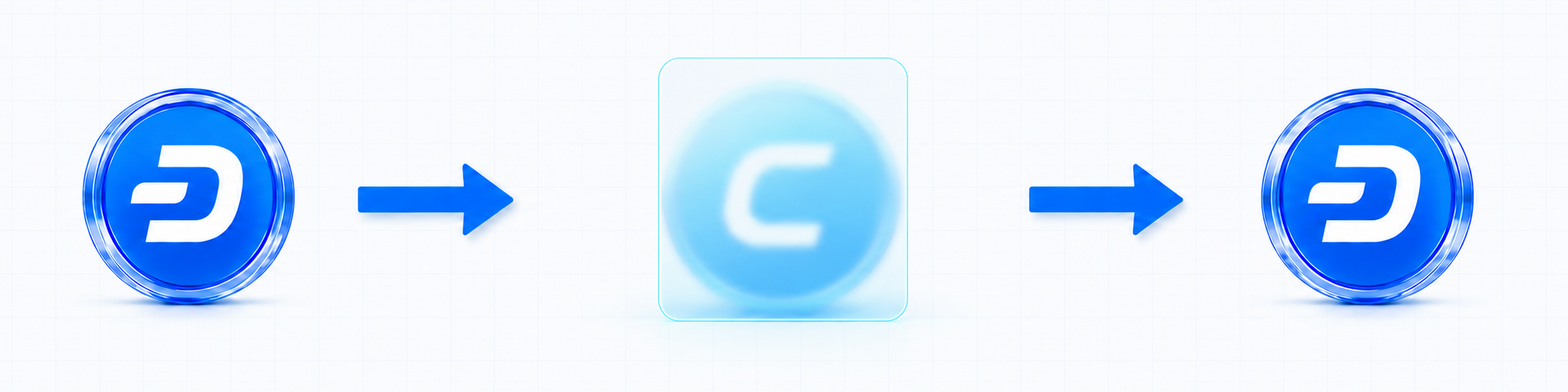
Platform Credits — the internal settlement unit of Dash Platform, tied to Dash at a fixed ratio: one Dash corresponds to 100 billion credits.

How the Privacy Works — Without the Complicated Math

Dash did not create a new ZK-scheme from scratch. The implementation is based on Orchard, Zcash's shielded protocol built on Halo 2 without a trusted setup. Dash's engineering work involved adapting it to Platform: custom state transitions, storage in GroveDB, fees, wallet synchronization, and the route back to Core.

Shortly before the release, a critical vulnerability was discovered in Orchard, potentially allowing double spending within the pool. The Zcash team fixed the proof scheme, and Dash Core Group transitioned its implementation to the updated libraries even before the release of Platform 4.0. An additional layer of control in Dash is provided by SumTree: this structure stores and cross-references the pool's state, preventing hidden inflation from going unnoticed.

One of the main problems with shielded systems is wallet synchronization. To detect incoming funds, the application receives encrypted notes and locally checks which ones its key can decrypt. The server does not learn which transfers belong to the user.

In the test version of the application, we created a new wallet and started synchronization: it took about 21 seconds, which is significantly faster than synchronizing the Zodl wallet for ZCash.

The release of mobile wallets with support for the new technology is expected soon.

Currently, the pool only works with Platform Credits. However, Dash has already announced plans to add separate shielded pools for native Platform tokens.

Private user assets are not a new concept. Dash's strength lies in the specific combination of capabilities: ZK-privacy, token and NFT issuance, and the ability to exchange created assets for Dash and back. Thanks to this, each asset gains a direct connection to an already established coin, and through it — to the external market.


Trending Cryptos

Related Questions

QWhat is the main innovation introduced in Dash Platform v4.0.0 regarding privacy?

ADash Platform v4.0.0 integrated shielded operations directly into the consensus protocol, based on Zcash's Orchard protocol. This is not an external mixer or a custodial service but a native, protocol-level privacy feature using zero-knowledge proofs.

QHow does the new shielded privacy model in Dash differ from its previous CoinJoin mechanism?

AThe new shielded privacy model using ZK-proofs is a second model of privacy that operates within the Platform, designed to be better suited for fast mobile wallets. The original CoinJoin mechanism, which operates in the main network for mixing transactions, continues to function. Regular Dash transactions remain transparent, making privacy optional.

QWhat critical issue was discovered in the Orchard protocol shortly before the Dash Platform v4.0 release, and how was it addressed?

AA critical vulnerability was discovered in the Orchard protocol that could potentially allow double-spending within the shielded pool. The Zcash team fixed the proof scheme, and the Dash Core Group updated their implementation to the patched libraries before the release. Dash adds an additional layer of control with SumTree, which monitors the pool's state to prevent hidden inflation.

QHow does Dash Platform ensure wallet synchronization privacy when detecting incoming shielded funds?

ATo maintain privacy during synchronization, the application receives encrypted notes from the server and locally checks which ones can be decrypted with its own key. This process allows the user to detect incoming funds without revealing to the server which specific transactions belong to them.

QWhat are Dash's future plans regarding shielded pools and assets on its platform?

ADash has announced plans to add separate shielded pools for native tokens on the Platform. This will extend ZK-privacy to user-issued assets and NFTs, allowing for private trading of these assets and their direct exchange for Dash, linking them to an established coin and the external market.

Related Reads

Qualcomm Chip Price Hike Deals a Blow to Android Phones

Qualcomm has officially announced a new round of price increases for its entire chip portfolio, effective September 1. The hikes, reaching up to 18% for the flagship Snapdragon 8 Elite Gen 6 Pro, follow similar moves by MediaTek, intensifying cost pressures on the already strained smartphone industry. CEO Cristiano Amon confirmed the plan, citing the need to offset rising industry-wide costs and restore declining profit margins. Qualcomm's Q3 FY2026 results showed a 25% drop in net profit, with mobile revenue plunging 20% year-over-year, hitting its lowest level since 2021. The surge in AI computing demand has led memory manufacturers to prioritize HBM production, creating a shortage in general-purpose DRAM and NAND Flash chips. Their prices soared by 93%-98% and 55%-60% respectively in Q1 2026, causing the memory cost share in smartphones to jump from 10%-15% to over 30%. Coupled with the soaring cost of advanced nodes like TSMC's 2nm and packaging, overall chip costs have reached historic highs. These upstream pressures are forcing downstream smartphone brands like Xiaomi, OPPO, and vivo to cut orders for mid-to-low-end models by up to 20% and use cost-saving measures like older chipsets. Reportedly, the Snapdragon 8E5 will be repurposed as a "long-lasting" chip for sub-brand phones in H2 2026. Amid this cost crisis, the Android market remains sluggish. Q2 2026 smartphone shipments in China fell 4.3% year-over-year, marking five consecutive quarters of decline. Major Android brands saw market share drop, while Huawei and Apple, with their in-house chip advantages, gained share. Qualcomm is diversifying into automotive and IoT sectors to reduce reliance on smartphones, but these new segments cannot yet fill the mobile revenue gap. Industry observers warn that the full impact of component cost hikes will hit in the second half of 2026, likely leading to higher-than-expected price increases for Android flagships and a further contraction in the Chinese smartphone market.

marsbit56m ago

Qualcomm Chip Price Hike Deals a Blow to Android Phones

marsbit56m ago

Breaking: GPT-5.6 Prices Slashed Effective Today

OpenAI has announced significant price cuts for its GPT-5.6 model API, effective immediately. The entry-level **GPT-5.6 Luna** sees the most drastic reduction, with input prices dropping 80% to $0.20 per million tokens and output prices falling to $1.20 per million tokens. The mid-tier **GPT-5.6 Terra** is reduced by 20%, now costing $2.00 (input) and $12.00 (output) per million tokens. The flagship **GPT-5.6 Sol** maintains its original price but introduces a new **Fast mode**, offering speeds up to 2.5 times faster for double the cost. The company attributes these price reductions to efficiency gains achieved through **GPT-5.6 Sol's own involvement in optimizing its production systems**. The model assisted in rewriting GPU kernels and improving speculative decoding, leading to a 20% reduction in end-to-end service costs and over 15% improvement in token generation efficiency. OpenAI emphasizes this process remained human-led. A key focus of the降价 is to lower the barrier for running **AI agent workflows**. By making the capable, tool-calling Luna model significantly cheaper, OpenAI aims to enable more frequent use in cost-sensitive, high-volume tasks like code review and monitoring. This creates a potential feedback loop: model-assisted efficiency gains lead to lower costs, which enables broader agent deployment, which in turn drives further optimization. The new pricing and features will also apply to Codex and ChatGPT Work subscriptions. The changes intensify competition in the large language model market, with OpenAI directly challenging rivals like Anthropic to respond.

marsbit1h ago

Breaking: GPT-5.6 Prices Slashed Effective Today

marsbit1h ago

Trading

Spot

Hot Articles

How to Buy DASH

Welcome to HTX.com! We've made purchasing DASH (DASH) simple and convenient. Follow our step-by-step guide to embark on your crypto journey.Step 1: Create Your HTX AccountUse your email or phone number to sign up for a free account on HTX. Experience a hassle-free registration journey and unlock all features.Get My AccountStep 2: Go to Buy Crypto and Choose Your Payment MethodCredit/Debit Card: Use your Visa or Mastercard to buy DASH (DASH) instantly.Balance: Use funds from your HTX account balance to trade seamlessly.Third Parties: We've added popular payment methods such as Google Pay and Apple Pay to enhance convenience.P2P: Trade directly with other users on HTX.Over-the-Counter (OTC): We offer tailor-made services and competitive exchange rates for traders.Step 3: Store Your DASH (DASH)After purchasing your DASH (DASH), store it in your HTX account. Alternatively, you can send it elsewhere via blockchain transfer or use it to trade other cryptocurrencies.Step 4: Trade DASH (DASH)Easily trade DASH (DASH) on HTX's spot market. Simply access your account, select your trading pair, execute your trades, and monitor in real-time. We offer a user-friendly experience for both beginners and seasoned traders.

3.2k Total ViewsPublished 2024.03.29Updated 2026.06.02

How to Buy DASH

Discussions

Welcome to the HTX Community. Here, you can stay informed about the latest platform developments and gain access to professional market insights. Users' opinions on the price of DASH (DASH) are presented below.

活动图片