XRP Price Forecast: Is XRP Nearing Historical Bottom with Hong Kong Retail Access Opening?

cryptonews.ruPublished on 2026-07-29Last updated on 2026-07-29

Abstract

XRP Price Forecast: XRP trading near $1.09 on July 29, attempting to bounce within a descending wedge pattern. Monthly RSI has hit its most oversold level in the token's history, exceeding even the March 2020 COVID crash lows. Key technical levels show resistance at the 20-day EMA ($1.0983) and the SuperTrend indicator ($1.1621), with support near $1.05 and the critical $1.00 level. Fundamentally, OSL Hong Kong has opened regulated retail trading for XRP, adding a potential demand catalyst. Spot flow data shows consistent net outflows from exchanges in July, suggesting accumulation. Derivatives metrics indicate balanced retail positioning. The bullish case requires a break above the wedge's upper trendline, while the bearish scenario could see a test of $1.00 if support fails.

$XRP is trading at $1.0873 on July 29, up 1.83%, attempting a bounce within a descending wedge that has squeezed the price since the May peak, as the monthly RSI is at the most oversold reading in the token's history.

$XRP is Still Inside the Descending Wedge, and the Supertrend is Bearish
$XRP Price Action 1D (Source: TradingView)

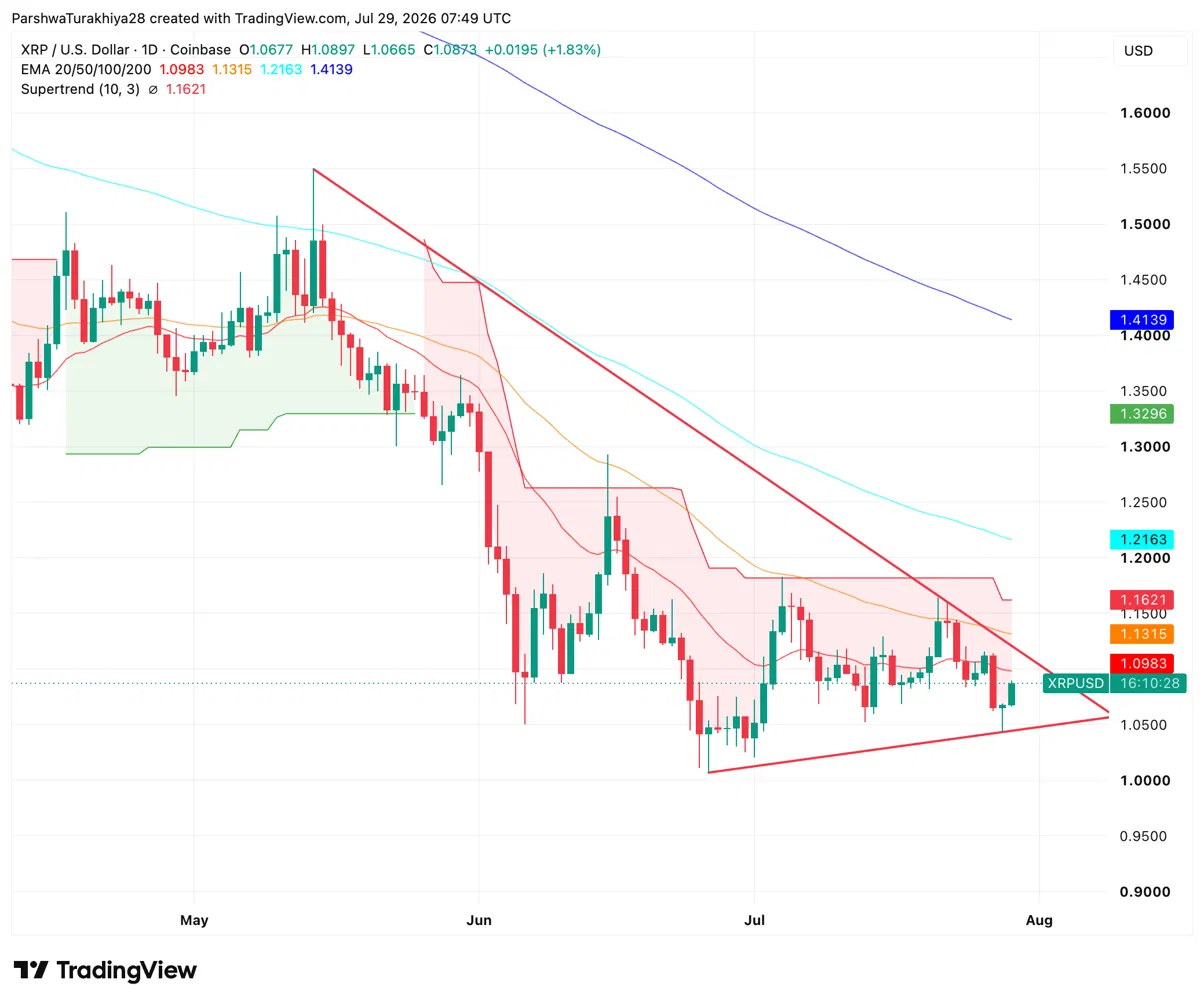
The daily chart shows how $XRP is compressing inside a descending wedge, with both trendlines noticeably converging. The lower trendline has held several tests around the $1.05 level. Today's bounce is pressuring the upper trendline around $1.10–$1.12. The Supertrend at $1.1621 is in a bearish position above the price and is the first indicator that needs to flip to confirm a trend change on the daily timeframe.

All four EMAs are sloping downwards above the current price. The 20-day EMA at $1.0983 is the immediate ceiling, nearly exactly matching the current price. The Ichimoku Cloud remains bearish overhead, adding another layer to the stack of resistance above. The round number $1.00 and the June low define the floor if the wedge breaks downward.

What are the Key Support and Resistance Levels for $XRP Today?

Resistance

  1. $1.0983 — 20-day EMA, immediate ceiling at the current price
  2. $1.1315 — 50-day EMA
  3. $1.1621 — Supertrend, needs to flip bullish to confirm the trend
  4. $1.2163 — 100-day EMA, extended upside target

Support

  1. $1.0665 — Today's session low and wedge lower trendline
  2. $1.0500 — Recent support zone after previous wedge floor tests
  3. $1.0000 — Round number and June low, last floor before uncharted territory

$XRP's Monthly RSI is More Oversold Than During the COVID Crash

$XRP is now at its most oversold levels ever.

— Down 72% from its ATH.
— It has hit a 2-year low near $1 last month.
— Monthly RSI is now more oversold than during the 2020 COVID crash.

Do you think the bottom is in? pic.twitter.com/jOV8xbk3gr

— Ash Crypto (@AshCrypto) July 28, 2026

Analyst Ash Crypto noted on July 28 that $XRP's monthly RSI has reached its highest oversold reading in history, surpassing even the COVID lows of March 2020. $XRP is now down 72% from its all-time high and hit a two-year low near $1.00 last month.

The monthly RSI reading is a slow-moving signal that takes time to confirm, but historically, extreme oversold readings over a monthly period have preceded multi-month recoveries rather than continued straight-line declines. The delay from the CLARITY Act and geopolitical noise from Iran are suppressing short-term momentum, but the monthly signal is the type long-term investors watch as an accumulation zone indicator.

OSL Hong Kong Opens Retail $XRP Trading with Settlement on the $XRP Ledger

Hong Kong retail just got the green light on $XRP. 🇭🇰

OSL HK opens $XRP/USD and $XRP/HKD to retail at 8PM today, first exchange in HK to do it. Now sitting alongside BTC, ETH, and SOL as the only retail-approved assets there.

Asia keeps building the on-ramps the US is still... https://t.co/qPeYa2sOj3 pic.twitter.com/NJrsocPwjZ

— Xaif Crypto (@Xaif_Crypto) July 29, 2026

OSL Hong Kong has become the first exchange in Hong Kong to open $XRP trading to retail investors. $XRP joins Bitcoin, Ethereum, and Solana as the only four assets available for retail trading on the platform. Settlement occurs directly via the $XRP Ledger.

This move expands regulated retail access for $XRP in Asia at a time when the token is reaching its most oversold monthly RSI levels historically. It adds an institutional demand signal to the on-chain ecosystem, which is already showing net exchange outflows.

What Spot Net Flows and Derivatives Show About Current Positioning
$XRP Spot Inflow/Outflow (Source: Coinglass)

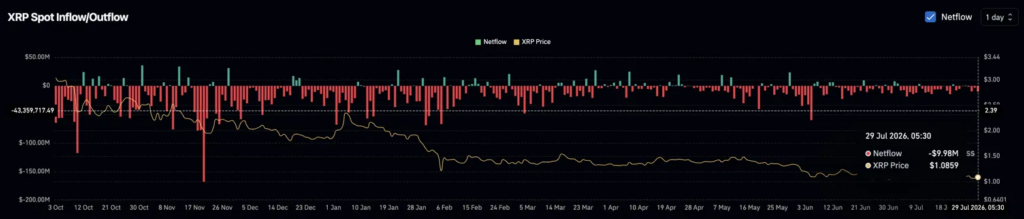
$XRP spot flow recorded -$9.98M on July 29, meaning more $XRP moved off exchanges than onto them. The net flow chart shows a sustained pattern of net outflows throughout July despite price weakness. Historically, holders removing supply from sell-side turnover during a price decline represent a bullish undercurrent beneath the bearish surface price movement.

$XRP Derivatives Overview — July 29, 2026

Metric Value What it Means
24h Volume $2.55B (+9.70%) Active trading without significant new directional positioning
Open Interest $2.45B (-0.08%) Almost flat, no major new bets
Long Liquidations (24h) $3.60M Long positions absorbing the bulk of recent volatility pain
Short Liquidations (24h) $945.84K Shorts experiencing far less pain than longs
Top Trader L/S (Accounts) 2.86 Large accounts confidently net long
Top Trader L/S (Positions) 1.49 Position sizes also net long
Retail L/S Ratio 1.0421 Nearly balanced — retail not overly committed either way
Source: Coinglass, July 29, 2026.

The retail long/short ratio at 1.0421 is almost perfectly balanced, showing that small traders are not too invested either way ahead of the FOMC decision. This is unusual for a market at historically extreme oversold readings and suggests that retail has not yet begun chasing the monthly RSI signal.

$XRP Price Forecast: Upside and Downside Targets

  • Upside Case: The wedge upper trendline breaks above $1.10, $XRP reclaims the 20-day EMA at $1.0983, OSL Hong Kong retail flows increase demand from Asia, and the monthly RSI extreme attracts spot accumulation towards the Supertrend at $1.1621 and the 50-day EMA at $1.1315, as the CLARITY Act window narrows to its final days.
  • Downside Case: The wedge upper trendline rejects the price again, $XRP loses the lower trendline near $1.05, and the CLARITY Act fails to make it to a vote before the August 8 recess, pushing price closer to the $1.00 round number as the most oversold monthly RSI in history remains low without a catalyst to spark a recovery.
end-content

Trending Cryptos

Related Questions

QWhat technical pattern is currently restraining the price of XRP, and what does the SuperTrend indicator show?

AThe price of XRP is currently constrained within a descending wedge pattern. The SuperTrend indicator is in a bearish position above the price, indicating that a trend change on the daily timeframe has not been confirmed.

QAccording to the article, what is historically significant about XRP's current monthly RSI reading?

AXRP's monthly RSI has reached its most oversold level in history, surpassing even the lows seen during the COVID-19 crash in March 2020. Historically, such extreme oversold conditions on a monthly scale have preceded multi-month recoveries.

QWhat is the significance of OSL Hong Kong's recent move regarding XRP?

AOSL Hong Kong became the first exchange in Hong Kong to open XRP trading to retail investors. XRP now joins Bitcoin, Ethereum, and Solana as the only four retail-approved assets on the platform, with settlement occurring directly through the XRP Ledger.

QWhat does the spot netflow data for XRP indicate about current holder behavior?

AThe spot netflow for XRP shows a net outflow of -$9.98M, meaning more XRP is being moved off exchanges than onto them. This sustained pattern of net outflows during a price decline is considered a bullish underlying flow beneath the surface bearish price action.

QWhat are the two main price forecast scenarios for XRP presented in the article's conclusion?

ABullish Case: A break above the wedge's upper trendline and the 20-day EMA at $1.0983, fueled by Asian demand from OSL Hong Kong and accumulation due to the extreme monthly RSI, targeting the SuperTrend at $1.1621 and the 50-day EMA at $1.1315. Bearish Case: A rejection at the wedge's upper trendline and a break below the lower trendline near $1.05, potentially pushing the price toward $1.00 if the CLARITY Act vote is delayed, leaving the historically oversold RSI without a catalyst for recovery.

Related Reads

After R&D Investment Catches Up with the U.S., Is the Sino-U.S. Chip Competition Still Just About Money?

The article examines the significance of recent data showing China's total R&D expenditure, measured by purchasing power parity (PPP), catching up to or slightly surpassing that of the United States in 2024. It argues that while this milestone reflects China's immense capacity to mobilize research resources, the competition in semiconductors now extends far beyond sheer financial input. The analysis highlights key differences: China's R&D is heavily skewed towards experimental development (over 80%), focusing on product engineering and industrialization, whereas the U.S. allocates a proportionally larger share (about 15%) to basic research. Furthermore, leading U.S. semiconductor firms reinvest a significant portion of their substantial global sales revenue into R&D, creating a sustainable commercial innovation cycle that is difficult to replicate. The article emphasizes that semiconductor progress depends on converting R&D into commercially viable products that pass rigorous customer validation and achieve repeat orders, not just on spending levels. It concludes that as China enters the top tier of R&D spenders, the critical challenges shift to improving resource allocation efficiency, fostering long-term basic research, and building effective mechanisms to bridge the gap between laboratory discoveries and reliable, market-ready industrial capabilities.

marsbit40m ago

After R&D Investment Catches Up with the U.S., Is the Sino-U.S. Chip Competition Still Just About Money?

marsbit40m ago

Top 10% of American Households Capture 88% of Wealth, How Is the AI Era Cake Divided?

AI Worsens Wealth Inequality as Top 10% of US Families Garner 88% of Stock Gains (2019-2026) A report from the China Finance 40 Forum highlights that the AI boom is significantly widening wealth inequality in the United States. From 2019 to Q1 2026, wealth from directly held stocks by US households nearly doubled from $29 trillion to approximately $55 trillion, with rapid growth concentrated post-2023, coinciding with the AI-driven stock market surge. The distribution of these gains has been starkly uneven. Between 2022 and Q1 2026, the wealth increase of about $21 trillion was captured almost entirely by the wealthiest families: the top 10% secured roughly 88% ($18.5 trillion), while the bottom 50% received only about 1% ($0.2 trillion). This has contributed to a growing disparity in disposable income shares. The report, referencing economic historian Robert Allen, draws parallels to historical technological shifts like the "Engels' Pause" during the First Industrial Revolution, where worker wages stagnated despite productivity gains. It suggests AI could induce a similar period where capital收益 outpace labor income, exacerbating inequality. Huang Yiping of Peking University identifies four mechanisms through which AI impacts income distribution: capital-bias (reducing labor's income share), task polarization (hollowing out middle-skill jobs), skill-based digital divides, and wealth amplification through assets. He warns that if this trend continues, strong supply growth driven by AI could be undermined by persistently weak consumer demand, threatening sustainable economic growth. To address these challenges, the report proposes a three-pronged strategy: 1) Defensive measures like strengthening social safety nets and antitrust enforcement; 2) Empowering workers through education reform and lifelong learning to collaborate with AI; and 3) Rebalancing via policies such as potential taxes on AI超额收益 and mechanisms for broader sharing of technology's benefits, ensuring AI's红利 are more equitably distributed.

marsbit46m ago

Top 10% of American Households Capture 88% of Wealth, How Is the AI Era Cake Divided?

marsbit46m ago

Trading

Spot

Hot Articles

What is XRP 2.0

XRP 2.0: A New Frontier in the Cryptocurrency Landscape Introduction to XRP 2.0 In the ever-evolving realm of cryptocurrency, new projects continuously emerge, vying for attention and adoption. One such promising initiative is XRP 2.0, a novel cryptocurrency project designed to leverage advanced blockchain technology and robust encryption methodologies. While the name draws parallels with Ripple’s XRP, it’s crucial to note that XRP 2.0 operates independently, focusing on enhancing transaction security, privacy, and scalability. As the digital financial landscape increasingly embraces decentralized solutions, XRP 2.0 aims to contribute meaningfully to web3 and the overall expansion of crypto projects. What is XRP 2.0? At its core, XRP 2.0 is a cryptocurrency project that aims to create a secure and decentralized digital currency ecosystem. Its foundational technology integrates sophisticated blockchain principles with cutting-edge encryption techniques. The overarching goal of XRP 2.0 is to establish itself as a reliable and efficient platform enabling swift transaction execution while prioritizing enhanced privacy protections for its users. The project is promoted as a solution to many limitations faced by existing cryptocurrencies, proposing a system that can handle a higher volume of transactions with improved speed and privacy. This versatility positions XRP 2.0 as a significant contender in a marketplace riddled with various digital currencies. Who is the Creator of XRP 2.0? The identity of the creator behind XRP 2.0 has been flagged as ‘Wilbur.’ However, comprehensive details regarding Wilbur or their associated entity remain elusive. The anonymity of many cryptocurrency creators is not an uncommon phenomenon in the industry, often designed to maintain a degree of privacy and security. Who are the Investors of XRP 2.0? As of now, specific information related to the investment foundations or organizations supporting XRP 2.0 is not publicly available. In the cryptocurrency sector, the backing by reputed investors can significantly influence a project's credibility and success, yet the transparency regarding the financial supporters of XRP 2.0 has not been established. How Does XRP 2.0 Work? XRP 2.0 stands out by employing a combination of blockchain technology and advanced encryption algorithms that ensures secure and decentralized transactions. Its innovative structure includes unique features designed to foster user engagement and broaden functionalities beyond conventional cryptocurrency transactions. Among these features, XRP 2.0 incorporates AI-powered capabilities, such as text-to-image and text-to-speech functionalities. These additions are designed to enhance the interactive experience for users, promoting broader applicability across various sectors. By bridging technological advancements with user-centered design, XRP 2.0 aims to capture the attention of a diverse range of individuals and enterprises looking to integrate cryptocurrency solutions into their operational frameworks. Timeline of XRP 2.0 Understanding XRP 2.0 requires examining the milestones that have defined its journey thus far: July 23, 2023: XRP 2.0 is introduced as a novel cryptocurrency project, aiming to revolutionize secure and decentralized transaction capabilities in the blockchain domain. September 8, 2023: The launching of another project, XRP20, occurs, marking the emergence of an ERC-20 token on the Ethereum blockchain that remains unrelated to XRP 2.0. November 13, 2023: The XRP Ledger undergoes a significant update with the release of rippled server software version 2.0.0. It is essential to note that this development is disconnected from the XRP 2.0 cryptocurrency project. Key Points About XRP 2.0 To distill the essence of XRP 2.0, several critical factors emerge: Unique Features: The inclusion of features like AI-powered text-to-image and text-to-speech further diversifies the potential applications of XRP 2.0. Blockchain Technology: The framework utilizes advanced blockchain mechanisms and encryption protocols, ensuring a secure and decentralized environment for transactions. Scalability and Privacy: XRP 2.0 prioritizes enhanced privacy protections in transaction processes and the scalability necessary to accommodate a growing user base. No Affiliation with Ripple: Importantly, despite its name, XRP 2.0 does not have any allegiance or collaboration with Ripple’s XRP, distinguishing its operational framework and objectives within the cryptocurrency ecosystem. Conclusion XRP 2.0 represents an ambitious venture into the cryptocurrency sphere, aiming to offer a combination of security, privacy, and efficiency in digital transactions. By integrating sophisticated technologies and user-friendly features, the project sets out to broaden the horizons of what cryptocurrency can achieve in today's digital economy. While the anonymity of its creator and lack of disclosed investors might raise questions for some, XRP 2.0's focus on advanced functionalities and decentralisation enhances its appeal amidst an increasingly crowded crypto market. As the cryptocurrency landscape continues to evolve, XRP 2.0 may yet emerge as a pivotal player in the expansion of secure and scalable blockchain solutions.

1.3k Total ViewsPublished 2024.04.01Updated 2024.12.03

What is XRP 2.0

Discussions

Welcome to the HTX Community. Here, you can stay informed about the latest platform developments and gain access to professional market insights. Users' opinions on the price of XRP (XRP) are presented below.

活动图片