Cardano Price Forecast: Can ADA Surpass $0.20 as Ark Invest and Hoskinson Debate Its Relevance?

cryptonews.ruPublished on 2026-07-27Last updated on 2026-07-27

Abstract

Cardano (ADA) is trading at $0.1659 on July 27, compressed at the apex of a triangle pattern. This coincides with Ark Invest's Director of Research questioning the industry's continued focus on Cardano as newsworthy, prompting a rebuttal from founder Charles Hoskinson who called the criticism institutional bias. Technically, ADA is caught between a descending trendline from May's peak and an ascending line from June's low of ~$0.1386, with the 20-day EMA at $0.1669 adding resistance. Key support is the 0.236 Fibonacci level at $0.1618, with resistance at the 50-day EMA ($0.1750) and the 0.382 Fib level ($0.1762). Derivatives data shows extremely low options volume at $6.59K, similar to previous low-volatility compression phases before directional moves. Open interest and 24-hour volume have dropped significantly, and long/short positioning is nearly balanced, indicating trader caution ahead of the upcoming FOMC meeting. Price Forecast: * **Bullish Case:** An upward triangle breakout above the 20-day and 50-day EMAs could target the 0.382 Fib ($0.1762) and 0.618 Fib ($0.1995) levels, potentially fueled by a risk-on FOMC outcome and renewed attention from the Hoskinson-Ark debate. * **Bearish Case:** A breakdown below the 0.236 Fib support at $0.1618 could see ADA decline toward the June low of $0.1386, driven by the negative narrative from Ark and risk aversion from FOMC uncertainty.

Cardano trades at $0.1659 on July 27th, holding steady and compressing at the apex of a triangle, on the same day that Ark Invest's Director of Research publicly questioned whether the industry should still consider Cardano a news-worthy entity.

$ADA Is at Triangle Apex, With Fibonacci 0.236 as the Last Floor
$ADA 1D Price Movement (Source: TradingView)

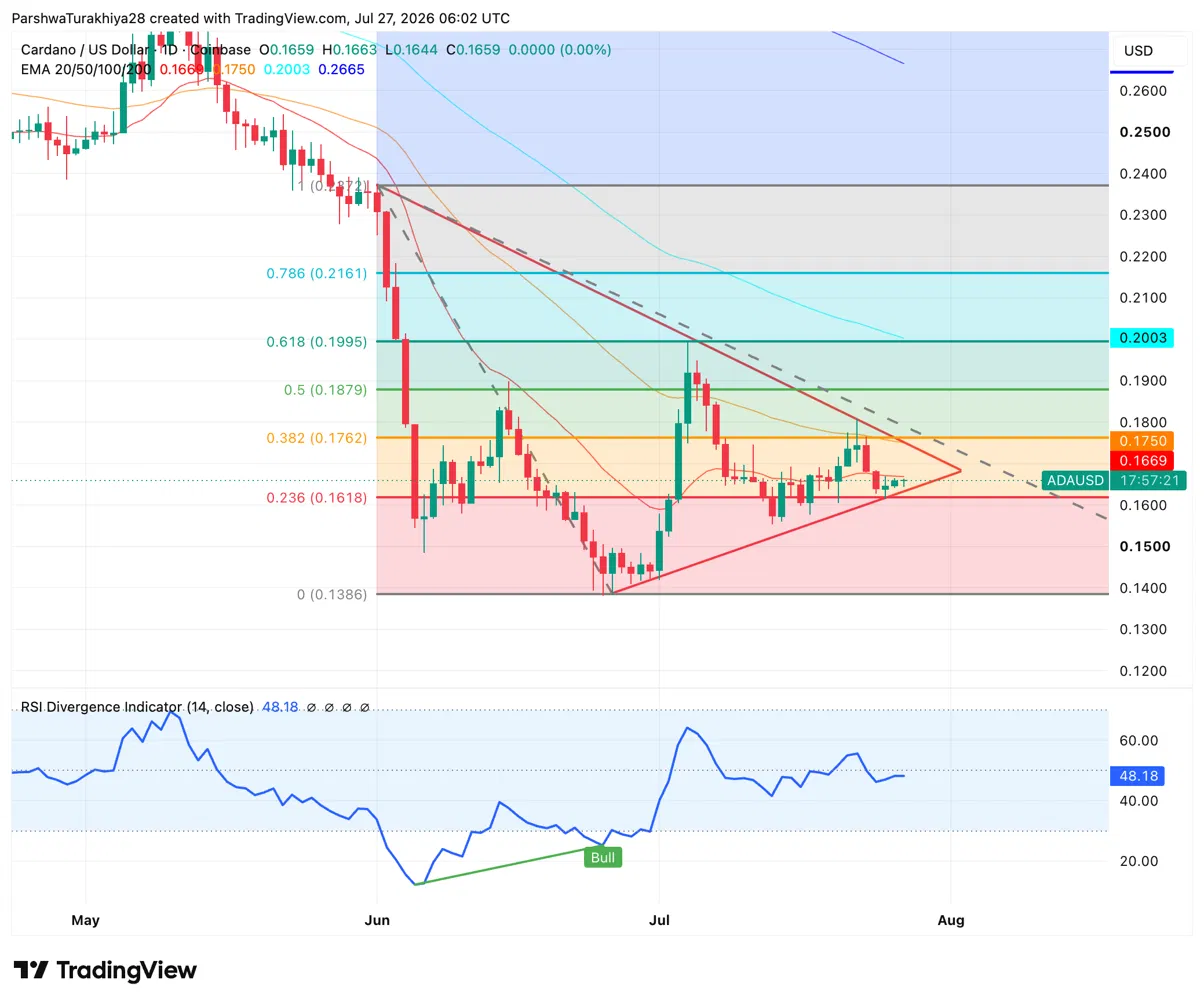
The daily chart shows how $ADA is compressing inside a triangle formed between the descending trendline from the May peak and the ascending trendline from the June low around $0.1386. Both trendlines converge at the current price, with the 20-day EMA at $0.1669 slightly above, adding a third layer of resistance at the top. Today, the price is trading in a range from $0.1644 to $0.1663—the narrowest daily range in weeks.

The Fibonacci 0.236 level at $0.1618 sits right below the current price and serves as the last significant support before the Fibonacci zero point at $0.1386. The RSI indicator at 48.18 is neutral, in the mid-range, showing no active bullish or bearish signal. Fibonacci 0.382 at $0.1762 and the 50-day EMA at $0.1750 form the first resistance cluster above, followed by Fibonacci 0.5 at $0.1879, Fibonacci 0.618 at $0.1995, and the 100-day EMA at $0.2003.

What Are the Key Support and Resistance Levels for $ADA Today?

  • Support at $0.1618 from the Fibonacci 0.236 level and the ascending triangle line
  • Resistance at $0.1669 from the 20-day EMA and $0.1750 from the 50-day EMA
  • Extended resistance at $0.1762 from Fibonacci 0.382 and $0.1995 from Fibonacci 0.618
  • Key low at $0.1386 from the Fibonacci zero point and June low

Ark Invest Calls Cardano Irrelevant—Hoskinson Labels it Personal Bias

Well, I don't think I'll get a fair shake from @ARKInvest anytime soon 🙁 It's sad that VCs hire people like this. An entire institution is biased by one person https://t.co/d5SA5ovsfH

— Charles Hoskinson (@IOHK_Charles) July 25, 2026

Ark Invest's Director of Research Lorenzo Valente responded to a The Block report about Hoskinson's comments on quantum computing, stating that the industry undermines its own credibility by continuing to invite Hoskinson to conferences, accepting Cardano sponsorships, and treating the network as news. Valente did not address the quantum argument specifically, framing his criticism as a matter of institutional credibility rather than a technical rebuttal.

Hoskinson directly replied to Valente's post, dismissing it as bias from a venture capital institution, not objective analysis. His original comments to The Block warned that Bitcoin's governance model might be too rigid to respond to quantum computing risks, specifically the vulnerability of dormant coins from the Satoshi era, and that Cardano's peer-reviewed, iterative approach better positions it for long-term relevance.

$ADA Derivatives: Market Awaits FOMC
$ADA Derivatives Analysis (Source: Coinglass)
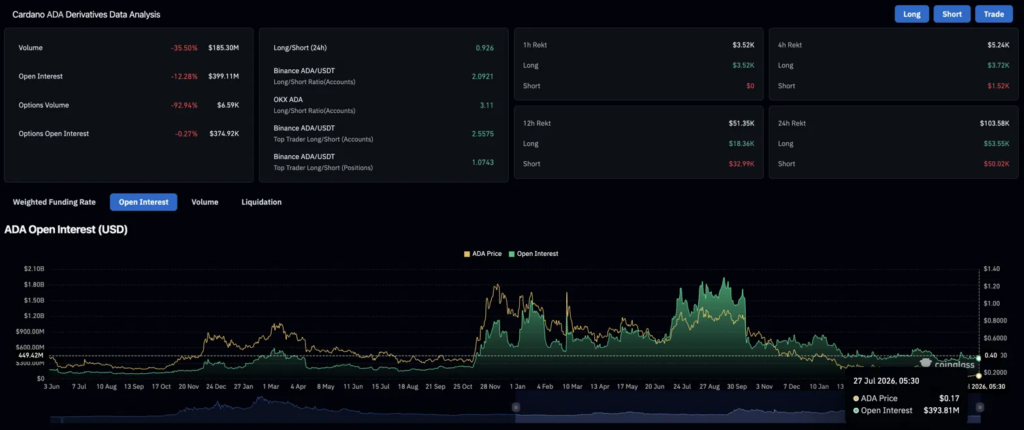
Metric Value Signal
24h Volume $185.30M (-35.50%) Sharp drop — market retreating, selling not active
Open Interest $399.11M (-12.28%) Position unwinding — reducing directional bets
Options Volume $6.59K (-92.94%) Near-zero level — same level as before previous breakouts during low volatility
Long Liquidations (24h) $53.55K Unusually balanced with shorts
Short Liquidations (24h) $50.02K Neither side dominated — true compression session
Top Trader L/S (Accounts) 2.56 Large accounts are net long by account count
Top Trader L/S (Positions) 1.07 Barely long by position size — large clients are cautious

The options volume dropping to $6.59K is the most telling derivative signal. Coinglass data shows this is the same level as last time $ADA was at a compression point with low volatility before a directional move.

Options traders are not hedging, meaning they are either waiting for an FOMC catalyst or have no directional conviction at current levels. The long/short ratio of 1.07—just above 1.0—confirms that even the largest accounts aren't committing size in either direction.

$ADA Price Forecast: Upside and Downside Targets

  • Bullish Case: The triangle breaks upward, $ADA closes above the 20-day EMA at $0.1669 and the 50-day EMA at $0.1750, a dovish FOMC on July 29th triggers a broader risk-on move, and price targets Fibonacci 0.382 at $0.1762 and Fibonacci 0.618 at $0.1995 as the Hoskinson-Ark debate refocuses attention on Cardano's development roadmap.
  • Bearish Case: The triangle breaks downward through Fibonacci 0.236 at $0.1618, the ascending trendline from the June low fails, and $ADA tumbles towards the Fibonacci zero point at $0.1386 as the Ark credibility narrative amplifies selling pressure and FOMC uncertainty dampens risk appetite.
end-content

Trending Cryptos

Related Questions

QAccording to the technical analysis, what is the current price pattern for ADA and what are the key support and resistance levels?

AADA is currently trading within a symmetrical triangle pattern, formed by a descending trendline from the May peak and an ascending trendline from the June low. Key support is at the 0.236 Fibonacci level at $0.1618, followed by the June low at $0.1386. Key resistance levels are the 20-day EMA at $0.1669, the 50-day EMA at $0.1750, the 0.382 Fibonacci level at $0.1762, and the 0.618 Fibonacci level at $0.1995.

QWhat was the core of the public dispute between Ark Invest's research director and Charles Hoskinson?

AArk Invest's Research Director, Lorenzo Valente, publicly questioned whether the industry should still consider Cardano newsworthy, suggesting its continued inclusion undermined institutional credibility. Charles Hoskinson responded by calling this institutional bias from a venture capital firm, not objective analysis. The debate stemmed from Hoskinson's comments to The Block about quantum computing risks and Bitcoin's governance.

QWhat does the derivatives data, particularly the options volume, suggest about market sentiment ahead of the FOMC meeting?

AThe derivatives data indicates extreme market caution and a lack of directional conviction ahead of the FOMC meeting. Options volume plummeted to $6.59K (-92.94%), a level last seen during previous low-volatility compression phases before a directional move. This suggests traders are not hedging or placing directional bets, likely waiting for the FOMC catalyst. The nearly balanced long/short liquidation amounts and a top trader long/short ratio of 1.07 confirm large accounts are also cautious and not committing to a strong directional view.

QWhat are the two primary price forecast scenarios outlined for ADA in the article?

AThe article outlines a bullish and a bearish scenario. The bullish case involves an upward breakout from the triangle, a close above the 20-day and 50-day EMAs, a positive reaction to the FOMC meeting, and a price target towards the $0.1762 (0.382 Fib) and $0.1995 (0.618 Fib) levels. The bearish case involves a breakdown below the $0.1618 support (0.236 Fib), a failure of the ascending trendline, and a decline towards the $0.1386 June low, fueled by negative sentiment from the Ark debate and risk-off sentiment from FOMC uncertainty.

QOn what date was the article's price data and market analysis based, and what upcoming event was highlighted as a potential catalyst?

AThe article's price data and market analysis were based on July 27. The upcoming Federal Open Market Committee (FOMC) meeting on July 29 was highlighted as a key potential catalyst for the market and ADA's price direction.

Related Reads

The Semiconductor Industry's Most Obscure Chokepoint Material: It Has Multiplied in Price Unnoticed, and China Just Banned Its Export

"Helium: The Silent Choke Point in Semiconductors" Helium, despite being the universe's second most abundant element, is critically scarce on Earth. It cannot be synthesized artificially and escapes Earth's gravity once released, making it a non-renewable resource. Yet, it is indispensable for advanced semiconductor manufacturing, requiring ultra-high purity (99.9999%) for processes like wafer etching, leak detection, and thermal management in lithography tools, with no viable substitutes. This low-profile resource, whose price has doubled unnoticed, suddenly gained attention when China imposed an export ban on July 10th. The ban is a response to a severe global shortage triggered months earlier. In March, missile attacks damaged the world's largest helium production hub in Qatar's Ras Laffan, halting a third of global supply with repairs expected to take 3-5 years. Concurrently, Russia tightened export controls, and the US sold off its federal helium reserve. Approximately 200 specialized transport containers, each worth ~$1 million, were stranded with perishable cargo. Global spot prices skyrocketed, and chipmakers like TSMC warned of potential impacts. China, which imports over 84% of its helium (primarily from Qatar and Russia), faces a severe squeeze. Despite being helium-poor, China has developed domestic extraction technology over five years, processing byproduct gases from LNG plants to produce ultra-pure helium. Domestic output, while still only covering less than 20% of demand, enabled the recent export ban aimed at securing domestic supply for its own expanding chip industry. The industry now faces "Helium Shortage 5.0." With key global sources constrained for years, this invisible gas—once wasted on party balloons—has become a critical, geopolitically charged bottleneck for chips, healthcare (MRI machines), and beyond, forcing the world to finally treat it as the finite strategic resource it is.

marsbit36m ago

The Semiconductor Industry's Most Obscure Chokepoint Material: It Has Multiplied in Price Unnoticed, and China Just Banned Its Export

marsbit36m ago

Early Investor of Unitree Bets on a Brain-Computer Interface Company

"Wabo Technologies, a brain-computer interface (BCI) startup, has secured new funding from Vertex Ventures (under Temasek), Hongtai Fund, Chengdu Future Industry Fund, and Huifengda Capital. Vertex Ventures is known for its early bet on Unitree Robotics. Inspired by the sci-fi film "Avatar," founder Zhang Xingzhi has pursued human-machine interaction for over a decade. He established Wabo in late 2025, coinciding with China's push for BCI as a future industry. Unlike companies focused solely on medical hardware, Wabo positions itself as a model company. Its core mission is to develop a "Human Neural Intent Model" that decodes EEG, EMG, and behavioral signals to understand a user's goals, confirmations, corrections, and stop intentions before physical action, translating them into standardized control signals for machines, robots, or smart devices. The young, full-stack team, backed by academic collaborators from Tianjin University and Fudan University, quickly attracted investors. The company had previously raised a seed round from Ceyuan Capital. Investors were impressed by Wabo's systematic capabilities in data collection, signal processing, and engineering, seeing potential beyond a single hardware product toward a reusable layer of human intent interpretation. Applications span medical rehabilitation, smart homes, embodied AI, and even space exploration, with Wabo partnering with Tianjin University on pioneering "space BCI" research. Wabo plans a dual-headquarters strategy, with Shanghai focusing on high-end R&D and model development, and Chengdu handling hardware, product development, and supply chain. The BCI sector in China is heating up, with over 30 financing deals in early 2026. Zhang believes future competition will center on who can build a sustainable data-model-scenario loop. He predicts industry consolidation within three years, with only companies that master this闭环 surviving. The vision from "Avatar" is inching closer to reality."

marsbit50m ago

Early Investor of Unitree Bets on a Brain-Computer Interface Company

marsbit50m ago

ChangXin Technology: A Cyclical Stock Standing Atop the Cycle Peak

Changxin Technology: A Cyclical Stock at the Peak On July 27, 2026, Changxin Technology topped the A-share market with a market capitalization of 3.28 trillion yuan, surging 465% on its first trading day. The company, which lost 16.3 billion yuan in 2023, reported an estimated net profit of 50-57 billion yuan for the first half of 2026. Its dramatic reversal mirrors the volatile DRAM (Dynamic Random Access Memory) cycle. The DRAM industry is inherently cyclical, with booms and busts every 3-4 years. This is due to product standardization and a significant time lag in supply adjustment. When prices rise, manufacturers expand capacity, but new production takes 2-3 years to come online, often leading to oversupply and price crashes when demand cools. Changxin's performance perfectly tracks this cycle. It recorded deep losses in 2023-2024 during the industry downturn, turned its first annual profit in 2025, and saw profits skyrocket in Q1 2026. This surge is primarily price-driven. The AI boom has led major players like Samsung and SK Hynix to shift 70-80% of new capacity to high-margin HBM (High Bandwidth Memory), creating a severe shortage and price explosion in general-purpose DRAM markets where Changxin competes. However, a massive global capacity expansion is underway. The top three manufacturers have announced nearly $70 billion in capital expenditure for 2026. Changxin itself plans to expand from three to seven 12-inch wafer fabs. This investment will translate into significant new supply in 2-3 years. While DRAM prices are expected to remain high through 2026-2027, price growth is already slowing, and a potential downturn is forecast for around 2028 as new capacity ramps up. A key challenge for Changxin is catching up in the critical HBM segment. While it has delivered HBM3 samples, leaders are already mass-producing more advanced HBM3E. Success in HBM is crucial for gaining true cyclical resilience. In conclusion, Changxin is a commendable company that has broken foreign monopolies in DRAM. Its long-term growth narrative—driven by import substitution and AI—is valid. Yet, its current valuation of 5-6x forward P/E, typical for a cyclical stock at its peak, suggests much future growth is already priced in. AI may extend the current cycle but cannot eliminate the industry's inherent volatility. For investors, the critical question is preparedness for the inevitable downturn when the cycle turns.

marsbit55m ago

ChangXin Technology: A Cyclical Stock Standing Atop the Cycle Peak

marsbit55m ago

Trading

Spot

Hot Articles

Discussions

Welcome to the HTX Community. Here, you can stay informed about the latest platform developments and gain access to professional market insights. Users' opinions on the price of ADA (ADA) are presented below.

活动图片