Original Author: Bao Yilong
Original Source: Wall Street Insights
Amidst the interweaving of geopolitics, climate, and technological shocks, Citigroup believes that "black swan" events in the commodity markets are evolving from once-a-decade occurrences to a near-normal state.
Zhuifeng Trading Desk News, July 23 – Citigroup Research’s Eric G Lee team released a report, outlining potential extreme risk scenarios for the second half of 2026 and beyond, with price shocks large enough to render traditional supply-demand analysis frameworks obsolete.
The tail-risk scenarios covered by Citigroup Research include: U.S.-Iran conflict evolving from a temporary shock into a multi-year persistent disturbance; a key mineral stockpiling race; gold falling 15-20% first and then doubling; extreme El Niño weather impacting agricultural products; AI bubble bursting or sustained boom triggering two-way volatility, etc.
Since 2020, the commodity markets have already experienced unprecedented density of extreme events: the COVID-19 pandemic, Russia-Ukraine conflict, trade wars, central bank gold-buying waves, and repeatedly flaring Middle East conflicts.
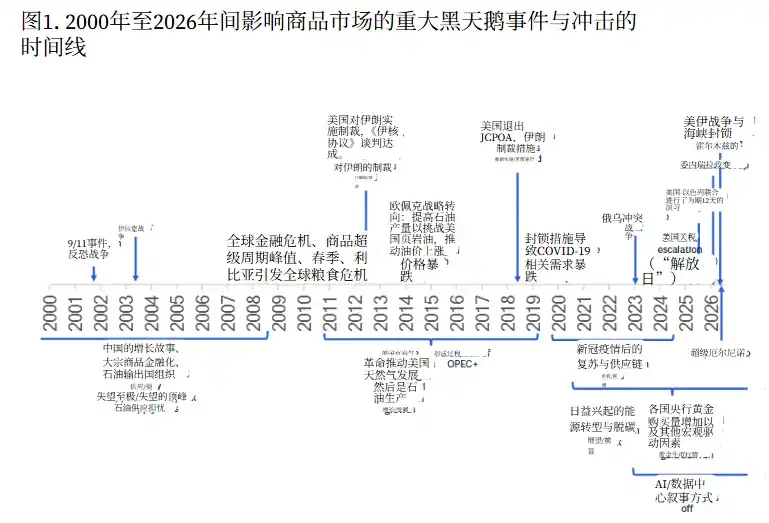
The report points out that these risk scenarios are not baseline forecasts, but rather "plausible events with high impact should they occur" tail scenarios, intended to supplement Citigroup's existing baseline forecast framework.
Highest Risk: U.S.-Iran Conflict Evolving into a Multi-Year Supply Crisis
Citigroup ranks the escalation of the U.S.-Iran conflict as the most impactful tail scenario, though its probability of occurrence is assessed as "low."
The report notes that from the "12-day war" in June 2025 when the U.S. and Israel jointly struck Iranian nuclear facilities, to the conflict resuming in February 2026, a fragile ceasefire agreement signed in June 2026, and renewed military escalation in July 2026, oil and refined product prices have already experienced multiple rounds of severe volatility.
If the conflict expands further, Iran could attack energy infrastructure in Gulf oil-producing countries. Combined with prolonged closures of the Strait of Hormuz and disruptions in the Bab el-Mandeb Strait, the world could face a sustained supply deficit of 5 to 10 million barrels per day.
Citigroup estimates that, assuming a demand elasticity of approximately -0.05, supply losses of this magnitude would drive oil prices up 100% to 200%, meaning flat price crude oil surpassing $200/barrel, with U.S. retail gasoline prices persistently remaining above $6/gallon.
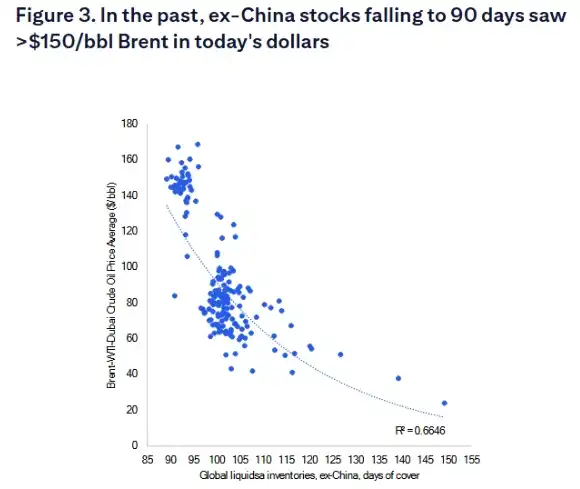
Citing historical data, the report states, if global oil inventories excluding China fall below 70 days of consumption coverage, the corresponding actual Brent price has reached above $150/barrel.
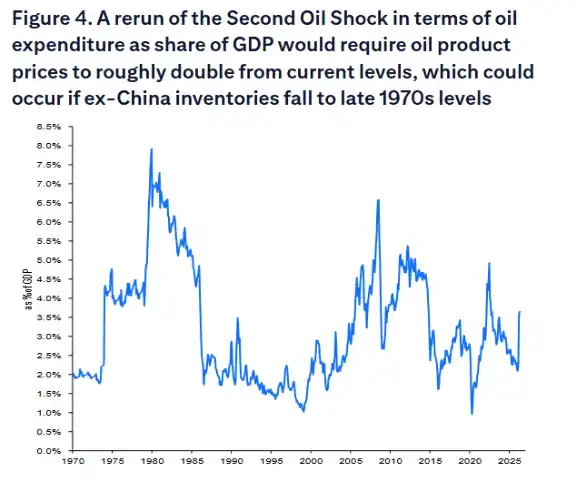
If the oil & gas expenditure's share of GDP were to repeat the 8% peak of the second oil crisis in the 1970s, the required oil price level would exceed $200/barrel.
As of July 2026, total global oil inventories excluding China remain around 94 days of consumption. However, Citigroup predicts that if a global deficit of 7 to 8 million barrels per day persists, this metric could fall below 70 days by early 2027.
Russia-Ukraine Escalation: Natural Gas Market Impact Expected to Exceed Crude Oil
Citigroup rates the possibility of stricter restrictions on Russian energy exports as "medium probability," emphasizing its impact on the natural gas market would be greater than on crude oil.
For liquefied natural gas (LNG), Russia exported about 44 billion cubic meters (bcm) in 2025, accounting for approximately 7% of global LNG supply, mainly from the Yamal LNG and Sakhalin-2 projects.
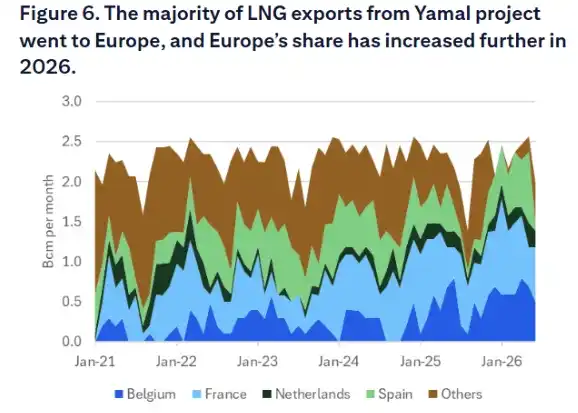
Of this, over 70% of Sakhalin-2 exports go to Japan and South Korea; around 90% of Yamal project exports are directed to Europe as of mid-2026.
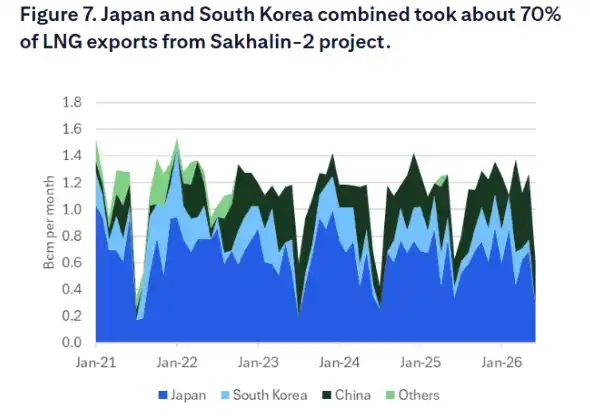
If a global ban on Russian LNG purchases were implemented, over 30 bcm of annual supply would need to be relocated. However, due to shipping and contractual limitations, the global LNG market would face a significant supply gap.
For pipeline gas, the damage from banning purchases of Russian pipeline gas would be even greater due to the physical constraints of pipelines limiting flexible redirection of gas flows.
Russia exports over 70 bcm of pipeline gas annually to markets outside China, with Europe and Turkey alone importing about 37 bcm combined.
Key Mineral Stockpiling: Copper Prices Could Break Through $20,000/Ton
Citigroup rates the probability of a key mineral stockpiling race as "high," with its impact varying by commodity and stockpiling scale. If governments engage in large-scale accumulation of strategic mineral stockpiles, copper prices could be pushed above $20,000 per ton.
The report points out that policy signals have emerged among major global economies such as the U.S. and the EU.
The U.S. "Project Vault" proposal plans to allocate $12 billion for stockpiling key industrial commodities, and the EU has announced a €3 billion fund for critical raw material security.
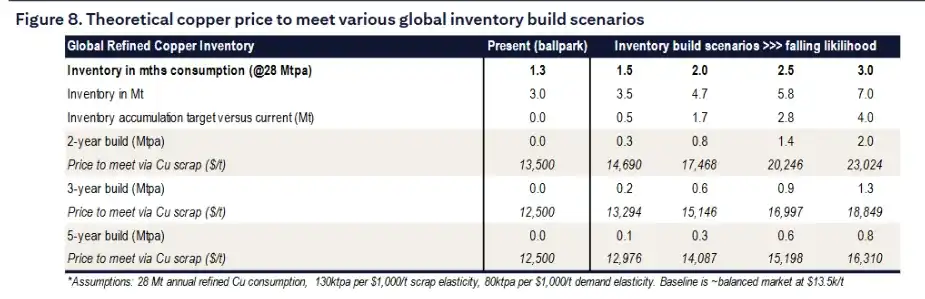
Citigroup uses the copper market as an example for calculation: if global refined copper inventories were to increase from the current ~1.3 months of consumption to 3 months, approximately 4 million tons of copper would need to be accumulated within two years.
Based on historical scrap copper supply elasticity, this would require copper prices to rise to around $23,000/ton. Citigroup's current benchmark scenario price for copper is around $13,500/ton.
Gold: Could Fall Another 15-20% Short-Term, Then Double Later
Citigroup rates gold's tail risk as low probability, low direct impact, but highly significant within the scenario analysis framework.
Gold prices surged from $2,500/oz in January 2025 to a peak of $5,500/oz in February 2026, and have since retreated to around $4,000/oz.
The report believes the risk of a larger-than-expected decline is most concentrated in the next 4 to 6 weeks. Once prices fall below $3,800/oz, liquidation pressure from ETFs and leveraged positions could be triggered on a large scale.
Potential triggers include: a worsening Middle East situation pushing up real interest rates and the dollar, and equity/bond market adjustments triggering liquidity squeezes.
However, the report remains highly optimistic about gold's medium to long-term trend.
China's trade surplus exceeding $1.3 trillion, continued central bank purchases, global fiscal sustainability concerns, and de-dollarization trends constitute multiple supports for long-term gold demand.
Citigroup expects that, driven by major inflation declines and a new round of investor buying, gold has the potential to rise to $6,000/oz in the coming years, nearly doubling from current levels.
Extreme El Niño: Cocoa Prices Could Return to $10,000/Ton
The U.S. National Oceanic and Atmospheric Administration's (NOAA) updated July forecast raised the probability of a very strong El Niño event to 81%, with a 97% chance of persistence until Spring 2027. Citigroup rates this as a "medium probability, high impact" tail scenario.
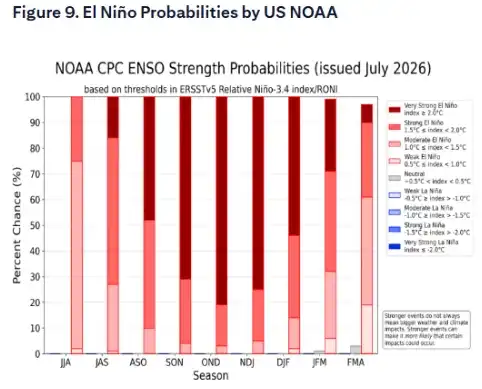
The report notes that extreme El Niño impacts different agricultural products significantly. Cocoa, sugar, and Robusta coffee are most affected; soybeans are next; corn and wheat are relatively less affected.
If West Africa experiences a Harmattan wind season similar to 2023-2024, cocoa supply would be severely impacted. Cocoa prices could return to $10,000/ton or higher, having previously reached record highs in 2024-2025.
For sugar, below-average rainfall in India in June, coupled with potential dual risks of monsoon deficiency in Thailand and floods in Brazil, global sugar prices could rise above 20 cents/pound.
Corn and soybean prices may find some support because El Niño typically boosts yields in U.S. producing regions, though European heatwaves and a weaker Indian monsoon remain key downside risk sources.
AI Boom & Bust: Bidirectional Shocks Diverge Commodity Landscape
Citigroup characterizes the impact of AI scenarios on commodities as "low to medium probability, highly divergent impact."
AI infrastructure expansion is becoming a significant driver of demand for electricity, natural gas, uranium, and grid metals like copper and aluminum. The report projects U.S. data center power consumption will roughly double by 2030.
If the AI bubble bursts, data center construction will contract sharply. Actual and expected demand for copper, natural gas, and uranium would be simultaneously damaged, while a decline in global risk appetite would further trigger a contraction in commodity demand.
However, simultaneously, a weaker dollar could provide passive support for commodity prices, and significant Fed rate cuts would also cushion the market to some extent.
If AI productivity dividends materialize, accelerating energy consumption and advancing grid investment would further strengthen the structural deficit narrative for copper and aluminum. Citigroup views this as one pathway for copper prices to reach $17,000/ton in a bull scenario.
Gold is seen as the most asymmetric hedge instrument under AI scenarios, benefiting from logic in both boom and bust cycles.
Power of Siberia 2 & LNG Oversupply: 2030s Prices Could Fall Below $6/MMBtu
Citigroup rates the signing of a final agreement between Russia and China on the Power of Siberia 2 pipeline as a "medium probability, high impact" scenario.
The pipeline has an annual capacity of 50 bcm. If operational around 2030, it would significantly reduce China's LNG import needs, exacerbating the global LNG market's expected shift towards looser conditions from 2028 onward.
The report predicts that under this scenario, the JKM Asian LNG benchmark price could fall to $5-6/MMBtu, well below the current forward prices for 2029-2030 above $8, and far below the $7-10 breakeven range for most new LNG supply terminals.
Citigroup notes that the potential 50 bcm/year of new supply between China and Russia is almost equivalent to Russia's existing ~53 bcm/year of pipeline gas exports to Europe. Its impact on the global LNG oversupply situation would far outweigh the debate over whether Russian pipeline gas returns to Europe.
Extremization of the Monroe Doctrine: Blockade of Americas' Oil Could Trigger a 1973 Replay
If the U.S. pushes the "Monroe Doctrine" to an extreme, blockading oil exports from Latin America or even the entire Americas, the global oil price landscape would undergo severe distortion.
The Monroe Doctrine is a core U.S. foreign policy principle articulated in 1823. Its core assertion is that "the Americas are for the Americans," aimed at opposing European powers' interference in American affairs, while declaring U.S. non-interference in European internal matters.
Citigroup lists "U.S. blockade of all oil exports from the Americas" as a low probability, high impact scenario.
Under this assumption, Latin America (including Mexico), with approximately 9.8 million barrels/day of crude oil production (~10% of global total output), would see its exports cut off from global markets. The shock magnitude would match or even exceed the 1973 Arab oil embargo.
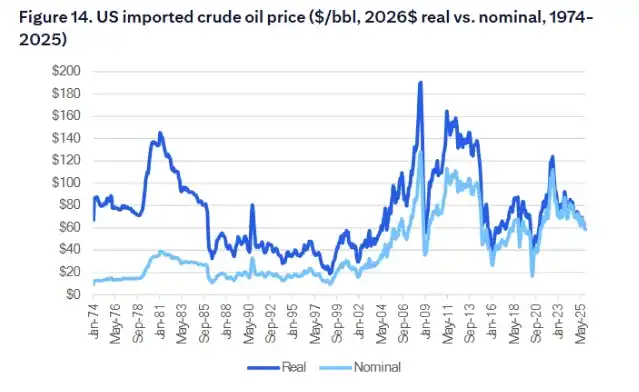
Back then, 7 OPEC member countries cut production by about 3.6 million barrels/day (~6% of global output), causing oil prices to surge from around $3/barrel to about $12/barrel in January 1974, a rise of approximately 300%.
Under this scenario, global benchmark crude prices (like Brent, Dubai) could surge above $100/barrel, while intra-Americas crude benchmarks (like WTI, WCS) could experience substantial discounts exceeding $30/barrel due to lack of outlets, creating a sharply divergent cross-regional price structure.




















