Google affiche pour la première fois un flux de trésorerie libre négatif au T2, relève ses dépenses d'investissement annuelles à un maximum de 2 050 milliards de dollars, tandis que son activité cloud explose avec une croissance de 82 %

链捕手Published on 2026-07-24Last updated on 2026-07-24

Abstract

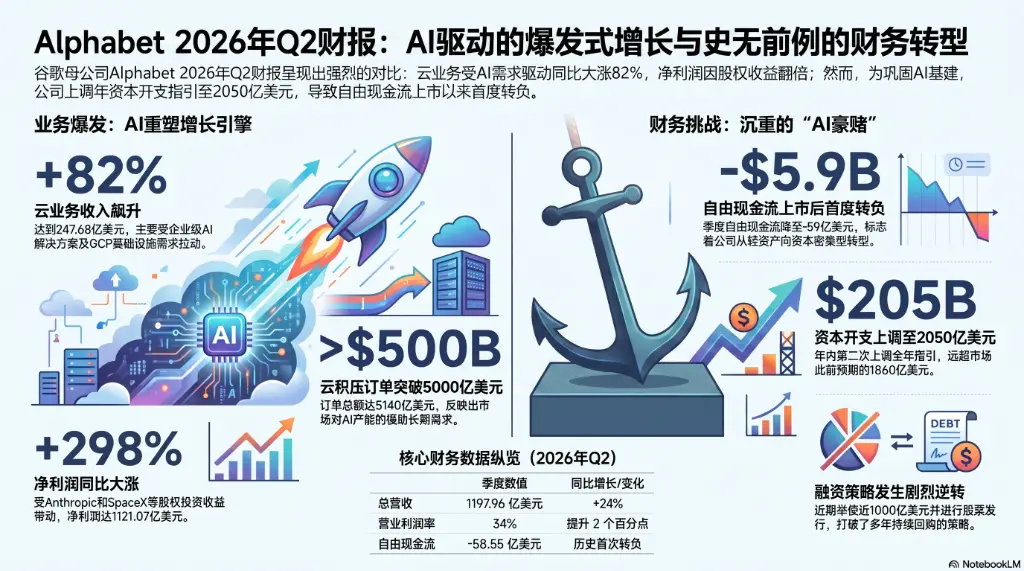
Alphabet (Google) a publié ses résultats du Q2 2026, présentant un bilan contrasté. D'un côté, le chiffre d'affaires a progressé de 24% pour atteindre 119,8 milliards de dollars, porté par l'explosion de Google Cloud. Ce dernier a enregistré une croissance de 82% sur un an (24,77 milliards de dollars), dépassant les attentes, et son carnet de commandes a franchi la barre des 5000 milliards de dollars. Cependant, le marché s'est principalement focalisé sur la santé financière. Pour la première fois depuis son introduction en bourse, le flux de trésorerie disponible trimestriel de Google est devenu négatif, à -58,55 milliards de dollars. Cette situation résulte d'une forte hausse des dépenses en capital (44,92 milliards de dollars au Q2), nécessaires aux investissements massifs dans l'infrastructure d'IA. La direction a d'ailleurs revu une deuxième fois cette année son guide annuel de dépenses en capital à la hausse, le portant désormais entre 1950 et 2050 milliards de dollars. Cette transformation vers un modèle plus capitalistique, financé par de nouvelles dettes et émissions d'actions, inquiète les investisseurs quant à la rentabilité future des paris sur l'IA. Malgré des bénéfices nets dopés par des plus-values sur participations, l'action a chuté après l'annonce. Le PDG Sundar Pichai a défendu la stratégie, affirmant que l'IA redéfinit toutes les activités et que les investissements commencent à porter leurs fruits, comme en témoigne la performance du cloud. La question ...

Auteur :杨宸、龙玥

Alphabet, la société mère de Google, a publié ses résultats du deuxième trimestre, avec des revenus cloud dépassant largement les attentes de Wall Street et un carnet de commandes cloud franchissant pour la première fois la barre des 5 000 milliards de dollars. Cependant, l'attention du marché s'est rapidement tournée vers un autre aspect : c'est la première fois depuis des décennies que le flux de trésorerie libre de Google est devenu négatif, tandis que la société a relevé pour la deuxième fois cette année ses prévisions de dépenses d'investissement annuelles, ce qui a fait monter d'un cran les inquiétudes des investisseurs quant à savoir si le grand pari sur l'IA pourra générer des retours correspondants.

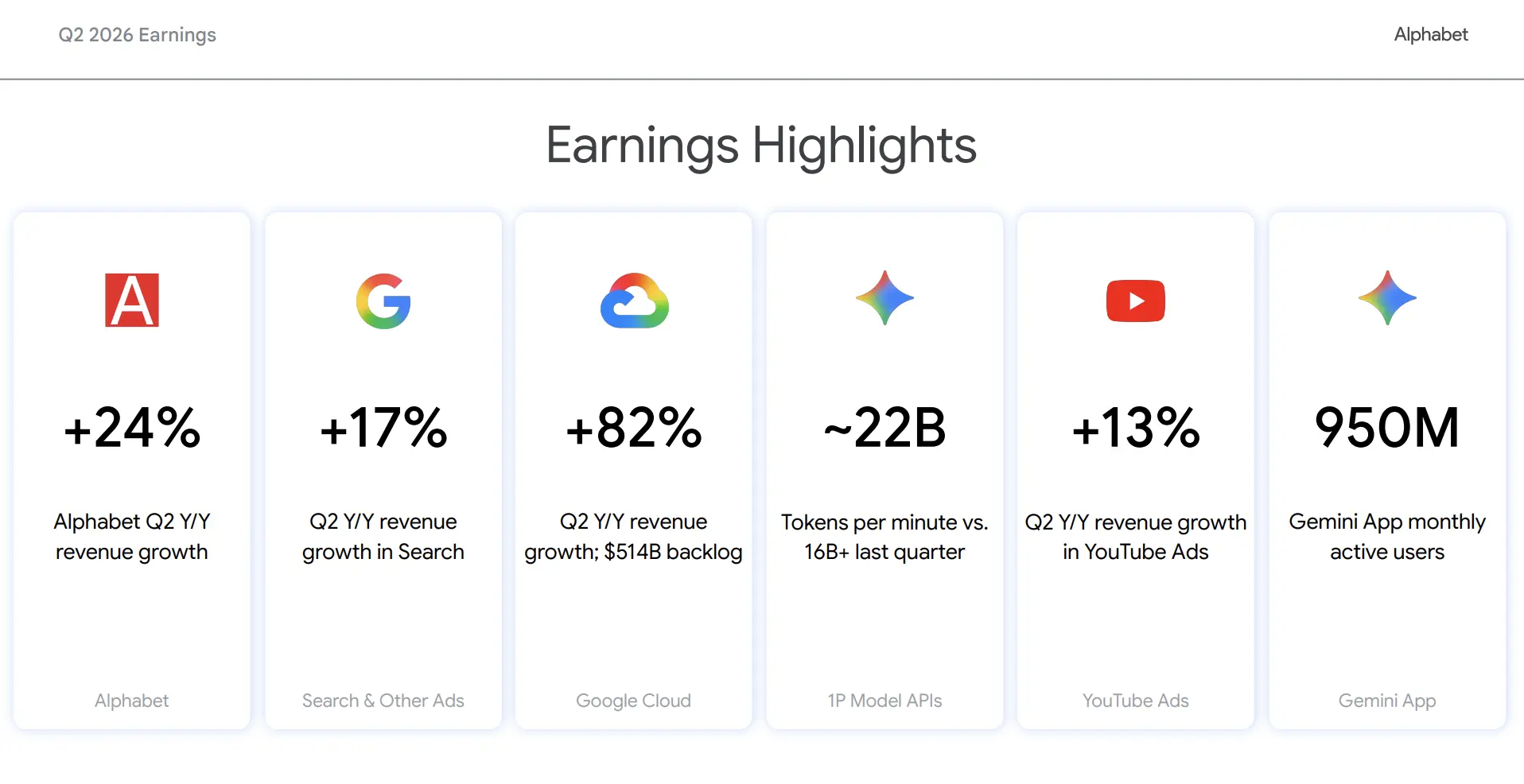
Pour le deuxième trimestre clos le 30 juin, Alphabet a réalisé un chiffre d'affaires de 119,796 milliards de dollars, en hausse de 24 % en glissement annuel ; en taux de change constants, la croissance était de 23 %, marquant le 12e trimestre consécutif de croissance à deux chiffres du chiffre d'affaires. Le résultat opérationnel a augmenté de 30 % pour atteindre 40,77 milliards de dollars, et la marge opérationnelle s'est améliorée de 2 points de pourcentage à 34 %.

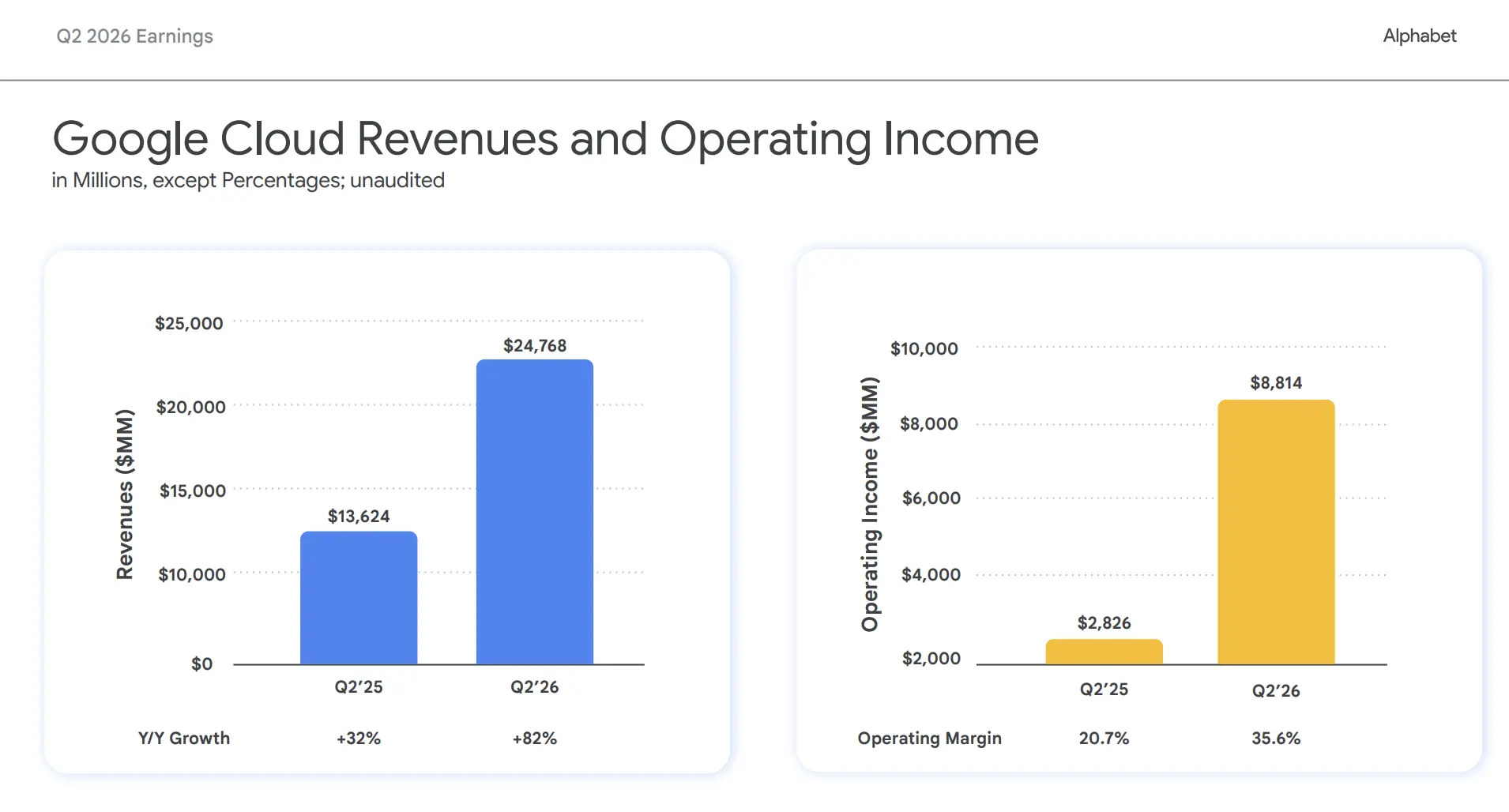
Parmi ceux-ci, les revenus de Google Cloud ont atteint 24,768 milliards de dollars, supérieurs aux attentes du marché de 22,46 milliards de dollars, avec une croissance spectaculaire de 82 %, la plus rapide des dernières années, montrant que les investissements en IA se traduisent durablement en retours commerciaux. Les revenus publicitaires issus de la recherche ont été de 63,27 milliards de dollars, légèrement inférieurs aux attentes du marché de 63,28 milliards de dollars.

Alphabet détient des participations dans plusieurs sociétés, dont Anthropic et SpaceX. Sous l'effet d'une augmentation significative des gains non réalisés sur titres, les revenus d'investissement du trimestre ont atteint près de 100 milliards de dollars, poussant le bénéfice net attribuable aux actionnaires ordinaires à une hausse de 298 % pour atteindre 112,107 milliards de dollars.
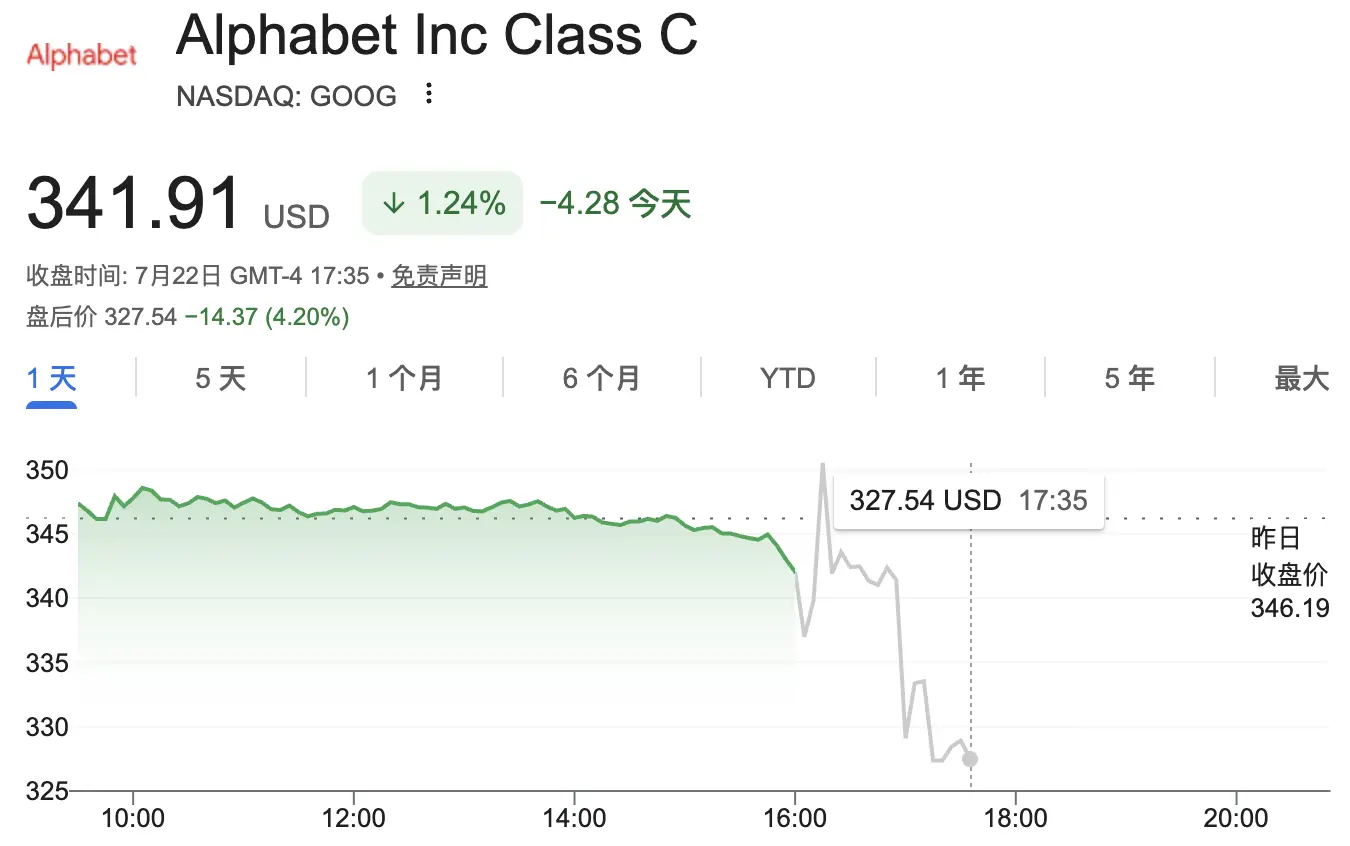
Après la publication des résultats, l'action Google a légèrement fluctué. Lors de la conférence téléphonique sur les résultats, Google a relevé ses prévisions de dépenses d'investissement annuelles entre 1 950 et 2 050 milliards de dollars, contre 1 800 à 1 900 milliards précédemment. Après l'annonce, les inquiétudes du marché sur la capacité de ces dépenses d'investissement massives à générer des retours correspondants ont fait chuter l'action de 4,2 %.
Flux de trésorerie libre devenu négatif pour la première fois, dépenses d'investissement relevées à nouveau

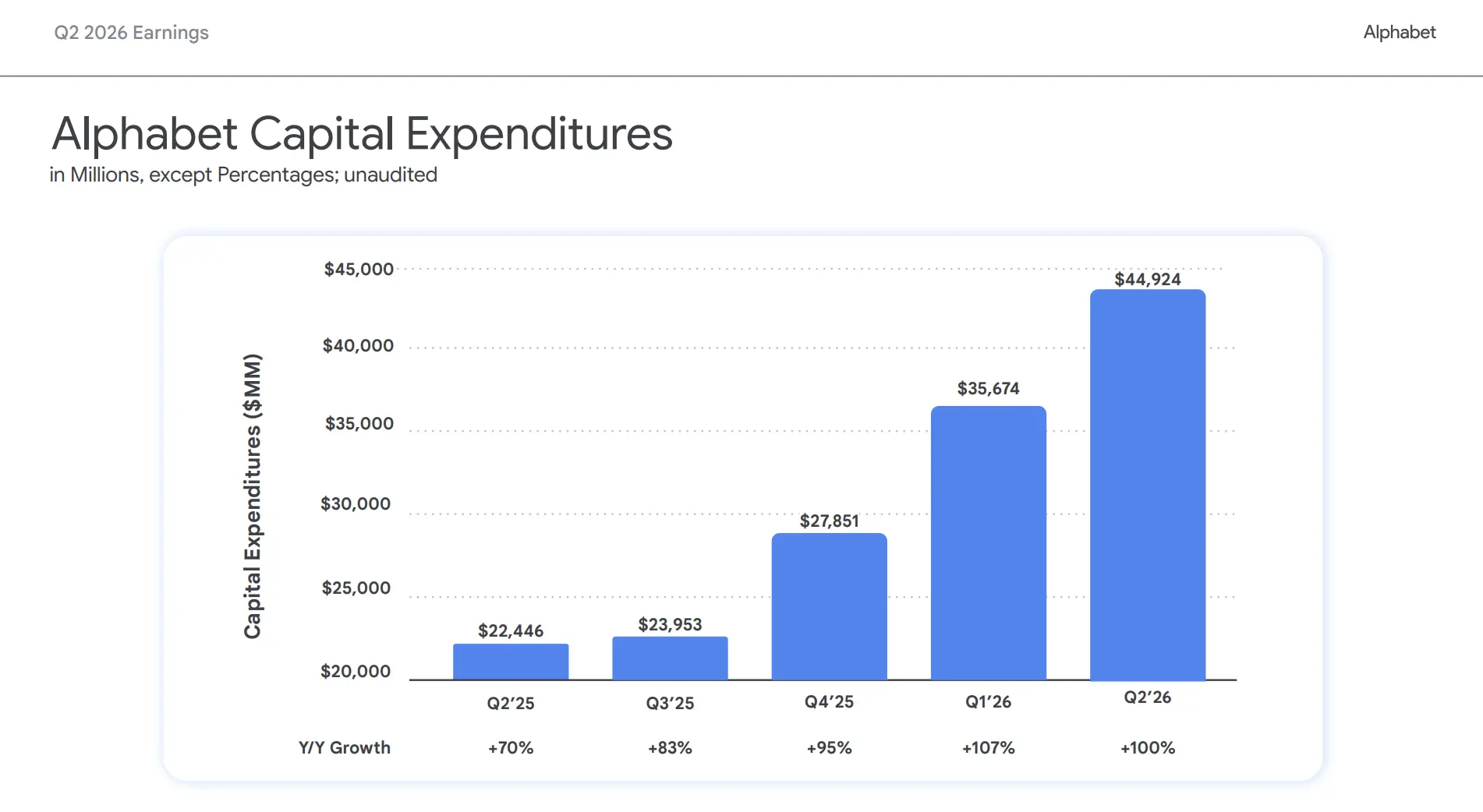
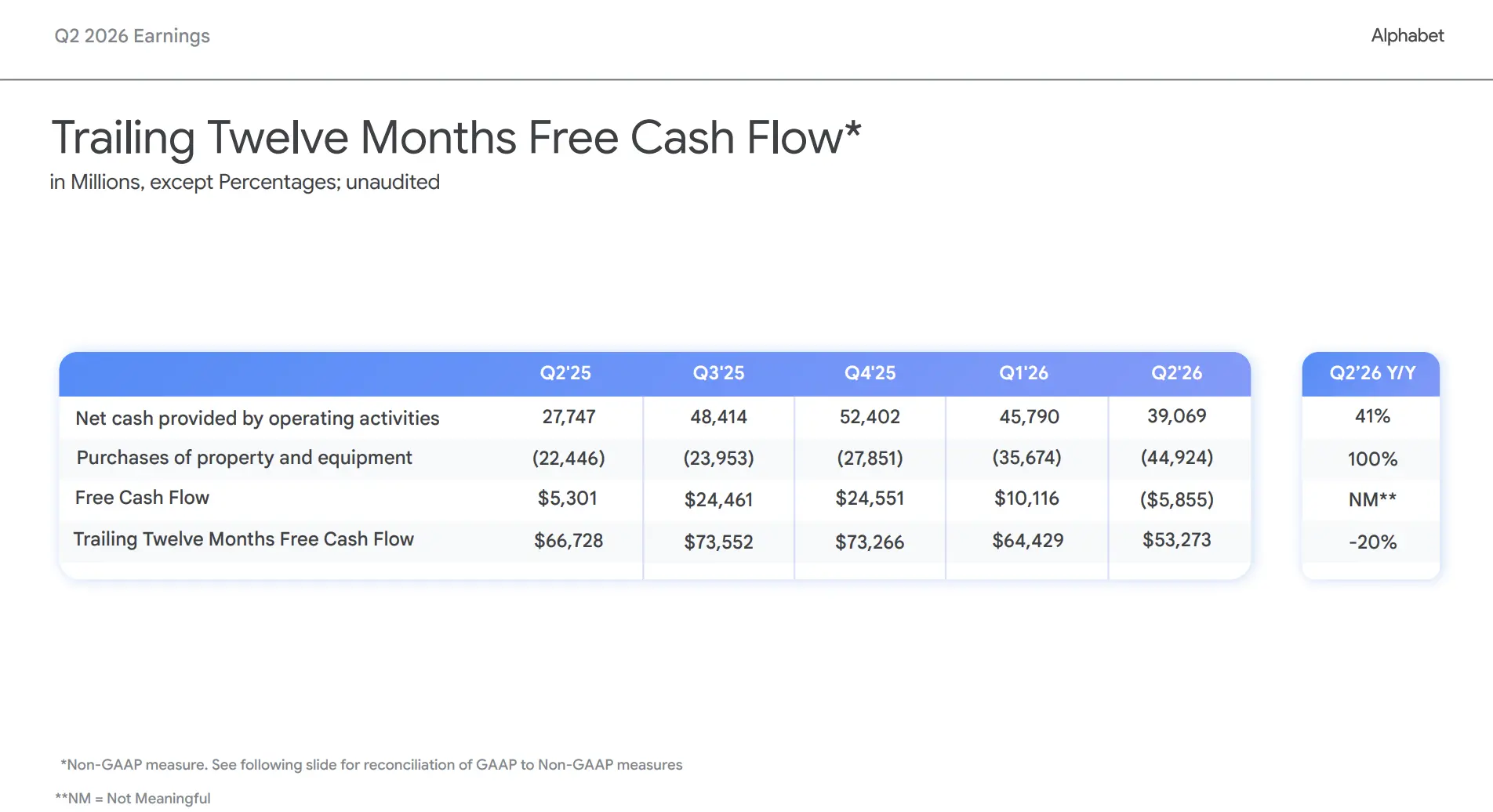
Les dépenses d'investissement d'Alphabet au deuxième trimestre se sont élevées à 44,924 milliards de dollars, bien supérieures aux 22,446 milliards de dollars de l'année précédente, provoquant directement la transformation du flux de trésorerie libre du trimestre en -5,855 milliards de dollars (environ -5,9 milliards de dollars) – c'est la première fois depuis des décennies que le flux de trésorerie libre trimestriel de Google est devenu négatif.

Le flux de trésorerie libre est un indicateur clé utilisé par Wall Street pour évaluer la santé financière des entreprises technologiques, mesurant les liquidités disponibles pour le remboursement de dettes ou la rémunération des actionnaires après couverture des coûts opérationnels et des dépenses d'investissement.

Lors de la conférence téléphonique sur les résultats, la directrice financière Anat Ashkenazi a annoncé que les prévisions de dépenses d'investissement pour l'année 2026 ont été relevées entre 1 950 et 2 050 milliards de dollars, supérieures aux précédentes prévisions de 1 800 à 1 900 milliards de dollars, et dépassant également les prévisions des analystes d'environ 1 860 milliards de dollars. C'est la deuxième fois cette année que Google relève ses prévisions de dépenses d'investissement – en avril dernier, les prévisions avaient déjà été relevées pour atteindre un maximum de 1 900 milliards de dollars.

Ashkenazi a déclaré : "Nous nous attendons à ce que le flux de trésorerie libre reste sous pression, en raison de nos investissements dans les infrastructures technologiques, qui nous permettent de saisir les opportunités de l'IA et de continuer à générer des retours substantiels."

Mais à l'annonce de la nouvelle, l'action a chuté. L'inquiétude des investisseurs réside dans le fait que Google est en train de passer rapidement d'une entreprise à l'actif léger à une société à forte intensité capitalistique. Pour soutenir les investissements massifs dans les infrastructures d'IA, Alphabet a récemment émis près de 1 000 milliards de dollars de dette et a terminé en juin sa première émission d'actions depuis plus de vingt ans, collectant environ 850 milliards de dollars nets – ce qui constitue un renversement marqué par rapport à la stratégie de rachats d'actions soutenue au cours des années précédentes.

Thomas Monteiro, analyste senior chez Investing.com, a déclaré : "Le relèvement supplémentaire des dépenses d'investissement n'est pas positif pour Alphabet. Dans un environnement de hausse des taux et de tension continue entre l'offre et la demande d'infrastructures d'IA, la logique du 'financement par les flux de trésorerie opérationnels' commence à s'éroder."

Cependant, Dec Mullarkey, directeur général de la société de gestion d'actifs SLC Management, est relativement optimiste : "Le marché veut voir les hyperscalers cloud se battre pour la suprématie de l'IA, mais pas au prix d'une érosion de la rentabilité. Actuellement, Alphabet maintient encore cet équilibre."

Ashkenazi a ajouté que la société utilisera une combinaison de flux de trésorerie opérationnels, de dette et de financement par actions pour soutenir ses dépenses, et a clairement indiqué qu'elle n'émettrait pas d'actions supplémentaires au-delà de ce qui a déjà été annoncé, tout en soulignant qu'elle maintiendra un bilan financier solide.

Google Cloud devient le principal moteur de croissance

En détaillant par activité, Google Cloud continue d'être l'activité à la croissance la plus rapide d'Alphabet.

Au deuxième trimestre, les revenus de Google Cloud ont atteint 24,768 milliards de dollars, en hausse de 82 %, accélérant encore par rapport aux périodes précédentes. La société a indiqué que la croissance provenait principalement des solutions d'IA d'entreprise de Google Cloud Platform (GCP), des infrastructures d'IA d'entreprise et de la demande continue pour les services cloud de base. Parallèlement, le résultat opérationnel de Google Cloud a atteint 8,814 milliards de dollars, nettement supérieur aux 2,826 milliards de dollars de l'année précédente, indiquant une nette amélioration de la rentabilité.

Le carnet de commandes cloud (backlog, montant des contrats signés mais non encore comptabilisés en revenus) a augmenté pour atteindre 5 140 milliards de dollars, contre environ 4 600 milliards de dollars au trimestre précédent, franchissant pour la première fois la barre des 5 000 milliards de dollars. La société a déclaré que plus de la moitié devrait être comptabilisée en revenus au cours des 24 prochains mois, avec une clientèle couvrant un "large éventail de profils clients hybrides".

Monteiro a déclaré que les performances surpassant les attentes du cloud indiquent au moins clairement que les investissements en IA de l'entreprise sont en train de "se traduire en revenus à forte croissance et rentables, les contrats correspondants se concrétisant immédiatement une fois les capacités construites".

Bien que Google Cloud reste derrière Amazon AWS et Microsoft Azure, grâce à la forte demande d'infrastructures d'IA de la part des start-up de l'IA et des clients d'entreprise, elle est devenue l'une des activités à la croissance la plus rapide d'Alphabet.
En comparaison, l'activité publicitaire traditionnelle continue de montrer une croissance stable :

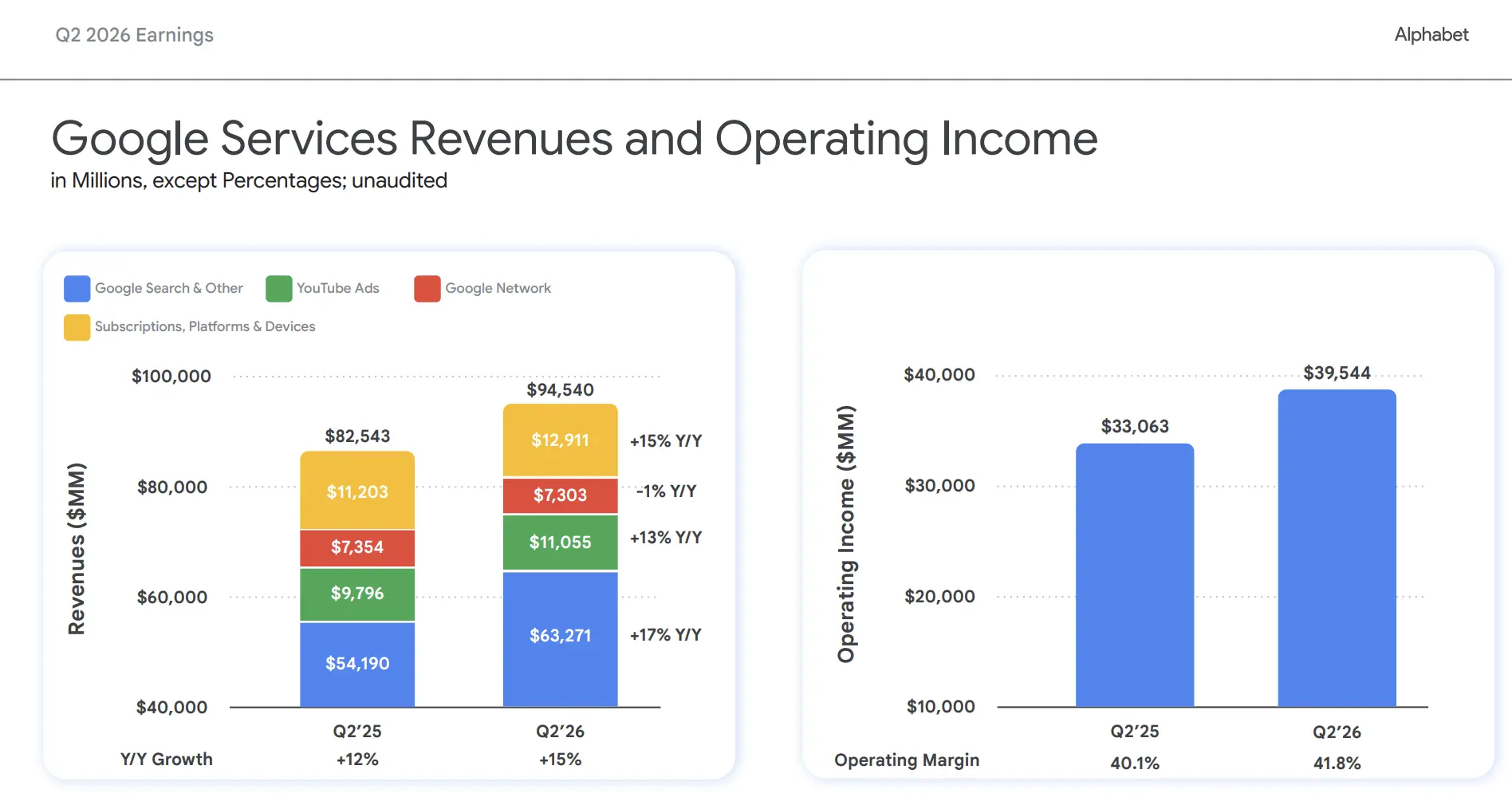
  • Les revenus de Google Search et autres activités ont été de 63,271 milliards de dollars, en hausse de 17 % ;
  • Les revenus publicitaires de YouTube ont été de 11,055 milliards de dollars, en hausse de 13 % ; en termes d'utilisateurs uniques mensuels de YouTube, pendant la Coupe du Monde 2026, plus de 1,7 milliard d'utilisateurs uniques ont utilisé la plateforme pour regarder des vidéos connexes, stimulant davantage la croissance du trafic ;
  • Les revenus des abonnements Google, de la plateforme et des appareils ont été de 12,911 milliards de dollars, en hausse de 15 %.

Les revenus totaux de Google Services ont atteint 94,54 milliards de dollars, en hausse de 15 %.
PDG : Les investissements en IA redéfinissent l'ensemble de Google, l'accent est mis sur Gemini 4

Le PDG d'Alphabet, Sundar Pichai, a déclaré que les investissements en IA de la société redéfinissent l'ensemble de l'activité. Il a déclaré aux investisseurs : "On a l'impression d'être à un stade très précoce de transformations structurelles de long terme dans de nombreux domaines... Au cours de l'année écoulée, nous sommes devenus plus optimistes quant aux opportunités futures."

Il a révélé que près de 90 % des entreprises du Fortune 100 utilisent désormais Gemini Enterprise ; le modèle Gemini traite 220 milliards de tokens API par minute, et l'application Gemini compte 950 millions d'utilisateurs actifs mensuels. Nate Elliott, analyste principal chez eMarketer, souligne : "Gemini n'est qu'à un pas de devenir le troisième produit d'IA grand public de Google avec un milliard d'utilisateurs (aux côtés d'AI Overviews et AI Mode)."

En ce qui concerne la feuille de route des modèles, Pichai s'est concentré sur le prochain modèle phare Gemini 4, le qualifiant de "prochain modèle de pointe à plus grande échelle", indiquant que les capacités de calcul sont actuellement priorisées pour sa formation, et a déclaré que le rythme de publication des modèles Google s'accélérerait. La sortie retardée de Gemini 3.5 Pro avait déjà soulevé des questions sur la compétitivité de Google dans des domaines comme la programmation IA, Anthropic et OpenAI ayant pris un avantage notable auprès de la communauté des développeurs.

Parallèlement, les fonctionnalités d'IA continuent de stimuler la croissance du volume de requêtes sur Google Search, la demande pour les produits de cybersécurité de l'entreprise reste forte, et le nouveau Gemini 3.5 Flash Cyber a montré une efficacité remarquable en termes de rapport coût-efficacité. De plus, pendant la Coupe du Monde 2026, plus de 1,7 milliard d'utilisateurs uniques ont regardé des vidéos connexes sur YouTube, stimulant davantage la croissance du trafic de la plateforme.

Pichai a déclaré que la "stratégie d'IA full-stack différenciée" de l'entreprise continue de créer une valeur commerciale mesurable pour les consommateurs, les clients d'entreprise et les partenaires.

Poursuite des investissements dans les infrastructures d'IA

Pour répondre à la demande croissante de puissance de calcul pour l'IA, Alphabet a renforcé son financement au deuxième trimestre.

La société a terminé en juin l'émission d'actions de catégorie A, de catégorie C et d'actions privilégiées convertibles obligatoires, collectant 49,6 milliards de dollars nets ; elle a simultanément émis pour 20,3 milliards de dollars d'obligations senior non garanties ; elle a également mis en place un programme d'émission d'actions ATM pouvant atteindre 40 milliards de dollars, qui n'avait pas encore été lancé fin du deuxième trimestre. Ces mesures ont permis à Alphabet de lever près de 1 000 milliards de dollars de dettes récemment.
En raison de l'augmentation significative des dépenses d'investissement, le flux de trésorerie libre du trimestre est devenu négatif à -5,855 milliards de dollars, mais le flux de trésorerie libre sur les 12 derniers mois reste à 53,273 milliards de dollars. Parallèlement, les dépenses d'investissement totales des quatre hyperscalers (Google, Meta, Microsoft, Amazon) devraient dépasser 7 250 milliards de dollars en 2026, et le flux de trésorerie libre de l'ensemble du secteur technologique a atteint son plus bas niveau depuis dix ans.
Dans l'ensemble, ce rapport de résultats présente un "double visage" marqué : la croissance explosive du cloud et un carnet de commandes dépassant 5 000 milliards de dollars confirment que les investissements en IA commencent à générer des retours commerciaux ; mais le flux de trésorerie libre devenu négatif pour la première fois et le relèvement des dépenses d'investissement pour la deuxième fois cette année maintiennent le marché en alerte quant à la durabilité de cette course aux armements en matière d'IA. La capacité de Google à maintenir un équilibre entre la lutte pour la suprématie de l'IA et la préservation de la santé financière restera la question centrale qui préoccupera le plus les investisseurs au cours des prochains trimestres.


Trending Cryptos

Related Questions

QPour quelle raison le flux de trésorerie disponible (free cash flow) de Google a-t-il été négatif au deuxième trimestre, et pourquoi cela inquiète-t-il les investisseurs ?

ALe flux de trésorerie disponible de Google (Alphabet) a été négatif au deuxième trimestre, à -58.55 milliards de dollars, principalement en raison d'une forte augmentation des dépenses en capital (Capex) qui ont atteint 44.924 milliards de dollars. Cela inquiète les investisseurs car c'est la première fois depuis des décennies que ce chiffre est négatif, signalant une transformation de l'entreprise d'un modèle à actifs légers vers un modèle à forte intensité capitalistique. Les investisseurs s'interrogent sur la soutenabilité de ces investissements massifs dans l'IA et sur leur capacité à générer des retours proportionnés.

QQuels sont les principaux points forts du rapport trimestriel de Google, en particulier concernant Google Cloud ?

ALes principaux points forts sont la performance exceptionnelle de Google Cloud. Ses revenus ont atteint 24,768 milliards de dollars, dépassant les attentes du marché et affichant une croissance de 82% en glissement annuel. Le carnet de commandes (backlog) a franchi pour la première fois la barre des 5000 milliards de dollars. De plus, la rentabilité de ce segment s'est considérablement améliorée, avec un bénéfice d'exploitation qui a plus que triplé pour atteindre 8,814 milliards de dollars, démontrant que les investissements dans l'IA génèrent des retours commerciaux concrets.

QComment Google finance-t-il cette augmentation massive de ses dépenses en capital, et quelles en sont les conséquences pour sa structure financière ?

AGoogle finance cette augmentation par une combinaison de flux de trésorerie d'exploitation, d'émissions de dette et de capitaux propres. Récemment, l'entreprise a émis pour environ 496 milliards de dollars d'actions et 203 milliards de dollars d'obligations, portant son endettement récent à près de 1000 milliards de dollars. Cela marque un changement stratégique par rapport aux années de rachats d'actions antérieures et transforme son bilan, la faisant passer à un modèle plus capitalistique. La CFO a toutefois assuré qu'aucune nouvelle émission d'actions au-delà de celles déjà annoncées n'était prévue et que l'entreprise maintiendrait un bilan solide.

QQuels sont les objectifs de Google concernant son modèle d'IA phare, Gemini, et quelle est sa position actuelle sur le marché ?

AL'objectif principal de Google est désormais centré sur le développement de Gemini 4, décrit par le PDG Sundar Pichai comme un "modèle frontalier de nouvelle génération, plus important". L'entreprise accélère son rythme de publication de modèles pour regagner du terrain face à des concurrents comme Anthropic et OpenAI. Actuellement, près de 90% des entreprises du Fortune 100 utilisent Gemini Enterprise, le modèle Gemini traite 22 milliards de tokens API par minute, et l'application Gemini compte 950 millions d'utilisateurs actifs mensuels, approchant le statut de produit grand public avec un milliard d'utilisateurs.

QQuelle est la nature "double" ou contradictoire des résultats du trimestre, comme le suggère la conclusion de l'article ?

ALa nature "double" des résultats réside dans le contraste entre des performances opérationnelles exceptionnelles et des indicateurs financiers préoccupants. D'un côté, Google Cloud connaît une croissance explosive et le carnet de commandes est record, prouvant le succès commercial de l'IA. De l'autre, le flux de trésorerie disponible est historiquement négatif et les dépenses en capital sont revues à la hausse pour la deuxième fois dans l'année (1950-2050 milliards de dollars). Cela place Google dans un équilibre délicat : continuer à investir massivement pour dominer la course à l'IA tout en préservant la santé financière à long terme, ce qui maintient les investisseurs en état d'alerte.

Related Reads

Wall Street's Most Famous 'Cassandra' Now Has His Sights Set on Nvidia

Michael Burry, the famed "Big Short" investor, has once again captured Wall Street's attention with a series of short positions against major tech and semiconductor stocks, most notably Nvidia. In late June and July, through his "Cassandra Unchained" newsletter, Burry disclosed short bets against Nvidia, Tesla, Applied Materials, Caterpillar, the SOXX semiconductor ETF, and later, Micron Technology. His core thesis revolves around potential distortions in the AI infrastructure boom, specifically questioning whether extended depreciation schedules (e.g., 6 years vs. a realistic 2-3 years for AI chips) by cloud giants like Microsoft and Google artificially inflate profits. He also raises concerns about possible "off-balance-sheet circular financing," where chip demand might be propped up by vendor-backed funding to clients. Nvidia's stock experienced volatility following these disclosures, briefly dipping but largely holding near Burry's reported entry points, leaving his positions roughly flat or slightly underwater as of late July. This move is part of a pattern for Burry, whose track record since his legendary 2008 bet is mixed. He has faced notable losses, such as on Tesla in 2021, while scoring on broader market turns like the 2020 pandemic crash. His methodology focuses intensely on free cash flow and scrutinizing original financial documents to spot overvaluation and structural risks, but it often struggles with timing the market. The article contrasts Burry's stance with other prominent investors. Steve Eisman, another "Big Short" figure, is not shorting Nvidia, citing strong fundamentals but expressing nervousness about sustainability. Jim Chanos agrees with the broad "accounting mismatch" concern—comparing it to the dot-com bubble—but targets financial leverage in private equity firms rather than the chip stocks themselves. While Nvidia's short interest remains relatively low at 1.3-1.4% of float, the massive stock size means absolute short losses have been significant, exceeding $5 billion earlier this year. The piece concludes that for ordinary investors, the key takeaway is not replicating specific short bets but learning from the critical frameworks these investors use: questioning rosy accounting, identifying structural vulnerabilities, and maintaining skepticism during market euphoria, even if pinpointing the exact catalyst for a downturn remains elusive.

marsbit12m ago

Wall Street's Most Famous 'Cassandra' Now Has His Sights Set on Nvidia

marsbit12m ago

Weekly Selection丨Epic Stock Market Volatility, Changxin Tech's IPO Reshapes Storage Landscape, Saylor Aims to Re-Anchor STRC Around September 8th

PANews Weekly Digest: Market Turmoil, Tech Breakthroughs, and Crypto Developments. The week saw significant volatility across global markets. South Korea's KOSPI index experienced extreme turbulence, including multiple trading halts, largely driven by sharp declines in AI hardware stocks like SK Hynix. In contrast, China's Changxin Xinqiao (CXC) achieved a landmark IPO with a market cap surpassing 4 trillion yuan, marking a major success for the domestic DRAM industry after a decade of losses. In the crypto and Web3 space, several key narratives emerged. AI is driving demand for new infrastructure, with projects like AI agent wallets and programmable payments gaining traction, attracting interest from firms like Coinbase. The Bitcoin mining sector is pivoting, with companies like MARA focusing on energy management as electricity becomes a core AI-era asset. Meanwhile, the RWA (Real World Assets) sector faces a "utilization puzzle," with hundreds of billions in on-chain assets remaining dormant. Notable market movements included a historic single-day surge of over 17% for the KOSPI index and a significant migration of $16.5 billion in staked ETH within the Lido ecosystem. Michael Saylor announced a target to re-peg the STRC stablecoin around September 8th. Other highlights include discussions on Ethereum's ambitious 2030 roadmap for scaling and privacy, analysis showing high protocol revenues not always translating to token price gains, and warnings from Citi about potential extreme commodity price shocks by late 2026.

marsbit17m ago

Weekly Selection丨Epic Stock Market Volatility, Changxin Tech's IPO Reshapes Storage Landscape, Saylor Aims to Re-Anchor STRC Around September 8th

marsbit17m ago

When the Market Begins to Question AI Capex: A Full Analysis of Q2 Earnings Reports from Five Tech Giants

In late July 2026, five major US tech giants—Alphabet, Intel, Microsoft, Meta, and Apple—released their Q2 earnings reports. While all companies exceeded revenue and profit expectations, driven by strong AI-related business growth, investor reactions diverged sharply due to concerns over escalating AI capital expenditures (capex) and their impact on free cash flow. Alphabet reported strong revenue growth and a surging cloud business, but its stock fell after announcing a doubled year-on-year capex and negative quarterly free cash flow for the first time. Intel posted its strongest revenue growth in over 15 years, but its stock experienced volatile trading after significantly raising its full-year capex guidance. Microsoft saw its stock surge after beating estimates and, crucially, lowering its capex forecast while projecting positive free cash flow. Meta faced the most severe sell-off as its profits declined despite revenue beats, with free cash flow plunging over 90% and its capex guidance raised. Apple reported record June-quarter results, but its stock plummeted after providing Q4 revenue guidance that fell short of expectations, citing supply chain constraints and forex headwinds. The overall takeaway is that the market's focus has shifted from validating AI demand to scrutinizing the timeline for returns on massive AI investments. Companies demonstrating a clearer path to managing capex and preserving free cash flow, like Microsoft, were rewarded, while those signaling continued aggressive spending faced investor skepticism.

Odaily星球日报26m ago

When the Market Begins to Question AI Capex: A Full Analysis of Q2 Earnings Reports from Five Tech Giants

Odaily星球日报26m ago

a16z: From Companies to DAOs, DUNA May Become the Next Generation Organizational Form

This article, "From Companies to DAOs: How DUNA Could Become the Next Organizational Form," traces the 500-year evolution of business collaboration. It begins with medieval structures like the *commenda* and Florentine *compagnia*, which exposed partners to personal risk. The modern corporation, exemplified by the Dutch East India Company (VOC), was a revolutionary leap, enabling large-scale, capital-intensive ventures by offering limited liability and reducing coordination costs. However, corporations introduced new challenges like principal-agent problems and bureaucratic overhead. The piece argues that software and internet-native protocols are now reducing these traditional overheads. Decentralized Autonomous Organizations (DAOs) emerged as a new model for coordination without centralized management. Yet, DAOs face a significant legal vacuum: they lack legal recognition, leaving members exposed to unlimited personal liability, and their tokens are vulnerable to being classified as securities under unclear regulations (e.g., the Howey Test). This has forced projects into suboptimal workarounds like offshore foundations. The article identifies the Decentralized Unincorporated Nonprofit Association (DUNA) as a potential solution. Recently legalized in states like Wyoming, the DUNA provides a legal wrapper for decentralized networks. It grants key protections—legal personality, limited liability, and perpetual existence—to a group without imposing a traditional hierarchical management structure. This allows token-holder communities to govern, hold assets, and contract as a single legal entity, aligning with their decentralized nature. While DUNA doesn't solve all governance challenges or magically resolve securities law questions, it represents a crucial step. It fills the legal recognition gap, offering a native legal form for internet-scale, decentralized collaboration and extending the separation of personal risk from organizational venture into a new domain.

marsbit1h ago

a16z: From Companies to DAOs, DUNA May Become the Next Generation Organizational Form

marsbit1h ago

2026 Mid-Year Report On-Chain RWA: Tokenized Stock Market Cap Doubles in a Year, But 90% of Rights Are Hollow Shells

The 2026 Mid-Year Report on On-Chain RWA highlights a significant growth in tokenized stock market capitalization, which nearly doubled from $951 million in March to $1.89 billion by July. However, the report reveals a fundamental contradiction in this "layer 2.5" ecosystem: products with the strongest legal foundation (like regulated U.S. infrastructure) lack liquidity and distribution, while freely tradable offshored wrapper products often lack substantive ownership rights. The increase is driven largely by a few products (SECZ, FGRS, STRCx) and platforms (Ondo, xStocks, Securitize collectively hold over 85% share). While distributed value across networks like Ethereum, Solana, and BNB Chain has grown, the market remains fragmented. Products referencing the same underlying asset (e.g., Apple stock) are distinct legal liabilities with different intermediaries and jurisdictional rules, offering varying degrees of legal claim. The report cautions that headline numbers are misleading, as they reflect changes in distributed token value—driven by issuance, conversions, and price movements—not pure investor inflows. True "canonical shares" with legal ownership, wide wallet distribution, institutional liquidity, and independent on-chain price discovery do not yet exist at scale. Tokenized treasuries show stronger product-market fit, and ETFs may be easier to scale than single stocks. The core takeaway is a trade-off: legal certainty versus liquidity and composability.

marsbit2h ago

2026 Mid-Year Report On-Chain RWA: Tokenized Stock Market Cap Doubles in a Year, But 90% of Rights Are Hollow Shells

marsbit2h ago

Trading

Spot

Hot Articles

What is SONIC

Sonic: Pioneering the Future of Gaming in Web3 Introduction to Sonic In the ever-evolving landscape of Web3, the gaming industry stands out as one of the most dynamic and promising sectors. At the forefront of this revolution is Sonic, a project designed to amplify the gaming ecosystem on the Solana blockchain. Leveraging cutting-edge technology, Sonic aims to deliver an unparalleled gaming experience by efficiently processing millions of requests per second, ensuring that players enjoy seamless gameplay while maintaining low transaction costs. This article delves into the intricate details of Sonic, exploring its creators, funding sources, operational mechanics, and the timeline of significant events that have shaped its journey. What is Sonic? Sonic is an innovative layer-2 network that operates atop the Solana blockchain, specifically tailored to enhance the existing Solana gaming ecosystem. It accomplishes this through a customised, VM-agnostic game engine paired with a HyperGrid interpreter, facilitating sovereign game economies that roll up back to the Solana platform. The primary goals of Sonic include: Enhanced Gaming Experiences: Sonic is committed to offering lightning-fast on-chain gameplay, allowing players and developers to engage with games at previously unattainable speeds. Atomic Interoperability: This feature enables transactions to be executed within Sonic without the need to redeploy Solana programmes and accounts. This makes the process more efficient and directly benefits from Solana Layer1 services and liquidity. Seamless Deployment: Sonic allows developers to write for Ethereum Virtual Machine (EVM) based systems and execute them on Solana’s SVM infrastructure. This interoperability is crucial for attracting a broader range of dApps and decentralised applications to the platform. Support for Developers: By offering native composable gaming primitives and extensible data types - dining within the Entity-Component-System (ECS) framework - game creators can craft intricate business logic with ease. Overall, Sonic's unique approach not only caters to players but also provides an accessible and low-cost environment for developers to innovate and thrive. Creator of Sonic The information regarding the creator of Sonic is somewhat ambiguous. However, it is known that Sonic's SVM is owned by the company Mirror World. The absence of detailed information about the individuals behind Sonic reflects a common trend in several Web3 projects, where collective efforts and partnerships often overshadow individual contributions. Investors of Sonic Sonic has garnered considerable attention and support from various investors within the crypto and gaming sectors. Notably, the project raised an impressive $12 million during its Series A funding round. The round was led by BITKRAFT Ventures, with other notable investors including Galaxy, Okx Ventures, Interactive, Big Brain Holdings, and Mirana. This financial backing signifies the confidence that investment foundations have in Sonic’s potential to revolutionise the Web3 gaming landscape, further validating its innovative approaches and technologies. How Does Sonic Work? Sonic utilises the HyperGrid framework, a sophisticated parallel processing mechanism that enhances its scalability and customisability. Here are the core features that set Sonic apart: Lightning Speed at Low Costs: Sonic offers one of the fastest on-chain gaming experiences compared to other Layer-1 solutions, powered by the scalability of Solana’s virtual machine (SVM). Atomic Interoperability: Sonic enables transaction execution without redeployment of Solana programmes and accounts, effectively streamlining the interaction between users and the blockchain. EVM Compatibility: Developers can effortlessly migrate decentralised applications from EVM chains to the Solana environment using Sonic’s HyperGrid interpreter, increasing the accessibility and integration of various dApps. Ecosystem Support for Developers: By exposing native composable gaming primitives, Sonic facilitates a sandbox-like environment where developers can experiment and implement business logic, greatly enhancing the overall development experience. Monetisation Infrastructure: Sonic natively supports growth and monetisation efforts, providing frameworks for traffic generation, payments, and settlements, thereby ensuring that gaming projects are not only viable but also sustainable financially. Timeline of Sonic The evolution of Sonic has been marked by several key milestones. Below is a brief timeline highlighting critical events in the project's history: 2022: The Sonic cryptocurrency was officially launched, marking the beginning of its journey in the Web3 gaming arena. 2024: June: Sonic SVM successfully raised $12 million in a Series A funding round. This investment allowed Sonic to further develop its platform and expand its offerings. August: The launch of the Sonic Odyssey testnet provided users with the first opportunity to engage with the platform, offering interactive activities such as collecting rings—a nod to gaming nostalgia. October: SonicX, an innovative crypto game integrated with Solana, made its debut on TikTok, capturing the attention of over 120,000 users within a short span. This integration illustrated Sonic’s commitment to reaching a broader, global audience and showcased the potential of blockchain gaming. Key Points Sonic SVM is a revolutionary layer-2 network on Solana explicitly designed to enhance the GameFi landscape, demonstrating great potential for future development. HyperGrid Framework empowers Sonic by introducing horizontal scaling capabilities, ensuring that the network can handle the demands of Web3 gaming. Integration with Social Platforms: The successful launch of SonicX on TikTok displays Sonic’s strategy to leverage social media platforms to engage users, exponentially increasing the exposure and reach of its projects. Investment Confidence: The substantial funding from BITKRAFT Ventures, among others, emphasizes the robust backing Sonic has, paving the way for its ambitious future. In conclusion, Sonic encapsulates the essence of Web3 gaming innovation, striking a balance between cutting-edge technology, developer-centric tools, and community engagement. As the project continues to evolve, it is poised to redefine the gaming landscape, making it a notable entity for gamers and developers alike. As Sonic moves forward, it will undoubtedly attract greater interest and participation, solidifying its place within the broader narrative of blockchain gaming.

2.1k Total ViewsPublished 2024.04.04Updated 2024.12.03

What is SONIC

What is $S$

Understanding SPERO: A Comprehensive Overview Introduction to SPERO As the landscape of innovation continues to evolve, the emergence of web3 technologies and cryptocurrency projects plays a pivotal role in shaping the digital future. One project that has garnered attention in this dynamic field is SPERO, denoted as SPERO,$$s$. This article aims to gather and present detailed information about SPERO, to help enthusiasts and investors understand its foundations, objectives, and innovations within the web3 and crypto domains. What is SPERO,$$s$? SPERO,$$s$ is a unique project within the crypto space that seeks to leverage the principles of decentralisation and blockchain technology to create an ecosystem that promotes engagement, utility, and financial inclusion. The project is tailored to facilitate peer-to-peer interactions in new ways, providing users with innovative financial solutions and services. At its core, SPERO,$$s$ aims to empower individuals by providing tools and platforms that enhance user experience in the cryptocurrency space. This includes enabling more flexible transaction methods, fostering community-driven initiatives, and creating pathways for financial opportunities through decentralised applications (dApps). The underlying vision of SPERO,$$s$ revolves around inclusiveness, aiming to bridge gaps within traditional finance while harnessing the benefits of blockchain technology. Who is the Creator of SPERO,$$s$? The identity of the creator of SPERO,$$s$ remains somewhat obscure, as there are limited publicly available resources providing detailed background information on its founder(s). This lack of transparency can stem from the project's commitment to decentralisation—an ethos that many web3 projects share, prioritising collective contributions over individual recognition. By centring discussions around the community and its collective goals, SPERO,$$s$ embodies the essence of empowerment without singling out specific individuals. As such, understanding the ethos and mission of SPERO remains more important than identifying a singular creator. Who are the Investors of SPERO,$$s$? SPERO,$$s$ is supported by a diverse array of investors ranging from venture capitalists to angel investors dedicated to fostering innovation in the crypto sector. The focus of these investors generally aligns with SPERO's mission—prioritising projects that promise societal technological advancement, financial inclusivity, and decentralised governance. These investor foundations are typically interested in projects that not only offer innovative products but also contribute positively to the blockchain community and its ecosystems. The backing from these investors reinforces SPERO,$$s$ as a noteworthy contender in the rapidly evolving domain of crypto projects. How Does SPERO,$$s$ Work? SPERO,$$s$ employs a multi-faceted framework that distinguishes it from conventional cryptocurrency projects. Here are some of the key features that underline its uniqueness and innovation: Decentralised Governance: SPERO,$$s$ integrates decentralised governance models, empowering users to participate actively in decision-making processes regarding the project’s future. This approach fosters a sense of ownership and accountability among community members. Token Utility: SPERO,$$s$ utilises its own cryptocurrency token, designed to serve various functions within the ecosystem. These tokens enable transactions, rewards, and the facilitation of services offered on the platform, enhancing overall engagement and utility. Layered Architecture: The technical architecture of SPERO,$$s$ supports modularity and scalability, allowing for seamless integration of additional features and applications as the project evolves. This adaptability is paramount for sustaining relevance in the ever-changing crypto landscape. Community Engagement: The project emphasises community-driven initiatives, employing mechanisms that incentivise collaboration and feedback. By nurturing a strong community, SPERO,$$s$ can better address user needs and adapt to market trends. Focus on Inclusion: By offering low transaction fees and user-friendly interfaces, SPERO,$$s$ aims to attract a diverse user base, including individuals who may not previously have engaged in the crypto space. This commitment to inclusion aligns with its overarching mission of empowerment through accessibility. Timeline of SPERO,$$s$ Understanding a project's history provides crucial insights into its development trajectory and milestones. Below is a suggested timeline mapping significant events in the evolution of SPERO,$$s$: Conceptualisation and Ideation Phase: The initial ideas forming the basis of SPERO,$$s$ were conceived, aligning closely with the principles of decentralisation and community focus within the blockchain industry. Launch of Project Whitepaper: Following the conceptual phase, a comprehensive whitepaper detailing the vision, goals, and technological infrastructure of SPERO,$$s$ was released to garner community interest and feedback. Community Building and Early Engagements: Active outreach efforts were made to build a community of early adopters and potential investors, facilitating discussions around the project’s goals and garnering support. Token Generation Event: SPERO,$$s$ conducted a token generation event (TGE) to distribute its native tokens to early supporters and establish initial liquidity within the ecosystem. Launch of Initial dApp: The first decentralised application (dApp) associated with SPERO,$$s$ went live, allowing users to engage with the platform's core functionalities. Ongoing Development and Partnerships: Continuous updates and enhancements to the project's offerings, including strategic partnerships with other players in the blockchain space, have shaped SPERO,$$s$ into a competitive and evolving player in the crypto market. Conclusion SPERO,$$s$ stands as a testament to the potential of web3 and cryptocurrency to revolutionise financial systems and empower individuals. With a commitment to decentralised governance, community engagement, and innovatively designed functionalities, it paves the way toward a more inclusive financial landscape. As with any investment in the rapidly evolving crypto space, potential investors and users are encouraged to research thoroughly and engage thoughtfully with the ongoing developments within SPERO,$$s$. The project showcases the innovative spirit of the crypto industry, inviting further exploration into its myriad possibilities. While the journey of SPERO,$$s$ is still unfolding, its foundational principles may indeed influence the future of how we interact with technology, finance, and each other in interconnected digital ecosystems.

227 Total ViewsPublished 2024.12.17Updated 2024.12.17

What is $S$

What is AGENT S

Agent S: The Future of Autonomous Interaction in Web3 Introduction In the ever-evolving landscape of Web3 and cryptocurrency, innovations are constantly redefining how individuals interact with digital platforms. One such pioneering project, Agent S, promises to revolutionise human-computer interaction through its open agentic framework. By paving the way for autonomous interactions, Agent S aims to simplify complex tasks, offering transformative applications in artificial intelligence (AI). This detailed exploration will delve into the project's intricacies, its unique features, and the implications for the cryptocurrency domain. What is Agent S? Agent S stands as a groundbreaking open agentic framework, specifically designed to tackle three fundamental challenges in the automation of computer tasks: Acquiring Domain-Specific Knowledge: The framework intelligently learns from various external knowledge sources and internal experiences. This dual approach empowers it to build a rich repository of domain-specific knowledge, enhancing its performance in task execution. Planning Over Long Task Horizons: Agent S employs experience-augmented hierarchical planning, a strategic approach that facilitates efficient breakdown and execution of intricate tasks. This feature significantly enhances its ability to manage multiple subtasks efficiently and effectively. Handling Dynamic, Non-Uniform Interfaces: The project introduces the Agent-Computer Interface (ACI), an innovative solution that enhances the interaction between agents and users. Utilizing Multimodal Large Language Models (MLLMs), Agent S can navigate and manipulate diverse graphical user interfaces seamlessly. Through these pioneering features, Agent S provides a robust framework that addresses the complexities involved in automating human interaction with machines, setting the stage for myriad applications in AI and beyond. Who is the Creator of Agent S? While the concept of Agent S is fundamentally innovative, specific information about its creator remains elusive. The creator is currently unknown, which highlights either the nascent stage of the project or the strategic choice to keep founding members under wraps. Regardless of anonymity, the focus remains on the framework's capabilities and potential. Who are the Investors of Agent S? As Agent S is relatively new in the cryptographic ecosystem, detailed information regarding its investors and financial backers is not explicitly documented. The lack of publicly available insights into the investment foundations or organisations supporting the project raises questions about its funding structure and development roadmap. Understanding the backing is crucial for gauging the project's sustainability and potential market impact. How Does Agent S Work? At the core of Agent S lies cutting-edge technology that enables it to function effectively in diverse settings. Its operational model is built around several key features: Human-like Computer Interaction: The framework offers advanced AI planning, striving to make interactions with computers more intuitive. By mimicking human behaviour in tasks execution, it promises to elevate user experiences. Narrative Memory: Employed to leverage high-level experiences, Agent S utilises narrative memory to keep track of task histories, thereby enhancing its decision-making processes. Episodic Memory: This feature provides users with step-by-step guidance, allowing the framework to offer contextual support as tasks unfold. Support for OpenACI: With the ability to run locally, Agent S allows users to maintain control over their interactions and workflows, aligning with the decentralised ethos of Web3. Easy Integration with External APIs: Its versatility and compatibility with various AI platforms ensure that Agent S can fit seamlessly into existing technological ecosystems, making it an appealing choice for developers and organisations. These functionalities collectively contribute to Agent S's unique position within the crypto space, as it automates complex, multi-step tasks with minimal human intervention. As the project evolves, its potential applications in Web3 could redefine how digital interactions unfold. Timeline of Agent S The development and milestones of Agent S can be encapsulated in a timeline that highlights its significant events: September 27, 2024: The concept of Agent S was launched in a comprehensive research paper titled “An Open Agentic Framework that Uses Computers Like a Human,” showcasing the groundwork for the project. October 10, 2024: The research paper was made publicly available on arXiv, offering an in-depth exploration of the framework and its performance evaluation based on the OSWorld benchmark. October 12, 2024: A video presentation was released, providing a visual insight into the capabilities and features of Agent S, further engaging potential users and investors. These markers in the timeline not only illustrate the progress of Agent S but also indicate its commitment to transparency and community engagement. Key Points About Agent S As the Agent S framework continues to evolve, several key attributes stand out, underscoring its innovative nature and potential: Innovative Framework: Designed to provide an intuitive use of computers akin to human interaction, Agent S brings a novel approach to task automation. Autonomous Interaction: The ability to interact autonomously with computers through GUI signifies a leap towards more intelligent and efficient computing solutions. Complex Task Automation: With its robust methodology, it can automate complex, multi-step tasks, making processes faster and less error-prone. Continuous Improvement: The learning mechanisms enable Agent S to improve from past experiences, continually enhancing its performance and efficacy. Versatility: Its adaptability across different operating environments like OSWorld and WindowsAgentArena ensures that it can serve a broad range of applications. As Agent S positions itself in the Web3 and crypto landscape, its potential to enhance interaction capabilities and automate processes signifies a significant advancement in AI technologies. Through its innovative framework, Agent S exemplifies the future of digital interactions, promising a more seamless and efficient experience for users across various industries. Conclusion Agent S represents a bold leap forward in the marriage of AI and Web3, with the capacity to redefine how we interact with technology. While still in its early stages, the possibilities for its application are vast and compelling. Through its comprehensive framework addressing critical challenges, Agent S aims to bring autonomous interactions to the forefront of the digital experience. As we move deeper into the realms of cryptocurrency and decentralisation, projects like Agent S will undoubtedly play a crucial role in shaping the future of technology and human-computer collaboration.

891 Total ViewsPublished 2025.01.14Updated 2025.01.14

What is AGENT S

Discussions

Welcome to the HTX Community. Here, you can stay informed about the latest platform developments and gain access to professional market insights. Users' opinions on the price of S (S) are presented below.

活动图片