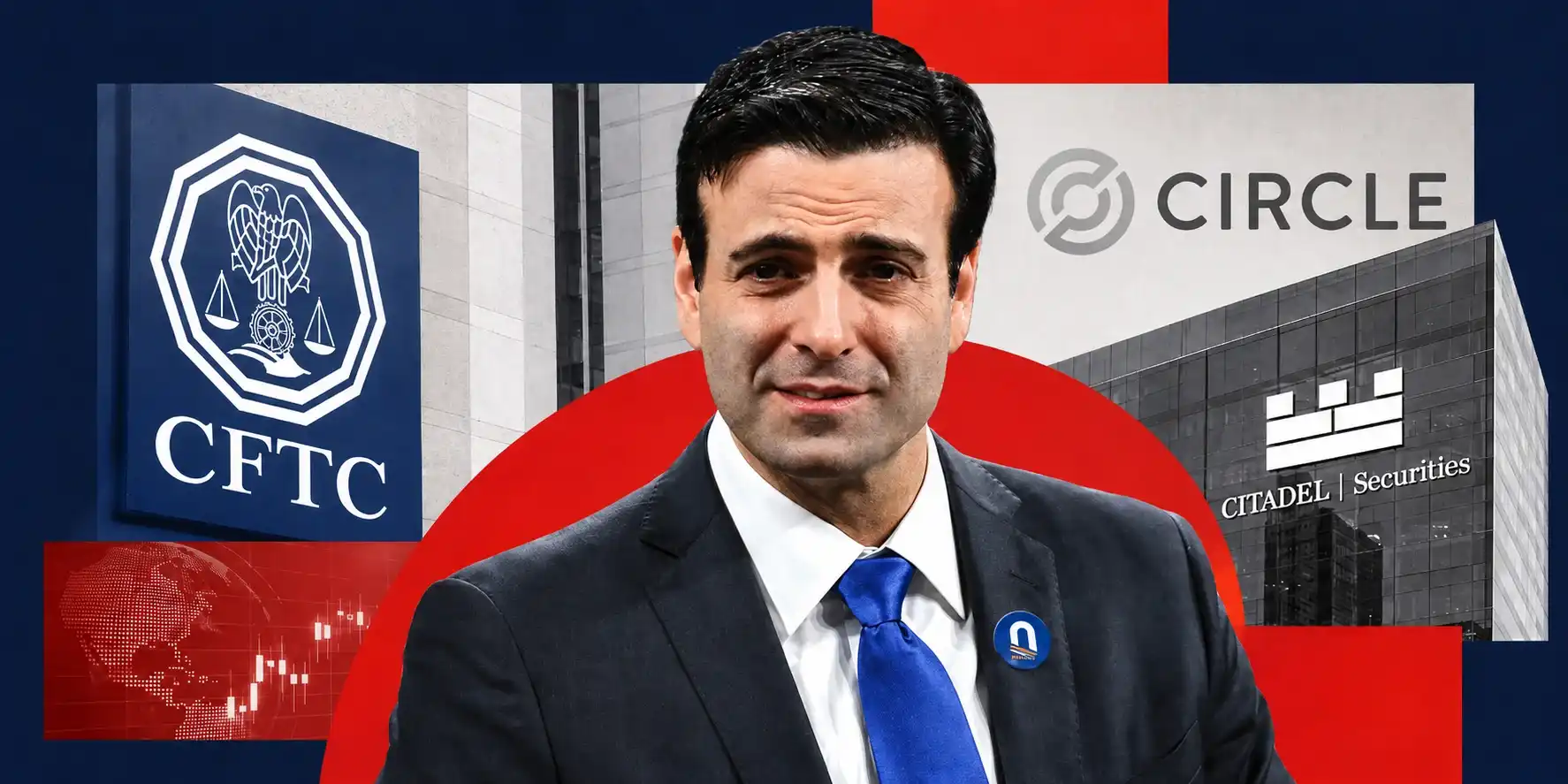
Ex presidente de la CFTC y presidente de Circle, Tarbert: Predica el 'largo plazo' pero vende acciones por 30 millones de dólares

marsbitPublished on 2026-07-22Last updated on 2026-07-22

Abstract

El expresidente de la CFTC y actual presidente de Circle, Heath Tarbert, ha instado públicamente a los inversores a mantener una perspectiva a largo plazo frente a la caída del 70% en el precio de las acciones de la compañía. Sin embargo, se revela que desde la OPV de Circle, Tarbert ha vendido continuamente acciones por un valor de aproximadamente 30 millones de dólares mediante planes de trading preestablecidos (10b5-1), sin realizar ninguna compra en el mercado abierto. Esta discrepancia entre su discurso público y sus acciones personales ha generado escepticismo sobre su verdadera confianza en el futuro de la empresa. Su carrera, que incluye pasar de la CFTC a Citadel Securities en apenas 27 días y luego a Circle, muestra un patrón de utilizar su experiencia regulatoria para beneficiar a empresas financieras en momentos clave. Mientras aboga por la paciencia de los accionistas minoristas, su historial sugiere una habilidad para capitalizar oportunidades personales a corto plazo, dejando a los inversores comunes asumir los riesgos a largo plazo.

Autor: Zen, PANews

"Circle se centra en el desarrollo a largo plazo, y creemos que el precio de la acción dará la respuesta al final."

Frente a la cruda realidad de que el precio de las acciones ha caído un 70% desde su máximo y la capitalización de mercado se ha evaporado. El 14 de julio, el ex presidente de la CFTC y presidente de Circle, Heath Tarbert, en una entrevista con FOX Business, cuando se le preguntó qué le diría a los inversores que compraron acciones de Circle en su máximo histórico, pronunció sin prisa la opinión anterior.

Sin embargo, la realidad no es favorable para Circle. Analistas de Mizuho Securities USA LLC rebajaron recientemente la calificación de Circle de "neutral" a "inferior al mercado", estableciendo el precio objetivo más bajo de Wall Street: 50 dólares.

Ante la continua caída del precio de las acciones, instar a los accionistas minoristas a optar por el largo plazo y mantener la paciencia es, sin duda, parte del trabajo de Tarbert como presidente. Sin embargo, cuando se reveló que, desde que Circle completó su OPI, Tarbert ha estado vendiendo continuamente acciones de CRCL, acumulando una venta de aproximadamente 30 millones de dólares sin haber realizado nunca una compra neta. Esta extrema discrepancia entre lo que dice en público y lo que hace en privado resulta especialmente irónica.

Venta frenética de acciones, dejando el 'largo plazo' de su discurso para el mercado

La puerta giratoria entre política y negocios es un guion clásico para los funcionarios estadounidenses tras dejar el cargo. Como ex presidente de la CFTC favorable a las criptomonedas, Heath Tarbert se unió a Circle en julio de 2023 como Director Jurídico y responsable de Asuntos Corporativos. La misión de Tarbert era claramente aprovechar su trayectoria, que abarca el Departamento del Tesoro de EE.UU., la CFTC, la Casa Blanca y Wall Street, para ayudar a Circle a comunicarse con los reguladores, acelerar el crecimiento empresarial y la cotización, así como impulsar la entrada de USDC en el sistema financiero tradicional.

El propio Tarbert había manifestado que valoraba el enfoque de desarrollo "prioritario en la regulación" de Circle y esperaba promover reglas claras y coherentes para los activos digitales. A principios de 2025, ascendió aún más al cargo de primer presidente de Circle, supervisando asuntos legales, cumplimiento normativo, riesgos, políticas públicas, comunicaciones y expansión internacional.

Por sus declaraciones públicas, Tarbert ha sido casi siempre uno de los promotores más activos de la narrativa del "largo plazo" de Circle. Ha reiterado que las stablecoins no deberían entenderse solo como herramientas para el comercio de criptomonedas, sino como la próxima generación de infraestructura para pagos, liquidaciones e Internet financiero. Y que las inversiones actuales de Circle no pueden medirse simplemente por las ganancias a corto plazo o la volatilidad del precio de las acciones.

Pero en lo que respecta a su participación accionarial personal, hizo arreglos muy diferentes a su postura pública incluso antes de la cotización de Circle. El 4 de junio de 2025, justo un día antes de que Circle fijara el precio de emisión de su OPI y comenzara a cotizar oficialmente, Tarbert estableció un plan de negociación 10b5-1, preparándose para vender un máximo de 353,290 acciones de Circle en un año.

Así, en los 13 meses posteriores a la cotización, vendió acciones durante 7 meses, acumulando la venta de más de 360,000 acciones, con un total de más de 30 millones de dólares. Entre ellas, el 2 de marzo de 2026, Tarbert vendió 122,007 acciones en una sola operación, valoradas en aproximadamente 11.5 millones de dólares, la mayor de todas sus transacciones.

El plan 10b5-1 permite a los altos ejecutivos establecer de antemano el momento, la cantidad o las condiciones de precio para vender acciones en el futuro cuando no poseen información material no pública, evitando así operaciones basadas en información privilegiada. La mayoría de las ventas de Tarbert se ejecutaron automáticamente por corredores bajo tales planes, obteniendo ganancias de aproximadamente 24.4 millones de dólares.

Quizás Tarbert consideró que la intensidad de sus ventas aún no era suficiente. Antes de que su primer plan de negociación terminara por completo, Tarbert estableció el 10 de marzo de 2026 un nuevo plan 10b5-1, preparándose para continuar vendiendo hasta 160,000 acciones más antes de fin de año, incluyendo acciones obtenidas mediante el ejercicio de opciones. Desde la cotización de Circle, Tarbert no ha comprado activamente acciones de la empresa en el mercado abierto.

En realidad, que los altos ejecutivos vendan parte de sus participaciones para diversificar sus activos personales es bastante común. Pero lo que disgusta a la comunidad es que, incluso después de vender masivamente en niveles de precio relativamente altos, cuando el precio de las acciones ha caído aproximadamente tres cuartas partes, él sigue enfatizando que el mercado debe persistir en el largo plazo, pero él mismo no tiene intención de aumentar su participación en el mercado abierto. Esto inevitablemente lleva a pensar que, en realidad, Tarbert solo quiere sacar dinero y marcharse, sin haber tenido nunca una verdadera confianza en el desarrollo a largo plazo de Circle.

Jugando con la puerta giratoria política-empresarial, se unió a Citadel Securities 27 días después de dejar la CFTC

De hecho, antes de entrar en el núcleo directivo de Circle, Tarbert ya era muy hábil capitalizando sus recursos políticos y comerciales en Estados Unidos.

Se formó en derecho y finanzas, trabajó en la Casa Blanca, el Comité Bancario del Senado y el Departamento del Tesoro de EE.UU., y también fue responsable de la práctica regulatoria bancaria en el bufete internacional Allen & Overy. Durante el gobierno de Trump, Tarbert se desempeñó como Subsecretario Adjunto del Tesoro para Mercados Internacionales, participando en la coordinación regulatoria financiera del G7, G20, el Consejo de Estabilidad Financiera y entre EE.UU. y Europa, y actuó temporalmente como Subsecretario de Asuntos Internacionales del Tesoro.

En 2019, Trump nominó a Tarbert para presidente de la CFTC. Al tener experiencia tanto en un gobierno republicano como antecedentes profesionales en regulación bancaria, finanzas internacionales y derecho, su nominación no enfrentó una resistencia significativa. El Senado finalmente confirmó su cargo con 84 votos a favor y 9 en contra, con un mandato que originalmente duraba hasta abril de 2024.

Tras las elecciones presidenciales de 2020, cuando los demócratas volvieron a la Casa Blanca, Tarbert renunció el mismo día de la toma de posesión de Biden. Su razón pública fue dejar paso al nuevo presidente para elegir un presidente permanente, lo cual es parte de la transición normal de poder en los organismos reguladores estadounidenses tras un cambio de partido.

Sin embargo, Tarbert podría haberse quedado como comisionado ordinario hasta 2024, pero renunció anticipadamente a todos sus cargos el 5 de marzo de 2021. Veintisiete días después, Tarbert se unió rápidamente a Citadel Securities, uno de los principales creadores de mercado directamente afectado por las políticas regulatorias financieras, como su Director Jurídico.

Esta experiencia posteriormente configuró la percepción básica que se tiene de él: extremadamente hábil para ingresar al sistema regulatorio, acumular recursos institucionales y luego transformar esos recursos en capacidad de cumplimiento normativo, cabildeo e influencia política para grandes empresas financieras.

De Citadel Securities a Circle, la polémica comienza con la 'puerta giratoria'

Además de unirse a Citadel Securities como alto ejecutivo menos de un mes después de dejar un cargo regulador clave, el momento específico en que aparentemente se "unió urgentemente" a esta empresa también generó dudas externas.

A principios de 2021, una gran cantidad de pequeños inversores compraron acciones como GameStop, que estaban fuertemente vendidas al descubierto por instituciones, provocando un aumento drástico en los precios y enormes pérdidas para algunos fondos de venta al descubierto. Justo en el punto álgido de esta situación, Robinhood restringió repentinamente a los usuarios la compra de acciones como GameStop y AMC, pero aún permitía vender, lo que hizo que los precios cayeran significativamente. Algunos inversores luego acusaron a Robinhood y Citadel Securities de conspirar para bajar los precios, argumentando que la plataforma debilitó la demanda de compra minorista al cerrar el "botón de compra", despejando así el camino para los vendedores al descubierto de Wall Street.

En este escándalo, Citadel Securities se convirtió en el foco de las sospechas. Por un lado, era uno de los ejecutores de órdenes más importantes de Robinhood y una fuente clave de pago por flujo de órdenes; por otro lado, el fondo de cobertura Citadel, de su fundador Ken Griffin, acababa de inyectar capital en Melvin Capital, gravemente afectado por el 'short squeeze' de GameStop. En ese momento, este importante creador de mercado enfrentaba un escrutinio concentrado del Congreso, los reguladores y la opinión pública.

Y justo en esta fase sensible, Tarbert, recién salido de la CFTC, asumió precisamente el cargo de Director Jurídico de Citadel Securities, responsable de asuntos legales, de cumplimiento y regulatorios. Tarbert poseía un profundo conocimiento del funcionamiento de los organismos reguladores, el proceso de formulación de políticas y contactos en Washington, precisamente lo que Citadel Securities más necesitaba entonces: capacidad para enfrentar investigaciones del Congreso y posibles reformas en la estructura del mercado.

Una vez en Citadel Securities, Tarbert no se limitó a los asuntos legales tradicionales. En 2023, durante su mandato como Director Jurídico, Citadel Securities se opuso firmemente a la reforma de subasta de órdenes minoristas propuesta por la SEC. La SEC deseaba que algunas órdenes minoristas fueran sometidas a subasta pública antes de ejecutarse para aumentar la competencia entre creadores de mercado. Citadel Securities presentó extensos comentarios argumentando que el análisis económico de la SEC contenía graves errores, que la reforma era un "experimento radical" no probado y que podría dañar la calidad de ejecución para los minoristas.

Cruces de intereses similares también aparecieron en el mercado de criptomonedas. En septiembre de 2022, Tarbert, en su calidad de Director Jurídico de Citadel Securities, compareció ante una audiencia del Senado de EE.UU., apoyando la "Ley de Protección al Consumidor de Productos Básicos Digitales", abogando por ampliar la autoridad regulatoria de la CFTC sobre el mercado spot de criptomonedas. Paralelamente, Citadel Securities ya había recibido una inversión de 1,150 millones de dólares de Sequoia Capital y la firma de inversión en criptomonedas Paradigm, y había declarado públicamente sus planes de expandir sus operaciones a los activos criptográficos.

Visto en orden cronológico, que un ex presidente de la CFTC, después de unirse a un creador de mercado que planea incursionar en el mercado de criptomonedas, impulse públicamente la ampliación de la autoridad de la CFTC sobre ese mercado, inevitablemente genera dudas: ¿Estaba diseñando reglas públicas desde la perspectiva de un regulador, o estaba ayudando a su potencial nuevo empleador a moldear de antemano un entorno de mercado más favorable?

En 2023, Tarbert dejó Citadel Securities y se unió a Circle. Y a fines de 2022, debido al entorno regulatorio, el plan de Circle para cotizar mediante una SPAC fracasó. Posteriormente, Circle necesitaba urgentemente un ejecutivo con profundos conocimientos políticos para despejar los obstáculos para su cotización, buscando una OPI directa. Dos años después, Circle completó con éxito su cotización, y Tarbert se convirtió una vez más en uno de los representantes externos más importantes de una empresa financiera altamente dependiente de las políticas regulatorias.

Desde la perspectiva de la empresa, Tarbert es sin duda un ejecutivo de gran valor. Conoce el funcionamiento del sistema regulatorio, es hábil movilizando recursos políticos, de contactos y de mercado, y siempre parece poder ayudar a la empresa a superar umbrales clave como el cumplimiento normativo, la financiación y el acceso al mercado, justo cuando más lo necesita.

A lo largo de la carrera de Tarbert, lo que la caracteriza es un juicio preciso de los ciclos políticos y las ventanas de oportunidad del mercado. Lo que realmente domina es transformar, en diferentes etapas, la credibilidad acumulada por su experiencia regulatoria, los recursos políticos y las oportunidades del mercado, en las fichas profesionales más valiosas para sí mismo.

Solo que, cuando cambia repetidamente de identidad entre organismos reguladores y empresas financieras, y materializa sus ganancias en el momento oportuno, quienes asumen el riesgo a largo plazo no son él mismo, sino aquellos inversores que creen en su narrativa pública.

Trending Cryptos

Related Questions

Q¿Quién es Heath Tarbert y cuál es su rol en Circle?

AHeath Tarbert es el presidente de Circle. Anteriormente fue presidente de la CFTC (Comisión de Comercio de Futuros de Productos Básicos de EE. UU.). En Circle, supervisa asuntos legales, de cumplimiento, políticas públicas y expansión internacional.

Q¿Qué acciones tomó Heath Tarbert con respecto a las acciones de Circle (CRCL) después de la OPI?

ADespués de la OPI de Circle, Heath Tarbert estableció un plan de venta de acciones (10b5-1) y vendió más de 360,000 acciones en un período de 13 meses, obteniendo alrededor de 30 millones de dólares. No ha realizado ninguna compra de acciones en el mercado abierto.

Q¿Por qué la venta de acciones de Tarbert generó controversia en contraste con sus declaraciones públicas?

AGeneró controversia porque, públicamente, Tarbert promueve una narrativa de 'a largo plazo' para los inversores de Circle, pero en la práctica ha estado vendiendo una cantidad significativa de sus acciones personales mientras el precio de la acción caía, sin mostrar confianza mediante compras en el mercado.

Q¿Qué papel desempeñó Heath Tarbert en Citadel Securities y por qué fue criticado?

ATras dejar la CFTC, Tarbert se unió a Citadel Securities como director legal en un momento sensible, después del incidente de GameStop. Fue criticado por un posible conflicto de interés, utilizando su experiencia regulatoria para beneficiar a una empresa del sector financiero en medio de un escrutinio político y regulatorio.

Q¿Cómo se describe la trayectoria profesional de Tarbert en el artículo en términos generales?

AEl artículo describe la trayectoria de Tarbert como un ejemplo clásico de la 'puerta giratoria' entre la regulación y las finanzas. Se caracteriza por aprovechar su experiencia y contactos en organismos reguladores para ocupar puestos clave en empresas financieras, ayudándolas en asuntos regulatorios y de cumplimiento en momentos críticos.

Related Reads

Sales Director Consulted with DeepSeek, Lost Job and 5 Million Rubles

Babuskinsky District Court of Moscow upheld the lawful dismissal of Ekaterina Remizova, sales director at GK Energoprof, for disclosing trade secrets. The employee was found to have forwarded company documents, including tender participation details and colleagues' salary data, to her personal email. Furthermore, she uploaded confidential reports with sales statistics, financial metrics, and cash flow data from the company's internal PowerBI resources into the external AI service DeepSeek. The court ruled that uploading such protected information into the DeepSeek AI system itself constitutes disclosure. An additional ground for dismissal was her disclosure of strategic company plans to a supplier, after which the counterparty ceased communication. The employer also cited systematic failure to meet sales targets. Following her dismissal, Remizova sued, demanding the termination be declared illegal, changed to "by mutual agreement," and seeking a contractual "golden parachute" of 5 million rubles. The court rejected the 5 million ruble claim, as such payment was only stipulated for mutual agreement or redundancy. While one disciplinary penalty was deemed unjustified, ordering the company to pay 10,000 rubles in moral compensation, the court largely sided with the employer, refusing to recognize the dismissal as unlawful. The case highlights risks associated with using external AI services. A security expert noted that DeepSeek's "Share" function creates links that can be indexed by search engines like Google, potentially turning temporary shares into permanent, publicly accessible digital traces containing corporate data.

cryptonews.ru14m ago

Sales Director Consulted with DeepSeek, Lost Job and 5 Million Rubles

cryptonews.ru14m ago

A Serious Threat is Looming for Bitcoin (BTC) and Cryptocurrencies: They Could Be the First Target!

The rapid advancement of quantum computing poses a serious threat not only to cryptocurrencies but to the entire encryption system, including banking. However, experts warn that the cryptocurrency market might be the first sector to suffer from this transformation. As predictions of a 'Q-Day' approach, the slow governance processes of cryptocurrencies, rather than their cryptography, could become the biggest obstacle to defending against quantum attacks. Quantum Xchange CEO Eddy Zervigon has compared cryptocurrencies to "canaries in the coal mine," stating that the first successful quantum-powered cyberattack is likely to target decentralized blockchain networks. While a cryptographically relevant quantum computer capable of breaking the elliptic curve cryptography underlying Bitcoin's signatures and banking security does not yet exist, work by giants like Microsoft, IBM, and Google suggests the threat is nearer than previously thought. The industry consensus estimates such a computer could emerge around 2029. Supporting this view, recent Google research indicates the number of physical qubits needed to break the cryptographic systems protecting Bitcoin and Ethereum has decreased by about 20 times compared to prior estimates, highlighting the accelerated danger. Zervigon concludes that Bitcoin's greatest risk lies not in its current cryptographic system, but in the slow pace of implementing major network upgrades.

cryptonews.ru59m ago

A Serious Threat is Looming for Bitcoin (BTC) and Cryptocurrencies: They Could Be the First Target!

cryptonews.ru59m ago

Crypto Outperforming Stocks: How Digital Assets Are Withstanding Macroeconomic Pressure

Crypto Outperforms Stocks Amid Macro Pressure Trading firm QCP Capital's report analyzes the divergent performance of crypto and stock markets ahead of the July 29 FOMC meeting. While major US stock indexes showed mixed results, with tech weakness pressuring the Nasdaq, crypto assets like Bitcoin (up ~11.6% in July) and Ethereum (up ~24.6%) have outperformed despite a challenging macro backdrop, including rising Treasury yields and risk-off sentiment. Key focus points include the upcoming Fed decision and commentary from Chair Kevin Warsh, which could signal the regulator's stance on inflation and growth. Spot Bitcoin and Ethereum ETFs saw a net outflow of ~$311 million on July 24, ending a seven-day inflow streak, highlighting shifting institutional sentiment. Option market data reveals increased demand for downside protection, indicating caution, though constructive long-term positioning remains. Implied volatility for Ethereum trades at a premium to Bitcoin, and perpetual funding rates stay positive. The week's key events are the FOMC decision, Treasury yield movements, ETF flow trends, and US regulatory developments like the CLARITY Act. The market balances crypto's resilience against growing option market caution, with the Fed's decision poised to tip the scales. Analysis compares the current Fed pause to historical rate-cutting cycles, questioning whether crypto's strength can persist if monetary policy tightening persists.

cryptonews.ru1h ago

Crypto Outperforming Stocks: How Digital Assets Are Withstanding Macroeconomic Pressure

cryptonews.ru1h ago

Trading

Spot

Hot Articles

What is SONIC

Sonic: Pioneering the Future of Gaming in Web3 Introduction to Sonic In the ever-evolving landscape of Web3, the gaming industry stands out as one of the most dynamic and promising sectors. At the forefront of this revolution is Sonic, a project designed to amplify the gaming ecosystem on the Solana blockchain. Leveraging cutting-edge technology, Sonic aims to deliver an unparalleled gaming experience by efficiently processing millions of requests per second, ensuring that players enjoy seamless gameplay while maintaining low transaction costs. This article delves into the intricate details of Sonic, exploring its creators, funding sources, operational mechanics, and the timeline of significant events that have shaped its journey. What is Sonic? Sonic is an innovative layer-2 network that operates atop the Solana blockchain, specifically tailored to enhance the existing Solana gaming ecosystem. It accomplishes this through a customised, VM-agnostic game engine paired with a HyperGrid interpreter, facilitating sovereign game economies that roll up back to the Solana platform. The primary goals of Sonic include: Enhanced Gaming Experiences: Sonic is committed to offering lightning-fast on-chain gameplay, allowing players and developers to engage with games at previously unattainable speeds. Atomic Interoperability: This feature enables transactions to be executed within Sonic without the need to redeploy Solana programmes and accounts. This makes the process more efficient and directly benefits from Solana Layer1 services and liquidity. Seamless Deployment: Sonic allows developers to write for Ethereum Virtual Machine (EVM) based systems and execute them on Solana’s SVM infrastructure. This interoperability is crucial for attracting a broader range of dApps and decentralised applications to the platform. Support for Developers: By offering native composable gaming primitives and extensible data types - dining within the Entity-Component-System (ECS) framework - game creators can craft intricate business logic with ease. Overall, Sonic's unique approach not only caters to players but also provides an accessible and low-cost environment for developers to innovate and thrive. Creator of Sonic The information regarding the creator of Sonic is somewhat ambiguous. However, it is known that Sonic's SVM is owned by the company Mirror World. The absence of detailed information about the individuals behind Sonic reflects a common trend in several Web3 projects, where collective efforts and partnerships often overshadow individual contributions. Investors of Sonic Sonic has garnered considerable attention and support from various investors within the crypto and gaming sectors. Notably, the project raised an impressive $12 million during its Series A funding round. The round was led by BITKRAFT Ventures, with other notable investors including Galaxy, Okx Ventures, Interactive, Big Brain Holdings, and Mirana. This financial backing signifies the confidence that investment foundations have in Sonic’s potential to revolutionise the Web3 gaming landscape, further validating its innovative approaches and technologies. How Does Sonic Work? Sonic utilises the HyperGrid framework, a sophisticated parallel processing mechanism that enhances its scalability and customisability. Here are the core features that set Sonic apart: Lightning Speed at Low Costs: Sonic offers one of the fastest on-chain gaming experiences compared to other Layer-1 solutions, powered by the scalability of Solana’s virtual machine (SVM). Atomic Interoperability: Sonic enables transaction execution without redeployment of Solana programmes and accounts, effectively streamlining the interaction between users and the blockchain. EVM Compatibility: Developers can effortlessly migrate decentralised applications from EVM chains to the Solana environment using Sonic’s HyperGrid interpreter, increasing the accessibility and integration of various dApps. Ecosystem Support for Developers: By exposing native composable gaming primitives, Sonic facilitates a sandbox-like environment where developers can experiment and implement business logic, greatly enhancing the overall development experience. Monetisation Infrastructure: Sonic natively supports growth and monetisation efforts, providing frameworks for traffic generation, payments, and settlements, thereby ensuring that gaming projects are not only viable but also sustainable financially. Timeline of Sonic The evolution of Sonic has been marked by several key milestones. Below is a brief timeline highlighting critical events in the project's history: 2022: The Sonic cryptocurrency was officially launched, marking the beginning of its journey in the Web3 gaming arena. 2024: June: Sonic SVM successfully raised $12 million in a Series A funding round. This investment allowed Sonic to further develop its platform and expand its offerings. August: The launch of the Sonic Odyssey testnet provided users with the first opportunity to engage with the platform, offering interactive activities such as collecting rings—a nod to gaming nostalgia. October: SonicX, an innovative crypto game integrated with Solana, made its debut on TikTok, capturing the attention of over 120,000 users within a short span. This integration illustrated Sonic’s commitment to reaching a broader, global audience and showcased the potential of blockchain gaming. Key Points Sonic SVM is a revolutionary layer-2 network on Solana explicitly designed to enhance the GameFi landscape, demonstrating great potential for future development. HyperGrid Framework empowers Sonic by introducing horizontal scaling capabilities, ensuring that the network can handle the demands of Web3 gaming. Integration with Social Platforms: The successful launch of SonicX on TikTok displays Sonic’s strategy to leverage social media platforms to engage users, exponentially increasing the exposure and reach of its projects. Investment Confidence: The substantial funding from BITKRAFT Ventures, among others, emphasizes the robust backing Sonic has, paving the way for its ambitious future. In conclusion, Sonic encapsulates the essence of Web3 gaming innovation, striking a balance between cutting-edge technology, developer-centric tools, and community engagement. As the project continues to evolve, it is poised to redefine the gaming landscape, making it a notable entity for gamers and developers alike. As Sonic moves forward, it will undoubtedly attract greater interest and participation, solidifying its place within the broader narrative of blockchain gaming.

1.9k Total ViewsPublished 2024.04.04Updated 2024.12.03

What is SONIC

What is $S$

Understanding SPERO: A Comprehensive Overview Introduction to SPERO As the landscape of innovation continues to evolve, the emergence of web3 technologies and cryptocurrency projects plays a pivotal role in shaping the digital future. One project that has garnered attention in this dynamic field is SPERO, denoted as SPERO,$$s$. This article aims to gather and present detailed information about SPERO, to help enthusiasts and investors understand its foundations, objectives, and innovations within the web3 and crypto domains. What is SPERO,$$s$? SPERO,$$s$ is a unique project within the crypto space that seeks to leverage the principles of decentralisation and blockchain technology to create an ecosystem that promotes engagement, utility, and financial inclusion. The project is tailored to facilitate peer-to-peer interactions in new ways, providing users with innovative financial solutions and services. At its core, SPERO,$$s$ aims to empower individuals by providing tools and platforms that enhance user experience in the cryptocurrency space. This includes enabling more flexible transaction methods, fostering community-driven initiatives, and creating pathways for financial opportunities through decentralised applications (dApps). The underlying vision of SPERO,$$s$ revolves around inclusiveness, aiming to bridge gaps within traditional finance while harnessing the benefits of blockchain technology. Who is the Creator of SPERO,$$s$? The identity of the creator of SPERO,$$s$ remains somewhat obscure, as there are limited publicly available resources providing detailed background information on its founder(s). This lack of transparency can stem from the project's commitment to decentralisation—an ethos that many web3 projects share, prioritising collective contributions over individual recognition. By centring discussions around the community and its collective goals, SPERO,$$s$ embodies the essence of empowerment without singling out specific individuals. As such, understanding the ethos and mission of SPERO remains more important than identifying a singular creator. Who are the Investors of SPERO,$$s$? SPERO,$$s$ is supported by a diverse array of investors ranging from venture capitalists to angel investors dedicated to fostering innovation in the crypto sector. The focus of these investors generally aligns with SPERO's mission—prioritising projects that promise societal technological advancement, financial inclusivity, and decentralised governance. These investor foundations are typically interested in projects that not only offer innovative products but also contribute positively to the blockchain community and its ecosystems. The backing from these investors reinforces SPERO,$$s$ as a noteworthy contender in the rapidly evolving domain of crypto projects. How Does SPERO,$$s$ Work? SPERO,$$s$ employs a multi-faceted framework that distinguishes it from conventional cryptocurrency projects. Here are some of the key features that underline its uniqueness and innovation: Decentralised Governance: SPERO,$$s$ integrates decentralised governance models, empowering users to participate actively in decision-making processes regarding the project’s future. This approach fosters a sense of ownership and accountability among community members. Token Utility: SPERO,$$s$ utilises its own cryptocurrency token, designed to serve various functions within the ecosystem. These tokens enable transactions, rewards, and the facilitation of services offered on the platform, enhancing overall engagement and utility. Layered Architecture: The technical architecture of SPERO,$$s$ supports modularity and scalability, allowing for seamless integration of additional features and applications as the project evolves. This adaptability is paramount for sustaining relevance in the ever-changing crypto landscape. Community Engagement: The project emphasises community-driven initiatives, employing mechanisms that incentivise collaboration and feedback. By nurturing a strong community, SPERO,$$s$ can better address user needs and adapt to market trends. Focus on Inclusion: By offering low transaction fees and user-friendly interfaces, SPERO,$$s$ aims to attract a diverse user base, including individuals who may not previously have engaged in the crypto space. This commitment to inclusion aligns with its overarching mission of empowerment through accessibility. Timeline of SPERO,$$s$ Understanding a project's history provides crucial insights into its development trajectory and milestones. Below is a suggested timeline mapping significant events in the evolution of SPERO,$$s$: Conceptualisation and Ideation Phase: The initial ideas forming the basis of SPERO,$$s$ were conceived, aligning closely with the principles of decentralisation and community focus within the blockchain industry. Launch of Project Whitepaper: Following the conceptual phase, a comprehensive whitepaper detailing the vision, goals, and technological infrastructure of SPERO,$$s$ was released to garner community interest and feedback. Community Building and Early Engagements: Active outreach efforts were made to build a community of early adopters and potential investors, facilitating discussions around the project’s goals and garnering support. Token Generation Event: SPERO,$$s$ conducted a token generation event (TGE) to distribute its native tokens to early supporters and establish initial liquidity within the ecosystem. Launch of Initial dApp: The first decentralised application (dApp) associated with SPERO,$$s$ went live, allowing users to engage with the platform's core functionalities. Ongoing Development and Partnerships: Continuous updates and enhancements to the project's offerings, including strategic partnerships with other players in the blockchain space, have shaped SPERO,$$s$ into a competitive and evolving player in the crypto market. Conclusion SPERO,$$s$ stands as a testament to the potential of web3 and cryptocurrency to revolutionise financial systems and empower individuals. With a commitment to decentralised governance, community engagement, and innovatively designed functionalities, it paves the way toward a more inclusive financial landscape. As with any investment in the rapidly evolving crypto space, potential investors and users are encouraged to research thoroughly and engage thoughtfully with the ongoing developments within SPERO,$$s$. The project showcases the innovative spirit of the crypto industry, inviting further exploration into its myriad possibilities. While the journey of SPERO,$$s$ is still unfolding, its foundational principles may indeed influence the future of how we interact with technology, finance, and each other in interconnected digital ecosystems.

164 Total ViewsPublished 2024.12.17Updated 2024.12.17

What is $S$

What is AGENT S

Agent S: The Future of Autonomous Interaction in Web3 Introduction In the ever-evolving landscape of Web3 and cryptocurrency, innovations are constantly redefining how individuals interact with digital platforms. One such pioneering project, Agent S, promises to revolutionise human-computer interaction through its open agentic framework. By paving the way for autonomous interactions, Agent S aims to simplify complex tasks, offering transformative applications in artificial intelligence (AI). This detailed exploration will delve into the project's intricacies, its unique features, and the implications for the cryptocurrency domain. What is Agent S? Agent S stands as a groundbreaking open agentic framework, specifically designed to tackle three fundamental challenges in the automation of computer tasks: Acquiring Domain-Specific Knowledge: The framework intelligently learns from various external knowledge sources and internal experiences. This dual approach empowers it to build a rich repository of domain-specific knowledge, enhancing its performance in task execution. Planning Over Long Task Horizons: Agent S employs experience-augmented hierarchical planning, a strategic approach that facilitates efficient breakdown and execution of intricate tasks. This feature significantly enhances its ability to manage multiple subtasks efficiently and effectively. Handling Dynamic, Non-Uniform Interfaces: The project introduces the Agent-Computer Interface (ACI), an innovative solution that enhances the interaction between agents and users. Utilizing Multimodal Large Language Models (MLLMs), Agent S can navigate and manipulate diverse graphical user interfaces seamlessly. Through these pioneering features, Agent S provides a robust framework that addresses the complexities involved in automating human interaction with machines, setting the stage for myriad applications in AI and beyond. Who is the Creator of Agent S? While the concept of Agent S is fundamentally innovative, specific information about its creator remains elusive. The creator is currently unknown, which highlights either the nascent stage of the project or the strategic choice to keep founding members under wraps. Regardless of anonymity, the focus remains on the framework's capabilities and potential. Who are the Investors of Agent S? As Agent S is relatively new in the cryptographic ecosystem, detailed information regarding its investors and financial backers is not explicitly documented. The lack of publicly available insights into the investment foundations or organisations supporting the project raises questions about its funding structure and development roadmap. Understanding the backing is crucial for gauging the project's sustainability and potential market impact. How Does Agent S Work? At the core of Agent S lies cutting-edge technology that enables it to function effectively in diverse settings. Its operational model is built around several key features: Human-like Computer Interaction: The framework offers advanced AI planning, striving to make interactions with computers more intuitive. By mimicking human behaviour in tasks execution, it promises to elevate user experiences. Narrative Memory: Employed to leverage high-level experiences, Agent S utilises narrative memory to keep track of task histories, thereby enhancing its decision-making processes. Episodic Memory: This feature provides users with step-by-step guidance, allowing the framework to offer contextual support as tasks unfold. Support for OpenACI: With the ability to run locally, Agent S allows users to maintain control over their interactions and workflows, aligning with the decentralised ethos of Web3. Easy Integration with External APIs: Its versatility and compatibility with various AI platforms ensure that Agent S can fit seamlessly into existing technological ecosystems, making it an appealing choice for developers and organisations. These functionalities collectively contribute to Agent S's unique position within the crypto space, as it automates complex, multi-step tasks with minimal human intervention. As the project evolves, its potential applications in Web3 could redefine how digital interactions unfold. Timeline of Agent S The development and milestones of Agent S can be encapsulated in a timeline that highlights its significant events: September 27, 2024: The concept of Agent S was launched in a comprehensive research paper titled “An Open Agentic Framework that Uses Computers Like a Human,” showcasing the groundwork for the project. October 10, 2024: The research paper was made publicly available on arXiv, offering an in-depth exploration of the framework and its performance evaluation based on the OSWorld benchmark. October 12, 2024: A video presentation was released, providing a visual insight into the capabilities and features of Agent S, further engaging potential users and investors. These markers in the timeline not only illustrate the progress of Agent S but also indicate its commitment to transparency and community engagement. Key Points About Agent S As the Agent S framework continues to evolve, several key attributes stand out, underscoring its innovative nature and potential: Innovative Framework: Designed to provide an intuitive use of computers akin to human interaction, Agent S brings a novel approach to task automation. Autonomous Interaction: The ability to interact autonomously with computers through GUI signifies a leap towards more intelligent and efficient computing solutions. Complex Task Automation: With its robust methodology, it can automate complex, multi-step tasks, making processes faster and less error-prone. Continuous Improvement: The learning mechanisms enable Agent S to improve from past experiences, continually enhancing its performance and efficacy. Versatility: Its adaptability across different operating environments like OSWorld and WindowsAgentArena ensures that it can serve a broad range of applications. As Agent S positions itself in the Web3 and crypto landscape, its potential to enhance interaction capabilities and automate processes signifies a significant advancement in AI technologies. Through its innovative framework, Agent S exemplifies the future of digital interactions, promising a more seamless and efficient experience for users across various industries. Conclusion Agent S represents a bold leap forward in the marriage of AI and Web3, with the capacity to redefine how we interact with technology. While still in its early stages, the possibilities for its application are vast and compelling. Through its comprehensive framework addressing critical challenges, Agent S aims to bring autonomous interactions to the forefront of the digital experience. As we move deeper into the realms of cryptocurrency and decentralisation, projects like Agent S will undoubtedly play a crucial role in shaping the future of technology and human-computer collaboration.

836 Total ViewsPublished 2025.01.14Updated 2025.01.14

What is AGENT S

Discussions

Welcome to the HTX Community. Here, you can stay informed about the latest platform developments and gain access to professional market insights. Users' opinions on the price of S (S) are presented below.

活动图片