Jensen Huang Mengubah Jepang Menjadi 'Titik Tumpu AI Fisik' Nvidia: Budi Sejarah 30 Tahun Lalu, Pengikatan Stack Penuh Kini

marsbitPublished on 2026-07-16Last updated on 2026-07-16

Abstract

Pendiri dan CEO NVIDIA Jensen Huang melakukan serangkaian kunjungan dan perjanjian kerja sama di Jepang, menandakan komitmen perusahaan untuk menjadikan Jepang sebagai titik tumpu penting dalam peta "AI Fisik" globalnya. Huang mengumumkan kolaborasi dengan raksasa robotik Jepang, Fanuc dan Yaskawa Electric, untuk mengembangkan teknologi robot dan AI. Kerja sama dengan Toyota juga diperluas ke berbagai bidang seperti kendaraan otonom, simulasi pabrik, dan kecerdasan kota. Huang menekankan bahwa AI dapat membantu Jepang mengatasi kekurangan tenaga kerja dan meningkatkan produktivitas. Kunjungan ini juga diwarnai reuni emosional Huang dengan Shoichiro Irimajiri, mantan presiden SEGA, yang menyelamatkan NVIDIA dari kebangkrutan pada 1996 dengan investasi sekitar $5 juta. Mereka mengumumkan kelanjutan kerja sama, di mana game SEGA mendatang akan mendukung platform NVIDIA RTX Spark. Pada malam sebelum pengumuman resmi, Huang mengadakan makan malam di sebuah izakaya dengan para eksekutif kunci dari rantai pasokan semikonduktor Jepang, termasuk Kioxia, Shin-Etsu Chemical, Tokyo Electron, dan Ajinomoto, menunjukkan upaya mendalam untuk mengikat basis manufaktur dan pasokan Jepang dengan teknologi NVIDIA. Selain otomotif dan robotika, NVIDIA memperluas kolaborasinya di Jepang ke sektor-sektor penting seperti kesehatan (dengan perusahaan farmasi seperti Eisai dan Astellas), keuangan (dengan Mizuho Bank dan SMFG), dan komputasi kuantum (dengan lembaga penelitian RIKEN). Ada pula spek...

Penulis: Wall Street Insights

Nvidia sedang menjadikan Jepang sebagai titik tumpu inti bagi peta AI fisik globalnya.

CEO Nvidia, Jensen Huang, pekan ini muncul di Tokyo, melakukan serangkaian penandatanganan kerja sama dan pertemuan bisnis secara intensif. Dilaporkan, Nvidia pada Kamis mengumumkan kerja sama dengan raksasa robot Jepang Fanuc dan Yaskawa Electric untuk memajukan pengembangan teknologi robot dan AI bersama.

Di saat bersamaan, Nvidia juga mengumumkan perluasan kerja sama dengan Toyota, mencakup mobil otonom, simulasi pabrik, dan kecerdasan kota di berbagai bidang. Huang dalam acara media di Tokyo menyatakan, "Dengan AI, robot akan menjadi cerdas, mudah beradaptasi, dan terjangkau."
Niat strategis kunjungan ke Jepang ini jelas: Nvidia secara sistematis mengikat fondasi manufaktur dan rantai pasok semikonduktor Jepang dengan teknologi stack penuh AI-nya secara mendalam.

Huang dalam sebuah wawancara membantah kekhawatiran pasar tentang gelembung investasi AI, menyatakan "Kami masih jauh dari gelembung AI, permintaannya sangat kuat", dan menekankan "Kami perlu membangun infrastruktur setidaknya untuk satu dekade ke depan." Ia juga menyatakan, Nvidia akan mengumumkan rencana kerja sama terkait AI berdaulat Jepang pada akhir pekan ini.

Selain itu, yang patut diperhatikan, kunjungan ini juga disertai dengan sebuah reuni yang sarat nuansa sejarah — Huang di Akihabara kembali tampil bersama mantan presiden Sega, Shoichiro Irimajiri, yang pernah menyelamatkan Nvidia saat berada di ambang kebangkrutan 30 tahun lalu, menambah ketebalan emosional pada perjalanan bisnis ini.

(Tangkapan Layar Video: Jensen Huang dan mantan presiden Sega berpelukan)

Reuni di Akihabara: "Budi Penyelamatan" 30 Tahun Lalu

Selain pertemuan bisnis, momen paling emosional dari perjalanan Huang terjadi di bekas pusat permainan Sega di Akihabara, Tokyo.

Menurut pengungkapan Sega, Huang menghadiri acara yang diadakan SEGA pada 15 Juli waktu setempat, kembali tampil bersama mantan presiden Sega, Shoichiro Irimajiri setelah bertahun-tahun. Huang dengan penuh perasaan menyatakan dalam acara tersebut: "Tanpa semua yang dilakukan Sega, tanpa semua yang dilakukan Shoichiro Irimajiri, Nvidia tidak akan bertahan hingga hari ini."

Kisah ini dapat ditelusuri kembali ke sekitar tahun 1996. Saat itu, Nvidia yang baru didirikan sedang mengembangkan chip grafis untuk konsol generasi berikutnya Sega, namun proyek itu gagal total karena salah memilih jalur teknologi, membuat perusahaan berada di ambang kebangkrutan.

Huang secara proaktif mengakui kegagalan tersebut kepada Irimajiri, yang saat itu menjabat sebagai wakil presiden Sega. Alih-alih menuntut pertanggungjawaban, Irimajiri justru mendorong Sega untuk berinvestasi sekitar $5 juta kepada perusahaan rintisan yang "kehabisan bekal" ini. Huang pernah mengenang:

"Saya katakan kepada Irimajiri, jika mereka menginvestasikan uang ini kepada kami, kemungkinan besar uang itu akan hilang; tetapi jika mereka tidak berinvestasi, kami akan bangkrut... Setelah mempertimbangkan beberapa hari, dia memberitahu saya: Kami investasi."

Berbekal dana ini, Nvidia melakukan pemutusan hubungan kerja (PHK) 60% karyawannya dan memulai kembali, meluncurkan RIVA 128 pada tahun 1997, kemudian membangun posisi pasarnya di bidang GPU dengan produk seperti RIVA TNT dan GeForce 256.

Yang cukup dramatis adalah, setelah Nvidia go public pada tahun 1999 dengan valuasi sekitar $3 miliar, Sega segera memilih untuk melepas sahamnya, memperoleh sekitar $15 juta dari penjualan saham tersebut. Kini, valuasi pasar Nvidia telah melebihi $5 triliun.

Dalam reuni ini, kedua belah pihak juga mengumumkan kelanjutan kerja sama — karya-karya mendatang Sega akan mendukung platform RTX Spark terbaru dari Nvidia, termasuk "VIRTUA FIGHTER CROSSROADS" yang akan datang. Kerja sama Nvidia dan Sega dimulai 30 tahun lalu, saat chip NV1 Nvidia pernah menyediakan dukungan grafis untuk versi PC "Virtua Fighter" pertama, yang juga merupakan salah satu game pertarungan 3D paling awal di dunia.
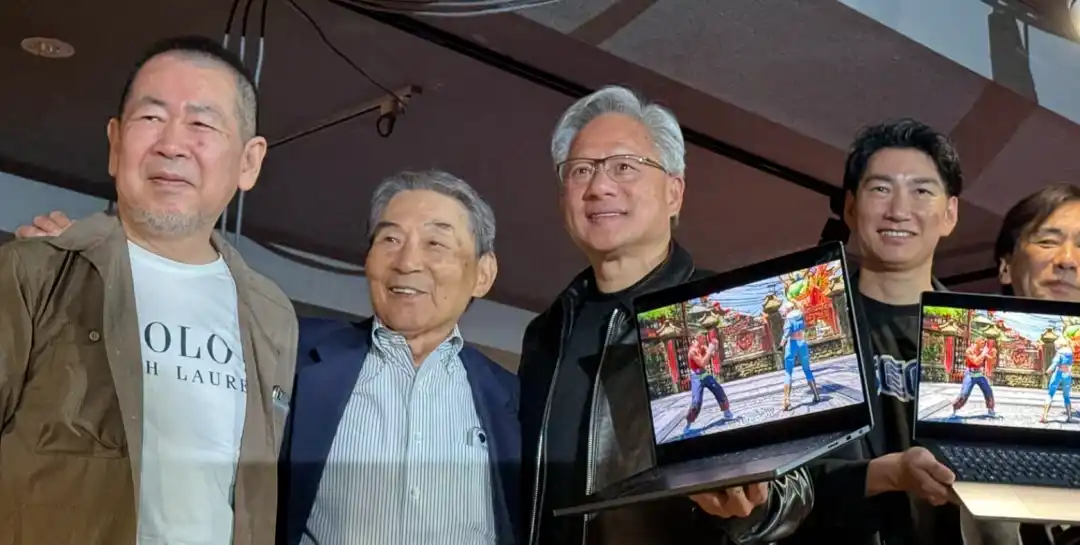
(Sumber Gambar: Situs Web Resmi Nvidia)

Jamuan Malam di Izakaya: Merangkul Inti Rantai Pasok Semikonduktor Jepang

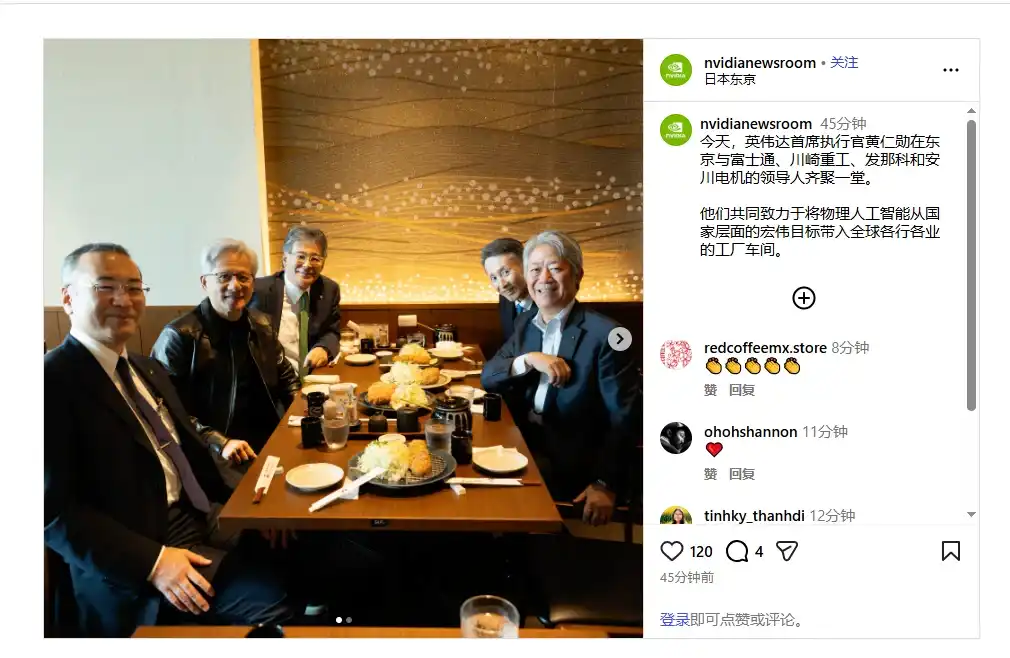
Pada malam sebelum pengumuman kerja sama resmi dirilis, Huang menyelesaikan "hubungan masyarakat" kolektif terhadap simpul kunci rantai pasok AI Jepang melalui sebuah jamuan makan malam yang sederhana namun penuh makna.

Menurut laporan The Straits Times Singapura, pada malam 15 Juli waktu setempat, Huang muncul di sebuah izakaya di Distrik Kanda, Tokyo, untuk makan malam bersama sejumlah eksekutif inti perusahaan rantai pasok Jepang, berlangsung sekitar dua jam.
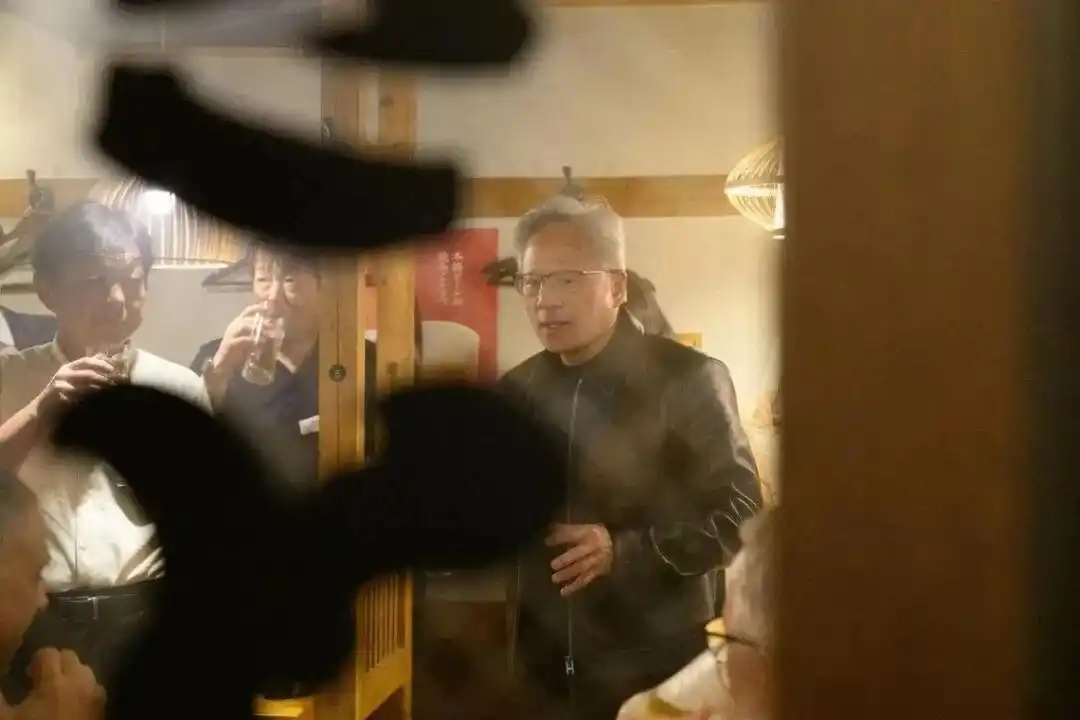
(Sumber Gambar: The Straits Times Singapura)

Yang hadir termasuk:

CEO produsen chip memori kilat canggih Kioxia, pimpinan pemasok wafer silikon terkemuka global Shin-Etsu Chemical, kepala produsen peralatan chip Tokyo Electron, eksekutif pemasok eksklusif film kemasan chip canggih Ajinomoto, serta pimpinan produsen kabel serat optik Sumitomo Electric Industries dan produsen kapasitor canggih Taiyo Yuden. Yuki Kusumi dari Panasonic Holdings juga hadir.

Diketahui, Huang dan rombongannya menikmati yakiniku (sate panggang) dan hotpot jeroan sapi, serta minum wiski Jepang.

Komposisi peserta pertemuan ini hampir menggambarkan panorama lengkap rantai pasok perangkat keras Jepang yang diandalkan oleh sistem AI generasi berikutnya Nvidia. Menurut sumber yang hadir, selama jamuan pernah muncul pembicaraan seperti "Mari kita bersama-sama mendorong kemakmuran industri semikonduktor dan lainnya, membuat harga saham terus naik".

Di luar izakaya, segerombolan orang dengan ponsel pintar berkumpul, berharap dapat menyaksikan langsung idola era AI yang dijuluki "kawajan-san" (Tuan Jaket Kulit) di media sosial. Dilaporkan, seorang turis Taiwan berusia 57 tahun, Chang Hui-Yu, di luar acara Sega mengatakan, "Saya pikir dia adalah orang paling berpengaruh di planet ini."

Bertaruh pada AI Fisik: Manufaktur Jepang adalah "Sekutu Alami"

Narasi strategis inti perjalanan Huang ini adalah memposisikan Jepang sebagai medan kunci bagi perkembangan AI fisik global.

Menurut laporan Kyodo News, Huang dalam wawancara di Tokyo menyatakan, "Ini adalah momen bersejarah bagi Jepang, karena Jepang secara historis unggul dalam manufaktur presisi dan manufaktur skala besar."

Ia meyakini, AI dapat membantu Jepang menghadapi masalah parah kekurangan tenaga kerja, "Melalui otomatisasi, AI, dan teknologi robot, kemampuan tenaga kerja yang ada dapat ditingkatkan, meningkatkan produktivitas nasional secara keseluruhan."

Pada tingkat kerja sama konkret, kerja sama Nvidia dengan Fanuc dan Yaskawa Electric langsung menargetkan peningkatan kecerdasan robot industri. Kerja sama dengan Toyota lebih komprehensif:

Toyota sedang mengembangkan kendaraan generasi berikutnya dengan kemampuan L2++ berdasarkan platform DRIVE AGX dan sistem operasi DriveOS Nvidia; sekaligus menggunakan model AI asisten kode yang memenuhi standar MISRA yang dilatih dengan Megatron-LM Nvidia untuk mempercepat rekayasa perangkat lunak kendaraan; dan memanfaatkan kerangka Omniverse dan Isaac Sim Nvidia untuk memajukan digital twin pabrik dan simulasi robot.

Anak perusahaan Toyota, Woven by Toyota, juga mengembangkan model bahasa visual multimodal untuk kecerdasan lalu lintas kota berdasarkan GPU H100 Nvidia.
Wakil Presiden Nvidia, Rishi Dhall, menyatakan, "AI fisik akan membawa kecerdasan pada setiap mesin bergerak, mulai dari mobil, robot, truk, hingga kota dan pabrik tempat mereka beroperasi."

Tata Letak Stack Penuh: Dari Kesehatan, Keuangan hingga Komputasi Kuantum

Selain robot dan otomotif, peta kerja sama Nvidia di Jepang meluas ke berbagai industri kunci, menunjukkan penetrasi sistematis dan menyeluruh.

Dalam bidang kesehatan dan ilmu hayati, sejumlah raksasa farmasi Jepang sedang mempercepat penemuan obat berbasis AI dengan bantuan platform BioNeMo Nvidia, termasuk Eisai, Astellas, Daiichi Sankyo dan Ono Pharmaceuticals. Canon meluncurkan sistem CT fotonik dipercepat pertama di Jepang yang ditenagai Nvidia, sementara Fujifilm mengomersialkan sistem CT seluruh tubuh pertama di Jepang yang dilengkapi Blackwell Nvidia. Kawasaki Heavy Industries berencana menggunakan platform Holoscan IGX, Isaac GR00T, dan Cosmos Nvidia untuk mengembangkan robot asisten bedah dan robot transportasi rumah sakit. Dalam industri keuangan, Mizuho Bank berencana membangun pabrik AI lokal terbesar di industri keuangan Jepang, dengan konfigurasi awal sistem DGX B200 Nvidia; Japan Research Institute (JRI) di bawah Mitsui Sumitomo Financial Group telah menyebarkan pabrik AI, mengubah data keuangan menjadi kecerdasan berdasarkan model terbuka Nemotron Nvidia; sementara Rakuten Bank akan menggunakan Toolkit Agen Nvidia untuk mengembangkan model dasar perdagangan. Dalam komputasi kuantum, dua superkomputer yang ditenagai oleh GB200 Nvidia di Institut Penelitian RIKEN Jepang telah mulai beroperasi: RIKYU dilengkapi dengan 1.600 GPU Blackwell Nvidia untuk mendukung pengembangan model dasar terbuka; sistem komputasi kinerja tinggi-kuantum ROQUO mengintegrasikan 540 GPU Blackwell, terhubung erat dengan komputer kuantum di kampus RIKEN. Lembaga seperti Mitsubishi Chemical, Mizuho Bank, Keio University, AIST bekerja sama dengan Nvidia, mencapai percepatan 13,4 kali lipat dibandingkan dengan node CPU murni dalam alur kerja analisis spektrum molekul.

Selain itu, dilaporkan, pasar menduga Nvidia mungkin mengumumkan kerja sama dengan "timnas model AI fisik" Jepang, Noetra. Noetra didirikan di bawah pimpinan SoftBank, menghimpun 44 perusahaan Jepang termasuk Honda dan NEC, dan pemerintah Jepang juga memberikan subsidi fiskal sebesar 1 triliun yen untuk ini.

Trending Cryptos

Related Questions

QApa inti dari kunjungan CEO Nvidia Jensen Huang ke Jepang baru-baru ini?

AInti kunjungan Jensen Huang ke Jepang adalah untuk menjadikan Jepang sebagai titik tumpu kunci dalam peta global "Physical AI" Nvidia. Ia melakukan serangkaian penandatanganan kerja sama dan pertemuan bisnis untuk mengikat infrastruktur manufaktur dan rantai pasok semikonduktor Jepang secara mendalam dengan teknologi AI full-stack Nvidia.

QSiapa yang membantu Nvidia saat hampir bangkrut 30 tahun yang lalu, dan apa yang dilakukan Jensen Huang dalam kunjungan ini terkait hal itu?

APerusahaan SEGA, khususnya mantan presidennya Shoichiro Irimajiri, membantu Nvidia dengan investasi sekitar $5 juta saat hampir bangkrut sekitar tahun 1996. Dalam kunjungan ini, Jensen Huang bertemu kembali dengan Irimajiri di lokasi lama pusat permainan SEGA di Akihabara, Tokyo, dan mengumumkan kelanjutan kerja sama di mana karya masa depan SEGA akan mendukung platform RTX Spark terbaru Nvidia.

QPerusahaan robot Jepang mana saja yang bekerja sama dengan Nvidia, dan apa fokus kerja samanya?

ANvidia mengumumkan kerja sama dengan dua raksasa robotika Jepang, yaitu Fanuc dan Yaskawa Electric. Fokus kerja samanya adalah untuk memajukan pengembangan teknologi robot dan AI bersama-sama.

QApa saja bidang kerja sama yang diperluas antara Nvidia dan Toyota?

AKerja sama yang diperluas antara Nvidia dan Toyota mencakup beberapa bidang utama: pengembangan kendaraan otonom (berbasis platform DRIVE AGX), simulasi pabrik menggunakan Omniverse dan Isaac Sim, kecerdasan perkotaan (oleh anak perusahaan Woven by Toyota), serta percepatan rekayasa perangkat lunak kendaraan dengan model AI asisten kode yang dilatih menggunakan Megatron-LM.

QApa saja sektor industri lain di Jepang yang disebutkan dalam artikel yang bekerja sama dengan Nvidia?

ASelain robotika dan otomotif, Nvidia juga bekerja sama dengan berbagai sektor industri kunci di Jepang, termasuk: kesehatan dan ilmu kehidupan (misalnya dengan Eisai, Canon, Fujifilm, Kawasaki Heavy Industries), keuangan (misalnya Mizuho Bank, Japan Research Institute, Rakuten Bank), serta komputasi kuantum (misalnya dengan RIKEN, Mitsubishi Chemical, AIST).

Related Reads

Why P2P and Exchangers Are Becoming Obsolete, and What Will Replace Them

Titled "Why P2P and Exchanges Are Becoming Obsolete, and What Will Replace Them," this article discusses the evolution of stablecoins, particularly USDT, from a trading tool to a global payment method. However, converting crypto back to fiat for daily expenses remains a challenge. The process of using P2P platforms or crypto exchanges has become increasingly risky and complex due to stricter banking anti-fraud measures, new legislation in Russia, and rampant fraud schemes like "triangles," where sellers can inadvertently receive stolen funds. The article highlights that while P2P was convenient, banks now scrutinize frequent peer-to-peer transfers, often freezing accounts. Exchanges also pose risks like unfavorable rates and unclear compliance. The market is therefore shifting towards integrated services that eliminate the manual conversion step. It cites OneSix as an example—a crypto wallet accessible via Telegram and web that embeds currency conversion directly into payment and withdrawal scenarios. Users can pay bills or send money as if using a bank app, with the crypto-to-fiat exchange happening seamlessly in the background. It also offers invoicing for freelancers and conducts AML checks, returning suspicious transactions instantly instead of freezing them. In conclusion, as crypto integrates into everyday finance, the demand for manual, risky exchange methods is declining. The future lies in unified platforms that combine storage, compliance, conversion, and payments into a single, secure user experience.

cryptonews.ru23m ago

Why P2P and Exchangers Are Becoming Obsolete, and What Will Replace Them

cryptonews.ru23m ago

The CEO of MARA Holdings Compares AI Operations to Bitcoin Mining! Which is More Profitable?

Fred Thiel, CEO of MARA Holdings (a major Bitcoin mining company), states that the rapid growth of the artificial intelligence (AI) sector is transforming mining companies' business models. He claims that powering data centers for AI is significantly more profitable than Bitcoin mining. In a recent interview, Thiel explained why many mining firms are diversifying into AI infrastructure. According to Thiel, the energy demands of data centers are surging, especially due to the spread of generative AI applications. This creates new revenue opportunities for Bitcoin mining companies with robust power infrastructure. MARA Holdings is among those monitoring this shift and aims to develop its energy and infrastructure services for AI data centers. Thiel emphasized that this move toward AI does not mean the end of Bitcoin mining. He stated that Bitcoin mining remains a sustainable business model, especially for miners in regions with low electricity costs, and it is still a crucial field for utilizing excess or idle power capacity. In recent years, many Bitcoin mining companies have begun using their energy-intensive infrastructure not just for block production but also for high-performance computing (HPC) and AI applications. This strategy aims to diversify revenue sources and increase resilience against cryptocurrency market volatility. Analysts note that the growing energy demand in the AI sector presents significant transformation opportunities for mining companies. The need for high-power, uninterrupted electricity supply, particularly for large data centers, gives Bitcoin miners with existing energy infrastructure expertise a considerable advantage.

cryptonews.ru34m ago

The CEO of MARA Holdings Compares AI Operations to Bitcoin Mining! Which is More Profitable?

cryptonews.ru34m ago

Ratio's CEO Says Multi-Currency Stablecoins Could Eliminate Costly FX Conversions in Asia

The CEO of Ratio, John Cho, argues that multi-currency stablecoins could save Asia billions by eliminating costly foreign exchange conversions in regional trade. While USD stablecoins like USDT and USDC work for global settlements, local Asian trade is conducted in local currencies like the Korean won or Singapore dollar. Forcing these transactions through USD intermediaries creates unnecessary costs and currency risk. Cho envisions a complementary ecosystem where local-currency stablecoins work alongside USD stablecoins, enabling seamless cross-border settlements without conversion friction. A key pain point in traditional banking is the need for pre-funded Nostro and Vostro accounts, which lock up vast amounts of working capital. Blockchain-based settlement layers like Ratio offer a 24/7 alternative, using on-chain liquidity to enable instant execution even when traditional channels are closed. Modern Web3 infrastructure providers are focusing on pragmatic integration with existing corporate systems like ERPs, allowing businesses to gradually shift volumes to digital channels for better speed, cost, and reduced slippage. Clear regulation is cited as the critical catalyst for widespread institutional adoption. As jurisdictions like the U.S. advance legislation (e.g., the CLARITY Act) and Asian countries are expected to pass their own stablecoin laws within 12-24 months, regulatory uncertainty is receding. The ultimate vision is for regulated stablecoins to become an invisible settlement layer integrated into national payment systems, where payments simply happen on-chain, erasing the boundary between traditional banking and digital assets.

cryptonews.ru53m ago

Ratio's CEO Says Multi-Currency Stablecoins Could Eliminate Costly FX Conversions in Asia

cryptonews.ru53m ago

Huang Xiaoming, Li Bin, Lei Jun, Liang Wenfeng... Who Are the Biggest Winners in the CXMT IPO Feast?

Changxin Technology, a leading Chinese memory chip manufacturer, successfully listed on the Shanghai Stock Exchange's STAR Market (科创板) on July 8, 2026. Its share price surged from the IPO price of 8.66 yuan to close at 49 yuan on the first day, catapulting its market capitalization to 3.28 trillion yuan, making it the most valuable A-share company and triggering a massive wealth creation event. The biggest winners were the company's founder, Zhu Yiming, and its employees. Zhu Yiming's family wealth skyrocketed nearly 300% to approximately $13.9 billion, with his direct stake in Changxin valued at around 80 billion yuan. Additionally, over 6700 employees benefited from stock ownership plans, creating at least 237 new millionaires (in CNY). Zhu also pledged to donate 768 million shares, worth over 37.6 billion yuan, for future employee incentives over a ten-year period. Several prominent investors and corporate clients also reaped significant paper gains from the IPO. Notable figures include: * **Liang Wenfeng**, founder of DeepSeek, whose funds netted a paper profit of approximately 827 million yuan. * **Kong Jianping**, founder of Nano Labs, saw his indirect holdings valued at roughly 940 million yuan. * **Li Bin**, founder of Nio, whose company's strategic investment of 158 million yuan is now worth about 740 million yuan. * **Lei Jun**, founder of Xiaomi, whose subsidiary holds shares currently showing a paper gain of over 736 million yuan. Xiaomi clarified this is a corporate investment, not direct personal wealth. The article notes that while this IPO created immense wealth for insiders and large investors, retail investors who were lucky enough to win an allotment in the lottery typically profited by around 20,000 yuan. The listing solidifies Changxin's position as China's premier domestic memory chipmaker.

marsbit1h ago

Huang Xiaoming, Li Bin, Lei Jun, Liang Wenfeng... Who Are the Biggest Winners in the CXMT IPO Feast?

marsbit1h ago

Trading

Spot

Hot Articles

What is SONIC

Sonic: Pioneering the Future of Gaming in Web3 Introduction to Sonic In the ever-evolving landscape of Web3, the gaming industry stands out as one of the most dynamic and promising sectors. At the forefront of this revolution is Sonic, a project designed to amplify the gaming ecosystem on the Solana blockchain. Leveraging cutting-edge technology, Sonic aims to deliver an unparalleled gaming experience by efficiently processing millions of requests per second, ensuring that players enjoy seamless gameplay while maintaining low transaction costs. This article delves into the intricate details of Sonic, exploring its creators, funding sources, operational mechanics, and the timeline of significant events that have shaped its journey. What is Sonic? Sonic is an innovative layer-2 network that operates atop the Solana blockchain, specifically tailored to enhance the existing Solana gaming ecosystem. It accomplishes this through a customised, VM-agnostic game engine paired with a HyperGrid interpreter, facilitating sovereign game economies that roll up back to the Solana platform. The primary goals of Sonic include: Enhanced Gaming Experiences: Sonic is committed to offering lightning-fast on-chain gameplay, allowing players and developers to engage with games at previously unattainable speeds. Atomic Interoperability: This feature enables transactions to be executed within Sonic without the need to redeploy Solana programmes and accounts. This makes the process more efficient and directly benefits from Solana Layer1 services and liquidity. Seamless Deployment: Sonic allows developers to write for Ethereum Virtual Machine (EVM) based systems and execute them on Solana’s SVM infrastructure. This interoperability is crucial for attracting a broader range of dApps and decentralised applications to the platform. Support for Developers: By offering native composable gaming primitives and extensible data types - dining within the Entity-Component-System (ECS) framework - game creators can craft intricate business logic with ease. Overall, Sonic's unique approach not only caters to players but also provides an accessible and low-cost environment for developers to innovate and thrive. Creator of Sonic The information regarding the creator of Sonic is somewhat ambiguous. However, it is known that Sonic's SVM is owned by the company Mirror World. The absence of detailed information about the individuals behind Sonic reflects a common trend in several Web3 projects, where collective efforts and partnerships often overshadow individual contributions. Investors of Sonic Sonic has garnered considerable attention and support from various investors within the crypto and gaming sectors. Notably, the project raised an impressive $12 million during its Series A funding round. The round was led by BITKRAFT Ventures, with other notable investors including Galaxy, Okx Ventures, Interactive, Big Brain Holdings, and Mirana. This financial backing signifies the confidence that investment foundations have in Sonic’s potential to revolutionise the Web3 gaming landscape, further validating its innovative approaches and technologies. How Does Sonic Work? Sonic utilises the HyperGrid framework, a sophisticated parallel processing mechanism that enhances its scalability and customisability. Here are the core features that set Sonic apart: Lightning Speed at Low Costs: Sonic offers one of the fastest on-chain gaming experiences compared to other Layer-1 solutions, powered by the scalability of Solana’s virtual machine (SVM). Atomic Interoperability: Sonic enables transaction execution without redeployment of Solana programmes and accounts, effectively streamlining the interaction between users and the blockchain. EVM Compatibility: Developers can effortlessly migrate decentralised applications from EVM chains to the Solana environment using Sonic’s HyperGrid interpreter, increasing the accessibility and integration of various dApps. Ecosystem Support for Developers: By exposing native composable gaming primitives, Sonic facilitates a sandbox-like environment where developers can experiment and implement business logic, greatly enhancing the overall development experience. Monetisation Infrastructure: Sonic natively supports growth and monetisation efforts, providing frameworks for traffic generation, payments, and settlements, thereby ensuring that gaming projects are not only viable but also sustainable financially. Timeline of Sonic The evolution of Sonic has been marked by several key milestones. Below is a brief timeline highlighting critical events in the project's history: 2022: The Sonic cryptocurrency was officially launched, marking the beginning of its journey in the Web3 gaming arena. 2024: June: Sonic SVM successfully raised $12 million in a Series A funding round. This investment allowed Sonic to further develop its platform and expand its offerings. August: The launch of the Sonic Odyssey testnet provided users with the first opportunity to engage with the platform, offering interactive activities such as collecting rings—a nod to gaming nostalgia. October: SonicX, an innovative crypto game integrated with Solana, made its debut on TikTok, capturing the attention of over 120,000 users within a short span. This integration illustrated Sonic’s commitment to reaching a broader, global audience and showcased the potential of blockchain gaming. Key Points Sonic SVM is a revolutionary layer-2 network on Solana explicitly designed to enhance the GameFi landscape, demonstrating great potential for future development. HyperGrid Framework empowers Sonic by introducing horizontal scaling capabilities, ensuring that the network can handle the demands of Web3 gaming. Integration with Social Platforms: The successful launch of SonicX on TikTok displays Sonic’s strategy to leverage social media platforms to engage users, exponentially increasing the exposure and reach of its projects. Investment Confidence: The substantial funding from BITKRAFT Ventures, among others, emphasizes the robust backing Sonic has, paving the way for its ambitious future. In conclusion, Sonic encapsulates the essence of Web3 gaming innovation, striking a balance between cutting-edge technology, developer-centric tools, and community engagement. As the project continues to evolve, it is poised to redefine the gaming landscape, making it a notable entity for gamers and developers alike. As Sonic moves forward, it will undoubtedly attract greater interest and participation, solidifying its place within the broader narrative of blockchain gaming.

1.9k Total ViewsPublished 2024.04.04Updated 2024.12.03

What is SONIC

What is $S$

Understanding SPERO: A Comprehensive Overview Introduction to SPERO As the landscape of innovation continues to evolve, the emergence of web3 technologies and cryptocurrency projects plays a pivotal role in shaping the digital future. One project that has garnered attention in this dynamic field is SPERO, denoted as SPERO,$$s$. This article aims to gather and present detailed information about SPERO, to help enthusiasts and investors understand its foundations, objectives, and innovations within the web3 and crypto domains. What is SPERO,$$s$? SPERO,$$s$ is a unique project within the crypto space that seeks to leverage the principles of decentralisation and blockchain technology to create an ecosystem that promotes engagement, utility, and financial inclusion. The project is tailored to facilitate peer-to-peer interactions in new ways, providing users with innovative financial solutions and services. At its core, SPERO,$$s$ aims to empower individuals by providing tools and platforms that enhance user experience in the cryptocurrency space. This includes enabling more flexible transaction methods, fostering community-driven initiatives, and creating pathways for financial opportunities through decentralised applications (dApps). The underlying vision of SPERO,$$s$ revolves around inclusiveness, aiming to bridge gaps within traditional finance while harnessing the benefits of blockchain technology. Who is the Creator of SPERO,$$s$? The identity of the creator of SPERO,$$s$ remains somewhat obscure, as there are limited publicly available resources providing detailed background information on its founder(s). This lack of transparency can stem from the project's commitment to decentralisation—an ethos that many web3 projects share, prioritising collective contributions over individual recognition. By centring discussions around the community and its collective goals, SPERO,$$s$ embodies the essence of empowerment without singling out specific individuals. As such, understanding the ethos and mission of SPERO remains more important than identifying a singular creator. Who are the Investors of SPERO,$$s$? SPERO,$$s$ is supported by a diverse array of investors ranging from venture capitalists to angel investors dedicated to fostering innovation in the crypto sector. The focus of these investors generally aligns with SPERO's mission—prioritising projects that promise societal technological advancement, financial inclusivity, and decentralised governance. These investor foundations are typically interested in projects that not only offer innovative products but also contribute positively to the blockchain community and its ecosystems. The backing from these investors reinforces SPERO,$$s$ as a noteworthy contender in the rapidly evolving domain of crypto projects. How Does SPERO,$$s$ Work? SPERO,$$s$ employs a multi-faceted framework that distinguishes it from conventional cryptocurrency projects. Here are some of the key features that underline its uniqueness and innovation: Decentralised Governance: SPERO,$$s$ integrates decentralised governance models, empowering users to participate actively in decision-making processes regarding the project’s future. This approach fosters a sense of ownership and accountability among community members. Token Utility: SPERO,$$s$ utilises its own cryptocurrency token, designed to serve various functions within the ecosystem. These tokens enable transactions, rewards, and the facilitation of services offered on the platform, enhancing overall engagement and utility. Layered Architecture: The technical architecture of SPERO,$$s$ supports modularity and scalability, allowing for seamless integration of additional features and applications as the project evolves. This adaptability is paramount for sustaining relevance in the ever-changing crypto landscape. Community Engagement: The project emphasises community-driven initiatives, employing mechanisms that incentivise collaboration and feedback. By nurturing a strong community, SPERO,$$s$ can better address user needs and adapt to market trends. Focus on Inclusion: By offering low transaction fees and user-friendly interfaces, SPERO,$$s$ aims to attract a diverse user base, including individuals who may not previously have engaged in the crypto space. This commitment to inclusion aligns with its overarching mission of empowerment through accessibility. Timeline of SPERO,$$s$ Understanding a project's history provides crucial insights into its development trajectory and milestones. Below is a suggested timeline mapping significant events in the evolution of SPERO,$$s$: Conceptualisation and Ideation Phase: The initial ideas forming the basis of SPERO,$$s$ were conceived, aligning closely with the principles of decentralisation and community focus within the blockchain industry. Launch of Project Whitepaper: Following the conceptual phase, a comprehensive whitepaper detailing the vision, goals, and technological infrastructure of SPERO,$$s$ was released to garner community interest and feedback. Community Building and Early Engagements: Active outreach efforts were made to build a community of early adopters and potential investors, facilitating discussions around the project’s goals and garnering support. Token Generation Event: SPERO,$$s$ conducted a token generation event (TGE) to distribute its native tokens to early supporters and establish initial liquidity within the ecosystem. Launch of Initial dApp: The first decentralised application (dApp) associated with SPERO,$$s$ went live, allowing users to engage with the platform's core functionalities. Ongoing Development and Partnerships: Continuous updates and enhancements to the project's offerings, including strategic partnerships with other players in the blockchain space, have shaped SPERO,$$s$ into a competitive and evolving player in the crypto market. Conclusion SPERO,$$s$ stands as a testament to the potential of web3 and cryptocurrency to revolutionise financial systems and empower individuals. With a commitment to decentralised governance, community engagement, and innovatively designed functionalities, it paves the way toward a more inclusive financial landscape. As with any investment in the rapidly evolving crypto space, potential investors and users are encouraged to research thoroughly and engage thoughtfully with the ongoing developments within SPERO,$$s$. The project showcases the innovative spirit of the crypto industry, inviting further exploration into its myriad possibilities. While the journey of SPERO,$$s$ is still unfolding, its foundational principles may indeed influence the future of how we interact with technology, finance, and each other in interconnected digital ecosystems.

194 Total ViewsPublished 2024.12.17Updated 2024.12.17

What is $S$

What is AGENT S

Agent S: The Future of Autonomous Interaction in Web3 Introduction In the ever-evolving landscape of Web3 and cryptocurrency, innovations are constantly redefining how individuals interact with digital platforms. One such pioneering project, Agent S, promises to revolutionise human-computer interaction through its open agentic framework. By paving the way for autonomous interactions, Agent S aims to simplify complex tasks, offering transformative applications in artificial intelligence (AI). This detailed exploration will delve into the project's intricacies, its unique features, and the implications for the cryptocurrency domain. What is Agent S? Agent S stands as a groundbreaking open agentic framework, specifically designed to tackle three fundamental challenges in the automation of computer tasks: Acquiring Domain-Specific Knowledge: The framework intelligently learns from various external knowledge sources and internal experiences. This dual approach empowers it to build a rich repository of domain-specific knowledge, enhancing its performance in task execution. Planning Over Long Task Horizons: Agent S employs experience-augmented hierarchical planning, a strategic approach that facilitates efficient breakdown and execution of intricate tasks. This feature significantly enhances its ability to manage multiple subtasks efficiently and effectively. Handling Dynamic, Non-Uniform Interfaces: The project introduces the Agent-Computer Interface (ACI), an innovative solution that enhances the interaction between agents and users. Utilizing Multimodal Large Language Models (MLLMs), Agent S can navigate and manipulate diverse graphical user interfaces seamlessly. Through these pioneering features, Agent S provides a robust framework that addresses the complexities involved in automating human interaction with machines, setting the stage for myriad applications in AI and beyond. Who is the Creator of Agent S? While the concept of Agent S is fundamentally innovative, specific information about its creator remains elusive. The creator is currently unknown, which highlights either the nascent stage of the project or the strategic choice to keep founding members under wraps. Regardless of anonymity, the focus remains on the framework's capabilities and potential. Who are the Investors of Agent S? As Agent S is relatively new in the cryptographic ecosystem, detailed information regarding its investors and financial backers is not explicitly documented. The lack of publicly available insights into the investment foundations or organisations supporting the project raises questions about its funding structure and development roadmap. Understanding the backing is crucial for gauging the project's sustainability and potential market impact. How Does Agent S Work? At the core of Agent S lies cutting-edge technology that enables it to function effectively in diverse settings. Its operational model is built around several key features: Human-like Computer Interaction: The framework offers advanced AI planning, striving to make interactions with computers more intuitive. By mimicking human behaviour in tasks execution, it promises to elevate user experiences. Narrative Memory: Employed to leverage high-level experiences, Agent S utilises narrative memory to keep track of task histories, thereby enhancing its decision-making processes. Episodic Memory: This feature provides users with step-by-step guidance, allowing the framework to offer contextual support as tasks unfold. Support for OpenACI: With the ability to run locally, Agent S allows users to maintain control over their interactions and workflows, aligning with the decentralised ethos of Web3. Easy Integration with External APIs: Its versatility and compatibility with various AI platforms ensure that Agent S can fit seamlessly into existing technological ecosystems, making it an appealing choice for developers and organisations. These functionalities collectively contribute to Agent S's unique position within the crypto space, as it automates complex, multi-step tasks with minimal human intervention. As the project evolves, its potential applications in Web3 could redefine how digital interactions unfold. Timeline of Agent S The development and milestones of Agent S can be encapsulated in a timeline that highlights its significant events: September 27, 2024: The concept of Agent S was launched in a comprehensive research paper titled “An Open Agentic Framework that Uses Computers Like a Human,” showcasing the groundwork for the project. October 10, 2024: The research paper was made publicly available on arXiv, offering an in-depth exploration of the framework and its performance evaluation based on the OSWorld benchmark. October 12, 2024: A video presentation was released, providing a visual insight into the capabilities and features of Agent S, further engaging potential users and investors. These markers in the timeline not only illustrate the progress of Agent S but also indicate its commitment to transparency and community engagement. Key Points About Agent S As the Agent S framework continues to evolve, several key attributes stand out, underscoring its innovative nature and potential: Innovative Framework: Designed to provide an intuitive use of computers akin to human interaction, Agent S brings a novel approach to task automation. Autonomous Interaction: The ability to interact autonomously with computers through GUI signifies a leap towards more intelligent and efficient computing solutions. Complex Task Automation: With its robust methodology, it can automate complex, multi-step tasks, making processes faster and less error-prone. Continuous Improvement: The learning mechanisms enable Agent S to improve from past experiences, continually enhancing its performance and efficacy. Versatility: Its adaptability across different operating environments like OSWorld and WindowsAgentArena ensures that it can serve a broad range of applications. As Agent S positions itself in the Web3 and crypto landscape, its potential to enhance interaction capabilities and automate processes signifies a significant advancement in AI technologies. Through its innovative framework, Agent S exemplifies the future of digital interactions, promising a more seamless and efficient experience for users across various industries. Conclusion Agent S represents a bold leap forward in the marriage of AI and Web3, with the capacity to redefine how we interact with technology. While still in its early stages, the possibilities for its application are vast and compelling. Through its comprehensive framework addressing critical challenges, Agent S aims to bring autonomous interactions to the forefront of the digital experience. As we move deeper into the realms of cryptocurrency and decentralisation, projects like Agent S will undoubtedly play a crucial role in shaping the future of technology and human-computer collaboration.

864 Total ViewsPublished 2025.01.14Updated 2025.01.14

What is AGENT S

Discussions

Welcome to the HTX Community. Here, you can stay informed about the latest platform developments and gain access to professional market insights. Users' opinions on the price of S (S) are presented below.

活动图片