ZCash supera los 560 dólares, pero 644 dólares sigue siendo el nivel por batir

ambcryptoPublished on 2026-07-16Last updated on 2026-07-16

Abstract

ZCash (ZEC) experimentó una fuerte subida, superando el 13% el martes y continuando al alza el miércoles. El interés abierto también aumentó, lo que respalda una perspectiva cautelosamente alcista. La criptomoneda logró romper niveles clave de resistencia en $500 y $560, señalando un posible cambio de tendencia. No obstante, el nivel de $644 sigue siendo un obstáculo crucial por superar para confirmar una estructura alcista definitiva en gráficos de menor plazo. Si se supera, los próximos objetivos podrían ser $690 y $750. Los indicadores en gráficos de mayor plazo, como el CMF y el RSI, muestran presión compradora y momentum alcista, pero los datos intradía revelan ciertas dudas sobre la fortaleza inmediata de los toros. En resumen, aunque la recuperación de ZCash desde los mínimos de junio es sólida y ha conquistado resistencias importantes, los traders esperan una ruptura clara por encima de $644, acompañada de entradas sostenidas de capital, para confirmar el giro alcista y actuar en consecuencia.

ZCash [ZEC] experimentó una subida del 13.85% el martes, 14 de julio. Subió otro 1.6% el miércoles, y su Interés Abierto ha aumentado un 7.70% en las últimas 24 horas.

En un informe reciente, AMBCrypto concluyó que los traders de swing y los inversores pueden adoptar una perspectiva cautelosamente alcista. El nivel de $560 fue marcado como una resistencia clave a corto plazo, pero ha sido superado.

Aún hay otro obstáculo por observar, pero por ahora, dos de las tres resistencias clave han sido recuperadas. Estas son la zona de oferta en el número redondo de $500 y el nivel de retroceso de $560.

En otras noticias, hubo una actividad comercial inusual a finales de mayo, cuando se descubrió la vulnerabilidad crítica en Orchard que permitía imprimir ZCash ilimitados.

El resurgimiento de ZCash está en marcha
Fuente: ZEC/USDT en TradingView

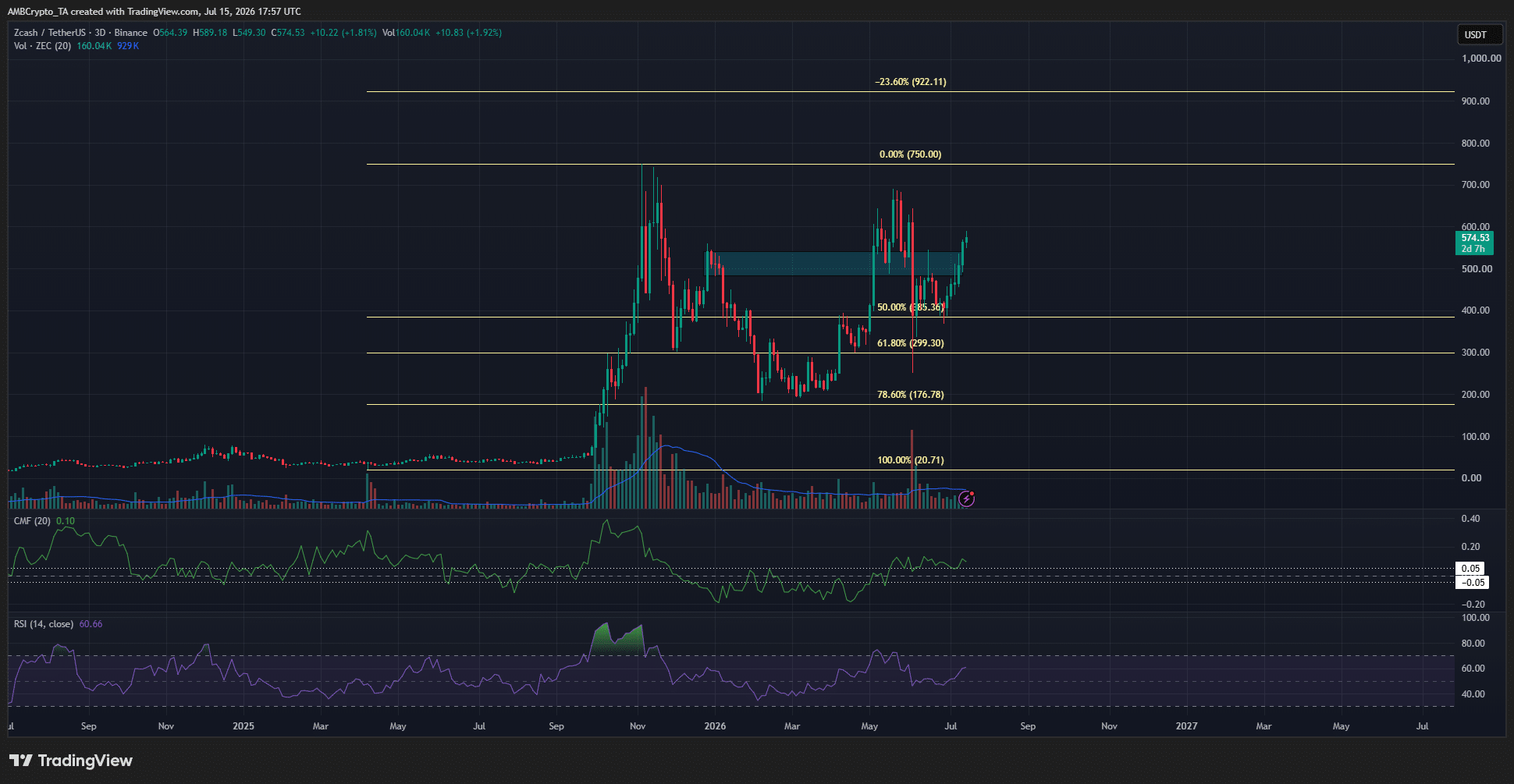
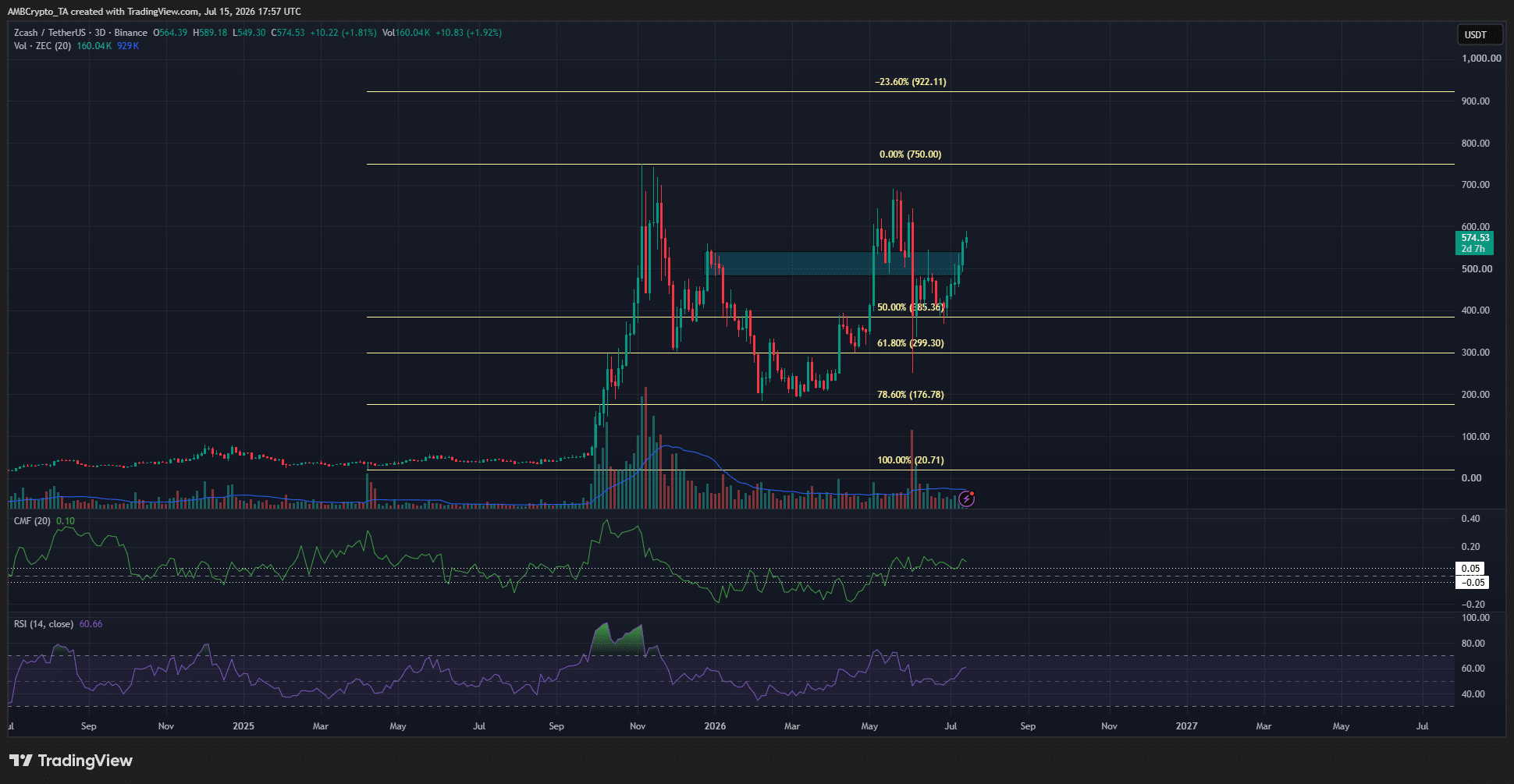
El retroceso de $176 fue respetado a principios de año, y comenzó un rebote. La vulnerabilidad crítica desencadenó una venta masiva profunda, pero desde principios de junio, la zona de oferta local de $500 ha sido recuperada una vez más.

El CMF en el gráfico de 3 días se mantuvo por encima de +0.05 para señalar una fuerte presión compradora. El RSI estaba en 60.6, lo que indica que el impulso alcista también era considerable.

ZCash ha obtenido 56.12% de ganancias en menos de tres semanas, medido desde el mínimo local en $368.3. Tal y como están las cosas, una mayor subida seguía siendo probable.

Llamada a la acción para traders: Comprar
Fuente: ZEC/USDT en TradingView

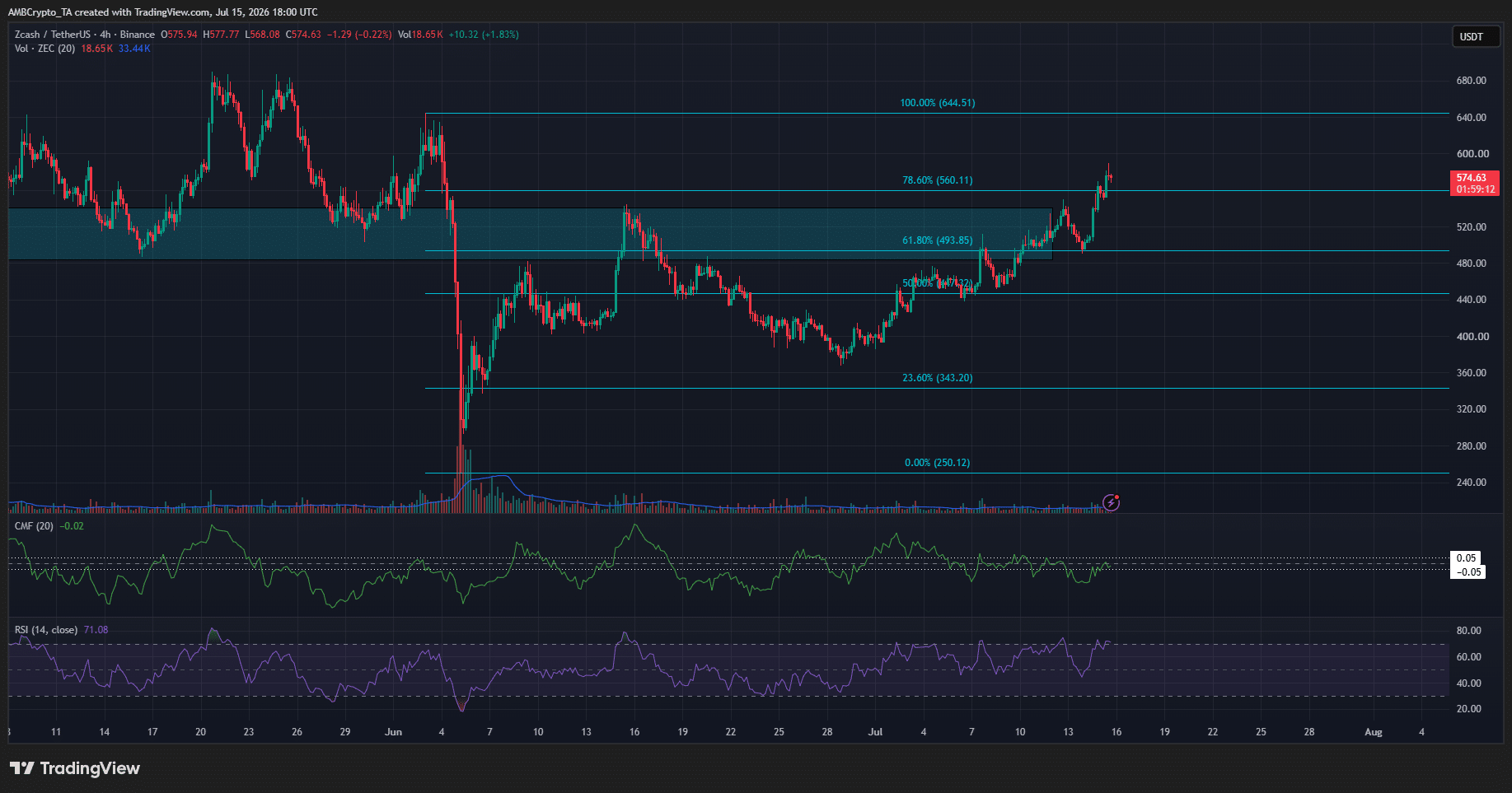
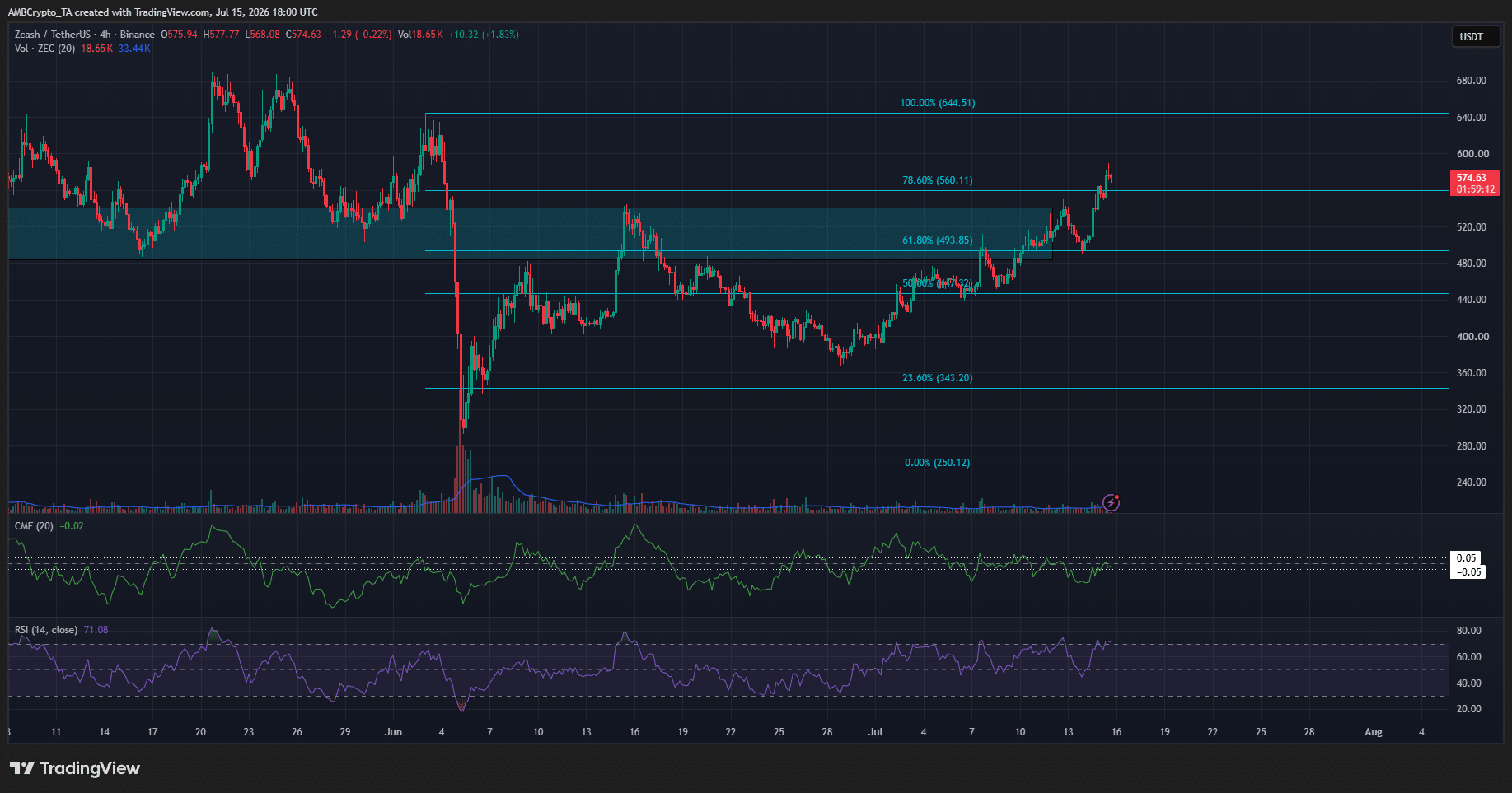
La estructura de swing en el gráfico de 4 horas era bajista, pero el nivel de retroceso del 78.6% en $560.11 ha sido superado. Era una leve preocupación que el CMF estuviera en -0.02 y no mostrara una firme presión compradora.

Un movimiento de precio por encima de $644 volvería alcista la estructura H4 de ZEC. El siguiente objetivo sería $690, un máximo alcanzado en mayo, con $750 como otro objetivo alcista.

Los traders pueden esperar a que se mantengan los flujos de capital y a un movimiento por encima de $644 para confirmar el cambio a tendencia alcista.


Resumen final

  • La ruptura de ZCash más allá de la zona de oferta de $500 estuvo acompañada de presión compradora en los marcos temporales superiores.
  • Al hacer zoom, los gráficos de marcos temporales inferiores mostraron ciertas dudas sobre la capacidad de los toros de ZEC para mantener la recuperación.


Trending Cryptos

Related Questions

Q¿Cuánto aumentó el precio de ZCash (ZEC) el martes 14 de julio, según el artículo?

AEl precio de ZCash (ZEC) aumentó un 13.85% el martes 14 de julio.

Q¿Qué nivel de precio se identificó como el próximo obstáculo clave para ZCash después de superar los $560?

AEl próximo obstáculo clave o nivel de resistencia que debe superar ZCash es $644.

Q¿Qué indicador técnico, mencionado en el artículo, se mantuvo por encima de +0.05 para señalar una fuerte presión de compra en el gráfico de 3 días?

AEl indicador CMF (Chaikin Money Flow) se mantuvo por encima de +0.05 en el gráfico de 3 días, señalando una fuerte presión de compra.

QSegún el análisis presentado, ¿qué evento a finales de mayo provocó una venta masiva de ZCash?

AA finales de mayo, la actividad de trading inusual y la venta masiva fueron provocadas por el descubrimiento de una vulnerabilidad crítica en Orchard que permitía imprimir ZCash ilimitadamente.

Q¿Cuál sería el próximo objetivo alcista para ZCash si logra superar y mantener un precio por encima de $644, según la recomendación a los traders?

ASi ZCash supera y se mantiene por encima de $644, el próximo objetivo alcista sería $690 (un máximo alcanzado en mayo), y luego $750 como otro objetivo.

Related Reads

After Three Consecutive Quarters of Decline, Can the Crypto Market Find a Window for Stabilization in Q3?

The cryptocurrency market has just concluded its worst-performing quarter since 2022, with total capitalization dropping 12.6% to $2.1 trillion. All core metrics indicate capital is leaving the sector, not just rotating within it. Bitcoin fell 14.2% and Ethereum dropped 25.4% in Q2, breaking their previous correlation with US tech stocks. A key driver is the reversal in US spot Bitcoin ETF flows, which saw a net outflow of approximately $4.67 billion in Q2, including a record monthly outflow near $4.5 billion in June. While recent data suggests long-term holders are accumulating again, sustained ETF outflows mean continued selling pressure. Market focus is now singularly on the Federal Reserve. The upcoming July FOMC meeting is seen as the most critical event for Q3. A dovish signal could support Bitcoin reclaiming a $68,000-$84,000 range, while a hawkish stance might establish a new trading band around $50,000-$56,000. Additionally, regulatory uncertainty persists, with the progress of the crucial *CLARITY Act* stalling in the Senate, reducing its perceived 2026 passage probability to 40-45%. Despite the broad downturn, a few sectors showed growth. Prediction markets saw nominal volume surge 48.7% year-over-year to $113.8 billion, and tokenized collectibles transaction volume rose 143% quarterly to $1.4 billion. The Real-World Asset (RWA) tokenization sector also continued steady growth, now representing ~$28.1 billion in on-chain value. The market's foundation for an extreme crash appears limited, with Bitcoin price hovering near its 200-week moving average. However, the trading paradigm has shifted from narrative-driven speculation to decisions based on price action, policy developments, and interest rate expectations, making a broad sentiment-driven rally unlikely in the near term.

marsbit16h ago

After Three Consecutive Quarters of Decline, Can the Crypto Market Find a Window for Stabilization in Q3?

marsbit16h ago

BIT Trading Moment: BTC Still Suppressed by Weekly 200 EMA, Rejection May Restart Decline; Storage and Semiconductors that Surged Last Night Begin Falling in Evening Trading

**Crypto & Stock Market Wrap: Bitcoin Tests Resistance, Stocks Retreat After AI Surge** Bitcoin consolidates around $66,000, facing key resistance near $68,000—an area seen as a major psychological and technical hurdle where previous rallies have failed. Analysts note the cryptocurrency is caught between its 200-week moving average (~$63,333) and 200-week EMA (~$68,328). A clear break above $68k is needed to signal a stronger bullish trend, while a rejection could lead to a retest of $63k support. Market sentiment remains cautious, with low futures open interest pointing to a low-liquidity rebound rather than a full bull market. Bitcoin spot ETFs saw another $203 million inflow. US stock futures pointed lower after a strong Tuesday session led by a massive rebound in semiconductors and memory stocks. The rally was fueled by renewed optimism about AI-driven hardware demand, with Micron, SanDisk, and SK Hynix surging. However, those gains reversed in pre-market trading. Super Micro Computer (SMCI) soared over 20% after hours on strong guidance and a record backlog. Other standouts included Rocket Lab and nuclear energy plays Oklo and X-Energy. Rising oil prices (Brent above $91) and climbing Treasury yields (10-year near 4.64%), however, are reigniting inflation concerns and acting as a headwind for equities. In Asia, markets were mixed. South Korea's KOSPI pared early gains to close slightly higher as semiconductor stocks like SK Hynix gave back initial surges. Japan's Nikkei edged lower as the yen hit a fresh 38-year low against the dollar, raising fears of potential market intervention. Key events to watch include the Samsung Galaxy launch, AMD's AI event, and a slew of major tech earnings from Alphabet, Tesla, and IBM after the close on Wednesday, followed by the ECB meeting and Intel's earnings on Thursday.

marsbit16h ago

BIT Trading Moment: BTC Still Suppressed by Weekly 200 EMA, Rejection May Restart Decline; Storage and Semiconductors that Surged Last Night Begin Falling in Evening Trading

marsbit16h ago

Former CFTC Chairman, Circle President Tarbert: Preaching Long-Termism While Cashing Out $30 Million Himself

Former CFTC Chairman and Circle President Heath Tarbert has consistently advocated for a long-term vision in public, urging patience from investors as Circle’s stock price has fallen significantly from its peak. However, it has been revealed that since Circle’s IPO, Tarbert has continuously sold his CRCL shares through pre-arranged trading plans, cashing out approximately $30 million, without making any public market purchases. This contrast between his public messaging and personal actions has drawn criticism. Tarbert joined Circle in July 2023 as Chief Legal Officer, leveraging his regulatory experience to help guide the company through its IPO and expansion. Despite promoting stablecoins as long-term infrastructure, he established a 10b5-1 trading plan just before Circle went public, leading to substantial stock sales over the following year. In March 2026, he initiated another plan to sell more shares. His career trajectory highlights a pattern of moving between high-level regulatory roles and influential positions in the financial sector. After resigning as CFTC Chairman in early 2021, he joined Citadel Securities as Chief Legal Officer just 27 days later, during a period of intense regulatory scrutiny for the firm. He later joined Circle, aiding its efforts to navigate regulatory challenges for its public listing. While Tarbert's expertise in policy and compliance is valuable to companies like Circle, his actions—advocating long-term confidence while personally divesting—raise questions about the alignment between his public statements and his private financial decisions, leaving investors who followed his advice to bear the market risks.

marsbit17h ago

Former CFTC Chairman, Circle President Tarbert: Preaching Long-Termism While Cashing Out $30 Million Himself

marsbit17h ago

Gate Research Institute: The 'Wall Street-ization' Wave of Crypto Financial Products – Competition or Integration?

The article titled "Gate Research Institute: Are Crypto Financial Products Sparking a 'Wall Street' Wave—Competition or Convergence?" explores the evolving relationship between the crypto ecosystem and traditional finance (TradFi). The piece begins by reflecting on Bitcoin's original 2009 vision of decentralization, disintermediation, and moving away from banks. It then contrasts this with the 2024 landscape, where key crypto assets like Bitcoin are increasingly held through Wall Street products like ETFs issued by giants like BlackRock. The article questions whether this signifies that TradFi is systematically taking over the rights to issue, price, custody, and distribute crypto financial assets. The core argument is that this is not a zero-sum takeover but rather a bidirectional convergence where each side addresses the other's weaknesses. Crypto offers 24/7 global markets, programmable settlement, and open access but lacks compliant channels, institutional-grade custody, deep fiat liquidity, and mainstream distribution. TradFi possesses these but is constrained by legacy systems, limited operating hours, and slow settlement. Two primary convergence paths are highlighted: * **Path A (CEX to TradFi):** Exemplified by Gate, which has progressed from offering tokenized stocks and CFDs to providing direct, real stock trading (US, Hong Kong, South Korea) within its platform, using USDT. * **Path B (TradFi to Crypto):** Exemplified by Robinhood, which has integrated crypto trading, acquired exchanges like Bitstamp, and is moving traditional assets like stocks onto the blockchain via tokenization and its own Layer 2. Both paths are ultimately competing to become the next-generation, unified financial account—a "super account" where users can seamlessly trade cryptocurrencies, stocks, ETFs, RWA (Real World Assets), and tokenized treasury products in one interface. The growth of RWA and tokenized treasuries (e.g., BlackRock's BUIDL) is presented as the asset-layer fusion, providing stable, yield-bearing assets on-chain and acting as a bridge between the two worlds. In conclusion, the "Wall Street-ization" of crypto is framed as a mutual transformation. Decentralized ideals persist in the protocol layer, while at the application layer, a more efficient, global, and accessible unified capital market is emerging from this convergence. The future competition lies not between crypto exchanges and stockbrokers, but between platforms vying to offer the most comprehensive asset coverage, liquidity, and user experience within a single account.

marsbit17h ago

Gate Research Institute: The 'Wall Street-ization' Wave of Crypto Financial Products – Competition or Integration?

marsbit17h ago

Trading

Spot

Hot Articles

How to Buy ZEC

Welcome to HTX.com! We've made purchasing Zcash (ZEC) simple and convenient. Follow our step-by-step guide to embark on your crypto journey.Step 1: Create Your HTX AccountUse your email or phone number to sign up for a free account on HTX. Experience a hassle-free registration journey and unlock all features.Get My AccountStep 2: Go to Buy Crypto and Choose Your Payment MethodCredit/Debit Card: Use your Visa or Mastercard to buy Zcash (ZEC) instantly.Balance: Use funds from your HTX account balance to trade seamlessly.Third Parties: We've added popular payment methods such as Google Pay and Apple Pay to enhance convenience.P2P: Trade directly with other users on HTX.Over-the-Counter (OTC): We offer tailor-made services and competitive exchange rates for traders.Step 3: Store Your Zcash (ZEC)After purchasing your Zcash (ZEC), store it in your HTX account. Alternatively, you can send it elsewhere via blockchain transfer or use it to trade other cryptocurrencies.Step 4: Trade Zcash (ZEC)Easily trade Zcash (ZEC) on HTX's spot market. Simply access your account, select your trading pair, execute your trades, and monitor in real-time. We offer a user-friendly experience for both beginners and seasoned traders.

3.9k Total ViewsPublished 2024.03.29Updated 2026.06.02

How to Buy ZEC

Discussions

Welcome to the HTX Community. Here, you can stay informed about the latest platform developments and gain access to professional market insights. Users' opinions on the price of ZEC (ZEC) are presented below.

活动图片