EE.UU. y Reino Unido revelan hoja de ruta para stablecoins mientras se estanca la Ley CLARITY: '¡Por su propio beneficio político!'

ambcryptoPublished on 2026-07-15Last updated on 2026-07-15

Abstract

Estados Unidos y Reino Unido reafirmaron su compromiso de reducir la fricción regulatoria para los activos digitales y modernizar los mercados de capitales. En una declaración conjunta, presentaron una hoja de ruta de 10 puntos sobre stablecoins y activos tokenizados, prometiendo no imponer requisitos de reserva desproporcionados que obstaculicen la innovación. Este enfoque sigue al ajuste del Reino Unido en su postura sobre las reservas de stablecoins. Sin embargo, mientras el Reino Unido avanza hacia un marco regulatorio claro para 2027, la ley estadounidense CLARITY Act, clave para la estructura del mercado de cripto, está estancada. Su probabilidad de aprobación ha caído a mínimos anuales, rondando el 32-38%, y se ha convertido en un tema político entre republicanos y demócratas. Aunque ambas naciones buscan un marco sin fricciones para stablecoins, la incertidumbre en EE.UU. podría hacerle perder terreno frente al avance regulatorio del Reino Unido.

EE.UU. y el Reino Unido han reafirmado su compromiso de reducir la fricción regulatoria para los activos digitales y la modernización de los mercados de capitales.

En una declaración conjunta emitida el 14 de julio, los dos gobiernos compartieron un documento de 10 puntos sobre las stablecoins y los activos tokenizados, con la innovación como pilar fundamental.

El Reino Unido y Estados Unidos afirman que las stablecoins son un vehículo importante para la innovación en el dinero digital. El Reino Unido y Estados Unidos tienen la intención de permitir el uso de stablecoins en las finanzas transfronterizas.

AD

Algunos de los temas abordados incluyen las reservas, la liquidez y los requisitos prudenciales para que los emisores de stablecoins operen en ambos mercados.

En particular, los países se comprometieron a evitar 'imponer' requisitos de reserva 'onerosos' para las stablecoins.

Ninguno de los dos gobiernos tiene la intención de imponer requisitos de reserva onerosos que sean desproporcionados al riesgo y que creen barreras injustificadas a la entrada.

La postura anterior es notable dada la reciente posición más suave del Reino Unido sobre las reservas de las stablecoins. Inicialmente, impulsó un plan estricto donde solo el 60% de las reservas generarían intereses, mientras que el 40% no generaría rendimientos en el banco central. La industria se opuso y lo calificó de anticompetitivo.

En respuesta, el Banco de Inglaterra suavizó la propuesta, permitiendo hasta un 70% en bonos generadores de rendimiento y reduciendo los requisitos de efectivo al 30%. Esto reflejó en cierta medida el marco de la Ley GENIUS de EE.UU., que exige que las reservas estén respaldadas por activos altamente líquidos como los bonos del Tesoro de EE.UU.

Además, eliminó sus límites a las tenencias individuales de stablecoins para igualar el mercado abierto de EE.UU. Aún así, los dos países tienen divergencias en algunos aspectos de la regulación de las criptomonedas.

La Ley CLARITY de EE.UU. se estanca mientras el Reino Unido apunta a normas claras para 2027

En primer lugar, el Reino Unido diferirá el impuesto a las ganancias de capital para los préstamos de criptomonedas para evitar cargas y la doble imposición. Las normas entrarán en vigor en 2027, junto con su marco regulatorio más amplio sobre criptomonedas que cubre las stablecoins, los intercambios, el staking y el abuso de mercado, entre otros.

Sin embargo, un proyecto de ley similar sobre la estructura del mercado de criptomonedas en EE.UU., la Ley CLARITY, se ha estancado y corre el riesgo de ser aplazado hasta la década de 2030. Con las disposiciones éticas convirtiéndose en un tema espinoso, las probabilidades de aprobación de la Ley CLARITY cayeron a un mínimo récord anual del 32% antes de alcanzar brevemente el 38%.

El proyecto de ley se ha convertido ahora en un tema político con una creciente retórica anti-tecnológica entre republicanos y demócratas, según Miles Jennings, director legal de la firma de capital de riesgo a16z.
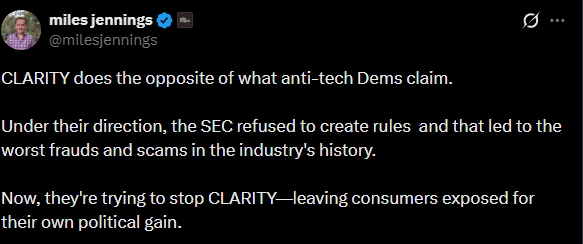
Fuente: X

EE.UU. y el Reino Unido están presionando por un marco sin fricciones para las stablecoins y la tokenización. Pero EE.UU. corre el riesgo de quedarse atrás en medio de la incertidumbre en torno a la Ley CLARITY.


Resumen final

  • EE.UU. y el Reino Unido prometieron reducir la fricción para el uso de las stablecoins como parte de la promoción de la innovación en los mercados de capitales.
  • Pero EE.UU. podría quedarse atrás, ya que las expectativas de aprobación de la Ley CLARITY han caído a mínimos récord.


Trending Cryptos

Related Questions

Q¿Qué afirmaron Estados Unidos y el Reino Unido sobre los stablecoins en su declaración conjunta?

AEn su declaración conjunta, Estados Unidos y el Reino Unido afirmaron que los stablecoins son un vehículo importante para la innovación en el dinero digital y expresaron su intención de permitir su uso en las finanzas transfronterizas. También se comprometieron a evitar imponer requisitos de reserva desproporcionados y onerosos que pudieran crear barreras injustificadas de entrada.

Q¿Cómo cambió inicialmente el Reino Unido su postura sobre las reservas de los stablecoins y por qué?

AInicialmente, el Reino Unido propuso un plan estricto en el que solo el 60% de las reservas ganaría intereses, mientras que el 40% sería no remunerado y se mantendría en el banco central. La industria se opuso y lo calificó de anticompetitivo. En respuesta, el Banco de Inglaterra suavizó la propuesta, permitiendo hasta el 70% en bonos que generan rendimiento y reduciendo los requisitos de efectivo al 30%.

Q¿En qué fecha tiene previsto el Reino Unido implementar su marco regulatorio cripto completo y qué aspectos cubrirá?

AEl Reino Unido tiene previsto implementar su marco regulatorio cripto completo para el año 2027. Este marco cubrirá stablecoins, intercambios (exchanges), staking, abuso de mercado, entre otros aspectos, y también incluirá la exención del impuesto sobre ganancias de capital para los préstamos de criptomonedas para evitar la doble imposición.

Q¿Cuál es la situación actual de la Ley CLARITY en Estados Unidos y cómo afecta a su competitividad?

ALa Ley CLARITY en Estados Unidos se ha estancado y corre el riesgo de ser aplazada hasta la década de 2030. Las probabilidades de su aprobación han caído a mínimos históricos. Esta incertidumbre legislativa, en contraste con el cronograma claro del Reino Unido, pone a Estados Unidos en riesgo de quedarse atrás en el desarrollo de un marco regulatorio sin fricciones para stablecoins y activos tokenizados.

QSegún Miles Jennings, ¿por qué se ha convertido la Ley CLARITY en un tema tan controvertido en Estados Unidos?

ASegún Miles Jennings, director legal de la firma de capital de riesgo a16z, la Ley CLARITY se ha convertido en un problema político debido al creciente discurso anti-tecnológico entre republicanos y demócratas, lo que ha dificultado su avance en el Congreso.

Related Reads

Wall Street's Most Famous 'Cassandra' Now Has His Sights Set on Nvidia

Michael Burry, the famed "Big Short" investor, has once again captured Wall Street's attention with a series of short positions against major tech and semiconductor stocks, most notably Nvidia. In late June and July, through his "Cassandra Unchained" newsletter, Burry disclosed short bets against Nvidia, Tesla, Applied Materials, Caterpillar, the SOXX semiconductor ETF, and later, Micron Technology. His core thesis revolves around potential distortions in the AI infrastructure boom, specifically questioning whether extended depreciation schedules (e.g., 6 years vs. a realistic 2-3 years for AI chips) by cloud giants like Microsoft and Google artificially inflate profits. He also raises concerns about possible "off-balance-sheet circular financing," where chip demand might be propped up by vendor-backed funding to clients. Nvidia's stock experienced volatility following these disclosures, briefly dipping but largely holding near Burry's reported entry points, leaving his positions roughly flat or slightly underwater as of late July. This move is part of a pattern for Burry, whose track record since his legendary 2008 bet is mixed. He has faced notable losses, such as on Tesla in 2021, while scoring on broader market turns like the 2020 pandemic crash. His methodology focuses intensely on free cash flow and scrutinizing original financial documents to spot overvaluation and structural risks, but it often struggles with timing the market. The article contrasts Burry's stance with other prominent investors. Steve Eisman, another "Big Short" figure, is not shorting Nvidia, citing strong fundamentals but expressing nervousness about sustainability. Jim Chanos agrees with the broad "accounting mismatch" concern—comparing it to the dot-com bubble—but targets financial leverage in private equity firms rather than the chip stocks themselves. While Nvidia's short interest remains relatively low at 1.3-1.4% of float, the massive stock size means absolute short losses have been significant, exceeding $5 billion earlier this year. The piece concludes that for ordinary investors, the key takeaway is not replicating specific short bets but learning from the critical frameworks these investors use: questioning rosy accounting, identifying structural vulnerabilities, and maintaining skepticism during market euphoria, even if pinpointing the exact catalyst for a downturn remains elusive.

marsbit13m ago

Wall Street's Most Famous 'Cassandra' Now Has His Sights Set on Nvidia

marsbit13m ago

Weekly Selection丨Epic Stock Market Volatility, Changxin Tech's IPO Reshapes Storage Landscape, Saylor Aims to Re-Anchor STRC Around September 8th

PANews Weekly Digest: Market Turmoil, Tech Breakthroughs, and Crypto Developments. The week saw significant volatility across global markets. South Korea's KOSPI index experienced extreme turbulence, including multiple trading halts, largely driven by sharp declines in AI hardware stocks like SK Hynix. In contrast, China's Changxin Xinqiao (CXC) achieved a landmark IPO with a market cap surpassing 4 trillion yuan, marking a major success for the domestic DRAM industry after a decade of losses. In the crypto and Web3 space, several key narratives emerged. AI is driving demand for new infrastructure, with projects like AI agent wallets and programmable payments gaining traction, attracting interest from firms like Coinbase. The Bitcoin mining sector is pivoting, with companies like MARA focusing on energy management as electricity becomes a core AI-era asset. Meanwhile, the RWA (Real World Assets) sector faces a "utilization puzzle," with hundreds of billions in on-chain assets remaining dormant. Notable market movements included a historic single-day surge of over 17% for the KOSPI index and a significant migration of $16.5 billion in staked ETH within the Lido ecosystem. Michael Saylor announced a target to re-peg the STRC stablecoin around September 8th. Other highlights include discussions on Ethereum's ambitious 2030 roadmap for scaling and privacy, analysis showing high protocol revenues not always translating to token price gains, and warnings from Citi about potential extreme commodity price shocks by late 2026.

marsbit18m ago

Weekly Selection丨Epic Stock Market Volatility, Changxin Tech's IPO Reshapes Storage Landscape, Saylor Aims to Re-Anchor STRC Around September 8th

marsbit18m ago

When the Market Begins to Question AI Capex: A Full Analysis of Q2 Earnings Reports from Five Tech Giants

In late July 2026, five major US tech giants—Alphabet, Intel, Microsoft, Meta, and Apple—released their Q2 earnings reports. While all companies exceeded revenue and profit expectations, driven by strong AI-related business growth, investor reactions diverged sharply due to concerns over escalating AI capital expenditures (capex) and their impact on free cash flow. Alphabet reported strong revenue growth and a surging cloud business, but its stock fell after announcing a doubled year-on-year capex and negative quarterly free cash flow for the first time. Intel posted its strongest revenue growth in over 15 years, but its stock experienced volatile trading after significantly raising its full-year capex guidance. Microsoft saw its stock surge after beating estimates and, crucially, lowering its capex forecast while projecting positive free cash flow. Meta faced the most severe sell-off as its profits declined despite revenue beats, with free cash flow plunging over 90% and its capex guidance raised. Apple reported record June-quarter results, but its stock plummeted after providing Q4 revenue guidance that fell short of expectations, citing supply chain constraints and forex headwinds. The overall takeaway is that the market's focus has shifted from validating AI demand to scrutinizing the timeline for returns on massive AI investments. Companies demonstrating a clearer path to managing capex and preserving free cash flow, like Microsoft, were rewarded, while those signaling continued aggressive spending faced investor skepticism.

Odaily星球日报27m ago

When the Market Begins to Question AI Capex: A Full Analysis of Q2 Earnings Reports from Five Tech Giants

Odaily星球日报27m ago

a16z: From Companies to DAOs, DUNA May Become the Next Generation Organizational Form

This article, "From Companies to DAOs: How DUNA Could Become the Next Organizational Form," traces the 500-year evolution of business collaboration. It begins with medieval structures like the *commenda* and Florentine *compagnia*, which exposed partners to personal risk. The modern corporation, exemplified by the Dutch East India Company (VOC), was a revolutionary leap, enabling large-scale, capital-intensive ventures by offering limited liability and reducing coordination costs. However, corporations introduced new challenges like principal-agent problems and bureaucratic overhead. The piece argues that software and internet-native protocols are now reducing these traditional overheads. Decentralized Autonomous Organizations (DAOs) emerged as a new model for coordination without centralized management. Yet, DAOs face a significant legal vacuum: they lack legal recognition, leaving members exposed to unlimited personal liability, and their tokens are vulnerable to being classified as securities under unclear regulations (e.g., the Howey Test). This has forced projects into suboptimal workarounds like offshore foundations. The article identifies the Decentralized Unincorporated Nonprofit Association (DUNA) as a potential solution. Recently legalized in states like Wyoming, the DUNA provides a legal wrapper for decentralized networks. It grants key protections—legal personality, limited liability, and perpetual existence—to a group without imposing a traditional hierarchical management structure. This allows token-holder communities to govern, hold assets, and contract as a single legal entity, aligning with their decentralized nature. While DUNA doesn't solve all governance challenges or magically resolve securities law questions, it represents a crucial step. It fills the legal recognition gap, offering a native legal form for internet-scale, decentralized collaboration and extending the separation of personal risk from organizational venture into a new domain.

marsbit1h ago

a16z: From Companies to DAOs, DUNA May Become the Next Generation Organizational Form

marsbit1h ago

2026 Mid-Year Report On-Chain RWA: Tokenized Stock Market Cap Doubles in a Year, But 90% of Rights Are Hollow Shells

The 2026 Mid-Year Report on On-Chain RWA highlights a significant growth in tokenized stock market capitalization, which nearly doubled from $951 million in March to $1.89 billion by July. However, the report reveals a fundamental contradiction in this "layer 2.5" ecosystem: products with the strongest legal foundation (like regulated U.S. infrastructure) lack liquidity and distribution, while freely tradable offshored wrapper products often lack substantive ownership rights. The increase is driven largely by a few products (SECZ, FGRS, STRCx) and platforms (Ondo, xStocks, Securitize collectively hold over 85% share). While distributed value across networks like Ethereum, Solana, and BNB Chain has grown, the market remains fragmented. Products referencing the same underlying asset (e.g., Apple stock) are distinct legal liabilities with different intermediaries and jurisdictional rules, offering varying degrees of legal claim. The report cautions that headline numbers are misleading, as they reflect changes in distributed token value—driven by issuance, conversions, and price movements—not pure investor inflows. True "canonical shares" with legal ownership, wide wallet distribution, institutional liquidity, and independent on-chain price discovery do not yet exist at scale. Tokenized treasuries show stronger product-market fit, and ETFs may be easier to scale than single stocks. The core takeaway is a trade-off: legal certainty versus liquidity and composability.

marsbit2h ago

2026 Mid-Year Report On-Chain RWA: Tokenized Stock Market Cap Doubles in a Year, But 90% of Rights Are Hollow Shells

marsbit2h ago

Trading

Spot

Hot Articles

How to Buy GAIN

Welcome to HTX.com! We've made purchasing GriffinAI (GAIN) simple and convenient. Follow our step-by-step guide to embark on your crypto journey.Step 1: Create Your HTX AccountUse your email or phone number to sign up for a free account on HTX. Experience a hassle-free registration journey and unlock all features.Get My AccountStep 2: Go to Buy Crypto and Choose Your Payment MethodCredit/Debit Card: Use your Visa or Mastercard to buy GriffinAI (GAIN) instantly.Balance: Use funds from your HTX account balance to trade seamlessly.Third Parties: We've added popular payment methods such as Google Pay and Apple Pay to enhance convenience.P2P: Trade directly with other users on HTX.Over-the-Counter (OTC): We offer tailor-made services and competitive exchange rates for traders.Step 3: Store Your GriffinAI (GAIN)After purchasing your GriffinAI (GAIN), store it in your HTX account. Alternatively, you can send it elsewhere via blockchain transfer or use it to trade other cryptocurrencies.Step 4: Trade GriffinAI (GAIN)Easily trade GriffinAI (GAIN) on HTX's spot market. Simply access your account, select your trading pair, execute your trades, and monitor in real-time. We offer a user-friendly experience for both beginners and seasoned traders.

4.3k Total ViewsPublished 2025.09.24Updated 2026.06.02

How to Buy GAIN

Discussions

Welcome to the HTX Community. Here, you can stay informed about the latest platform developments and gain access to professional market insights. Users' opinions on the price of GAIN (GAIN) are presented below.

活动图片