Aperçu des événements récents : Changements dans la logique d'investissement de l'ETH, signaux d'alerte pour l'évaluation de l'IA, et les paris de Multicoin sur ZEC et HYPE

marsbitPublished on 2026-07-15Last updated on 2026-07-15

Abstract

**Résumé :** Cet article compile quatre analyses clés du marché des crypto-monnaies et de la technologie, offrant un aperçu des dynamiques actuelles et des perspectives d'investissement. **1. Évolution de la logique d'investissement dans Ethereum (ETH) :** Le rapport met en lumière un changement fondamental. Alors que l'écosystème Ethereum reste actif et porteur de valeur (notamment via les stablecoins et les RWA - Real World Assets), la capacité de la couche principale (L1) à capturer cette valeur s'affaiblit. La migration des utilisateurs vers les solutions de couche 2 (L2) et la baisse des frais de transaction réduisent les revenus et la destruction d'ETH sur le L1. La croissance future d'ETH dépendra de sa capacité à devenir une couche de règlement pour les institutions financières et à générer une activité économique réelle plus élevée sur le réseau principal. **2. Évaluation du marché de l'IA : un signal d'alarme de BlackRock :** Selon BlackRock, la bulle actuelle de l'IA a atteint un niveau comparable à la "mi-parcours" de la bulle internet des années 2000. L'indice CAPE de Shiller pour le S&P 500 a atteint environ 40x, un niveau historiquement élevé. Cependant, la forte croissance des bénéfices des entreprises (notamment des géants de la technologie "Mag 7") soutient encore les valorisations élevées. La concentration du marché, similaire à 1999, pose un risque si la croissance des bénéfices ralentit. La question n'est plus de savoir "jusqu'où l'IA peut monter", mais...

Auteur : ChainFeeds

Compilation : Shenchao TechFlow

Introduction de Shenchao : Cet article résume quatre des observations de recherche et d'investissement les plus importantes du marché cryptographique récent : la captation de valeur d'Ethereum en panne, l'avertissement de BlackRock selon lequel l'évaluation de l'IA a atteint la mi-chemin, les positions importantes de Multicoin sur Zcash et HYPE, et les raisons pour lesquelles Wall Street dit "non" à ChatGPT. Pour les investisseurs cherchant à comprendre la logique de configuration du cycle actuel, ces quatre jugements concernent directement si vous devez encore détenir de l'ETH, combien de temps les actions de l'IA peuvent encore monter, et si le secteur de la vie privée et de l'IA répond à une réelle demande.

Analyse panoramique de l'écosystème Ethereum : Quels changements dans la logique d'investissement ?

Nick Researcher réexamine Ethereum d'un point de vue macroéconomique et financier. Les données du deuxième trimestre 2026 révèlent un signal complexe : les revenus d'Ethereum se sont légèrement améliorés par rapport au trimestre précédent, mais la capacité de capture des frais du L1 (réseau principal) reste bien inférieure à celle de l'année dernière ; les rendements on-chain sont proches des plus bas historiques ; l'activité DeFi a diminué ; l'écosystème L2 (Layer 2) continue de s'étendre, avec des projets comme Robinhood qui se développent également sur l'infrastructure liée à Ethereum, mais ces activités ne contribuent pas suffisamment de valeur au L1 ; parallèlement, le taux de dilution de l'ETH reste proche de celui du Bitcoin.

La plus grande controverse actuelle autour de l'ETH est qu'Ethereum n'a pas perdu en compétitivité, mais l'ancienne logique d'investissement est en train de changer. Auparavant, la logique haussière du marché pour l'ETH était très simple : plus d'utilisateurs entrant sur Ethereum, stimulant l'activité du L1, générant plus de frais de transaction, entraînant plus de destructions d'ETH, et renforçant ainsi la capacité de captation de valeur de l'ETH. Mais ce modèle s'affaiblit. Les utilisateurs migrent progressivement vers les L2, et certains utilisateurs quittent l'écosystème parce que l'expérience L2 ne répond pas à leurs attentes ; les frais de transaction baissent, tandis que l'offre de blobs croît plus vite que la demande ; les L2 traitent un volume important d'activités de transaction, mais paient toujours des frais limités au réseau principal Ethereum.

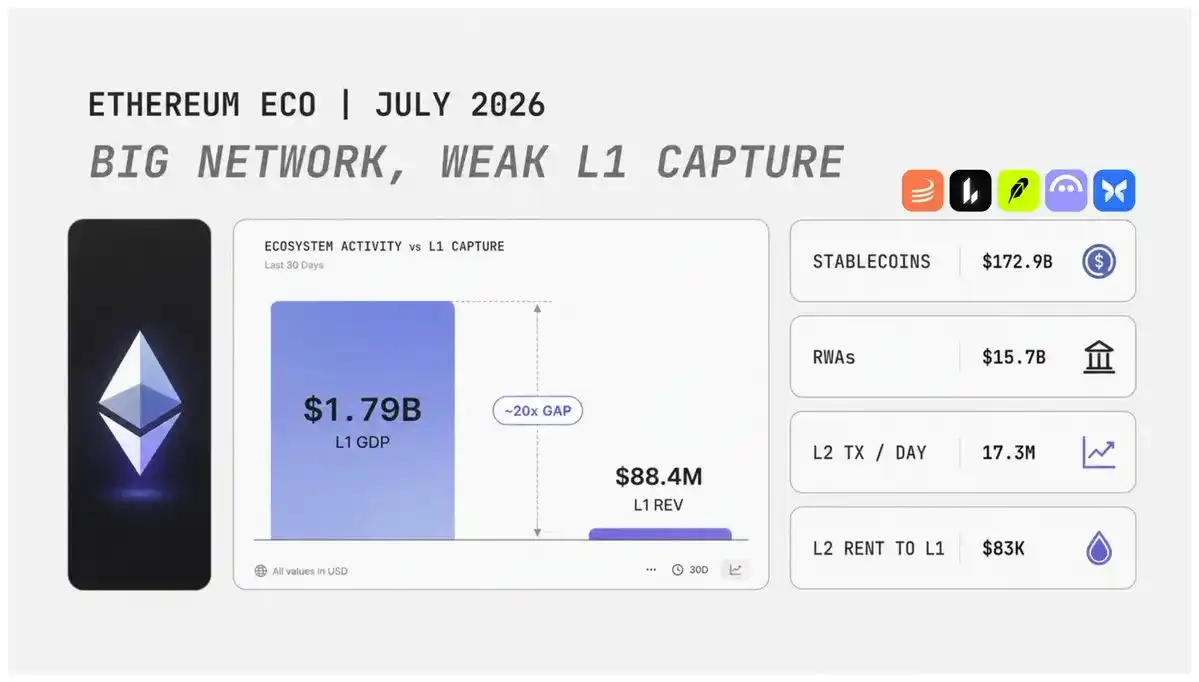
Les données les plus cruciales sont les suivantes : au deuxième trimestre 2026, la valeur économique réelle (Real Economic Value) générée par le L1 d'Ethereum était de 88,4 millions de dollars, en hausse de 7% en glissement trimestriel, mais en baisse de 68% sur un an. Parallèlement, la couche applicative sur le L1 d'Ethereum a généré environ 1,79 milliard de dollars de revenus de frais. Cela montre que les applications de l'écosystème Ethereum possèdent toujours une forte valeur économique, mais qu'Ethereum en tant que couche de base, le réseau principal, n'en capture qu'une partie relativement faible. C'est la contradiction centrale dans la logique d'investissement actuelle de l'ETH.

Ethereum héberge toujours un grand nombre d'activités financières importantes, notamment les principaux protocoles comme Tether, Circle, Lido, Aave, Uniswap, qui sont des acteurs majeurs de l'écosystème Ethereum. Les stablecoins restent l'un des plus grands avantages d'Ethereum. Au deuxième trimestre 2026, l'offre de stablecoins sur le L1 d'Ethereum a atteint 1729 milliards de dollars, et même avec une baisse d'environ 4% en glissement trimestriel, elle maintient une échelle énorme. Mais l'échelle n'est pas le seul facteur clé, la vitesse de circulation des capitaux est tout aussi importante. Si les stablecoins restent simplement sur la chaîne sans être utilisés pour des activités financières comme les transactions, le règlement ou le nantissement, ils ne créent pas suffisamment de valeur économique. L'Ethereum actuel possède une vaste échelle d'actifs, mais manque d'efficacité dans la circulation des capitaux.

Les actifs du monde réel (RWA) pourraient devenir un important moteur de croissance pour l'ETH dans la phase suivante. Actuellement, l'échelle des RWA on-chain sur le L1 d'Ethereum dépasse déjà 15,7 milliards de dollars, soit une augmentation d'environ 90% sur un an, incluant des bons du Trésor tokenisés, des matières premières et des actions. Mais avoir un TVL plus élevé ne suffit pas à prouver une capacité de captation de valeur. Au deuxième trimestre 2026, le volume quotidien moyen des transactions RWA sur Solana a dépassé celui d'Ethereum, bien que son TVL RWA soit plus faible, ce qui montre que l'avantage d'Ethereum réside davantage dans la profondeur institutionnelle, tandis que celui de Solana est la vitesse de circulation des capitaux.

Pour l'ETH, la logique de hausse future nécessite que trois conditions soient simultanément remplies : premièrement, que davantage d'actifs institutionnels entrent dans l'écosystème Ethereum ; deuxièmement, que davantage d'activités de règlement financier aient lieu sur le réseau Ethereum ; troisièmement, que les actifs on-chain génèrent une fréquence de transaction réelle plus élevée. Le modèle économique du jeton ETH conserve actuellement des avantages, avec un taux de dilution net annualisé au deuxième trimestre d'environ 0,85%, proche du niveau du BTC. Mais des risques existent : le rendement total on-chain est tombé à 2,68%, un plus bas historique, dont 94% des revenus proviennent de l'émission d'ETH, et non des frais payés par les utilisateurs réels. Cela signifie que la réévaluation future de l'ETH dépendra essentiellement de sa capacité à devenir une couche de règlement pour le système financier institutionnel.
Rapport BlackRock : La bulle de l'IA actuelle a atteint la "mi-chemin" de la bulle Internet des années 2000, un indicateur est déjà au rouge

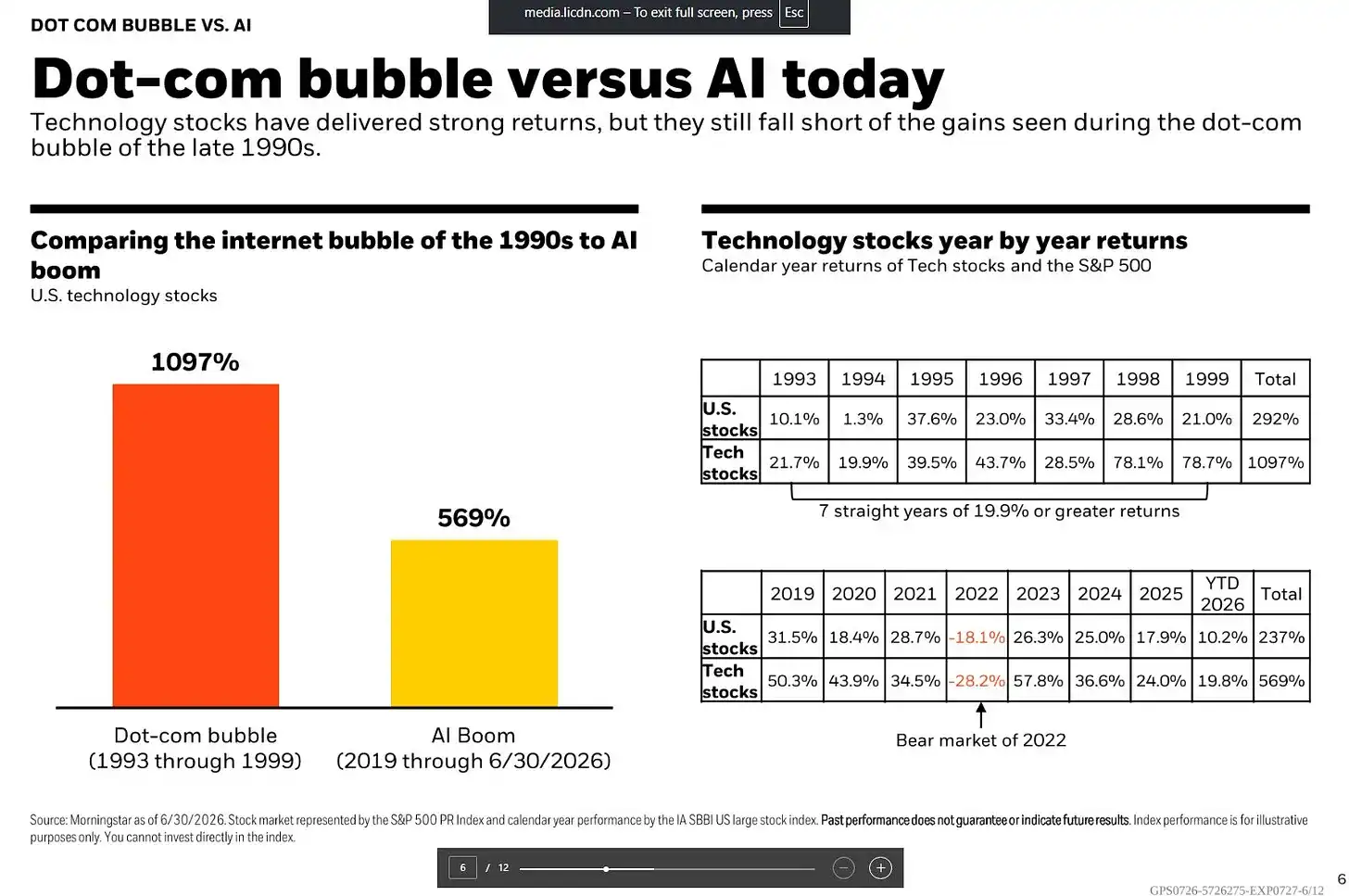
Selon BlackRock, citant des données de Morningstar, sur les 7 années de 1993 à 1999, les actions technologiques américaines ont augmenté cumulativement de 1097%, tandis que le marché boursier américain dans son ensemble a augmenté de 292% sur la même période. Les actions technologiques ont affiché un rendement annualisé d'au moins 19,9% pendant 7 années consécutives, avec des hausses particulièrement fortes en 1998 et 1999, atteignant respectivement 78,1% et 78,7%.

En comparaison, dans le cycle de l'IA de 2019 au 30 juin 2026, les actions technologiques ont augmenté cumulativement de 569%, tandis que le marché boursier américain dans son ensemble a augmenté de 237% sur la même période. Cette hausse, bien que robuste, présente un rythme nettement différent. Durant cette période, les actions technologiques ont connu un ajustement important en 2022, avec une baisse de 28,2% sur l'année, suivie d'un rebond de 57,8% en 2023, puis des hausses de 36,6% et 24,0% en 2024 et 2025 respectivement, et une poursuite de la hausse de 19,8% au premier semestre 2026.

La plus grande différence entre les deux cycles apparaît dans la seconde moitié : pendant la bulle Internet, le marché a accéléré rapidement au cours des deux dernières années, avec une hausse cumulative approchant 200% en 1998 et 1999 ; tandis que le cycle de l'IA, bien qu'ayant connu une accélération notable en 2023, a vu l'amplitude de ses hausses se réduire progressivement par la suite. En d'autres termes, la tendance actuelle du cycle de l'IA est plus stable comparée à la bulle Internet, mais le marché reste très divisé quant à savoir s'il entrera dans une phase finale de hausse frénétique.

L'évaluation actuelle du marché est au cœur des débats sur le cycle de l'IA. Le CAPE ratio (Shiller Price-to-Earnings Ratio) du S&P 500 est remonté à environ 40 fois, revenant aux niveaux élevés de l'époque de la bulle Internet. Cet indicateur calcule le niveau d'évaluation en utilisant les bénéfices moyens ajustés de l'inflation sur 10 ans, et 40 fois signifie que les investisseurs sont prêts à payer 40 dollars pour 1 dollar de profit moyen à long terme, un niveau historique uniquement atteint autour de l'an 2000.

Cependant, BlackRock estime que se concentrer uniquement sur les indicateurs d'évaluation à long terme n'est pas exhaustif, et que le PER prospectif sur 12 mois offre une autre perspective. Actuellement, le PER prospectif du S&P 500 est d'environ 21 fois, principalement parce que les attentes de bénéfices des entreprises ont augmenté parallèlement à la hausse des cours. Les données montrent que les bénéfices du S&P 500 au deuxième trimestre devraient augmenter de 23% en glissement annuel, soit la septième croissance trimestrielle consécutive à deux chiffres. BlackRock considère qu'une telle croissance des bénéfices est relativement rare dans l'histoire. Parallèlement, les grandes entreprises technologiques du Mag 7 affichent un PER actuel d'environ 26 fois, alors que la croissance attendue de leurs bénéfices dépasse 30%, avec une croissance bénéficiaire composite d'environ 27,6%.

Par conséquent, la plus grande contradiction du marché actuel est la suivante : les indicateurs d'évaluation à long terme ont déjà émis des signaux de risque de surévaluation, mais la croissance des bénéfices des entreprises continue de soutenir ces hautes évaluations.

Au 31 mai 2026, selon les données de Morningstar, la part des actions technologiques dans la capitalisation boursière totale des États-Unis avait atteint 37,5%, dépassant le niveau de la fin des années 1990 pendant la bulle Internet. Si l'on considère en outre des entreprises comme Alphabet, Meta et Amazon, qui, bien que non classées dans le secteur technologique, sont profondément impliquées dans l'industrie de l'IA, la concentration réelle des actifs liés à l'IA pourrait être encore plus élevée.

La force motrice du marché actuel s'étend également des traditionnels Mag 7 à un éventail plus large d'entreprises bénéficiant de l'IA, un nouveau concept de marché, MANGOS, est en train d'émerger, représentant Meta, Anthropic, Nvidia, Google, OpenAI et SpaceX. L'indice Morningstar Global Next Generation Artificial Intelligence a augmenté d'environ 45% cumulativement en avril et mai 2026, avant de connaître un repli en juin.

La concentration du marché est l'un des points les plus similaires entre le cycle actuel de l'IA et la bulle Internet. Fin 1999, quelques sociétés technologiques comme Cisco, Intel, Microsoft et Oracle ont entraîné la dernière phase de hausse du Nasdaq. Aujourd'hui, bien que les leaders de l'IA aient une plus grande capacité à générer des bénéfices, si la croissance future des bénéfices ne peut pas répondre aux attentes du marché, des portefeuilles d'investissement très concentrés pourraient toujours faire face à des risques d'ajustement rapide.

BlackRock estime que juger que l'IA a déjà formé une bulle est en soi un jugement majeur, car cela implique que le marché suppose que l'IA ne peut pas apporter d'amélioration durable de la productivité à long terme. La question à laquelle les investisseurs doivent réellement prêter attention aujourd'hui est passée de "Combien l'IA peut-elle encore monter ?" à "Combien de temps la croissance des bénéfices de l'IA peut-elle durer ?"
Dialogue avec un partenaire de Multicoin : Le marché cryptographique a touché le fond, trois cryptomonnaies prometteuses pour ce cycle

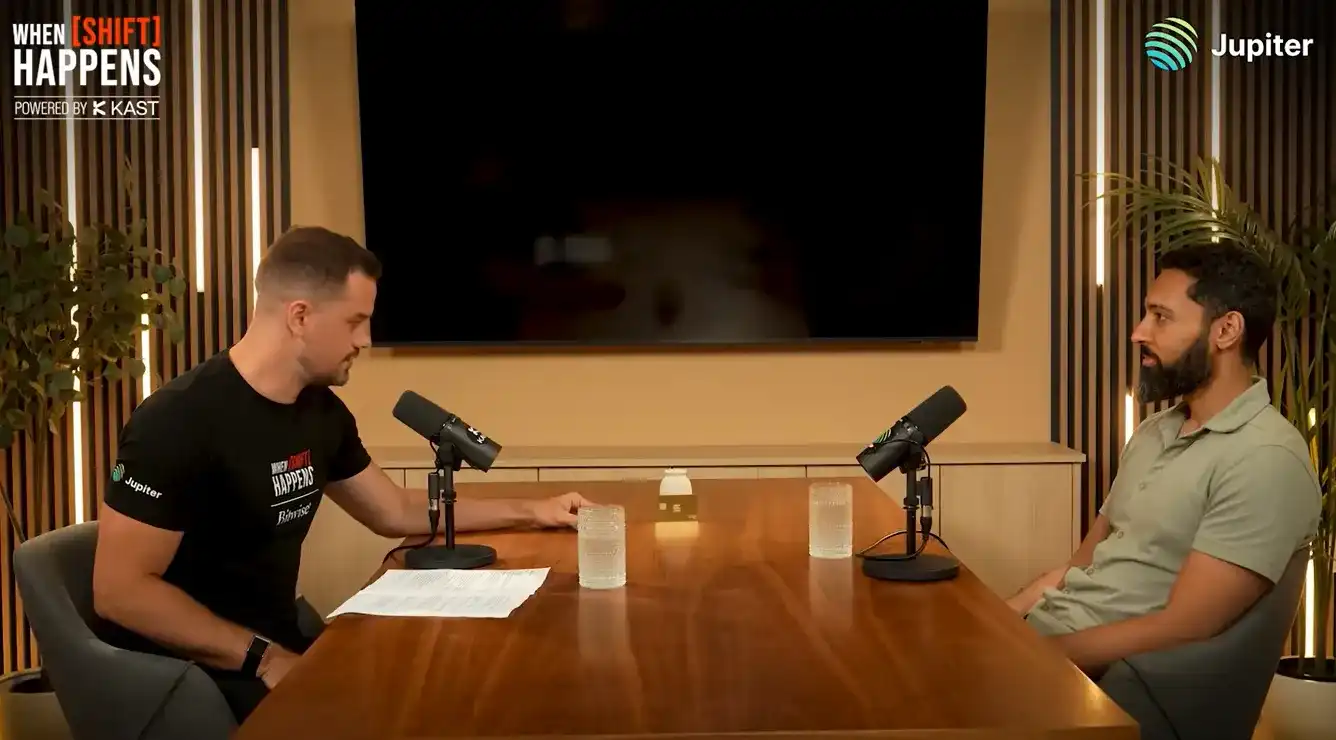
Le managing partner de Multicoin Capital, Tushar Jain, a partagé son point de vue sur le marché cryptographique actuel et a détaillé sa logique d'investissement pour Solana, Hyperliquid et Zcash.

Tushar Jain a déclaré qu'il considère toujours Solana comme l'architecture technologique correcte pour les marchés de capitaux d'Internet, nécessitant une chaîne open source sans permission pour tout intégrer sur une seule plateforme. Il reste optimiste quant aux performances et à l'architecture de Solana. Mais simultanément, le volume des transactions de produits dérivés se déplace vers Hyperliquid. Il détient actuellement des positions importantes sur ces deux actifs et est optimiste pour les deux. Solana est le leader des transactions au comptant et hébergera les transactions au comptant des titres tokenisés, mais Hyperliquid est clairement en tête pour les produits dérivés. Plutôt que d'être un maximaliste extrême, il vaut mieux penser en termes de probabilités et détenir les deux. Il n'est pas maximaliste pour un actif particulier et ne s'accrochera pas à une position ou à une opinion jusqu'au bout.

Pour 2026, un choix qui lui semble très évident est Zcash (ZEC), bien que, en raison de contraintes de liquidité et de capitalisation boursière, sa position soit relativement petite, Multicoin a accumulé une part assez importante de l'offre totale. Il aime l'élan de Zcash, son cas d'usage et sa communauté, cela lui rappelle Bitcoin à ses débuts. L'année dernière, lorsqu'il l'a vu monter, il a discuté avec de nombreuses personnes qui l'avaient soutenu tôt et a constaté que même après la baisse des prix, ils maintenaient leur conviction ; ce n'est pas un jeu d'argent à court terme. De plus, Zcash n'a pas de fondamentaux (pas de flux de trésorerie ni de revenus), ce qui signifie que sa valeur dépend entièrement du consensus des gens, ce qui lui confère au contraire un potentiel de hausse plus important. En tant que réserve de valeur, plus il est grand, mieux c'est.

Multicoin détient bien une position sur HYPE, mais Tushar Jain recommande aux investisseurs d'examiner leur logique de dérivation et de tirer leurs propres conclusions. Les hypothèses qu'ils ont établies ne sont pas agressives : premièrement, un taux de croissance annuel composé (CAGR) de 35% pour les dérivés cryptographiques (il était de 45% sur les 5 dernières années, ils ont donc réduit d'un quart la croissance) ; deuxièmement, une part de marché des DEX de 32% dans les dérivés (passée de presque zéro en 2022 à 16% aujourd'hui, un doublement à 32% en deux ans est conforme à la tendance) ; troisièmement, Hyperliquid maintient 30% de part de marché dans les dérivés décentralisés (c'est également conservateur, car les données de volume de transaction sont faciles à gonfler, mais actuellement Hyperliquid détient 59% du volume réel d'ouvertures de positions (OI) sur l'ensemble du réseau, une donnée difficile à falsifier) ; quatrièmement, une croissance linéaire du collatéral en USDC avec le volume de transactions (tant que la préférence des traders pour l'effet de levier reste inchangée, les stablecoins utilisés comme collatéral augmenteront naturellement proportionnellement au volume de transactions et à l'OI).
Au carrefour de l'IA : Pourquoi Wall Street dit "non" à ChatGPT et Claude ?

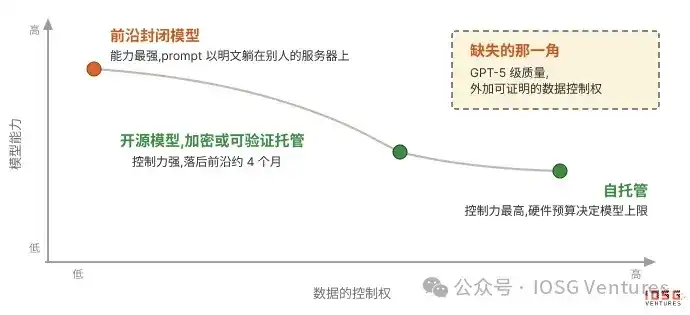
L'IA axée sur la vie privée n'est pas une seule approche technologique, mais plutôt un ensemble de solutions tournant autour d'une question centrale : dans le processus où une invite (prompt) quitte l'appareil de l'utilisateur, transite par le réseau, entre dans le serveur exécutant le modèle, puis renvoie le résultat, où existe le texte en clair, qui peut le lire, et comment l'utilisateur peut-il vérifier que ses données sont vraiment protégées. Les mécanismes de confidentialité actuellement sur le marché résolvent essentiellement le même problème, mais adoptent différents modèles de confiance.

La confidentialité au niveau protocole repose sur les promesses du fournisseur de services. Par exemple, dans la solution d'entreprise à rétention zéro, le fournisseur de services peut connaître l'identité de l'utilisateur et traiter son invite, mais promet de ne pas conserver les données, l'exécution reposant principalement sur des contrats et la réputation de la marque. Les mandataires anonymes masquent l'identité de l'utilisateur, mais ne cachent pas le contenu de l'entrée, donc les fournisseurs de services de modèle en aval peuvent toujours voir le texte en clair. TLS ne protège que la sécurité des données pendant leur transmission entre machines, mais le destinataire final peut toujours lire tout le contenu.

Oblivious HTTP (OHTTP) sépare davantage les connaissances sur l'identité et le contenu, permettant au relais de connaître la source de la requête, mais pas de lire le contenu, et au destinataire de traiter la requête sans savoir qui l'a envoyée. OHTTP est devenu une norme IETF et commence à être utilisé par certaines entreprises dans des environnements de production. Cependant, pour les modèles phares à source fermée, ce type de solution atteint presque la limite de la protection de la vie privée, car les poids du modèle eux-mêmes sont l'actif le plus précieux des entreprises d'IA. L'entraînement d'un modèle de pointe coûte des dizaines de milliards de dollars, les laboratoires maintiennent leur valorisation grâce à l'écart de capacités des modèles, et ne divulgueront donc pas facilement les poids du modèle ou le code complet du service.

Les solutions de confidentialité structurelle tentent de remplacer les promesses de confiance traditionnelles par des mécanismes matériels, cryptographiques ou d'isolation physique. Parmi celles-ci, l'informatique confidentielle avec Environnement d'Exécution de Confiance (TEE) est actuellement la voie la plus proche d'une adoption commerciale. Le TEE exécute le processus d'inférence du modèle dans un enclave matériel, une zone semblable à un espace scellé à l'intérieur de la puce, où même l'opérateur du serveur ne peut pas lire directement les données. La puce génère une attestation, prouvant à distance à l'utilisateur qu'elle exécute bien le modèle et le code spécifié.

Mais le TEE présente encore des limites : l'invite n'est protégée qu'après être entrée dans l'enclave, les intermédiaires avant l'entrée, comme les mandataires ou les relais, peuvent encore présenter des risques de lecture. Le chiffrement de bout en bout (E2EE) renforce la protection en fermant les étapes intermédiaires, l'appareil de l'utilisateur chiffrant directement l'invite avec la clé de l'enclave, les nœuds intermédiaires ne pouvant que transmettre le texte chiffré. Cependant, le coût de l'E2EE est une complexité d'ingénierie accrue, car toutes les fonctionnalités dépendant des données en clair doivent être repensées.

Le chiffrement totalement homomorphe (FHE) et le calcul sécurisé multipartite (MPC) tentent quant à eux d'éliminer complètement les parties de confiance, permettant au serveur de calculer directement sur l'état chiffré. Mais étant donné que les modèles Transformer impliquent de nombreuses opérations complexes, le coût de l'inférence FHE reste bien supérieur à l'inférence ordinaire, le coût du calcul sur texte chiffré pouvant atteindre des dizaines de milliers de fois celui sur texte clair. Actuellement, les puces de cryptographie se développent, mais leur application commerciale à grande échelle nécessitera encore du temps. En comparaison, l'inférence locale est la méthode la plus radicale pour la vie privée, car le modèle fonctionne sur l'appareil de l'utilisateur lui-même, il n'y a pas de problème de serveur, de relais ou de fuite de données, mais le coût est la capacité du modèle et le coût du matériel.

Le futur point de compétition pour l'IA privée pourrait ne pas être uniquement le scénario de chat, mais les flux de travail d'agents plus complexes. Actuellement, tous les mécanismes d'inférence privée résolvent principalement la protection des données entre l'invite et le modèle, mais un agent d'IA, pour exécuter une tâche, doit également appeler des outils externes, comme un calendrier, une base de données, un moteur de recherche ou des systèmes internes d'entreprise, et ces outils deviennent de nouveaux points d'exposition en clair. Un agent fonctionnant complètement localement, s'il veut obtenir des informations en dehors de son ensemble d'entraînement, doit encore envoyer des requêtes à des services externes, et le fournisseur de services ne peut pas accomplir la tâche s'il ne peut pas lire le texte en clair.

Les solutions principales actuelles restent au niveau protocole, par exemple en gérant les appels d'outils via une passerelle centrale, masquant les informations personnelles identifiables avant l'envoi de la requête, contrôlant les autorisations d'accès et enregistrant les comportements d'appel. Mais cette méthode dépend encore de la confiance dans le fournisseur de services, car le serveur de l'outil doit toujours lire la requête en clair. Les solutions structurelles essaient, elles, d'exécuter directement des outils comme le MCP Server dans un TEE, permettant à l'utilisateur de vérifier la promesse de confidentialité via l'attestation. Cependant, le TEE ne peut protéger que le processus de transmission, il ne garantit pas que le fournisseur de service final ne lise pas le contenu de la requête. La véritable difficulté réside dans les scénarios de recherche ouverte et d'agents complexes, car la recherche cryptée fait encore face à des problèmes de performance et de coût.

À l'avenir, les points de capture de valeur pour l'IA privée pourraient se concentrer sur des problèmes non encore résolus : exécuter des boucles d'entraînement dans un enclave, protéger de bout en bout les appels d'outils, développer des systèmes de recherche sans exposer le contenu de la requête. Celui qui pourra résoudre l'un des liens centraux pourrait établir un avantage d'infrastructure vraiment difficile à commoditizer.
Après la tokenisation de l'or : Comment les RWA on-chain créent-ils des rendements réels ?

La plupart des actifs réels (RWA) on-chain se concentrent actuellement encore sur des actifs à faible risque, comme les bons du Trésor américain, et s'étendent progressivement à d'autres catégories d'actifs comme les actions. Parmi eux, l'or est actuellement la catégorie de matière première la plus importante en termes de volume on-chain, et constitue un cas important pour le développement de la tokenisation d'actifs. Le volume de l'or on-chain dépasse désormais 4,9 milliards de dollars, ses propriétés uniques de réserve de valeur en faisant l'un des premiers actifs traditionnels à être tokenisé.

Cependant, la plupart des produits d'or on-chain actuels restent encore relativement limités, leur fonction principale étant de permettre aux utilisateurs d'acheter de l'or au comptant, sans mécanismes permettant d'utiliser davantage ces actifs pour générer des rendements. Cela crée un écart d'efficacité entre les RWA on-chain et les produits de la finance traditionnelle (TradFi), et limite également la valeur et les cas d'usage réels des actifs on-chain.

L'objectif principal de la prochaine phase de développement des RWA pourrait ne plus être seulement d'augmenter le volume d'actifs placés sur la chaîne, mais de rendre ces actifs productifs et générateurs de revenus. Prenons l'exemple de l'or : les marchés financiers traditionnels ont déjà développé des produits comme les ETF à call couvert (covered call) sur l'or, permettant aux investisseurs d'utiliser des options pour obtenir des revenus ou couvrir des risques. Mais les produits traditionnels présentent généralement des limitations telles que des seuils d'entrée élevés, des frais élevés, la nécessité d'un KYC, d'une custode et de la participation d'un courtier. Par exemple, l'ETF à call couvert sur l'or GLDI, relativement mature, prélève des frais de gestion d'environ 0,65%, déduits directement des rendements des investisseurs.

En comparaison, les produits d'or on-chain peuvent, grâce à des contrats intelligents et des stratégies structurées, réduire les barrières à l'entrée et tenter de transformer l'actif or, qui ne génère pas de flux de trésorerie, en un actif générateur de revenus.

Faire en sorte que l'actif or génère des rendements est une direction importante pour la prochaine phase de développement des RWA. L'or lui-même est une catégorie d'actifs d'environ 30 000 milliards de dollars, et c'est l'une des premières matières premières à avoir été tokenisée sur la chaîne. Bien que plus de 4,9 milliards de dollars d'actifs or soient actuellement sur la chaîne, la grande majorité des fonds restent inactifs et ne génèrent pas de rendements.

Avec le développement des stratégies à call couvert dans les marchés financiers traditionnels, les investisseurs peuvent déjà obtenir des revenus supplémentaires grâce aux options en plus de leur détention d'or, tout en réduisant partiellement le risque de volatilité des prix. Des protocoles on-chain comme Enhanced tentent d'introduire ce modèle dans la blockchain, augmentant l'efficacité du capital des RWA grâce à des stratégies structurées.

L'or est particulièrement adapté comme premier cas en raison de plusieurs caractéristiques : premièrement, l'or est longtemps considéré comme un actif de réserve de valeur, et son prix a récemment atteint de nouveaux sommets, attirant davantage d'investisseurs ; deuxièmement, l'incertitude géopolitique et macroéconomique mondiale croissante renforce encore la demande d'or ; enfin, le prix de l'or ne fluctue généralement pas aussi violemment que les actifs très volatils, ce qui le rend plus adapté pour obtenir des revenus stables sous forme de primes d'options via des stratégies à call couvert.

La logique de la stratégie à call couvert est que l'investisseur détient l'or au comptant et vend simultanément une option d'achat, obtenant ainsi des revenus sous forme de prime. Si le prix de l'or ne dépasse pas le prix d'exercice, l'investisseur conserve l'or et obtient le revenu ; si le prix augmente au-delà du prix d'exercice, il doit renoncer à une partie de la hausse potentielle. Par conséquent, cette stratégie convient mieux aux investisseurs optimistes sur l'or à long terme, mais qui ne s'attendent pas à une hausse unilatérale importante des prix.

La PAXG Volatility Income Vault, lancée par Enhanced, est son premier produit Thesis Vault, visant à utiliser la volatilité de l'or pour créer des revenus pour les utilisateurs. Ce produit est basé sur PAXG (le jeton d'or on-chain), utilisant la stratégie d'option à call couvert pour permettre aux utilisateurs d'obtenir des revenus d'options tout en détenant l'actif or.

Son mécanisme de fonctionnement est basé sur un système RFQ (Request for Quotes, système d'appel d'offres). En arrière-plan, les actifs déposés par les utilisateurs sont mis aux enchères par lots, les teneurs de marché fournissant des offres, puis la transaction d'option est exécutée sur la chaîne, et l'utilisateur reçoit à l'avance le revenu de la prime d'option.

Les participants peuvent également vendre directement des options d'achat couvertes sur leurs propres actifs et personnaliser les paramètres d'exécution, comme le prix d'exercice, la durée et la direction. À l'avenir, ce mécanisme pourrait être étendu à d'autres actifs ERC-20 que l'or.

Le PAXG Vault utilise des options de style européen, qui ne peuvent être exercées qu'à la date d'échéance, et les fonds sont bloqués pendant chaque cycle. Les utilisateurs peuvent déposer du PAXG ou de l'USDC, le système convertira automatiquement l'USDC en PAXG. Le cycle d'options est fixé à deux semaines, soit environ 26 cycles par an, et le prix d'exercice est prévu pour être fixé dans une fourchette de 3% à 7% au-dessus du prix actuel de l'or.

Les utilisateurs peuvent choisir entre deux modes de revenus : le mode de réinvestissement (compound) convertira automatiquement les primes USDC reçues en PAXG, les ajoutant au cycle suivant pour continuer à générer des revenus, ce qui convient mieux aux investisseurs détenant de l'or à long terme ; le mode de revenus (income) placera les revenus séparément, permettant aux utilisateurs de retirer l'USDC à tout moment, ce qui convient mieux aux détenteurs de capitaux importants souhaitant obtenir des flux de trésorerie à partir d'actifs or inactifs.

Ce modèle tente de résoudre le problème central des RWA traditionnels : non seulement placer les actifs sur la chaîne, mais aussi faire en sorte que les actifs génèrent une véritable valeur économique.

Trending Cryptos

Related Questions

QQuels sont les principaux changements dans la logique d'investissement de l'ETH identifiés dans l'article, et quelles données clés illustrent ces changements ?

ALa logique d'investissement traditionnelle pour l'ETH, qui reposait sur une augmentation de l'activité sur le L1 générant plus de frais et de brûlage de jetons, est en train de s'affaiblir. L'article révèle que les utilisateurs migrent vers les solutions de couche 2 (L2), mais que ces dernières ne contribuent pas suffisamment de valeur au L1 principal. Une donnée clé illustrant ce changement est que la valeur économique réelle (Real Economic Value) générée par le L1 d'Ethereum au deuxième trimestre 2026 était de 88,4 millions de dollars, en hausse de 7% en glissement trimestriel mais en baisse de 68% sur un an. Cela montre que l'écosystème d'Ethereum (applications) crée encore une forte valeur (17,9 milliards de dollars de frais), mais que la couche de base (L1) n'en capture qu'une faible partie.

QSelon le rapport de BlackRock cité dans l'article, pourquoi l'évaluation du marché de l'IA est-elle considérée comme étant à un carrefour critique, et quels sont les deux principaux indicateurs contradictoires présentés ?

ALe rapport de BlackRock indique que l'évaluation du marché de l'IA est à un carrefour car elle présente des signaux contradictoires. D'une part, le ratio CAPE de Shiller (basé sur les bénéfices moyens ajustés de l'inflation sur 10 ans) du S&P 500 a atteint environ 40, un niveau similaire à celui de la bulle internet des années 2000, ce qui est un signal d'alarme de surévaluation. D'autre part, le ratio cours/bénéfices anticipé sur 12 mois (forward P/E) du S&P 500 est d'environ 21, un niveau plus modéré car il est soutenu par une croissance des bénéfices d'entreprise robuste (une augmentation de 23% des bénéfices attendue au T2 2026). Cette contradiction résume le dilemme du marché : les indicateurs de valorisation à long terme sont élevés, mais la croissance des bénéfices continue de justifier les prix.

QQuelles sont les trois cryptomonnaies que le partenaire de Multicoin Capital, Tushar Jain, mentionne comme étant prometteuses pour le cycle actuel, et quelle est la raison spécifique évoquée pour son intérêt envers Zcash (ZEC) ?

ATushar Jain de Multicoin Capital mentionne trois cryptomonnaies comme étant prometteuses : Solana (SOL), Hyperliquid (HYPE) et Zcash (ZEC). Concernant Zcash (ZEC), il exprime un intérêt particulier car, selon lui, l'actif bénéficie d'un élan positif (momentum), d'un cas d'usage clair (la vie privée) et d'une communauté engagée qui lui rappelle les débuts du Bitcoin. De plus, il souligne que Zcash n'a pas de fondamentaux (pas de flux de trésorerie ni de revenus), ce qui signifie que sa valeur dépend entièrement du consensus social. Cette caractéristique, selon lui, pourrait lui offrir un potentiel de hausse plus important en tant que réserve de valeur, car "plus elle est grande, mieux c'est".

QQuels sont les principaux mécanismes de confidentialité (privacy) discutés dans la section sur l'IA, et quels sont leurs avantages et limites respectifs pour protéger les données utilisateur ?

AL'article discute de plusieurs mécanismes de confidentialité pour l'IA : 1) Les engagements au niveau du protocole (promesses du fournisseur de ne pas conserver les données), limités par la confiance dans la marque. 2) Les mandataires anonymes, qui masquent l'identité mais pas le contenu. 3) OHTTP (Oblivious HTTP), un standard IETF qui sépare la connaissance de l'identité et du contenu, offrant une meilleure protection mais ne s'appliquant pas aux poids des modèles propriétaires. 4) L'environnement d'exécution de confiance (TEE), qui isole le calcul dans une enclave matérielle, protégeant les données pendant le traitement, mais pas avant leur entrée. 5) Le chiffrement complètement homomorphe (FHE) et le calcul multipartite sécurisé (MPC), qui permettent des calculs sur des données chiffrées mais sont extrêmement coûteux en calcul. 6) L'inférence locale, la plus sûre car les données ne quittent jamais l'appareil, mais limitée par la capacité du modèle et le coût matériel.

QSelon l'article, quel est le principal défi de la phase suivante pour les actifs du monde réel tokenisés (RWA) sur la blockchain, et comment le produit "PAXG Volatility Income Vault" d'Enhanced tente-t-il de le résoudre pour l'or ?

ALe principal défi pour les RWA sur la blockchain n'est plus simplement de mettre davantage d'actifs en ligne, mais de rendre ces actifs productifs et générateurs de rendement. Actuellement, de nombreux actifs tokenisés comme l'or sont principalement détenus de manière statique sans créer de valeur économique supplémentaire. Le produit "PAXG Volatility Income Vault" d'Enhanced tente de résoudre ce problème pour l'or tokenisé (PAXG) en mettant en œuvre une stratégie de vente d'options d'achat couvertes (covered call). Cela permet aux détenteurs de PAXG de générer un revenu complémentaire (prime d'option) tout en restant exposés à l'or. Le protocole utilise un système RFQ (Request for Quotes) pour exécuter les transactions d'options de manière efficace sur la blockchain, offrant ainsi une alternative plus accessible et potentiellement moins coûteuse aux produits financiers traditionnels similaires.

Related Reads

After Three Consecutive Quarters of Decline, Can the Crypto Market Find a Window for Stabilization in Q3?

The cryptocurrency market has just concluded its worst-performing quarter since 2022, with total capitalization dropping 12.6% to $2.1 trillion. All core metrics indicate capital is leaving the sector, not just rotating within it. Bitcoin fell 14.2% and Ethereum dropped 25.4% in Q2, breaking their previous correlation with US tech stocks. A key driver is the reversal in US spot Bitcoin ETF flows, which saw a net outflow of approximately $4.67 billion in Q2, including a record monthly outflow near $4.5 billion in June. While recent data suggests long-term holders are accumulating again, sustained ETF outflows mean continued selling pressure. Market focus is now singularly on the Federal Reserve. The upcoming July FOMC meeting is seen as the most critical event for Q3. A dovish signal could support Bitcoin reclaiming a $68,000-$84,000 range, while a hawkish stance might establish a new trading band around $50,000-$56,000. Additionally, regulatory uncertainty persists, with the progress of the crucial *CLARITY Act* stalling in the Senate, reducing its perceived 2026 passage probability to 40-45%. Despite the broad downturn, a few sectors showed growth. Prediction markets saw nominal volume surge 48.7% year-over-year to $113.8 billion, and tokenized collectibles transaction volume rose 143% quarterly to $1.4 billion. The Real-World Asset (RWA) tokenization sector also continued steady growth, now representing ~$28.1 billion in on-chain value. The market's foundation for an extreme crash appears limited, with Bitcoin price hovering near its 200-week moving average. However, the trading paradigm has shifted from narrative-driven speculation to decisions based on price action, policy developments, and interest rate expectations, making a broad sentiment-driven rally unlikely in the near term.

marsbit16h ago

After Three Consecutive Quarters of Decline, Can the Crypto Market Find a Window for Stabilization in Q3?

marsbit16h ago

BIT Trading Moment: BTC Still Suppressed by Weekly 200 EMA, Rejection May Restart Decline; Storage and Semiconductors that Surged Last Night Begin Falling in Evening Trading

**Crypto & Stock Market Wrap: Bitcoin Tests Resistance, Stocks Retreat After AI Surge** Bitcoin consolidates around $66,000, facing key resistance near $68,000—an area seen as a major psychological and technical hurdle where previous rallies have failed. Analysts note the cryptocurrency is caught between its 200-week moving average (~$63,333) and 200-week EMA (~$68,328). A clear break above $68k is needed to signal a stronger bullish trend, while a rejection could lead to a retest of $63k support. Market sentiment remains cautious, with low futures open interest pointing to a low-liquidity rebound rather than a full bull market. Bitcoin spot ETFs saw another $203 million inflow. US stock futures pointed lower after a strong Tuesday session led by a massive rebound in semiconductors and memory stocks. The rally was fueled by renewed optimism about AI-driven hardware demand, with Micron, SanDisk, and SK Hynix surging. However, those gains reversed in pre-market trading. Super Micro Computer (SMCI) soared over 20% after hours on strong guidance and a record backlog. Other standouts included Rocket Lab and nuclear energy plays Oklo and X-Energy. Rising oil prices (Brent above $91) and climbing Treasury yields (10-year near 4.64%), however, are reigniting inflation concerns and acting as a headwind for equities. In Asia, markets were mixed. South Korea's KOSPI pared early gains to close slightly higher as semiconductor stocks like SK Hynix gave back initial surges. Japan's Nikkei edged lower as the yen hit a fresh 38-year low against the dollar, raising fears of potential market intervention. Key events to watch include the Samsung Galaxy launch, AMD's AI event, and a slew of major tech earnings from Alphabet, Tesla, and IBM after the close on Wednesday, followed by the ECB meeting and Intel's earnings on Thursday.

marsbit16h ago

BIT Trading Moment: BTC Still Suppressed by Weekly 200 EMA, Rejection May Restart Decline; Storage and Semiconductors that Surged Last Night Begin Falling in Evening Trading

marsbit16h ago

Former CFTC Chairman, Circle President Tarbert: Preaching Long-Termism While Cashing Out $30 Million Himself

Former CFTC Chairman and Circle President Heath Tarbert has consistently advocated for a long-term vision in public, urging patience from investors as Circle’s stock price has fallen significantly from its peak. However, it has been revealed that since Circle’s IPO, Tarbert has continuously sold his CRCL shares through pre-arranged trading plans, cashing out approximately $30 million, without making any public market purchases. This contrast between his public messaging and personal actions has drawn criticism. Tarbert joined Circle in July 2023 as Chief Legal Officer, leveraging his regulatory experience to help guide the company through its IPO and expansion. Despite promoting stablecoins as long-term infrastructure, he established a 10b5-1 trading plan just before Circle went public, leading to substantial stock sales over the following year. In March 2026, he initiated another plan to sell more shares. His career trajectory highlights a pattern of moving between high-level regulatory roles and influential positions in the financial sector. After resigning as CFTC Chairman in early 2021, he joined Citadel Securities as Chief Legal Officer just 27 days later, during a period of intense regulatory scrutiny for the firm. He later joined Circle, aiding its efforts to navigate regulatory challenges for its public listing. While Tarbert's expertise in policy and compliance is valuable to companies like Circle, his actions—advocating long-term confidence while personally divesting—raise questions about the alignment between his public statements and his private financial decisions, leaving investors who followed his advice to bear the market risks.

marsbit17h ago

Former CFTC Chairman, Circle President Tarbert: Preaching Long-Termism While Cashing Out $30 Million Himself

marsbit17h ago

Gate Research Institute: The 'Wall Street-ization' Wave of Crypto Financial Products – Competition or Integration?

The article titled "Gate Research Institute: Are Crypto Financial Products Sparking a 'Wall Street' Wave—Competition or Convergence?" explores the evolving relationship between the crypto ecosystem and traditional finance (TradFi). The piece begins by reflecting on Bitcoin's original 2009 vision of decentralization, disintermediation, and moving away from banks. It then contrasts this with the 2024 landscape, where key crypto assets like Bitcoin are increasingly held through Wall Street products like ETFs issued by giants like BlackRock. The article questions whether this signifies that TradFi is systematically taking over the rights to issue, price, custody, and distribute crypto financial assets. The core argument is that this is not a zero-sum takeover but rather a bidirectional convergence where each side addresses the other's weaknesses. Crypto offers 24/7 global markets, programmable settlement, and open access but lacks compliant channels, institutional-grade custody, deep fiat liquidity, and mainstream distribution. TradFi possesses these but is constrained by legacy systems, limited operating hours, and slow settlement. Two primary convergence paths are highlighted: * **Path A (CEX to TradFi):** Exemplified by Gate, which has progressed from offering tokenized stocks and CFDs to providing direct, real stock trading (US, Hong Kong, South Korea) within its platform, using USDT. * **Path B (TradFi to Crypto):** Exemplified by Robinhood, which has integrated crypto trading, acquired exchanges like Bitstamp, and is moving traditional assets like stocks onto the blockchain via tokenization and its own Layer 2. Both paths are ultimately competing to become the next-generation, unified financial account—a "super account" where users can seamlessly trade cryptocurrencies, stocks, ETFs, RWA (Real World Assets), and tokenized treasury products in one interface. The growth of RWA and tokenized treasuries (e.g., BlackRock's BUIDL) is presented as the asset-layer fusion, providing stable, yield-bearing assets on-chain and acting as a bridge between the two worlds. In conclusion, the "Wall Street-ization" of crypto is framed as a mutual transformation. Decentralized ideals persist in the protocol layer, while at the application layer, a more efficient, global, and accessible unified capital market is emerging from this convergence. The future competition lies not between crypto exchanges and stockbrokers, but between platforms vying to offer the most comprehensive asset coverage, liquidity, and user experience within a single account.

marsbit17h ago

Gate Research Institute: The 'Wall Street-ization' Wave of Crypto Financial Products – Competition or Integration?

marsbit17h ago

Trading

Spot

Hot Articles

What is LINON

Linde plc Tokenized Stock (Ondo): Revolutionizing Traditional Equity Access Through Blockchain Innovation The emergence of Linde plc Tokenized Stock (Ondo), represented by the ticker $LINON, signifies a monumental shift in the fusion of traditional financial structures and decentralized finance (DeFi). This innovative financial instrument showcases the tremendous potential of blockchain technology to democratize access to traditional equity markets while ensuring the security and regulatory compliance necessary for institutional-grade financial products. Through Ondo Finance's pioneering tokenization platform, $LINON provides a seamless pathway for global investors to engage with one of the world's leading industrial gas companies, Linde plc, creating a blockchain-native representation of the underlying equity. Introduction to Linde plc Tokenized Stock The landscape of financial markets is witnessing a groundbreaking transformation through the tokenization of real-world assets. Linde plc Tokenized Stock (Ondo) epitomizes this revolutionary approach by bridging the gap between conventional stock ownership and blockchain-enabled financial infrastructure. The $LINON token allows investors to gain exposure to one of the prominent industrial companies worldwide through decentralized technology. Operating within Ondo Finance's comprehensive ecosystem, $LINON symbolizes a practical application of tokenization technology that enhances accessibility, efficiency, and global connectivity in traditional financial markets. By leveraging blockchain infrastructure, this tokenized stock enables international investors to participate in U.S. equity markets, overcoming traditional barriers associated with cross-border investing. The significance of $LINON goes beyond technological innovation; it represents a fundamental shift in asset structuring, distribution, and trading in the digital age. This tokenized stock maintains all the economic benefits associated with traditional Linde plc shares while offering improved liquidity, programmable compliance features, and seamless integration with decentralized finance protocols. The development of $LINON indicates a growing acceptance of blockchain technology as a viable means for traditional finance, exemplifying how even well-established assets like Linde plc can integrate into blockchain systems. This approach preserves the core attributes that appeal to investors while introducing advanced capabilities that enhance the overall investment proposition. Project Overview and Objectives Linde plc Tokenized Stock (Ondo) encapsulates a strategic effort to democratize access to traditional equity markets through advanced blockchain technologies. The primary objective of $LINON is to provide approved global investors seamless access to the economic exposure associated with Linde plc shares, furthering an effort to create a more inclusive financial ecosystem. Beyond the digital representation of traditional assets, $LINON endeavors to eliminate barriers of geography and time zones that limit investor participation. Its design ensures that blockchain technology can elevate traditional investment vehicles without undermining the security or compliance requirements expected by investors. Key goals of the project include enhanced liquidity provision, programmable compliance mechanisms, and interoperability with other blockchain networks. Each $LINON token is fortified by actual Linde plc securities housed at U.S.-registered broker-dealers, allowing holders to reap economic advantages akin to traditional stockholders, such as dividend reinvestment. Furthermore, $LINON aims to establish new industry standards for institutional-grade tokenized securities, paving the way for traditional assets to embrace blockchain technology while remaining compliant with regulatory frameworks. By associating itself with a company as reputable as Linde plc, the project opens avenues for exploring tokenized equities catering to both conservative institutional players and daring retail investors. Project Creator and Development Team The vision for Linde plc Tokenized Stock (Ondo) comes from Nathan Allman, founder and CEO of Ondo Finance. His background in traditional finance coupled with expertise in blockchain technology positions him uniquely to navigate the complexities of asset tokenization. Allman's academic journey began at Brown University, focusing on Economics and Biology, equipping him with valuable analytical skills. His time at Goldman Sachs in the Digital Assets division strengthened his understanding of the interplay between financial institutions and emerging technologies, laying the groundwork for his later endeavors in alternative investment strategies. Under Allman's guidance, Ondo Finance has emerged as a leader in asset tokenization, launching $LINON as a flagship example of the company's larger mission towards revolutionizing traditional financial systems using blockchain technology. His commitment to leveraging blockchain for creating institutional-grade financial products has shaped the landscape of real-world asset tokenization. Investment and Funding Structure The growth of Ondo Finance, the platform powering Linde plc Tokenized Stock (Ondo), is bolstered by robust financial backing from prestigious venture capital firms and strategic investors. This strong investment foundation underpins the development of the key infrastructure essential for compliant tokenized securities like $LINON. In August 2021, Ondo Finance secured $4 million in seed funding led by a major venture capital firm, which enabled the company to commence platform development and establish the necessary regulatory processes for tokenizing real-world assets. This early investment cemented Ondo Finance's credibility within the industry. The Series A funding round followed, garnering $20 million with participation from renowned firms committed to transformative technology companies. This backing demonstrated substantial institutional confidence in Ondo Finance's vision, allowing it to hone its approach to asset tokenization through mechanisms that ensure compliance and accessibility. Noteworthy contributors, including institutional investors and experienced partners, have added significant value to Ondo Finance’s development efforts. Their involvement underscores the confidence across sectors in Ondo Finance's approach to bridging traditional finance with blockchain innovations. Technical Infrastructure and Innovation The technical architecture that underpins Linde plc Tokenized Stock (Ondo) represents a sophisticated melding of traditional finance systems and cutting-edge blockchain technology. The architecture's foundation is built on the Ethereum network, renowned for its security and programmability—both critical for intricate financial instruments. The $LINON tokenization process comprises creating a blockchain-native representation of Linde plc shares that preserves economic benefits while augmenting investor capabilities. Each token corresponds to actual shares held at U.S.-registered broker-dealers, creating a compliant custody structure that legitimizes the asset's existence and value. Automated compliance systems are integrated into the tokenization process, managing critical components such as know-your-customer (KYC) verification and anti-money laundering (AML) protocols. This incorporation of programmable compliance empowers $LINON to uphold regulatory standards essential for institutional proliferation. Cross-chain interoperability characterizes the advanced technical features of $LINON. While initially deployed on Ethereum, the framework is designed for expansion to other networks such as Solana and BNB Chain. This adaptability enhances liquidity and accessibility, allowing investors to select their preferred blockchain ecosystems. Historical Timeline and Development Crafting the history of Linde plc Tokenized Stock (Ondo) unfolds in parallel with the evolution of Ondo Finance's tokenization platform. The timeline's inception dates back to March 2021 when Nathan Allman laid the foundations for creating institutional-grade financial products on blockchain infrastructure. The initial funding round in August 2021 provided crucial resources for developing the platform and establishing partnerships necessary for effective tokenization. By January 2023, Ondo Finance launched its tokenized treasury products, establishing mechanisms that would facilitate future tokenized equities such as $LINON. A pivotal milestone arose in February 2025 when Ondo Chain—a Layer 1 blockchain designed specifically for asset tokenization—was introduced. This infrastructure enhances capabilities vital for institutional markets, demonstrating Ondo Finance's long-term commitment to tokenization. Subsequently, the launch of Ondo Global Markets in September 2025 marked the official debut of $LINON. This milestone showcased the successful transition from development to active trading, enabling investors around the world to access American financial markets seamlessly. Ongoing development plans include a targeted expansion of available tokenized assets to over 1,000 by the end of 2025, pointing to a bright future for Ondo Finance's ecosystem and its mission to broaden tokenized equity accessibility. Regulatory Compliance and Legal Framework The legal architecture governing Linde plc Tokenized Stock (Ondo) emphasizes a sophisticated approach to regulatory compliance, allowing tokenized securities to be implemented within a blockchain-based framework. The legal structure governing $LINON spans multiple jurisdictions while maintaining a robust legal footing. Compliance systems ensure that only eligible investors can access the token, enforced through automated verification that aligns with international regulations. This innovative regulatory technology promises real-time enforcement of complex requirements, considerably enhancing efficiency in operating within the regulatory landscape. The custody framework undergirding $LINON ensures that the underlying shares are securely held at U.S.-registered broker-dealers, complying with necessary regulations while delivering blockchain-driven access to investors. The token maintains its economic equivalency and security through this carefully structured custody arrangement. KYC and AML compliance systems are embedded within the smart contract architecture, ensuring integrity and adherence to regulatory practices while fostering transparency for investors. The jurisdictional restrictions mark a commitment to navigating the evolving landscape of international securities laws. Market Impact and Industry Significance The advent of Linde plc Tokenized Stock (Ondo) holds profound implications for the broader financial landscape, symbolizing a clear shift towards blockchain-enabled markets. $LINON serves as a proof-of-concept for integrating traditional companies into blockchain ecosystems, showcasing the potential benefits such as broader accessibility and improved efficiency. The market's response to $LINON indicates a growing acceptance of tokenization among institutional investors, contributing to the emergence of an expanding sector wherein traditional assets can be interconnected with blockchain innovations. The success of $LINON further solidifies market confidence, indicating an overarching shift towards recognizing asset tokenization as a transformative force in finance. Future Development and Expansion Plans The future trajectory for Linde plc Tokenized Stock (Ondo) centers around the expansion of the tokenization ecosystem and enhanced infrastructure supporting blockchain-enabled financial services. Plans for cross-chain integration usher in new opportunities for liquidity and flexibility within the investment framework, with existing capabilities poised for continuous enhancement. With the introduction of Ondo Chain, Ondo Finance aims to transition $LINON to an optimized blockchain environment specifically designed for asset tokenization. This new infrastructure heralds exciting prospects for the development of institutional-grade financial products, ensuring ongoing compatibility with contemporary investment strategies. Further integration with decentralized finance protocols signifies a commitment to empowering $LINON holders through advanced financial strategies. The anticipated expansion of available tokenized assets promises to broaden investor access, enhancing the utility and appeal of the platform. In alignment with ambitions for regulatory expansion, ongoing efforts to secure approvals for new jurisdictions will enhance investor access, further positioning $LINON at the forefront of the burgeoning tokenization market. Conclusion Linde plc Tokenized Stock (Ondo), as represented by the $LINON token, stands at the intersection of traditional finance and blockchain innovation. It embodies a transformative milestone in how financial assets are structured, distributed, and engaged within modern investment ecosystems. The technical sophistication behind $LINON, combined with its regulatory compliance framework, illustrates that asset tokenization can improve financial infrastructure rather than simply digitizing existing products. This pioneering effort not only enhances investor access to U.S. equity markets but also signifies an evolution of how traditional financial services can integrate blockchain technology. As the asset tokenization market grows exponentially, with prospects suggesting significant valuation increases, $LINON paves the way for a future where tokenized securities become standard fixtures in the financial landscape. The trajectory of $LINON will undoubtedly influence how traditional finance adapts to a transformed, blockchain-powered world.

3.5k Total ViewsPublished 2025.12.05Updated 2025.12.05

What is LINON

What is CRMON

Salesforce Tokenized Stock (Ondo): Revolutionising Traditional Equity Access Through Blockchain Innovation The emergence of Salesforce Tokenized Stock (CRMON) marks a pivotal advancement in integrating traditional financial markets with blockchain technology. This innovative approach offers investors unprecedented access to equity exposure through tokenisation. Developed by Ondo Finance, CRMON provides tokenholders with economic exposure equivalent to holding Salesforce stock (CRM) while automatically reinvesting dividends. This effectively bridges the gap between conventional equity markets and decentralised finance (DeFi). Introduction and Comprehensive Overview of Salesforce Tokenized Stock In recent years, the financial landscape has dramatically transformed due to blockchain technology, fundamentally altering how investors access and interact with traditional assets. The development of Salesforce Tokenized Stock (CRMON) is a prime example of this evolution, representing a sophisticated fusion of conventional equity markets with cutting-edge distributed ledger technology. CRMON is a tokenised version of Salesforce stock, emerging from the innovative work of Ondo Finance, a leading platform in the real-world asset tokenisation sector that positions itself as a bridge between traditional finance and decentralised systems. Designed to provide tokenholders with economic exposure that mirrors the performance of the underlying Salesforce stock, CRMON incorporates automatic dividend reinvestment mechanisms. This eliminates many traditional barriers associated with international equity investment, such as complex brokerage relationships, currency conversion challenges, and restricted trading hours. The tokenisation process reimagines stock ownership as a blockchain-native asset while maintaining its economic equivalence with the underlying security, offering enhanced portability and integration capabilities within decentralised finance ecosystems. CRMON transcends its individual utility as an investment instrument to represent a fundamental shift in how financial markets can operate in an increasingly digital world. By maintaining full backing through U.S.-registered broker-dealers and implementing robust compliance frameworks, CRMON demonstrates that tokenised securities can achieve the regulatory standards necessary for institutional adoption while delivering the technological advantages of blockchain infrastructure. Understanding Tokenized Real-World Assets and CRMON's Strategic Position Tokenised real-world assets signify one of the most significant innovations in modern finance, fundamentally reimagining how traditional securities are represented, traded, and utilised within digital ecosystems. CRMON operates as a tokenised equity instrument correlating directly with Salesforce stock while optimising accessibility and efficiency. This aligns with Ondo Finance's broader mission to democratise access to institutional-grade financial products through innovative tokenisation strategies. The tokenisation process guarantees complete economic equivalence with the underlying Salesforce equity. Each CRMON token represents a proportional claim on Salesforce stock held by qualified custodians, with dividend payments automatically reinvested to maintain continuous exposure to total return performance. This structure simplifies dividend management and ensures that tokenholders receive the full economic benefit of their equity exposure, encompassing both capital appreciation and income generation. Ondo Finance's strategy in tokenising Salesforce stock demonstrates its expertise in creating compliant, institutional-grade products that meet traditional financial markets' stringent requirements. The platform’s focus on merging regulatory compliance with blockchain benefits positions it at the forefront of decentralised finance, captivating both institutional and retail investors seeking blockchain-native solutions. The Technology and Innovation Framework Behind CRMON The technological infrastructure supporting CRMON integrates blockchain technology with traditional financial mechanisms, delivering institutional-grade security and compliance while maintaining the operational advantages of decentralised systems. Built on the Ethereum blockchain, CRMON utilises robust smart contract capabilities to ensure transparent, secure operations. The smart contract architecture incorporates layered security and compliance mechanisms, enabling automated compliance checks and real-time asset backing verification. Integration with oracle services maintains accurate pricing and dividend information, ensuring CRMON reflects the underlying Salesforce stock's accurate performance. This architecture delivers automated dividend reinvestments and other corporate actions, eliminating manual processing requirements and directly enhancing tokenholder benefits. Ondo Finance ensures CRMON's security structure includes daily third-party verification of holdings, independent collateral agents, and a multiple-layer custody system through partnerships with established financial institutions. This framework safeguards tokenholder interests against operational risks while providing robust asset backing. The user interface enhances integration capabilities, allowing seamless interaction between CRMON and various decentralised finance protocols, as well as cryptocurrency exchanges. This interoperability enables users to leverage their tokenised equity across multiple platforms, creating sophisticated investment strategies that marry traditional equity characteristics with blockchain-native innovation. Leadership and Corporate Structure of Ondo Finance The leadership team behind CRMON and Ondo Finance blends expertise from traditional finance and blockchain technology, presenting a robust combination of skills essential for successfully bridging conventional markets with decentralised finance. Nathan Allman, the founder and CEO, emerged from a distinguished financial background before establishing Ondo Finance in 2021. Allman's experience includes notable roles at major financial institutions, including significant contributions to developing cryptocurrency market services. His insights into regulatory compliance were paramount in developing products like CRMON that successfully unify traditional securities with blockchain technology. With a team of professionals boasting substantial experience in both conventional finance and blockchain sectors, Ondo Finance's leadership comprises diverse expertise that covers every aspect of tokenised asset development. Justin Schmidt serves as President and COO, contributing unique operational expertise, while Chris Tyrell brings essential compliance knowledge. Investment Landscape and Funding History The investment landscape surrounding Ondo Finance reflects significant institutional confidence in its mission to tokenise real-world assets. The company has raised substantial funds through various investment rounds, attracting leading venture capital firms and strategic investors that recognise the transformative potential of tokenised securities like CRMON. Notably, Ondo Finance completed a successful Series A funding round in 2022, led by well-known venture capital firms. This funding success validates Ondo Finance's innovative approach to creating compliant, institutional-grade tokenised products. In total, Ondo Finance has successfully secured substantial funding, raising significant capital for product development and market expansion, including a noteworthy token sale that reinforced its governance structure through the establishment of the ONDO token. The diverse composition of investors reflects broad market confidence in Ondo Finance's business model, demonstrating support from both traditional and blockchain-native organisations. Operational Mechanics and Technical Implementation The operational framework supporting CRMON exemplifies sophisticated integration of traditional financial mechanisms with blockchain technology. The technical implementation introduces multiple layers of security, compliance, and operational efficiency to meet institutional standards while enhancing accessibility. The tokenisation process begins by acquiring actual Salesforce stock through U.S.-registered broker-dealers, ensuring each CRMON token maintains direct correlation with the underlying equity performance. Smart contracts automate operational processes, including dividend reinvestment and corporate action processing, facilitating a streamlined user experience. The Minting and redemption processes allow authorised participants to manage CRMON tokens effectively. During U.S. trading hours, institutions can mint new tokens by depositing stablecoins that are used to purchase corresponding Salesforce equity. This structure maintains a tight correlation with underlying assets, enhancing liquidity and price discovery. Additionally, the infrastructure supports twenty-four-hour token transfer capabilities, providing CRMON holders with operations outside traditional market hours. This represents a significant advantage over conventional securities ownership, thus promoting integration with decentralised finance applications. Plans for cross-chain compatibility through partnerships signal further ambitions for CRMON's market reach. By expanding to other blockchain networks, Ondo Finance aims to enhance accessibility and user engagement with tokenised equity products. Timeline and Historical Development of Tokenized Equity Innovation The timeline of CRMON's development and Ondo Finance's broader tokenised capabilities demonstrates a systematic innovation process beginning with the company's founding in 2021. 2021: Ondo Finance is founded by Nathan Allman and co-founders, launching initial products focused on structured vault offerings on the Ethereum blockchain. 2022: The company completes substantial funding rounds—both equity and token sales—totaling significant capital and launching initial tokenised U.S. Treasury products. 2023-2024: Ondo Finance experiences substantial growth, establishing partnerships with major financial institutions while expanding its product offerings beyond fixed-income securities. February 2025: Ondo Global Markets is announced, marking the transition into equity tokenisation with plans for accessing over one hundred U.S. stocks and ETFs. September 2025: The official launch of Ondo Global Markets includes CRMON alongside other tokenised equity offerings, marking a significant evolution in Ondo Finance's product ecosystem. This timeline highlights the organisation's rapid growth and its capability to adapt its technological and compliance frameworks to accommodate different asset classes effectively while maintaining security and regulatory integrity. Regulatory Framework and Compliance Approach Ondo Finance's regulatory framework showcases a sophisticated compliance strategy, essential for achieving institutional adoption in the tokenised securities market. The company's strong partnerships with U.S.-registered broker-dealers promote adherence to Securities and Exchange Commission regulations and apply robust investor protections. Acquisitions, such as Oasis Pro—a registered broker-dealer—significantly enhance Ondo Finance's compliance capabilities, ensuring thorough alignment with existing regulatory structures. The company employs independent verification procedures that foster transparency, aiming for a solid performance standards reputation. Furthermore, Ondo Finance's commitment extends to international regulatory compliance, ensuring token access remains restricted to eligible investors while adhering to pertinent cross-border securities regulations. Comprehensive attention to tax implications and reporting requirements fortifies the security and compliance landscape of CRMON, ensuring that investor obligations remain manageable. Future Prospects and Market Positioning The forward-looking landscape for CRMON and Ondo Finance illustrates substantial growth opportunities driven by institutional adoption of blockchain technology and escalating demand for efficient alternatives to conventional securities ownership. Market projections indicate the tokenised asset sector could value multiple trillion dollars by 2030. With plans to scale CRMON offerings significantly and integrate it with a dedicated blockchain infrastructure—Ondo Chain—Ondo Finance aims to elevate its institutional-grade tokenised asset operations. Additionally, the development of strategic partnerships enhances distribution capabilities while establishing the company's credibility in the financial market. Furthermore, the integration of tokenised equity with decentralised finance protocols offers new potential for innovative financial products and strategies previously impossible with traditional securities. These factors underscore CRMON's positioning to effectively capture increased market share and deliver innovative solutions for international investment exposure. Conclusion Salesforce Tokenized Stock (CRMON) symbolises a transformative development within financial markets, successfully bridging traditional equity ownership with blockchain technology to create unprecedented accessibility for global investors. Through Ondo Finance's sophisticated tokenisation framework, CRMON provides complete economic exposure to Salesforce equity performance while enhancing operational advantages that exceed traditional ownership. The launch of CRMON reflects the broader evolution of financial markets towards blockchain infrastructures that maintain regulatory compliance while delivering increased efficiency. Ondo Finance's extensive approach to regulatory adherence, institutional-grade security, and technological innovation solidifies CRMON as a model for future tokenised securities, delivering access previously unattainable in conventional brokerage structures. As the tokenised asset sector continues to develop, CRMON is well-positioned to address historical inefficiencies in capital markets while providing investors with innovative solutions for accessing traditional securities. The outlook for CRMON looks exceptionally promising, supported by ambitious expansion plans, technological innovations, and strategic partnerships, thereby representing a pioneering model of modern financial infrastructure evolving through blockchain integration.

3.6k Total ViewsPublished 2025.12.05Updated 2025.12.05

What is CRMON

What is SHOPON

Shopify Tokenized Stock (Ondo): A Comprehensive Analysis of Real-World Asset Tokenization in Web3 This article delves into the Shopify Tokenized Stock (Ondo), recognised by its ticker symbol $SHOPON, exploring its implications at the intersection of traditional finance and blockchain technology. As a part of Ondo Finance's tokenized securities platform, Shopify’s tokenized stock exemplifies advancements in democratizing access to global capital markets through innovative digital assets. Introduction and Overview of Shopify Tokenized Stock (Ondo) Shopify Tokenized Stock (Ondo), or $SHOPON, portrays a pivotal innovation in the realm of tokenized securities, allowing investors to gain economic exposure akin to directly owning shares of Shopify Inc. This token, developed under the umbrella of Ondo Finance, not only provides investors with the ability to hold digital representations of the company’s stock but also integrates features such as automatic reinvestment of dividends. This advancement represents a substantial shift in the landscape of decentralized finance (DeFi), linking conventional equity markets with blockchain solutions designed to enhance accessibility, transparency, and liquidity. By eliminating geographical barriers and enabling 24/7 trading capabilities, $SHOPON is positioned as a bridge connecting traditional financial instruments and the emerging Web3 ecosystem. What is Shopify Tokenized Stock (Ondo), $SHOPON? The $SHOPON token serves as a digital manifestation of Shopify Inc.'s shares, engineered to provide a direct correlation to the underlying asset's performance. Through the utilization of blockchain technology, the token gives holders a mechanism to participate in the economic benefits associated with equity ownership, including capital appreciation and dividend distribution. The unique aspect of $SHOPON lies in its automatic dividend reinvestment mechanism, which allows returns to compound without necessitating active management by the investor. This feature inherently enhances its attractiveness as an investment vehicle, particularly for individuals seeking passive income growth alongside exposure to high-performing equities. The tokenization process is facilitated by the custody of actual Shopify shares through regulated intermediaries, ensuring that every $SHOPON token is verifiably backed by real equity. This structure empowers investors with the dual advantages of both traditional financial characteristics and the innovative benefits tied to blockchain technology. Who is the Creator of Shopify Tokenized Stock (Ondo)? The creator of Shopify Tokenized Stock (Ondo), Nathan Allman, is an experienced figure in the finance sector, formerly associated with Goldman Sachs. His rich background includes significant expertise in digital asset development, bridging the gap between traditional finance and cryptocurrencies. Allman’s educational journey, marked by studies at Brown University, provided him with a deep understanding of economics and biology, equipping him with analytical skills that inform his strategic vision. In 2021, he founded Ondo Finance, committing to developing tokenized securities that meet institutional-grade standards while leveraging blockchain's transformative capabilities. Under Allman's leadership, Ondo Finance has focused on creating compliant and innovative financial products that empower a diverse investor base. Who are the Investors of Shopify Tokenized Stock (Ondo)? The investment landscape surrounding Shopify Tokenized Stock (Ondo) is notably robust, underpinned by significant institutional support. Primarily, Pantera Capital stands out as a strategic partner through the Ondo Catalyst initiative, a $250 million commitment aimed at accelerating the development of on-chain capital markets. This partnership not only signifies institutional confidence in the potential of tokenized assets but also reinforces Ondo Finance's operational capabilities and market positioning. The funding pathways have included earlier rounds that amassed millions in seed funding and further structural investments, solidifying relationships with both venture capital firms and private investors. Moreover, the financial framework is complemented by strategic partnerships with established financial institutions and technology companies, enhancing Ondo’s infrastructure and operational expertise. How Does Shopify Tokenized Stock (Ondo), $SHOPON Work? At the core of $SHOPON's operational framework is a sophisticated system integrating traditional finance mechanisms with blockchain technology. The custody of actual Shopify shares ensures that token holders retain authentic economic exposure, safeguarding their investments in line with recognized legal structures. The smart contracts employed in managing $SHOPON handle various functions, including automatic dividend reinvestment and ownership transfer, offering instant settlement and increased liquidity, marking a significant departure from conventional trading systems plagued by multi-day settlement delays. By providing interoperability with other decentralized finance applications, $SHOPON empowers holders with potentially lucrative opportunities for advanced investment strategies, including lending and automated market making. This complex integration presents a unique value proposition, catering to both traditional and crypto-native investors. The innovative structure of $SHOPON also allows for real-time settlements and transactions documented on the blockchain, delivering unparalleled transparency and security—a major advancement over standard equity trading practices. Timeline of Shopify Tokenized Stock (Ondo) March 2021: Nathan Allman establishes Ondo Finance, initially focusing on decentralized finance yield optimization. August 2021: Completion of a $4 million seed funding round led by Pantera Capital. January 2023: Launch of initial tokenized treasury security products, laying the groundwork for future equity tokenization. July 2025: Announcement of the Ondo Catalyst initiative, a strategic investment program valued at $250 million, aimed at propelling the development of tokenization in capital markets. September 3, 2025: Launch of Ondo Global Markets featuring over 100 tokenized U.S. stocks and ETFs, including $SHOPON. Technical Implementation and Blockchain Infrastructure Shopify Tokenized Stock (Ondo) operates on a technical architectural framework that marries blockchain protocols with traditional financial custody arrangements. The ecosystem leverages Ethereum's smart contract capabilities, providing seamless transaction management while ensuring compliance with regulatory standards through established financial custodians. Central to this architecture are security measures and transparent transaction records that affirm the legitimacy of each tokenholder's economic stake. With automated features managed by intricate smart contracts, $SHOPON not only streamlines ownership transfers but also allows for the tactical reinvestment of dividends—a hallmark of modern investment strategies. Moreover, the incorporation of LayerZero technology facilitates cross-chain interoperability, making $SHOPON accessible across multiple blockchain environments while preserving its functional robustness. This forward-thinking technical design positions $SHOPON as an adaptable asset within the larger DeFi milieu. Regulatory Framework and Compliance Architecture $SHOPON's regulatory framework is built upon the meticulous navigation of existing financial regulations that govern securities. The custody arrangements for the underlying Shopify shares are managed by U.S.-regulated broker-dealers, ensuring compliance and protection for investors. By maintaining a separation between the blockchain tokenization process and traditional custody, $SHOPON adheres to legal requirements while offering innovative functionalities that challenge conventional constraints. This dual-layered compliance approach enhances investor confidence and underscores Ondo Finance's commitment to regulatory integrity. Notably, the availability of $SHOPON is tailored to international investors from regions such as Asia-Pacific, Europe, and Africa, as regulatory parameters in the U.S. and U.K. present challenges in accessing tokenized securities. Market Access and Global Distribution Strategy The distribution strategy of $SHOPON is keenly designed to optimize global access while conforming to regulatory standards. The platform aims to establish comprehensive coverage for eligible investors across multiple regions, effectively dismantling traditional barriers through the implementation of blockchain technology. Integration with various cryptocurrency wallets and exchanges also promotes user-friendliness and accessibility, establishing a streamlined experience for investors to manage their holdings. Moreover, the 24/7 trading capabilities afforded by the tokenized model allow participants to react promptly to market shifts, fundamentally transforming how global equities are accessed and traded. Technology Integration and Cross-Chain Functionality The remarkable technological underpinnings of $SHOPON propagate its multi-chain functionality, set to expand its reach beyond Ethereum to networks such as Solana and BNB Chain. Such cross-chain capabilities allow users flexibility when navigating between blockchains, concurrently leveraging distinct network attributes to optimize their trading experience. LayerZero serves as the backbone for ensuring decentralized transfers between networks while providing the requisite security and speed, quintessential for maintaining investor trust. This comprehensive interoperability illustrates $SHOPON's commitment to being a versatile, user-centric asset in the evolving investment landscape. Ecosystem Integration and DeFi Compatibility Incorporating $SHOPON into broader DeFi protocols signifies its potential beyond traditional stock ownership. Token holders can leverage their holdings for various sophisticated strategies and applications, enhancing investment returns and liquidity management. By establishing a presence in lending protocols and automated trading systems, $SHOPON effectively democratizes access to advanced financial strategies previously limited to institutional investors. Such integration contributes to a more competitive and dynamic financial landscape, where individual investors can capitalize on tools typically reserved for larger entities. Risk Management and Security Framework Security remains paramount in the operational infrastructure of $SHOPON. The tokenization framework employs multiple layers of protection—beginning with regulated custody of the underlying Shopify shares. The operational protocols establish rigorous auditing, key management, and transaction monitoring standards, thus safeguarding against potential vulnerabilities. Moreover, meticulous adherence to evolving regulatory requirements provides an extra layer of security, fortifying investor protections and institutional compliance. Market Impact and Industry Implications The introduction of Shopify Tokenized Stock (Ondo) heralds a transformative shift in how financial markets operate, emphasizing the potential of tokenized securities to reshape traditional investment paradigms. The successful integration of $SHOPON encapsulates the efficiencies inherent in blockchain technology and opens avenues for new user demographics previously barred from extensive market participation. The impact extends beyond the immediate benefits to token holders, indicating broader trends that may challenge the status quo of investment services, particularly in addressing geographic restrictions and operational costs typically associated with traditional brokerage platforms. Undeniably, $SHOPON encapsulates the potential for traditional institutions to innovate further, leveraging the increasing demand for seamless blockchain access to complement existing financial infrastructure. Future Development Roadmap and Strategic Vision As Ondo Finance looks forward, the trajectory of $SHOPON rests on ambitious goals aimed at broadening the spectrum of available tokenized assets significantly. Over the next few years, plans are in place to expand to more than 1,000 tokenized securities, further enhancing market participation and investment options for individuals worldwide. Continued integration with traditional financial actors, development of specialized institutional products, and enhancements in automated trading capabilities will ensure that $SHOPON maintains its position at the forefront of financial innovation. Regulatory collaboration will also remain a focal point, establishing a framework that not only supports the compliance requirements but also promotes a healthy environment for tokenized asset proliferation. Conclusion and Market Significance In summary, Shopify Tokenized Stock (Ondo), represented by the ticker $SHOPON, is more than merely a tokenized equity offering; it embodies the innovation possible when traditional finance collides with modern blockchain applications. With a robust technical architecture, a commitment to compliance, and a clear strategic vision, $SHOPON exemplifies the potential for tokenized assets to enhance liquidity, accessibility, and functionality in capital markets. As the global investment landscape evolves, the transformative implications of $SHOPON extend beyond individual investors to revolutionize how financial instruments are perceived, traded, and utilized within both traditional and decentralized frameworks.

3.6k Total ViewsPublished 2025.12.05Updated 2025.12.05

What is SHOPON

Discussions

Welcome to the HTX Community. Here, you can stay informed about the latest platform developments and gain access to professional market insights. Users' opinions on the price of HYPE (HYPE) are presented below.

活动图片