Celebración de la reunión cerrada sobre RWA de Japón, stablecoins y ecosistema BNB en Tokio

marsbitPublished on 2026-07-15Last updated on 2026-07-15

Abstract

El 13 de julio de 2026, durante el evento WebX, se celebró en Tokio el "Encuentro Cerrado sobre RWA, Stablecoins y el Ecosistema BNB en Japón". Organizado por ASIAN STAR con la colaboración de Hash Global y BNB Chain como socio del ecosistema blockchain, el evento reunió a instituciones financieras tradicionales japonesas, empresas cotizadas, proveedores de activos reales, emisores de stablecoins y equipos de infraestructura Web3. Los debates se centraron en la tokenización de activos del mundo real (RWA), la liquidación con stablecoins, la distribución global y la financiación institucional en cadena. Los ponentes subrayaron la transición desde la mera "tokenización de activos" hacia la construcción de una infraestructura financiera institucional completa. Se destacó el potencial de los activos japoneses, como bienes raíces y fondos de inversión, y la necesidad de combinar su calidad y marco regulatorio claro con la liquidez global, la eficiencia de liquidación y las capacidades de distribución que ofrecen cadenas como BNB Chain y las stablecoins. Las discusiones en mesas redondas enfatizaron que la liquidez surge de activos subyacentes confiables, cumplimiento normativo y demanda real, no solo de la tecnología. Las stablecoins fiduciarias, en particular el yen japonés, fueron identificadas como una capa de liquidación clave para conectar los activos japoneses con el capital global. Como resultado concreto del evento, ASIAN STAR y Hash Global firmaron un Memorándum de Ente...

El 13 de julio de 2026, durante WebX, se celebró la "Reunión cerrada sobre RWA de Japón, stablecoins y ecosistema BNB" en la Torre Toranomon Alcea Conference de Tokio. El evento fue organizado por ASIAN STAR en cooperación con Hash Global, con BNB Chain como socio ecológico de la cadena de bloques, reuniendo a instituciones financieras tradicionales japonesas, empresas cotizadas, proveedores de activos reales, emisores de stablecoins y equipos de infraestructura Web3. Se llevaron a cabo discusiones en profundidad sobre la tokenización de activos del mundo real (RWA), la liquidación con stablecoins, la distribución global y la financiación institucionalizada en cadena.

De la "tokenización de activos" hacia una infraestructura financiera institucionalizada

En su discurso de apertura, Wu Wenwei, presidente de ASIAN STAR, afirmó que Japón posee activos reales de alta calidad con flujos de efectivo estables y bases crediticias sólidas, como bienes raíces, fideicomisos inmobiliarios, derechos de fondos y activos relacionados con REITs. ASIAN STAR entiende los RWA como la digitalización y distribución global de activos bajo un marco regulatorio, no simplemente como una emisión de tokens; la gobernanza, valoración, divulgación de información, KYC/AML y la gestión de idoneidad del inversor son fundamentos necesarios para que los activos japoneses se conecten con el sistema financiero global en cadena.

En la sesión de ponencias, Sean Wu se centró en el potencial de liquidez del mercado inmobiliario japonés de aproximadamente 300 billones de yenes. Presentó la visión de ASIAN STAR para avanzar en la segregación de activos, eficiencia fiscal y gestión de cumplimiento regulatorio mediante estructuras como GK-TK japonesas, combinadas con la liquidación de bajo coste, custodia institucional y protocolos DeFi de BNB Chain, para dotar a los derechos inmobiliarios y de fideicomiso de capacidades adicionales como la distribución automática de ingresos, financiación mediante garantías y reinversión. Los datos sobre el tamaño del mercado y los rendimientos relacionados se compartieron en el acto.

Zach, representante de BNB Chain, señaló que la industria RWA está pasando de explicar "qué es un RWA" a resolver "cómo lograr la escalabilidad". Los activos tokenizados con valor financiero real no deberían ser meros registros digitales en una cartera, sino poder integrarse en escenarios financieros reales como garantías, préstamos, pagos y liquidaciones. BNB Chain aspira a utilizar su red de usuarios global, su ecosistema de stablecoins y su liquidez en cadena para proporcionar a los activos japoneses una infraestructura de distribución y aplicación más eficiente.

KK, fundador de Hash Global, propuso el marco sinérgico "Activos de calidad japoneses + Stablecoins en USD/JPY + Liquidez global de BNB Chain": el mercado japonés se encarga de la autenticidad de los activos, el cumplimiento normativo y la protección del inversor, mientras que el ecosistema de la cadena pública proporciona distribución internacional, eficiencia en la liquidación y liquidez posterior. También definió BNB como un "token de valor-utilidad" que combina captura de valor y uso práctico, considerando que se está convirtiendo gradualmente en el activo base más central para un sistema financiero abierto.

Kimio Mikazuki, director representante y CEO de Osaka Digital Exchange, compartió el estado actual de desarrollo del mercado de Security Tokens en Japón. Según su presentación, el volumen acumulado de emisión de Security Tokens en Japón es de aproximadamente 3,5 billones de yenes, compuesto principalmente por valores respaldados por bienes raíces y bonos corporativos; al mismo tiempo, el mercado sigue dominado por cadenas privadas y distribución a través de corredores tradicionales, y aún existe un amplio margen para conectar con los usuarios globales de Web3, los ecosistemas de cadenas públicas y la liquidez secundaria en cadena.

La liquidez comienza con la confianza, el cumplimiento y activos de calidad

El primer panel, "Tokenización de activos del mundo real y límites de cumplimiento", fue moderado por Zhou Ruoyun, directora para Japón de Antalpha, con la participación de Kimio Mikazuki, Henry (fundador y CEO del Grupo DigiFT), Kunaal (responsable de negocios institucionales para Asia-Pacífico, Oriente Medio y Norte de África en Ondo Finance) y Bridget (CEO de Asseto). La conclusión común de los ponentes fue: la "tokenización" de activos no es un fin en sí mismo. La liquidez surge primero de un activo subyacente confiable y una demanda real de transacciones bidireccionales, y depende de una regulación clara, socios licenciados, custodia institucional, divulgación de información, distribución entre mercados y mecanismos de creación de mercado.

Los participantes también señalaron que el cumplimiento normativo no es solo un coste o una limitación, sino la base para la entrada de capital institucional, la seguridad de los activos y la trazabilidad de responsabilidades. Para los proyectos RWA, deberían primero validar la calidad del activo, el encaje producto-mercado y la capacidad de distribución global, para luego elegir una estructura de tokenización adecuada, evitando "tokenizar por tokenizar".

Las stablecoins se convierten en la capa clave de liquidación que conecta los activos japoneses con el capital global

El segundo panel, "Stablecoins, liquidación en cadena y liquidez global", fue moderado por KK, con la participación de Yoshida Seihaku (fundador y CEO de HashPort), Jong (representante de BNB Chain) y Athena Yu (CEO de United Stables). La discusión se centró en cómo las stablecoins en yenes pueden evolucionar de ser herramientas de pago nacionales a canales de liquidación transfronteriza y distribución global para activos japoneses.

Los ponentes consideraron que la base fundamental de una stablecoin es la confianza, incluyendo marca, licencias, sistemas AML, gestión de reservas y mecanismos predecibles de emisión y canje; sobre esta base, los emisores también necesitan construir canales fiables de entrada/salida de moneda fiduciaria, grupos de liquidez entre divisas y redes de socios para la distribución. A medida que la oferta y los casos de uso de stablecoins en yenes se expandan gradualmente, se espera que puedan formar un ciclo de liquidación en cadena más eficiente con activos como bienes raíces japoneses, acciones cotizadas y fondos del mercado monetario.

align="justify">En cuanto a las condiciones para la implementación de proyectos piloto RWA en Japón, los participantes señalaron que los primeros proyectos deben contar simultáneamente con socios licenciados claros, herramientas de cumplimiento y privacidad, custodia institucional, gestión de idoneidad del inversor, liquidación con stablecoins, canales de moneda fiduciaria, así como planes reales de distribución global y liquidez secundaria. Los activos de calidad, las instituciones confiables y una base regulatoria relativamente clara son las ventajas centrales del mercado japonés; cómo conectar con el capital y usuarios globales en cadena es el problema clave que debe resolverse en la próxima etapa.

Firma de un MOU de cooperación estratégica para promover conjuntamente un proyecto de fondo inmobiliario japonés

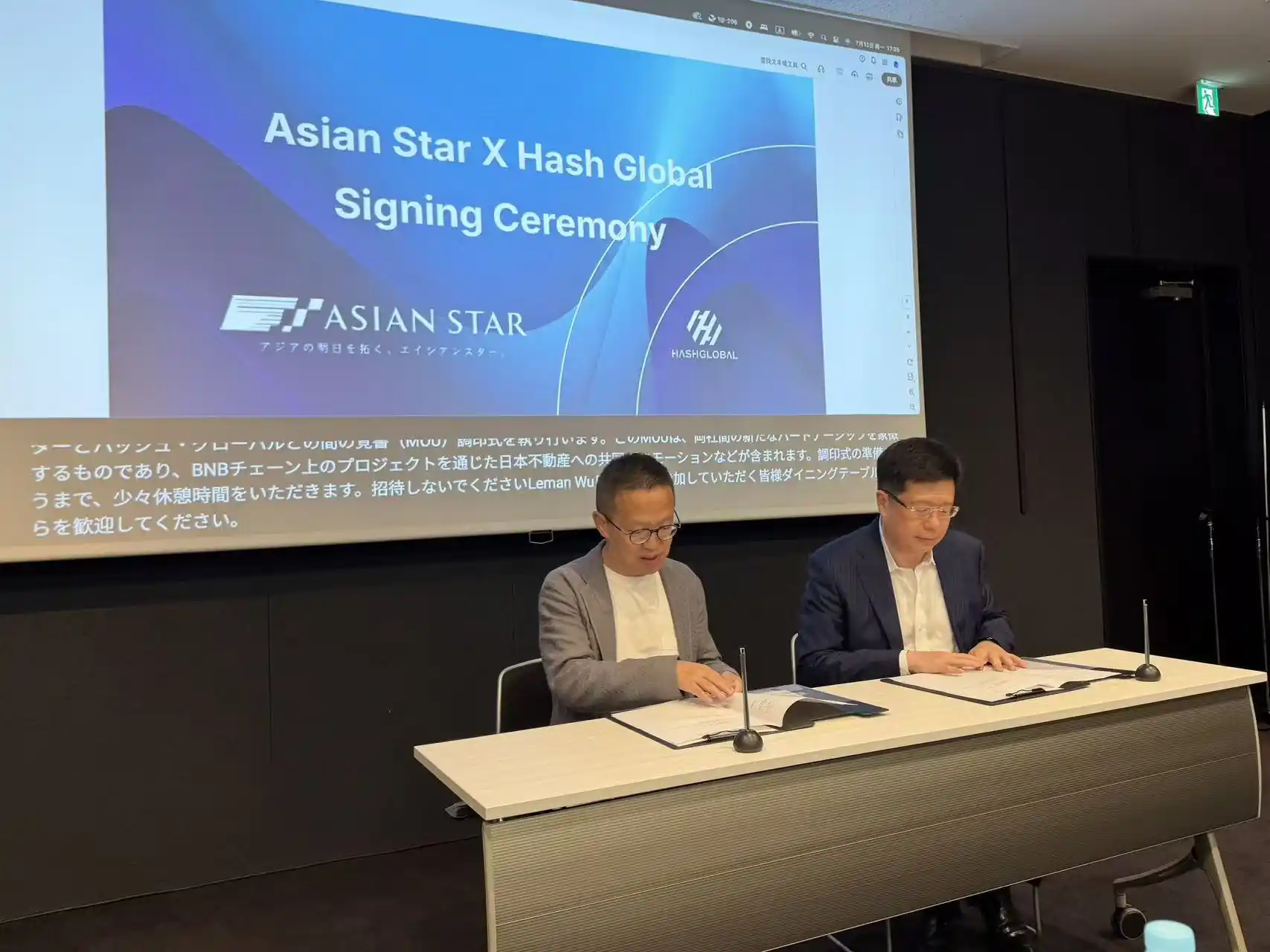
Al final del evento, ASIAN STAR y Hash Global celebraron una ceremonia de firma de un Memorando de Entendimiento (MOU) de cooperación estratégica. El presidente Wu Wenwei y KK firmaron e intercambiaron documentos en nombre de ambas partes. Según la información anunciada en el acto, las partes cooperarán en el desarrollo de un proyecto de fondo inmobiliario japonés dentro del ecosistema de BNB Chain, explorando más a fondo rutas de colaboración para la emisión de activos conforme a la normativa, la liquidación en cadena, la distribución global y la creación de liquidez.

Esta reunión cerrada continuó las discusiones mantenidas después del Foro Institucional BNB en Hong Kong y estableció un diálogo de cooperación más concreto entre las instituciones financieras tradicionales japonesas, proveedores de activos, emisores de stablecoins y el ecosistema de cadenas públicas. A medida que la regulación, la participación institucional y la infraestructura en cadena maduren gradualmente, la oportunidad de los RWA en Japón ya no se limita a "digitalizar activos", sino a construir una infraestructura financiera institucionalizada que cubra la emisión, liquidación, distribución, negociación, garantía y gestión de activos. ASIAN STAR, Hash Global y los socios del ecosistema de BNB Chain continuarán promoviendo la conexión de activos japoneses de calidad con el capital Web3 global, facilitando que los activos del mundo real avancen hacia aplicaciones más amplias en cadena.


Trending Cryptos

Related Questions

Q¿Qué evento se celebró en Tokio el 13 de julio de 2026 y quiénes fueron los organizadores principales?

AEl 13 de julio de 2026, durante WebX, se celebró en Tokio el 'Encuentro Cerrado Japonés sobre RWA, Stablecoins y el Ecosistema BNB'. El evento fue organizado por ASIAN STAR y coorganizado por Hash Global, con BNB Chain como socio del ecosistema blockchain.

QSegún los ponentes, ¿cuál es la visión sobre la tokenización de activos del mundo real (RWA) y qué se considera fundamental para su éxito?

ALos ponentes enfatizaron que la tokenización de RWA no debe ser solo la emisión de tokens, sino la digitalización y distribución global de activos bajo un marco regulatorio. Se considera fundamental una base de confianza, que incluye gobernanza, valoración, divulgación de información, cumplimiento de KYC/AML y gestión de idoneidad del inversor, así como activos subyacentes de calidad y demanda de transacción real.

Q¿Qué papel clave se atribuyó a las stablecoins en el evento, especialmente en relación con los activos japoneses?

AEn el evento, se destacó el papel de las stablecoins (especialmente las denominadas en yenes) como una capa de liquidación clave para conectar activos japoneses con capital global. Se planteó que su evolución desde herramientas de pago domésticas hacia canales de liquidación transfronteriza y distribución global es crucial para la eficiencia de los activos tokenizados.

Q¿Qué acuerdo estratégico se anunció al final del evento y entre qué entidades?

AAl final del evento, ASIAN STAR y Hash Global firmaron un Memorándum de Entendimiento (MOU) de cooperación estratégica. Acordaron colaborar en el desarrollo de un fondo de inversión inmobiliario japonés dentro del ecosistema de BNB Chain, explorando vías para la emisión de activos regulados, liquidación on-chain y distribución global.

QSegún el representante de Osaka Digital Exchange, ¿cuál es el estado actual del mercado de Security Tokens en Japón?

ASegún Kimio Mikazuki, CEO de Osaka Digital Exchange, el mercado japonés de Security Tokens tiene un volumen de emisión acumulado de aproximadamente 3,5 billones de yenes, compuesto principalmente por valores de beneficios inmobiliarios y bonos corporativos. Sin embargo, el mercado aún opera principalmente en blockchains privadas y a través de distribuidores tradicionales, con espacio para una mayor conexión con el ecosistema Web3 global y la liquidez secundaria on-chain.

Related Reads

UNI Doubles in Two Months Against the Trend: A 5-Year-Overdue Value Realization

Amidst a generally stagnant crypto market in June and July, UNI, the governance token of Uniswap, saw a significant surge, nearly doubling in price from around $2.3 to $4.6. This rally represents a delayed but significant value reassessment, triggered by the practical implementation of its long-debated "fee switch" mechanism. The key turning point was the on-chain execution of the UNIfication proposal in December 2025. It activated a protocol fee on select pools, directed Unichain sequencer revenue (net of costs) to a communal treasury, executed a one-time burn of 100 million UNI, and established a system where all protocol revenue flows into a "TokenJar" contract. This treasury has a single exit: purchasing and permanently burning UNI via a "Firepit" contract. Initially, the market reacted tepidly as the generated revenue and corresponding burn rate were modest. The narrative shifted dramatically in July 2025 with two major developments. First, the launch of Robinhood Chain, tailored for tokenized stocks, rapidly became a primary source of volume and fees for Uniswap, at one point contributing nearly half of its weekly fees. Second, governance votes successfully expanded the fee mechanism to v4 pools and initiated a temperature check for fees on Robinhood Chain. The activation of v4 fees caused the protocol's daily revenue earmarked for UNI burns to nearly triple. The core of UNI's recent price action is the transition from a pure governance token to a cash-flow asset with a permanent, protocol-funded buyer. Its effectiveness is amplified by UNI's mature and widely distributed supply, with no major impending unlocks to dilute the impact of the buybacks. The sustainability of this rally now hinges on whether the transaction volume, particularly on Robinhood Chain, persists after its initial gas subsidies expire, determining if this is a genuine value realization or a subsidy-fueled spike.

marsbit1h ago

UNI Doubles in Two Months Against the Trend: A 5-Year-Overdue Value Realization

marsbit1h ago

Breaking: Google Earth Urgently Pulls Back Nano Banana 2 Image Generation Feature!

Google Earth's newly launched "Create image" feature, powered by the Nano Banana 2 AI image generation model, was abruptly withdrawn shortly after its release due to being "played" by users. The feature allowed users to generate and overlay AI-created visuals directly onto real-world satellite and 3D maps in Google Earth. The tool enabled creative applications like historical recreations (e.g., visualizing ancient Pompeii), generating informational graphics for landmarks, and envisioning architectural projects or futuristic cityscapes on real terrain. It operated under "geospatial grounding," meaning the AI respected the underlying geography, topography, and perspective of the chosen map view. The model also integrated with Gemini to retrieve relevant factual information. However, upon release, users quickly tested its limits. A prominent example involved reimagining Philadelphia's historic Independence Hall as a post-apocalyptic ruin overrun by "happy" zombies, evil clowns, and giant alien mechs. This highlighted both the feature's playful potential and its risks regarding the generation of inappropriate or misleading content on realistic maps, leading to its swift temporary removal. Google stated it would re-release the feature after implementing "enhanced guardrails." Analysts note this move strategically leverages Google's vast proprietary geospatial data, positioning its AI not just for artistic generation but for spatially accurate world visualization—a unique advantage in the competitive AI image generation landscape.

marsbit3h ago

Breaking: Google Earth Urgently Pulls Back Nano Banana 2 Image Generation Feature!

marsbit3h ago

Altman Admits: Overestimated AI Snatching Jobs! Huang Renxun: The Unemployment Narrative Is Completely Backwards

Sam Altman has revised his earlier predictions about AI rapidly replacing jobs, admitting he overestimated the speed at which AI would eliminate entry-level white-collar roles. Speaking on the "Invest Like the Best" podcast, he stated that people do not truly want an AI CEO, as accountability and human connection remain critical. He found that individuals prefer interacting with people who can be held responsible for decisions. Similarly, NVIDIA's Jensen Huang argued that the narrative of AI destroying jobs is misguided. He distinguishes between tasks and jobs, noting that while AI can automate specific tasks, entire jobs—encompassing communication, judgment, coordination, and accountability—are not eliminated. He cited examples like radiologists and software engineers, where demand for these roles has increased as AI handles repetitive tasks, allowing for business expansion and the creation of more positions. Data from a University of Maryland and LinkUp study supports this, showing that U.S. job postings for new graduates have actually risen, countering the fear of vanishing entry-level roles. However, a significant shift is occurring: the traditional entry-level tasks that help newcomers gain experience are being automated, making initial career access more challenging. The key insight is that as AI takes over standardized tasks, the enduring value of human work shifts toward areas of responsibility, trust-building, and final decision-making—aspects that AI cannot replicate. The real "moat" for professionals lies in these irreplaceable human elements.

marsbit3h ago

Altman Admits: Overestimated AI Snatching Jobs! Huang Renxun: The Unemployment Narrative Is Completely Backwards

marsbit3h ago

Trading

Spot

Hot Articles

What is BNB WHALES

Understanding BNB Whales: A Deep Dive into the Cryptocurrency Landscape Introduction to BNB Whales In the vibrant world of cryptocurrencies, new projects regularly emerge, often promising innovative solutions and unique experiences. One such project is BNB Whales, launched in 2023 and built on the BNB Smart Chain (BEP20). BNB Whales sets out to establish a distinctive presence within the cryptocurrency ecosystem, focusing on creating an engaging platform that combines the benefits of blockchain technology with social and gaming interactions. This article aims to delve deeper into BNB Whales, exploring its core components, mechanics, and developmental trajectory. What are BNB Whales? BNB Whales is a cryptocurrency initiative that seeks to provide a diverse range of features and opportunities for its users in the burgeoning Web3 environment. Utilizing the BEP20 standard, the project operates with a total token supply of 100 trillion (100,000,000,000,000,000). Despite this significant figure, it is noteworthy that no tokens are currently in circulation, indicating that the project may still be in its early developmental stages. The primary goal of BNB Whales is to create a platform where users can participate in various interactive activities while benefiting from the security and transparency afforded by blockchain technology. By fostering a unique and engaging environment, BNB Whales aims to build a strong community of users who are invested in the project and its development. Who is the Creator of BNB Whales? The identity of the creator of BNB Whales remains undisclosed at this time, presenting a challenge for those looking to understand the project's founding principles and visionary insights. This absence of publicly available information regarding the project's leadership may raise questions among potential investors and users about its governance and accountability structure. Who are the Investors of BNB Whales? As BNB Whales continues to evolve, information concerning specific investors or support from investment foundations is currently unavailable. The project’s official documentation, including its whitepaper, does not disclose either individual or institutional financial backers. The lack of transparency in this regard can sometimes raise questions about the legitimacy and sustainability of new projects within the cryptocurrency ecosystem. How Does BNB Whales Work? BNB Whales operates on the BNB Smart Chain utilizing the BEP20 standard, which is known for its efficiency and low transaction fees, attracting a variety of developers and projects. The unique aspect of BNB Whales lies in its focus on creating a community-driven platform. While precise operational details are scarce, the project emphasizes interaction and engagement, potentially incorporating gamified elements into its offerings. The emphasis on community is pivotal, as it aligns with prevailing trends in the cryptocurrency space, where user input and participation often dictate a project's success. Further innovation may be anticipated, but at present, the specific mechanisms and features that differentiate BNB Whales from other crypto initiatives remain to be fully elucidated. Without detailed information regarding its functionality, it is challenging to evaluate the project's differentiators comprehensively. Timeline of BNB Whales The development of BNB Whales has unfolded across key milestones, marking its journey in the cryptocurrency landscape. Below is a timeline of significant events pertaining to the project: 2023: Launch of BNB Whales, marking the project's entry into the market. 2023: Publication of the project's whitepaper, which lays out the overarching goals and operational framework. Ongoing: BNB Whales continues to develop its features, aiming to build a robust user base and expand its offerings. Key Points About BNB Whales Platform: BNB Smart Chain (BEP20) Total Supply: 100 trillion tokens (100,000,000,000,000,000) Circulating Supply: 0 tokens (indicating a nascent stage) Project Goal: To foster an engaging cryptocurrency platform for interaction and community building. Creator: Unknown Investors: Not disclosed Operational Status: Active with ongoing development and expansion Conclusion As BNB Whales navigates the competitive cryptocurrency landscape, it offers a glimpse into the potential of community-driven projects built on the foundations of blockchain technology. By focusing on engagement and interaction, the initiative stands at the forefront of innovation in the Web3 space. However, the project's success ultimately hinges on the clarity of its operational mechanics, the disclosure of its governance, and the establishment of a solid user community. For potential users and investors alike, BNB Whales represents a case study in the evolving nature of cryptocurrency projects—one that illustrates both the exciting possibilities and the complexities associated with new initiatives. As the landscape continues to evolve, it will be essential to monitor BNB Whales' progress and its impact on the broader cryptocurrency ecosystem.

4.0k Total ViewsPublished 2024.04.01Updated 2024.12.03

What is BNB WHALES

What is PONKE BNB

Ponke BNB: A New Approach in the Cryptocurrency Space Introduction Ponke BNB, a newcomer in the cryptocurrency arena, was launched in 2024 and operates on the BNB Smart Chain (BEP20) platform. This innovative project seeks to build a distinctive and engaged community, focusing on sustainable reward generation. As the cryptocurrency landscape evolves, Ponke BNB aims to address critical issues surrounding reward sustainability, making it a project worth observing for enthusiasts and investors alike. What is Ponke BNB? At its core, Ponke BNB is a cryptocurrency designed specifically for the BNB Smart Chain ecosystem. Boasting an immense total supply of 370,000,000,000,000,000 tokens, it is worth noting that currently, there are no tokens in circulation. The guiding mission of Ponke BNB is to foster a sustainable reward system that mitigates the challenges associated with rewards depletion, a common pitfall in many cryptocurrencies today. The mechanics of Ponke BNB's functionality centre around encouraging user participation, while simultaneously providing rewards that can stand the test of time. The unique structure of its reward system is aimed at ensuring longevity and stability, addressing essential market concerns. Who is the Creator of Ponke BNB? Despite extensive exploration, the identity of Ponke BNB's creator remains unknown. There is a notable absence of publicly available information regarding the project’s founder or its development team. This anonymity, while not uncommon in the cryptocurrency space, raises some questions about transparency and accountability in project management. Who are the Investors of Ponke BNB? Similar to the lack of clarity surrounding its creator, there is no public information available regarding any investment foundations or organizations that support Ponke BNB. This absence of investor data can often breed uncertainty among prospective investors, who typically prefer a clear understanding of the backing behind cryptocurrencies they consider engaging with. How Does Ponke BNB Work? Ponke BNB stands out through its inventive two-layered sustainable reward generating system. This system is built to tackle the issue of rewards depletion effectively. By engaging users and creating a vibrant community, Ponke BNB seeks to provide a stable and enjoyable environment, which emphasizes user interaction and rewards. The operation framework of Ponke BNB encourages participation through various activities and challenges that are designed to incentivise users while ensuring that the reward system remains sustainable. It aims to stimulate the community and promote an engaging atmosphere where members can feel valued and appreciated. Timeline of Ponke BNB The evolution of Ponke BNB can be summarized through a few key milestones: 2024: The inception of Ponke BNB on the BNB Smart Chain (BEP20) platform marked a significant entry into the cryptocurrency market. 2024: The release of the project’s whitepaper and official website provided comprehensive insights into Ponke BNB’s goals and objectives, forming the foundation for its community-driven approach. Key Features of Ponke BNB Ponke BNB is built on several key features that set it apart from other cryptocurrency projects: Sustainable Reward System The two-layered reward system is designed to foster engagement, prevent depletion of rewards, and ensure the longevity of returns for participants in the Ponke BNB ecosystem. Community Engagement The project places a strong emphasis on active community engagement, driving participation through activities designed to create a social and collaborative environment. This community-centric approach empowers users to have a hand in shaping the project's future directions. BNB Smart Chain Integration Operating on the BEP20 platform, Ponke BNB is reinforced by the security and efficiency offered by the BNB Smart Chain. Users benefit from fast and cost-effective transactions, positioning Ponke BNB well within the broader cryptocurrency ecosystem. Conclusion In summary, Ponke BNB is an emergent cryptocurrency project aiming to carve a niche for itself in the growing digital currency landscape. With its focus on a sustainable reward system and community engagement, it presents a fresh outlook in an otherwise volatile sector. While uncertainties linger concerning the project's creators and investors, Ponke BNB continues to strive for transparency and innovation. As the cryptocurrency market continues to develop, Ponke BNB’s principles of sustainability and community-driven dynamics place it in a promising light for future observers and participants alike.

3.8k Total ViewsPublished 2024.04.01Updated 2024.12.03

What is PONKE BNB

What is BNB CARD

Understanding BNB Card: Revolutionizing Digital Identity in Web3 In the rapidly evolving landscape of blockchain technology and cryptocurrency, the BNB Card or $BNBCARD stands out as a noteworthy project. This community-driven utility meme token leverages the BNB Smart Chain (BSC), aiming to integrate meme culture with innovative digital identity solutions. As more users dive into the realms of decentralization, it is crucial to dissect what BNB Card offers, its operational nuances, and its potential market impact. What is BNB Card ($BNBCARD)? At its core, BNB Card represents a meme token with substantial utility. It is designed to empower users by enabling the creation of personalized digital identity cards that are both expressive and functional. The project encapsulates several key features: Customizable ID Cards: Users have the ability to design Binance-themed digital ID cards, providing them with a platform for self-expression and enhanced community interaction. Decentralized Framework: Developed on the BSC, BNB Card emphasizes key attributes such as security, transparency, and user sovereignty. The decentralized nature of the framework allows for transactions that are both efficient and secure. Community-Centric Model: The emphasis on grassroots participation rather than laboratory-driven financial models creates an engaging environment for its users. By leveraging the inherent virality of meme culture, BNB Card fosters a robust community movement. The primary goal of BNB Card is to democratize digital identity tools in Web3, offering accessible solutions that benefit the users without the encumbrances typically associated with traditional identity management systems. Creator and Investors When exploring the identity behind BNB Card, it is important to note that no singular creator is explicitly credited. Instead, the project appears to be community-driven, suggesting a collective effort inspired by the notion of Binance's “Early Builder Card.” This organic development approach is common among projects within the meme token spectrum, where development is often influenced by the community's passion rather than a central authority. In terms of investment, the absence of publicly disclosed institutional backers further highlights the project's grassroots foundation. It thrives on organic community support, reflecting a usual characteristic of meme-driven projects that often engage their audience through social channels rather than formal investment routes. How It Works BNB Card employs several mechanisms that delineate its functioning and innovative spirit: Token Utility: The BNBCARD token allows users access to a suite of ID creation tools while also providing a platform for community governance. The token serves as the linchpin that enables these functionalities. Blockchain Integration: By utilizing the BSC, BNB Card ensures compatibility with Ethereum Virtual Machine (EVM)-based applications. This integration provides users with the benefits of low transaction fees while enhancing accessibility. DIY Ecosystem: Central to BNB Card’s appeal is its do-it-yourself (DIY) approach to digital identity card generation. This participatory element encourages users to engage in creative expression, fostering an inclusive culture that thrives on contribution and collaboration. Timeline Chronology is vital to understanding BNB Card's trajectory. Important milestones in the project’s history include: March 18, 2025: BNB Card was listed on LBank, marking a significant step in its exchange journey and opening doors for liquidity and user accessibility. March 19, 2025: A pivotal moment occurred as the token experienced an astronomical surge of 26,000% within 24 hours, garnering attention for its potential and the community’s enthusiasm. Ongoing Developments: The project is continuously expanding its partnerships with decentralized exchanges (DEXs) like PancakeSwap, further enhancing liquidity and user engagement. Innovation and Differentiation Understanding what sets BNB Card apart involves deeper exploration into its innovative framework: Meme-Utility Hybrid: BNB Card successfully merges the playful allure of meme culture with practical applications in digital identity management. This niche approach effectively caters to a broad demographic, appealing to both tech-savvy users and those new to crypto. Decentralized Governance: Operating devoid of centralized control allows the project to harness community input directly. The collective decision-making process buoyed by community involvement empowers users, ensuring their voices contribute to the development and direction of the project. Scalability: BNB Card stands to benefit immensely from the 2025 roadmap upgrades to the BNB Chain, which include enhancements such as increased transaction speeds and the integration of artificial intelligence tools. These improvements position the project advantageously within a highly competitive environment. Conclusion BNB Card is emblematic of a new wave of digital identity solutions within the Web3 ecosystem. By blending fun, community engagement, and practical utility, it invites users to participate actively in shaping their digital personas. As the project navigates the dynamic cryptocurrency landscape, its success will likely hinge on maintaining strong community support while adapting to technological advancements and user needs. The integration of decentralization with meme culture serves not only as a means for user-driven engagement but also as a foundation for the evolving narrative surrounding digital identity in the age of blockchain. In summation, BNB Card not only exemplifies the convergence of creativity and utility within the crypto space but also underscores the importance of community in steering the future of decentralized technologies.

4.3k Total ViewsPublished 2025.03.26Updated 2025.03.26

What is BNB CARD

Discussions

Welcome to the HTX Community. Here, you can stay informed about the latest platform developments and gain access to professional market insights. Users' opinions on the price of BNB (BNB) are presented below.

活动图片