Everyone online says GPT-5.6 Sol's Max tier has become dumber. OpenAI insists there's no nerf, just an "experiment." The knob turned during that experiment slashed the Max tier's budget from 960 down to 128, invisible to users.
Woke up to find GPT-5.6 Sol had become dumber!
A Japanese market research team, not long after starting work in the morning, discovered something off with their Codex Sol MAX. The team leader wrote a long post about the morning's ordeal and posted it on Reddit's r/codex.
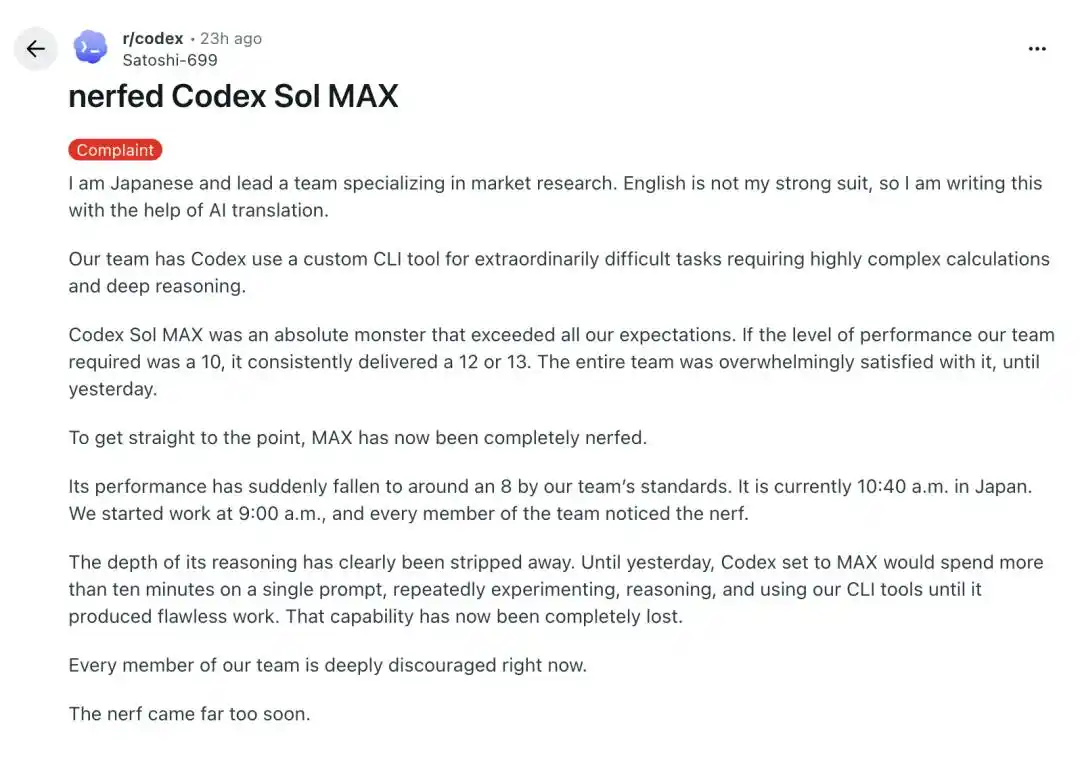
9 AM, the team started work as usual. By 10:40 AM, every single member had noticed the same thing.
They had Codex Sol MAX connected to a self-developed CLI tool, specifically for chewing through jobs requiring extremely complex calculations and deep reasoning.
Initially, Codex Sol MAX lived up to expectations, delivering 12 or 13 points out of a 10-point requirement. It was a "monster that far exceeded expectations," and "everyone was overwhelmingly satisfied with it."
But on this morning, that "monster's" performance suddenly slumped to 8 points.
The depth of reasoning had clearly been stripped away.
Before this, when faced with a prompt, Codex Sol MAX would take over ten minutes, repeatedly trying, reasoning, and calling their tools until the job was done flawlessly.
That capability had "completely vanished" on this very morning.
The Whole Internet Feels It's "Dumber"
The Japanese team's experience was just one example among many in the Codex community these past few days.
The complaints were highly consistent: the model indeed got faster, answers came more briskly, but it was unwilling to dig deep. That old drive to research first, then act, constantly revising itself, was gone.
A user on X summed up everyone's gut feeling:
Everyone's reasoning tier has been collectively downgraded by one level—if you used to run on Extra High, now you have to crank it to Max to get back the same level of effort.
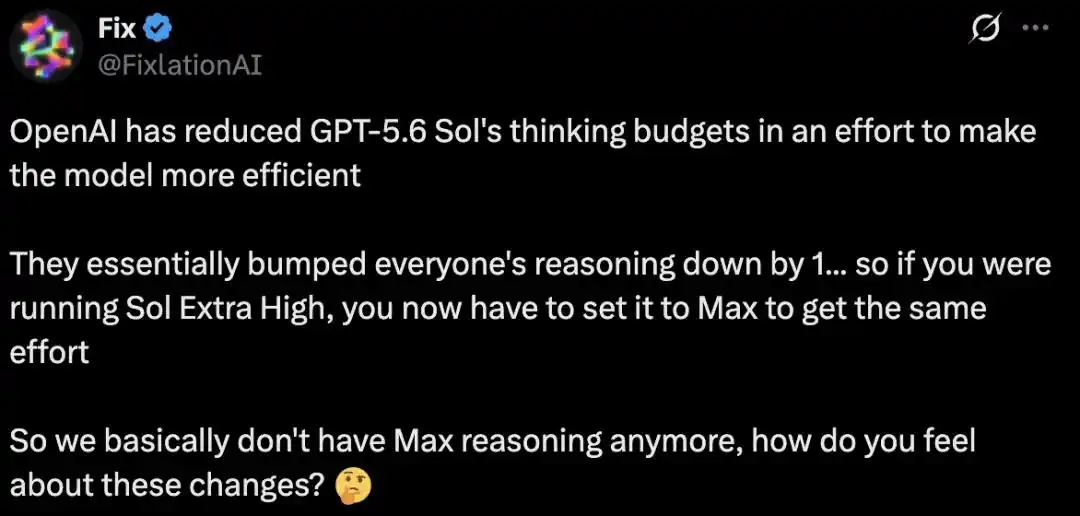
This kind of change is impossible for ordinary users to prove.
You can't see if the model weights were swapped, nor how much computing power the server allocated to you.
All you can perceive are four things: how fast it replies, how long it thinks, whether it reviews itself, and whether it calls upon other agents to help.
These are all indirect signals; none are written on a model card.
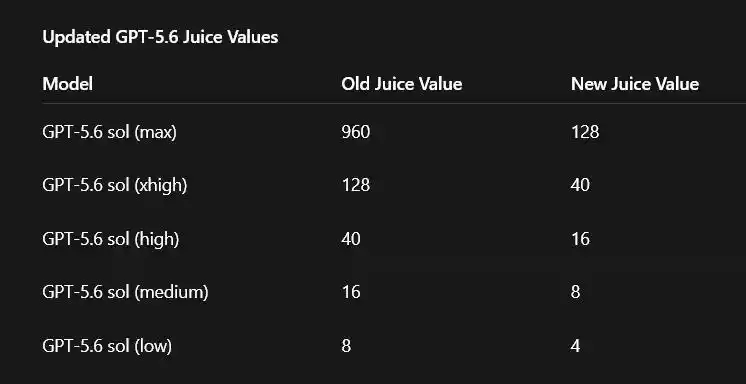
So, community users dug into it themselves and unearthed an internal parameter OpenAI never publicly disclosed: the juice value.
A Number Never Mentioned Officially
What OpenAI has publicly talked about are only the reasoning tiers.
At the GPT-5.6 launch on July 9th, the official line was the first-time introduction of max reasoning effort, "giving Sol the most ample time for deep reasoning." There's even an ultra tier above, which by default engages four agents to work in parallel.
In ChatGPT, these translate to those few options in the model selector: Medium, High, Extra High—all running Sol underneath, with the Pro tier running Sol Pro.
The juice value is the layer beneath these tiers: the internal reasoning compute budget. Users can't see it, and OpenAI has never published its values.
A community user, ns123abc, used a piece of hidden prompt text known as a "model fingerprint" to read a value from the system configuration: juice.
The community had previously observed that Sol's max tier corresponded to 960. This time, the screen showed 128—a drop of nearly 87%.
Almost simultaneously, another set of screenshots began circulating: the usable context for users in the Codex client had dropped from around 372k back to 272k.
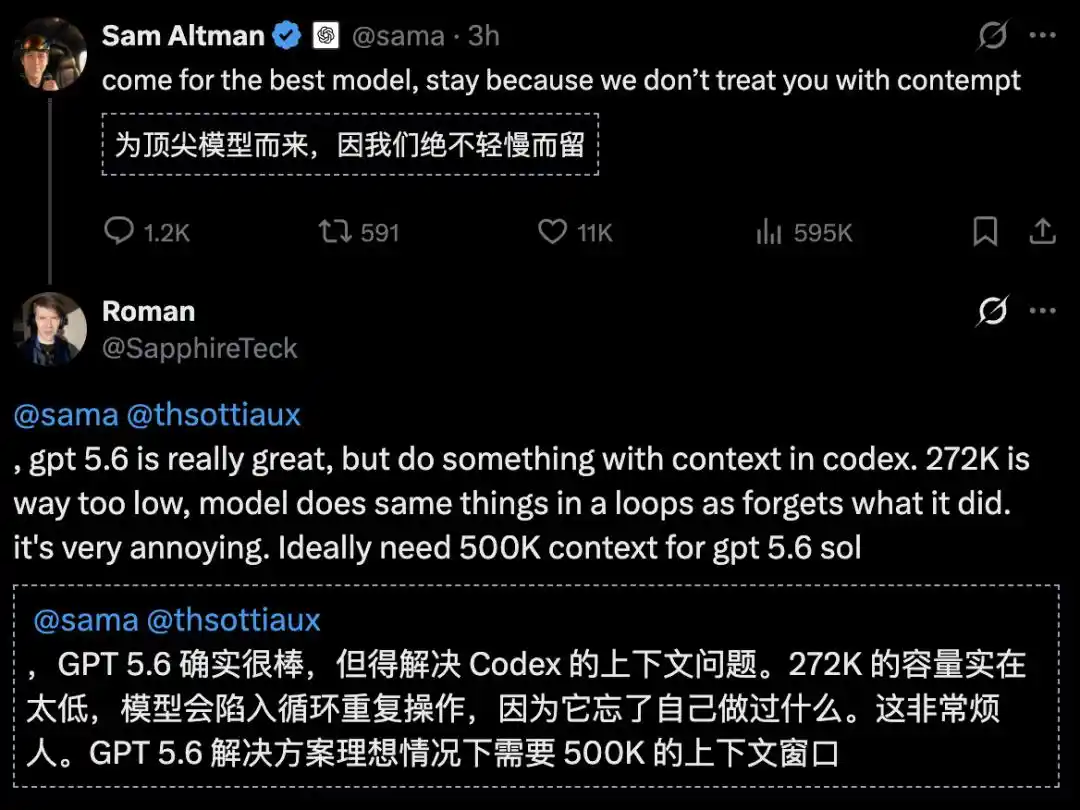
These two numbers quickly ignited the entire community.
Tibo: No Nerf, We're Investigating Usage
That same night, Tibo (Thibault Sottiaux), who leads Codex and ChatGPT Work at OpenAI, stepped up to speak.
Tibo posted an update on X, starting with: No nerf, only good things.
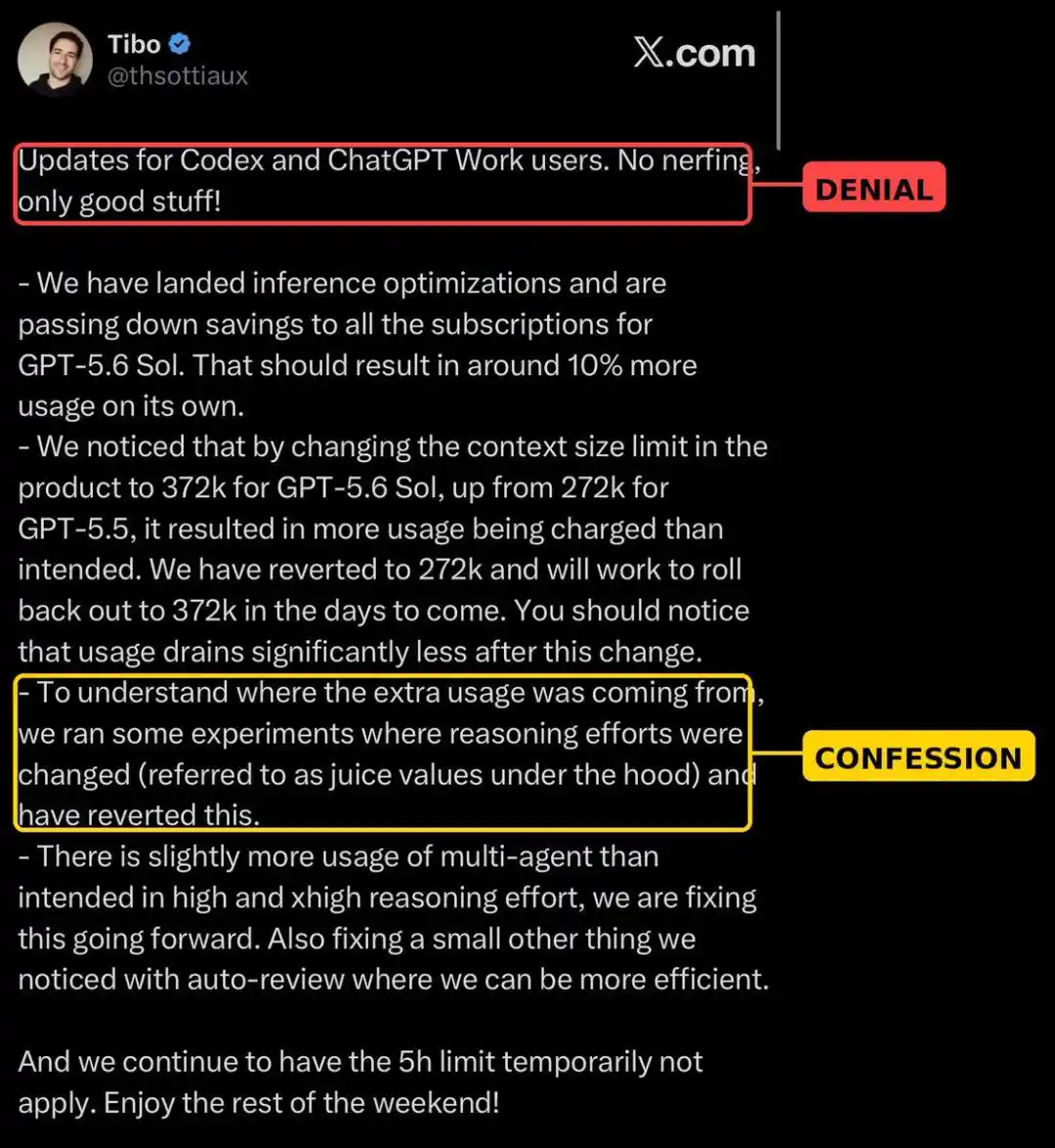
He then emphasized four points in one breath.
First, reasoning efficiency optimizations have already rolled out. The compute savings are being returned to all subscribers, which alone adds roughly 10% more usage.
Second, Sol's context window was raised from GPT-5.5's 272k to 372k, which resulted in higher-than-expected billing deductions. It has now been rolled back to 272k, with 372k being reintroduced in the coming days.
Third, to figure out where the extra usage was coming from, the team ran some experiments where they tweaked the reasoning effort—internally called "juice values."
This has now been reverted.
Fourth, the invocation of multi-agent for high and xhigh tiers was higher than expected, and there was waste on the auto-review side—both are being fixed.
Tibo's post essentially said: It's not a "nerf," it's "parameter tuning."
He didn't mention whether model weights were touched. But he did admit that the configurations users actually received had indeed been changed.
So what exactly is "juice"? Based on publicly available information, it appears closer to an internal system marker for reasoning resource allocation—roughly speaking, how much reasoning resource the system allows the model to invest in a single task.
While lowering the budget doesn't necessarily mean "the model weakened," it can quietly change many things:
How many paths can be explored in a long-horizon task, how many rounds of comparison between multiple solutions, whether code generation is actively tested after being produced, how many times it's willing to roll back after failure, and the "long-tail capabilities" in extremely difficult tasks that determine success or failure.
Ultimately, it represents how much thought the model is willing to put into a task.
To end this debate requires a strictly controlled experiment: the same model snapshot, the same batch of tasks, the same set of tool environments, changing only the juice variable.
See how much performance drops in complex coding, long-horizon agent tasks, mathematical reasoning, and error recovery.
This evidence remains absent to this day.
Every Token the Vendor Saves, the User Feels
Returning to the experiment Tibo mentioned. How did it come about?
After GPT-5.6 launched, demand surged immediately.
OpenAI temporarily lifted the five-hour usage limit window to handle the overwhelming volume of calls.
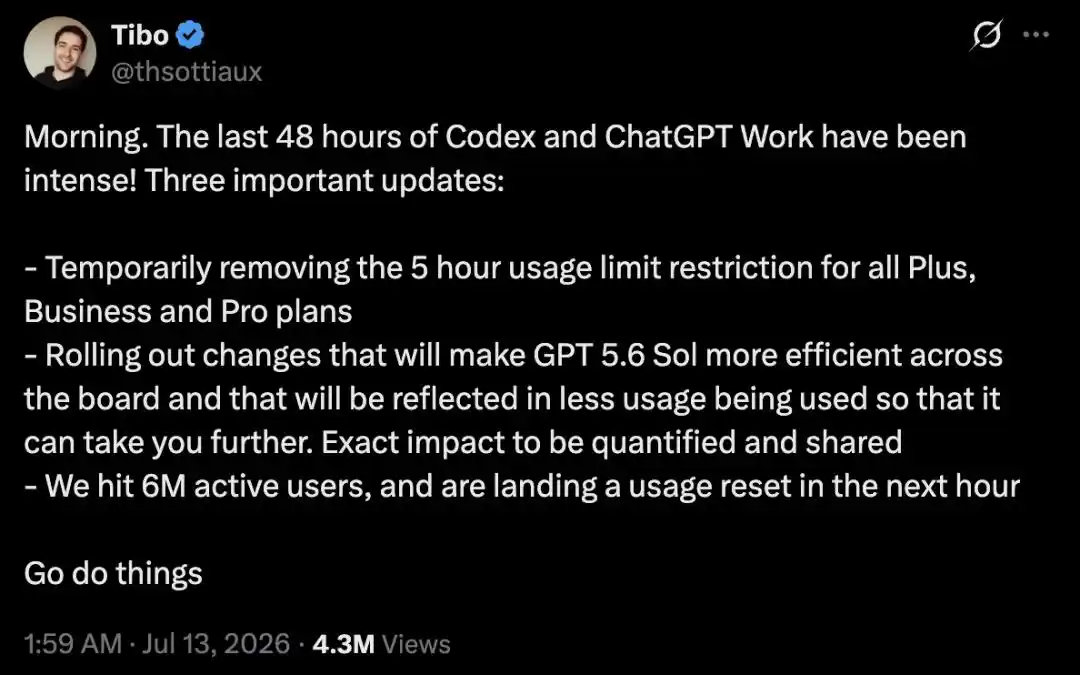
And GPT-5.6's most eye-catching new features—the longer thinking in max tier, ultra defaulting to four parallel agents, the larger context window—are precisely the token-hungry beasts.
The extra usage emerged exactly from here.
Hence, the experiment. To audit the bill, first lower the budget variable to see exactly where the usage goes—this makes perfect engineering sense.
But the problem lies exactly here: when the vendor saves tokens, users perceive it, most directly as the model "unwilling to think."
The variable that was adjusted happens to be the one users can feel.
AI Stops "Performing Miracles," Starts Punching the Clock
Over the past few years, large model companies have fostered a near-religious imagination.
People treated models like oracles, hoping they'd spit out an answer humans hadn't thought of in the dead of night, tolerating slowness, higher costs, occasional craziness.
But lab miracles can afford to ignore costs; once in production as industrial infrastructure, they cannot.
Thus, frontier models like Sol are transitioning from lab prophets who occasionally "perform miracles" into engines that keep running within daily workflows.
This resembles a process of intelligence domestication, and this controversy publicly exposed the process. Simultaneously, users' illusion of "fixed intelligence" is about to end.
Subscribing to a model is more like buying a light bulb: the model is fixed, but the brightness dial has always been in the platform's hands.
This might be the correct commercial choice, but it shouldn't forever remain in a black box.
If AI is truly to become enterprise infrastructure, vendors must provide boundaries more concrete than model names, letting users understand what exactly their paid "Max" tier guarantees.
Otherwise, it's just a price tag.
References:
https://x.com/thsottiaux/status/2076495156757577895
https://x.com/FixlationAI/status/2076469274441380349
https://www.reddit.com/r/codex/comments/1uuy5eq/nerfed_codex_sol_max/
This article is from the WeChat public account "新智元" (New AI Era), author: 元宇 (Yuan Yu)