Bitcoin OG whale awakens after 7 years, moves $188M BTC: Is a sell-off coming?

ambcryptoPublished on 2026-07-13Last updated on 2026-07-13

Abstract

A long-dormant Bitcoin whale, inactive since October 2018, moved 2,931 BTC (worth approximately $188 million) to a new wallet. This movement, occurring while Bitcoin traded near $63,000, sparked speculation of a potential sell-off, as the holdings had increased nearly tenfold in value. Analysis of the Spent Output Profit Ratio (SOPR) indicates the broader market is not in a phase of aggressive profit-taking, with the metric hovering near 1. Concurrently, on-chain data reveals strong accumulation by retail and smaller investors (wallets holding 0.1 to 100 BTC) between April and July 2026, with some larger institutional cohorts also increasing holdings. Despite a recent dip and rising oil prices—a historical headwind for crypto—Bitcoin demonstrated resilience by maintaining support above $60,000 and posting gains in late June. The article suggests the market may be growing less reactive to macroeconomic fears. The whale's transfer alone does not confirm an imminent sale.

After seven years of inactivity, a Bitcoin [BTC] OG holder moved 2,931 BTC, valued at about $188.03 million, to a new wallet in a recent on-chain development.

That said, this Bitcoin whale had not touched its holdings since the 23rd of October 2018. At that time, the leading cryptocurrency was trading close to $6,475.


Source: Lookonchain/X

This means at the current price, the value must have increased by nearly 10x. Needless to say, such large transfers from long-dormant wallets often indicate that the owner is getting ready to sell some or all of the holdings and realize significant profits.

However, a wallet transfer by itself does not prove a sale. This occurred after Bitcoin had dropped 1.36% over the previous day to $62,939.94 at the time of writing.

Are investors selling at a loss or profit?

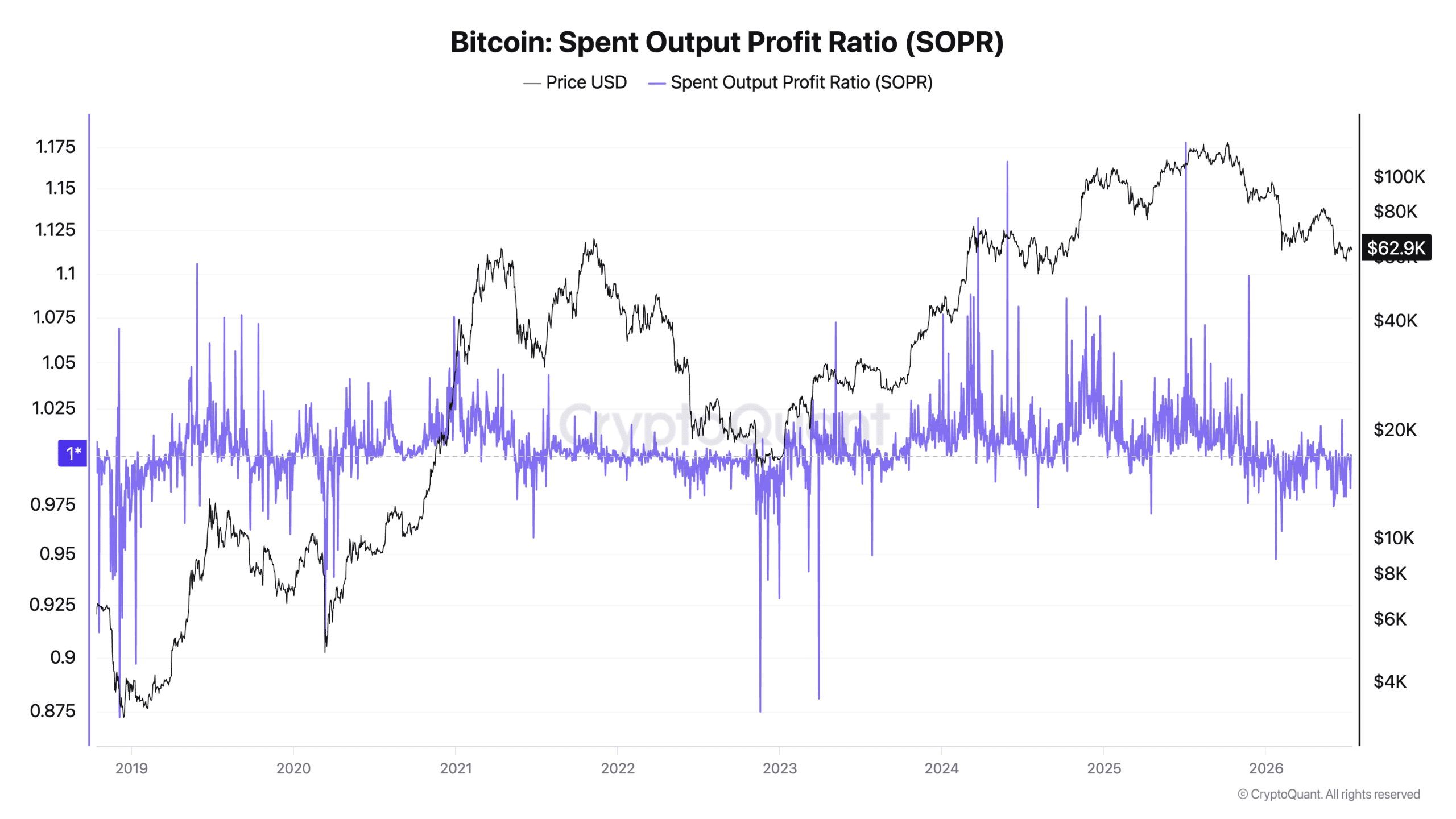
However, the SOPR was near 1, indicating that the market as a whole is only making small gains instead of the aggressive profit-taking that usually occurs at cycle tops.

Interestingly, the SOPR remained close to 1 even back in October 2018, suggesting that coins were being spent near their purchase price.
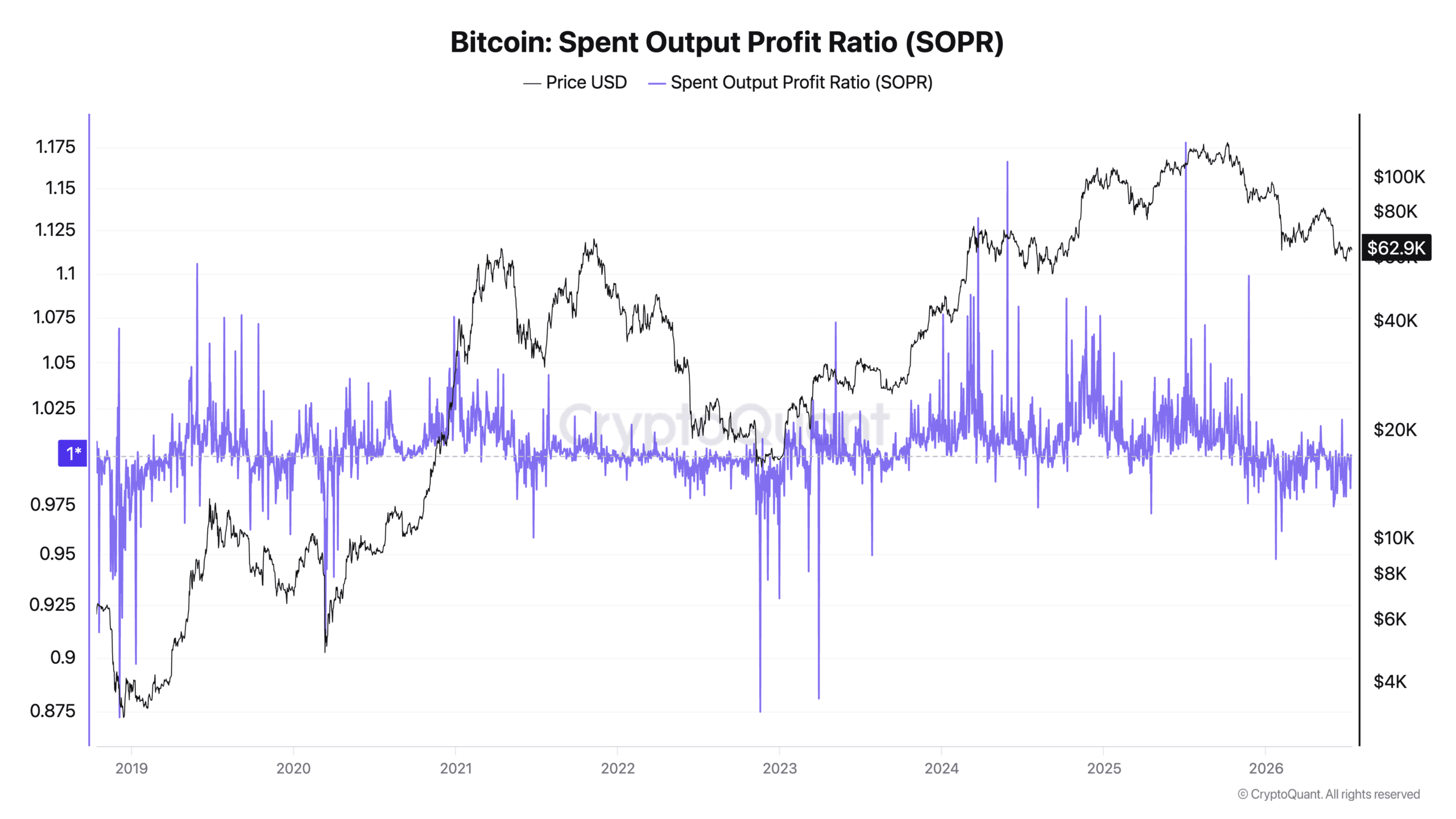
Source: CryptoQuant

However, the market environment has entirely changed from a bear market in 2018 to a mature cycle in 2026. While early adopters still hold significant unrealized gains, the general market no longer exhibits the excessive profit-taking behavior.

Bitcoin accumulation is strong

At the same time, Santiment’s supply distribution suggested that retail and small investors were the main drivers of Bitcoin accumulation between April and July 2026. During this time, wallets holding between 0.1 and 100 BTC steadily grew their balances.
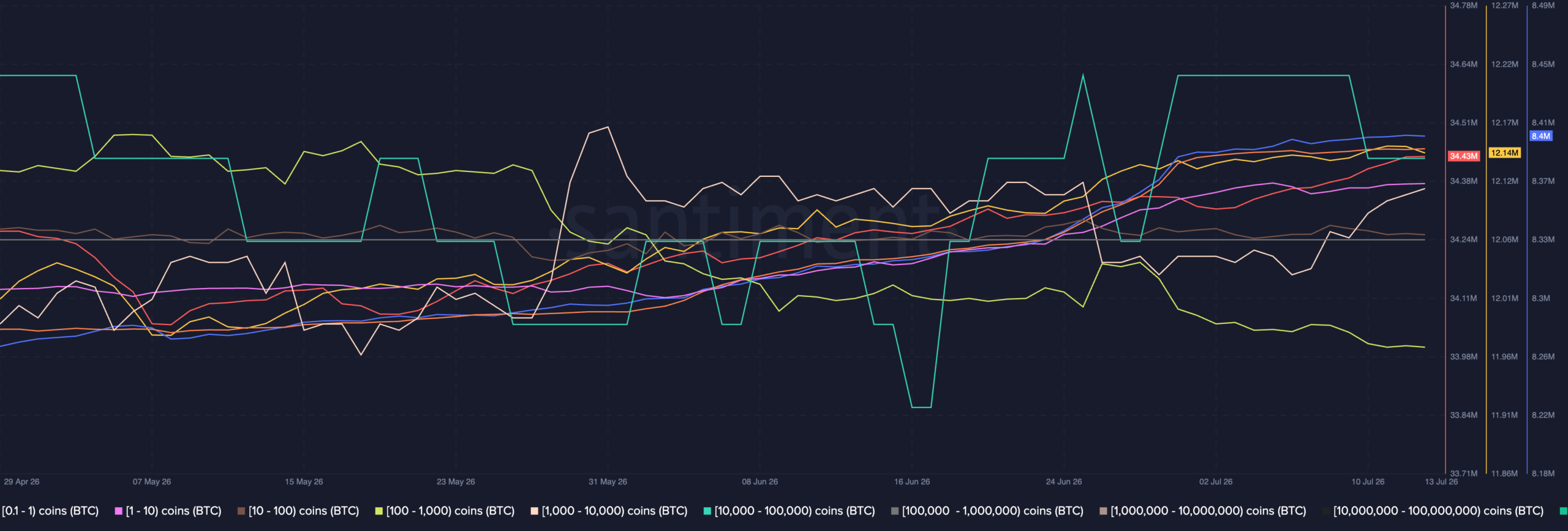
Source: Santiment

The accumulation of the 1,000–10,000 BTC cohort also suggests that some institutions and big whales are still purchasing.

On the other hand, wallets with 100–1,000 BTC steadily decreased their holdings, whereas the 10,000–100,000 BTC cohort experienced abrupt balance changes that most likely reflected transfers between custodians or exchanges rather than outright sales.

Bitcoin is resilient

The fact that Bitcoin rallied by over 6% in late June and early July while remaining well above the $60,000 support level further demonstrated its tenacity.

This strength coincided with oil prices rising more than 5% toward the $75 resistance level as macro uncertainty returned after U.S. President Donald Trump pulled out of the Iran ceasefire.

Historically, cryptocurrency market corrections have frequently followed increases in oil prices.

Nonetheless, the fact that Bitcoin has managed to sustain its upward trajectory despite these macro challenges raises the possibility that the market is growing more resilient to fear fueled by macro factors.


Final Summary

  • After seven years, an early bitcoin whale moved nearly 3K BTC to a new wallet.
  • This whale movement happened when Bitcoin was trading around $63k and the SOPR was at 1.

Trending Cryptos

Related Questions

QWhat significant action did a long-dormant Bitcoin OG whale take after 7 years of inactivity, and what was the approximate value of the BTC moved?

AThe whale moved 2,931 BTC from a wallet that had been inactive since October 2018 to a new wallet. The value of the transfer was approximately $188.03 million.

QWhy is the movement of a long-dormant whale wallet often interpreted by the market, and what does the article clarify about this specific transfer?

ALarge transfers from long-dormant wallets are often interpreted as a sign that the owner may be preparing to sell. However, the article clarifies that a wallet transfer by itself does not prove a sale has occurred.

QWhat does the Spent Output Profit Ratio (SOPR) being near 1 indicate about the current Bitcoin market according to the article?

AThe SOPR being near 1 indicates that the market as a whole is only making small gains or realizing minimal profits, rather than engaging in the aggressive profit-taking that typically occurs at market cycle tops.

QAccording to Santiment's data, which wallet size cohorts were the main drivers of Bitcoin accumulation between April and July 2026?

AAccording to Santiment's supply distribution, wallets holding between 0.1 and 100 BTC were the main drivers of accumulation. The 1,000–10,000 BTC cohort also showed accumulation, suggesting institutional or large whale buying.

QDespite a historical correlation, how did Bitcoin's price action demonstrate resilience in the face of rising oil prices and macro uncertainty in late June/early July?

ABitcoin rallied over 6% in late June and early July and remained well above the $60,000 support level. This strength, despite rising oil prices and geopolitical uncertainty, suggests the market is growing more resilient to macro-fueled fear.

Related Reads

Why P2P and Exchangers Are Becoming Obsolete, and What Will Replace Them

Titled "Why P2P and Exchanges Are Becoming Obsolete, and What Will Replace Them," this article discusses the evolution of stablecoins, particularly USDT, from a trading tool to a global payment method. However, converting crypto back to fiat for daily expenses remains a challenge. The process of using P2P platforms or crypto exchanges has become increasingly risky and complex due to stricter banking anti-fraud measures, new legislation in Russia, and rampant fraud schemes like "triangles," where sellers can inadvertently receive stolen funds. The article highlights that while P2P was convenient, banks now scrutinize frequent peer-to-peer transfers, often freezing accounts. Exchanges also pose risks like unfavorable rates and unclear compliance. The market is therefore shifting towards integrated services that eliminate the manual conversion step. It cites OneSix as an example—a crypto wallet accessible via Telegram and web that embeds currency conversion directly into payment and withdrawal scenarios. Users can pay bills or send money as if using a bank app, with the crypto-to-fiat exchange happening seamlessly in the background. It also offers invoicing for freelancers and conducts AML checks, returning suspicious transactions instantly instead of freezing them. In conclusion, as crypto integrates into everyday finance, the demand for manual, risky exchange methods is declining. The future lies in unified platforms that combine storage, compliance, conversion, and payments into a single, secure user experience.

cryptonews.ru37m ago

Why P2P and Exchangers Are Becoming Obsolete, and What Will Replace Them

cryptonews.ru37m ago

The CEO of MARA Holdings Compares AI Operations to Bitcoin Mining! Which is More Profitable?

Fred Thiel, CEO of MARA Holdings (a major Bitcoin mining company), states that the rapid growth of the artificial intelligence (AI) sector is transforming mining companies' business models. He claims that powering data centers for AI is significantly more profitable than Bitcoin mining. In a recent interview, Thiel explained why many mining firms are diversifying into AI infrastructure. According to Thiel, the energy demands of data centers are surging, especially due to the spread of generative AI applications. This creates new revenue opportunities for Bitcoin mining companies with robust power infrastructure. MARA Holdings is among those monitoring this shift and aims to develop its energy and infrastructure services for AI data centers. Thiel emphasized that this move toward AI does not mean the end of Bitcoin mining. He stated that Bitcoin mining remains a sustainable business model, especially for miners in regions with low electricity costs, and it is still a crucial field for utilizing excess or idle power capacity. In recent years, many Bitcoin mining companies have begun using their energy-intensive infrastructure not just for block production but also for high-performance computing (HPC) and AI applications. This strategy aims to diversify revenue sources and increase resilience against cryptocurrency market volatility. Analysts note that the growing energy demand in the AI sector presents significant transformation opportunities for mining companies. The need for high-power, uninterrupted electricity supply, particularly for large data centers, gives Bitcoin miners with existing energy infrastructure expertise a considerable advantage.

cryptonews.ru47m ago

The CEO of MARA Holdings Compares AI Operations to Bitcoin Mining! Which is More Profitable?

cryptonews.ru47m ago

Ratio's CEO Says Multi-Currency Stablecoins Could Eliminate Costly FX Conversions in Asia

The CEO of Ratio, John Cho, argues that multi-currency stablecoins could save Asia billions by eliminating costly foreign exchange conversions in regional trade. While USD stablecoins like USDT and USDC work for global settlements, local Asian trade is conducted in local currencies like the Korean won or Singapore dollar. Forcing these transactions through USD intermediaries creates unnecessary costs and currency risk. Cho envisions a complementary ecosystem where local-currency stablecoins work alongside USD stablecoins, enabling seamless cross-border settlements without conversion friction. A key pain point in traditional banking is the need for pre-funded Nostro and Vostro accounts, which lock up vast amounts of working capital. Blockchain-based settlement layers like Ratio offer a 24/7 alternative, using on-chain liquidity to enable instant execution even when traditional channels are closed. Modern Web3 infrastructure providers are focusing on pragmatic integration with existing corporate systems like ERPs, allowing businesses to gradually shift volumes to digital channels for better speed, cost, and reduced slippage. Clear regulation is cited as the critical catalyst for widespread institutional adoption. As jurisdictions like the U.S. advance legislation (e.g., the CLARITY Act) and Asian countries are expected to pass their own stablecoin laws within 12-24 months, regulatory uncertainty is receding. The ultimate vision is for regulated stablecoins to become an invisible settlement layer integrated into national payment systems, where payments simply happen on-chain, erasing the boundary between traditional banking and digital assets.

cryptonews.ru1h ago

Ratio's CEO Says Multi-Currency Stablecoins Could Eliminate Costly FX Conversions in Asia

cryptonews.ru1h ago

Huang Xiaoming, Li Bin, Lei Jun, Liang Wenfeng... Who Are the Biggest Winners in the CXMT IPO Feast?

Changxin Technology, a leading Chinese memory chip manufacturer, successfully listed on the Shanghai Stock Exchange's STAR Market (科创板) on July 8, 2026. Its share price surged from the IPO price of 8.66 yuan to close at 49 yuan on the first day, catapulting its market capitalization to 3.28 trillion yuan, making it the most valuable A-share company and triggering a massive wealth creation event. The biggest winners were the company's founder, Zhu Yiming, and its employees. Zhu Yiming's family wealth skyrocketed nearly 300% to approximately $13.9 billion, with his direct stake in Changxin valued at around 80 billion yuan. Additionally, over 6700 employees benefited from stock ownership plans, creating at least 237 new millionaires (in CNY). Zhu also pledged to donate 768 million shares, worth over 37.6 billion yuan, for future employee incentives over a ten-year period. Several prominent investors and corporate clients also reaped significant paper gains from the IPO. Notable figures include: * **Liang Wenfeng**, founder of DeepSeek, whose funds netted a paper profit of approximately 827 million yuan. * **Kong Jianping**, founder of Nano Labs, saw his indirect holdings valued at roughly 940 million yuan. * **Li Bin**, founder of Nio, whose company's strategic investment of 158 million yuan is now worth about 740 million yuan. * **Lei Jun**, founder of Xiaomi, whose subsidiary holds shares currently showing a paper gain of over 736 million yuan. Xiaomi clarified this is a corporate investment, not direct personal wealth. The article notes that while this IPO created immense wealth for insiders and large investors, retail investors who were lucky enough to win an allotment in the lottery typically profited by around 20,000 yuan. The listing solidifies Changxin's position as China's premier domestic memory chipmaker.

marsbit1h ago

Huang Xiaoming, Li Bin, Lei Jun, Liang Wenfeng... Who Are the Biggest Winners in the CXMT IPO Feast?

marsbit1h ago

Trading

Spot

Hot Articles

What is $BITCOIN

DIGITAL GOLD ($BITCOIN): A Comprehensive Analysis Introduction to DIGITAL GOLD ($BITCOIN) DIGITAL GOLD ($BITCOIN) is a blockchain-based project operating on the Solana network, which aims to combine the characteristics of traditional precious metals with the innovation of decentralized technologies. While it shares a name with Bitcoin, often referred to as “digital gold” due to its perception as a store of value, DIGITAL GOLD is a separate token designed to create a unique ecosystem within the Web3 landscape. Its goal is to position itself as a viable alternative digital asset, although specifics regarding its applications and functionalities are still developing. What is DIGITAL GOLD ($BITCOIN)? DIGITAL GOLD ($BITCOIN) is a cryptocurrency token explicitly designed for use on the Solana blockchain. In contrast to Bitcoin, which provides a widely recognized value storage role, this token appears to focus on broader applications and characteristics. Notable aspects include: Blockchain Infrastructure: The token is built on the Solana blockchain, known for its capacity to handle high-speed and low-cost transactions. Supply Dynamics: DIGITAL GOLD has a maximum supply capped at 100 quadrillion tokens (100P $BITCOIN), although details regarding its circulating supply are currently undisclosed. Utility: While precise functionalities are not explicitly outlined, there are indications that the token could be utilized for various applications, potentially involving decentralized applications (dApps) or asset tokenization strategies. Who is the Creator of DIGITAL GOLD ($BITCOIN)? At present, the identity of the creators and development team behind DIGITAL GOLD ($BITCOIN) remains unknown. This situation is typical among many innovative projects within the blockchain space, particularly those aligning with decentralized finance and meme coin phenomena. While such anonymity may foster a community-driven culture, it intensifies concerns about governance and accountability. Who are the Investors of DIGITAL GOLD ($BITCOIN)? The available information indicates that DIGITAL GOLD ($BITCOIN) does not have any known institutional backers or prominent venture capital investments. The project seems to operate on a peer-to-peer model focused on community support and adoption rather than traditional funding routes. Its activity and liquidity are primarily situated on decentralized exchanges (DEXs), such as PumpSwap, rather than established centralized trading platforms, further highlighting its grassroots approach. How DIGITAL GOLD ($BITCOIN) Works The operational mechanics of DIGITAL GOLD ($BITCOIN) can be elaborated on based on its blockchain design and network attributes: Consensus Mechanism: By leveraging Solana’s unique proof-of-history (PoH) combined with a proof-of-stake (PoS) model, the project ensures efficient transaction validation contributing to the network's high performance. Tokenomics: While specific deflationary mechanisms have not been extensively detailed, the vast maximum token supply implies that it may cater to microtransactions or niche use cases that are still to be defined. Interoperability: There exists the potential for integration with Solana’s broader ecosystem, including various decentralized finance (DeFi) platforms. However, the details regarding specific integrations remain unspecified. Timeline of Key Events Here is a timeline that highlights significant milestones concerning DIGITAL GOLD ($BITCOIN): 2023: The initial deployment of the token occurs on the Solana blockchain, marked by its contract address. 2024: DIGITAL GOLD gains visibility as it becomes available for trading on decentralized exchanges like PumpSwap, allowing users to trade it against SOL. 2025: The project witnesses sporadic trading activity and potential interest in community-led engagements, although no noteworthy partnerships or technical advancements have been documented as of yet. Critical Analysis Strengths Scalability: The underlying Solana infrastructure supports high transaction volumes, which could enhance the utility of $BITCOIN in various transaction scenarios. Accessibility: The potential low trading price per token could attract retail investors, facilitating wider participation due to fractional ownership opportunities. Risks Lack of Transparency: The absence of publicly known backers, developers, or an audit process may yield skepticism regarding the project's sustainability and trustworthiness. Market Volatility: The trading activity is heavily reliant on speculative behavior, which can result in significant price volatility and uncertainty for investors. Conclusion DIGITAL GOLD ($BITCOIN) emerges as an intriguing yet ambiguous project within the rapidly evolving Solana ecosystem. While it attempts to leverage the “digital gold” narrative, its departure from Bitcoin's established role as a store of value underscores the need for a clearer differentiation of its intended utility and governance structure. Future acceptance and adoption will likely depend on addressing the current opacity and defining its operational and economic strategies more explicitly. Note: This report encompasses synthesised information available as of October 2023, and developments may have transpired beyond the research period.

1.1k Total ViewsPublished 2025.05.13Updated 2025.05.13

What is $BITCOIN

Discussions

Welcome to the HTX Community. Here, you can stay informed about the latest platform developments and gain access to professional market insights. Users' opinions on the price of BTC (BTC) are presented below.

活动图片