Decred phá vỡ xu hướng giảm kéo dài nhiều tháng – DCR có thể chạm mốc 16,68 USD tiếp theo?

ambcryptoPublished on 2026-07-13Last updated on 2026-07-13

Abstract

Decred (DCR) đã tăng mạnh 24.03% trong 24 giờ qua, thu hút sự chú ý của thị trường khi khối lượng giao dịch tăng vọt 400.65%. Mặc dù có đà tăng giá ấn tượng và việc phá vỡ kênh giảm giá nhiều tháng, áp lực bán vẫn tồn tại, được thể hiện qua chỉ báo Spot Taker CVD. Tuy nhiên, lệnh mua lớn từ các "cá voi" cho thấy sự tham gia mạnh mẽ hơn của các tổ chức. Chỉ số RSI đang ở vùng quá mua, cảnh báo về khả năng điều chỉnh ngắn hạn. Mục tiêu kháng cự quan trọng tiếp theo là $16.68. Sự phục hồi của DCR phụ thuộc vào việc phe mua có tiếp tục hấp thụ được áp lực bán hay không để thử thách mức giá này.

Decred [DCR] đã tăng mạnh 24,03% trong 24 giờ qua tại thời điểm báo chí và thu hút sự chú ý của thị trường trở lại sau khi người mua quay lại mạnh mẽ. Khối lượng giao dịch hàng ngày tăng vọt 400,65% lên khoảng 8,3 triệu USD, trong khi vốn hóa thị trường tăng 24,07% lên 242,93 triệu USD.

Những mức tăng này phản ánh mức độ tham gia mạnh hơn thay vì hoạt động mua lẻ riêng lẻ. Các nhà đầu tư cũng đã quay trở lại sau khi DCR giao dịch trong nhiều tháng trong một xu hướng giảm dai dẳng. Kết quả là, đợt tăng giá đã thay đổi tâm lý thị trường và đưa đồng tiền này vào nhóm các mã token có hiệu suất mạnh nhất trong phiên giao dịch.

Dù vậy, riêng hoạt động giao dịch tăng cao không xác nhận rằng người mua đã giành được toàn quyền kiểm soát. Thay vào đó, sự mở rộng nhanh chóng về khối lượng cho thấy thị trường đã bước vào một giai đoạn quyết định khi cả người mua và người bán đều tích cực cạnh tranh để định hướng.

Sức ép bán vẫn tồn tại bên dưới đợt tăng giá

Bất chấp sự phục hồi giá ấn tượng, định vị thị trường giao ngay lại cho thấy một bức tranh cân bằng hơn.

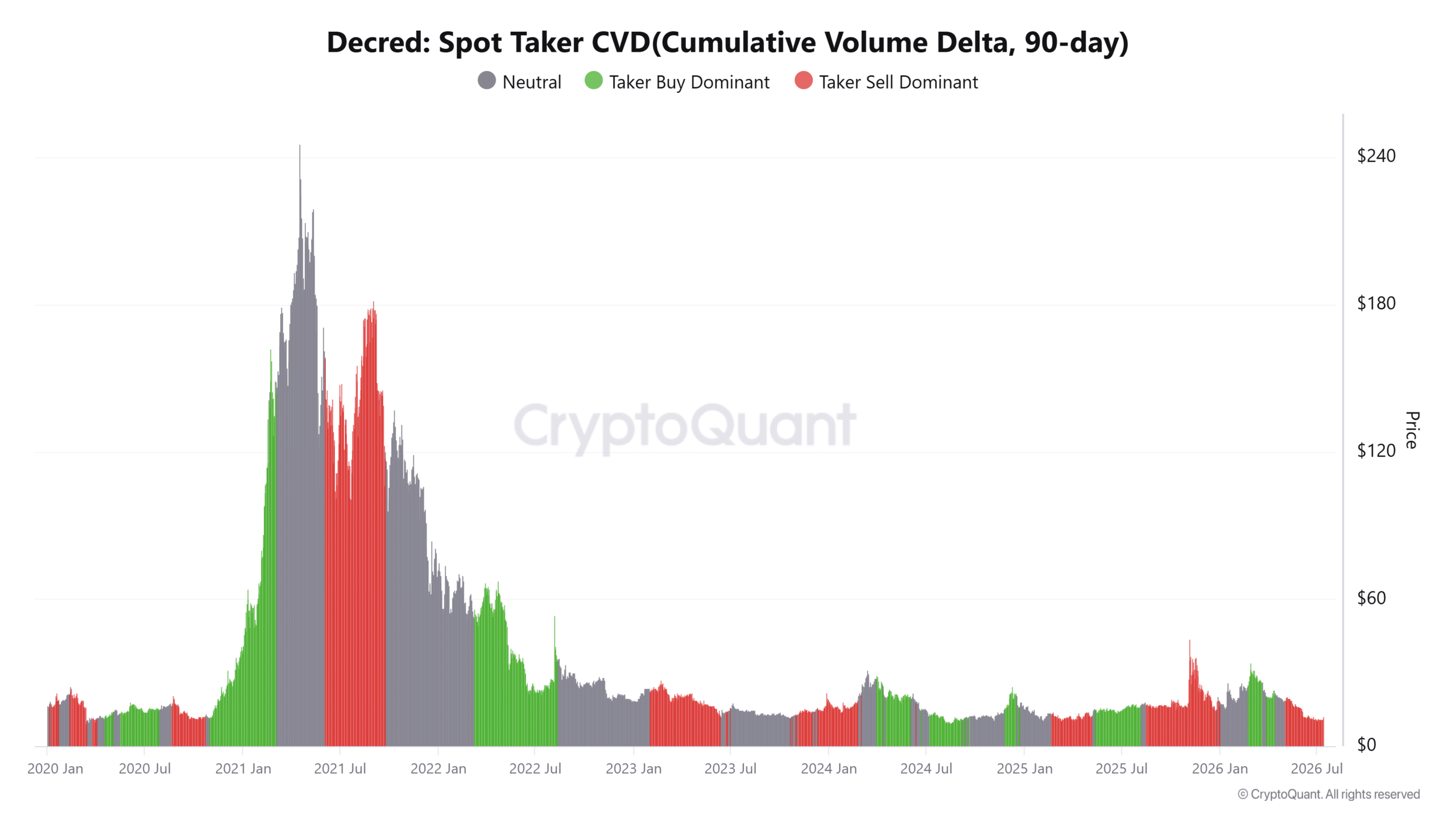
Chỉ số Chênh lệch Khối lượng Tích lũy (CVD) 90 ngày trên Thị trường Giao ngay vẫn chịu sự chi phối của người bán, cho thấy lệnh bán thị trường tiếp tục vượt quá lệnh mua chủ động trong suốt giai đoạn rộng hơn. Chỉ số như vậy nhấn mạnh rằng người bán vẫn vào lệnh ngay cả khi giá tăng mạnh. Tuy nhiên, người mua đã hấp thụ phần lớn nguồn cung đó thay vì để đợt tăng giá đảo chiều ngay lập tức.

Hành vi như vậy thường phản ánh nhu cầu được cải thiện vì hoạt động mua vào bền vững đã xoay xở để bù đắp áp lực bán liên tục. Dù vậy, chỉ số cho thấy niềm tin tăng giá đã không trở thành một chiều. Nếu việc bán chủ động tiếp tục gia tăng gần các mức giá cao hơn, DCR có thể đối mặt với sức kháng cự mạnh hơn trước khi mở rộng đà phục hồi.
Nguồn: CryptoQuant

Các lệnh lớn ám chỉ niềm tin thị trường mạnh hơn

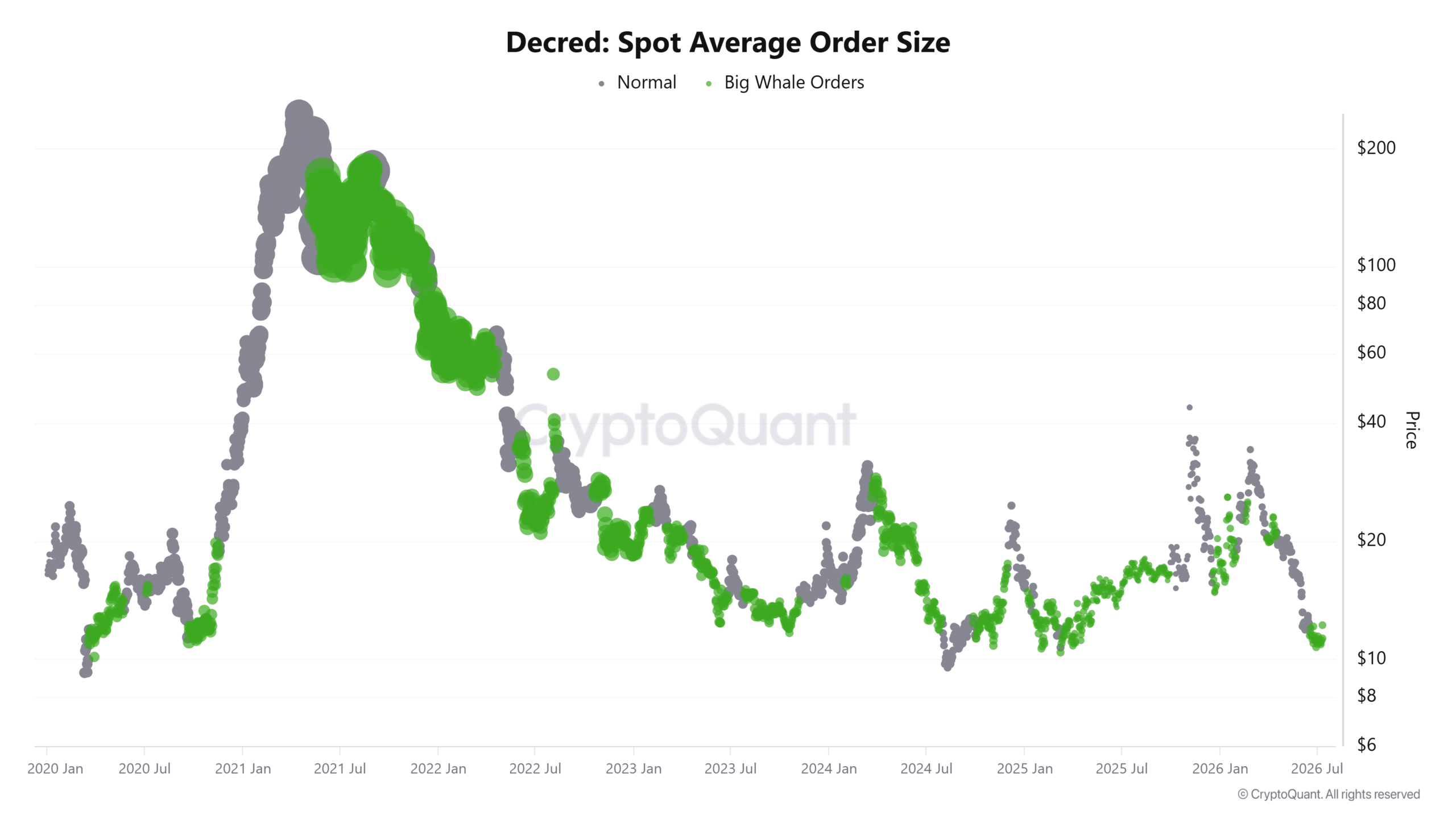
Chỉ số Quy mô Lệnh Trung bình Giao ngay cho thấy sự xuất hiện của các lệnh lớn từ cá voi (whale) trong đợt tăng giá, tiết lộ rằng những người tham gia lớn đã trở nên tích cực hơn. Sự phát triển này phù hợp với sự gia tăng mạnh về khối lượng giao dịch thay vì mâu thuẫn với nó.

Các giao dịch lớn hơn thường phản ánh việc triển khai vốn mạnh hơn so với hoạt động do nhà đầu tư nhỏ lẻ (retail) dẫn dắt. Mặc dù chỉ số không tiết lộ liệu mọi lệnh đại diện cho việc mua hay bán, nhưng nó xác nhận sự tham gia ở quy mô tổ chức đã tăng lên.

Sự tham gia như vậy thường có ảnh hưởng lớn hơn đến hướng giá ngắn hạn vì các lệnh lớn hấp thụ tính thanh khoản hiệu quả hơn. Khi sự quan tâm từ những người chơi lớn hơn mở rộng, Decred đã thu hút sự chú ý rộng rãi hơn của thị trường.

Dù vậy, sự tham gia tiếp tục từ những nhà giao dịch này sẽ vẫn cần thiết nếu người mua có ý định duy trì đà tăng gần đây.
Nguồn: CryptoQuant

Phá vỡ kênh giá thay đổi triển vọng kỹ thuật của DCR

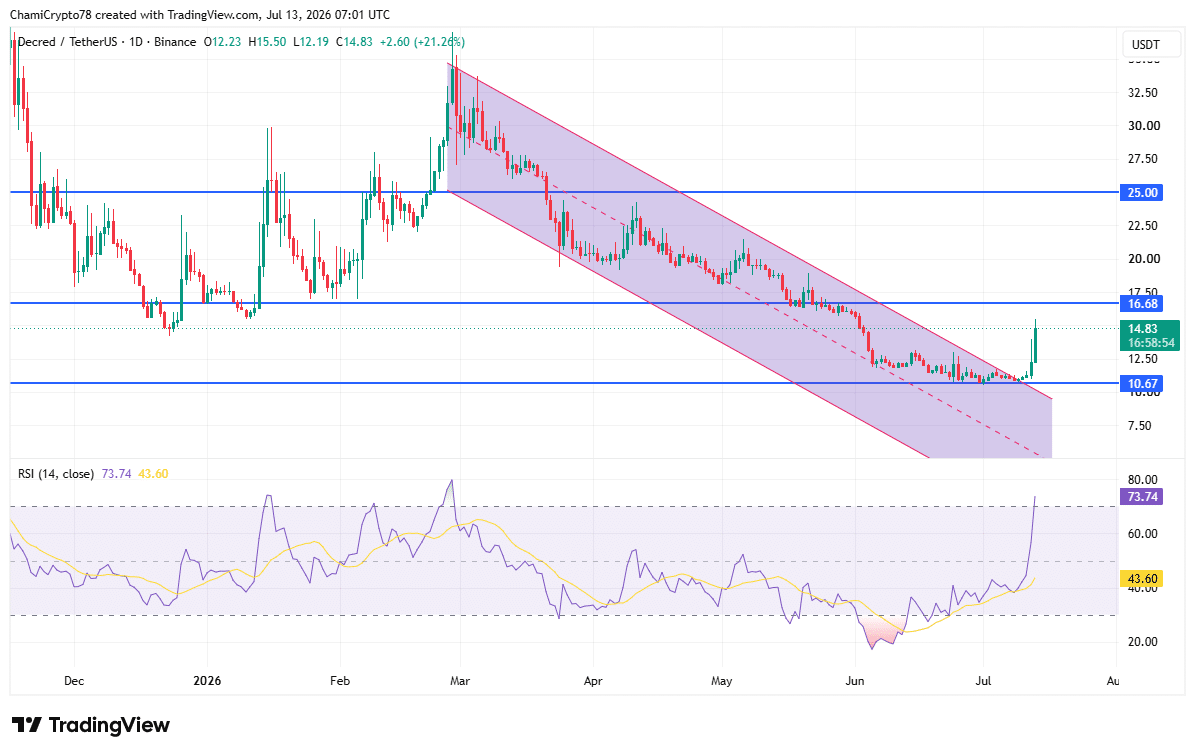
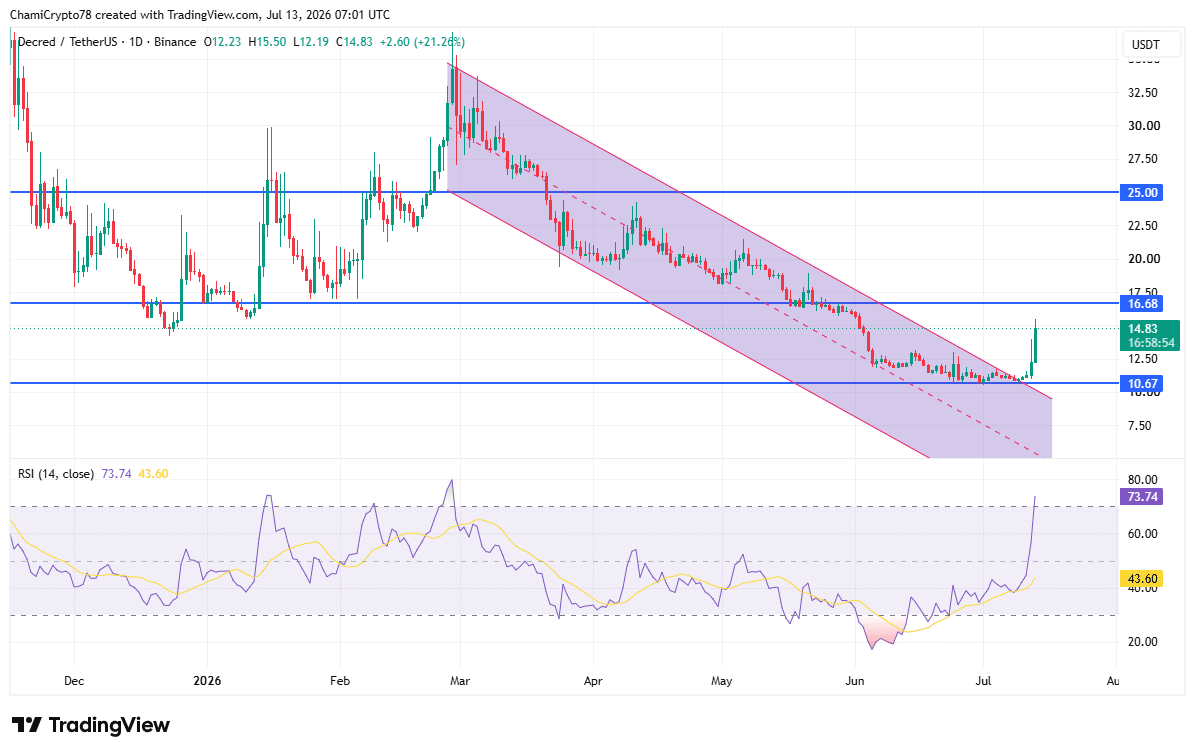
DCR đã phá vỡ lên trên kênh giá giảm kéo dài nhiều tháng sau khi dành nhiều tháng tôn trọng các đỉnh thấp hơn và đáy thấp hơn. Sự phá vỡ này đánh dấu lần vi phạm mang tính quyết định đầu tiên đối với cấu trúc giảm giá có thể nhìn thấy trên biểu đồ hàng ngày. Giá cũng phục hồi mạnh mẽ từ vùng hỗ trợ gần 10,67 USD trước khi leo lên hướng tới vùng kháng cự chính tiếp theo ở mức 16,68 USD.

Trong khi đó, Chỉ số Sức mạnh Tương đối (RSI) đạt 73,74 tại thời điểm viết bài, đặt chỉ báo này vào lãnh thổ mua quá mức sau khi tăng mạnh từ các điều kiện trung lập. Các chỉ số đọc như vậy thường chỉ ra hoạt động mua đặc biệt mạnh, nhưng chúng cũng cảnh báo về khả năng kiệt sức trong ngắn hạn.

Dù vậy, việc phá vỡ vẫn có ý nghĩa kỹ thuật quan trọng vì giá đóng cửa trên kênh giảm thay vì bị từ chối từ đường biên trên của nó. Nếu người mua bảo vệ được vùng phá vỡ, DCR có thể thách thức mốc 16,68 USD. Nếu không, việc chốt lời có thể kích hoạt một đợt điều chỉnh giảm lành mạnh trước một đợt tăng giá khác.
Nguồn: TradingView

DCR có thể vượt qua mốc 16,68 USD tiếp theo?

Việc phá vỡ của Decred đã cải thiện đáng kể cấu trúc kỹ thuật của nó sau nhiều tháng yếu kém liên tục.

Khối lượng tăng và các lệnh cỡ cá voi gia tăng đã hỗ trợ cho sự thay đổi đó, mặc dù sự thống trị của người bán trong Spot Taker CVD cho thấy nguồn cung vẫn chưa biến mất.

Nếu người mua tiếp tục hấp thụ việc bán chủ động, DCR có thể lấy lại mức 16,68 USD và củng cố đà phục hồi. Ngược lại, áp lực bán dai dẳng gần vùng kháng cự có thể làm chậm đà tăng trước khi bước đi tiếp theo theo hướng mới phát triển.


Tóm tắt cuối cùng

  • Decred đã phá vỡ xu hướng giảm dài hạn trong khi khối lượng tăng phản ánh sự tham gia trở lại của thị trường.
  • Áp lực bán vẫn tồn tại, tuy nhiên người mua đã hấp thụ nguồn cung khi DCR tiến gần đến vùng kháng cự chính gần 16,68 USD.


Trending Cryptos

Related Questions

QDecred (DCR) đã có mức tăng trưởng bao nhiêu phần trăm trong 24 giờ qua theo bài viết?

ADecred (DCR) đã tăng 24.03% trong vòng 24 giờ qua.

QMức kháng cự tiếp theo chính mà DCR đang hướng tới là gì?

AMức kháng cự tiếp theo chính mà DCR đang hướng tới là 16.68 đô la.

QChỉ báo nào cho thấy áp lực bán vẫn tồn tại bên dưới đợt tăng giá, theo bài viết?

AChỉ báo 90-day Spot Taker Cumulative Volume Delta (CVD) cho thấy áp lực bán vẫn chiếm ưu thế.

QSự gia tăng của chỉ báo Spot Average Order Size cho thấy điều gì về thị trường?

ASự gia tăng của chỉ báo Spot Average Order Size cho thấy sự xuất hiện của các lệnh lớn từ 'cá voi', phản ánh sự tham gia ngày càng tích cực của các nhà đầu tư tổ chức hoặc có số vốn lớn.

QÝ nghĩa kỹ thuật quan trọng của việc DCR phá vỡ kênh giảm giá nhiều tháng là gì?

AViệc phá vỡ kênh giảm giá nhiều tháng là một tín hiệu kỹ thuật quan trọng, đánh dấu sự vi phạm quyết định đầu tiên đối với cấu trúc giảm giá và cải thiện triển vọng kỹ thuật của DCR.

Related Reads

U.S. Tech Momentum Stocks Post Largest Single-Day Gain Ever, But Is the Plunge Over?

US tech momentum stocks staged a sharp rebound on Tuesday (July 21st). Morgan Stanley's TMT Momentum Factor surged over 12%, marking its largest single-day gain on record, exceeding even peaks from the 2000 dot-com bubble. Key momentum indices from Goldman Sachs also posted their strongest daily performances in years. The rally was led by semiconductors, with the Philadelphia Semiconductor Index jumping 4.6%. This rebound followed three consecutive down days and a cumulative 33% plunge in momentum stocks, one of the steepest drawdowns since the dot-com era. Analysts attribute the surge largely to a short squeeze. Heavy selling had pushed high-beta momentum stocks into deeply oversold territory, forcing many short sellers, particularly in Asia, to cover their positions, creating a self-reinforcing buying spiral. However, the rebound's internals appear weak. Trading volume was notably low, and advancing stocks still lagged decliners on the S&P 500, indicating a narrow, concentrated rally rather than broad market participation. Diverging views emerge on the outlook. BTIG warns the bounce has hit key resistance and recommends selling into strength, citing extreme volatility and historical parallels to past market tops. Conversely, Goldman Sachs and UBS believe the momentum unwind is nearing its end, suggesting it may be time to gradually add exposure, as positioning has been significantly reduced. They caution, however, that high volatility warrants a measured approach, potentially using defined-risk strategies. The upcoming earnings season, particularly reports from major tech firms like Alphabet, is seen as a critical test for the rally's sustainability. Simultaneously, bond markets flashed a warning, with yields rising partly due to spiking oil prices. Analysts note that if long-term Treasury yields break decisively higher, it could pose a significant headwind for equities, especially growth stocks.

marsbit5m ago

U.S. Tech Momentum Stocks Post Largest Single-Day Gain Ever, But Is the Plunge Over?

marsbit5m ago

U.S. Tech Momentum Stocks Record Largest Single-Day Gain Ever, but Has the Rout Ended?

U.S. tech momentum stocks staged a dramatic rebound on Tuesday, July 21st. Key momentum indices like the Morgan Stanley TMT Momentum Factor and Goldman Sachs' High Beta Momentum Long Index posted historic or near-historic single-day gains, fueled largely by semiconductor stocks. This sharp rally followed a severe three-day sell-off that saw momentum stocks plunge 33%, marking one of the steepest pullbacks since the dot-com bubble. Analysts attribute the bounce primarily to a short squeeze, as forced covering from over-leveraged traders, particularly in Asia, created a buying spiral. However, the rally's health is questioned due to weak market breadth—overall trading volume was low, and decliners outnumbered advancers in the S&P 500 despite the index's gain—suggesting a narrow, concentrated surge rather than broad recovery. Opinions on the sustainability diverge. BTIG strategists warn the rebound has hit key resistance levels, citing extreme volatility and historic stock dispersion as signs of an ongoing broader correction, and recommend selling into strength. Conversely, Goldman Sachs and UBS view the aggressive momentum unwinding as nearing its end, noting reduced positioning and a lack of new fundamental catalysts. They suggest the sell-off presents a selective opportunity to add exposure, albeit cautiously and gradually using defined-risk strategies. The immediate trajectory hinges on the ongoing earnings season, with market focus on Alphabet's capital expenditure guidance for AI investment clarity. Meanwhile, bond markets present a risk, with rising Treasury yields—potentially heading toward 5.5%—and widening credit spreads for mega-cap tech companies posing a threat to equity valuations. The combination of technical factors, earnings results, and macro conditions leaves the durability of the rebound in doubt.

链捕手8m ago

U.S. Tech Momentum Stocks Record Largest Single-Day Gain Ever, but Has the Rout Ended?

链捕手8m ago

Long-Divided Must Unite, Long-United Must Divide: When L1 Becomes Its Own Rollup, What Is Ethereum's Endgame?

"The Inevitable Cycle: When L1 Becomes Its Own Rollup – What is Ethereum's Endgame?" For years, the Ethereum community grappled with concerns that L2s were fragmenting the ecosystem and eroding L1's value. While L2s provided cheaper execution, they also splintered liquidity and the unified user experience of a single chain. This has prompted a fundamental reassessment of the relationship between L1 and L2. Ethereum's roadmap is evolving. The "Scale" initiative merges L1 and L2 expansion into a holistic framework. L1 itself is advancing with higher gas limits, statelessness, and zkEVM verification, no longer content to be just a low-throughput settlement layer. Consequently, the primary value proposition of L2s is shifting from merely providing cheap blockspace to offering L1 cannot easily provide: application-specific optimizations, privacy features, and flexible governance models. L2s are becoming a spectrum of execution environments with varying degrees of security inheritance from Ethereum. A critical challenge in this multi-chain future is interoperability. The vision is to make Ethereum "feel like one chain again." This relies on advancements in native account abstraction (like EIP-7702) and intent-based architectures (Open Intents Framework), where users declare desired outcomes, and solvers handle the complex cross-chain execution. Furthermore, shortening Ethereum's finality time from minutes to seconds is crucial, as it underpins trust between chains for bridges, stablecoins, and cross-chain applications. Perhaps the most provocative idea is that Ethereum L1 itself could become a form of "its own Rollup." As zkEVM and proof systems mature, high-performance nodes could execute transactions and generate validity proofs. Regular validators would then verify these proofs instead of re-executing all transactions. This blurs the traditional L1/L2 hierarchy, making "Rollup" more of a general execution-verification architecture. Native Rollup aims to integrate L2 validation more directly into the Ethereum protocol, allowing L2s to inherit L1's security more fully and move away from reliance on security councils. In the end, L2s are not destined to replace L1 or be made obsolete by it. The likely future is a unified system where diverse execution environments—each optimized for specific use cases like DeFi, gaming, or privacy—coexist. They will share a common foundation of security, liquidity, and verifiable state, seamlessly connected to restore a cohesive user experience. The next phase for Ethereum is not just about scaling through separation, but about intelligently reintegrating what was separated back into a coherent whole.

链捕手24m ago

Long-Divided Must Unite, Long-United Must Divide: When L1 Becomes Its Own Rollup, What Is Ethereum's Endgame?

链捕手24m ago

Agent Race Ends, Super Workbench Takes Over

The era of fragmented AI agents is ending. Over the past month, China's tech giants—Tencent, Alibaba, and ByteDance—have simultaneously shifted strategy: instead of launching new, standalone AI agents, they are consolidating their various agent projects into unified "super workbenches." Tencent integrated its QClaw teams into WorkBuddy, a strategic product hailed as a potential third flagship after QQ and WeChat. Alibaba is merging its QoderWork, Wukong, and MuleRun agents into a new "Qianwen Office" platform under DingTalk's leadership. ByteDance rebranded its TRAE SOLO coding agent to TRAE Work, signaling a broader focus on workflow collaboration. This convergence marks a pivotal industry consensus. The initial exploration phase, where companies rapidly built numerous overlapping agents for different scenarios, proved costly and inefficient. With open-source tools eroding technical barriers, competition has shifted from agent creation to resource consolidation and cost control. Historically, platform wars are won not by creating more products, but by simplifying them—as seen with browsers unifying web access and super-apps consolidating services. Now, the "super workbench" aims to become the unified AI entry point for work. This reflects a deeper market realization: the primary audience for AI is no longer just programmers (a market in the tens of millions) but all knowledge workers (a market of billions). The real opportunity lies in augmenting everyday tasks—managing emails, documents, data, and meetings—across the entire workday. The core battleground is becoming control over the primary AI entry point that employees use daily. Tencent's WorkBuddy leverages WeChat and Tencent Docs; Alibaba's Qianwen Office taps into DingTalk's organizational data; ByteDance's TRAE Work integrates with Feishu's workflows. Whoever owns this "super workbench" gains strategic control over orchestrating enterprise data and APIs. This shift is redefining enterprise software. Traditional SaaS applications, valued for their user interfaces, will recede into the background. Their core functionalities will be exposed as standardized "Skills" or APIs for the super workbench's agents to invoke. Software value will shift from selling user seats to charging based on API calls and outcomes delivered. The evolution of agents is moving through clear stages: first as novel standalone products, then as consolidated primary work entry points, and finally as pervasive, invisible capabilities embedded into the digital fabric. The recent moves by major tech firms signal the transition from the first stage into the second, accelerating toward the third. In the end, the most successful agent technology may become invisible—like electricity or the HTTP protocol—a fundamental, unnamed infrastructure powering work itself.

marsbit51m ago

Agent Race Ends, Super Workbench Takes Over

marsbit51m ago

Trading

Spot

Hot Articles

How to Buy RE

Welcome to HTX.com! We've made purchasing Re (RE) simple and convenient. Follow our step-by-step guide to embark on your crypto journey.Step 1: Create Your HTX AccountUse your email or phone number to sign up for a free account on HTX. Experience a hassle-free registration journey and unlock all features.Get My AccountStep 2: Go to Buy Crypto and Choose Your Payment MethodCredit/Debit Card: Use your Visa or Mastercard to buy Re (RE) instantly.Balance: Use funds from your HTX account balance to trade seamlessly.Third Parties: We've added popular payment methods such as Google Pay and Apple Pay to enhance convenience.P2P: Trade directly with other users on HTX.Over-the-Counter (OTC): We offer tailor-made services and competitive exchange rates for traders.Step 3: Store Your Re (RE)After purchasing your Re (RE), store it in your HTX account. Alternatively, you can send it elsewhere via blockchain transfer or use it to trade other cryptocurrencies.Step 4: Trade Re (RE)Easily trade Re (RE) on HTX's spot market. Simply access your account, select your trading pair, execute your trades, and monitor in real-time. We offer a user-friendly experience for both beginners and seasoned traders.

1.5k Total ViewsPublished 2026.06.18Updated 2026.06.29

How to Buy RE

Discussions

Welcome to the HTX Community. Here, you can stay informed about the latest platform developments and gain access to professional market insights. Users' opinions on the price of RE (RE) are presented below.

活动图片