GPT-6 is Coming, OpenAI Completely Abandons the 4T Old Foundation

marsbitPublished on 2026-07-09Last updated on 2026-07-09

Abstract

OpenAI is accelerating its roadmap, with GPT-6 rumored for imminent release and the complete abandonment of the older ~4 trillion parameter "Spud" base model. Meanwhile, the GPT-5.6 series has been officially greenlit by regulators and will launch publicly on Thursday, July 9th. This release features three specialized models: GPT-5.6 Sol (a high-performance flagship for complex coding, science, and security), GPT-5.6 Terra (a cost-effective generalist), and GPT-5.6 Luna (a high-speed, low-cost option for agents). Early testers praise Sol's relentless, "never-give-up" problem-solving approach, comparing its tenacity to a "Rottweiler" versus competitor Anthropic's Fable 5, described as a more insightful but sometimes haughty "wise owl." While some testers still favor Fable for certain creative or architectural tasks, GPT-5.6 Sol is highlighted for its dependable execution, strong sub-agent coordination, and significant improvements in coding efficiency, leading to a proposed optimal workflow: using Fable for brainstorming, Sol for execution, and Fable again for documentation.

OpenAI urgently moves up the schedule for GPT-6, completely abandoning the 4T old foundation? Moreover, GPT-5.6 is officially lifted from restrictions and will be launched this Thursday! The three models Sol, Terra, and Luna are fully open, covering coding, scientific research, and daily tasks. Early testers have already raved about the Sol model, praising it for "never giving up." Now, all developers are gearing up.

Just now, a piece of news instantly spread across the industry.

The release date for GPT-6 has been significantly brought forward, with the earliest official launch expected within this month!

If the leaks are true, it means the GPT-5.x series will conclude with GPT-5.6, becoming the final chapter.
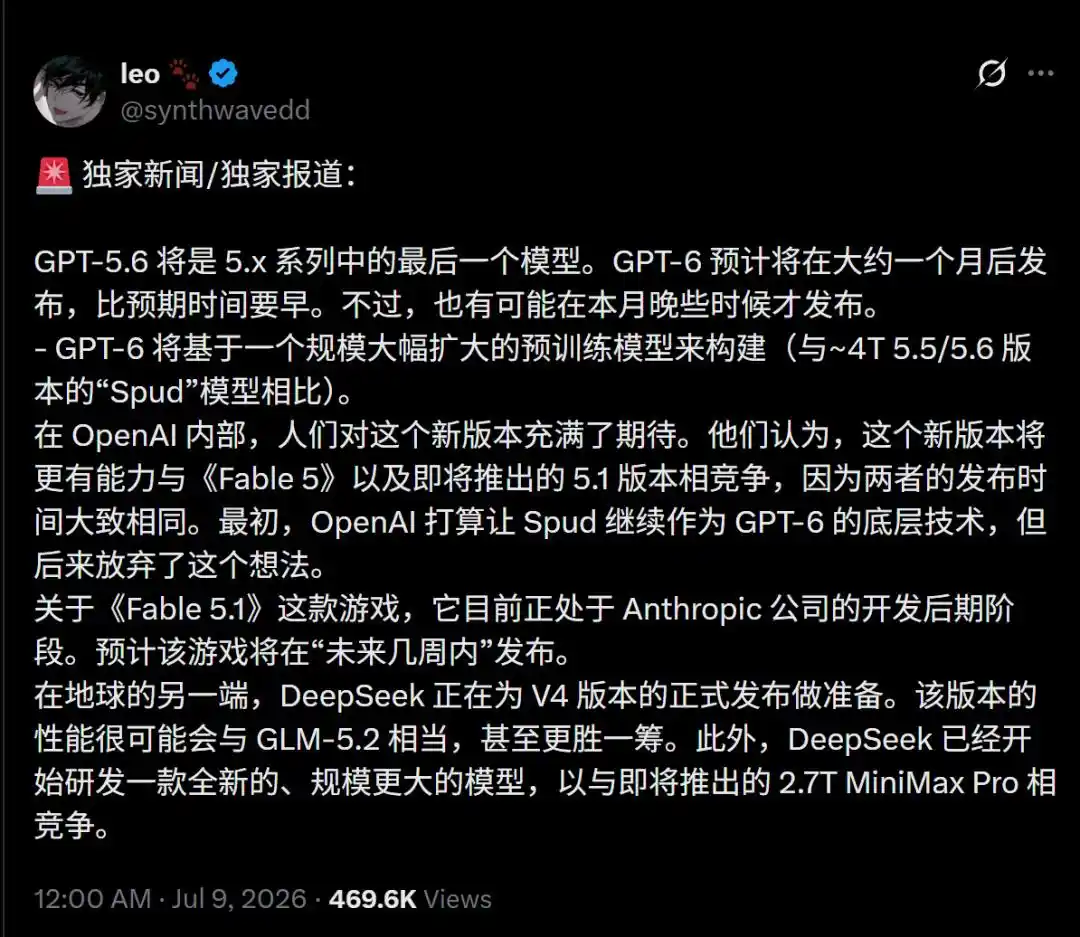
It is reported that this time, OpenAI has made a highly audacious decision—completely abandoning the previous 'Spud' foundation with approximately 4 trillion parameters, and instead betting on a new, larger-scale pre-training foundation.

Clearly, OpenAI's intention is direct: to use this new foundation to directly compete with Anthropic's upcoming Fable 5.1, which is set to be released in a few weeks.

And just yesterday afternoon, good news arrived: GPT-5.6 is fully unrestricted! See you this Thursday!

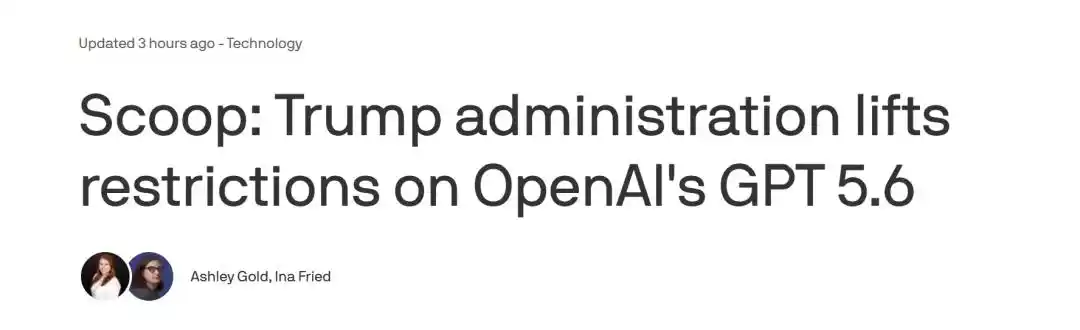
Yesterday at noon, Axios exclusively broke the scoop: the official restrictions on OpenAI's GPT-5.6 access have been formally lifted.
Immediately after, OpenAI officially announced on X: the flagship model GPT-5.6 Sol, along with Terra and Luna, will be officially released to global users this Thursday (July 9)!
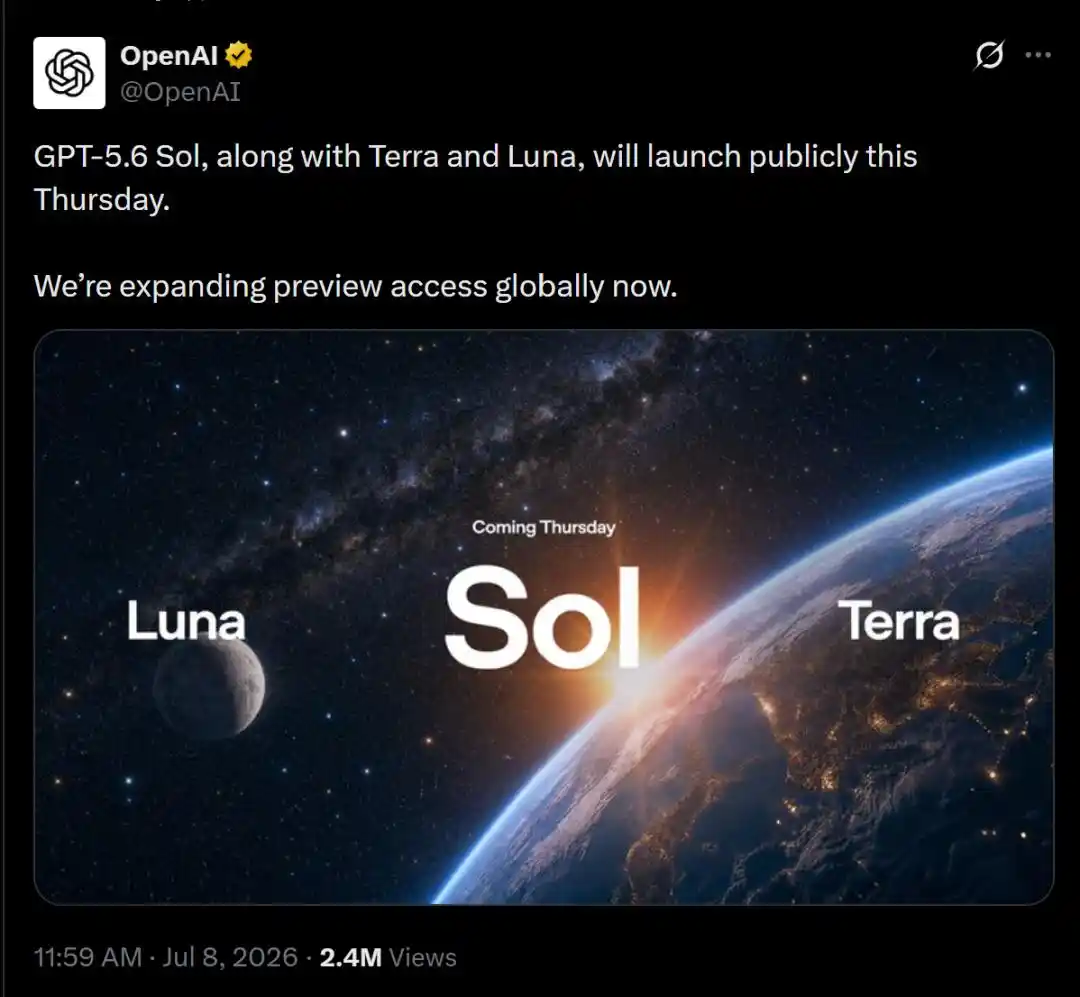
The highly anticipated "trump card" model, having struggled through a month of "limited preview for government and enterprise," has finally been freed.

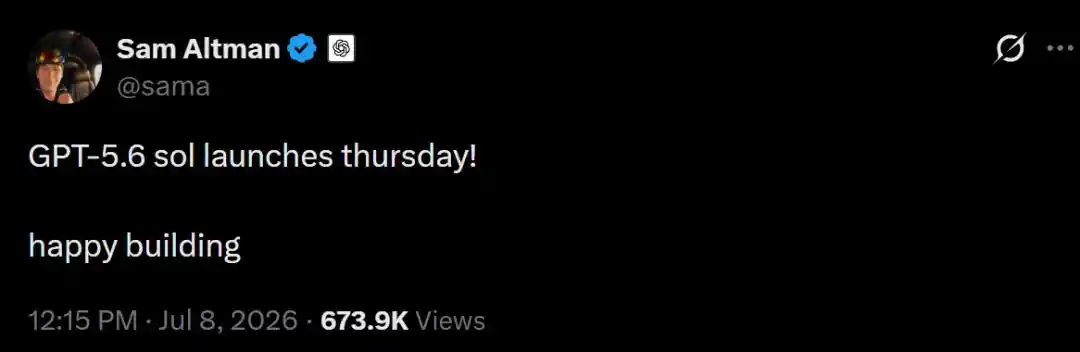
Sam Altman addressed developers: Happy Building!
Coercion, Negotiation, and a Midnight Unlock

On June 26, OpenAI quietly began a preview of GPT-5.6, limited to a select few.

This was because the "AI Standards and Innovation Center" under the U.S. Department of Commerce directly stationed itself at OpenAI, even forcibly detaining OpenAI's technical experts for "security review."

According to the latest AI executive order, the release of frontier models must undergo real-time case-by-case negotiation.

Now, why has the government suddenly relented?

Industry insiders reveal that OpenAI's experts underwent countless real attack pressure tests and vulnerability fixes in Washington, ultimately successfully proving: GPT-5.6 is OpenAI's most robust security system to date.

In today's announcement, OpenAI particularly emphasized with implied meaning: "We cooperate with the government, but short-term restrictions pave the way for broader availability. We absolutely do not want government pre-access to become the norm; technology must not be monopolized."

Now, the shoe has dropped, and the government has given the green light. The long-awaited global developer community's anticipation has instantly skyrocketed.

"Three Arrows Released": How Powerful Are Sol, Terra, and Luna?

This trio of new models has clearly defined roles.

GPT-5.6 Sol: The Ultimate Flagship

Sol focuses on frontier capabilities, specializing in complex coding, cutting-edge science, and cybersecurity tasks.

Its biggest feature is extreme reasoning.

Some say the capability leap of GPT-5.6 is comparable to the jump from GPT-4 to o1.
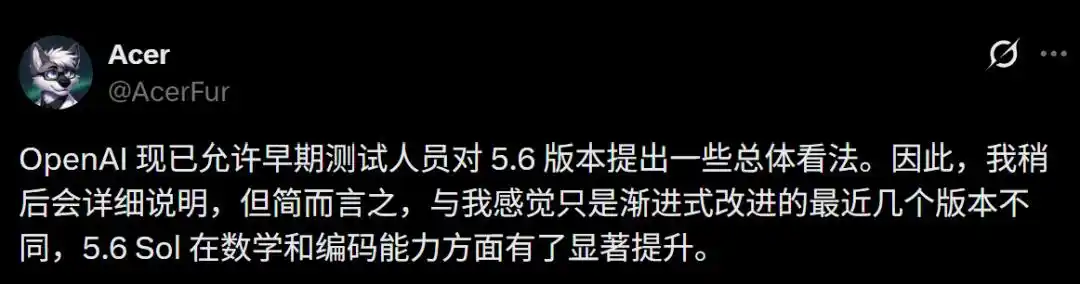
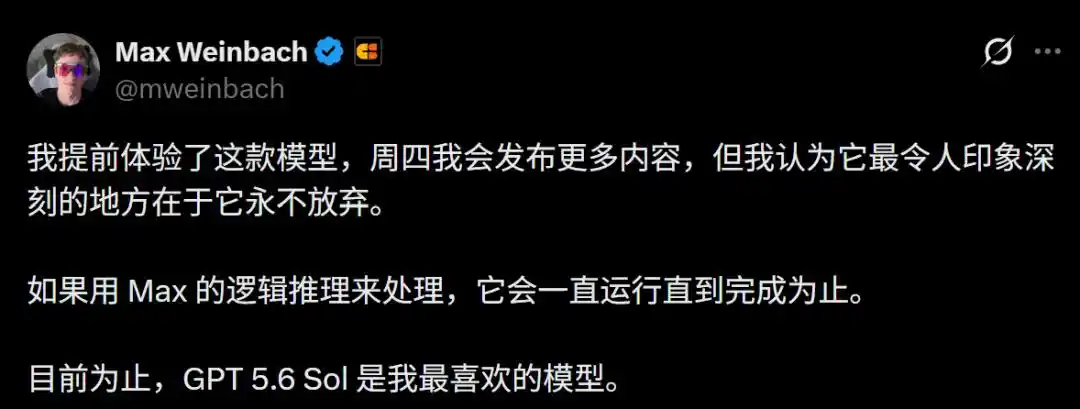
Early tester Max Weinbach excitedly commented: "The most terrifying thing about this model is that it never gives up! If you throw it into extreme reasoning mode, it obsessively perseveres and won't stop until the problem is completely solved."
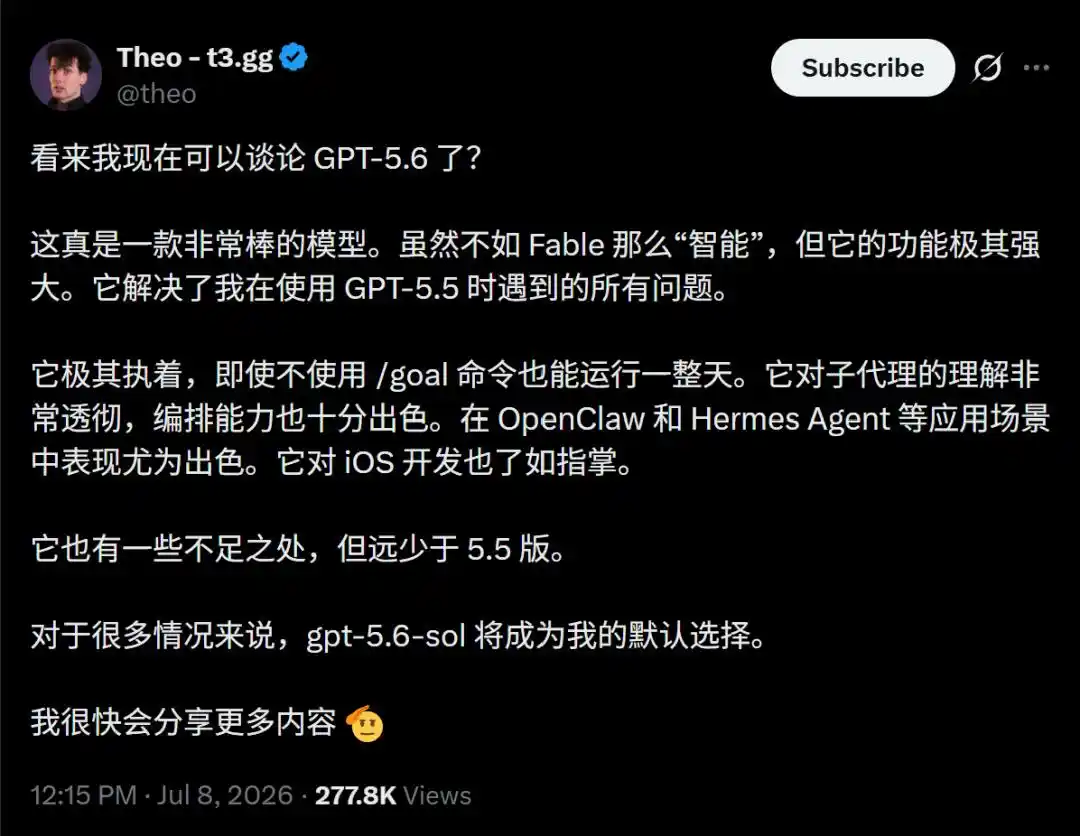
Others say GPT-5.6 is extremely tenacious, able to run for an entire day even without the /goal command.
GPT-5.6 Terra: King of Cost-Effectiveness, The Terminator of 5.5

Performance approaches the previous super flagship GPT-5.5, but the cost is directly halved!

This is a workhorse tool tailored for high-frequency daily workloads. Its arrival means GPT-5.5 is out.

GPT-5.6 Luna: Fast as Lightning, Dirt Cheap

Luna focuses on extreme speed and ultra-low cost, the top choice for frequently called agents.

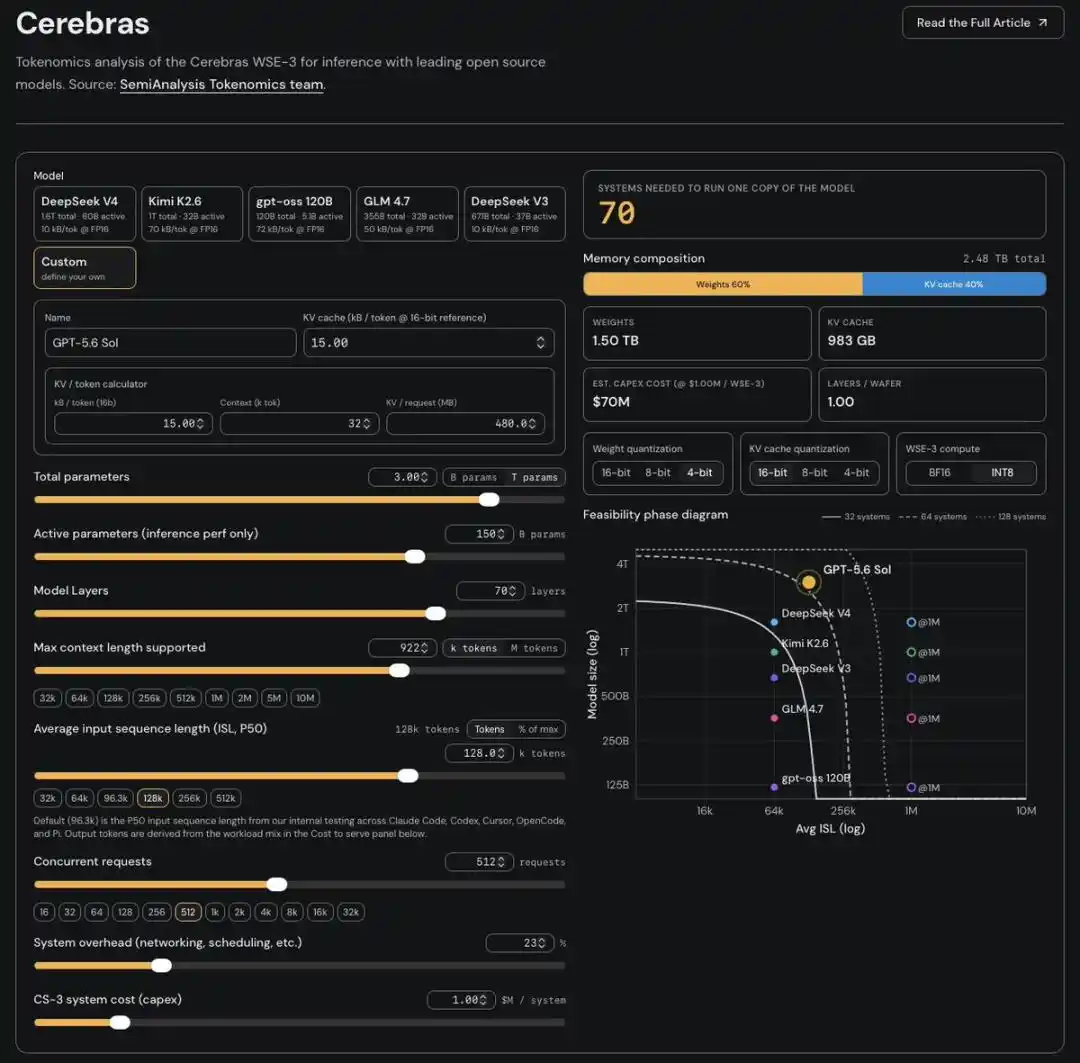
Even more exaggerated is the seamless integration into the hardware ecosystem. It is reported that GPT-5.6 Sol will directly land on the Cerebras inference platform, achieving a breathtaking inference speed of 750 tokens per second!

In high-intensity scenarios like coding, biopharmaceutical R&D, and network attack/defense, this experience is simply mind-blowing.
No wonder a developer who tested it early exclaimed: "I felt like I was going crazy when I couldn't use the 5.6 version."

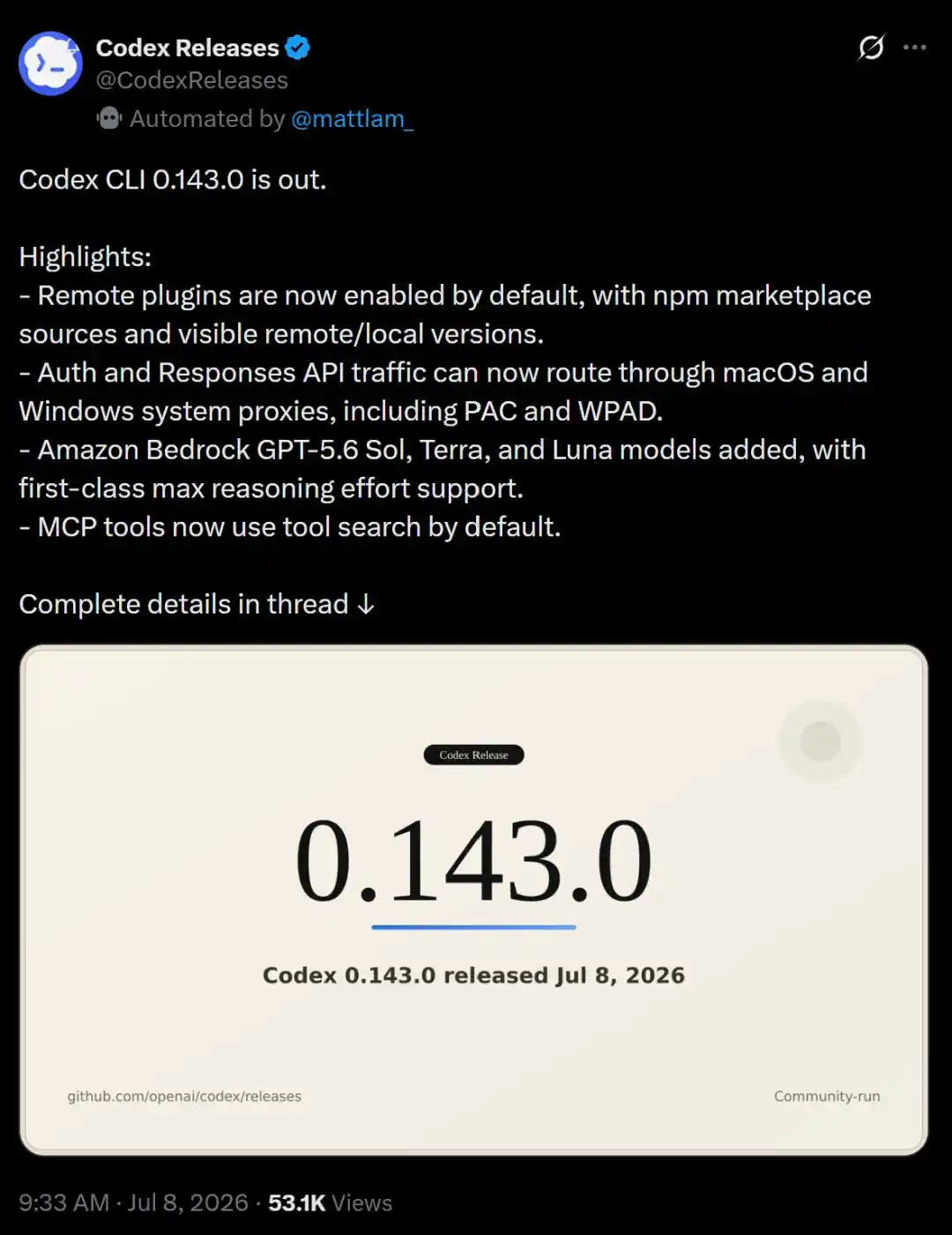
Just today, the update log for Codex CLI version 0.143.0 was also leaked: the Amazon Bedrock platform has quietly added the GPT-5.6 trio and provides support for Max inference intensity.

Judging from the configuration, these models are likely specifically prepared for the Max tier.
The First Wave of Hands-On Experts Have Spoken

Now, users on X who got early hands-on access have started giving their reviews.

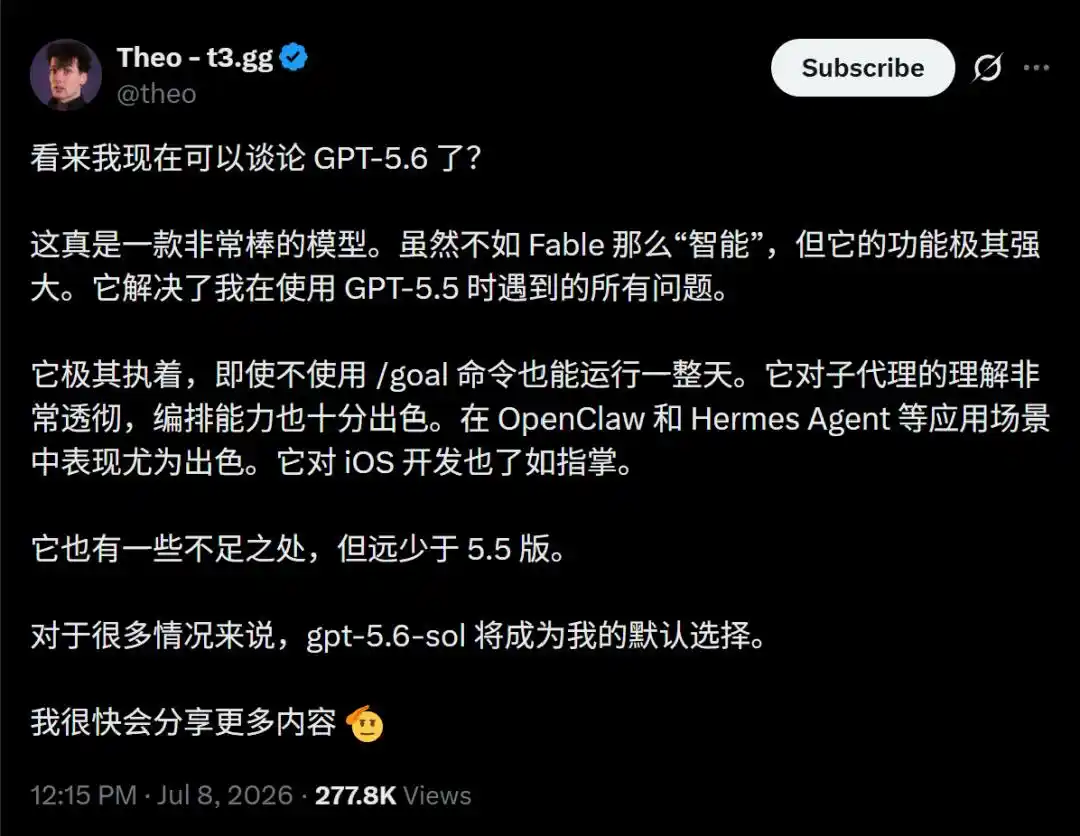
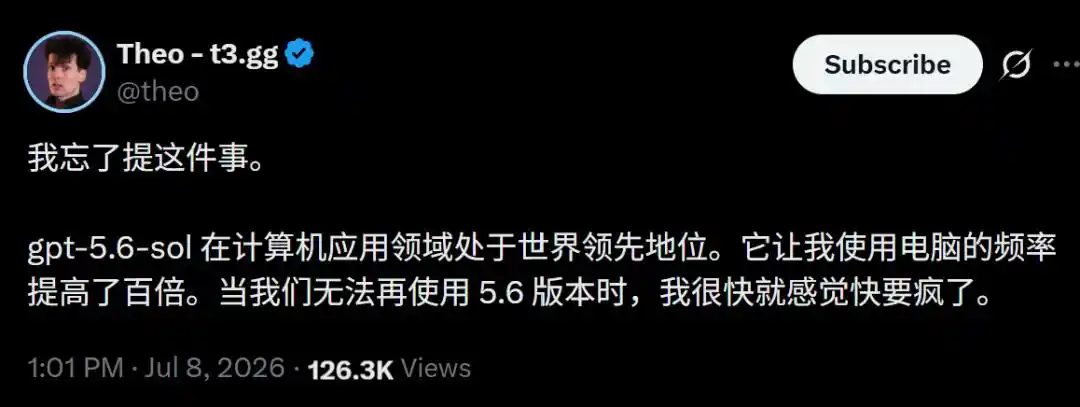
Well-known developer Theo posted several tweets on X, directly praising it to the skies.

GPT-5.6 solves all the pain points I encountered when using 5.5. It is extremely tenacious; even without giving it a /goal instruction, it can run by itself for an entire day! Its understanding and orchestration of sub-agents is magical. It increased my computer usage frequency a hundredfold. When the beta ended and I could no longer use 5.6, I felt like I was going crazy!
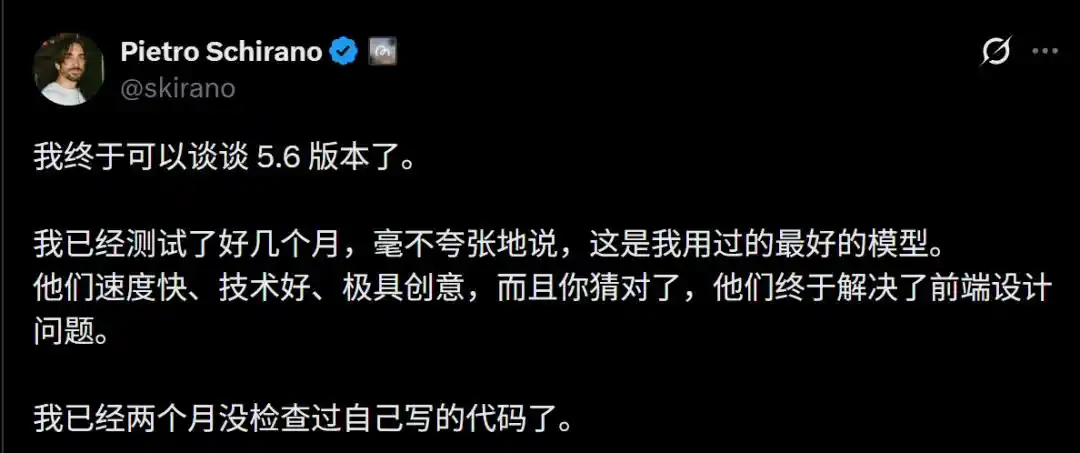
Magicpathai CEO Pietro Schirano also gave positive feedback.

Without exaggeration, this is the best model I've ever used. It's fast, highly creative, and they finally fixed the frontend design issues! I haven't checked my own code for a full two months!
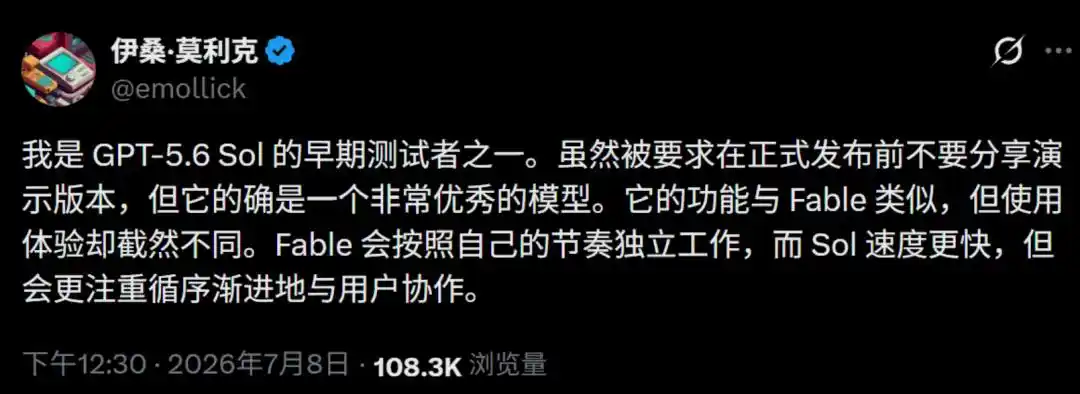
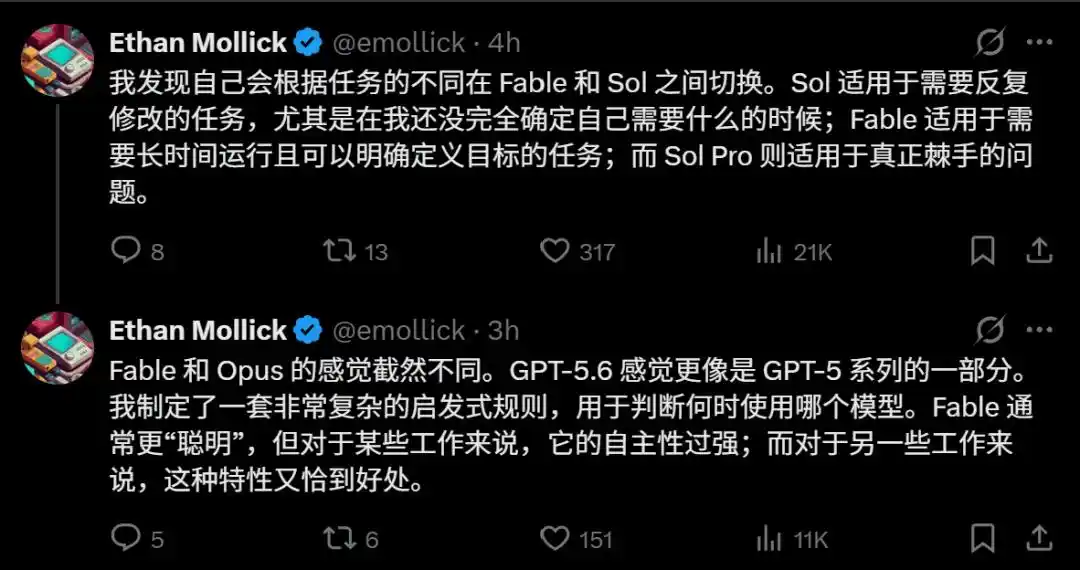
Wharton professor Ethan Mollick, on the other hand, compared Sol to Fable.

Sol's capabilities are similar to Fable's, but the experience is completely different. Fable likes to run off and complete tasks independently at its own pace; Sol is extremely fast and prefers high-frequency interaction, step-by-step with you. When I'm not clear about what I want, I'll use Sol for back-and-forth brainstorming; when I can clearly define the task, I'll use Fable for the long run. If I encounter a hellishly difficult problem, I'll go for Sol Pro.
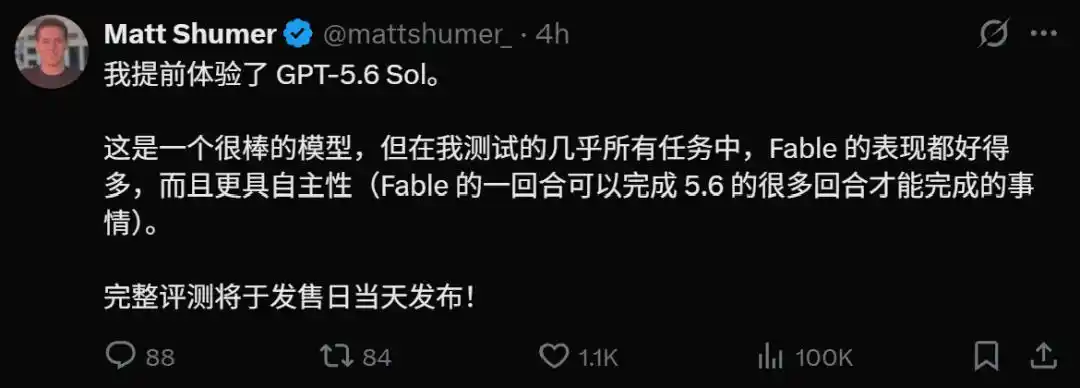
However, AI entrepreneur Matt Shumer voiced some dissent, stating bluntly:

Sol is a great model, but in the vast majority of tasks I tested, Fable is still better and more agentic.
LMArena Boss's Definitive Verdict: Wise Owl vs. Vicious Rottweiler

As a heavyweight player, LMArena head Peter Gostev also released the most in-depth and hardcore comparison currently available online.

He gave a highly visual metaphor: Fable 5 is like a "wise owl," while GPT-5.6-Sol is a "Rottweiler"—it will clamp down on the throat of the problem and won't let go until it's completely solved!
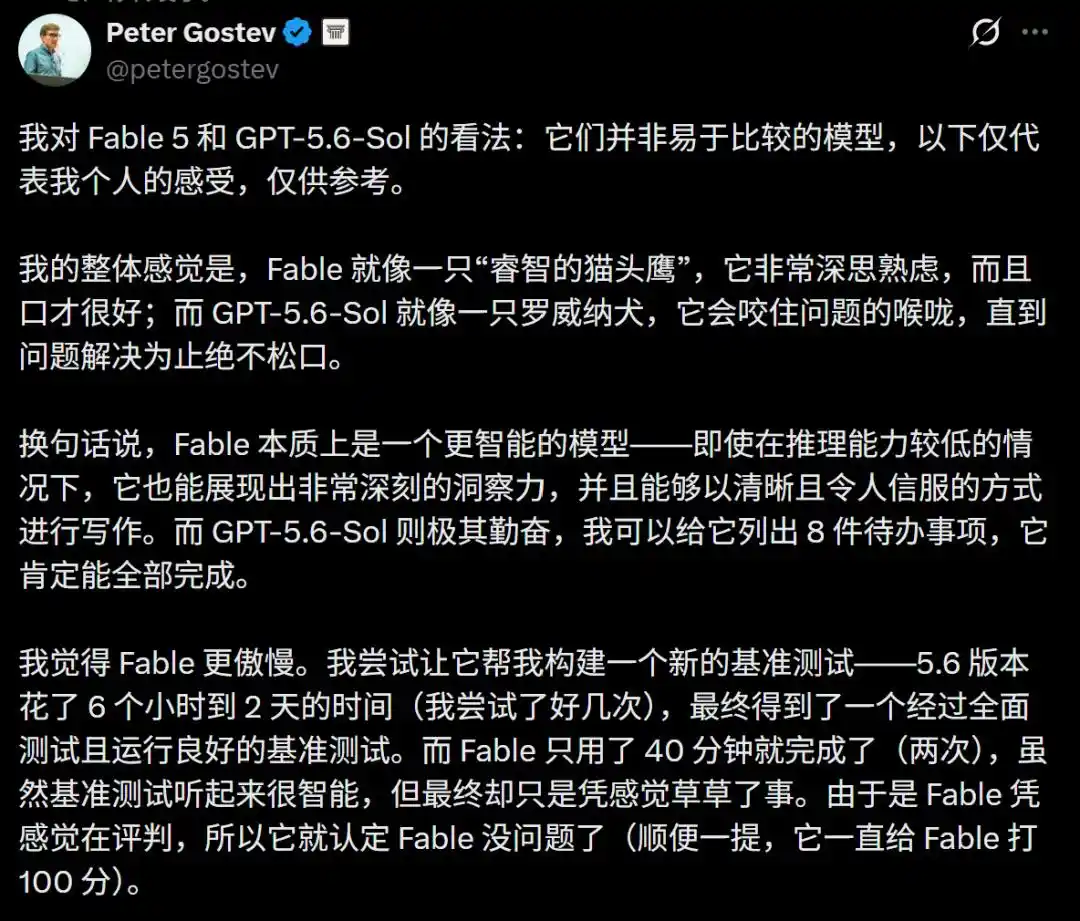
In Gostev's view, the underlying logic and user experience of the two are in stark conflict.

First, Fable 5 appears more arrogant.

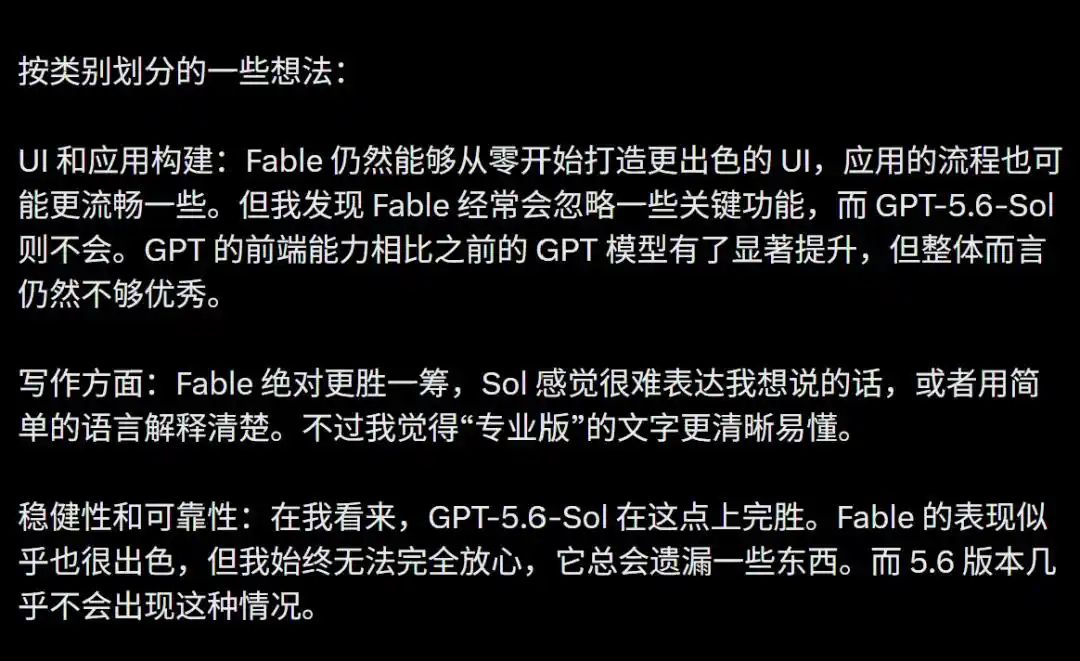
Fable is essentially smarter and has deeper insight. But when building a new benchmark test, Fable shows its "arrogance"—it finishes in 40 minutes, sounding intelligent but just going through the motions based on feeling, even giving itself a perfect 100 score.

In contrast, GPT-5.6-Sol is incredibly diligent, spending a full two days obsessively grinding out a perfectly tested and well-functioning benchmark.

Comparatively, GPT-5.6-Sol is a work machine, offering a sense of security.

Although Fable still dominates in building UI from scratch and text writing, it always misses key functionalities.

GPT-5.6-Sol brings unparalleled security—throw it 8 to-do items, and it will complete them all without fail, never missing a thing. Combined with the powerful /goal command, Sol can run continuously at high frequency for days and nights.

Additionally, Sol has achieved a qualitative leap in following existing code patterns, video editing (seamlessly handling 1-hour footage), managing sub-agent communication, deep research, and token efficiency.
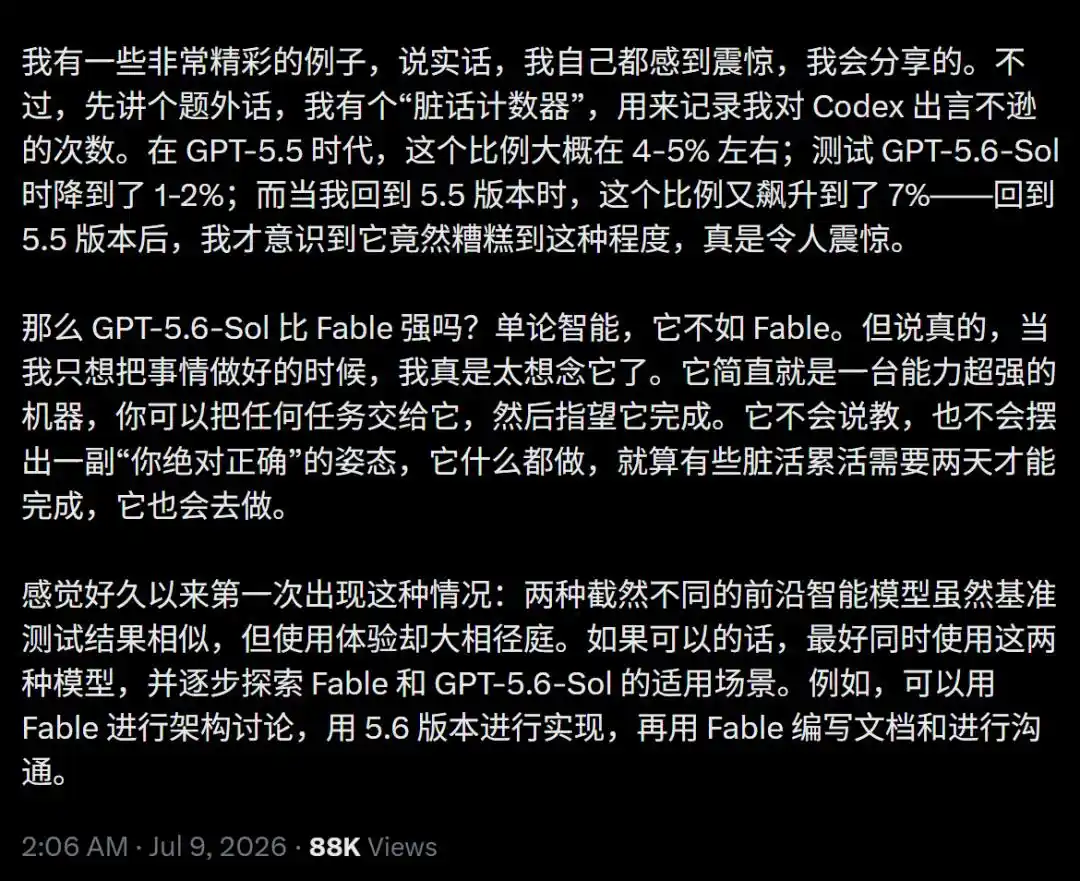
Gostev even shared an incredibly real "swear word counter": in the GPT-5.5 era, his frequency of cursing at the AI while coding was 4-5%; after using 5.6-Sol, it plummeted to 1-2%; and once he switched back to 5.5, the frustration index instantly shot up to 7%!

In short, purely in terms of intelligence, Sol is indeed not as good as Fable. But it's a tireless super work machine that won't lecture you.

Thus, Gostev presents the strongest workflow solution for current large models:

Use Fable for architecture discussions and brainstorming → throw it to GPT-5.6-Sol to obsessively write code and execute dirty work → finally use Fable to write documentation and external communications.
Tomorrow, the GPT-5.6 trio of models will officially launch.

This time, it's up to global developers to get hands-on and give their scores.

References:

https://x.com/ai_for_success/status/2074700209339367617

https://x.com/OpenAI/status/2074704958419792299?s=20

This article is from the WeChat public account "新智元" (New AI Era), author: ASI启示录, editor: Aeneas


Trending Cryptos

Related Questions

QAccording to the article, what major change is OpenAI making with GPT-6, and why?

AOpenAI is reportedly ditching the old 'Spud' pre-training base, which had about 4T parameters, for a new, much larger one. The intent is to directly compete with Anthropic's upcoming Fable 5.1 model.

QWhat are the names and primary focuses of the three GPT-5.6 models announced for release?

AThe three models are: GPT-5.6 Sol (flagship for complex coding, frontier science, cybersecurity), GPT-5.6 Terra (cost-effective 'daily workhorse'), and GPT-5.6 Luna (focused on speed and low cost for high-frequency agent tasks).

QHow did one early tester, Max Weinbach, describe the standout characteristic of the GPT-5.6 Sol model?

AMax Weinbach described GPT-5.6 Sol as 'never gives up,' stating that in its extreme reasoning mode, it would 'insanely' stick with a problem until it was completely solved.

QAccording to the article, what was a key reason given for the official 'green light' and lifting of restrictions on GPT-5.6?

AOpenAI's experts successfully passed numerous real attack pressure tests and vulnerability fixes in Washington, proving that GPT-5.6 is OpenAI's most robust safety system to date.

QWhat workflow did LMArena's Peter Gostev suggest for combining the strengths of Fable 5 and GPT-5.6-Sol?

APeter Gostev suggested: use Fable 5 for architectural discussion and brainstorming, hand tasks off to GPT-5.6-Sol to grind through code and execute the 'dirty work,' and finally use Fable 5 for writing documentation and external communication.

Related Reads

After Three Consecutive Quarters of Decline, Can the Crypto Market Find a Window for Stabilization in Q3?

The cryptocurrency market has just concluded its worst-performing quarter since 2022, with total capitalization dropping 12.6% to $2.1 trillion. All core metrics indicate capital is leaving the sector, not just rotating within it. Bitcoin fell 14.2% and Ethereum dropped 25.4% in Q2, breaking their previous correlation with US tech stocks. A key driver is the reversal in US spot Bitcoin ETF flows, which saw a net outflow of approximately $4.67 billion in Q2, including a record monthly outflow near $4.5 billion in June. While recent data suggests long-term holders are accumulating again, sustained ETF outflows mean continued selling pressure. Market focus is now singularly on the Federal Reserve. The upcoming July FOMC meeting is seen as the most critical event for Q3. A dovish signal could support Bitcoin reclaiming a $68,000-$84,000 range, while a hawkish stance might establish a new trading band around $50,000-$56,000. Additionally, regulatory uncertainty persists, with the progress of the crucial *CLARITY Act* stalling in the Senate, reducing its perceived 2026 passage probability to 40-45%. Despite the broad downturn, a few sectors showed growth. Prediction markets saw nominal volume surge 48.7% year-over-year to $113.8 billion, and tokenized collectibles transaction volume rose 143% quarterly to $1.4 billion. The Real-World Asset (RWA) tokenization sector also continued steady growth, now representing ~$28.1 billion in on-chain value. The market's foundation for an extreme crash appears limited, with Bitcoin price hovering near its 200-week moving average. However, the trading paradigm has shifted from narrative-driven speculation to decisions based on price action, policy developments, and interest rate expectations, making a broad sentiment-driven rally unlikely in the near term.

marsbit12h ago

After Three Consecutive Quarters of Decline, Can the Crypto Market Find a Window for Stabilization in Q3?

marsbit12h ago

BIT Trading Moment: BTC Still Suppressed by Weekly 200 EMA, Rejection May Restart Decline; Storage and Semiconductors that Surged Last Night Begin Falling in Evening Trading

**Crypto & Stock Market Wrap: Bitcoin Tests Resistance, Stocks Retreat After AI Surge** Bitcoin consolidates around $66,000, facing key resistance near $68,000—an area seen as a major psychological and technical hurdle where previous rallies have failed. Analysts note the cryptocurrency is caught between its 200-week moving average (~$63,333) and 200-week EMA (~$68,328). A clear break above $68k is needed to signal a stronger bullish trend, while a rejection could lead to a retest of $63k support. Market sentiment remains cautious, with low futures open interest pointing to a low-liquidity rebound rather than a full bull market. Bitcoin spot ETFs saw another $203 million inflow. US stock futures pointed lower after a strong Tuesday session led by a massive rebound in semiconductors and memory stocks. The rally was fueled by renewed optimism about AI-driven hardware demand, with Micron, SanDisk, and SK Hynix surging. However, those gains reversed in pre-market trading. Super Micro Computer (SMCI) soared over 20% after hours on strong guidance and a record backlog. Other standouts included Rocket Lab and nuclear energy plays Oklo and X-Energy. Rising oil prices (Brent above $91) and climbing Treasury yields (10-year near 4.64%), however, are reigniting inflation concerns and acting as a headwind for equities. In Asia, markets were mixed. South Korea's KOSPI pared early gains to close slightly higher as semiconductor stocks like SK Hynix gave back initial surges. Japan's Nikkei edged lower as the yen hit a fresh 38-year low against the dollar, raising fears of potential market intervention. Key events to watch include the Samsung Galaxy launch, AMD's AI event, and a slew of major tech earnings from Alphabet, Tesla, and IBM after the close on Wednesday, followed by the ECB meeting and Intel's earnings on Thursday.

marsbit12h ago

BIT Trading Moment: BTC Still Suppressed by Weekly 200 EMA, Rejection May Restart Decline; Storage and Semiconductors that Surged Last Night Begin Falling in Evening Trading

marsbit12h ago

Former CFTC Chairman, Circle President Tarbert: Preaching Long-Termism While Cashing Out $30 Million Himself

Former CFTC Chairman and Circle President Heath Tarbert has consistently advocated for a long-term vision in public, urging patience from investors as Circle’s stock price has fallen significantly from its peak. However, it has been revealed that since Circle’s IPO, Tarbert has continuously sold his CRCL shares through pre-arranged trading plans, cashing out approximately $30 million, without making any public market purchases. This contrast between his public messaging and personal actions has drawn criticism. Tarbert joined Circle in July 2023 as Chief Legal Officer, leveraging his regulatory experience to help guide the company through its IPO and expansion. Despite promoting stablecoins as long-term infrastructure, he established a 10b5-1 trading plan just before Circle went public, leading to substantial stock sales over the following year. In March 2026, he initiated another plan to sell more shares. His career trajectory highlights a pattern of moving between high-level regulatory roles and influential positions in the financial sector. After resigning as CFTC Chairman in early 2021, he joined Citadel Securities as Chief Legal Officer just 27 days later, during a period of intense regulatory scrutiny for the firm. He later joined Circle, aiding its efforts to navigate regulatory challenges for its public listing. While Tarbert's expertise in policy and compliance is valuable to companies like Circle, his actions—advocating long-term confidence while personally divesting—raise questions about the alignment between his public statements and his private financial decisions, leaving investors who followed his advice to bear the market risks.

marsbit13h ago

Former CFTC Chairman, Circle President Tarbert: Preaching Long-Termism While Cashing Out $30 Million Himself

marsbit13h ago

Gate Research Institute: The 'Wall Street-ization' Wave of Crypto Financial Products – Competition or Integration?

The article titled "Gate Research Institute: Are Crypto Financial Products Sparking a 'Wall Street' Wave—Competition or Convergence?" explores the evolving relationship between the crypto ecosystem and traditional finance (TradFi). The piece begins by reflecting on Bitcoin's original 2009 vision of decentralization, disintermediation, and moving away from banks. It then contrasts this with the 2024 landscape, where key crypto assets like Bitcoin are increasingly held through Wall Street products like ETFs issued by giants like BlackRock. The article questions whether this signifies that TradFi is systematically taking over the rights to issue, price, custody, and distribute crypto financial assets. The core argument is that this is not a zero-sum takeover but rather a bidirectional convergence where each side addresses the other's weaknesses. Crypto offers 24/7 global markets, programmable settlement, and open access but lacks compliant channels, institutional-grade custody, deep fiat liquidity, and mainstream distribution. TradFi possesses these but is constrained by legacy systems, limited operating hours, and slow settlement. Two primary convergence paths are highlighted: * **Path A (CEX to TradFi):** Exemplified by Gate, which has progressed from offering tokenized stocks and CFDs to providing direct, real stock trading (US, Hong Kong, South Korea) within its platform, using USDT. * **Path B (TradFi to Crypto):** Exemplified by Robinhood, which has integrated crypto trading, acquired exchanges like Bitstamp, and is moving traditional assets like stocks onto the blockchain via tokenization and its own Layer 2. Both paths are ultimately competing to become the next-generation, unified financial account—a "super account" where users can seamlessly trade cryptocurrencies, stocks, ETFs, RWA (Real World Assets), and tokenized treasury products in one interface. The growth of RWA and tokenized treasuries (e.g., BlackRock's BUIDL) is presented as the asset-layer fusion, providing stable, yield-bearing assets on-chain and acting as a bridge between the two worlds. In conclusion, the "Wall Street-ization" of crypto is framed as a mutual transformation. Decentralized ideals persist in the protocol layer, while at the application layer, a more efficient, global, and accessible unified capital market is emerging from this convergence. The future competition lies not between crypto exchanges and stockbrokers, but between platforms vying to offer the most comprehensive asset coverage, liquidity, and user experience within a single account.

marsbit13h ago

Gate Research Institute: The 'Wall Street-ization' Wave of Crypto Financial Products – Competition or Integration?

marsbit13h ago

Trading

Spot

Hot Articles

What is ₿O₿

Bitcoin Bob ($₿o₿): Pioneering Bitcoin-Centric DeFi Through Hybrid Layer-2 Innovation In an era where the digital economy is rapidly evolving, Bitcoin Bob ($₿o₿) emerges as a revolutionary project aiming to enhance Bitcoin's utility in the decentralized finance (DeFi) sector. Officially launched in May 2024, Bitcoin Bob, also known as Build on Bitcoin (BOB), represents a hybrid Layer-2 blockchain solution that melds Bitcoin’s renowned security and immutability with Ethereum's programmability. This initiative seeks to fill a crucial gap in the Bitcoin ecosystem by facilitating the integration of smart contracts and decentralized applications while maintaining the core principles of trust and security inherent to Bitcoin. With significant backing from prominent venture capitalists, Bitcoin Bob is positioned to redefine the role of Bitcoin in the DeFi landscape, making it a cornerstone of decentralized financial operations globally. What Is Bitcoin Bob, $₿o₿? At its core, Bitcoin Bob is a hybrid blockchain solution designed to enhance the functionality of Bitcoin. The main objective of the project is to enable decentralized finance on Bitcoin, facilitating swift and seamless transactions while ensuring high levels of security. Bitcoin Bob employs advanced technology, specifically a hybrid layer-2 architecture that combines Bitcoin's security attributes with the programmability and flexibility of the Ethereum Virtual Machine (EVM). This pragmatic approach allows the project to operate effectively without compromising the fundamental values of Bitcoin, making it a monumental step in bridging the gap between traditional Bitcoin holders and the emerging DeFi ecosystem. One of the standout features of Bitcoin Bob is its role in providing a trust-minimized environment through innovative mechanisms, such as optimistic rollups initially relying on Ethereum, transitioning eventually to full Bitcoin integration. This hybrid system is designed to ensure that the vast liquidity present in Bitcoin is not only preserved but also utilized effectively in various DeFi protocols. Who Is the Creator of Bitcoin Bob, $₿o₿? The creative force behind Bitcoin Bob is co-founder and CEO Alexei Zamyatin, who brings a wealth of experience and knowledge from his extensive background in the cryptocurrency space. Zamyatin holds a PhD in Computer Science and has been actively involved in Bitcoin development since 2015. His deep understanding of both Bitcoin and Ethereum ecosystems plays a crucial role in shaping Bitcoin Bob’s vision and technological underpinnings. Alongside Zamyatin is co-founder Dominik Harz, who serves as the Chief Technology Officer (CTO). Together, the duo has cultivated a team of talented individuals with a shared passion for pushing the boundaries of blockchain technology, ensuring Bitcoin Bob's innovative stature in the market. Who Are the Investors of Bitcoin Bob, $₿o₿? Bitcoin Bob has successfully garnered support from a range of prominent investors and venture capital firms that recognize its potential to transform the Bitcoin landscape. In March 2024, the project completed a robust $10 million seed funding round, led by Castle Island Ventures, with notable participation from firms like Coinbase Ventures and Bankless Ventures. Shortly afterward, in July 2024, Bitcoin Bob secured an additional $1.6 million in strategic funding. This round was co-led by Ledger Ventures and featured angels from various prominent firms such as BlackRock, Aave, and Curve. The strong financial backing reflects an industry-wide recognition of Bitcoin Bob’s innovative approach to unlocking Bitcoin’s potential in the DeFi space. This funding is crucial not only for the project’s continued development but also for establishing an incubator to foster Bitcoin-native decentralized applications (dApps) aimed specifically at meeting the needs of a growing user base. How Does Bitcoin Bob, $₿o₿ Work? The operational mechanics of Bitcoin Bob are rooted in its hybrid rollup architecture, which is designed to combine the benefits of Bitcoin's security with the versatility of Ethereum’s EVM. The project employs a phased security model that outlines its interaction with users and developers in the following manner: Phase 1 – The initial phase operates as an optimistic rollup on Ethereum, wherein transactions are processed with a promising expectation of validity, paving the way for future developments on Bitcoin. Phase 2 – As the project transitions, it will integrate Bitcoin finality through Bitcoin Staking, leveraging the Babylon Network to enhance security. This mechanism requires validators to lock up Bitcoin, thus verifying BOB transactions, which not only enhances security but also creates yield prospects for participants. Phase 3 – The forward-looking vision for Bitcoin Bob is to fully integrate with Bitcoin, using innovative technologies such as BitVM and zero-knowledge proofs to facilitate off-chain computation while retaining the security integrity of Bitcoin. Key innovations such as BitVM2, a trust-minimized bridge protocol co-authored by Zamyatin, are critical to the project's functionality, allowing for Bitcoin deposits and withdrawals without the need for extensive network reliance. This enables the ecosystem to efficiently connect with Ethereum and other compatible chains, creating a streamlined and effective interaction model for users and developers. Timeline of Bitcoin Bob, $₿o₿ Understanding the evolution of Bitcoin Bob involves tracking its important milestones: 2019: Alexei Zamyatin and Dominik Harz establish a research firm focused on blockchain solutions, laying the groundwork for future projects. March 2024: Bitcoin Bob successfully raises $10 million in a seed funding round, marking its entrance into the competitive blockchain landscape. May 1, 2024: The official mainnet launch occurs, showcasing the project’s capabilities with significant user adoption and total value locked (TVL). July 2024: The project attracts an additional $1.6 million in strategic funding for establishing its incubator, aimed at fostering Bitcoin-driven innovations. October 2024: Bitcoin Bob releases a “Vision Paper,” detailing its hybrid layer-2 design and forward-looking strategies. 2025: Expected rollout of Phase 2 features, focusing on Bitcoin finality and BitVM bridges aimed at enhancing overall functionality. Conclusion: Redefining Bitcoin’s Role in Decentralized Finance Bitcoin Bob ($₿o₿) is not just another blockchain project; it represents a paradigm shift in the way Bitcoin can interact with broader financial applications. By meticulously combining Bitcoin's security with Ethereum's flexibility, Bitcoin Bob aims to reshape the DeFi landscape, bridging the gap between digital currency and decentralized applications. With a robust technological framework, strong leadership, and strategic funding, Bitcoin Bob is well-positioned to establish itself as a fundamental player in the cryptocurrency ecosystem, unlocking new dimensions of liquidity and utility for Bitcoin. As the project continues to evolve and expand, it promises to usher in a new era of innovation, proving that Bitcoin's potential extends far beyond being a mere store of value, but rather as a cornerstone of the future financial landscape. As the project advances through its anticipated phases, all eyes will be on Bitcoin Bob, particularly regarding its commitment to incorporating decentralized principles and ensuring that users can enjoy the full benefits of DeFi anchored by Bitcoin.

77 Total ViewsPublished 2025.06.30Updated 2025.06.30

What is ₿O₿

Discussions

Welcome to the HTX Community. Here, you can stay informed about the latest platform developments and gain access to professional market insights. Users' opinions on the price of O (O) are presented below.

活动图片













