Behind ANSEM's 300% Weekly Surge: The Recovery and Traps of Solana Meme Coins

Foresight NewsPublished on 2026-07-08Last updated on 2026-07-08

Abstract

The meme coin ANSEM surged nearly 299% in a week, driving a resurgence in Solana-based meme token activity. Data from DeFiLlama shows Pump.fun's weekly DEX volume reached $5.33 billion, with July 4th marking the platform's first $1 billion daily volume since April. This revival saw a spike in new token launches and heightened trading activity, with memes again accounting for over 20% of Solana's weekly transaction volume. However, industry reports highlight significant risks. The average meme coin holding time has plummeted to around 100 seconds, and sophisticated bots often front-run retail investors, acquiring large portions of supply at launch before dumping. Research analyzing thousands of projects indicates widespread market manipulation, with a majority of top-gaining tokens showing signs of wash trading and pool manipulation. While meme coins effectively attract new users and generate hype for the Solana ecosystem, the current rally raises the critical question of whether this cycle can break free from the established pattern where late-arriving retail traders become exit liquidity for early bots and coordinated groups. The market's future trajectory hinges on whether the momentum can be sustained or if it will fade, leading traders back to major assets like SOL.


Author: Gino Matos

Compiled by: Chopper, Foresight News


The Meme coin ANSEM has surged nearly 299% in seven days, driving a recovery in the Solana Meme coin market. According to DeFiLlama data, the weekly trading volume of Pump.fun on decentralized exchanges (DEX) reached $5.33 billion, with a 30-day trading volume of $18.22 billion.


July 4th marked the first time since April 8th that Pump.fun and PumpSwap's daily trading volume exceeded $1 billion, and the trading volume for the week of June 29th to July 5th was the first to surpass $5 billion since late March.


Driven by the ANSEM rally, on July 1st, the Solana Meme coin launch platform saw the number of newly launched tokens and graduating projects hit an 80-day high. Alongside ANSEM's explosive popularity, a large number of copycat tokens emerged simultaneously. The proliferation of copycats has historically been a typical signal of a Meme coin bull market revival. A Phemex research report on July 1st pointed out that within just two weeks, the issuance fees on the Pump.fun platform recovered to 62% of their previous peak, and trading volume rebounded to 55%.
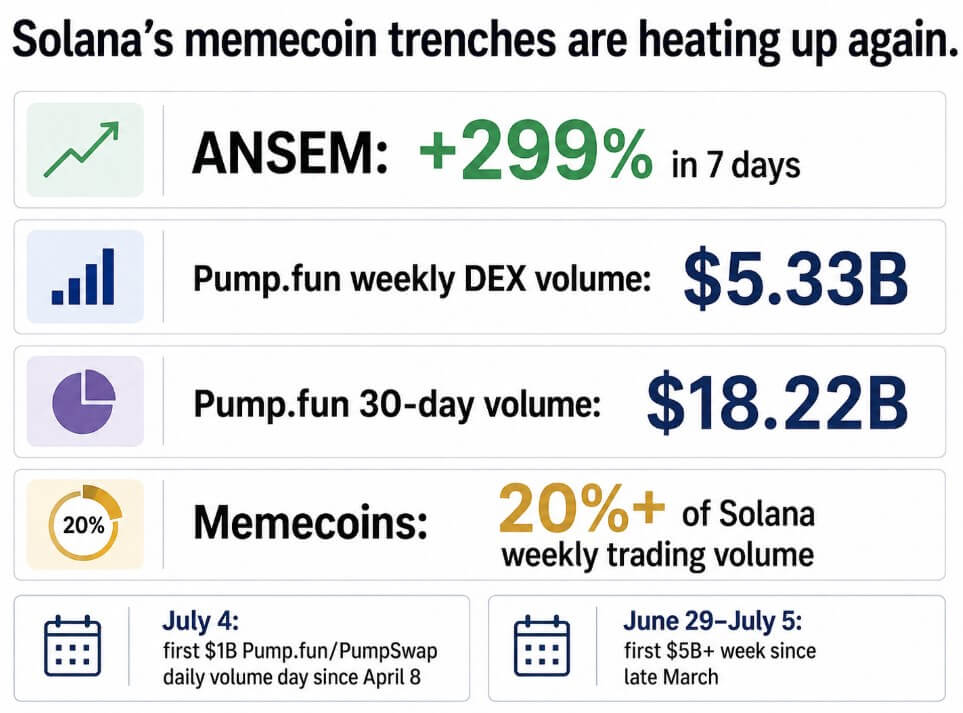

ANSEM rose 299% in a week, Pump.fun's weekly trading volume was $5.33 billion, and Meme coins accounted for over 20% of Solana's trading volume


This recovery trend is also reflected in the broader market. Data from Blockworks shows that Meme coins account for over 20% of Solana's weekly trading volume, the first time since mid-May.


A Galaxy research report from October 2025 noted that in Q4 2024, Meme coins once accounted for 50% of Solana's weekly trading volume. The current 20% share indicates only a modest market recovery, still far from its peak.


Galaxy also pointed out that compared to various formal DeFi products, Meme coins can more quickly attract ordinary retail investors to create wallets, use decentralized exchanges, and cross-chain bridges. These tokens have an extremely low barrier to entry and inherent social virality, directly converting traffic and hype into tradable assets.


However, the contradiction within the sector is also highlighted here. While Meme coins can attract new users, their ultra-fast-paced trading rules foster an extremely unequal playing field, where retail investors often end up as exit liquidity for bots and whales. The meteoric rise of ANSEM has brought this contradiction back into the spotlight.


Statistics from Galaxy show that the current average holding time for Meme coins is only 100 seconds, down from about 300 seconds in previous cycles, indicating a significant acceleration in trading pace. Sniping bots and batch wallets hoard large amounts of tokens the moment they launch, then sell off to cash out once retail investors FOMO in.


A paper presented at the 2026 ACM Conference on Computer and Communications Security, titled "Preventing Manipulative Bots in Meme Coin Copy Trading," fully dissects this harvesting logic: copy trading has become the mainstream entry method for retail, but bots react far faster than humans. The paper surveyed over 6,000 Meme projects, finding that the vast majority of tokens are swept up by bots within 1 to 5 blocks of launch.


The MemeTrans platform, tracking over 41,000 Solana Meme projects and 200 million on-chain transactions, found that various coordinated manipulation accounts hold an average of 36.5% of a project's circulating supply; while holdings appear dispersed, they are actually highly concentrated. In the survey, 84.13% of projects were flagged as high-risk. Another research report analyzed 34,988 Meme tokens, revealing that among the top gainers, 82.8% showed signs of artificial volume generation like wash trading and pool manipulation, with over 17,000 wallet addresses incurring cumulative losses exceeding $9.3 million.


These data clearly reflect a pattern: the Meme coins with the most exaggerated gains often have the most severe artificial manipulation.


So, has the Meme market recovered?


A bull market scenario is characterized by Pump's daily trading volume consistently exceeding $1 billion, with Solana's Meme coins accounting for close to 30% of weekly trading volume.


ANSEM drives the continuous emergence of explosive secondary Meme coins, with user growth, launch speed, and attention reinforcing each other. This situation more closely resembles the early rise of Meme coins.


In a bear market scenario, ANSEM's copycats distract investors, Pump's weekly trading volume falls back below $3 billion, and Meme coins' share of Solana's total trading volume drops to 15%-18%. In this case, ANSEM would be a flash in the pan, and traders would turn back to SOL, mainstream cryptocurrencies, and other more liquid altcoins.
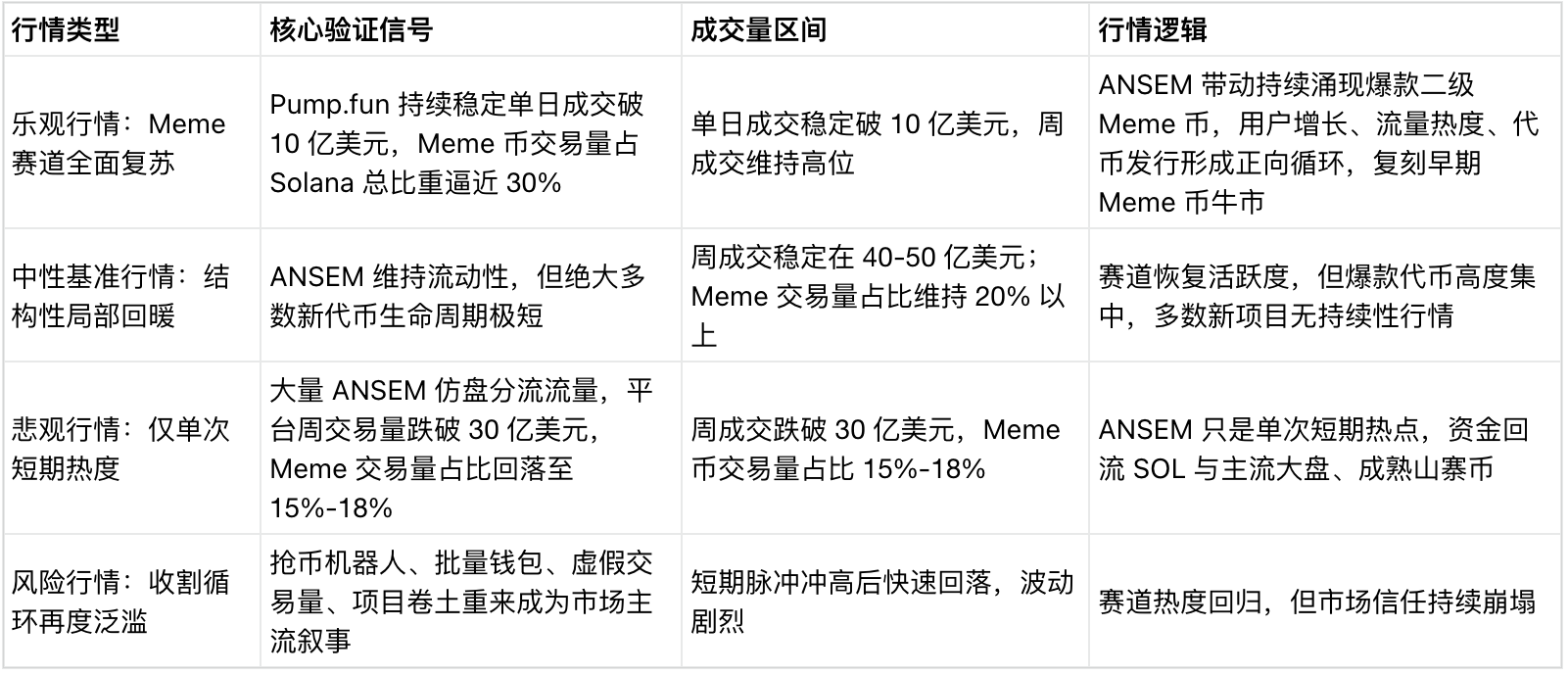

Four subsequent market scenarios


It is undeniable that the Solana Meme sector possesses strong traffic-driving capabilities, achieving levels of attention and hype that most formal blockchain products find hard to match. However, with this ANSEM-driven market recovery, the industry needs to consider: Can this wave of hype break free from the old cycle of bot sniping and whale manipulation, and stop making later-entering retail investors the exit liquidity for early funds?


Trending Cryptos

Related Questions

QAccording to the article, what is the key indicator of a true bull market for Solana meme coins?

AA true bull market for Solana meme coins is indicated by the daily trading volume on platforms like Pump.fun consistently exceeding $10 billion and meme coins accounting for close to 30% of Solana's total weekly trading volume.

QWhat significant risk for retail investors in the meme coin market is highlighted by the academic paper presented at the 2026 International Conference on Computer Communication and Networks?

AThe paper highlights the risk of 'sniping bots' and manipulation. It details that bots can execute trades within 1 to 5 blocks after a meme coin launches, accumulating large positions before most human investors can react, creating an uneven and potentially predatory trading environment.

QBased on the data from MemeTrans, what percentage of the analyzed Solana meme projects were flagged as high-risk?

AAccording to the MemeTrans platform's analysis of over 41,000 Solana meme projects, 84.13% of them were flagged as high-risk assets.

QWhat does the article suggest is the primary contradiction or paradox within the Solana meme coin ecosystem?

AThe primary contradiction is that while meme coins are excellent at attracting new users to the Solana ecosystem due to their low barrier to entry and viral nature, they also create a hyper-fast, unequal trading environment. This environment, dominated by bots and coordinated groups, often results in retail investors becoming exit liquidity for early, manipulative insiders.

QWhat scenario would likely lead ANSEM to be a fleeting phenomenon, causing traders to shift focus back to major assets like SOL?

AANSEM would become a fleeting phenomenon in a bearish market scenario. This is characterized by its numerous copycat versions diluting investor attention, weekly trading volume on Pump.fun falling back below $3 billion, and the meme coin share of Solana's total trading volume dropping to 15-18%.

Related Reads

The Verdict in Choi Tae-won's Divorce Case: Revealing the Inheritance Undercurrent Behind SK Hynix's Trillion-Won Empire

SK Group Chairman Chey Tae-won's high-profile divorce case, involving a record 1.38 trillion won settlement, has drawn attention to the succession plans for Korea's second-largest conglomerate, especially its crown jewel, SK hynix. Unlike traditional chaebol scripts centered on the eldest son, Chey's three children from his marriage to former President Roh Tae-woo's daughter, Roh Soh-yeong, are carving distinct, non-traditional paths. Eldest daughter Chey Yun-jung (b. 1989) is seen as the most evident successor. With a scientific and consulting background, she holds executive roles at SK bioscience and SK Inc.'s growth support department, focusing on future strategy and biopharma. Her marriage is to an AI infrastructure entrepreneur, not a traditional business alliance. Second daughter Chey Min-jung (b. 1991) took a unique route, voluntarily serving as a South Korean naval officer, including an anti-piracy deployment. She later worked on policy and strategy for SK hynix in Washington D.C. before co-founding an AI-driven healthcare startup. She married a former U.S. Marine Corps officer, connecting her to U.S. defense and policy circles—networks crucial for a global semiconductor giant. The only son, Chey In-geun (b. 1995), who studied physics like his father, worked briefly at SK E&S before joining McKinsey. Despite fitting the traditional "heir" profile as the eldest son, he remains silent and holds no public position or shares in SK, suggesting the old succession playbook is obsolete. As SK hynix's valuation soars, becoming a geopolitical asset in the AI era, the heirs' legitimacy is no longer automatic. They must prove themselves in fields like AI biotech, global policy, and strategic consulting. Their marriages also reflect new elite networks in tech and defense, not old political alliances. Their inheritance is the complex challenge of navigating a globalized, tech-driven world, not just a corporate throne.

marsbit11h ago

The Verdict in Choi Tae-won's Divorce Case: Revealing the Inheritance Undercurrent Behind SK Hynix's Trillion-Won Empire

marsbit11h ago

From OpenSea to OpenRouter: Is Alex Atallah Repeating His 'Exit at the Peak' Playbook?

From OpenSea to OpenRouter: Is Alex Atallah Repeating His "Exit at the Peak" Playbook? According to the Wall Street Journal, payments giant Stripe is in talks to acquire the AI model aggregation platform OpenRouter in a potential deal valuing the company near $100 billion. This would mark founder Alex Atallah's second creation of a company reaching a $100 billion valuation, following his co-founding of NFT marketplace OpenSea. OpenRouter, founded just over three years ago, has grown rapidly by acting as a unified gateway for developers to access over 400 AI models. It currently has about 10 million users and processes over 200 trillion tokens monthly. While the platform's annualized revenue is around $50 million, its valuation has skyrocketed from $1.3 billion in March 2026. The potential acquisition by Stripe, a company OpenRouter's founder once likened it to, represents a major expansion into AI infrastructure for the payments leader. This move echoes Atallah's previous timing with OpenSea, where he departed before the NFT market's significant downturn. For OpenRouter, selling now may be strategic. Despite its scale, its business model—charging a 5-5.5% fee on AI inference calls—faces pressure from competition, open-source models, and potential price wars among model providers, limiting its profitability narrative for an IPO. A key asset for potential acquirers like Stripe is OpenRouter's vast repository of real-world AI usage data, which offers unique insights into model performance and developer preferences that are difficult to replicate. Whether this potential deal signifies a new valuation benchmark for AI infrastructure or another market peak signal remains to be seen.

链捕手12h ago

From OpenSea to OpenRouter: Is Alex Atallah Repeating His 'Exit at the Peak' Playbook?

链捕手12h ago

Trading

Spot

Hot Articles

Discussions

Welcome to the HTX Community. Here, you can stay informed about the latest platform developments and gain access to professional market insights. Users' opinions on the price of MEME (MEME) are presented below.

活动图片