Samudra Pasifik "Demam", Bagaimana Cuaca Ekstrem Menjadi Mesin Pencetak Uang Wall Street?

链捕手Published on 2026-07-08Last updated on 2026-07-08

Abstract

**Laut Pasifik 'Demam', Cuaca Ekstrem Jadi Mesin Uang Wall Street** Musim panas 2026 diawali cuaca ekstrem di berbagai belahan dunia, dari banjir besar di Cina hingga kekeringan di Asia Tenggara. Pola cuaca tak biasa ini didorong oleh fenomena El Niño yang kuat, di mana suhu permukaan laut di Pasifik tengah-timur menghangat secara signifikan, mengganggu pola iklim global. El Niño kali ini diprediksi bisa menjadi salah satu yang terkuat sejak 1950. Dampaknya beragam: menyebabkan kekeringan yang mengurangi produksi kelapa sawit dan karet di Asia Tenggara, melemahkan muson di India (mengancam gula dan kapas), serta menghangatkan perairan Peru sehingga mengganggu tangkapan ikan anchovy. Namun, di Brasil dan Argentina, El Niño justru bisa mendatangkan hujan yang baik untuk tanaman. Perubahan cuaca ini telah menjadi peluang finansial besar. Dana lindung nilai seperti Moreton Capital Partners mengumpulkan miliaran dolar untuk bertaruh pada komoditas pertanian yang terdampak. Kisah sukses serupa telah terjadi sejak 1970-an, seperti trader legendaris Richard Dennis yang meraup keuntungan dari lonjakan harga kedelai akibat El Niño. Baru-baru ini pada 2024, cuaca kering di Afrika Barat mendorong harga kakao meroket, menghasilkan keuntungan besar bagi dana-dana tren. Meskipun pasar telah bereaksi lebih dulu dengan kenaikan harga beberapa komoditas seperti minyak sawit dan gula, data riil penurunan produksi biasanya baru terlihat setelah puncak El Niño. Para pelaku pasar kini memantau...

Penulis: Jia Liu, Zhangsheng Beatz

Tianjin mengalami hujan deras tiba-tiba selama beberapa hari berturut-turut. Saat keluar rumah cuaca masih cerah, di tengah perjalanan sudah basah kuyup. Penerbangan teman ke Shenzhen malam ini dibatalkan karena topan, tiket kereta cepat ke arah Zhejiang semuanya dijual habis.

Membuka ponsel untuk membaca berita, hujan di Fushun, Liaoning, melebihi 329 mm dalam beberapa jam. Warga Fangchenggang, Guangxi, mengatakan ini adalah banjir terparah dalam 20 tahun terakhir. Tujuh stasiun meteorologi nasional memecahkan rekor curah hujan harian dalam sejarah. Peringatan gelombang panas skala terbesar di Tiongkok Utara, suhu permukaan tanah mendekati 50°C. Pekan pertama Juli, dua hingga tiga topan terbentuk secara bersamaan di antrian di Samudra Pasifik Barat. Topan super "Bavi" sedang mendekati pantai tenggara.

Setelah memasuki musim panas 2026, cuaca domestik jelas-jelas mulai menjadi tidak tenang.

Yang tidak tenang bukan hanya kita. Air laut di pesisir Peru terus menghangat, penangkapan ikan teri terbatas, harga tepung ikan naik sekitar 80% dalam setahun terakhir. Setelah memasuki musim kemarau, sinyal kekeringan di Asia Tenggara menguat, wilayah penghasil kelapa sawit Malaysia dan Indonesia mulai tegang. Curah hujan monsun India belum mencapai jendela kunci, tetapi pasar sudah bertaruh akan melemah. Area tanam gandum Australia ditandai oleh analis kemungkinan menyusut drastis.

Perubahan cuaca ekstrem ini tersebar di berbagai benua, tampaknya tidak berhubungan. Namun faktanya, selain mekanisme pemicu langsung seperti uap air monsun, sirkulasi luar badai tropis, lokasi, dan topografi, mereka kemungkinan besar dipengaruhi oleh badai yang sama:

ENSO, El Niño.

El Niño, Samudra Pasifik Demam

ENSO, terjemahan bahasa Indonesianya adalah Osilasi Selatan-El Niño, adalah sinyal tahunan terbesar dalam sistem iklim bumi. Sederhananya, ia menggambarkan perubahan periodik antara suhu laut Pasifik dan sirkulasi atmosfer.

Dalam kondisi normal, Pasifik timur di khatulistiwa lebih dingin, Pasifik barat lebih hangat, angin pasat mendorong air hangat ke Pasifik Barat. Tetapi jika angin pasat melemah, air hangat mengalir kembali ke timur, suhu laut Pasifik Tengah-Timur naik secara abnormal, itulah El Niño.

Lembaga meteorologi menilai apakah El Niño terjadi, terutama melihat area kunci: wilayah laut Niño3.4 (area laut kunci di Pasifik Khatulistiwa Tengah, dapat dipahami sebagai "termometer" untuk mengukur kekuatan El Niño). Jika area ini secara berturut-turut beberapa bulan lebih tinggi 0.5°C di atas tahun normal, dianggap memasuki kondisi El Niño; jika lebih tinggi 2°C, termasuk level super kuat. Tahun 1997 dan 2015, adalah dua putaran El Niño super kuat yang khas.

Dan El Niño tahun ini, mungkin menjadi yang terkuat sejak 1950.

Tanggal 11 Juni, Administrasi Kelautan dan Atmosfer Nasional AS secara resmi mengeluarkan peringatan El Niño, mengonfirmasi kondisi El Niño telah muncul, dan memperkirakan akan menguat hingga akhir 2026 hingga awal 2027. Mereka berpendapat, periode November tahun ini hingga Januari tahun depan, kemungkinan terjadinya El Niño super kuat adalah 63%. Penilaian Institut Fisika Atmosfer Akademi Ilmu Pengetahuan Tiongkok sedikit lebih konservatif, kemungkinan terjadi intensitas sedang lebih dari 70%, kemungkinan super kuat sekitar satu persen.
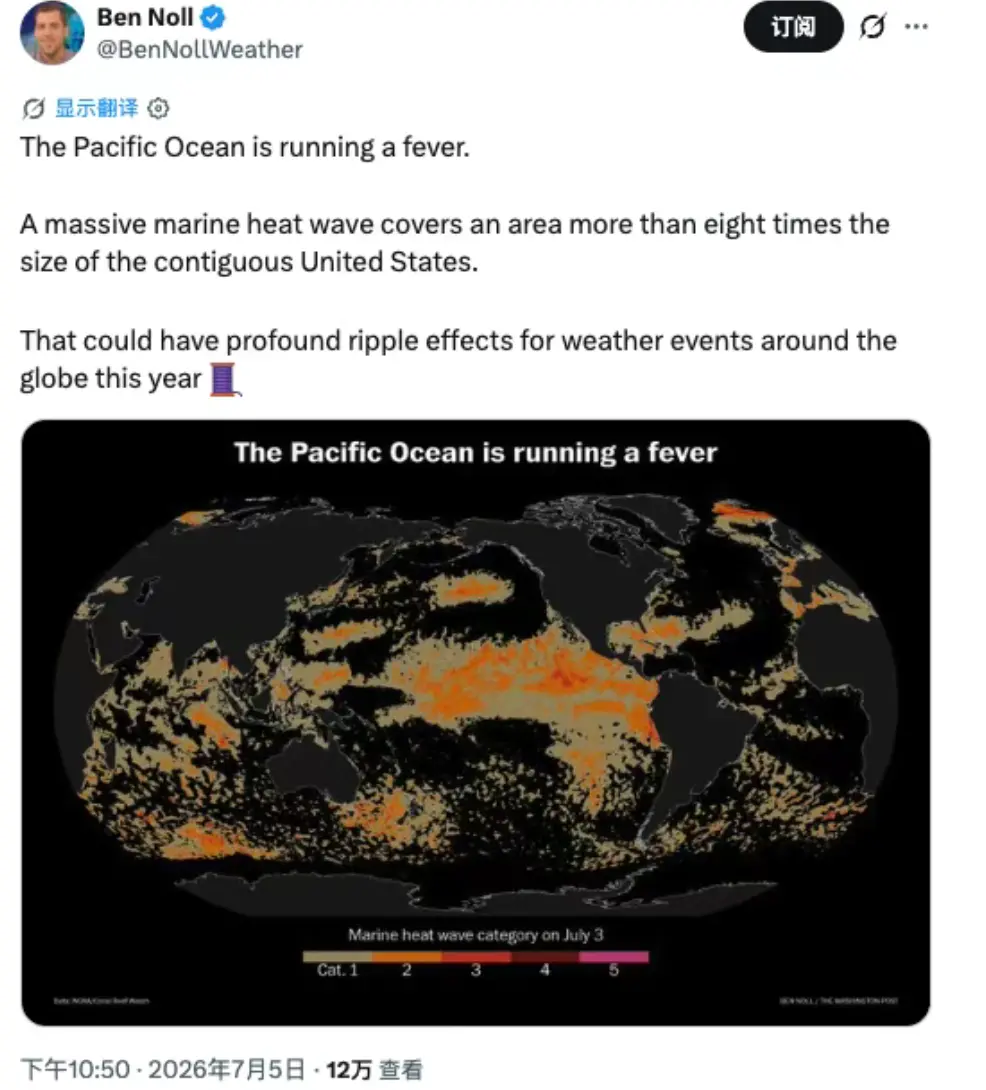
Ahli meteorologi Ben Noll memposting peta suhu laut Pasifik di X, dengan judul "The Pacific is on fire". Di peta, oranye tua dan merah memenuhi sebagian besar Pasifik, menunjukkan luasnya gelombang panas laut ini melebihi 8 kali lipat daratan AS.

Bagi kita, dampaknya bukan "langsung menciptakan suatu hujan deras", tetapi mengubah dasar warna sirkulasi atmosfer. Ia memengaruhi posisi tekanan subtropis tinggi Pasifik Barat, mengubah jalur pengiriman uap air monsun musim panas Asia Timur, membuat sabuk hujan lebih mudah menyimpang dari posisi normal, risiko panas ekstrem, kekeringan, dan konveksi kuat juga meningkat.

Ditambah lagi dengan pemanasan global, setiap kenaikan suhu atmosfer 1°C, kapasitas menampung uap air meningkat sekitar 7%. Jadi El Niño hari ini, tidak terjadi dalam iklim normal, tetapi terjadi di atas latar belakang yang memang sudah lebih panas, lebih lembap, dan lebih mudah menjadi ekstrem.

Di sini ada monsun dan topan, tetapi di sisi lain pasar keuangan sudah mencium aroma tertentu, ada dana yang mulai bergerak.

24 Juni, Bloomberg melaporkan, hedge fund Moreton Capital Partners sedang mengumpulkan dana 500 juta dolar AS untuk sebuah alat khusus. Sasaran perdagangannya adalah tanaman pertanian yang akan terkena dampak El Niño seperti jagung Afrika Selatan, minyak sawit Malaysia, gandum Australia. Pendiri bersama Les Finemore hanya memberikan satu alasan: pasar jauh meremehkan risiko yang dibawa oleh El Niño tahun ini.

Cuaca bukan lagi noise latar belakang dalam portofolio komoditas, dalam tingkat tertentu ia bisa menjadi tema yang berdiri sendiri, direkrut secara terpisah.

Kenapa Finemore bisa merekrut 500 juta dolar? Karena menghasilkan uang dari cuaca ekstrem seperti El Niño bukan teori, selama beberapa dekade selalu ada orang yang menghasilkan banyak uang karenanya.

Emas Pertama Pendiri "Turtle Trading"

1972, ikan teri di pesisir Peru tiba-tiba menghilang.

Ikan kecil panjang belasan sentimeter ini, sebagian besar orang di dunia tidak akan pernah memakannya, tetapi ia digiling menjadi tepung ikan, salah satu sumber protein terpenting dalam pakan ternak global.

Penyebab hilangnya ikan teri, tepatnya karena air laut Pasifik Khatulistiwa tiba-tiba menghangat, air dingin tidak naik lagi, rantai plankton terputus. Ahli meteorologi kemudian memberi nama fenomena ini: El Niño.

Tepung ikan hilang, pemasok pakan harus mencari pengganti, harga tepung kedelai naik, lalu harga kedelai ikut naik.

Di Bursa Dagang Chicago, seorang trader muda belum 26 tahun, Richard Dennis, melihat harga terus membuat rekor baru, terus membeli kedelai. 1974, ia mendapat sekitar 500 ribu dolar dari kedelai, akhir tahun menjadi jutawan.

Richard Dennis di masa muda

Dan trader muda Richard Dennis yang mendapat emas pertama saat itu, adalah pendiri "Turtle Trader" yang kelak terkenal, namanya menjadi salah satu leluhur aliran perdagangan tren.

Ada juga cerita khas dari Anthony Ward, julukan Chocfinger (Jari Cokelat). Ia mendirikan Armajaro di London tahun 1998, khusus mengerjakan kakao dan kopi. Tempat paling khusus perusahaan ini bukan di meja perdagangan tetapi di departemen meteorologi: jaringan stasiun cuaca mandiri, mempekerjakan ahli meteorologi penuh waktu, tim riset lebih dari 20 orang di wilayah penghasil Afrika Barat.

Logikanya, perubahan kecil cuaca bisa membuat hasil panen fluktuasi 10%, siapa yang lebih dulu tahu cuaca lebih dulu tahu harga. 2002 ia menyantap tiga perempat volume serah kakao bulan itu di Bursa London, laba sebelum pajak 10,4 juta pound. 17 Juli 2010, menerima 240,1 ribu ton kakao fisik sekaligus, nilai 658 juta pound, 7% produksi tahunan global, pada dasarnya seluruh stok terlihat Eropa saat itu. Harga kakao didorong ke level tertinggi sejak 1977.

Mari kita lihat beberapa contoh beberapa tahun terakhir.

2024, kakao adalah komoditas paling gila di dunia. Pantai Gading dan Ghana di Afrika Barat, penghasil tujuh persen kakao global, mengalami angin Harmattan (angin kering panas dari Sahara yang bertiup ke pantai Afrika Barat) yang sangat panas dan kering secara abnormal, buah kakao rusak parah, ditambah penyakit, pohon tua, stok rendah, futures kakao naik lebih dari 400% dalam dua tahun, pernah menembus 10 ribu dolar per ton.

Yang mendapat bagian besar tren ini, bukan hanya orang di industri kakao, tetapi juga sekelompok dana tren kuantitatif. Razvan Remsing dari Aspect Capital mengatakan itu adalah kuartal pertama terbaik mereka dalam 25 tahun. Strategi managed futures AQR naik sekitar 17,4% di kuartal pertama. Dana tren di bawah Capital Fund Management naik sekitar 17,5%. Dana andalan Aspect hingga akhir April naik 21,4%. Winton, didirikan oleh David Harding, dana makro beragamnya naik sekitar 13% di kuartal pertama.

Pada periode yang sama, selain menghasilkan banyak uang dari kakao, Winton juga menghasilkan banyak uang di arah lain: El Niño biasanya membuat bagian AS musim dingin lebih hangat. Musim dingin tidak terlalu dingin, permintaan gas untuk pemanas melemah, stok menumpuk, harga acuan gas alam AS Henry Hub (setara dengan Brent di pasar minyak) jatuh ke dekat level terendah dalam hampir 30 tahun.

Beli di Titik Terendah Kakao, Atau Gula?

Kembali ke 2026. Putaran El Niño ini belum mencapai puncak, tetapi pasar sudah lari lebih dulu.

Minyak sawit utama akhir April dari 9400 yuan naik ke 9993 yuan lalu turun. Karet dari titik terendah April mulai, pertengahan Mei pernah menembus 18300 yuan. Gula dalam tarik-menarik berulang antara 5200 hingga 5450 yuan. Kacang tanah dengan dukungan kekeringan dan biaya mencatat tujuh kenaikan berturut-turut.

Anehnya, fundamental nyata varietas-varietas ini tidak mendukung kenaikan. Stok minyak sawit Malaysia akhir Mei masih meningkat dibandingkan bulan sebelumnya, stok gula domestik naik 1,83 juta ton dibandingkan tahun lalu, stok minyak sawit domestik naik 25,68% dibandingkan tahun lalu. Produksi belum mulai turun, harga sudah naik lebih dulu. Satu-satunya alasan naik, adalah imajinasi terhadap penurunan produksi yang dibawa El Niño dalam 6 hingga 12 bulan ke depan.

Lima puluh tahun terakhir, setiap putaran El Niño intensitas sedang ke atas meninggalkan jejak di pasar komoditas. Putaran 1982 minyak sawit naik 169%. 2009 hingga 2010 karet Indonesia turun 11,3%, harga spot dua tahun naik 157,79%. 2015 hingga 2016 gula naik 65%.
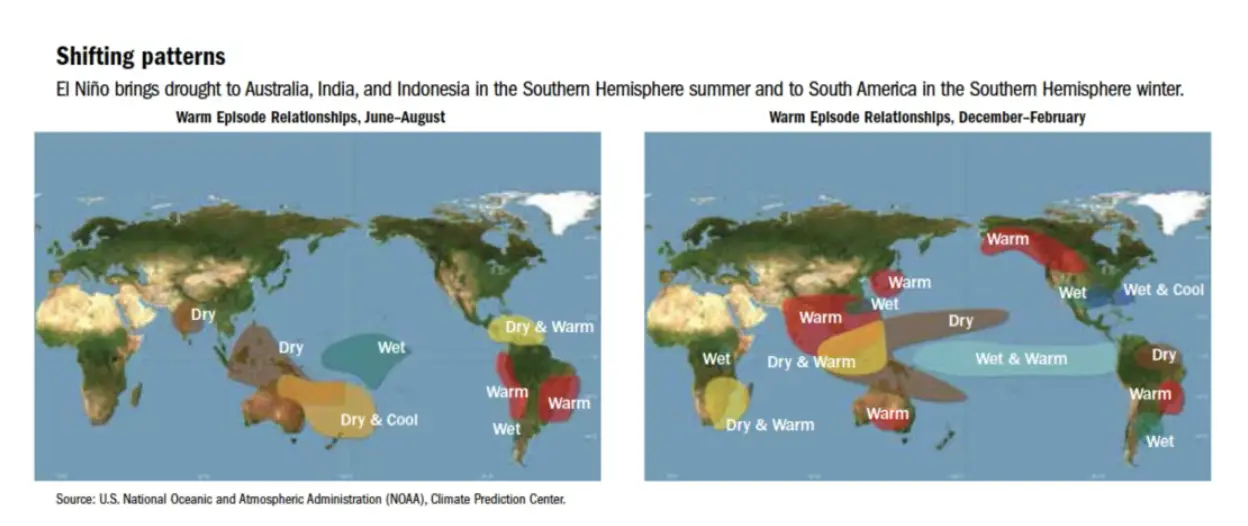
Di Asia Tenggara, ia membawa kekeringan, menekan produksi minyak sawit dan karet. Di India, ia membuat monsun melemah, memengaruhi gula dan kapas. Di Peru, ia membuat ikan teri hilang, mendorong naik tepung ikan. Tetapi di ujung lain Amerika Selatan, yang dibawanya adalah lebih banyak hujan, malah mungkin memperbaiki kedelai dan tebu Brasil dan Argentina. Di wilayah tambang Chili dan Peru, hujan deras yang menyerang bukan lahan pertanian tetapi tambang tembaga. Di AS, musim dingin hangat menekan permintaan gas alam.

Diskusi komunitas luar negeri tentang El Niño ini masih berlanjut.
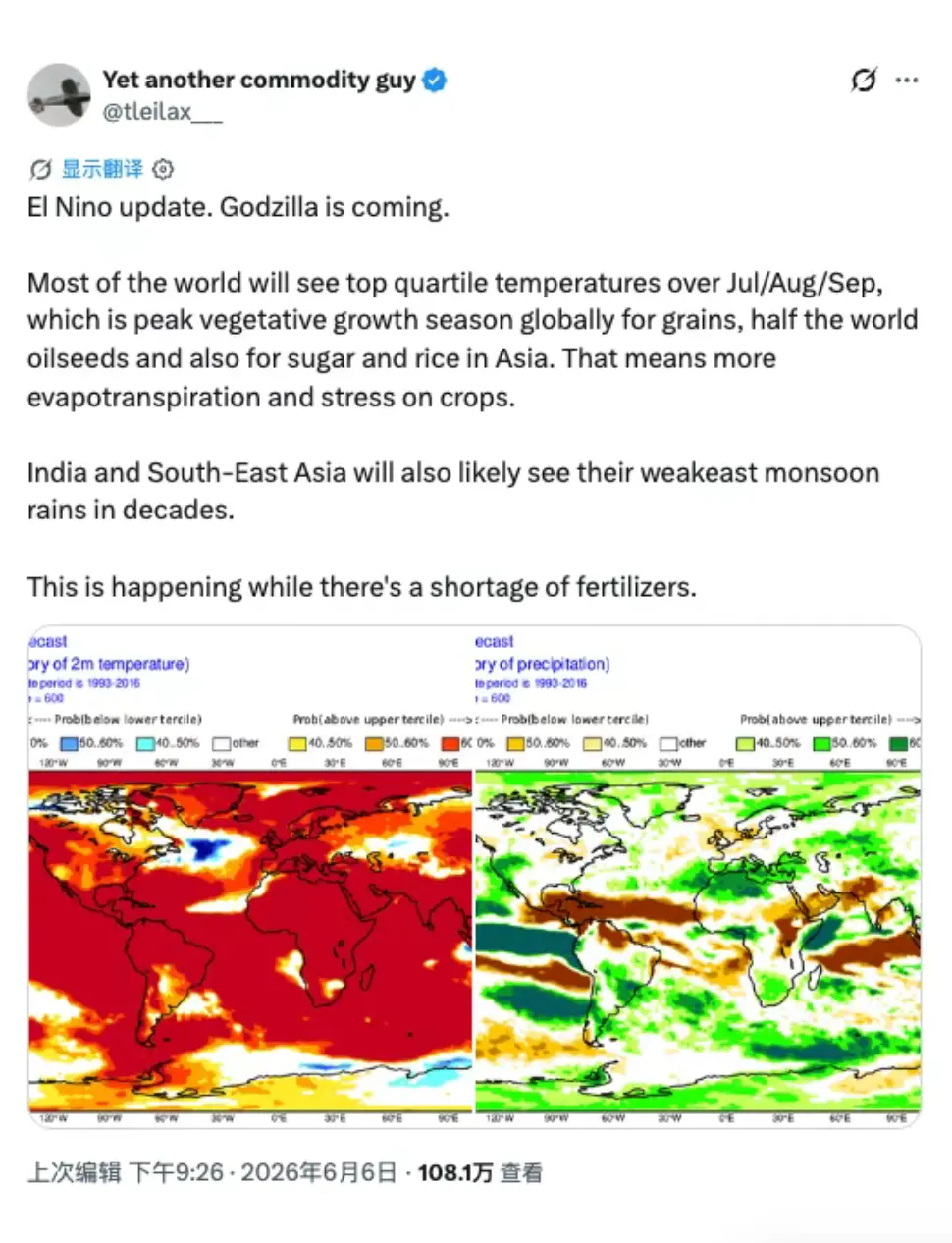
Blogger lingkaran komoditas @tleilax__ memposting postingan dengan dua grafik prediksi. Satu grafik melihat berapa suhu global Juli hingga September tahun ini akan lebih tinggi dibandingkan periode yang sama tahun sebelumnya. Grafik hampir seluruhnya merah, dan waktu ini tepatnya adalah periode pertumbuhan penting biji-bijian, biji minyak, padi Asia, dan gula.

Grafik lain melihat apakah curah hujan akan lebih banyak atau sedikit dibandingkan periode yang sama tahun sebelumnya. Grafik menunjukkan India dan Asia Tenggara luasnya lebih kering, tepatnya sesuai dengan kekhawatiran terbesar pasar yaitu monsun melemah.

Oleh karena itu kesimpulannya: India dan Asia Tenggara mungkin mengalami curah hujan monsun terlemah dalam beberapa dekade, dan ini terjadi di latar belakang kekurangan pupuk global. Postingan ini saat ini mendapat lebih dari 1,08 juta kali dilihat.

Kolom komoditas di Substack memasukkan minyak sawit, kapas, dan kakao sebagai kluster dengan risiko-return paling jelas dalam 6 hingga 12 bulan ke depan. Komunitas investasi Singapura memeriksa satu per satu saham perkebunan Malaysia, kesimpulannya adalah penanam murni hulu mendapat seluruh elastisitas, perusahaan seperti Wilmar International yang berbasis pengolahan menengah-hilang malah diremas keuntungannya oleh kenaikan harga minyak sawit. Komunitas saham AS menyebarkan argumen yang lebih rumit: perusahaan pertanian Brasil dan Argentina, Adecoagro, adalah "lindung nilai cuaca untuk portofolio teknologi yang berat", karena El Niño yang dibawa ke Amerika Selatan adalah hujan bukan kekeringan, saat produksi Asia turun mendorong harga naik, produksinya malah berekspansi.

Naskah tren putaran ini masih sebagian besar belum terbuka, jadi bukan semakin awal membeli semakin baik. Indikator keras yang bisa mengubah arah posisi tidak banyak, tetapi masing-masing kunci:

  • Indeks Niño3.4 musim gugur-dingin apakah menembus 2.0°C, ini garis pemisah antara sedang dan super kuat, juga tombol untuk volatilitas produk pertanian secara keseluruhan naik.

  • Data curah hujan monsun India Juni hingga September, kemudi untuk grup varietas gula, kapas, dan beras.

  • Laporan stok bulanan Badan Minyak Sawit Malaysia, kecepatan pencernaan stok tinggi menentukan kapan tren ekspektasi bertemu dengan tren realitas.

  • Curah hujan Juli di Guangxi domestik dan hari berkelanjutan suhu tinggi Tiongkok Utara, yang pertama mengatur gula, yang kedua mengatur listrik.

  • Skala pengumpulan dana berikutnya untuk dana khusus cuaca seperti Moreton, jumlah dana institusi menentukan apakah perdagangan cuaca adalah pulsa atau garis utama selama setahun penuh.

Pengalaman tahun 1972 dan 2024 mengarah pada selisih waktu yang sama: efek harga sebenarnya dari El Niño, sebagian besar terjadi setelah puncak peristiwa. Dennis baru menghasilkan uang dua tahun setelah runtuhnya ikan teri, kakao baru benar-benar meledak setelah ENSO berubah netral. Paruh kedua 2026 pasar memperdagangkan ekspektasi, tahun 2027 yang diperdagangkan adalah penurunan produksi itu sendiri.

Awalnya, Tidak Ada yang Memperhatikan Badai Ini

Selain peluang perdagangan ini, yang lebih patut direnungkan adalah dua postingan blogger keuangan @FinanceLancelot di X yang memicu banyak repost.
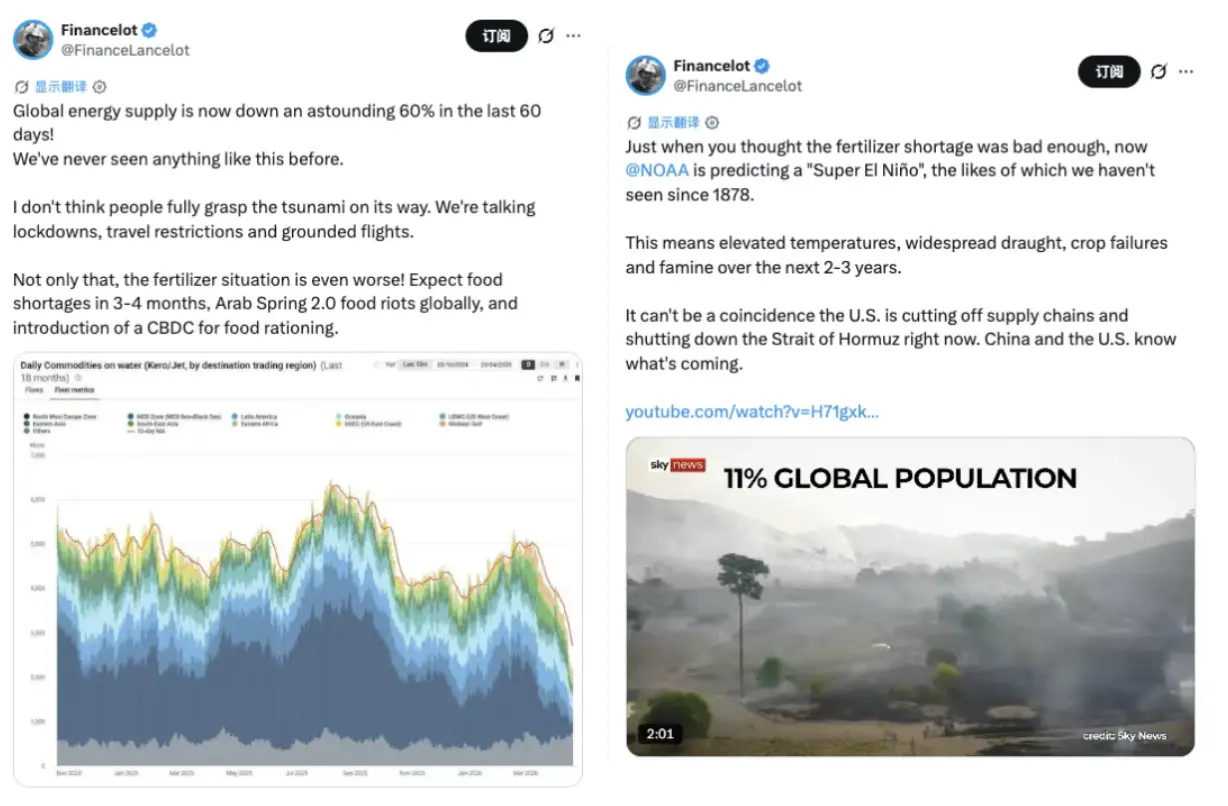
Satu mengatakan NOAA (Administrasi Kelautan dan Atmosfer Nasional AS, salah satu lembaga pemantau iklim yang paling sering dikutip di dunia) sedang memprediksi "Super El Niño" yang belum pernah terlihat sejak 1878, artinya pemanasan, kekeringan luas, gagal panen, dan risiko kelaparan dalam dua hingga tiga tahun ke depan, disertai video Sky News, judulnya "11% populasi global".

Yang lain juga pandangan serupa: pasokan energi dan pengiriman laut global turun 60% dalam 60 hari terakhir, disertai grafik aliran produk minyak pengiriman, kurva dari posisi tinggi awal tahun jatuh seperti tebing. Kesimpulannya adalah kekurangan pupuk ditambah El Niño, dalam 3 hingga 4 bulan kemungkinan terjadi kekurangan pangan global.

Kalimat postingan ini membawa nuansa kiamat yang jelas, tidak bisa diterima begitu saja.

Tetapi mereka mencerminkan satu hal: di pasar sudah ada sekelompok orang yang merangkai narasi El Niño, pemutusan energi, kekurangan pupuk, ketegangan Selat Hormuz menjadi satu narasi, dan narasi ini sedang mendapatkan lalu lintas dan perhatian.

Yang lebih penting, narasi ini tidak hanya menuju untung-rugi di akun futures, tetapi mungkin berdampak pada semua orang biasa, menambah biaya hidup semua orang.

Awalnya, tidak ada yang memperhatikan badai ini. Ini hanyalah sebuah topan, hujan deras, kenaikan suhu air laut yang kecil.

Tetapi badai tidak berhenti karena tidak ada yang memperhatikan. Hujan deras di berbagai tempat di dunia, penerbangan yang dibatalkan, ikan teri Peru yang hilang, buah kakao Ghana yang busuk, gula yang kekurangan, ini semua sudah menjadi bagian dari badai, pada akhirnya akan jatuh dalam kehidupan orang yang berbeda.


Trending Cryptos

Related Questions

QApa yang dimaksud dengan ENSO atau El Niño, dan mengapa dia disebut 'demamnya Samudra Pasifik' dalam artikel?

AENSO (El Niño-Southern Oscillation) adalah sinyal iklim tahunan terbesar di Bumi yang menggambarkan perubahan periodik antara suhu laut dan sirkulasi atmosfer di Samudra Pasifik. Disebut 'demamnya Samudra Pasifik' karena selama fenomena El Niño, suhu permukaan laut di bagian tengah dan timur Pasifik tropis meningkat secara signifikan (anomali positif), bagaikan samudra sedang mengalami demam.

QBagaimana fenomena El Niño dapat menjadi peluang investasi atau alat menghasilkan uang di pasar keuangan, seperti yang disebutkan di artikel?

AEl Niño dapat mengganggu produksi pertanian dan komoditas di berbagai wilayah (seperti kekeringan di Asia Tenggara yang menekan produksi kelapa sawit dan karet, atau hujan berlebih di Amerika Selatan yang mengganggu pertambangan tembaga). Gangguan ini mempengaruhi pasokan, yang kemudian mendorong harga komoditas terkait naik. Investor dan dana lindung nilai (seperti Moreton Capital Partners) dapat memprediksi dampak ini lebih awal dan mengambil posisi di pasar berjangka untuk mendapatkan keuntungan dari pergerakan harga tersebut.

QSiapa Richard Dennis dan apa hubungannya dengan El Niño dalam konteks sejarah pasar komoditas?

ARichard Dennis adalah seorang trader legendaris, salah satu pendiri 'Turtle Traders'. Artikel menyebutkan bahwa kekayaan pertamanya (sekitar $500,000 pada tahun 1974) diperoleh dengan membeli kontrak berjangka kedelai. Harga kedelai saat itu terdorong naik karena kekurangan tepung ikan dari Peru, yang disebabkan oleh fenomena El Niño yang menghilangkan ikan anchovy (bahan baku tepung ikan). Jadi, El Niño secara tidak langsung memberinya peluang trading yang sukses.

QKomoditas apa saja yang disebutkan paling berisiko atau berpotensi terdampak oleh El Niño tahun 2026 ini, dan mengapa?

AArtikel menyebutkan beberapa komoditas yang berisiko: Minyak Kelapa Sawit dan Karet (karena kekeringan di Malaysia dan Indonesia), Gula dan Kapas (karena musim hujan yang lemah di India), Kakao (karena kondisi cuaca yang tidak menentu di Afrika Barat), serta Gandum Australia. Komoditas-komodida ini sangat bergantung pada kondisi cuaca normal di wilayah produksi utamanya, yang akan terganggu oleh pola curah hujan dan suhu ekstrem akibat El Niño.

QApa indikator kunci (hard indicators) yang perlu dipantau untuk mengonfirmasi dampak serius El Niño pada pasar, menurut artikel?

AArtikel menyebutkan lima indikator kunci: 1) Indeks Niño3.4 melebihi 2.0°C di musim gugur/musim dingin (menandakan El Niño kuat). 2) Data curah hujan muson India periode Juni-September. 3) Laporan stok bulanan minyak sawit dari Malaysian Palm Oil Board (MPOB). 4) Curah hujan di Guangxi (Cina) dan durasi gelombang panas di Tiongkok utara. 5) Skala pengumpulan dana lanjutan oleh dana khusus cuaca seperti Moreton Capital.

Related Reads

Collateral Dollars: How Does a 'Second-Layer Dollar' Above Stablecoins Form?

Collateral Dollars: How Does a "Second Layer of Dollars" Form on Top of Stablecoins? Most assume stablecoins replicate Eurodollar functions, expanding the offshore dollar system. However, stablecoins primarily replace specific functions like operational dollar balances for settlement. They do not inherently create new dollar credit; they substitute existing claims. The key question is: what happens when financial intermediaries use stablecoins as collateral to create a new layer of dollar-denominated claims? This "collateral dollar" channel operates through secured lending, not direct money creation. A money-like event only occurs when a liability issued against the controlled stablecoin is funded, rolled over, or accepted at near-par value by another balance sheet. The discount (haircut) prices the gap between "effective control over the token" and "reliable convertibility to bank dollars." Elasticity stems not from the stablecoin itself but from the liability issued against it and the willingness of third-party balance sheets to treat that liability as a near-par asset. Compared to the traditional Eurodollar system—where elasticity originates from bank deposit creation—the stablecoin collateral chain is structurally different. Eurodollar deposits are credit-expansive from inception. Stablecoins are initially substitutive; elasticity emerges later if an intermediary's liability against them gains monetary acceptance. Stablecoins disrupt specific tiers of the offshore dollar system, mainly replacing operational settlement balances. They do not replace the need for full dollar balance-sheet capacity (credit lines, hedging, maturity transformation). For systemic impact, the second-layer liability must pass three tests: transferability, funding capacity, and monetary acceptance (being fundable or held at par by others). Pressure transmission also differs. In the Eurodollar system, stress moves up a hierarchy of claims. In a stablecoin collateral chain, the second-layer liability can lose its money-like status well before the underlying stablecoin faces a run, often triggered by haircut increases and margin calls that create a dynamic spiral of falling token prices and rising discounts. In conclusion, the "collateral dollar" is not the stablecoin itself. It is the second-layer liability issued against a controlled token balance that is willing to be funded and maintained at near-par value. Its existence depends on that liability surviving the leap from "token liquidity" to "bank dollar liquidity."

marsbit1h ago

Collateral Dollars: How Does a 'Second-Layer Dollar' Above Stablecoins Form?

marsbit1h ago

Trading

Spot

Hot Articles

What is SONIC

Sonic: Pioneering the Future of Gaming in Web3 Introduction to Sonic In the ever-evolving landscape of Web3, the gaming industry stands out as one of the most dynamic and promising sectors. At the forefront of this revolution is Sonic, a project designed to amplify the gaming ecosystem on the Solana blockchain. Leveraging cutting-edge technology, Sonic aims to deliver an unparalleled gaming experience by efficiently processing millions of requests per second, ensuring that players enjoy seamless gameplay while maintaining low transaction costs. This article delves into the intricate details of Sonic, exploring its creators, funding sources, operational mechanics, and the timeline of significant events that have shaped its journey. What is Sonic? Sonic is an innovative layer-2 network that operates atop the Solana blockchain, specifically tailored to enhance the existing Solana gaming ecosystem. It accomplishes this through a customised, VM-agnostic game engine paired with a HyperGrid interpreter, facilitating sovereign game economies that roll up back to the Solana platform. The primary goals of Sonic include: Enhanced Gaming Experiences: Sonic is committed to offering lightning-fast on-chain gameplay, allowing players and developers to engage with games at previously unattainable speeds. Atomic Interoperability: This feature enables transactions to be executed within Sonic without the need to redeploy Solana programmes and accounts. This makes the process more efficient and directly benefits from Solana Layer1 services and liquidity. Seamless Deployment: Sonic allows developers to write for Ethereum Virtual Machine (EVM) based systems and execute them on Solana’s SVM infrastructure. This interoperability is crucial for attracting a broader range of dApps and decentralised applications to the platform. Support for Developers: By offering native composable gaming primitives and extensible data types - dining within the Entity-Component-System (ECS) framework - game creators can craft intricate business logic with ease. Overall, Sonic's unique approach not only caters to players but also provides an accessible and low-cost environment for developers to innovate and thrive. Creator of Sonic The information regarding the creator of Sonic is somewhat ambiguous. However, it is known that Sonic's SVM is owned by the company Mirror World. The absence of detailed information about the individuals behind Sonic reflects a common trend in several Web3 projects, where collective efforts and partnerships often overshadow individual contributions. Investors of Sonic Sonic has garnered considerable attention and support from various investors within the crypto and gaming sectors. Notably, the project raised an impressive $12 million during its Series A funding round. The round was led by BITKRAFT Ventures, with other notable investors including Galaxy, Okx Ventures, Interactive, Big Brain Holdings, and Mirana. This financial backing signifies the confidence that investment foundations have in Sonic’s potential to revolutionise the Web3 gaming landscape, further validating its innovative approaches and technologies. How Does Sonic Work? Sonic utilises the HyperGrid framework, a sophisticated parallel processing mechanism that enhances its scalability and customisability. Here are the core features that set Sonic apart: Lightning Speed at Low Costs: Sonic offers one of the fastest on-chain gaming experiences compared to other Layer-1 solutions, powered by the scalability of Solana’s virtual machine (SVM). Atomic Interoperability: Sonic enables transaction execution without redeployment of Solana programmes and accounts, effectively streamlining the interaction between users and the blockchain. EVM Compatibility: Developers can effortlessly migrate decentralised applications from EVM chains to the Solana environment using Sonic’s HyperGrid interpreter, increasing the accessibility and integration of various dApps. Ecosystem Support for Developers: By exposing native composable gaming primitives, Sonic facilitates a sandbox-like environment where developers can experiment and implement business logic, greatly enhancing the overall development experience. Monetisation Infrastructure: Sonic natively supports growth and monetisation efforts, providing frameworks for traffic generation, payments, and settlements, thereby ensuring that gaming projects are not only viable but also sustainable financially. Timeline of Sonic The evolution of Sonic has been marked by several key milestones. Below is a brief timeline highlighting critical events in the project's history: 2022: The Sonic cryptocurrency was officially launched, marking the beginning of its journey in the Web3 gaming arena. 2024: June: Sonic SVM successfully raised $12 million in a Series A funding round. This investment allowed Sonic to further develop its platform and expand its offerings. August: The launch of the Sonic Odyssey testnet provided users with the first opportunity to engage with the platform, offering interactive activities such as collecting rings—a nod to gaming nostalgia. October: SonicX, an innovative crypto game integrated with Solana, made its debut on TikTok, capturing the attention of over 120,000 users within a short span. This integration illustrated Sonic’s commitment to reaching a broader, global audience and showcased the potential of blockchain gaming. Key Points Sonic SVM is a revolutionary layer-2 network on Solana explicitly designed to enhance the GameFi landscape, demonstrating great potential for future development. HyperGrid Framework empowers Sonic by introducing horizontal scaling capabilities, ensuring that the network can handle the demands of Web3 gaming. Integration with Social Platforms: The successful launch of SonicX on TikTok displays Sonic’s strategy to leverage social media platforms to engage users, exponentially increasing the exposure and reach of its projects. Investment Confidence: The substantial funding from BITKRAFT Ventures, among others, emphasizes the robust backing Sonic has, paving the way for its ambitious future. In conclusion, Sonic encapsulates the essence of Web3 gaming innovation, striking a balance between cutting-edge technology, developer-centric tools, and community engagement. As the project continues to evolve, it is poised to redefine the gaming landscape, making it a notable entity for gamers and developers alike. As Sonic moves forward, it will undoubtedly attract greater interest and participation, solidifying its place within the broader narrative of blockchain gaming.

1.8k Total ViewsPublished 2024.04.04Updated 2024.12.03

What is SONIC

What is $S$

Understanding SPERO: A Comprehensive Overview Introduction to SPERO As the landscape of innovation continues to evolve, the emergence of web3 technologies and cryptocurrency projects plays a pivotal role in shaping the digital future. One project that has garnered attention in this dynamic field is SPERO, denoted as SPERO,$$s$. This article aims to gather and present detailed information about SPERO, to help enthusiasts and investors understand its foundations, objectives, and innovations within the web3 and crypto domains. What is SPERO,$$s$? SPERO,$$s$ is a unique project within the crypto space that seeks to leverage the principles of decentralisation and blockchain technology to create an ecosystem that promotes engagement, utility, and financial inclusion. The project is tailored to facilitate peer-to-peer interactions in new ways, providing users with innovative financial solutions and services. At its core, SPERO,$$s$ aims to empower individuals by providing tools and platforms that enhance user experience in the cryptocurrency space. This includes enabling more flexible transaction methods, fostering community-driven initiatives, and creating pathways for financial opportunities through decentralised applications (dApps). The underlying vision of SPERO,$$s$ revolves around inclusiveness, aiming to bridge gaps within traditional finance while harnessing the benefits of blockchain technology. Who is the Creator of SPERO,$$s$? The identity of the creator of SPERO,$$s$ remains somewhat obscure, as there are limited publicly available resources providing detailed background information on its founder(s). This lack of transparency can stem from the project's commitment to decentralisation—an ethos that many web3 projects share, prioritising collective contributions over individual recognition. By centring discussions around the community and its collective goals, SPERO,$$s$ embodies the essence of empowerment without singling out specific individuals. As such, understanding the ethos and mission of SPERO remains more important than identifying a singular creator. Who are the Investors of SPERO,$$s$? SPERO,$$s$ is supported by a diverse array of investors ranging from venture capitalists to angel investors dedicated to fostering innovation in the crypto sector. The focus of these investors generally aligns with SPERO's mission—prioritising projects that promise societal technological advancement, financial inclusivity, and decentralised governance. These investor foundations are typically interested in projects that not only offer innovative products but also contribute positively to the blockchain community and its ecosystems. The backing from these investors reinforces SPERO,$$s$ as a noteworthy contender in the rapidly evolving domain of crypto projects. How Does SPERO,$$s$ Work? SPERO,$$s$ employs a multi-faceted framework that distinguishes it from conventional cryptocurrency projects. Here are some of the key features that underline its uniqueness and innovation: Decentralised Governance: SPERO,$$s$ integrates decentralised governance models, empowering users to participate actively in decision-making processes regarding the project’s future. This approach fosters a sense of ownership and accountability among community members. Token Utility: SPERO,$$s$ utilises its own cryptocurrency token, designed to serve various functions within the ecosystem. These tokens enable transactions, rewards, and the facilitation of services offered on the platform, enhancing overall engagement and utility. Layered Architecture: The technical architecture of SPERO,$$s$ supports modularity and scalability, allowing for seamless integration of additional features and applications as the project evolves. This adaptability is paramount for sustaining relevance in the ever-changing crypto landscape. Community Engagement: The project emphasises community-driven initiatives, employing mechanisms that incentivise collaboration and feedback. By nurturing a strong community, SPERO,$$s$ can better address user needs and adapt to market trends. Focus on Inclusion: By offering low transaction fees and user-friendly interfaces, SPERO,$$s$ aims to attract a diverse user base, including individuals who may not previously have engaged in the crypto space. This commitment to inclusion aligns with its overarching mission of empowerment through accessibility. Timeline of SPERO,$$s$ Understanding a project's history provides crucial insights into its development trajectory and milestones. Below is a suggested timeline mapping significant events in the evolution of SPERO,$$s$: Conceptualisation and Ideation Phase: The initial ideas forming the basis of SPERO,$$s$ were conceived, aligning closely with the principles of decentralisation and community focus within the blockchain industry. Launch of Project Whitepaper: Following the conceptual phase, a comprehensive whitepaper detailing the vision, goals, and technological infrastructure of SPERO,$$s$ was released to garner community interest and feedback. Community Building and Early Engagements: Active outreach efforts were made to build a community of early adopters and potential investors, facilitating discussions around the project’s goals and garnering support. Token Generation Event: SPERO,$$s$ conducted a token generation event (TGE) to distribute its native tokens to early supporters and establish initial liquidity within the ecosystem. Launch of Initial dApp: The first decentralised application (dApp) associated with SPERO,$$s$ went live, allowing users to engage with the platform's core functionalities. Ongoing Development and Partnerships: Continuous updates and enhancements to the project's offerings, including strategic partnerships with other players in the blockchain space, have shaped SPERO,$$s$ into a competitive and evolving player in the crypto market. Conclusion SPERO,$$s$ stands as a testament to the potential of web3 and cryptocurrency to revolutionise financial systems and empower individuals. With a commitment to decentralised governance, community engagement, and innovatively designed functionalities, it paves the way toward a more inclusive financial landscape. As with any investment in the rapidly evolving crypto space, potential investors and users are encouraged to research thoroughly and engage thoughtfully with the ongoing developments within SPERO,$$s$. The project showcases the innovative spirit of the crypto industry, inviting further exploration into its myriad possibilities. While the journey of SPERO,$$s$ is still unfolding, its foundational principles may indeed influence the future of how we interact with technology, finance, and each other in interconnected digital ecosystems.

100 Total ViewsPublished 2024.12.17Updated 2024.12.17

What is $S$

What is AGENT S

Agent S: The Future of Autonomous Interaction in Web3 Introduction In the ever-evolving landscape of Web3 and cryptocurrency, innovations are constantly redefining how individuals interact with digital platforms. One such pioneering project, Agent S, promises to revolutionise human-computer interaction through its open agentic framework. By paving the way for autonomous interactions, Agent S aims to simplify complex tasks, offering transformative applications in artificial intelligence (AI). This detailed exploration will delve into the project's intricacies, its unique features, and the implications for the cryptocurrency domain. What is Agent S? Agent S stands as a groundbreaking open agentic framework, specifically designed to tackle three fundamental challenges in the automation of computer tasks: Acquiring Domain-Specific Knowledge: The framework intelligently learns from various external knowledge sources and internal experiences. This dual approach empowers it to build a rich repository of domain-specific knowledge, enhancing its performance in task execution. Planning Over Long Task Horizons: Agent S employs experience-augmented hierarchical planning, a strategic approach that facilitates efficient breakdown and execution of intricate tasks. This feature significantly enhances its ability to manage multiple subtasks efficiently and effectively. Handling Dynamic, Non-Uniform Interfaces: The project introduces the Agent-Computer Interface (ACI), an innovative solution that enhances the interaction between agents and users. Utilizing Multimodal Large Language Models (MLLMs), Agent S can navigate and manipulate diverse graphical user interfaces seamlessly. Through these pioneering features, Agent S provides a robust framework that addresses the complexities involved in automating human interaction with machines, setting the stage for myriad applications in AI and beyond. Who is the Creator of Agent S? While the concept of Agent S is fundamentally innovative, specific information about its creator remains elusive. The creator is currently unknown, which highlights either the nascent stage of the project or the strategic choice to keep founding members under wraps. Regardless of anonymity, the focus remains on the framework's capabilities and potential. Who are the Investors of Agent S? As Agent S is relatively new in the cryptographic ecosystem, detailed information regarding its investors and financial backers is not explicitly documented. The lack of publicly available insights into the investment foundations or organisations supporting the project raises questions about its funding structure and development roadmap. Understanding the backing is crucial for gauging the project's sustainability and potential market impact. How Does Agent S Work? At the core of Agent S lies cutting-edge technology that enables it to function effectively in diverse settings. Its operational model is built around several key features: Human-like Computer Interaction: The framework offers advanced AI planning, striving to make interactions with computers more intuitive. By mimicking human behaviour in tasks execution, it promises to elevate user experiences. Narrative Memory: Employed to leverage high-level experiences, Agent S utilises narrative memory to keep track of task histories, thereby enhancing its decision-making processes. Episodic Memory: This feature provides users with step-by-step guidance, allowing the framework to offer contextual support as tasks unfold. Support for OpenACI: With the ability to run locally, Agent S allows users to maintain control over their interactions and workflows, aligning with the decentralised ethos of Web3. Easy Integration with External APIs: Its versatility and compatibility with various AI platforms ensure that Agent S can fit seamlessly into existing technological ecosystems, making it an appealing choice for developers and organisations. These functionalities collectively contribute to Agent S's unique position within the crypto space, as it automates complex, multi-step tasks with minimal human intervention. As the project evolves, its potential applications in Web3 could redefine how digital interactions unfold. Timeline of Agent S The development and milestones of Agent S can be encapsulated in a timeline that highlights its significant events: September 27, 2024: The concept of Agent S was launched in a comprehensive research paper titled “An Open Agentic Framework that Uses Computers Like a Human,” showcasing the groundwork for the project. October 10, 2024: The research paper was made publicly available on arXiv, offering an in-depth exploration of the framework and its performance evaluation based on the OSWorld benchmark. October 12, 2024: A video presentation was released, providing a visual insight into the capabilities and features of Agent S, further engaging potential users and investors. These markers in the timeline not only illustrate the progress of Agent S but also indicate its commitment to transparency and community engagement. Key Points About Agent S As the Agent S framework continues to evolve, several key attributes stand out, underscoring its innovative nature and potential: Innovative Framework: Designed to provide an intuitive use of computers akin to human interaction, Agent S brings a novel approach to task automation. Autonomous Interaction: The ability to interact autonomously with computers through GUI signifies a leap towards more intelligent and efficient computing solutions. Complex Task Automation: With its robust methodology, it can automate complex, multi-step tasks, making processes faster and less error-prone. Continuous Improvement: The learning mechanisms enable Agent S to improve from past experiences, continually enhancing its performance and efficacy. Versatility: Its adaptability across different operating environments like OSWorld and WindowsAgentArena ensures that it can serve a broad range of applications. As Agent S positions itself in the Web3 and crypto landscape, its potential to enhance interaction capabilities and automate processes signifies a significant advancement in AI technologies. Through its innovative framework, Agent S exemplifies the future of digital interactions, promising a more seamless and efficient experience for users across various industries. Conclusion Agent S represents a bold leap forward in the marriage of AI and Web3, with the capacity to redefine how we interact with technology. While still in its early stages, the possibilities for its application are vast and compelling. Through its comprehensive framework addressing critical challenges, Agent S aims to bring autonomous interactions to the forefront of the digital experience. As we move deeper into the realms of cryptocurrency and decentralisation, projects like Agent S will undoubtedly play a crucial role in shaping the future of technology and human-computer collaboration.

768 Total ViewsPublished 2025.01.14Updated 2025.01.14

What is AGENT S

Discussions

Welcome to the HTX Community. Here, you can stay informed about the latest platform developments and gain access to professional market insights. Users' opinions on the price of S (S) are presented below.

活动图片