太平洋“发烧”,极端天气如何沦为华尔街提款机?

链捕手Published on 2026-07-08Last updated on 2026-07-08

Abstract

文章揭示了当前太平洋厄尔尼诺现象的严重性及其对全球气候与经济的连锁影响。2026年入夏以来,中国多地遭遇极端暴雨、洪水和高温,西太平洋台风活跃。与此同时,秘鲁鱼粉涨价、东南亚干旱、印度季风偏弱、澳大利亚小麦种植面积可能收缩等全球性事件,其背后共同的驱动因素正是本轮可能成为1950年以来最强的厄尔尼诺事件。 厄尔尼诺通过改变大气环流,叠加全球变暖背景,显著增加了极端天气风险。然而,气候异常早已成为金融市场的交易主题。文章回顾了历史案例:1972年厄尔尼诺导致秘鲁鳀鱼消失,间接推高大豆价格,让年轻交易员理查德·丹尼斯赚得第一桶金;专攻可可的交易公司通过自建气象网络把握先机;2024年西非干旱导致可可期货暴涨,令一批量化基金获利丰厚。 当前,尽管棕榈油、白糖等农产品现实库存高企,但市场已开始提前交易未来6至12个月可能因厄尔尼诺导致的减产预期。关键观察指标包括: Niño3.4海域温度是否突破2°C、印度季风降雨数据、马来西亚棕榈油库存变化等。历史表明,价格的最大影响往往出现在厄尔尼诺峰值之后。 文章最后指出,网络社区已出现将厄尔尼诺、能源断供、化肥短缺等因素串联的“末日叙事”,这反映了极端天气与地缘政治等风险正相互交织,其影响远超金融市场,最终将转化为普通人的生活成本压力。风暴的影响已然开始,并将持续渗透至全球各个角落。

作者:加六,涨声Beatz

天津连着好几天突然的暴雨,出门前还是晴天,走到半路就被浇透。朋友晚上飞深圳的航班因为台风取消了,浙江方向的高铁票全部停售。

打开手机看新闻,辽宁抚顺数小时降雨超过 329 毫米,广西防城港有居民说这是 20 年来最严重的洪水,7 个国家级气象站单日降水破历史极值。华北最大规模高温预警,局地地表逼近 50°C。7 月第一周,两到三个台风同时在西太平洋排队生成,超强台风「巴威」正在逼近东南沿海。

2026 年入夏后,国内的天气显然开始变得不安分起来。

不安分的不只是我们。秘鲁沿岸海水持续偏暖,鳀鱼捕捞受限,鱼粉价格过去一年涨了约 80%。东南亚进入旱季后干旱信号增强,马来西亚和印尼的油棕产区开始紧张。印度季风降雨还没到关键窗口,但市场已经在押注它会偏弱。澳大利亚小麦种植面积被分析师标注为可能大幅收缩。

这些极端的天气变化分散在不同大洲,看上去彼此无关。但事实上,除了季风水汽、热带风暴外围环流、位置和地形这些直接的触发机制之外,他们大概率都受到了同一场风暴的影响:

ENSO,厄尔尼诺。

厄尔尼诺,太平洋在发烧

ENSO,中文翻译是厄尔尼诺-南方涛动,是地球气候系统里最大的年际信号。简单说,它描述的是太平洋海温和大气环流之间的周期变化。

正常情况下,赤道太平洋东边偏冷、西边偏暖,信风会把暖水推向西太平洋。但如果信风减弱,暖水向东回流,中东太平洋海温异常升高,就是厄尔尼诺。

气象机构判断厄尔尼诺是否发生,主要看一个关键区域: Niño3.4 海域(赤道中太平洋一块关键海域,可以理解成判断厄尔尼诺强弱的「温度计」)。如果这个区域连续几个月比正常年份高出 0.5°C 以上,就算进入厄尔尼诺状态;如果高出 2°C 以上,就属于超强级别。1997 年和 2015 年,就是两轮典型的超强厄尔尼诺。

而今年的厄尔尼诺,可能成为 1950 年以来最强级别的一次。

6 月 11 日,美国国家海洋和大气管理局正式发布厄尔尼诺预警,确认厄尔尼诺条件已经出现,并预计会增强到 2026 年底到 2027 年初。他们认为,今年 11 月到明年 1 月,出现超强厄尔尼诺的概率为 63%。中科院大气物理所的判断稍保守,发生中等强度的概率超过 70%,超强概率约一成。

气象学家 Ben Noll 在 X 上发了一张太平洋海温图,标题是「太平洋在发烧」。图上深橙色和红色铺满了大半个太平洋,显示这场海洋热浪覆盖的面积,超过美国本土的 8 倍。

对我们来说,它的影响不是“直接制造某一场暴雨”,而是改变大气环流的底色。它会影响西太平洋副热带高压的位置,改变东亚夏季风输送水汽的路径,让雨带更容易偏离常规位置,高温、干旱、强对流的风险也会上升。

再叠加全球变暖,大气每升温 1°C,能容纳的水汽大约增加 7%。所以今天的厄尔尼诺,不是在正常气候里发生,而是在一个本来就更热、更湿、更容易走极端的背景上发生。

这边是季风和台风,但是另一边的金融市场上已经嗅到了一些味道,有基金在蠢蠢欲动。

6 月 24 日,彭博报道,对冲基金 Moreton Capital Partners 正在为一只专项工具募集 5 亿美元。交易的标的是南非玉米、马来西亚棕榈油、澳大利亚小麦这些会受到厄尔尼诺影响的农作物。联合创始人 Les Finemore 给出的理由只有一句:市场远远低估了今年厄尔尼诺所带来的风险。

天气不再是大宗商品组合里的背景噪音,在某种程度上他完全可以作为单独立项、单独募资的主题。

Finemore 凭什么能募到 5 亿美元?因为靠厄尔尼诺这样的极端天气赚钱这件事不是理论,几十多年来都不断有人因此赚过大钱。

「海龟交易法」创始人的第一桶金

1972 年,秘鲁海岸的鳀鱼突然没了。

这种十几厘米长的小鱼,全世界大多数人一辈子不会吃到,但它被磨成鱼粉,是全球动物饲料里最重要的蛋白质来源之一。

鳀鱼消失的原因,正是因为赤道太平洋的海水突然变暖,冷水不再上涌,浮游生物链断掉了。气象学家后来给这种现象取了个名字:厄尔尼诺。

鱼粉没了,饲料商得找替代品,豆粕价格被硬拉起来,于是大豆的价格跟着涨。

芝加哥商品交易所里,一个不到 26 岁的年轻交易员 Richard Dennis 看见价格不停创新高,就不停地买大豆。1974 年,他在大豆上赚了大约 50 万美元,年底成了百万富翁。

年轻时的 Richard Dennis

而当时这个赚到第一桶金的年轻交易员 Richard Dennis ,就是后来大名鼎鼎的「海龟交易员」创始人,他的名字成了趋势交易流派的祖师爷之一。

还有一个典型的故事是来自 Anthony Ward,外号 Chocfinger(巧克力手指)。他 1998 年在伦敦创办 Armajaro,专做可可和咖啡。这家公司最特殊的地方不在交易台而在气象部门:自建气象站网络,雇全职气象学家,西非产地铺了 20 多人的调研团队。

他的逻辑是,天气的小幅变化能让作物单产波动 10%,谁先知道天气谁先知道价格。2002 年他吃下伦敦交易所当月可可交割量的四分之三,税前利润 1040 万英镑。2010 年 7 月 17 日,一次性接收 24.01 万吨可可实物,价值 6.58 亿英镑,全球年产量的 7%,基本是当时欧洲全部可见库存。可可价格被推到 1977 年以来最高。

我们再来看看近些年的一些例子。

2024 年,可可是全球最疯的商品。西非的科特迪瓦和加纳,全球七成可可的产地,遭遇异常高温和干燥的哈马丹风(一种从撒哈拉吹向西非海岸的干热风),可可荚大面积腐坏,叠加病害、老树、低库存,可可期货两年涨超 400%,一度突破每吨 1 万美元。

吃到行情大头的,不只是可可行业的人,还有一群量化趋势基金。Aspect Capital 的 Razvan Remsing 说那是他们 25 年来最好的第一季度。AQR 的管理期货策略一季度涨了约 17.4%。Capital Fund Management 旗下趋势基金涨了约 17.5%。Aspect 旗舰基金到 4 月下旬涨了 21.4%。David Harding 创立的 Winton,旗下多元宏观基金一季度涨约 13%。

同一时期,Winton 除了在可可上赚到了不少钱之外,还在另一个方向赚了大钱:厄尔尼诺通常会让美国部分地区冬季偏暖。冬天没那么冷,取暖用气需求就弱,库存堆起来,美国天然气基准价格 Henry Hub(相当于原油市场的布伦特)跌到近 30 年低位附近。

抄底可可,还是白糖?

回到 2026 年。这一轮厄尔尼诺还没到峰值,但盘面已经抢跑了一轮。

棕榈油主力 4 月下旬从 9400 元冲到 9993 元然后回落。橡胶从 4 月低点起步,5 月中旬一度突破 18300 元。白糖在 5200 到 5450 元之间反复拉锯。花生借着旱情和成本支撑走了七连阳。

奇怪的地方在于,这些品种的现实基本面都不支持涨。马来西亚棕榈油 5 月底库存还在环比增加,国内白糖库存同比多了 183 万吨,棕榈油国内库存同比高出 25.68%。产量还没开始掉,价格先涨了。涨的唯一理由,是对厄尔尼诺在 6 到 12 个月后带来的减产的想象。

过去五十年,每一轮中等以上强度的厄尔尼诺都在商品市场留下过划痕。1982 年那轮棕榈油涨 169%。2009 至 2010 年印尼橡胶减产 11.3%,现货价格两年涨了 157.79%。2015 至 2016 年白糖涨 65%。
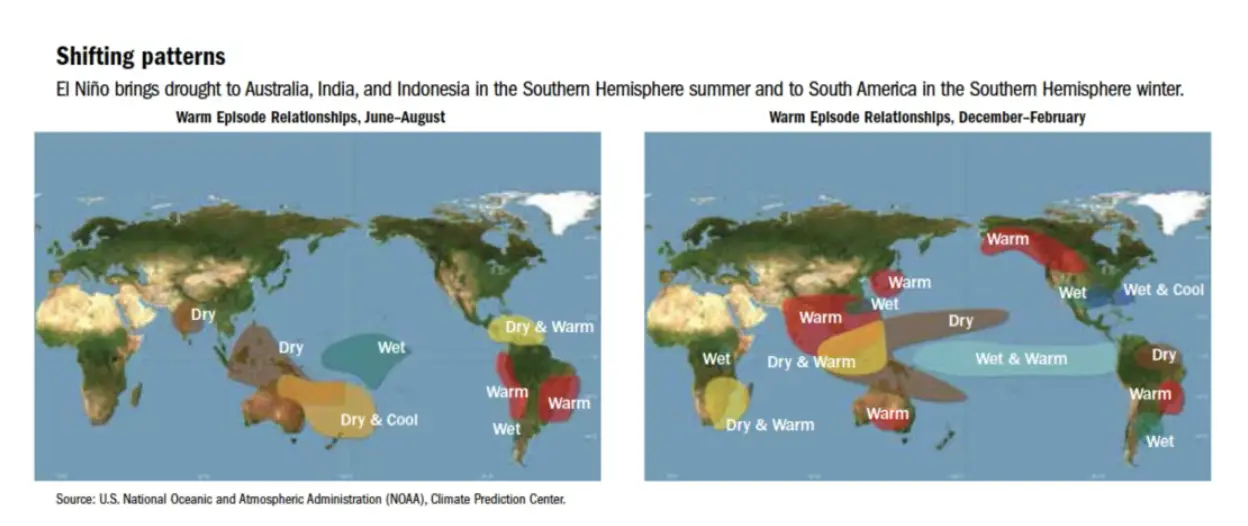
在东南亚,它带来干旱,压棕榈油和橡胶的产量。在印度,它让季风偏弱,影响糖和棉花。在秘鲁,它让鳀鱼消失,推高鱼粉。但在南美的另一端,它带来的是更多雨水,反而可能改善巴西和阿根廷的大豆和甘蔗。在智利和秘鲁的矿区,强降雨冲击的不是农田而是铜矿。在美国,暖冬压的是天然气需求。

海外社区对这次厄尔尼诺的讨论依然在发酵。

大宗商品圈的博主 @tleilax__ 发的帖子配了两张预测图,一张图看的是今年 7 到 9 月全球气温会比往年同期高多少。图上几乎一片红色,而这个时间正好是谷物、油籽、亚洲稻米和白糖的重要生长期。

另一张图看的是降雨会比往年同期多还是少。图上印度和东南亚大面积偏干,正好对应市场最担心的季风偏弱。

因此他的结论是:印度和东南亚可能经历数十年来最弱的季风降雨,而这发生在全球化肥短缺的背景上。这条帖子目前得到超过 108 万次浏览。

Substack 上的大宗商品专栏把棕榈油、棉花、可可列为未来 6 至 12 个月风险收益最清晰的集群。新加坡投资社区在逐家排查马来西亚种植园股,结论是纯上游种植商吃到全部弹性,丰益国际这种中下游加工为主的公司反而被棕榈油涨价挤利润。美股社区在传一个更绕的论点:巴西和阿根廷的农业公司 Adecoagro 是「科技重仓组合的天气对冲」,因为厄尔尼诺给南美带来的是雨水而不是干旱,亚洲减产推高价格时它的产量反而在扩张。

这轮行情的剧本还剩大半没展开,所以并不是越早买入越好。能改变仓位方向的硬指标不多,但每一个都是关键:

  • Niño3.4 指数秋冬是否突破 2.0°C,这是中等和超强的分界线,也是农产品波动率整体上台阶的开关。

  • 印度季风 6 至 9 月的降雨数据,白糖、棉花、稻米这一组品种的方向盘。

  • 马来西亚棕榈油局的月度库存报告,高库存消化的速度决定预期行情何时接上现实行情。

  • 国内广西 7 月降雨和华北高温的持续天数,前者管糖后者管电。

  • Moreton 这类天气专项基金后续的募资规模,机构资金的量决定天气交易是一波脉冲还是一整年的主线。

1972 年和 2024 年的经验指向同一个时间差:厄尔尼诺真正的价格效应,大多发生在事件峰值之后。Dennis 在鳀鱼崩盘两年后才赚到钱,可可在 ENSO 转中性之后才真正爆发。2026 年下半年市场交易的是预期,2027 年交易的才是减产本身。

最初,没有人在意这场风暴

除了这些交易机会之外,更值得深思的是金融博主 @FinanceLancelot 在 X 上发的两条引发大量转发的帖子。
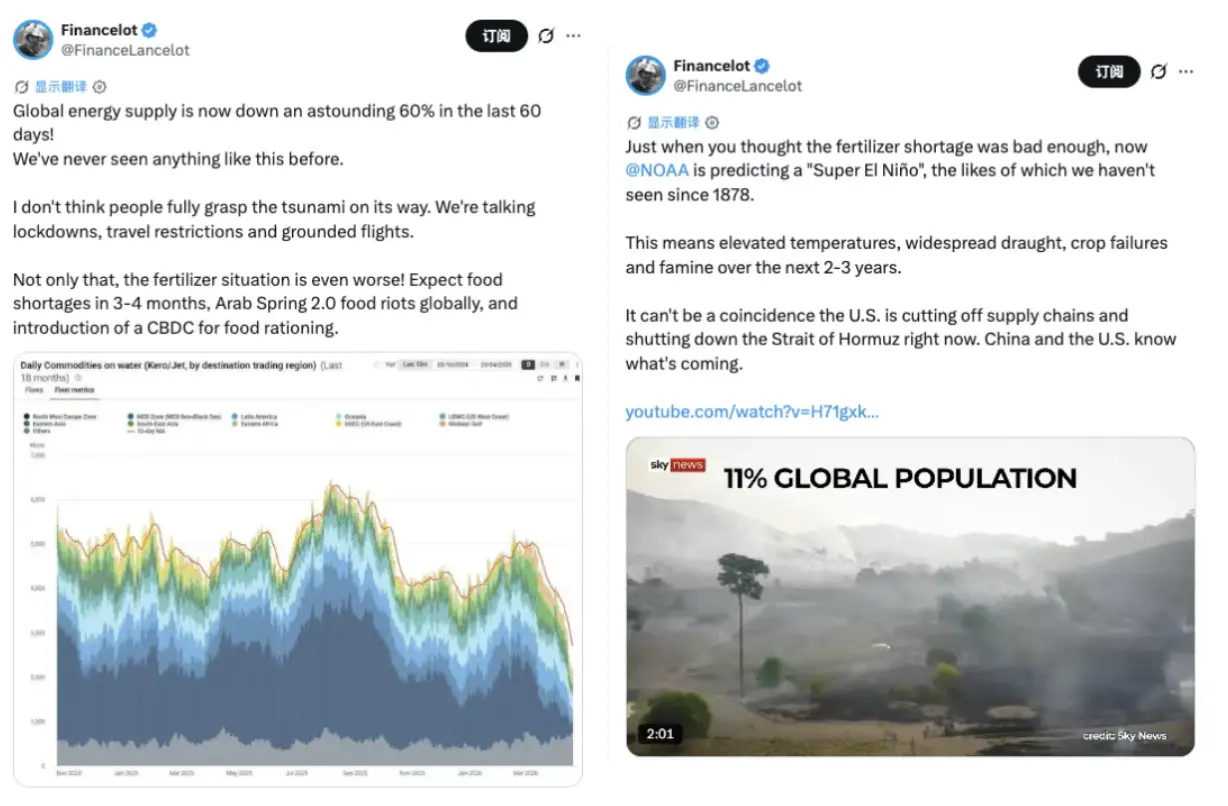
一条说 NOAA(美国国家海洋和大气管理局,全球最常被引用的气候监测机构之一)正在预测一次自 1878 年以来从未见过的「超级厄尔尼诺」,意味着未来两到三年内升温、大面积干旱、粮食歉收和饥荒风险,配了一段 Sky News 的视频,标题是「全球 11% 人口」。

另一条也是类似的观点:全球能源海运供应在过去 60 天内下降了 60%,配了一张航运油品流量图,曲线从年初的高位断崖式下坠。他的结论是化肥短缺叠加厄尔尼诺,3 到 4 个月内全球范围内可能出现粮食短缺。

这些帖子的措辞带着明显的末日论色彩,不能照单全收。

但它们反映了一件事:市场上已经有一批人在把厄尔尼诺、能源断供、化肥短缺、霍尔木兹海峡紧张这几条线串成一个叙事,而且这个叙事正在获得流量和注意力。

更重要的是,这个叙事指向的不只是期货账户里的盈亏,而是可能会对所有普通人都有影响,加进了所有人的生活成本里。

最初,没有人在意这场风暴。这不过是一场台风,一阵暴雨,一次海水温度的小幅上涨。

但风暴不会因为没人在意就停下来。世界各地的暴雨,被取消的航班,秘鲁消失的鳀鱼,加纳腐烂的可可荚,短缺的白糖,这些已经是风暴的一部分,最终都将落在不同人的生活里。

Trending Cryptos

Related Questions

Q这篇文章的核心主题是什么?

A文章探讨了极端天气现象(特别是厄尔尼诺)如何通过影响全球大宗商品(如农产品)的供给,进而演变为华尔街等金融市场的交易机会和利润来源,并警示气候变化对普通民众生活成本的影响。

Q根据文章,2026年预计发生的厄尔尼诺事件有何特殊性?

A2026年正在形成的厄尔尼诺,被预测可能成为1950年以来甚至1878年以来最强级别的事件之一。其规模巨大,例如太平洋海温异常覆盖面积超过美国本土的8倍,可能引发一系列连锁性的极端天气,对全球农业和商品市场造成深远影响。

Q文章提到了哪几位通过极端天气进行金融交易并获利的著名人物或案例?

A文中提到了三个典型例子:1)Richard Dennis:在1970年代因厄尔尼诺导致秘鲁鳀鱼减产、大豆价格飙升,他通过做多大豆期货赚得第一桶金,后成为“海龟交易法”创始人。2)Anthony Ward(巧克力手指):他创办的Armajaro公司通过在可可产地建立气象和调研团队,提前预判天气对产量的影响,并在2010年通过囤积大量可可实物推动价格暴涨。3)2024年多家量化基金:因西非可可产区遭遇极端干旱导致可可期货价格飙升,多家趋势跟踪基金(如Aspect Capital, AQR等)获得了创纪录的回报。

Q在2026年,市场预期本轮厄尔尼诺将对哪些大宗商品产生何种方向的影响?

A市场基于历史经验和气候模型,预期厄尔尼诺将:1)对东南亚(马来西亚、印尼)带来干旱,可能压制棕榈油、橡胶的产量,导致价格上涨。2)使印度季风偏弱,影响白糖、棉花、稻米的产量。3)在秘鲁附近海域导致鳀鱼消失,推高鱼粉及替代品豆粕价格。4)相反,可能为南美(巴西、阿根廷)带来更多雨水,反而有利于当地的大豆和甘蔗生产。5)在美国,暖冬可能抑制取暖需求,压低天然气价格。

Q文章指出,判断本轮厄尔尼诺行情走向需要关注哪些关键指标?

A文章列出了几个改变市场预期的关键硬指标:1)Niño3.4海域海温指数在秋冬是否突破2.0°C(判断是否达到超强级别)。2)印度6-9月季风降雨的实际数据。3)马来西亚棕榈油局的月度库存报告(观察高库存消化速度)。4)中国广西7月降雨和华北高温的持续天数(分别影响白糖和电力需求)。5)类似Moreton Capital这类专项天气主题基金的募资规模(反映机构资金的关注度)。

Related Reads

Collateral Dollars: How Does a 'Second-Layer Dollar' Above Stablecoins Form?

Collateral Dollars: How Does a "Second Layer of Dollars" Form on Top of Stablecoins? Most assume stablecoins replicate Eurodollar functions, expanding the offshore dollar system. However, stablecoins primarily replace specific functions like operational dollar balances for settlement. They do not inherently create new dollar credit; they substitute existing claims. The key question is: what happens when financial intermediaries use stablecoins as collateral to create a new layer of dollar-denominated claims? This "collateral dollar" channel operates through secured lending, not direct money creation. A money-like event only occurs when a liability issued against the controlled stablecoin is funded, rolled over, or accepted at near-par value by another balance sheet. The discount (haircut) prices the gap between "effective control over the token" and "reliable convertibility to bank dollars." Elasticity stems not from the stablecoin itself but from the liability issued against it and the willingness of third-party balance sheets to treat that liability as a near-par asset. Compared to the traditional Eurodollar system—where elasticity originates from bank deposit creation—the stablecoin collateral chain is structurally different. Eurodollar deposits are credit-expansive from inception. Stablecoins are initially substitutive; elasticity emerges later if an intermediary's liability against them gains monetary acceptance. Stablecoins disrupt specific tiers of the offshore dollar system, mainly replacing operational settlement balances. They do not replace the need for full dollar balance-sheet capacity (credit lines, hedging, maturity transformation). For systemic impact, the second-layer liability must pass three tests: transferability, funding capacity, and monetary acceptance (being fundable or held at par by others). Pressure transmission also differs. In the Eurodollar system, stress moves up a hierarchy of claims. In a stablecoin collateral chain, the second-layer liability can lose its money-like status well before the underlying stablecoin faces a run, often triggered by haircut increases and margin calls that create a dynamic spiral of falling token prices and rising discounts. In conclusion, the "collateral dollar" is not the stablecoin itself. It is the second-layer liability issued against a controlled token balance that is willing to be funded and maintained at near-par value. Its existence depends on that liability surviving the leap from "token liquidity" to "bank dollar liquidity."

marsbit1h ago

Collateral Dollars: How Does a 'Second-Layer Dollar' Above Stablecoins Form?

marsbit1h ago

Trading

Spot

Hot Articles

What is SONIC

Sonic: Pioneering the Future of Gaming in Web3 Introduction to Sonic In the ever-evolving landscape of Web3, the gaming industry stands out as one of the most dynamic and promising sectors. At the forefront of this revolution is Sonic, a project designed to amplify the gaming ecosystem on the Solana blockchain. Leveraging cutting-edge technology, Sonic aims to deliver an unparalleled gaming experience by efficiently processing millions of requests per second, ensuring that players enjoy seamless gameplay while maintaining low transaction costs. This article delves into the intricate details of Sonic, exploring its creators, funding sources, operational mechanics, and the timeline of significant events that have shaped its journey. What is Sonic? Sonic is an innovative layer-2 network that operates atop the Solana blockchain, specifically tailored to enhance the existing Solana gaming ecosystem. It accomplishes this through a customised, VM-agnostic game engine paired with a HyperGrid interpreter, facilitating sovereign game economies that roll up back to the Solana platform. The primary goals of Sonic include: Enhanced Gaming Experiences: Sonic is committed to offering lightning-fast on-chain gameplay, allowing players and developers to engage with games at previously unattainable speeds. Atomic Interoperability: This feature enables transactions to be executed within Sonic without the need to redeploy Solana programmes and accounts. This makes the process more efficient and directly benefits from Solana Layer1 services and liquidity. Seamless Deployment: Sonic allows developers to write for Ethereum Virtual Machine (EVM) based systems and execute them on Solana’s SVM infrastructure. This interoperability is crucial for attracting a broader range of dApps and decentralised applications to the platform. Support for Developers: By offering native composable gaming primitives and extensible data types - dining within the Entity-Component-System (ECS) framework - game creators can craft intricate business logic with ease. Overall, Sonic's unique approach not only caters to players but also provides an accessible and low-cost environment for developers to innovate and thrive. Creator of Sonic The information regarding the creator of Sonic is somewhat ambiguous. However, it is known that Sonic's SVM is owned by the company Mirror World. The absence of detailed information about the individuals behind Sonic reflects a common trend in several Web3 projects, where collective efforts and partnerships often overshadow individual contributions. Investors of Sonic Sonic has garnered considerable attention and support from various investors within the crypto and gaming sectors. Notably, the project raised an impressive $12 million during its Series A funding round. The round was led by BITKRAFT Ventures, with other notable investors including Galaxy, Okx Ventures, Interactive, Big Brain Holdings, and Mirana. This financial backing signifies the confidence that investment foundations have in Sonic’s potential to revolutionise the Web3 gaming landscape, further validating its innovative approaches and technologies. How Does Sonic Work? Sonic utilises the HyperGrid framework, a sophisticated parallel processing mechanism that enhances its scalability and customisability. Here are the core features that set Sonic apart: Lightning Speed at Low Costs: Sonic offers one of the fastest on-chain gaming experiences compared to other Layer-1 solutions, powered by the scalability of Solana’s virtual machine (SVM). Atomic Interoperability: Sonic enables transaction execution without redeployment of Solana programmes and accounts, effectively streamlining the interaction between users and the blockchain. EVM Compatibility: Developers can effortlessly migrate decentralised applications from EVM chains to the Solana environment using Sonic’s HyperGrid interpreter, increasing the accessibility and integration of various dApps. Ecosystem Support for Developers: By exposing native composable gaming primitives, Sonic facilitates a sandbox-like environment where developers can experiment and implement business logic, greatly enhancing the overall development experience. Monetisation Infrastructure: Sonic natively supports growth and monetisation efforts, providing frameworks for traffic generation, payments, and settlements, thereby ensuring that gaming projects are not only viable but also sustainable financially. Timeline of Sonic The evolution of Sonic has been marked by several key milestones. Below is a brief timeline highlighting critical events in the project's history: 2022: The Sonic cryptocurrency was officially launched, marking the beginning of its journey in the Web3 gaming arena. 2024: June: Sonic SVM successfully raised $12 million in a Series A funding round. This investment allowed Sonic to further develop its platform and expand its offerings. August: The launch of the Sonic Odyssey testnet provided users with the first opportunity to engage with the platform, offering interactive activities such as collecting rings—a nod to gaming nostalgia. October: SonicX, an innovative crypto game integrated with Solana, made its debut on TikTok, capturing the attention of over 120,000 users within a short span. This integration illustrated Sonic’s commitment to reaching a broader, global audience and showcased the potential of blockchain gaming. Key Points Sonic SVM is a revolutionary layer-2 network on Solana explicitly designed to enhance the GameFi landscape, demonstrating great potential for future development. HyperGrid Framework empowers Sonic by introducing horizontal scaling capabilities, ensuring that the network can handle the demands of Web3 gaming. Integration with Social Platforms: The successful launch of SonicX on TikTok displays Sonic’s strategy to leverage social media platforms to engage users, exponentially increasing the exposure and reach of its projects. Investment Confidence: The substantial funding from BITKRAFT Ventures, among others, emphasizes the robust backing Sonic has, paving the way for its ambitious future. In conclusion, Sonic encapsulates the essence of Web3 gaming innovation, striking a balance between cutting-edge technology, developer-centric tools, and community engagement. As the project continues to evolve, it is poised to redefine the gaming landscape, making it a notable entity for gamers and developers alike. As Sonic moves forward, it will undoubtedly attract greater interest and participation, solidifying its place within the broader narrative of blockchain gaming.

1.8k Total ViewsPublished 2024.04.04Updated 2024.12.03

What is SONIC

What is $S$

Understanding SPERO: A Comprehensive Overview Introduction to SPERO As the landscape of innovation continues to evolve, the emergence of web3 technologies and cryptocurrency projects plays a pivotal role in shaping the digital future. One project that has garnered attention in this dynamic field is SPERO, denoted as SPERO,$$s$. This article aims to gather and present detailed information about SPERO, to help enthusiasts and investors understand its foundations, objectives, and innovations within the web3 and crypto domains. What is SPERO,$$s$? SPERO,$$s$ is a unique project within the crypto space that seeks to leverage the principles of decentralisation and blockchain technology to create an ecosystem that promotes engagement, utility, and financial inclusion. The project is tailored to facilitate peer-to-peer interactions in new ways, providing users with innovative financial solutions and services. At its core, SPERO,$$s$ aims to empower individuals by providing tools and platforms that enhance user experience in the cryptocurrency space. This includes enabling more flexible transaction methods, fostering community-driven initiatives, and creating pathways for financial opportunities through decentralised applications (dApps). The underlying vision of SPERO,$$s$ revolves around inclusiveness, aiming to bridge gaps within traditional finance while harnessing the benefits of blockchain technology. Who is the Creator of SPERO,$$s$? The identity of the creator of SPERO,$$s$ remains somewhat obscure, as there are limited publicly available resources providing detailed background information on its founder(s). This lack of transparency can stem from the project's commitment to decentralisation—an ethos that many web3 projects share, prioritising collective contributions over individual recognition. By centring discussions around the community and its collective goals, SPERO,$$s$ embodies the essence of empowerment without singling out specific individuals. As such, understanding the ethos and mission of SPERO remains more important than identifying a singular creator. Who are the Investors of SPERO,$$s$? SPERO,$$s$ is supported by a diverse array of investors ranging from venture capitalists to angel investors dedicated to fostering innovation in the crypto sector. The focus of these investors generally aligns with SPERO's mission—prioritising projects that promise societal technological advancement, financial inclusivity, and decentralised governance. These investor foundations are typically interested in projects that not only offer innovative products but also contribute positively to the blockchain community and its ecosystems. The backing from these investors reinforces SPERO,$$s$ as a noteworthy contender in the rapidly evolving domain of crypto projects. How Does SPERO,$$s$ Work? SPERO,$$s$ employs a multi-faceted framework that distinguishes it from conventional cryptocurrency projects. Here are some of the key features that underline its uniqueness and innovation: Decentralised Governance: SPERO,$$s$ integrates decentralised governance models, empowering users to participate actively in decision-making processes regarding the project’s future. This approach fosters a sense of ownership and accountability among community members. Token Utility: SPERO,$$s$ utilises its own cryptocurrency token, designed to serve various functions within the ecosystem. These tokens enable transactions, rewards, and the facilitation of services offered on the platform, enhancing overall engagement and utility. Layered Architecture: The technical architecture of SPERO,$$s$ supports modularity and scalability, allowing for seamless integration of additional features and applications as the project evolves. This adaptability is paramount for sustaining relevance in the ever-changing crypto landscape. Community Engagement: The project emphasises community-driven initiatives, employing mechanisms that incentivise collaboration and feedback. By nurturing a strong community, SPERO,$$s$ can better address user needs and adapt to market trends. Focus on Inclusion: By offering low transaction fees and user-friendly interfaces, SPERO,$$s$ aims to attract a diverse user base, including individuals who may not previously have engaged in the crypto space. This commitment to inclusion aligns with its overarching mission of empowerment through accessibility. Timeline of SPERO,$$s$ Understanding a project's history provides crucial insights into its development trajectory and milestones. Below is a suggested timeline mapping significant events in the evolution of SPERO,$$s$: Conceptualisation and Ideation Phase: The initial ideas forming the basis of SPERO,$$s$ were conceived, aligning closely with the principles of decentralisation and community focus within the blockchain industry. Launch of Project Whitepaper: Following the conceptual phase, a comprehensive whitepaper detailing the vision, goals, and technological infrastructure of SPERO,$$s$ was released to garner community interest and feedback. Community Building and Early Engagements: Active outreach efforts were made to build a community of early adopters and potential investors, facilitating discussions around the project’s goals and garnering support. Token Generation Event: SPERO,$$s$ conducted a token generation event (TGE) to distribute its native tokens to early supporters and establish initial liquidity within the ecosystem. Launch of Initial dApp: The first decentralised application (dApp) associated with SPERO,$$s$ went live, allowing users to engage with the platform's core functionalities. Ongoing Development and Partnerships: Continuous updates and enhancements to the project's offerings, including strategic partnerships with other players in the blockchain space, have shaped SPERO,$$s$ into a competitive and evolving player in the crypto market. Conclusion SPERO,$$s$ stands as a testament to the potential of web3 and cryptocurrency to revolutionise financial systems and empower individuals. With a commitment to decentralised governance, community engagement, and innovatively designed functionalities, it paves the way toward a more inclusive financial landscape. As with any investment in the rapidly evolving crypto space, potential investors and users are encouraged to research thoroughly and engage thoughtfully with the ongoing developments within SPERO,$$s$. The project showcases the innovative spirit of the crypto industry, inviting further exploration into its myriad possibilities. While the journey of SPERO,$$s$ is still unfolding, its foundational principles may indeed influence the future of how we interact with technology, finance, and each other in interconnected digital ecosystems.

100 Total ViewsPublished 2024.12.17Updated 2024.12.17

What is $S$

What is AGENT S

Agent S: The Future of Autonomous Interaction in Web3 Introduction In the ever-evolving landscape of Web3 and cryptocurrency, innovations are constantly redefining how individuals interact with digital platforms. One such pioneering project, Agent S, promises to revolutionise human-computer interaction through its open agentic framework. By paving the way for autonomous interactions, Agent S aims to simplify complex tasks, offering transformative applications in artificial intelligence (AI). This detailed exploration will delve into the project's intricacies, its unique features, and the implications for the cryptocurrency domain. What is Agent S? Agent S stands as a groundbreaking open agentic framework, specifically designed to tackle three fundamental challenges in the automation of computer tasks: Acquiring Domain-Specific Knowledge: The framework intelligently learns from various external knowledge sources and internal experiences. This dual approach empowers it to build a rich repository of domain-specific knowledge, enhancing its performance in task execution. Planning Over Long Task Horizons: Agent S employs experience-augmented hierarchical planning, a strategic approach that facilitates efficient breakdown and execution of intricate tasks. This feature significantly enhances its ability to manage multiple subtasks efficiently and effectively. Handling Dynamic, Non-Uniform Interfaces: The project introduces the Agent-Computer Interface (ACI), an innovative solution that enhances the interaction between agents and users. Utilizing Multimodal Large Language Models (MLLMs), Agent S can navigate and manipulate diverse graphical user interfaces seamlessly. Through these pioneering features, Agent S provides a robust framework that addresses the complexities involved in automating human interaction with machines, setting the stage for myriad applications in AI and beyond. Who is the Creator of Agent S? While the concept of Agent S is fundamentally innovative, specific information about its creator remains elusive. The creator is currently unknown, which highlights either the nascent stage of the project or the strategic choice to keep founding members under wraps. Regardless of anonymity, the focus remains on the framework's capabilities and potential. Who are the Investors of Agent S? As Agent S is relatively new in the cryptographic ecosystem, detailed information regarding its investors and financial backers is not explicitly documented. The lack of publicly available insights into the investment foundations or organisations supporting the project raises questions about its funding structure and development roadmap. Understanding the backing is crucial for gauging the project's sustainability and potential market impact. How Does Agent S Work? At the core of Agent S lies cutting-edge technology that enables it to function effectively in diverse settings. Its operational model is built around several key features: Human-like Computer Interaction: The framework offers advanced AI planning, striving to make interactions with computers more intuitive. By mimicking human behaviour in tasks execution, it promises to elevate user experiences. Narrative Memory: Employed to leverage high-level experiences, Agent S utilises narrative memory to keep track of task histories, thereby enhancing its decision-making processes. Episodic Memory: This feature provides users with step-by-step guidance, allowing the framework to offer contextual support as tasks unfold. Support for OpenACI: With the ability to run locally, Agent S allows users to maintain control over their interactions and workflows, aligning with the decentralised ethos of Web3. Easy Integration with External APIs: Its versatility and compatibility with various AI platforms ensure that Agent S can fit seamlessly into existing technological ecosystems, making it an appealing choice for developers and organisations. These functionalities collectively contribute to Agent S's unique position within the crypto space, as it automates complex, multi-step tasks with minimal human intervention. As the project evolves, its potential applications in Web3 could redefine how digital interactions unfold. Timeline of Agent S The development and milestones of Agent S can be encapsulated in a timeline that highlights its significant events: September 27, 2024: The concept of Agent S was launched in a comprehensive research paper titled “An Open Agentic Framework that Uses Computers Like a Human,” showcasing the groundwork for the project. October 10, 2024: The research paper was made publicly available on arXiv, offering an in-depth exploration of the framework and its performance evaluation based on the OSWorld benchmark. October 12, 2024: A video presentation was released, providing a visual insight into the capabilities and features of Agent S, further engaging potential users and investors. These markers in the timeline not only illustrate the progress of Agent S but also indicate its commitment to transparency and community engagement. Key Points About Agent S As the Agent S framework continues to evolve, several key attributes stand out, underscoring its innovative nature and potential: Innovative Framework: Designed to provide an intuitive use of computers akin to human interaction, Agent S brings a novel approach to task automation. Autonomous Interaction: The ability to interact autonomously with computers through GUI signifies a leap towards more intelligent and efficient computing solutions. Complex Task Automation: With its robust methodology, it can automate complex, multi-step tasks, making processes faster and less error-prone. Continuous Improvement: The learning mechanisms enable Agent S to improve from past experiences, continually enhancing its performance and efficacy. Versatility: Its adaptability across different operating environments like OSWorld and WindowsAgentArena ensures that it can serve a broad range of applications. As Agent S positions itself in the Web3 and crypto landscape, its potential to enhance interaction capabilities and automate processes signifies a significant advancement in AI technologies. Through its innovative framework, Agent S exemplifies the future of digital interactions, promising a more seamless and efficient experience for users across various industries. Conclusion Agent S represents a bold leap forward in the marriage of AI and Web3, with the capacity to redefine how we interact with technology. While still in its early stages, the possibilities for its application are vast and compelling. Through its comprehensive framework addressing critical challenges, Agent S aims to bring autonomous interactions to the forefront of the digital experience. As we move deeper into the realms of cryptocurrency and decentralisation, projects like Agent S will undoubtedly play a crucial role in shaping the future of technology and human-computer collaboration.

768 Total ViewsPublished 2025.01.14Updated 2025.01.14

What is AGENT S

Discussions

Welcome to the HTX Community. Here, you can stay informed about the latest platform developments and gain access to professional market insights. Users' opinions on the price of S (S) are presented below.

活动图片