¿La inversión de $77 millones de Cathie Wood en junio significa que las acciones cripto son realmente un 'sustituto' de Bitcoin?

marsbitPublished on 2026-07-06Last updated on 2026-07-06

Abstract

Resumen: En junio, ARK Invest de Cathie Wood compró acciones de empresas cripto por valor de 77 millones de dólares, apostando por ellas como una alternativa a poseer Bitcoin directamente. Sin embargo, un análisis de CryptoSlate revela diferencias clave. Las acciones de nueve empresas cripto mostraron una volatilidad anualizada de 30 días entre el 68% y el 90%, casi el doble que la del Bitcoin (37.6%). Además, su correlación con el precio de Bitcoin varía significativamente. Solo MSTR actúa como un sustituto apalancado de Bitcoin, con una alta correlación (0.85). Coinbase ofrece una exposición moderada, mientras que acciones como Circle y Robinhood están más influenciadas por riesgos empresariales específicos (competencia, resultados financieros) que por el mercado cripto. Incluso las empresas mineras han obtenido rendimientos positivos este año debido a su diversificación hacia servicios de computación para IA, no por el precio de Bitcoin. El caso de MicroStrategy ilustra el riesgo adicional de la estructura de capital: al caer su valoración por debajo de sus activos (Bitcoin y efectivo), se enfrenta a presiones financieras que un tenedor directo de Bitcoin no sufriría. En conclusión, las acciones cripto no son un sustituto de bajo riesgo para Bitcoin, ya que a menudo amplifican su volatilidad o añaden riesgos empresariales independientes.

Autora: Andjela Radmilac, cryptoslate

Traducción: Luffy, Foresight News

ARK Invest, gestionado por Cathie Wood, acumuló compras de acciones de empresas criptográficas cotizadas por valor de 77 millones de dólares en junio. Según los datos de divulgación de operaciones diarias de ARK, durante el peor mes para Bitcoin en cuatro años, el fondo aumentó su posición en Coinbase en 44 millones de dólares, en Circle en 25.25 millones, y en Bullish en 8.2 millones.

Wood y varias instituciones han mantenido durante años la misma lógica de inversión: las empresas criptográficas cotizadas ofrecen a los inversores un canal regulado para participar en el ciclo de crecimiento de la industria cripto sin necesidad de poseer Bitcoin directamente. Sin embargo, un análisis de datos de CryptoSlate hasta el 2 de julio revela el enorme coste oculto en esta vía de inversión en acciones.

La volatilidad real anualizada a 30 días de 9 empresas criptográficas estadounidenses oscila entre el 68% y el 90%, casi el doble que la volatilidad del Bitcoin del 37.6%. Extendiendo el periodo a 90 días, la volatilidad de Circle alcanza el 103.6%, mientras que la de Bitcoin es solo del 37.8%. La diferencia en las correcciones de precios también es significativa: Circle retrocedió un 51.4% desde máximos, MSTR un 48.6%, Bullish un 43.6%; mientras que Bitcoin cayó un 36.4% desde los máximos de casi 97,000 dólares de enero, menos que todas las acciones mencionadas.
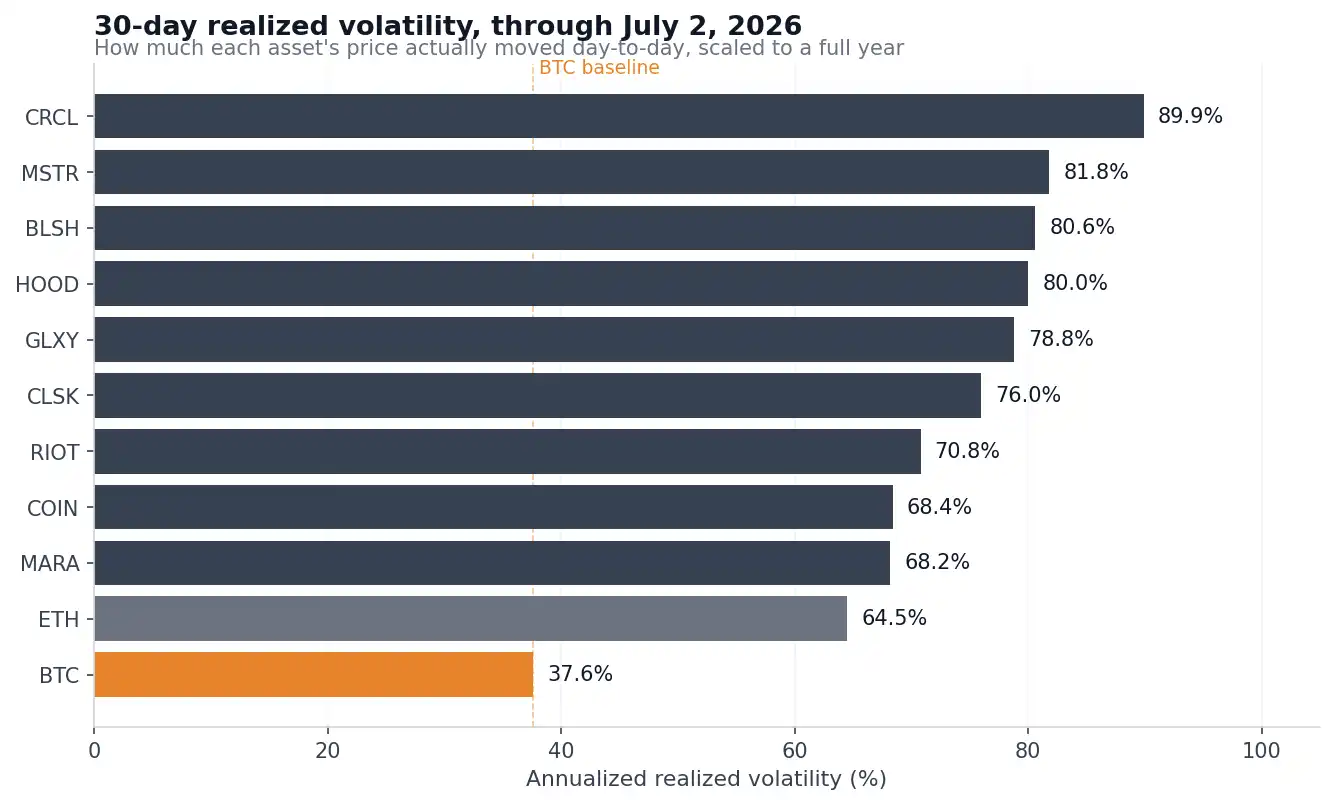
Volatilidad real anualizada a 30 días de BTC, ETH y nueve acciones de empresas criptográficas cotizadas en EE.UU. desde el 1 de enero hasta el 2 de julio de 2026.

En términos de volatilidad, las acciones cripto parecen un Bitcoin apalancado, pero los datos de correlación cuentan una historia diferente. En los últimos 90 días de negociación, Circle, Robinhood y Bullish tuvieron coeficientes de correlación con Bitcoin de solo 0.55–0.58 (la escala va de 0 a 1, donde 1 es movimiento perfectamente sincronizado y 0 es sin relación). Esto significa que las fluctuaciones del precio de la criptomoneda explican solo alrededor de un tercio del movimiento de las acciones, y el resto proviene de riesgos específicos de la empresa: resultados trimestrales, competencia en el sector, actividades de financiación, dilución de capital por nuevas emisiones, etc. Los inversores que buscaban exposición al sector cripto a través de acciones obtuvieron solo una exposición parcial al precio de la criptomoneda y asumieron una serie completa de riesgos operativos exclusivos del mercado bursátil.

Solo una acción sigue realmente a Bitcoin

La siguiente tabla muestra la correlación de las acciones de empresas criptográficas con Bitcoin desde finales de 2025. El coeficiente beta representa el cambio porcentual en la acción por cada cambio del 1% en Bitcoin.
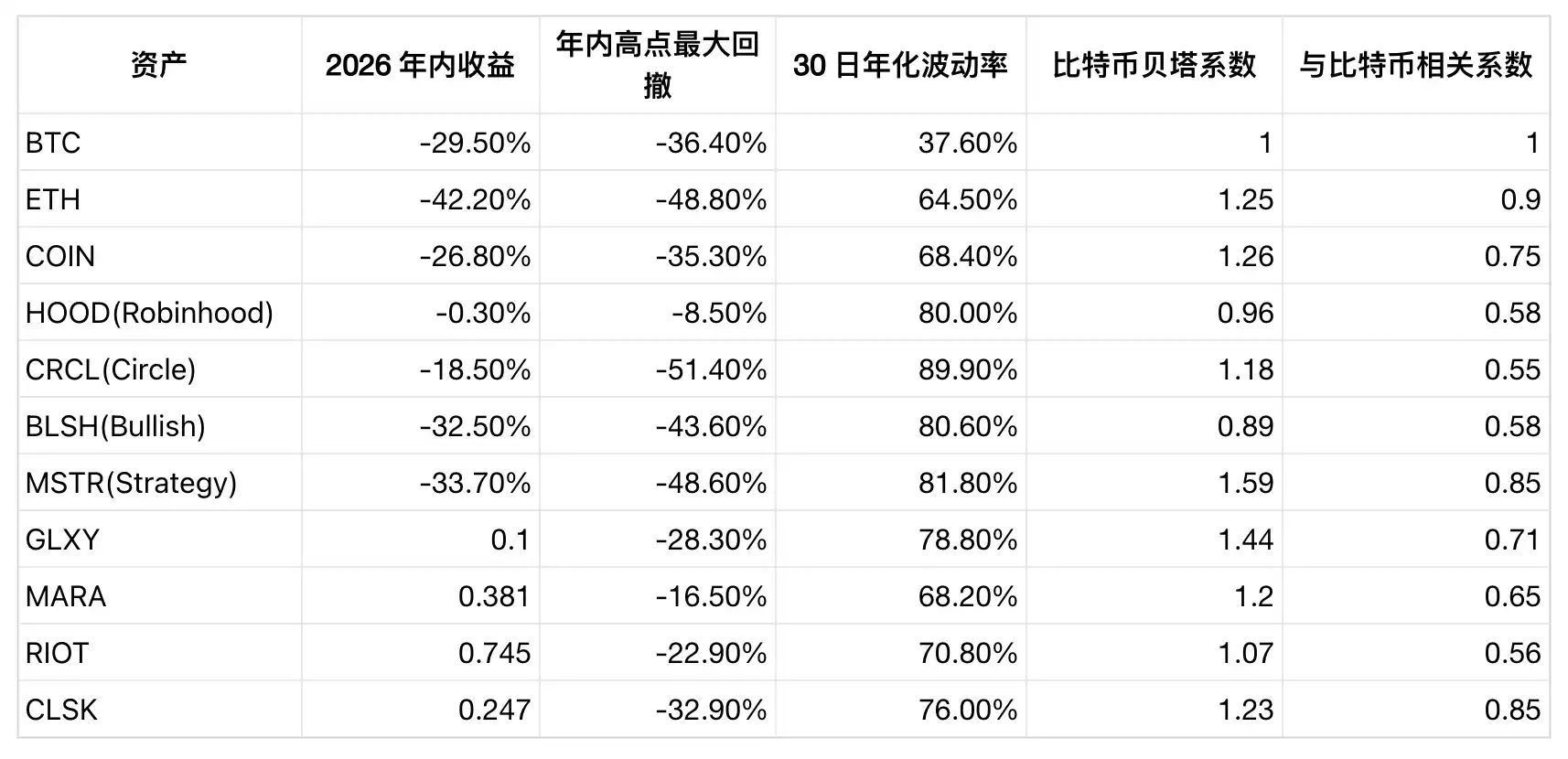
En todo el mercado, solo MSTR puede considerarse un sustituto de Bitcoin. Con una beta de 1.59 y una correlación de 0.85, significa que es esencialmente una herramienta de capital que posee Bitcoin con apalancamiento. En la actual corrección, sus pérdidas anuales y la magnitud de la caída desde máximos superaron con creces a las de Bitcoin.

Coinbase es una opción relativamente equilibrada. Sus pérdidas anuales del -26.8% son ligeramente menores que las de BTC, con un coeficiente beta de 1.26 y un coeficiente de correlación de 0.75, la segunda correlación más fuerte con Bitcoin dentro del sector. Sin embargo, su volatilidad sigue siendo casi el doble que la de Bitcoin, y su precio ha caído un 60.6% desde el máximo histórico de 419.78 dólares de julio de 2025, lo que significa mayores pérdidas para los inversores que compraron en ese máximo en comparación con quienes compraron Bitcoin en su máximo histórico de octubre de 2025.

Circle ejemplifica perfectamente el "riesgo empresarial bajo un disfraz cripto". Tiene la correlación más baja con Bitcoin en el sector y la volatilidad más alta a 90 días. El detonante ocurrió el 30 de junio: se lanzó oficialmente la stablecoin Open USD, respaldada conjuntamente por más de 140 empresas, incluidos Coinbase, Stripe, Visa, Mastercard y BlackRock, y CRCL cayó un 17.5% en un solo día. Esta caída apenas tuvo relación con el movimiento de Bitcoin, fue puramente una desventaja específica de la empresa derivada de la competencia por cuota de mercado en el sector de las stablecoins.

Robinhood es un caso opuesto que también confirma la independencia del negocio individual respecto a las tendencias cripto. Esta acción cayó solo un 0.3% en el año, con una corrección máxima anual de solo el 8.5%. El negocio cripto es solo una pequeña parte de su cartera de corretaje de acciones, opciones y derivados; su diversificación amortiguó la caída. Pero, a la inversa, en fases alcistas del mercado cripto, es difícil que ofrezca a los inversores ganancias significativas ligadas al precio de las criptomonedas.

El comportamiento de las mineras es el más anómalo. Mientras Bitcoin caía un 29.5% en el año, RIOT subió un 74.5%, MARA un 38.1% y CleanSpark un 24.7%. La lógica central es su transformación en proveedores de servicios de computación de alto rendimiento para IA, firmando contratos de alquiler de capacidad de cómputo por decenas de miles de millones de dólares y reduciendo continuamente sus reservas de Bitcoin. Aunque su comportamiento diario aún sigue las fluctuaciones de Bitcoin (todos tienen coeficientes beta mayores a 1), sus ganancias anuales están completamente impulsadas por el negocio de alojamiento de IA, desvinculadas del precio de la criptomoneda.
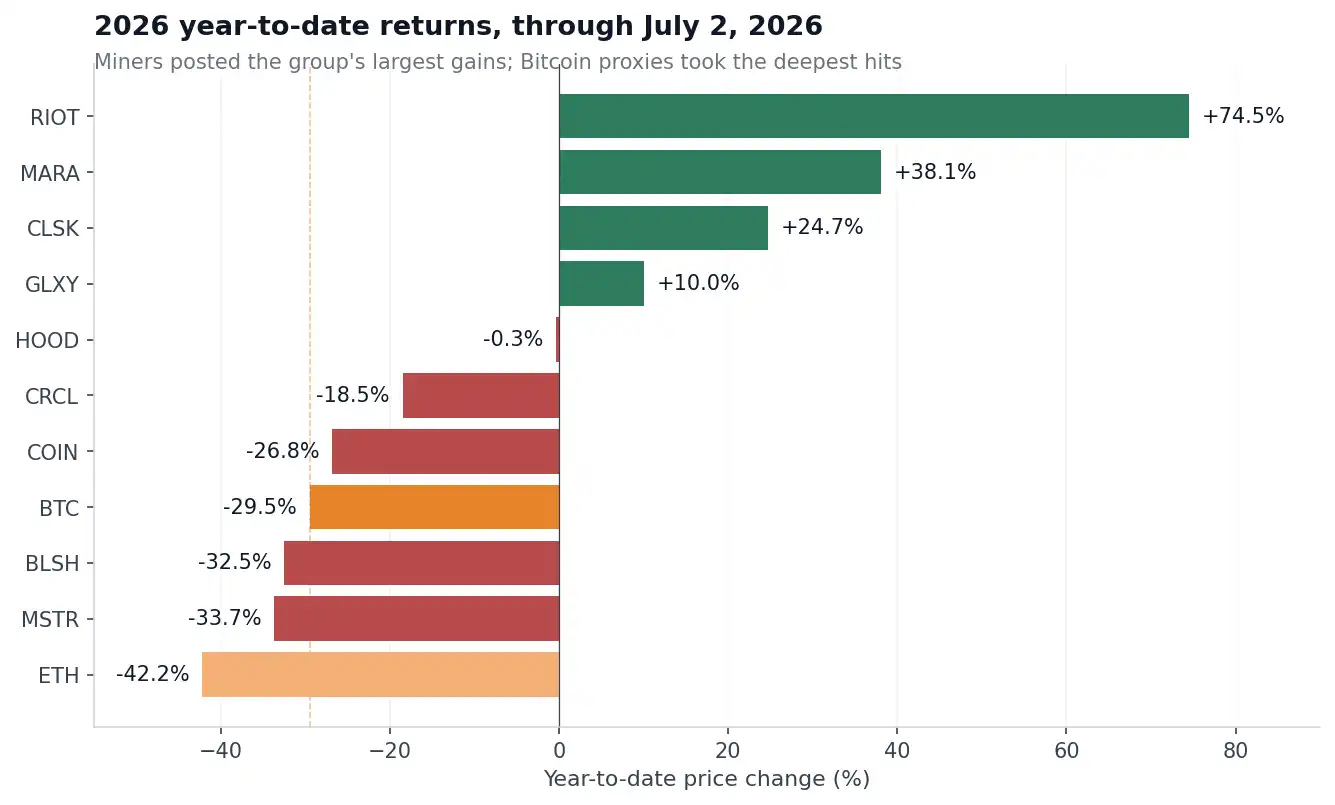
Cambio de precio desde principios de año de BTC, ETH y nueve acciones de empresas criptográficas cotizadas en EE.UU.

Bitcoin en sí mismo no tiene poca volatilidad. El índice de volatilidad a 30 días de Bitcoin de Volmex cayó a un mínimo de 24.5 a finales de mayo, con un máximo de 68.7 a principios de febrero, recuperándose a 41.6 a principios de julio. Aun así, la volatilidad de la mayoría de las acciones cripto sigue siendo aproximadamente el doble.

Caso de Strategy: La estructura de capital aporta riesgos adicionales

Poseer Bitcoin solo conlleva el riesgo de la subida y bajada de su precio; comprar acciones de empresas criptográficas cotizadas añade múltiples variables: riesgo operativo empresarial, dilución de capital, desaparición de la prima de valoración, presión de financiación, cambios en la estructura de capital, etc.

Strategy expuso recientemente todas estas vulnerabilidades en un mes. A finales de junio, su múltiplo de valor contable ajustado (mNAV) cayó por debajo de 1 por primera vez. Esta métrica mide la valoración total de la empresa frente a su activo neto. Un múltiplo inferior a 1 significa que el mercado valora toda la empresa menos que el efectivo y el Bitcoin que tiene en sus reservas. Según la divulgación del 22 de junio, Strategy posee 847,363 bitcoins. El día que el mNAV cayó por debajo de 1, estos bitcoins valían aproximadamente 50 mil millones de dólares.

Un mNAV superior a 1 es la base del ciclo de crecimiento de Strategy. En el pasado, la empresa podía emitir acciones ordinarias y preferentes con prima, recaudar fondos y continuar acumulando Bitcoin, aumentando así las tenencias por acción. Una vez que el mNAV cae por debajo de 1, este ciclo erosiona el valor para los accionistas en sentido inverso: emitir nuevas acciones para recaudar fondos y comprar Bitcoin equivale a vender los activos de Bitcoin existentes con descuento.

CryptoSlate ya informó en enero que las empresas con tenencias de Bitcoin se dividen en aquellas con prima de valoración y aquellas con descuento. A finales de junio, la capitalización total de Strategy era de 29.54 mil millones de dólares, menos de la mitad del máximo de más de 71 mil millones de 2024, y sus cuatro clases de acciones preferentes cayeron a mínimos históricos.

Strategy presentó un plan de respuesta. El 29 de junio anunció un plan de recompra de acciones de hasta 1.25 mil millones de dólares, al mismo tiempo que autorizó la venta de Bitcoin para complementar la liquidez, cubriendo los dividendos de las acciones preferentes y los intereses de la deuda. Unas semanas antes, la empresa realizó su primera venta de Bitcoin desde 2022 el 1 de junio, vendiendo solo 32 bitcoins. Tras el anuncio, la acción subió un 12.6% en un día, poniendo fin a ocho sesiones consecutivas de caídas. La empresa con mayores tenencias de Bitcoin del mundo necesita vender sus reservas en un mercado bajista para obtener flujo de caja, una restricción que no se encuentra al poseer Bitcoin directamente y un riesgo exclusivo de las acciones.

Este es precisamente el contexto de las compras de ARK en contra de la tendencia. El 25 de junio, cuando las acciones cripto cayeron drásticamente, los fondos de Wood compraron 3.27 millones de dólares en acciones de Robinhood en un solo día, aumentando simultáneamente sus posiciones en Coinbase, Circle y Bullish. Wood cree que el precio objetivo a largo plazo de Bitcoin está en el nivel del millón de dólares, y actualmente está aprovechando los descuentos significativos para posicionarse en empresas criptográficas cotizadas que han tenido una profunda corrección desde los máximos de 2025.

Los datos revelan la verdadera naturaleza de estas empresas.

  • Strategy = Bitcoin con apalancamiento + riesgo de dilución de capital;
  • Circle = empresa de pagos en el sector de stablecoins, inmersa en una batalla por cuota de mercado;
  • Robinhood = corredor integral, las criptomonedas son solo un negocio secundario.

La compra de esta canasta de acciones por parte de Wood es esencialmente una apuesta por una combinación de diferentes modelos de negocio, donde la exposición a las criptomonedas varía enormemente entre ellas.

Cada acción tiene su propia lógica de inversión independiente: Coinbase superó a Bitcoin este año, Robinhood mantuvo su precio de principios de año, y el sector de las mineras lideró en términos de rendimiento general. Pero la pregunta central sigue siendo: ¿comprar acciones cripto es realmente menos riesgoso que poseer la criptomoneda directamente?

Los datos de las nueve empresas cotizadas muestran que las acciones o bien amplifican la volatilidad de Bitcoin, o bien añaden riesgos operativos empresariales no relacionados con el precio de la criptomoneda.

Las acciones criptográficas realmente fuertes este año dependieron de negocios de crecimiento independientes como la capacidad de cómputo para IA, el flujo de clientes de corretaje o productos de pago, donde Bitcoin fue solo un factor secundario.

Trending Cryptos

Related Questions

Q¿Cuánto invirtió ARK Invest en acciones de empresas de criptomonedas en junio y en qué empresas concretas?

AARK Invest invirtió 77 millones de dólares en junio, comprando acciones de Coinbase (44 millones), Circle (25.25 millones) y Bullish (8.2 millones).

QSegún el análisis de datos, ¿cómo se compara la volatilidad de las acciones de empresas cripto con la de Bitcoin?

ALa volatilidad de las 9 acciones analizadas (68%-90% en 30 días) es casi el doble que la de Bitcoin (37.6%). En un período de 90 días, la volatilidad de Circle fue del 103.6%, frente al 37.8% de Bitcoin.

QSegún el artículo, ¿qué acción se considera un verdadero sustituto de Bitcoin y por qué?

AMicroStrategy (MSTR) se considera el único sustituto real de Bitcoin, con un coeficiente beta de 1.59 y una correlación de 0.85, lo que la convierte esencialmente en una herramienta de capital apalancada sobre Bitcoin.

Q¿Qué riesgos únicos de las empresas añade la inversión en acciones de empresas cripto en comparación con la tenencia directa de Bitcoin?

AInvertir en acciones añade riesgos empresariales específicos como resultados trimestrales, competencia, dilución de capital por nuevas emisiones, presión de financiación y cambios en la estructura de capital, además del riesgo del precio de Bitcoin.

Q¿Por qué las acciones de empresas mineras (como RIOT y MARA) han tenido un rendimiento positivo en 2026 a pesar de la caída de Bitcoin?

ASu buen rendimiento se debe principalmente a su transformación en proveedores de servicios de computación de alto rendimiento para IA, firmando contratos de arrendamiento de capacidad de cálculo por decenas de miles de millones, lo que las desacopla del precio de Bitcoin.

Related Reads

MSTR Discloses Sale of 3,588 Bitcoins, Stock Price Drops Over 5% at One Point During Trading

MicroStrategy, the world's largest corporate holder of Bitcoin, has significantly shifted its business model. Between June 29 and July 5, the company sold 3,588 bitcoins for approximately $216 million to fund quarterly dividends for its preferred stock. This marks its largest-ever Bitcoin sale and signals a strategic pivot: Bitcoin is transitioning from a "buy-and-hold" reserve asset to a liquidity management tool for the company. This move follows a recent authorization allowing Bitcoin sales when equity fundraising is less attractive. The announcement contributed to a more than 5% intraday drop in MicroStrategy's stock price, while Bitcoin fell to around $61,800—below the company's average holding cost of roughly $75,700. The sale represents a major departure from MicroStrategy's long-standing "never sell" commitment, which saw its first minor breach in May with a $2.5 million sale. The latest, hundred-times-larger transaction underscores growing financial pressures. Analysts note the company faces about $1.5 billion in annual preferred dividend obligations, far exceeding cash flow from its software business. As of July 5, MicroStrategy holds 843,775 bitcoins. Its current operational logic involves buying Bitcoin during favorable financing conditions and selling portions to cover dividends when needed, creating a flexible capital management cycle amidst a challenging market environment.

华尔街日报1h ago

MSTR Discloses Sale of 3,588 Bitcoins, Stock Price Drops Over 5% at One Point During Trading

华尔街日报1h ago

Q-Day Countdown: Will Quantum Computing End Cryptocurrencies?

Quantum Computing's Threat to Cryptocurrency: A Countdown to Q-Day Quantum computing, specifically Shor's algorithm, poses a fundamental threat to the public-key cryptography (e.g., ECDSA, RSA) that secures blockchain networks like Bitcoin and Ethereum. This critical juncture, known as Q-Day, is estimated to occur potentially within the next 5-15 years. The core vulnerability stems from the public and immutable nature of blockchains. Assets in addresses where the public key is already exposed on-chain (e.g., spent outputs) are at direct risk, as a sufficiently powerful quantum computer could derive the private key. This threatens the very trust model of cryptocurrencies. The response lies in Post-Quantum Cryptography (PQC)—algorithms like lattice-based ML-DSA and hash-based SLH-DSA, which are resistant to quantum attacks. NIST has standardized key PQC algorithms (FIPS 203, 204, 205), providing a migration path. However, the primary challenge is not technical but socio-economic and involves complex governance: * **Bitcoin's** path is constrained by its conservative ethos. Migrating requires a soft-fork to new address types, facing hurdles like significantly larger signature sizes and, most critically, the divisive governance question of how to handle at-risk legacy UTXOs without violating core principles. * **Ethereum** is pursuing a "cryptographic agility" strategy, with a multi-layered roadmap. It leverages account abstraction for user accounts and is developing compressed hash-based signatures (e.g., leanXMSS) for its consensus layer, aiming for a full-stack upgrade over time. In conclusion, quantum computing does not spell an instant end for cryptocurrency but initiates a critical countdown. The industry has a limited "engineering comfort window" to orchestrate a coordinated, ecosystem-wide migration to PQC. The ultimate bottlenecks are the immense coordination efforts and governance decisions required for this foundational transition.

marsbit2h ago

Q-Day Countdown: Will Quantum Computing End Cryptocurrencies?

marsbit2h ago

Trump, the President Who Knows Best How to 'Trade Stocks'

Former US President Donald Trump reported a record-breaking $2.2 billion in personal income for 2025, the highest annual income ever disclosed by a sitting president. This figure, from a 927-page government ethics filing, represented a 3.5-fold increase from his $600 million income in 2024 and boosted his net worth to $6.5 billion. The primary drivers were cryptocurrency (64% of income, approximately $1.4 billion) and real estate (26%, approximately $575 million). His crypto earnings stemmed largely from the launch of his personal meme coin, $TRUMP, generating over $600 million in licensing fees, and substantial profits from the WLFI token and its parent company. Despite a sluggish property market, his Mar-a-Lago resort and associated golf clubs saw revenue surges of 50% and 27%, respectively, attributed to their use as venues for presidential events. Trump's financial disclosure also revealed an unprecedented level of stock market activity, with over 22,000 trades executed in 2025, averaging 87 trades per market day. Media analyses noted several instances where significant trading coincided with major policy announcements, such as proposed tariffs, raising questions about potential conflicts of interest. While the White House stated these trades were handled by a family-managed trust fund and not Trump directly, critics highlighted this as a departure from the blind trusts traditionally used by presidents post-Watergate. The report has intensified debate over the commercialization of the presidency. Supporters view it as a success story of a businessman-president, while critics argue it demonstrates an unprecedented conversion of public influence into private wealth, with policy decisions potentially linked to personal financial gains. The controversy centers on whether Trump's earnings represent innovative entrepreneurship or a fundamental conflict of interest, sparking renewed calls for stricter ethics reforms in US governance.

marsbit3h ago

Trump, the President Who Knows Best How to 'Trade Stocks'

marsbit3h ago

Countdown to Q-Day: Will Quantum Computing End Cryptocurrencies?

The article explores the existential threat quantum computing poses to cryptocurrencies and the urgent need for "post-quantum" migration. It outlines that quantum computers, through Shor's algorithm, could break the elliptic-curve cryptography (ECC) underlying blockchain security, potentially allowing private keys to be derived from public keys. The core challenge is not a lack of post-quantum cryptography (PQC) standards—like NIST's ML-KEM and ML-DSA—but the immense complexity of upgrading entire ecosystems before "Q-Day" (when quantum computers become capable of such attacks, estimated around 2035-2045). Key points include: * **Bitcoin's** risk is concentrated in legacy UTXOs with exposed public keys (e.g., early P2PK outputs). Migration faces massive hurdles: PQC signatures are much larger, increasing transaction size and cost, and the governance dilemma of handling un-migrated assets threatens its "code is law" ethos. * **Ethereum's** strategy focuses on "cryptographic agility," using Account Abstraction for user accounts and developing compressed hash-based signatures (like leanXMSS with SNARK aggregation) for consensus. Its migration is a complex, full-stack overhaul of execution, consensus, and data layers. * The "security debt" is enormous. The comfortable engineering window for a coordinated, ecosystem-wide upgrade is only 5-8 years. High-value infrastructure (exchanges, bridges) may face pressure before mainnet protocols. In conclusion, quantum computing is not an instant "doomsday" event but a forcing function for systemic change. Bitcoin's ultimate test is social consensus and property rights governance, while Ethereum's is technical complexity. Failure to migrate in time could lead to a fundamental re-pricing of crypto assets.

链捕手3h ago

Countdown to Q-Day: Will Quantum Computing End Cryptocurrencies?

链捕手3h ago

Trading

Spot

Hot Articles

What is SONIC

Sonic: Pioneering the Future of Gaming in Web3 Introduction to Sonic In the ever-evolving landscape of Web3, the gaming industry stands out as one of the most dynamic and promising sectors. At the forefront of this revolution is Sonic, a project designed to amplify the gaming ecosystem on the Solana blockchain. Leveraging cutting-edge technology, Sonic aims to deliver an unparalleled gaming experience by efficiently processing millions of requests per second, ensuring that players enjoy seamless gameplay while maintaining low transaction costs. This article delves into the intricate details of Sonic, exploring its creators, funding sources, operational mechanics, and the timeline of significant events that have shaped its journey. What is Sonic? Sonic is an innovative layer-2 network that operates atop the Solana blockchain, specifically tailored to enhance the existing Solana gaming ecosystem. It accomplishes this through a customised, VM-agnostic game engine paired with a HyperGrid interpreter, facilitating sovereign game economies that roll up back to the Solana platform. The primary goals of Sonic include: Enhanced Gaming Experiences: Sonic is committed to offering lightning-fast on-chain gameplay, allowing players and developers to engage with games at previously unattainable speeds. Atomic Interoperability: This feature enables transactions to be executed within Sonic without the need to redeploy Solana programmes and accounts. This makes the process more efficient and directly benefits from Solana Layer1 services and liquidity. Seamless Deployment: Sonic allows developers to write for Ethereum Virtual Machine (EVM) based systems and execute them on Solana’s SVM infrastructure. This interoperability is crucial for attracting a broader range of dApps and decentralised applications to the platform. Support for Developers: By offering native composable gaming primitives and extensible data types - dining within the Entity-Component-System (ECS) framework - game creators can craft intricate business logic with ease. Overall, Sonic's unique approach not only caters to players but also provides an accessible and low-cost environment for developers to innovate and thrive. Creator of Sonic The information regarding the creator of Sonic is somewhat ambiguous. However, it is known that Sonic's SVM is owned by the company Mirror World. The absence of detailed information about the individuals behind Sonic reflects a common trend in several Web3 projects, where collective efforts and partnerships often overshadow individual contributions. Investors of Sonic Sonic has garnered considerable attention and support from various investors within the crypto and gaming sectors. Notably, the project raised an impressive $12 million during its Series A funding round. The round was led by BITKRAFT Ventures, with other notable investors including Galaxy, Okx Ventures, Interactive, Big Brain Holdings, and Mirana. This financial backing signifies the confidence that investment foundations have in Sonic’s potential to revolutionise the Web3 gaming landscape, further validating its innovative approaches and technologies. How Does Sonic Work? Sonic utilises the HyperGrid framework, a sophisticated parallel processing mechanism that enhances its scalability and customisability. Here are the core features that set Sonic apart: Lightning Speed at Low Costs: Sonic offers one of the fastest on-chain gaming experiences compared to other Layer-1 solutions, powered by the scalability of Solana’s virtual machine (SVM). Atomic Interoperability: Sonic enables transaction execution without redeployment of Solana programmes and accounts, effectively streamlining the interaction between users and the blockchain. EVM Compatibility: Developers can effortlessly migrate decentralised applications from EVM chains to the Solana environment using Sonic’s HyperGrid interpreter, increasing the accessibility and integration of various dApps. Ecosystem Support for Developers: By exposing native composable gaming primitives, Sonic facilitates a sandbox-like environment where developers can experiment and implement business logic, greatly enhancing the overall development experience. Monetisation Infrastructure: Sonic natively supports growth and monetisation efforts, providing frameworks for traffic generation, payments, and settlements, thereby ensuring that gaming projects are not only viable but also sustainable financially. Timeline of Sonic The evolution of Sonic has been marked by several key milestones. Below is a brief timeline highlighting critical events in the project's history: 2022: The Sonic cryptocurrency was officially launched, marking the beginning of its journey in the Web3 gaming arena. 2024: June: Sonic SVM successfully raised $12 million in a Series A funding round. This investment allowed Sonic to further develop its platform and expand its offerings. August: The launch of the Sonic Odyssey testnet provided users with the first opportunity to engage with the platform, offering interactive activities such as collecting rings—a nod to gaming nostalgia. October: SonicX, an innovative crypto game integrated with Solana, made its debut on TikTok, capturing the attention of over 120,000 users within a short span. This integration illustrated Sonic’s commitment to reaching a broader, global audience and showcased the potential of blockchain gaming. Key Points Sonic SVM is a revolutionary layer-2 network on Solana explicitly designed to enhance the GameFi landscape, demonstrating great potential for future development. HyperGrid Framework empowers Sonic by introducing horizontal scaling capabilities, ensuring that the network can handle the demands of Web3 gaming. Integration with Social Platforms: The successful launch of SonicX on TikTok displays Sonic’s strategy to leverage social media platforms to engage users, exponentially increasing the exposure and reach of its projects. Investment Confidence: The substantial funding from BITKRAFT Ventures, among others, emphasizes the robust backing Sonic has, paving the way for its ambitious future. In conclusion, Sonic encapsulates the essence of Web3 gaming innovation, striking a balance between cutting-edge technology, developer-centric tools, and community engagement. As the project continues to evolve, it is poised to redefine the gaming landscape, making it a notable entity for gamers and developers alike. As Sonic moves forward, it will undoubtedly attract greater interest and participation, solidifying its place within the broader narrative of blockchain gaming.

1.7k Total ViewsPublished 2024.04.04Updated 2024.12.03

What is SONIC

What is $S$

Understanding SPERO: A Comprehensive Overview Introduction to SPERO As the landscape of innovation continues to evolve, the emergence of web3 technologies and cryptocurrency projects plays a pivotal role in shaping the digital future. One project that has garnered attention in this dynamic field is SPERO, denoted as SPERO,$$s$. This article aims to gather and present detailed information about SPERO, to help enthusiasts and investors understand its foundations, objectives, and innovations within the web3 and crypto domains. What is SPERO,$$s$? SPERO,$$s$ is a unique project within the crypto space that seeks to leverage the principles of decentralisation and blockchain technology to create an ecosystem that promotes engagement, utility, and financial inclusion. The project is tailored to facilitate peer-to-peer interactions in new ways, providing users with innovative financial solutions and services. At its core, SPERO,$$s$ aims to empower individuals by providing tools and platforms that enhance user experience in the cryptocurrency space. This includes enabling more flexible transaction methods, fostering community-driven initiatives, and creating pathways for financial opportunities through decentralised applications (dApps). The underlying vision of SPERO,$$s$ revolves around inclusiveness, aiming to bridge gaps within traditional finance while harnessing the benefits of blockchain technology. Who is the Creator of SPERO,$$s$? The identity of the creator of SPERO,$$s$ remains somewhat obscure, as there are limited publicly available resources providing detailed background information on its founder(s). This lack of transparency can stem from the project's commitment to decentralisation—an ethos that many web3 projects share, prioritising collective contributions over individual recognition. By centring discussions around the community and its collective goals, SPERO,$$s$ embodies the essence of empowerment without singling out specific individuals. As such, understanding the ethos and mission of SPERO remains more important than identifying a singular creator. Who are the Investors of SPERO,$$s$? SPERO,$$s$ is supported by a diverse array of investors ranging from venture capitalists to angel investors dedicated to fostering innovation in the crypto sector. The focus of these investors generally aligns with SPERO's mission—prioritising projects that promise societal technological advancement, financial inclusivity, and decentralised governance. These investor foundations are typically interested in projects that not only offer innovative products but also contribute positively to the blockchain community and its ecosystems. The backing from these investors reinforces SPERO,$$s$ as a noteworthy contender in the rapidly evolving domain of crypto projects. How Does SPERO,$$s$ Work? SPERO,$$s$ employs a multi-faceted framework that distinguishes it from conventional cryptocurrency projects. Here are some of the key features that underline its uniqueness and innovation: Decentralised Governance: SPERO,$$s$ integrates decentralised governance models, empowering users to participate actively in decision-making processes regarding the project’s future. This approach fosters a sense of ownership and accountability among community members. Token Utility: SPERO,$$s$ utilises its own cryptocurrency token, designed to serve various functions within the ecosystem. These tokens enable transactions, rewards, and the facilitation of services offered on the platform, enhancing overall engagement and utility. Layered Architecture: The technical architecture of SPERO,$$s$ supports modularity and scalability, allowing for seamless integration of additional features and applications as the project evolves. This adaptability is paramount for sustaining relevance in the ever-changing crypto landscape. Community Engagement: The project emphasises community-driven initiatives, employing mechanisms that incentivise collaboration and feedback. By nurturing a strong community, SPERO,$$s$ can better address user needs and adapt to market trends. Focus on Inclusion: By offering low transaction fees and user-friendly interfaces, SPERO,$$s$ aims to attract a diverse user base, including individuals who may not previously have engaged in the crypto space. This commitment to inclusion aligns with its overarching mission of empowerment through accessibility. Timeline of SPERO,$$s$ Understanding a project's history provides crucial insights into its development trajectory and milestones. Below is a suggested timeline mapping significant events in the evolution of SPERO,$$s$: Conceptualisation and Ideation Phase: The initial ideas forming the basis of SPERO,$$s$ were conceived, aligning closely with the principles of decentralisation and community focus within the blockchain industry. Launch of Project Whitepaper: Following the conceptual phase, a comprehensive whitepaper detailing the vision, goals, and technological infrastructure of SPERO,$$s$ was released to garner community interest and feedback. Community Building and Early Engagements: Active outreach efforts were made to build a community of early adopters and potential investors, facilitating discussions around the project’s goals and garnering support. Token Generation Event: SPERO,$$s$ conducted a token generation event (TGE) to distribute its native tokens to early supporters and establish initial liquidity within the ecosystem. Launch of Initial dApp: The first decentralised application (dApp) associated with SPERO,$$s$ went live, allowing users to engage with the platform's core functionalities. Ongoing Development and Partnerships: Continuous updates and enhancements to the project's offerings, including strategic partnerships with other players in the blockchain space, have shaped SPERO,$$s$ into a competitive and evolving player in the crypto market. Conclusion SPERO,$$s$ stands as a testament to the potential of web3 and cryptocurrency to revolutionise financial systems and empower individuals. With a commitment to decentralised governance, community engagement, and innovatively designed functionalities, it paves the way toward a more inclusive financial landscape. As with any investment in the rapidly evolving crypto space, potential investors and users are encouraged to research thoroughly and engage thoughtfully with the ongoing developments within SPERO,$$s$. The project showcases the innovative spirit of the crypto industry, inviting further exploration into its myriad possibilities. While the journey of SPERO,$$s$ is still unfolding, its foundational principles may indeed influence the future of how we interact with technology, finance, and each other in interconnected digital ecosystems.

93 Total ViewsPublished 2024.12.17Updated 2024.12.17

What is $S$

What is AGENT S

Agent S: The Future of Autonomous Interaction in Web3 Introduction In the ever-evolving landscape of Web3 and cryptocurrency, innovations are constantly redefining how individuals interact with digital platforms. One such pioneering project, Agent S, promises to revolutionise human-computer interaction through its open agentic framework. By paving the way for autonomous interactions, Agent S aims to simplify complex tasks, offering transformative applications in artificial intelligence (AI). This detailed exploration will delve into the project's intricacies, its unique features, and the implications for the cryptocurrency domain. What is Agent S? Agent S stands as a groundbreaking open agentic framework, specifically designed to tackle three fundamental challenges in the automation of computer tasks: Acquiring Domain-Specific Knowledge: The framework intelligently learns from various external knowledge sources and internal experiences. This dual approach empowers it to build a rich repository of domain-specific knowledge, enhancing its performance in task execution. Planning Over Long Task Horizons: Agent S employs experience-augmented hierarchical planning, a strategic approach that facilitates efficient breakdown and execution of intricate tasks. This feature significantly enhances its ability to manage multiple subtasks efficiently and effectively. Handling Dynamic, Non-Uniform Interfaces: The project introduces the Agent-Computer Interface (ACI), an innovative solution that enhances the interaction between agents and users. Utilizing Multimodal Large Language Models (MLLMs), Agent S can navigate and manipulate diverse graphical user interfaces seamlessly. Through these pioneering features, Agent S provides a robust framework that addresses the complexities involved in automating human interaction with machines, setting the stage for myriad applications in AI and beyond. Who is the Creator of Agent S? While the concept of Agent S is fundamentally innovative, specific information about its creator remains elusive. The creator is currently unknown, which highlights either the nascent stage of the project or the strategic choice to keep founding members under wraps. Regardless of anonymity, the focus remains on the framework's capabilities and potential. Who are the Investors of Agent S? As Agent S is relatively new in the cryptographic ecosystem, detailed information regarding its investors and financial backers is not explicitly documented. The lack of publicly available insights into the investment foundations or organisations supporting the project raises questions about its funding structure and development roadmap. Understanding the backing is crucial for gauging the project's sustainability and potential market impact. How Does Agent S Work? At the core of Agent S lies cutting-edge technology that enables it to function effectively in diverse settings. Its operational model is built around several key features: Human-like Computer Interaction: The framework offers advanced AI planning, striving to make interactions with computers more intuitive. By mimicking human behaviour in tasks execution, it promises to elevate user experiences. Narrative Memory: Employed to leverage high-level experiences, Agent S utilises narrative memory to keep track of task histories, thereby enhancing its decision-making processes. Episodic Memory: This feature provides users with step-by-step guidance, allowing the framework to offer contextual support as tasks unfold. Support for OpenACI: With the ability to run locally, Agent S allows users to maintain control over their interactions and workflows, aligning with the decentralised ethos of Web3. Easy Integration with External APIs: Its versatility and compatibility with various AI platforms ensure that Agent S can fit seamlessly into existing technological ecosystems, making it an appealing choice for developers and organisations. These functionalities collectively contribute to Agent S's unique position within the crypto space, as it automates complex, multi-step tasks with minimal human intervention. As the project evolves, its potential applications in Web3 could redefine how digital interactions unfold. Timeline of Agent S The development and milestones of Agent S can be encapsulated in a timeline that highlights its significant events: September 27, 2024: The concept of Agent S was launched in a comprehensive research paper titled “An Open Agentic Framework that Uses Computers Like a Human,” showcasing the groundwork for the project. October 10, 2024: The research paper was made publicly available on arXiv, offering an in-depth exploration of the framework and its performance evaluation based on the OSWorld benchmark. October 12, 2024: A video presentation was released, providing a visual insight into the capabilities and features of Agent S, further engaging potential users and investors. These markers in the timeline not only illustrate the progress of Agent S but also indicate its commitment to transparency and community engagement. Key Points About Agent S As the Agent S framework continues to evolve, several key attributes stand out, underscoring its innovative nature and potential: Innovative Framework: Designed to provide an intuitive use of computers akin to human interaction, Agent S brings a novel approach to task automation. Autonomous Interaction: The ability to interact autonomously with computers through GUI signifies a leap towards more intelligent and efficient computing solutions. Complex Task Automation: With its robust methodology, it can automate complex, multi-step tasks, making processes faster and less error-prone. Continuous Improvement: The learning mechanisms enable Agent S to improve from past experiences, continually enhancing its performance and efficacy. Versatility: Its adaptability across different operating environments like OSWorld and WindowsAgentArena ensures that it can serve a broad range of applications. As Agent S positions itself in the Web3 and crypto landscape, its potential to enhance interaction capabilities and automate processes signifies a significant advancement in AI technologies. Through its innovative framework, Agent S exemplifies the future of digital interactions, promising a more seamless and efficient experience for users across various industries. Conclusion Agent S represents a bold leap forward in the marriage of AI and Web3, with the capacity to redefine how we interact with technology. While still in its early stages, the possibilities for its application are vast and compelling. Through its comprehensive framework addressing critical challenges, Agent S aims to bring autonomous interactions to the forefront of the digital experience. As we move deeper into the realms of cryptocurrency and decentralisation, projects like Agent S will undoubtedly play a crucial role in shaping the future of technology and human-computer collaboration.

763 Total ViewsPublished 2025.01.14Updated 2025.01.14

What is AGENT S

Discussions

Welcome to the HTX Community. Here, you can stay informed about the latest platform developments and gain access to professional market insights. Users' opinions on the price of S (S) are presented below.

活动图片