Se cancela el mayor centro de datos del mundo

marsbitPublished on 2026-07-06Last updated on 2026-07-06

Abstract

El grupo Blackstone detuvo oficialmente la construcción del proyecto "Digital Gateway", que aspiraba a ser el mayor campus de centros de datos del mundo, en Virginia, Estados Unidos. El proyecto, que requería una inversión de más de 100.000 millones de dólares y ocupaba 2.100 acres, se ha enfrentado a la resistencia de la comunidad local durante cinco años debido a su cercanía con un sitio histórico y a los temores sobre el consumo de recursos y la contaminación. Un fallo judicial en marzo invalidó los permisos clave, lo que llevó a un socio a retirarse y finalmente a Blackstone a cancelar el proyecto. Esta decisión refleja un punto de inflexión en la fiebre de la infraestructura de IA, que se topa con cuellos de botella reales: problemas de suministro eléctrico masivo, crecientes protestas ciudadanas y un endurecimiento normativo a nivel local. Informes indican que proyectos de centros de datos por valor de 130.000 millones de dólares se retrasaron solo en el primer trimestre en EE.UU., lo que sugiere que la expansión desenfrenada del sector podría estar frenándose.

Mientras el mercado aún debate la venta por parte de Blackstone de tres centros de datos en Virginia por 3.500 millones de dólares, este gigante global de gestión de activos alternativos, que supervisa más de 1,3 billones de dólares, ha dado un movimiento aún más sorprendente: su operadora de centros de datos, QTS, ha cancelado oficialmente la construcción del proyecto Digital Gateway en la zona.

Este súper proyecto, que alguna vez se anunció como el "parque de centros de datos más grande del mundo" con un área total mayor que dos veces Central Park de Nueva York, ha quedado completamente paralizado.

En tan solo unos días, Blackstone, por un lado, se deshizo de activos maduros a un alto precio y, por otro, canceló activamente un gigantesco proyecto de reserva. Esta maniobra brusca deja al descubierto los problemas reales ocultos bajo la fiebre de la infraestructura de computación para la IA, presentándolos claramente ante todos.

01

Fin de cinco años de tira y afloja: la crónica del fracaso de un súper proyecto

Este proyecto suspendido se ubica en el condado de Prince William, Virginia. Con un área de 2.100 acres, estaba originalmente planeado con una inversión superior a los 100.000 millones de dólares para construir 37 edificios de centros de datos, con un área total de 22 millones de pies cuadrados. Una vez completado, habría sido, sin duda, el parque de centros de datos más grande del mundo.

Sin embargo, desde el primer día de su anuncio, el proyecto se vio inmerso en un pantano de controversias.

El terreno colinda con el sitio histórico del campo de batalla de la Guerra Civil estadounidense y originalmente era un área de desarrollo protegida con restricciones políticas. La idea de nivelarlo para construir un denso complejo de centros de datos encontró la oposición inmediata de los residentes locales.
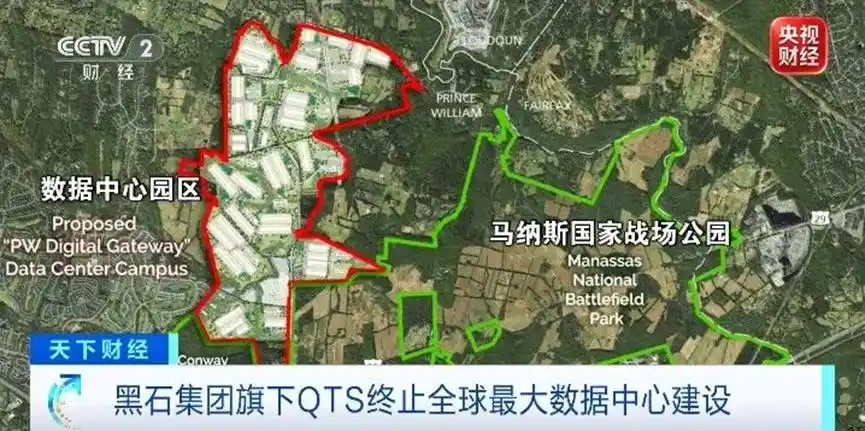
Fuente: Internet

Esta lucha se prolongó durante cinco años completos.

Los residentes presionaron a los legisladores locales y presentaron demandas legales contra el proceso de planificación, arrastrando el proyecto paso a paso a un estado de estancamiento.

El golpe mortal para la aprobación del proyecto fue una pequeña omisión procedimental.

En 2023, el gobierno del condado correspondiente en Virginia celebró una audiencia de zonificación de 27 horas sobre la conversión de terrenos agrícolas y semirrurales para uso de centros de datos, con cientos de partidarios y opositores presentes.

Tras la audiencia, el gobierno regional aprobó por un estrecho margen la solicitud de cambio de uso, pero el intervalo entre las dos publicaciones en el periódico no cumplió con el plazo mínimo de seis días requerido por la normativa.

Los opositores se aferraron a este vacío legal, llevando el caso finalmente a los tribunales estatales.

En marzo de este año, un tribunal de Virginia dictaminó que la aprobación de zonificación era inválida, lo que equivale a privar al proyecto de su estatus legal de desarrollo.

Dos meses después, el otro gran desarrollador del proyecto, Compass Datacenters, propiedad del gigante canadiense de gestión de activos Brookfield, decidió retirarse.

El presidente de la compañía admitió posteriormente que los continuos litigios judiciales y las crecientes barreras regulatorias habían bloqueado completamente cualquier camino viable para avanzar con el proyecto.

Con la salida del socio, todos los costos de las grandes obras de infraestructura complementaria, como las redes de agua y electricidad, que originalmente compartían ambas partes, recayeron únicamente sobre QTS.

Además, es probable que el fallo del tribunal sentara un precedente judicial desfavorable, lo que generaría aún más problemas en el futuro.

Tras sopesar los pros y los contras, Blackstone finalmente concluyó que continuar no era rentable y optó por cortar pérdidas y retirarse.

Esta resistencia no es un caso aislado.

Una encuesta reciente de Gallup muestra que el 70% de los estadounidenses se oponen a la construcción de centros de datos para IA cerca de sus hogares, y casi la mitad de ellos se opone firmemente.
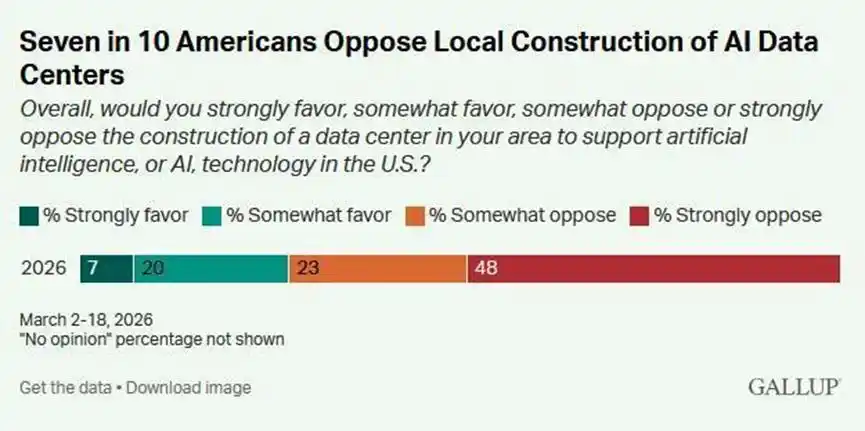
Fuente: Internet

Las preocupaciones de la gente son muy reales: los centros de datos consumen enormes cantidades de recursos hídricos y energéticos, generan contaminación acústica, del aire y del agua, elevan el costo de vida local y agravan la congestión del tráfico.

Ante la vida cotidiana de las personas comunes, incluso la narrativa más grandiosa de la IA parece algo lejana.

02

El capital comienza a retirarse en lo alto: la infraestructura de la IA choca con un techo real

La movida de Blackstone ha causado un gran revuelo en Wall Street y el mundo tecnológico principalmente porque ellos mismos son un actor de referencia en esta ola de inversión en centros de datos.

Tras adquirir QTS en 2021, tomar el control del proveedor de servicios de computación australiano AirTrunk en 2024 y llevar a la OPV en mayo de este año a su plataforma de adquisición de centros de datos, Blackstone Digital Infrastructure Trust, en su expansión continua, Blackstone también se autodenomina el mayor proveedor de servicios de centros de datos del mundo.

Sin embargo, precisamente este líder de la industria ahora vende activos maduros y cancela proyectos de reserva simultáneamente, replicando la estrategia que utilizó anteriormente en el mercado de oficinas para "vender en la cima".

Años atrás, con el auge del trabajo desde casa y la continua caída de alquileres y valores de oficinas, Blackstone vendió con importantes descuentos múltiples edificios de oficinas emblemáticos, anticipándose con precisión al punto de inflexión del ciclo.

Ahora, al aplicar esta misma lógica al sector de los centros de datos, también se ve en la industria como una señal de "realización de ganancias en lo alto". Cuando el capital que mejor comprende los ciclos comienza a retirarse, a menudo significa que los riesgos del sector ya están superando a los beneficios.
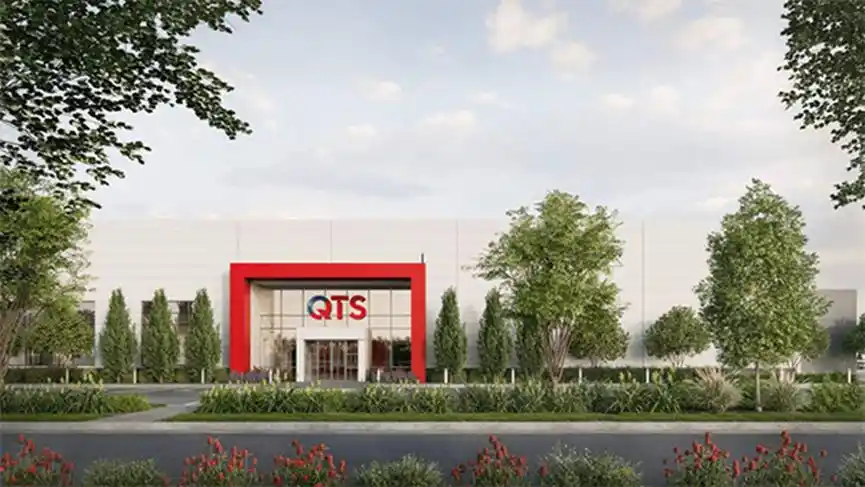
QTS, operadora de centros de datos de Blackstone Group. Fuente: Internet

De hecho, dejando de lado el ardiente entusiasmo por la computación para la IA, los cuellos de botella reales de la industria de centros de datos ya son evidentes.

Un informe de investigación de la empresa de inteligencia de IA estadounidense Data Center Watch indica que solo en el primer trimestre de este año, el valor total de los proyectos de centros de datos retrasados en Estados Unidos ascendía a aproximadamente 130.000 millones de dólares.

Un informe de JPMorgan señala que, según un análisis de imágenes satelitales, más del 60% de los proyectos de centros de datos programados para completarse en 2027 aún no han comenzado su construcción, y otro 7% ya está en estado de retraso. Las principales razones involucran cuellos de botella en el suministro eléctrico y la oposición ciudadana.

Un hecho ineludible es que los centros de datos están impulsando el consumo de electricidad de Estados Unidos hacia máximos históricos.

Datos del Instituto de Investigación Eléctrica de EE.UU. (EPRI) muestran que los centros de datos actualmente representan el 5% de la demanda eléctrica del país, y podrían triplicarse para 2035; en Virginia, esta proporción incluso supera el 25%.

El EPRI menciona explícitamente que la red eléctrica y las políticas relacionadas originales simplemente no fueron diseñadas para la velocidad y escala de demanda que trae la infraestructura de IA. La construcción de centros de datos primero ha chocado, en el plano físico, con un techo en el suministro eléctrico.

Incluso si en marzo de este año gigantes como Microsoft, Google, Amazon, Oracle, Meta y OpenAI se comprometieron conjuntamente a asumir los costos de las mejoras de infraestructura, construyendo o adquiriendo ellos mismos la nueva energía requerida para sus proyectos, ni siquiera los fondos más abundantes pueden resolver de inmediato los problemas de retrasos en la entrega de equipos eléctricos y la acumulación masiva de permisos de aprobación.

Además de las restricciones del lado de la oferta eléctrica, la fuerte oposición ciudadana se está convirtiendo en otro factor central que obstaculiza la implementación de centros de datos.

El informe de Data Center Watch muestra que el primer trimestre de 2026 fue el período con más bloqueos y retrasos de proyectos de centros de datos registrados, donde los opositores en todo el país obstaculizaron o retrasaron al menos 75 proyectos en tres meses.

El número de grupos activos de oposición ciudadana contra centros de datos en todo el país aumentó drásticamente, de 396 a finales de 2025 a 833 en marzo, abarcando 49 estados. Maryland, Ohio y Texas son los estados con más grupos de oposición.

En muchos casos, las fuerzas de oposición se movilizan incluso antes de que el proyecto se presente formalmente para su aprobación.

En mayo de este año, cientos de personas se congregaron frente al Capitolio del estado de Utah para protestar contra el gigantesco proyecto Stratos, planeado para el condado de Box Elder y que abarcaría 40.000 acres.

Lo más crucial es que la dirección de las políticas a nivel local se está endureciendo.

Virginia ya ha aprobado un proyecto de ley presupuestario que añade un impuesto al consumo energético de los centros de datos, y varios estados están considerando promulgar moratorias o prohibiciones para la construcción de nuevos centros de datos.

El capital caliente choca contra la oposición ciudadana, el endurecimiento de políticas y las deficiencias en infraestructura. Si la infraestructura de computación para la IA podrá mantener su ritmo de expansión desenfrenado anterior, la respuesta es cada vez más incierta.

La retirada de Blackstone quizás sea solo el comienzo. Cuando la fiebre amaine, la industria finalmente tendrá que volver a la senda de enfrentar los costos y respetar la realidad.

Referencias:

"La construcción de centros de datos en EE.UU. encuentra obstáculos, 130.000 millones en proyectos estancados en el Q1" - 21st Century Business Herald

"Se termina la construcción del mayor centro de datos del mundo" - Cailian Press

Este artículo proviene del WeChat público "Phoenix Net Finance", autor: Storm Eye

Trending Cryptos

Related Questions

Q¿Qué proyecto de centro de datos detuvo el gigante inmobiliario Blackstone a través de su operador QTS?

ABlackstone, a través de su operador QTS, detuvo el proyecto del centro de datos 'Digital Gateway' en el condado de Prince William, Virginia, que pretendía ser el campus de centros de datos más grande del mundo.

Q¿Cuáles fueron las principales razones por las que la comunidad local se opuso al proyecto Digital Gateway?

ALa comunidad local se opuso principalmente porque el proyecto estaba cerca de un sitio histórico de la Guerra Civil, consumiría grandes cantidades de recursos hídricos y energéticos, causaría contaminación (ruido, aire, agua), aumentaría el costo de vida y generaría congestión de tráfico.

QSegún el artículo, ¿qué problema técnico legal fue decisivo para la anulación del permiso de zonificación del proyecto?

AEl problema técnico legal decisivo fue que los dos avisos públicos del permiso de zonificación no cumplieron con el intervalo mínimo requerido de seis días según la normativa, lo que llevó a un tribunal estatal a anular la aprobación.

Q¿Qué señal interpreta el mercado financiero sobre la venta de activos maduros y la cancelación de proyectos por parte de Blackstone en el sector de centros de datos?

AEl mercado financiero interpreta estas acciones como una señal de 'salida en la cima' o toma de ganancias en un momento alto del ciclo, similar a lo que hizo Blackstone con el mercado de oficinas, sugiriendo que los riesgos en el sector podrían estar superando a los beneficios.

Q¿Qué dos grandes obstáculos, además de la oposición pública, enfrenta actualmente la expansión de la infraestructura de centros de datos para IA en Estados Unidos según el artículo?

AAdemás de la fuerte oposición pública, los dos grandes obstáculos son: 1) Cuellos de botella en el suministro de energía eléctrica, donde la red no está diseñada para la demanda masiva y rápida, y 2) La creciente tendencia de endurecimiento de las políticas y regulaciones locales, como impuestos al consumo energético y moratorias para nuevos proyectos.

Related Reads

End of Correction or Continuation of Trend: Technical Structure Review of BTC and HYPE | Guest Analysis

**Weekly Technical Analysis: BTC & HYPE Structure Review** This analysis covers the multi-timeframe technical structure for Bitcoin (BTC) and HYPE. **Bitcoin (BTC) Analysis:** BTC's correction from its May 6 high has formed a clear four-segment pattern on the daily chart. The market is currently in a (3-4) rebound phase. The key determinant for the short-term trend is the endpoint of this rebound ("Endpoint 4"): * **Path 1 (Preferred Scenario):** If the rebound surpasses the $65,700 resistance, subsequent pullbacks are less likely to break the key support at $57,820 (July 1 low). This would suggest a transition into a consolidating range, building energy for a potential bullish reversal. * **Path 2:** Failure to reach $65,700, or even $64,500, increases the probability of a breakdown below $57,820, continuing the downtrend. The 4-hour chart shows a completed five-wave decline from June 15, culminating in a momentum divergence at the low, which supported the recent bounce. **BTC Weekly Outlook & Strategy (Jul 6-12):** * **Core View:** Focus on the high point of the daily rebound from $57,820. * **Key Levels:** * Resistance: $64,500-$65,700; $67,300; $69,500-$71,000. * Support: $60,950-$62,300; $57,820; $55,000. * **Strategy:** * **Mid-term:** Maintain ~20% short position. Consider increasing shorts to <50% if price stalls in the $65,700-$67,300 zone with confirming model signals. * **Short-term:** Use 30% capital for swing trades between support/resistance. * **Plans:** * **Plan A (Short):** Enter shorts (~30%) if price is rejected at $65,700-$67,300. * **Plan B (Long):** Enter longs (~15%) only if price breaks above $65,700 first, then pulls back and finds support near $57,820. **HYPE Analysis:** The rebound from the June 25 low has developed a seven-segment structure on the 4-hour chart. Price is approaching the historical high zone near $76.94. Internal models have triggered top warnings, suggesting caution against chasing the rally and highlighting near-term pullback risks. **HYPE Weekly Outlook & Strategy:** * **Core View:** Observe price action in the $75-$76.94 resistance area. * **Key Levels:** * Resistance: $75-$76.94; $80. * Support: $68; $65.5; $60.5-$61.5. * **Strategy:** Prioritize profit-taking and risk management. If holding longs, consider moving stop-loss to ~$68 to protect gains. Close positions promptly on signs of a downturn. **Trade Recap:** A recent short-term long trade in HYPE, entered at $64 based on model buy signals and exited at ~$70.55 on sell signals, yielded a profit of approximately 10.23%. **General Risk Management:** Always set an initial stop-loss. Move stop-loss to breakeven at +1% profit, and trail it upwards by 1% for every subsequent 1% gain to lock in profits. *Disclaimer: Market conditions change rapidly. All analysis, models, and strategies presented are for educational/log purposes only and do not constitute investment advice. Trade at your own risk.*

Odaily星球日报11m ago

End of Correction or Continuation of Trend: Technical Structure Review of BTC and HYPE | Guest Analysis

Odaily星球日报11m ago

Is Anyone Still Buying in the Crypto Market? Unpacking 3 Common Watch-and-Wait Mentalities Today

Is Anyone Still Buying in the Crypto Market? Unpacking 3 Common Wait-and-See Mindsets This article analyzes the current cautious sentiment in the crypto market, distilled from conversations with sophisticated investors. The author identifies three dominant investor mindsets: 1. **Satisfied with Current Holdings:** Many retain a long-term belief in digital assets but see no immediate catalyst for significant price appreciation. They hold positions to avoid missing a future surge but allocate minimal new capital or attention. A shift requires a new, observable catalyst or a rotation from other portfolio areas. 2. **Waiting for Lower Prices:** This reflects not just short-term timing but a belief about crypto's total addressable market and upside potential. It could change if key perceived cycle bottoms pass without a crash, a major bullish event occurs (e.g., sovereign adoption), or price rebounds trigger FOMO-driven buying. 3. **High Opportunity Cost of Allocation:** The core question is comparative growth. With AI-related equities appearing to offer relentless, high-speed growth, justifying marginal investment into assets without similar perceived momentum is difficult. A slowdown in the AI trade could potentially mark a bottom and trigger capital reallocation into crypto. In conclusion, while long-term conviction persists for many, near-term marginal capital flows are constrained by these beliefs. The author suggests the market may be closer to a bottom than a top, but the current climate is defined by this wait-and-see approach, awaiting a catalyst to reignite broader investor commitment.

marsbit1h ago

Is Anyone Still Buying in the Crypto Market? Unpacking 3 Common Watch-and-Wait Mentalities Today

marsbit1h ago

China Added 67 New Unicorns in Half a Year, with AI and Robotics Accounting for Over Half

China added 67 new unicorn companies in the first half of 2026, reaching a total of 517 unicorns with a combined valuation of approximately $2.39 trillion. This surge marks a significant rebound after a post-2022 slowdown and sets a new semi-annual record. The growth is primarily driven by Artificial Intelligence (AI) and Robotics, which together account for over 53% of the new entrants. Specifically, 19 new unicorns are in robotics and 17 in AI. Notable companies include DeepSeek ($615.38B) and Kling AI ($18B). The trend indicates a decisive shift from internet consumer models to hard tech innovation. Geographically, new unicorns are highly concentrated in four cities: Beijing (19), Shanghai (18), Shenzhen (9), and Hangzhou (5), which together host 76.1% of the new companies. Hangzhou's overall valuation is boosted significantly by DeepSeek. Valuation distribution among new unicorns is pyramidal: 77.6% are valued between $1B and $2B, indicating early-stage status, while only two exceed $10B. There is a notable "speed divide": many AI/robotics startups achieved unicorn status in under three years, often via corporate spin-offs or led by star founders, while hard tech companies in semiconductors or biotech typically took over eight years. The report concludes that this wave reflects China's accelerating transition into an AI and robotics-powered innovation cycle, characterized by faster company formation, heightened geographic concentration, and a clear focus on foundational technologies.

marsbit2h ago

China Added 67 New Unicorns in Half a Year, with AI and Robotics Accounting for Over Half

marsbit2h ago

Trading

Spot

Hot Articles

What is SONIC

Sonic: Pioneering the Future of Gaming in Web3 Introduction to Sonic In the ever-evolving landscape of Web3, the gaming industry stands out as one of the most dynamic and promising sectors. At the forefront of this revolution is Sonic, a project designed to amplify the gaming ecosystem on the Solana blockchain. Leveraging cutting-edge technology, Sonic aims to deliver an unparalleled gaming experience by efficiently processing millions of requests per second, ensuring that players enjoy seamless gameplay while maintaining low transaction costs. This article delves into the intricate details of Sonic, exploring its creators, funding sources, operational mechanics, and the timeline of significant events that have shaped its journey. What is Sonic? Sonic is an innovative layer-2 network that operates atop the Solana blockchain, specifically tailored to enhance the existing Solana gaming ecosystem. It accomplishes this through a customised, VM-agnostic game engine paired with a HyperGrid interpreter, facilitating sovereign game economies that roll up back to the Solana platform. The primary goals of Sonic include: Enhanced Gaming Experiences: Sonic is committed to offering lightning-fast on-chain gameplay, allowing players and developers to engage with games at previously unattainable speeds. Atomic Interoperability: This feature enables transactions to be executed within Sonic without the need to redeploy Solana programmes and accounts. This makes the process more efficient and directly benefits from Solana Layer1 services and liquidity. Seamless Deployment: Sonic allows developers to write for Ethereum Virtual Machine (EVM) based systems and execute them on Solana’s SVM infrastructure. This interoperability is crucial for attracting a broader range of dApps and decentralised applications to the platform. Support for Developers: By offering native composable gaming primitives and extensible data types - dining within the Entity-Component-System (ECS) framework - game creators can craft intricate business logic with ease. Overall, Sonic's unique approach not only caters to players but also provides an accessible and low-cost environment for developers to innovate and thrive. Creator of Sonic The information regarding the creator of Sonic is somewhat ambiguous. However, it is known that Sonic's SVM is owned by the company Mirror World. The absence of detailed information about the individuals behind Sonic reflects a common trend in several Web3 projects, where collective efforts and partnerships often overshadow individual contributions. Investors of Sonic Sonic has garnered considerable attention and support from various investors within the crypto and gaming sectors. Notably, the project raised an impressive $12 million during its Series A funding round. The round was led by BITKRAFT Ventures, with other notable investors including Galaxy, Okx Ventures, Interactive, Big Brain Holdings, and Mirana. This financial backing signifies the confidence that investment foundations have in Sonic’s potential to revolutionise the Web3 gaming landscape, further validating its innovative approaches and technologies. How Does Sonic Work? Sonic utilises the HyperGrid framework, a sophisticated parallel processing mechanism that enhances its scalability and customisability. Here are the core features that set Sonic apart: Lightning Speed at Low Costs: Sonic offers one of the fastest on-chain gaming experiences compared to other Layer-1 solutions, powered by the scalability of Solana’s virtual machine (SVM). Atomic Interoperability: Sonic enables transaction execution without redeployment of Solana programmes and accounts, effectively streamlining the interaction between users and the blockchain. EVM Compatibility: Developers can effortlessly migrate decentralised applications from EVM chains to the Solana environment using Sonic’s HyperGrid interpreter, increasing the accessibility and integration of various dApps. Ecosystem Support for Developers: By exposing native composable gaming primitives, Sonic facilitates a sandbox-like environment where developers can experiment and implement business logic, greatly enhancing the overall development experience. Monetisation Infrastructure: Sonic natively supports growth and monetisation efforts, providing frameworks for traffic generation, payments, and settlements, thereby ensuring that gaming projects are not only viable but also sustainable financially. Timeline of Sonic The evolution of Sonic has been marked by several key milestones. Below is a brief timeline highlighting critical events in the project's history: 2022: The Sonic cryptocurrency was officially launched, marking the beginning of its journey in the Web3 gaming arena. 2024: June: Sonic SVM successfully raised $12 million in a Series A funding round. This investment allowed Sonic to further develop its platform and expand its offerings. August: The launch of the Sonic Odyssey testnet provided users with the first opportunity to engage with the platform, offering interactive activities such as collecting rings—a nod to gaming nostalgia. October: SonicX, an innovative crypto game integrated with Solana, made its debut on TikTok, capturing the attention of over 120,000 users within a short span. This integration illustrated Sonic’s commitment to reaching a broader, global audience and showcased the potential of blockchain gaming. Key Points Sonic SVM is a revolutionary layer-2 network on Solana explicitly designed to enhance the GameFi landscape, demonstrating great potential for future development. HyperGrid Framework empowers Sonic by introducing horizontal scaling capabilities, ensuring that the network can handle the demands of Web3 gaming. Integration with Social Platforms: The successful launch of SonicX on TikTok displays Sonic’s strategy to leverage social media platforms to engage users, exponentially increasing the exposure and reach of its projects. Investment Confidence: The substantial funding from BITKRAFT Ventures, among others, emphasizes the robust backing Sonic has, paving the way for its ambitious future. In conclusion, Sonic encapsulates the essence of Web3 gaming innovation, striking a balance between cutting-edge technology, developer-centric tools, and community engagement. As the project continues to evolve, it is poised to redefine the gaming landscape, making it a notable entity for gamers and developers alike. As Sonic moves forward, it will undoubtedly attract greater interest and participation, solidifying its place within the broader narrative of blockchain gaming.

1.7k Total ViewsPublished 2024.04.04Updated 2024.12.03

What is SONIC

What is $S$

Understanding SPERO: A Comprehensive Overview Introduction to SPERO As the landscape of innovation continues to evolve, the emergence of web3 technologies and cryptocurrency projects plays a pivotal role in shaping the digital future. One project that has garnered attention in this dynamic field is SPERO, denoted as SPERO,$$s$. This article aims to gather and present detailed information about SPERO, to help enthusiasts and investors understand its foundations, objectives, and innovations within the web3 and crypto domains. What is SPERO,$$s$? SPERO,$$s$ is a unique project within the crypto space that seeks to leverage the principles of decentralisation and blockchain technology to create an ecosystem that promotes engagement, utility, and financial inclusion. The project is tailored to facilitate peer-to-peer interactions in new ways, providing users with innovative financial solutions and services. At its core, SPERO,$$s$ aims to empower individuals by providing tools and platforms that enhance user experience in the cryptocurrency space. This includes enabling more flexible transaction methods, fostering community-driven initiatives, and creating pathways for financial opportunities through decentralised applications (dApps). The underlying vision of SPERO,$$s$ revolves around inclusiveness, aiming to bridge gaps within traditional finance while harnessing the benefits of blockchain technology. Who is the Creator of SPERO,$$s$? The identity of the creator of SPERO,$$s$ remains somewhat obscure, as there are limited publicly available resources providing detailed background information on its founder(s). This lack of transparency can stem from the project's commitment to decentralisation—an ethos that many web3 projects share, prioritising collective contributions over individual recognition. By centring discussions around the community and its collective goals, SPERO,$$s$ embodies the essence of empowerment without singling out specific individuals. As such, understanding the ethos and mission of SPERO remains more important than identifying a singular creator. Who are the Investors of SPERO,$$s$? SPERO,$$s$ is supported by a diverse array of investors ranging from venture capitalists to angel investors dedicated to fostering innovation in the crypto sector. The focus of these investors generally aligns with SPERO's mission—prioritising projects that promise societal technological advancement, financial inclusivity, and decentralised governance. These investor foundations are typically interested in projects that not only offer innovative products but also contribute positively to the blockchain community and its ecosystems. The backing from these investors reinforces SPERO,$$s$ as a noteworthy contender in the rapidly evolving domain of crypto projects. How Does SPERO,$$s$ Work? SPERO,$$s$ employs a multi-faceted framework that distinguishes it from conventional cryptocurrency projects. Here are some of the key features that underline its uniqueness and innovation: Decentralised Governance: SPERO,$$s$ integrates decentralised governance models, empowering users to participate actively in decision-making processes regarding the project’s future. This approach fosters a sense of ownership and accountability among community members. Token Utility: SPERO,$$s$ utilises its own cryptocurrency token, designed to serve various functions within the ecosystem. These tokens enable transactions, rewards, and the facilitation of services offered on the platform, enhancing overall engagement and utility. Layered Architecture: The technical architecture of SPERO,$$s$ supports modularity and scalability, allowing for seamless integration of additional features and applications as the project evolves. This adaptability is paramount for sustaining relevance in the ever-changing crypto landscape. Community Engagement: The project emphasises community-driven initiatives, employing mechanisms that incentivise collaboration and feedback. By nurturing a strong community, SPERO,$$s$ can better address user needs and adapt to market trends. Focus on Inclusion: By offering low transaction fees and user-friendly interfaces, SPERO,$$s$ aims to attract a diverse user base, including individuals who may not previously have engaged in the crypto space. This commitment to inclusion aligns with its overarching mission of empowerment through accessibility. Timeline of SPERO,$$s$ Understanding a project's history provides crucial insights into its development trajectory and milestones. Below is a suggested timeline mapping significant events in the evolution of SPERO,$$s$: Conceptualisation and Ideation Phase: The initial ideas forming the basis of SPERO,$$s$ were conceived, aligning closely with the principles of decentralisation and community focus within the blockchain industry. Launch of Project Whitepaper: Following the conceptual phase, a comprehensive whitepaper detailing the vision, goals, and technological infrastructure of SPERO,$$s$ was released to garner community interest and feedback. Community Building and Early Engagements: Active outreach efforts were made to build a community of early adopters and potential investors, facilitating discussions around the project’s goals and garnering support. Token Generation Event: SPERO,$$s$ conducted a token generation event (TGE) to distribute its native tokens to early supporters and establish initial liquidity within the ecosystem. Launch of Initial dApp: The first decentralised application (dApp) associated with SPERO,$$s$ went live, allowing users to engage with the platform's core functionalities. Ongoing Development and Partnerships: Continuous updates and enhancements to the project's offerings, including strategic partnerships with other players in the blockchain space, have shaped SPERO,$$s$ into a competitive and evolving player in the crypto market. Conclusion SPERO,$$s$ stands as a testament to the potential of web3 and cryptocurrency to revolutionise financial systems and empower individuals. With a commitment to decentralised governance, community engagement, and innovatively designed functionalities, it paves the way toward a more inclusive financial landscape. As with any investment in the rapidly evolving crypto space, potential investors and users are encouraged to research thoroughly and engage thoughtfully with the ongoing developments within SPERO,$$s$. The project showcases the innovative spirit of the crypto industry, inviting further exploration into its myriad possibilities. While the journey of SPERO,$$s$ is still unfolding, its foundational principles may indeed influence the future of how we interact with technology, finance, and each other in interconnected digital ecosystems.

93 Total ViewsPublished 2024.12.17Updated 2024.12.17

What is $S$

What is AGENT S

Agent S: The Future of Autonomous Interaction in Web3 Introduction In the ever-evolving landscape of Web3 and cryptocurrency, innovations are constantly redefining how individuals interact with digital platforms. One such pioneering project, Agent S, promises to revolutionise human-computer interaction through its open agentic framework. By paving the way for autonomous interactions, Agent S aims to simplify complex tasks, offering transformative applications in artificial intelligence (AI). This detailed exploration will delve into the project's intricacies, its unique features, and the implications for the cryptocurrency domain. What is Agent S? Agent S stands as a groundbreaking open agentic framework, specifically designed to tackle three fundamental challenges in the automation of computer tasks: Acquiring Domain-Specific Knowledge: The framework intelligently learns from various external knowledge sources and internal experiences. This dual approach empowers it to build a rich repository of domain-specific knowledge, enhancing its performance in task execution. Planning Over Long Task Horizons: Agent S employs experience-augmented hierarchical planning, a strategic approach that facilitates efficient breakdown and execution of intricate tasks. This feature significantly enhances its ability to manage multiple subtasks efficiently and effectively. Handling Dynamic, Non-Uniform Interfaces: The project introduces the Agent-Computer Interface (ACI), an innovative solution that enhances the interaction between agents and users. Utilizing Multimodal Large Language Models (MLLMs), Agent S can navigate and manipulate diverse graphical user interfaces seamlessly. Through these pioneering features, Agent S provides a robust framework that addresses the complexities involved in automating human interaction with machines, setting the stage for myriad applications in AI and beyond. Who is the Creator of Agent S? While the concept of Agent S is fundamentally innovative, specific information about its creator remains elusive. The creator is currently unknown, which highlights either the nascent stage of the project or the strategic choice to keep founding members under wraps. Regardless of anonymity, the focus remains on the framework's capabilities and potential. Who are the Investors of Agent S? As Agent S is relatively new in the cryptographic ecosystem, detailed information regarding its investors and financial backers is not explicitly documented. The lack of publicly available insights into the investment foundations or organisations supporting the project raises questions about its funding structure and development roadmap. Understanding the backing is crucial for gauging the project's sustainability and potential market impact. How Does Agent S Work? At the core of Agent S lies cutting-edge technology that enables it to function effectively in diverse settings. Its operational model is built around several key features: Human-like Computer Interaction: The framework offers advanced AI planning, striving to make interactions with computers more intuitive. By mimicking human behaviour in tasks execution, it promises to elevate user experiences. Narrative Memory: Employed to leverage high-level experiences, Agent S utilises narrative memory to keep track of task histories, thereby enhancing its decision-making processes. Episodic Memory: This feature provides users with step-by-step guidance, allowing the framework to offer contextual support as tasks unfold. Support for OpenACI: With the ability to run locally, Agent S allows users to maintain control over their interactions and workflows, aligning with the decentralised ethos of Web3. Easy Integration with External APIs: Its versatility and compatibility with various AI platforms ensure that Agent S can fit seamlessly into existing technological ecosystems, making it an appealing choice for developers and organisations. These functionalities collectively contribute to Agent S's unique position within the crypto space, as it automates complex, multi-step tasks with minimal human intervention. As the project evolves, its potential applications in Web3 could redefine how digital interactions unfold. Timeline of Agent S The development and milestones of Agent S can be encapsulated in a timeline that highlights its significant events: September 27, 2024: The concept of Agent S was launched in a comprehensive research paper titled “An Open Agentic Framework that Uses Computers Like a Human,” showcasing the groundwork for the project. October 10, 2024: The research paper was made publicly available on arXiv, offering an in-depth exploration of the framework and its performance evaluation based on the OSWorld benchmark. October 12, 2024: A video presentation was released, providing a visual insight into the capabilities and features of Agent S, further engaging potential users and investors. These markers in the timeline not only illustrate the progress of Agent S but also indicate its commitment to transparency and community engagement. Key Points About Agent S As the Agent S framework continues to evolve, several key attributes stand out, underscoring its innovative nature and potential: Innovative Framework: Designed to provide an intuitive use of computers akin to human interaction, Agent S brings a novel approach to task automation. Autonomous Interaction: The ability to interact autonomously with computers through GUI signifies a leap towards more intelligent and efficient computing solutions. Complex Task Automation: With its robust methodology, it can automate complex, multi-step tasks, making processes faster and less error-prone. Continuous Improvement: The learning mechanisms enable Agent S to improve from past experiences, continually enhancing its performance and efficacy. Versatility: Its adaptability across different operating environments like OSWorld and WindowsAgentArena ensures that it can serve a broad range of applications. As Agent S positions itself in the Web3 and crypto landscape, its potential to enhance interaction capabilities and automate processes signifies a significant advancement in AI technologies. Through its innovative framework, Agent S exemplifies the future of digital interactions, promising a more seamless and efficient experience for users across various industries. Conclusion Agent S represents a bold leap forward in the marriage of AI and Web3, with the capacity to redefine how we interact with technology. While still in its early stages, the possibilities for its application are vast and compelling. Through its comprehensive framework addressing critical challenges, Agent S aims to bring autonomous interactions to the forefront of the digital experience. As we move deeper into the realms of cryptocurrency and decentralisation, projects like Agent S will undoubtedly play a crucial role in shaping the future of technology and human-computer collaboration.

763 Total ViewsPublished 2025.01.14Updated 2025.01.14

What is AGENT S

Discussions

Welcome to the HTX Community. Here, you can stay informed about the latest platform developments and gain access to professional market insights. Users' opinions on the price of S (S) are presented below.

活动图片