World's Largest Data Center Project Scrapped

marsbitPublished on 2026-07-06Last updated on 2026-07-06

Abstract

Blackstone Abandons Plans for World's Largest Data Center, Signaling Wider AI Infrastructure Headwinds Blackstone has halted construction of its massive "Digital Gateway" data center campus in Virginia, which was planned to be the world's largest. The project's cancellation follows a five-year battle with local residents concerned about historical preservation, environmental impact, and strain on local resources. A procedural error in the zoning approval process ultimately led a state court to invalidate the project's permits. This move comes shortly after Blackstone sold other mature data center assets, suggesting a strategic pivot by the asset management giant. Industry analysts see this as a potential sign of "peak" investment enthusiasm, mirroring Blackstone's past exits from overheated sectors like office real estate. The cancellation highlights significant bottlenecks facing the AI-driven data center boom across the U.S. Key challenges include severe power grid constraints, with data centers' electricity demand projected to triple nationally by 2035, and mounting grassroots opposition. A report notes over $130 billion worth of U.S. data center projects were delayed in Q1 2026 alone, primarily due to power shortages and community resistance. Local and state governments are also beginning to implement stricter regulations, including new taxes and moratoriums on construction. Blackstone's exit underscores that the breakneck expansion of AI infrastructure is colliding w...

As the market is still abuzz with Blackstone Group's $3.5 billion sale of three data centers in Virginia, this alternative asset management giant overseeing over $1.3 trillion in assets has made another, even more surprising move — its data center operator QTS has officially halted the construction of the local Digital Gateway data center project.

This mega-project, once touted as the "world's largest data center campus" with a total area larger than two New York Central Parks, has now come to a complete standstill.

Within just a few days, Blackstone's dual actions — cashing out mature assets at a high point while proactively scrapping a massive reserve project — lay bare the real-world challenges hidden beneath the AI computing infrastructure boom through this abrupt strategic shift.

01

End of a Five-Year Battle: The Untold Story of a Mega-Project's Demise

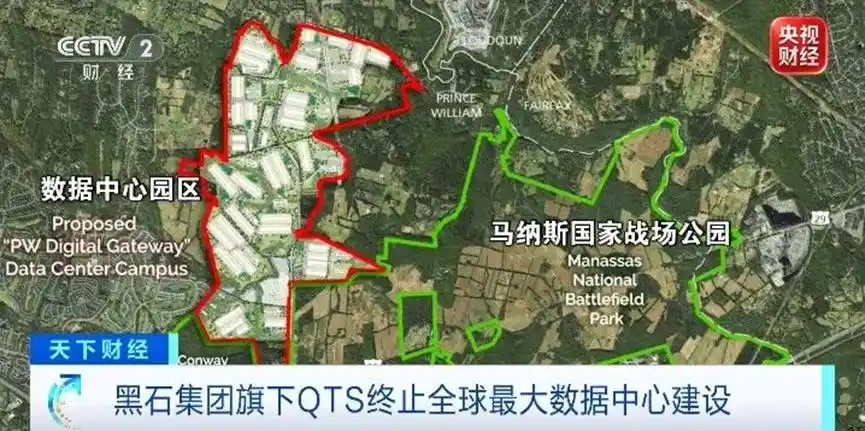
The stalled project is located in Prince William County, Virginia, spanning 2,100 acres. Originally planned with an investment exceeding $100 billion, it aimed to construct 37 data center buildings with a total area of 22 million square feet, which would have made it the undisputed world's largest data center campus.

Yet, from the very first day of public disclosure, the project plunged into a quagmire of controversy.

The site is adjacent to a historic Civil War battlefield and was originally protected land with development restrictions. The idea of clearing it to build densely packed data centers prompted immediate opposition from local residents.
Source: Internet

This resistance lasted a full five years.

Residents pressured local legislators and filed lawsuits targeting the planning process, gradually dragging the project into stagnation.

The fatal blow to the project's approval came from a seemingly minor procedural oversight.

In 2023, the relevant county government in Virginia held a zoning hearing lasting 27 hours regarding the conversion of agricultural and semi-rural land for data center use. Hundreds of supporters and opponents attended to voice their positions.

After the hearing, the regional government approved the rezoning application by a slim majority, but the two newspaper publication notices did not meet the legally required minimum six-day interval.

Opponents seized upon this flaw, eventually taking the case to state court.

In March of this year, a Virginia state court ruled the zoning approval invalid, effectively stripping the project of its legal development status.

Two months later, the other major developer — Compass Datacenters, owned by Canadian asset management giant Brookfield — decided to withdraw first.

The company's president later admitted that the continuous legal disputes and escalating regulatory barriers had completely blocked any feasible path for the project's advancement.

With the partner gone, the massive costs for infrastructure upgrades like water and power grids, originally shared by both parties, fell entirely on QTS.

Coupled with the fact that the court ruling could set an unfavorable legal precedent, leading to even more trouble ahead, Blackstone ultimately decided that continuing was not worth the cost and chose to cut its losses and exit.

This opposition is not an isolated case.

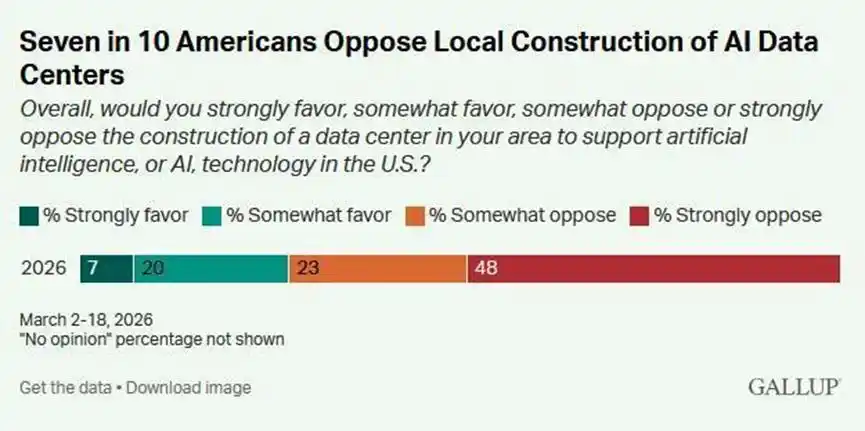
A recent Gallup poll shows that 70% of Americans oppose building AI data centers near their homes, with nearly half strongly opposing it.
Source: Internet

Public concerns are very practical. Data centers consume vast amounts of water and electricity, generate noise, air, and water pollution, increase local living costs, and exacerbate traffic congestion.

In the face of ordinary people's lives, even the grandest AI narratives seem somewhat distant.

02

Capital Begins High-Level Retreat as AI Infrastructure Hits Reality Ceiling

The reason Blackstone's move has sent shockwaves through Wall Street and the tech sector is that it has been a benchmark player in this wave of data center investment.

After acquiring QTS in 2021, buying Australian computing service provider AirTrunk in 2024, and pushing its data center acquisition platform, Blackstone Digital Infrastructure Trust, to an IPO in May this year, Blackstone has aggressively expanded, even calling itself the world's largest data center service provider.

Yet now, this industry leader is selling off mature assets while axing reserve projects, mirroring its "exit at the peak" strategy in the office market years ago.

When the work-from-home trend emerged earlier, causing office rents and values to plummet, Blackstone heavily discounted and sold off several landmark office buildings, accurately timing the cycle's inflection point.

Now, replicating this approach in the data center sector is seen by the industry as a signal of "selling high." When capital most attuned to cycles begins to retreat, it often means the sector's risks are starting to outweigh its rewards.
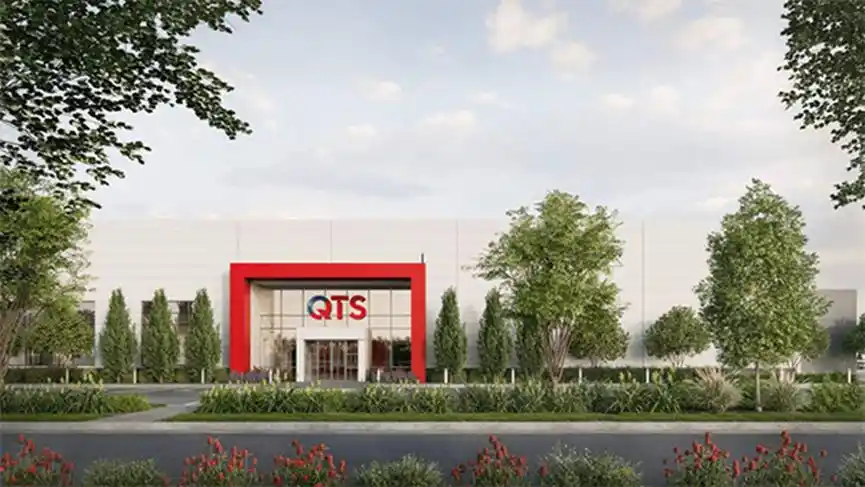
QTS, a data center operator under U.S. Blackstone Group. Source: Internet

In fact, looking beyond the hotly discussed AI computing boom, the real bottlenecks in the data center industry have long been apparent.

A research report from U.S. AI intelligence firm Data Center Watch indicates that in the first quarter of this year alone, delayed data center projects across the U.S. were worth approximately $130 billion.

A J.P. Morgan report, based on satellite image analysis, noted that over 60% of data center projects scheduled for completion in 2027 have not yet broken ground, with another 7% already delayed. The main reasons involve power supply bottlenecks and public opposition.

An unavoidable fact is that data centers are pushing U.S. electricity consumption toward historic highs.

Data from the Electric Power Research Institute (EPRI) shows data centers currently account for 5% of U.S. electricity demand, potentially tripling by 2035; in Virginia, this proportion already exceeds 25%.

EPRI explicitly stated that the existing grid and related policies were simply not designed for the speed and scale of demand brought by AI infrastructure. Data center construction has first hit the physical ceiling of power supply.

Even though in March this year, giants like Microsoft, Google, Amazon, Oracle, Meta, and OpenAI collectively pledged to bear the costs of infrastructure upgrades and build or procure the new power needed for their projects, even ample funds cannot instantly solve problems like delayed power equipment delivery and massive permit approval backlogs.

Beyond power supply constraints, strong public resistance is becoming another core factor hindering data center deployment.

The Data Center Watch report shows Q1 2026 was the period with the most recorded instances of data center projects being blocked or delayed, with opponents obstructing or delaying at least 75 projects across the U.S. in three months.

The number of active grassroots opposition groups targeting data centers nationwide surged from 396 at the end of 2025 to 833 by March, spanning 49 states, with Maryland, Ohio, and Texas being hotspots with the most opposition groups.

In many cases, mobilization against projects begins even before formal applications are submitted.

In May this year, hundreds gathered outside the Utah State Capitol to protest the proposed massive 40,000-acre Stratos project in Box Elder County.

More crucially, policy winds are tightening at the local level.

Virginia has passed a budget bill adding an energy consumption tax for data centers, and several states are also considering temporary moratoriums on new data center construction.

As speculative capital collides with public opposition, policy tightening, and infrastructure shortcomings, whether AI computing infrastructure can maintain its previous breakneck expansion pace is becoming increasingly uncertain.

Blackstone's exit this time might just be the beginning. As the frenzy subsides, the industry must eventually return to a path of acknowledging costs and respecting reality.

References:

"U.S. Data Center Construction Hits Roadblocks, $130 Billion in Projects Stalled in Q1" - 21st Century Business Herald

"World's Largest Data Center Construction Terminated" - Cailian Press

This article is from the WeChat public account "Phoenix.com Finance," author: Storm Eye

Trending Cryptos

Related Questions

QWhy did the Digital Gateway data center project in Virginia get canceled?

AThe project was canceled due to a combination of factors: intense local opposition over five years, a successful legal challenge based on a procedural error in the rezoning approval, the withdrawal of co-developer Compass Datacenters, and the resulting high costs and regulatory uncertainties that made continuation unviable for the remaining developer, QTS (owned by Blackstone).

QWhat were the main reasons for public opposition to the AI data center project in Prince William County, Virginia?

AResidents opposed the project primarily because it was located near a historic Civil War battlefield, would consume vast amounts of water and electricity, potentially cause noise and pollution, increase local living costs, and exacerbate traffic congestion.

QWhat broader trend in the US data center industry does Blackstone's move to sell mature assets and cancel a major project signal, according to the article?

AThe article suggests Blackstone's move signals a 'high-level cash-out' and a potential inflection point, similar to its previous exit from the office market. It indicates that risks (like public opposition, power constraints, and policy tightening) may be starting to outweigh the rewards in the AI infrastructure boom.

QAccording to the article, what are the two major practical bottlenecks currently hindering data center construction in the United States?

AThe two major bottlenecks are: 1) A severe power supply shortage, as the electrical grid was not designed for the rapid and massive demand from AI data centers. 2) Widespread and growing grassroots opposition from local communities across the country, leading to project delays and cancellations.

QHow significant is the scale of delayed data center projects in the US as mentioned in the article?

ACiting reports, the article states that in the first quarter of 2026 alone, delayed data center projects in the US were valued at approximately $130 billion. Furthermore, over 60% of projects slated for completion by 2027 had not broken ground, with another 7% already facing delays.

Related Reads

Want to Get Freebies from Robinhood Chain? Which Ecosystem Projects Are Worth Watching?

**Title: Want to Get the Robinhood Chain Airdrop? Which Ecosystem Projects Are Worth Watching?** **Summary:** Robinhood Chain, a key part of Robinhood's push into Layer 2, aims to build a comprehensive ecosystem covering stock tokens, RWAs, perpetual contracts, and spot trading. With its mainnet launch on July 2, 2026, came a 90-day gas fee waiver for swaps, cross-chain transactions, and Perp trading. While the ecosystem's TVL was still modest at around $76.73 million as of July 6, 2026, several early projects present potential opportunities. Key projects highlighted include: * **Arcus:** A stock token and crypto DEX built by dYdX Labs and Robinhood Crypto, focusing on spot and perpetual contracts. Future ARCUS tokens are expected to prioritize the existing dYdX community. * **Lighter:** A ZK-powered decentralized perpetual and spot exchange deployed on Robinhood Chain. It has committed $11 million worth of LIT tokens to the Robinhood community, with users earning points (and double points via Robinhood Wallet) for trading, convertible to LIT. * **Morpho:** Integral to the newly launched "Robinhood Earn" program in the US, where user-supplied USDG stablecoins are lent out via Morpho vaults, targeting a 7% APY. * **Rialto:** An on-chain spot exchange supporting crypto, stocks, ETFs, and commodities. It will initially list over 90 Robinhood stock tokens and uses a "propAMM" system where market makers provide quotes from their own inventory. * **Arrakis:** A non-custodial, on-chain market maker protocol for token issuers to manage concentrated liquidity on DEXs. * **Meridian:** A platform on Robinhood Chain focusing on RWA perpetual contracts and prediction markets, settled in USDe. It rebranded from Ethereal and had previously planned to allocate 15% of its future governance tokens to ENA stakers. * **Native:** An on-chain price discovery and execution system recently deployed on Robinhood Chain, though the team has stated there are no current plans for a token launch. The article emphasizes that this is not investment advice and urges participants to conduct their own research (DYOR).

Foresight News1h ago

Want to Get Freebies from Robinhood Chain? Which Ecosystem Projects Are Worth Watching?

Foresight News1h ago

Trading

Spot

Hot Articles

What is SONIC

Sonic: Pioneering the Future of Gaming in Web3 Introduction to Sonic In the ever-evolving landscape of Web3, the gaming industry stands out as one of the most dynamic and promising sectors. At the forefront of this revolution is Sonic, a project designed to amplify the gaming ecosystem on the Solana blockchain. Leveraging cutting-edge technology, Sonic aims to deliver an unparalleled gaming experience by efficiently processing millions of requests per second, ensuring that players enjoy seamless gameplay while maintaining low transaction costs. This article delves into the intricate details of Sonic, exploring its creators, funding sources, operational mechanics, and the timeline of significant events that have shaped its journey. What is Sonic? Sonic is an innovative layer-2 network that operates atop the Solana blockchain, specifically tailored to enhance the existing Solana gaming ecosystem. It accomplishes this through a customised, VM-agnostic game engine paired with a HyperGrid interpreter, facilitating sovereign game economies that roll up back to the Solana platform. The primary goals of Sonic include: Enhanced Gaming Experiences: Sonic is committed to offering lightning-fast on-chain gameplay, allowing players and developers to engage with games at previously unattainable speeds. Atomic Interoperability: This feature enables transactions to be executed within Sonic without the need to redeploy Solana programmes and accounts. This makes the process more efficient and directly benefits from Solana Layer1 services and liquidity. Seamless Deployment: Sonic allows developers to write for Ethereum Virtual Machine (EVM) based systems and execute them on Solana’s SVM infrastructure. This interoperability is crucial for attracting a broader range of dApps and decentralised applications to the platform. Support for Developers: By offering native composable gaming primitives and extensible data types - dining within the Entity-Component-System (ECS) framework - game creators can craft intricate business logic with ease. Overall, Sonic's unique approach not only caters to players but also provides an accessible and low-cost environment for developers to innovate and thrive. Creator of Sonic The information regarding the creator of Sonic is somewhat ambiguous. However, it is known that Sonic's SVM is owned by the company Mirror World. The absence of detailed information about the individuals behind Sonic reflects a common trend in several Web3 projects, where collective efforts and partnerships often overshadow individual contributions. Investors of Sonic Sonic has garnered considerable attention and support from various investors within the crypto and gaming sectors. Notably, the project raised an impressive $12 million during its Series A funding round. The round was led by BITKRAFT Ventures, with other notable investors including Galaxy, Okx Ventures, Interactive, Big Brain Holdings, and Mirana. This financial backing signifies the confidence that investment foundations have in Sonic’s potential to revolutionise the Web3 gaming landscape, further validating its innovative approaches and technologies. How Does Sonic Work? Sonic utilises the HyperGrid framework, a sophisticated parallel processing mechanism that enhances its scalability and customisability. Here are the core features that set Sonic apart: Lightning Speed at Low Costs: Sonic offers one of the fastest on-chain gaming experiences compared to other Layer-1 solutions, powered by the scalability of Solana’s virtual machine (SVM). Atomic Interoperability: Sonic enables transaction execution without redeployment of Solana programmes and accounts, effectively streamlining the interaction between users and the blockchain. EVM Compatibility: Developers can effortlessly migrate decentralised applications from EVM chains to the Solana environment using Sonic’s HyperGrid interpreter, increasing the accessibility and integration of various dApps. Ecosystem Support for Developers: By exposing native composable gaming primitives, Sonic facilitates a sandbox-like environment where developers can experiment and implement business logic, greatly enhancing the overall development experience. Monetisation Infrastructure: Sonic natively supports growth and monetisation efforts, providing frameworks for traffic generation, payments, and settlements, thereby ensuring that gaming projects are not only viable but also sustainable financially. Timeline of Sonic The evolution of Sonic has been marked by several key milestones. Below is a brief timeline highlighting critical events in the project's history: 2022: The Sonic cryptocurrency was officially launched, marking the beginning of its journey in the Web3 gaming arena. 2024: June: Sonic SVM successfully raised $12 million in a Series A funding round. This investment allowed Sonic to further develop its platform and expand its offerings. August: The launch of the Sonic Odyssey testnet provided users with the first opportunity to engage with the platform, offering interactive activities such as collecting rings—a nod to gaming nostalgia. October: SonicX, an innovative crypto game integrated with Solana, made its debut on TikTok, capturing the attention of over 120,000 users within a short span. This integration illustrated Sonic’s commitment to reaching a broader, global audience and showcased the potential of blockchain gaming. Key Points Sonic SVM is a revolutionary layer-2 network on Solana explicitly designed to enhance the GameFi landscape, demonstrating great potential for future development. HyperGrid Framework empowers Sonic by introducing horizontal scaling capabilities, ensuring that the network can handle the demands of Web3 gaming. Integration with Social Platforms: The successful launch of SonicX on TikTok displays Sonic’s strategy to leverage social media platforms to engage users, exponentially increasing the exposure and reach of its projects. Investment Confidence: The substantial funding from BITKRAFT Ventures, among others, emphasizes the robust backing Sonic has, paving the way for its ambitious future. In conclusion, Sonic encapsulates the essence of Web3 gaming innovation, striking a balance between cutting-edge technology, developer-centric tools, and community engagement. As the project continues to evolve, it is poised to redefine the gaming landscape, making it a notable entity for gamers and developers alike. As Sonic moves forward, it will undoubtedly attract greater interest and participation, solidifying its place within the broader narrative of blockchain gaming.

1.7k Total ViewsPublished 2024.04.04Updated 2024.12.03

What is SONIC

What is $S$

Understanding SPERO: A Comprehensive Overview Introduction to SPERO As the landscape of innovation continues to evolve, the emergence of web3 technologies and cryptocurrency projects plays a pivotal role in shaping the digital future. One project that has garnered attention in this dynamic field is SPERO, denoted as SPERO,$$s$. This article aims to gather and present detailed information about SPERO, to help enthusiasts and investors understand its foundations, objectives, and innovations within the web3 and crypto domains. What is SPERO,$$s$? SPERO,$$s$ is a unique project within the crypto space that seeks to leverage the principles of decentralisation and blockchain technology to create an ecosystem that promotes engagement, utility, and financial inclusion. The project is tailored to facilitate peer-to-peer interactions in new ways, providing users with innovative financial solutions and services. At its core, SPERO,$$s$ aims to empower individuals by providing tools and platforms that enhance user experience in the cryptocurrency space. This includes enabling more flexible transaction methods, fostering community-driven initiatives, and creating pathways for financial opportunities through decentralised applications (dApps). The underlying vision of SPERO,$$s$ revolves around inclusiveness, aiming to bridge gaps within traditional finance while harnessing the benefits of blockchain technology. Who is the Creator of SPERO,$$s$? The identity of the creator of SPERO,$$s$ remains somewhat obscure, as there are limited publicly available resources providing detailed background information on its founder(s). This lack of transparency can stem from the project's commitment to decentralisation—an ethos that many web3 projects share, prioritising collective contributions over individual recognition. By centring discussions around the community and its collective goals, SPERO,$$s$ embodies the essence of empowerment without singling out specific individuals. As such, understanding the ethos and mission of SPERO remains more important than identifying a singular creator. Who are the Investors of SPERO,$$s$? SPERO,$$s$ is supported by a diverse array of investors ranging from venture capitalists to angel investors dedicated to fostering innovation in the crypto sector. The focus of these investors generally aligns with SPERO's mission—prioritising projects that promise societal technological advancement, financial inclusivity, and decentralised governance. These investor foundations are typically interested in projects that not only offer innovative products but also contribute positively to the blockchain community and its ecosystems. The backing from these investors reinforces SPERO,$$s$ as a noteworthy contender in the rapidly evolving domain of crypto projects. How Does SPERO,$$s$ Work? SPERO,$$s$ employs a multi-faceted framework that distinguishes it from conventional cryptocurrency projects. Here are some of the key features that underline its uniqueness and innovation: Decentralised Governance: SPERO,$$s$ integrates decentralised governance models, empowering users to participate actively in decision-making processes regarding the project’s future. This approach fosters a sense of ownership and accountability among community members. Token Utility: SPERO,$$s$ utilises its own cryptocurrency token, designed to serve various functions within the ecosystem. These tokens enable transactions, rewards, and the facilitation of services offered on the platform, enhancing overall engagement and utility. Layered Architecture: The technical architecture of SPERO,$$s$ supports modularity and scalability, allowing for seamless integration of additional features and applications as the project evolves. This adaptability is paramount for sustaining relevance in the ever-changing crypto landscape. Community Engagement: The project emphasises community-driven initiatives, employing mechanisms that incentivise collaboration and feedback. By nurturing a strong community, SPERO,$$s$ can better address user needs and adapt to market trends. Focus on Inclusion: By offering low transaction fees and user-friendly interfaces, SPERO,$$s$ aims to attract a diverse user base, including individuals who may not previously have engaged in the crypto space. This commitment to inclusion aligns with its overarching mission of empowerment through accessibility. Timeline of SPERO,$$s$ Understanding a project's history provides crucial insights into its development trajectory and milestones. Below is a suggested timeline mapping significant events in the evolution of SPERO,$$s$: Conceptualisation and Ideation Phase: The initial ideas forming the basis of SPERO,$$s$ were conceived, aligning closely with the principles of decentralisation and community focus within the blockchain industry. Launch of Project Whitepaper: Following the conceptual phase, a comprehensive whitepaper detailing the vision, goals, and technological infrastructure of SPERO,$$s$ was released to garner community interest and feedback. Community Building and Early Engagements: Active outreach efforts were made to build a community of early adopters and potential investors, facilitating discussions around the project’s goals and garnering support. Token Generation Event: SPERO,$$s$ conducted a token generation event (TGE) to distribute its native tokens to early supporters and establish initial liquidity within the ecosystem. Launch of Initial dApp: The first decentralised application (dApp) associated with SPERO,$$s$ went live, allowing users to engage with the platform's core functionalities. Ongoing Development and Partnerships: Continuous updates and enhancements to the project's offerings, including strategic partnerships with other players in the blockchain space, have shaped SPERO,$$s$ into a competitive and evolving player in the crypto market. Conclusion SPERO,$$s$ stands as a testament to the potential of web3 and cryptocurrency to revolutionise financial systems and empower individuals. With a commitment to decentralised governance, community engagement, and innovatively designed functionalities, it paves the way toward a more inclusive financial landscape. As with any investment in the rapidly evolving crypto space, potential investors and users are encouraged to research thoroughly and engage thoughtfully with the ongoing developments within SPERO,$$s$. The project showcases the innovative spirit of the crypto industry, inviting further exploration into its myriad possibilities. While the journey of SPERO,$$s$ is still unfolding, its foundational principles may indeed influence the future of how we interact with technology, finance, and each other in interconnected digital ecosystems.

93 Total ViewsPublished 2024.12.17Updated 2024.12.17

What is $S$

What is AGENT S

Agent S: The Future of Autonomous Interaction in Web3 Introduction In the ever-evolving landscape of Web3 and cryptocurrency, innovations are constantly redefining how individuals interact with digital platforms. One such pioneering project, Agent S, promises to revolutionise human-computer interaction through its open agentic framework. By paving the way for autonomous interactions, Agent S aims to simplify complex tasks, offering transformative applications in artificial intelligence (AI). This detailed exploration will delve into the project's intricacies, its unique features, and the implications for the cryptocurrency domain. What is Agent S? Agent S stands as a groundbreaking open agentic framework, specifically designed to tackle three fundamental challenges in the automation of computer tasks: Acquiring Domain-Specific Knowledge: The framework intelligently learns from various external knowledge sources and internal experiences. This dual approach empowers it to build a rich repository of domain-specific knowledge, enhancing its performance in task execution. Planning Over Long Task Horizons: Agent S employs experience-augmented hierarchical planning, a strategic approach that facilitates efficient breakdown and execution of intricate tasks. This feature significantly enhances its ability to manage multiple subtasks efficiently and effectively. Handling Dynamic, Non-Uniform Interfaces: The project introduces the Agent-Computer Interface (ACI), an innovative solution that enhances the interaction between agents and users. Utilizing Multimodal Large Language Models (MLLMs), Agent S can navigate and manipulate diverse graphical user interfaces seamlessly. Through these pioneering features, Agent S provides a robust framework that addresses the complexities involved in automating human interaction with machines, setting the stage for myriad applications in AI and beyond. Who is the Creator of Agent S? While the concept of Agent S is fundamentally innovative, specific information about its creator remains elusive. The creator is currently unknown, which highlights either the nascent stage of the project or the strategic choice to keep founding members under wraps. Regardless of anonymity, the focus remains on the framework's capabilities and potential. Who are the Investors of Agent S? As Agent S is relatively new in the cryptographic ecosystem, detailed information regarding its investors and financial backers is not explicitly documented. The lack of publicly available insights into the investment foundations or organisations supporting the project raises questions about its funding structure and development roadmap. Understanding the backing is crucial for gauging the project's sustainability and potential market impact. How Does Agent S Work? At the core of Agent S lies cutting-edge technology that enables it to function effectively in diverse settings. Its operational model is built around several key features: Human-like Computer Interaction: The framework offers advanced AI planning, striving to make interactions with computers more intuitive. By mimicking human behaviour in tasks execution, it promises to elevate user experiences. Narrative Memory: Employed to leverage high-level experiences, Agent S utilises narrative memory to keep track of task histories, thereby enhancing its decision-making processes. Episodic Memory: This feature provides users with step-by-step guidance, allowing the framework to offer contextual support as tasks unfold. Support for OpenACI: With the ability to run locally, Agent S allows users to maintain control over their interactions and workflows, aligning with the decentralised ethos of Web3. Easy Integration with External APIs: Its versatility and compatibility with various AI platforms ensure that Agent S can fit seamlessly into existing technological ecosystems, making it an appealing choice for developers and organisations. These functionalities collectively contribute to Agent S's unique position within the crypto space, as it automates complex, multi-step tasks with minimal human intervention. As the project evolves, its potential applications in Web3 could redefine how digital interactions unfold. Timeline of Agent S The development and milestones of Agent S can be encapsulated in a timeline that highlights its significant events: September 27, 2024: The concept of Agent S was launched in a comprehensive research paper titled “An Open Agentic Framework that Uses Computers Like a Human,” showcasing the groundwork for the project. October 10, 2024: The research paper was made publicly available on arXiv, offering an in-depth exploration of the framework and its performance evaluation based on the OSWorld benchmark. October 12, 2024: A video presentation was released, providing a visual insight into the capabilities and features of Agent S, further engaging potential users and investors. These markers in the timeline not only illustrate the progress of Agent S but also indicate its commitment to transparency and community engagement. Key Points About Agent S As the Agent S framework continues to evolve, several key attributes stand out, underscoring its innovative nature and potential: Innovative Framework: Designed to provide an intuitive use of computers akin to human interaction, Agent S brings a novel approach to task automation. Autonomous Interaction: The ability to interact autonomously with computers through GUI signifies a leap towards more intelligent and efficient computing solutions. Complex Task Automation: With its robust methodology, it can automate complex, multi-step tasks, making processes faster and less error-prone. Continuous Improvement: The learning mechanisms enable Agent S to improve from past experiences, continually enhancing its performance and efficacy. Versatility: Its adaptability across different operating environments like OSWorld and WindowsAgentArena ensures that it can serve a broad range of applications. As Agent S positions itself in the Web3 and crypto landscape, its potential to enhance interaction capabilities and automate processes signifies a significant advancement in AI technologies. Through its innovative framework, Agent S exemplifies the future of digital interactions, promising a more seamless and efficient experience for users across various industries. Conclusion Agent S represents a bold leap forward in the marriage of AI and Web3, with the capacity to redefine how we interact with technology. While still in its early stages, the possibilities for its application are vast and compelling. Through its comprehensive framework addressing critical challenges, Agent S aims to bring autonomous interactions to the forefront of the digital experience. As we move deeper into the realms of cryptocurrency and decentralisation, projects like Agent S will undoubtedly play a crucial role in shaping the future of technology and human-computer collaboration.

763 Total ViewsPublished 2025.01.14Updated 2025.01.14

What is AGENT S

Discussions

Welcome to the HTX Community. Here, you can stay informed about the latest platform developments and gain access to professional market insights. Users' opinions on the price of S (S) are presented below.

活动图片