Évaluation de 8 milliards de dollars, multipliée par 2 en 8 mois ! Sur quoi repose la banque cryptophile Erebor Bank ?

marsbitPublished on 2026-07-04Last updated on 2026-07-04

Abstract

Erebor Bank, une nouvelle banque numérique favorable aux crypto-monnaies fondée par Palmer Luckey (créateur d'Oculus) et soutenue par Peter Thiel, est en discussion pour une levée de fonds à une valorisation cible de 80 milliards de dollars. Cela représente près du double de sa valorisation de décembre dernier (43,5 milliards de dollars). Cette croissance fulgurante en seulement huit mois s'explique principalement par l'explosion de ses dépôts, passés de 11 milliards de dollars fin mars à environ 40,5 milliards de dollars en trois mois. L'ambition d'Erebor est de combler le vide laissé par la faillite de la Silicon Valley Bank (SVB) en s'adressant spécifiquement aux startups technologiques, de la défense et du secteur crypto. Son modèle repose sur la possession de sa propre licence bancaire nationale (OCC), lui permettant d'éviter la dépendance à un partenaire tiers. À long terme, la banque vise à intégrer des services de stablecoin (dépôts, paiements, règlement 24/7) dans son offre régulée, comme en témoigne son premier partenariat avec le réseau Sui. Cependant, le modèle présente des risques similaires à ceux de SVB : une clientèle concentrée (startups, investisseurs), des actifs collatéraux non traditionnels, et une exposition aux volatilités des marchés crypto. Son succès dépendra de sa capacité à exécuter sa stratégie, de la pérennité du cadre réglementaire favorable aux actifs numériques, et de la demande réelle du marché pour ses services intégrés.

Auteur : Chloe, ChainCatcher

Selon Bloomberg, Erebor, une banque numérique lancée par Palmer Luckey, fondateur d'Anduril, et soutenue par l'investisseur milliardaire Peter Thiel, est en discussion avec des investisseurs pour un nouveau tour de financement, visant une valorisation d'au moins 8 milliards de dollars, soit environ le double de celle du tour de décembre dernier (levée de 350 millions de dollars, valorisation de 4,35 milliards de dollars). Les négociations en sont encore à un stade précoce, la valorisation n'étant pas encore finalisée. Un porte-parole d'Erebor a refusé de commenter les discussions.

Une banque créée il y a seulement quelques mois, dont la valorisation double, est l'un des cas de hausse de valorisation les plus élevés parmi les nouvelles banques agréées aux États-Unis ces dernières années. Ce qui pousse vraiment les investisseurs à revoir leur offre, c'est peut-être la vitesse d'expansion de ses résultats financiers.

Quel potentiel les investisseurs voient-ils dans les résultats financiers ?

Selon des sources informées, le volume des dépôts d'Erebor est passé de 1,1 milliard de dollars déclaré aux autorités de régulation fin mars à environ 4,05 milliards de dollars en trois mois, soit une multiplication par près de quatre en un seul trimestre. Près de 400 nouveaux clients ont été ajoutés, et la banque prévoit d'être rentable d'ici fin 2026.
Cette vitesse de croissance suscite également des interrogations extérieures : Erebor est-il trop proche des cercles technologiques de la Silicon Valley et de la défense gouvernementale ? Certains soupçonnent un jeu de "va-et-vient interne".

Luckey a répondu directement à cela, soulignant qu'aucune part de la croissance trimestrielle ne provenait de ses propres sociétés, et que les nouveaux clients avaient indépendamment choisi Erebor. Il a ajouté qu'une grande partie de l'expansion récente s'était concentrée sur des entreprises reconstruisant les capacités de fabrication américaines, et que la banque avait également élargi le financement d'équipements, le crédit aux entreprises de capital-risque et les activités de prêt aux entreprises industrielles et de défense.

En revenant aux résultats du premier trimestre, on voit un total d'actifs de 1,703 milliard de dollars, des dépôts de 1,098 milliard de dollars, et des fonds propres bancaires de 600,6 millions de dollars. Il n'y avait aucune activité de prêt ou de crédit-bail au bilan, ni d'autres emprunts que les dépôts (fonds fédéraux, accords de rachat, autres emprunts, dette subordonnée, etc., tous à zéro). La structure des actifs est extrêmement orientée vers la liquidité : environ 1,411 milliard de dollars en espèces et dépôts interbancaires, et environ 275 millions de dollars en titres de créance et actions disponibles à la vente (dont 116 millions en obligations et 159 millions en actions).

De plus, le revenu net d'intérêts trimestriel n'était que de 3,36 millions de dollars, les dépenses hors intérêts de 10,56 millions de dollars, enregistrant une perte nette de 6,01 millions de dollars. Cependant, pour une nouvelle banque qui vient de démarrer et qui amortit encore les coûts technologiques, de conformité et opérationnels, de telles pertes sont des dépenses nécessaires.

En d'autres termes, les investisseurs acceptent une valorisation de 8 milliards de dollars non pas pour le potentiel de monétisation actuel d'Erebor, mais pour la vitesse à laquelle ses dépôts sont passés de 1,1 à 4,05 milliards de dollars, et pour l'anticipation de sa capacité future à prêter ces dépôts et à développer des activités de stablecoin.

Un fondateur peu familier de Wall Street, mais de taille

Pour comprendre Erebor, il faut d'abord comprendre le modèle de construction de produit qui revient sans cesse.

Le parcours du fondateur Palmer Luckey s'étend d'Oculus VR à Anduril, se concentrant toujours sur des industries à forte intensité capitalistique à l'intersection du matériel, des barrières réglementaires et des écosystèmes adjacents au gouvernement. En 2012, il s'est attaqué au marché de la VR encore embryonnaire, résolvant les problèmes de latence et de suivi spatial qui préoccupaient le secteur depuis des années, avant de vendre Oculus à Facebook pour 2 milliards de dollars en 2014. Son deuxième projet entrepreneurial, Anduril, applique la même approche à l'industrie de la défense : utiliser de l'argent de capital-risque privé pour d'abord développer des systèmes de défense, puis les vendre au gouvernement en tant que "produit" plutôt que selon le modèle traditionnel du "coût majoré", établissant ainsi des relations profondes avec le département de la Défense et la communauté du renseignement. Luckey a clairement déclaré qu'Erebor collaborerait "dès le premier jour" avec les services de renseignement pour prévenir les fraudes, adoptant une posture de conformité proactive.

Mais Luckey lui-même est un outsider du secteur bancaire. La marque Erebor repose en partie sur sa réputation et celle de Thiel, mais le prestige ne peut remplacer les performances en matière de régulation et d'exploitation. Dès qu'elle met les pieds sur Wall Street, cette banque finira par être jugée selon les normes d'un établissement régulé.

C'est pourquoi la véritable équipe opérationnelle possède de solides antécédents financiers : le président Michael Hagedorn vient de la banque régionale de Wells Fargo ; le PDG Owen Rapaport a une expérience en conformité cryptographique via Aer Compliance ; le directeur de la stratégie Jacob Hirshman a participé aux activités de stablecoin de Circle et a exercé chez Sullivan & Cromwell ; le vice-président de la croissance, Noah Pompan, a travaillé chez MoonPay. Les investisseurs incluent le 8VC de Joe Lonsdale, le Founders Fund de Thiel, Lux Capital et un fonds associé à a16z.
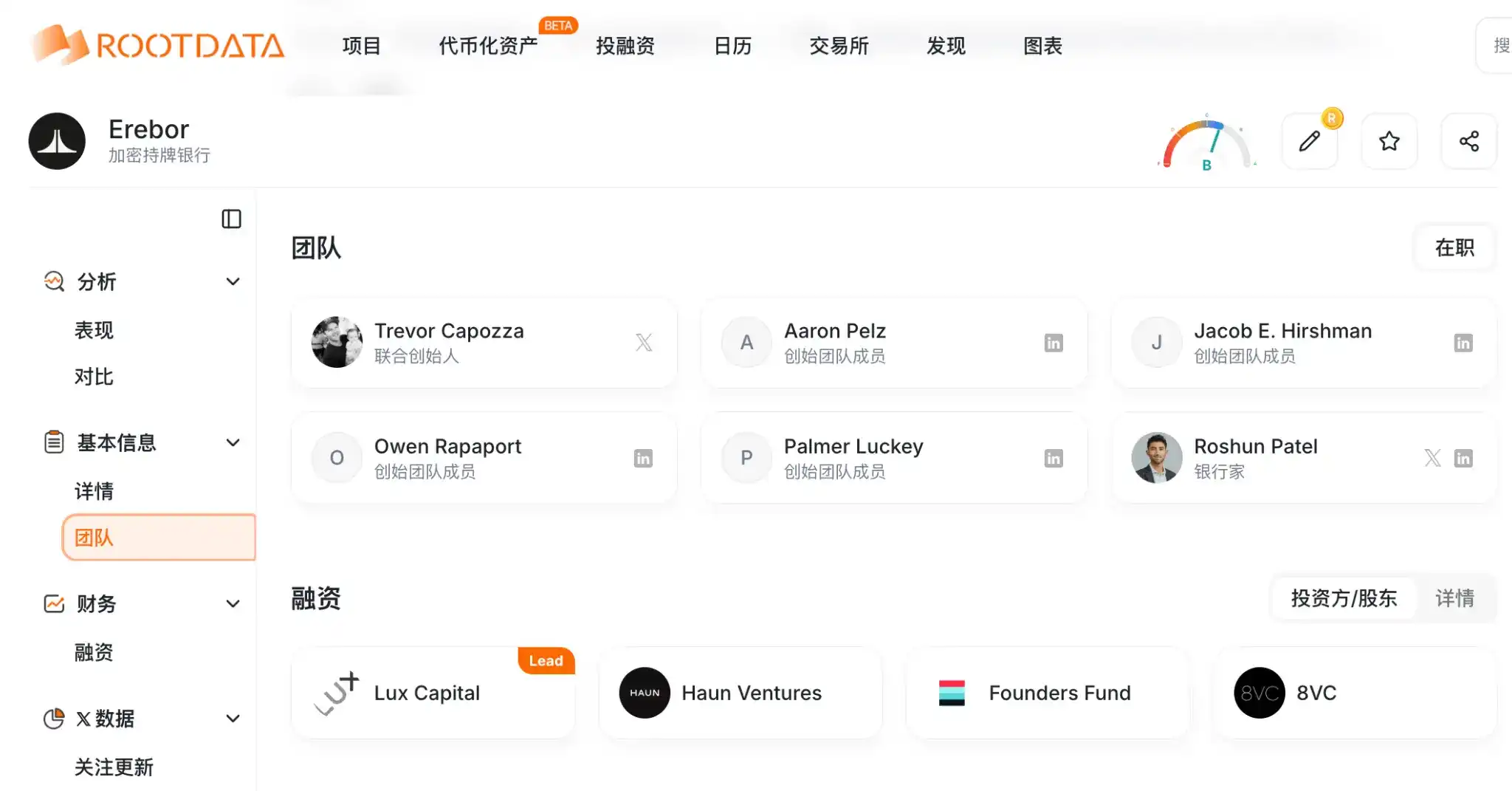
Source de l'image :RootData

Un autre choix stratégique clé d'Erebor est de : insister pour obtenir sa propre licence et être responsable de ses résultats financiers, contrairement à Mercury ou Brex qui dépendent de banques partenaires. L'argument de Luckey est que dépendre d'une infrastructure tierce, c'est s'exposer au risque de "déplatformisation", de pressions politiques et de restrictions de produits ; ce n'est qu'en détenant une licence et un registre qu'elle pourra réaliser ses promesses de règlement sur chaîne, de création et de rachat de stablecoins.

En revenant aux débuts d'Erebor, ils sont presque entièrement liés à l'effondrement de la Silicon Valley Bank (SVB) en 2023. Cette faillite a privé de nombreuses startups et sociétés de capital-risque de leur partenaire bancaire et de la garantie de leurs dépôts du jour au lendemain. Luckey et les investisseurs estiment que cela a laissé un "vide structurel", c'est-à-dire la disparition de banques spécialisées dans les startups, tandis que les banques traditionnelles sont trop conservatrices ou lentes pour ces startups détenant des actifs non standard (contrats de défense, matériel d'IA, jetons numériques).

Erebor prétend résoudre quatre points de douleur principaux : premièrement, fournir du crédit pour des actifs physiques, les banques traditionnelles étant douées pour prêter sur l'immobilier ou les créances, mais pas pour évaluer des "GPU" ou de la "recherche aérospatiale" ; deuxièmement, combler la fracture entre on-chain et off-chain, en intégrant les services bancaires en monnaie fiduciaire et le règlement par stablecoin dans le même bilan régulé ; troisièmement, répondre aux besoins de règlement 24h/24 et 7j/7, remplaçant les systèmes SWIFT et ACH fonctionnant encore sur des calendriers vieux de plusieurs décennies ; quatrièmement, fournir un accès au dollar pour les entreprises internationales à forte croissance, luttant contre les frictions de "débancarisation" qu'elles rencontrent souvent.

Bien sûr, la part de réalité et de marketing dans ce potentiel opérationnel reste à discuter. Les entreprises soutenues par le capital-risque ont aujourd'hui des options alternatives comme le financement non bancaire, le prêt DeFi, et certaines banques existantes avaient déjà commencé à cibler les niches technologiques avant la faillite de SVB. Les fondateurs d'Erebor croient clairement que les institutions existantes ne suffisent pas, et le fait qu'elle ait obtenu une licence bancaire complète suggère que les régulateurs pensent peut-être aussi qu'il y a du vrai dans ce jugement ?

De plus, les actifs numériques sont au cœur de la stratégie à long terme d'Erebor. Elle prévoit d'accepter les dépôts et les paiements en stablecoins en dollars, offrant une conversion instantanée entre monnaie fiduciaire et stablecoins, des voies de règlement continues, et, dans un cadre régulé, de soutenir progressivement la création et le rachat de stablecoins. Sa licence OCC lui permet même explicitement de détenir de petites quantités d'actifs cryptographiques sur son propre bilan pour payer les frais de transaction on-chain. La lettre de l'autorité de régulation qualifie cette détention d'activité "accessoire" aux opérations bancaires, ce qui constitue un précédent notable en matière de conformité.

Le 2 avril, la Fondation Sui a annoncé qu'Erebor prenait désormais en charge le réseau Sui, permettant aux clients d'effectuer des dépôts et retraits de stablecoins. C'est l'une des premières preuves publiques de la connexion de son infrastructure bancaire régulée aux paiements on-chain.

Cependant, la réalité présente aussi des écarts. Selon des sources informées, la demande de prêts garantis par des cryptomonnaies est inférieure aux attentes initiales de la banque. Cela corrobore les résultats financiers mentionnés précédemment : ce qui a réellement stimulé la croissance récente, ce sont plutôt les entreprises reconstruisant les capacités de fabrication américaines, ainsi que le financement de leurs équipements et la dette de capital-risque. En d'autres termes, Erebor ressemble actuellement plus à un hybride "défense + fabrication avancée + crypto" qu'à une banque cryptographique purement native.

Au bon moment, au bon endroit : le timing de la demande de licence d'Erebor était-il parfait ?

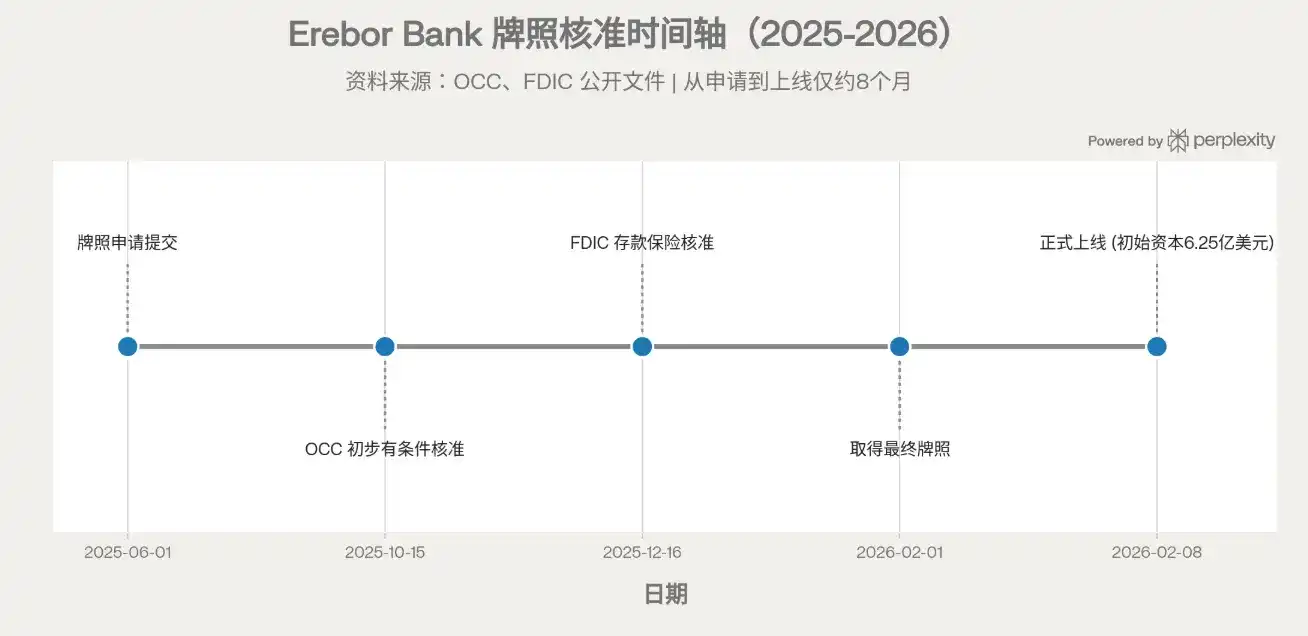
En détaillant la partie licence, Erebor a obtenu l'approbation conditionnelle préliminaire de l'OCC le 15 octobre 2025, l'approbation de l'assurance-dépôts de la FDIC le 16 décembre, sa licence définitive début février 2026, et a officiellement lancé ses opérations le 8 février avec un capital initial d'environ 625 millions de dollars (contre environ 275 millions de dollars au stade de l'approbation préliminaire, une augmentation significative). C'est la première nouvelle licence bancaire nationale (de novo) délivrée sous l'administration gouvernementale américaine actuelle.
Tout cela se produit dans un contexte de changement notable de la politique bancaire américaine : sous l'autorité du commissaire Jonathan Gould à l'OCC, la posture régulatoire s'est clairement montrée ouverte aux banques d'actifs numériques, Gould lui-même qualifiant cette licence d'exemple de "système financier dynamique et diversifié" ; ajoutez à cela l'avancée du cadre législatif fédéral pour les stablecoins (GENIUS Act), et la zone légale autrefois floue a été considérablement clarifiée.

Il est à noter que les autorités de régulation n'ont pas non plus tout autorisé sans condition. En échange de l'approbation, l'OCC et la FDIC ont imposé des conditions strictes : maintenir un ratio de levier de catégorie 1 d'au moins 12 % pendant les trois premières années (environ le double du seuil "bien capitalisé"), avec un engagement de complément de capital. On peut dire que la viabilité d'Erebor est en partie liée au cycle politique actuel. Si la position réglementaire venait à changer à l'avenir, ou si les règles concernant les stablecoins et la lutte contre le blanchiment d'argent se durcissaient, tout son discours fondé sur des "règles favorables aux jetons" pourrait faire face à des vents contraires.

Enfin, selon les analyses des médias étrangers, le modèle d'Erebor reproduit presque chaque risque des leçons de l'effondrement de SVB.

Elle sert des entreprises technologiques en phase de démarrage, avec des garanties constituées d'actifs non traditionnels. Elle dessert une clientèle de grands comptes (startups, fondateurs, fonds d'investissement), et non des milliers de particuliers. L'échec ou le retrait d'un seul client important (turbulences du marché cryptographique, retrait majeur du capital-risque) pourrait avoir un impact significatif sur sa liquidité. Les régulateurs ont déjà souligné que la structure de clientèle "monoculture" de SVB était l'un des facteurs ayant contribué à la ruée.

La corrélation avec les cryptomonnaies rend le problème plus complexe. Si un stablecoin qu'elle soutient perd sa parité, ou si les prix des cryptos s'effondrent, sa base de dépôts et les garanties de prêt pourraient simultanément se déprécier. En outre, il y a le risque d'un renversement politique (tout son discours repose sur des règles favorables aux jetons), le risque d'exécution lié à la construction d'un système central et d'un règlement on-chain à partir de zéro, et la prémisse, encore non vérifiée, que "les stablecoins seront réellement largement adoptés par les clients". Enfin, il y a le risque de réputation et politique. Les associations politiques controversées de Luckey, ajoutées à la nouveauté de la "banque cryptographique", pourraient amplifier la perte de confiance du marché si la banque rencontrait des difficultés.

On peut dire qu'Erebor est une expérience de grande envergure se déroulant à l'intersection de la banque, des cryptomonnaies et de la politique industrielle.

Le besoin qu'elle met en avant sur le marché est le déficit de financement après la chute de SVB, ainsi que les frictions liées aux paiements cryptographiques. Aujourd'hui, les régulateurs ont donné leur accord sur le papier, l'équipe combine prestige technologique et expérience de Wall Street, et l'exécution de ce nouveau modèle, la pérennité de la position réglementaire, ainsi que la demande réelle du marché pour ses services intégrés, sont précisément les points sur lesquels le marché porte un regard critique.

Trending Cryptos

Related Questions

QQuelle est la valorisation cible d'Erebor Bank dans sa nouvelle levée de fonds et comment cela se compare-t-il à sa valorisation précédente ?

AErebor Bank vise une valorisation d'au moins 80 milliards de dollars dans sa nouvelle levée de fonds. Cette valorisation est presque le double de celle de son dernier tour de financement en décembre, qui s'élevait à 43,5 milliards de dollars.

QQuels sont les principaux facteurs qui expliquent la croissance rapide des dépôts d'Erebor Bank et les attentes des investisseurs ?

ALa croissance rapide des dépôts, passant de 11 milliards de dollars fin mars à environ 40,5 milliards de dollars en trois mois, et l'ajout de près de 400 nouveaux clients sont les principaux facteurs. Les investisseurs anticipent la capacité future de la banque à utiliser ces dépôts pour des activités de prêt et de développement de services liés aux stablecoins.

QQuelle est la stratégie et l'expérience de Palmer Luckey, fondateur d'Erebor Bank, dans ses entreprises précédentes ?

APalmer Luckey a fondé Oculus VR (vendu à Facebook en 2014 pour 20 milliards de dollars) puis Anduril, une entreprise de défense. Sa stratégie repose sur l'entrée dans des industries à forte intensité capitalistique avec des barrières réglementaires, en développant d'abord des produits avec du capital-risque avant de les vendre au gouvernement.

QQuels sont les quatre principaux problèmes qu'Erebor Bank prétend résoudre pour ses clients ?

AErebor Bank vise à résoudre quatre problèmes : 1) Fournir du crédit pour des actifs physiques non traditionnels (comme du matériel GPU), 2) Relier les mondes financiers traditionnel (hors chaîne) et numérique (sur chaîne), 3) Offrir des règlements 24h/24 et 7j/7, 4) Faciliter l'accès au dollar pour les entreprises internationales à croissance rapide.

QQuels sont les principaux risques identifiés pour le modèle d'entreprise d'Erebor Bank, notamment en comparaison avec la Silicon Valley Bank (SVB) ?

ALes risques principaux incluent : une clientèle concentrée (startups, fonds) similaire à celle de la SVB, rendant la banque vulnérable aux retraits massifs ; l'exposition à la volatilité du marché des crypto-actifs ; le risque de changement de politique réglementaire ; les risques d'exécution technique ; et les risques de réputation liés aux affiliations politiques controversées de son fondateur.

Related Reads

MSTR Discloses Sale of 3,588 Bitcoins, Stock Price Drops Over 5% at One Point During Trading

MicroStrategy, the world's largest corporate holder of Bitcoin, has significantly shifted its business model. Between June 29 and July 5, the company sold 3,588 bitcoins for approximately $216 million to fund quarterly dividends for its preferred stock. This marks its largest-ever Bitcoin sale and signals a strategic pivot: Bitcoin is transitioning from a "buy-and-hold" reserve asset to a liquidity management tool for the company. This move follows a recent authorization allowing Bitcoin sales when equity fundraising is less attractive. The announcement contributed to a more than 5% intraday drop in MicroStrategy's stock price, while Bitcoin fell to around $61,800—below the company's average holding cost of roughly $75,700. The sale represents a major departure from MicroStrategy's long-standing "never sell" commitment, which saw its first minor breach in May with a $2.5 million sale. The latest, hundred-times-larger transaction underscores growing financial pressures. Analysts note the company faces about $1.5 billion in annual preferred dividend obligations, far exceeding cash flow from its software business. As of July 5, MicroStrategy holds 843,775 bitcoins. Its current operational logic involves buying Bitcoin during favorable financing conditions and selling portions to cover dividends when needed, creating a flexible capital management cycle amidst a challenging market environment.

华尔街日报3h ago

MSTR Discloses Sale of 3,588 Bitcoins, Stock Price Drops Over 5% at One Point During Trading

华尔街日报3h ago

Q-Day Countdown: Will Quantum Computing End Cryptocurrencies?

Quantum Computing's Threat to Cryptocurrency: A Countdown to Q-Day Quantum computing, specifically Shor's algorithm, poses a fundamental threat to the public-key cryptography (e.g., ECDSA, RSA) that secures blockchain networks like Bitcoin and Ethereum. This critical juncture, known as Q-Day, is estimated to occur potentially within the next 5-15 years. The core vulnerability stems from the public and immutable nature of blockchains. Assets in addresses where the public key is already exposed on-chain (e.g., spent outputs) are at direct risk, as a sufficiently powerful quantum computer could derive the private key. This threatens the very trust model of cryptocurrencies. The response lies in Post-Quantum Cryptography (PQC)—algorithms like lattice-based ML-DSA and hash-based SLH-DSA, which are resistant to quantum attacks. NIST has standardized key PQC algorithms (FIPS 203, 204, 205), providing a migration path. However, the primary challenge is not technical but socio-economic and involves complex governance: * **Bitcoin's** path is constrained by its conservative ethos. Migrating requires a soft-fork to new address types, facing hurdles like significantly larger signature sizes and, most critically, the divisive governance question of how to handle at-risk legacy UTXOs without violating core principles. * **Ethereum** is pursuing a "cryptographic agility" strategy, with a multi-layered roadmap. It leverages account abstraction for user accounts and is developing compressed hash-based signatures (e.g., leanXMSS) for its consensus layer, aiming for a full-stack upgrade over time. In conclusion, quantum computing does not spell an instant end for cryptocurrency but initiates a critical countdown. The industry has a limited "engineering comfort window" to orchestrate a coordinated, ecosystem-wide migration to PQC. The ultimate bottlenecks are the immense coordination efforts and governance decisions required for this foundational transition.

marsbit4h ago

Q-Day Countdown: Will Quantum Computing End Cryptocurrencies?

marsbit4h ago

Trump, the President Who Knows Best How to 'Trade Stocks'

Former US President Donald Trump reported a record-breaking $2.2 billion in personal income for 2025, the highest annual income ever disclosed by a sitting president. This figure, from a 927-page government ethics filing, represented a 3.5-fold increase from his $600 million income in 2024 and boosted his net worth to $6.5 billion. The primary drivers were cryptocurrency (64% of income, approximately $1.4 billion) and real estate (26%, approximately $575 million). His crypto earnings stemmed largely from the launch of his personal meme coin, $TRUMP, generating over $600 million in licensing fees, and substantial profits from the WLFI token and its parent company. Despite a sluggish property market, his Mar-a-Lago resort and associated golf clubs saw revenue surges of 50% and 27%, respectively, attributed to their use as venues for presidential events. Trump's financial disclosure also revealed an unprecedented level of stock market activity, with over 22,000 trades executed in 2025, averaging 87 trades per market day. Media analyses noted several instances where significant trading coincided with major policy announcements, such as proposed tariffs, raising questions about potential conflicts of interest. While the White House stated these trades were handled by a family-managed trust fund and not Trump directly, critics highlighted this as a departure from the blind trusts traditionally used by presidents post-Watergate. The report has intensified debate over the commercialization of the presidency. Supporters view it as a success story of a businessman-president, while critics argue it demonstrates an unprecedented conversion of public influence into private wealth, with policy decisions potentially linked to personal financial gains. The controversy centers on whether Trump's earnings represent innovative entrepreneurship or a fundamental conflict of interest, sparking renewed calls for stricter ethics reforms in US governance.

marsbit4h ago

Trump, the President Who Knows Best How to 'Trade Stocks'

marsbit4h ago

Countdown to Q-Day: Will Quantum Computing End Cryptocurrencies?

The article explores the existential threat quantum computing poses to cryptocurrencies and the urgent need for "post-quantum" migration. It outlines that quantum computers, through Shor's algorithm, could break the elliptic-curve cryptography (ECC) underlying blockchain security, potentially allowing private keys to be derived from public keys. The core challenge is not a lack of post-quantum cryptography (PQC) standards—like NIST's ML-KEM and ML-DSA—but the immense complexity of upgrading entire ecosystems before "Q-Day" (when quantum computers become capable of such attacks, estimated around 2035-2045). Key points include: * **Bitcoin's** risk is concentrated in legacy UTXOs with exposed public keys (e.g., early P2PK outputs). Migration faces massive hurdles: PQC signatures are much larger, increasing transaction size and cost, and the governance dilemma of handling un-migrated assets threatens its "code is law" ethos. * **Ethereum's** strategy focuses on "cryptographic agility," using Account Abstraction for user accounts and developing compressed hash-based signatures (like leanXMSS with SNARK aggregation) for consensus. Its migration is a complex, full-stack overhaul of execution, consensus, and data layers. * The "security debt" is enormous. The comfortable engineering window for a coordinated, ecosystem-wide upgrade is only 5-8 years. High-value infrastructure (exchanges, bridges) may face pressure before mainnet protocols. In conclusion, quantum computing is not an instant "doomsday" event but a forcing function for systemic change. Bitcoin's ultimate test is social consensus and property rights governance, while Ethereum's is technical complexity. Failure to migrate in time could lead to a fundamental re-pricing of crypto assets.

链捕手4h ago

Countdown to Q-Day: Will Quantum Computing End Cryptocurrencies?

链捕手4h ago

Trading

Spot

Hot Articles

What is SONIC

Sonic: Pioneering the Future of Gaming in Web3 Introduction to Sonic In the ever-evolving landscape of Web3, the gaming industry stands out as one of the most dynamic and promising sectors. At the forefront of this revolution is Sonic, a project designed to amplify the gaming ecosystem on the Solana blockchain. Leveraging cutting-edge technology, Sonic aims to deliver an unparalleled gaming experience by efficiently processing millions of requests per second, ensuring that players enjoy seamless gameplay while maintaining low transaction costs. This article delves into the intricate details of Sonic, exploring its creators, funding sources, operational mechanics, and the timeline of significant events that have shaped its journey. What is Sonic? Sonic is an innovative layer-2 network that operates atop the Solana blockchain, specifically tailored to enhance the existing Solana gaming ecosystem. It accomplishes this through a customised, VM-agnostic game engine paired with a HyperGrid interpreter, facilitating sovereign game economies that roll up back to the Solana platform. The primary goals of Sonic include: Enhanced Gaming Experiences: Sonic is committed to offering lightning-fast on-chain gameplay, allowing players and developers to engage with games at previously unattainable speeds. Atomic Interoperability: This feature enables transactions to be executed within Sonic without the need to redeploy Solana programmes and accounts. This makes the process more efficient and directly benefits from Solana Layer1 services and liquidity. Seamless Deployment: Sonic allows developers to write for Ethereum Virtual Machine (EVM) based systems and execute them on Solana’s SVM infrastructure. This interoperability is crucial for attracting a broader range of dApps and decentralised applications to the platform. Support for Developers: By offering native composable gaming primitives and extensible data types - dining within the Entity-Component-System (ECS) framework - game creators can craft intricate business logic with ease. Overall, Sonic's unique approach not only caters to players but also provides an accessible and low-cost environment for developers to innovate and thrive. Creator of Sonic The information regarding the creator of Sonic is somewhat ambiguous. However, it is known that Sonic's SVM is owned by the company Mirror World. The absence of detailed information about the individuals behind Sonic reflects a common trend in several Web3 projects, where collective efforts and partnerships often overshadow individual contributions. Investors of Sonic Sonic has garnered considerable attention and support from various investors within the crypto and gaming sectors. Notably, the project raised an impressive $12 million during its Series A funding round. The round was led by BITKRAFT Ventures, with other notable investors including Galaxy, Okx Ventures, Interactive, Big Brain Holdings, and Mirana. This financial backing signifies the confidence that investment foundations have in Sonic’s potential to revolutionise the Web3 gaming landscape, further validating its innovative approaches and technologies. How Does Sonic Work? Sonic utilises the HyperGrid framework, a sophisticated parallel processing mechanism that enhances its scalability and customisability. Here are the core features that set Sonic apart: Lightning Speed at Low Costs: Sonic offers one of the fastest on-chain gaming experiences compared to other Layer-1 solutions, powered by the scalability of Solana’s virtual machine (SVM). Atomic Interoperability: Sonic enables transaction execution without redeployment of Solana programmes and accounts, effectively streamlining the interaction between users and the blockchain. EVM Compatibility: Developers can effortlessly migrate decentralised applications from EVM chains to the Solana environment using Sonic’s HyperGrid interpreter, increasing the accessibility and integration of various dApps. Ecosystem Support for Developers: By exposing native composable gaming primitives, Sonic facilitates a sandbox-like environment where developers can experiment and implement business logic, greatly enhancing the overall development experience. Monetisation Infrastructure: Sonic natively supports growth and monetisation efforts, providing frameworks for traffic generation, payments, and settlements, thereby ensuring that gaming projects are not only viable but also sustainable financially. Timeline of Sonic The evolution of Sonic has been marked by several key milestones. Below is a brief timeline highlighting critical events in the project's history: 2022: The Sonic cryptocurrency was officially launched, marking the beginning of its journey in the Web3 gaming arena. 2024: June: Sonic SVM successfully raised $12 million in a Series A funding round. This investment allowed Sonic to further develop its platform and expand its offerings. August: The launch of the Sonic Odyssey testnet provided users with the first opportunity to engage with the platform, offering interactive activities such as collecting rings—a nod to gaming nostalgia. October: SonicX, an innovative crypto game integrated with Solana, made its debut on TikTok, capturing the attention of over 120,000 users within a short span. This integration illustrated Sonic’s commitment to reaching a broader, global audience and showcased the potential of blockchain gaming. Key Points Sonic SVM is a revolutionary layer-2 network on Solana explicitly designed to enhance the GameFi landscape, demonstrating great potential for future development. HyperGrid Framework empowers Sonic by introducing horizontal scaling capabilities, ensuring that the network can handle the demands of Web3 gaming. Integration with Social Platforms: The successful launch of SonicX on TikTok displays Sonic’s strategy to leverage social media platforms to engage users, exponentially increasing the exposure and reach of its projects. Investment Confidence: The substantial funding from BITKRAFT Ventures, among others, emphasizes the robust backing Sonic has, paving the way for its ambitious future. In conclusion, Sonic encapsulates the essence of Web3 gaming innovation, striking a balance between cutting-edge technology, developer-centric tools, and community engagement. As the project continues to evolve, it is poised to redefine the gaming landscape, making it a notable entity for gamers and developers alike. As Sonic moves forward, it will undoubtedly attract greater interest and participation, solidifying its place within the broader narrative of blockchain gaming.

1.7k Total ViewsPublished 2024.04.04Updated 2024.12.03

What is SONIC

What is $S$

Understanding SPERO: A Comprehensive Overview Introduction to SPERO As the landscape of innovation continues to evolve, the emergence of web3 technologies and cryptocurrency projects plays a pivotal role in shaping the digital future. One project that has garnered attention in this dynamic field is SPERO, denoted as SPERO,$$s$. This article aims to gather and present detailed information about SPERO, to help enthusiasts and investors understand its foundations, objectives, and innovations within the web3 and crypto domains. What is SPERO,$$s$? SPERO,$$s$ is a unique project within the crypto space that seeks to leverage the principles of decentralisation and blockchain technology to create an ecosystem that promotes engagement, utility, and financial inclusion. The project is tailored to facilitate peer-to-peer interactions in new ways, providing users with innovative financial solutions and services. At its core, SPERO,$$s$ aims to empower individuals by providing tools and platforms that enhance user experience in the cryptocurrency space. This includes enabling more flexible transaction methods, fostering community-driven initiatives, and creating pathways for financial opportunities through decentralised applications (dApps). The underlying vision of SPERO,$$s$ revolves around inclusiveness, aiming to bridge gaps within traditional finance while harnessing the benefits of blockchain technology. Who is the Creator of SPERO,$$s$? The identity of the creator of SPERO,$$s$ remains somewhat obscure, as there are limited publicly available resources providing detailed background information on its founder(s). This lack of transparency can stem from the project's commitment to decentralisation—an ethos that many web3 projects share, prioritising collective contributions over individual recognition. By centring discussions around the community and its collective goals, SPERO,$$s$ embodies the essence of empowerment without singling out specific individuals. As such, understanding the ethos and mission of SPERO remains more important than identifying a singular creator. Who are the Investors of SPERO,$$s$? SPERO,$$s$ is supported by a diverse array of investors ranging from venture capitalists to angel investors dedicated to fostering innovation in the crypto sector. The focus of these investors generally aligns with SPERO's mission—prioritising projects that promise societal technological advancement, financial inclusivity, and decentralised governance. These investor foundations are typically interested in projects that not only offer innovative products but also contribute positively to the blockchain community and its ecosystems. The backing from these investors reinforces SPERO,$$s$ as a noteworthy contender in the rapidly evolving domain of crypto projects. How Does SPERO,$$s$ Work? SPERO,$$s$ employs a multi-faceted framework that distinguishes it from conventional cryptocurrency projects. Here are some of the key features that underline its uniqueness and innovation: Decentralised Governance: SPERO,$$s$ integrates decentralised governance models, empowering users to participate actively in decision-making processes regarding the project’s future. This approach fosters a sense of ownership and accountability among community members. Token Utility: SPERO,$$s$ utilises its own cryptocurrency token, designed to serve various functions within the ecosystem. These tokens enable transactions, rewards, and the facilitation of services offered on the platform, enhancing overall engagement and utility. Layered Architecture: The technical architecture of SPERO,$$s$ supports modularity and scalability, allowing for seamless integration of additional features and applications as the project evolves. This adaptability is paramount for sustaining relevance in the ever-changing crypto landscape. Community Engagement: The project emphasises community-driven initiatives, employing mechanisms that incentivise collaboration and feedback. By nurturing a strong community, SPERO,$$s$ can better address user needs and adapt to market trends. Focus on Inclusion: By offering low transaction fees and user-friendly interfaces, SPERO,$$s$ aims to attract a diverse user base, including individuals who may not previously have engaged in the crypto space. This commitment to inclusion aligns with its overarching mission of empowerment through accessibility. Timeline of SPERO,$$s$ Understanding a project's history provides crucial insights into its development trajectory and milestones. Below is a suggested timeline mapping significant events in the evolution of SPERO,$$s$: Conceptualisation and Ideation Phase: The initial ideas forming the basis of SPERO,$$s$ were conceived, aligning closely with the principles of decentralisation and community focus within the blockchain industry. Launch of Project Whitepaper: Following the conceptual phase, a comprehensive whitepaper detailing the vision, goals, and technological infrastructure of SPERO,$$s$ was released to garner community interest and feedback. Community Building and Early Engagements: Active outreach efforts were made to build a community of early adopters and potential investors, facilitating discussions around the project’s goals and garnering support. Token Generation Event: SPERO,$$s$ conducted a token generation event (TGE) to distribute its native tokens to early supporters and establish initial liquidity within the ecosystem. Launch of Initial dApp: The first decentralised application (dApp) associated with SPERO,$$s$ went live, allowing users to engage with the platform's core functionalities. Ongoing Development and Partnerships: Continuous updates and enhancements to the project's offerings, including strategic partnerships with other players in the blockchain space, have shaped SPERO,$$s$ into a competitive and evolving player in the crypto market. Conclusion SPERO,$$s$ stands as a testament to the potential of web3 and cryptocurrency to revolutionise financial systems and empower individuals. With a commitment to decentralised governance, community engagement, and innovatively designed functionalities, it paves the way toward a more inclusive financial landscape. As with any investment in the rapidly evolving crypto space, potential investors and users are encouraged to research thoroughly and engage thoughtfully with the ongoing developments within SPERO,$$s$. The project showcases the innovative spirit of the crypto industry, inviting further exploration into its myriad possibilities. While the journey of SPERO,$$s$ is still unfolding, its foundational principles may indeed influence the future of how we interact with technology, finance, and each other in interconnected digital ecosystems.

93 Total ViewsPublished 2024.12.17Updated 2024.12.17

What is $S$

What is AGENT S

Agent S: The Future of Autonomous Interaction in Web3 Introduction In the ever-evolving landscape of Web3 and cryptocurrency, innovations are constantly redefining how individuals interact with digital platforms. One such pioneering project, Agent S, promises to revolutionise human-computer interaction through its open agentic framework. By paving the way for autonomous interactions, Agent S aims to simplify complex tasks, offering transformative applications in artificial intelligence (AI). This detailed exploration will delve into the project's intricacies, its unique features, and the implications for the cryptocurrency domain. What is Agent S? Agent S stands as a groundbreaking open agentic framework, specifically designed to tackle three fundamental challenges in the automation of computer tasks: Acquiring Domain-Specific Knowledge: The framework intelligently learns from various external knowledge sources and internal experiences. This dual approach empowers it to build a rich repository of domain-specific knowledge, enhancing its performance in task execution. Planning Over Long Task Horizons: Agent S employs experience-augmented hierarchical planning, a strategic approach that facilitates efficient breakdown and execution of intricate tasks. This feature significantly enhances its ability to manage multiple subtasks efficiently and effectively. Handling Dynamic, Non-Uniform Interfaces: The project introduces the Agent-Computer Interface (ACI), an innovative solution that enhances the interaction between agents and users. Utilizing Multimodal Large Language Models (MLLMs), Agent S can navigate and manipulate diverse graphical user interfaces seamlessly. Through these pioneering features, Agent S provides a robust framework that addresses the complexities involved in automating human interaction with machines, setting the stage for myriad applications in AI and beyond. Who is the Creator of Agent S? While the concept of Agent S is fundamentally innovative, specific information about its creator remains elusive. The creator is currently unknown, which highlights either the nascent stage of the project or the strategic choice to keep founding members under wraps. Regardless of anonymity, the focus remains on the framework's capabilities and potential. Who are the Investors of Agent S? As Agent S is relatively new in the cryptographic ecosystem, detailed information regarding its investors and financial backers is not explicitly documented. The lack of publicly available insights into the investment foundations or organisations supporting the project raises questions about its funding structure and development roadmap. Understanding the backing is crucial for gauging the project's sustainability and potential market impact. How Does Agent S Work? At the core of Agent S lies cutting-edge technology that enables it to function effectively in diverse settings. Its operational model is built around several key features: Human-like Computer Interaction: The framework offers advanced AI planning, striving to make interactions with computers more intuitive. By mimicking human behaviour in tasks execution, it promises to elevate user experiences. Narrative Memory: Employed to leverage high-level experiences, Agent S utilises narrative memory to keep track of task histories, thereby enhancing its decision-making processes. Episodic Memory: This feature provides users with step-by-step guidance, allowing the framework to offer contextual support as tasks unfold. Support for OpenACI: With the ability to run locally, Agent S allows users to maintain control over their interactions and workflows, aligning with the decentralised ethos of Web3. Easy Integration with External APIs: Its versatility and compatibility with various AI platforms ensure that Agent S can fit seamlessly into existing technological ecosystems, making it an appealing choice for developers and organisations. These functionalities collectively contribute to Agent S's unique position within the crypto space, as it automates complex, multi-step tasks with minimal human intervention. As the project evolves, its potential applications in Web3 could redefine how digital interactions unfold. Timeline of Agent S The development and milestones of Agent S can be encapsulated in a timeline that highlights its significant events: September 27, 2024: The concept of Agent S was launched in a comprehensive research paper titled “An Open Agentic Framework that Uses Computers Like a Human,” showcasing the groundwork for the project. October 10, 2024: The research paper was made publicly available on arXiv, offering an in-depth exploration of the framework and its performance evaluation based on the OSWorld benchmark. October 12, 2024: A video presentation was released, providing a visual insight into the capabilities and features of Agent S, further engaging potential users and investors. These markers in the timeline not only illustrate the progress of Agent S but also indicate its commitment to transparency and community engagement. Key Points About Agent S As the Agent S framework continues to evolve, several key attributes stand out, underscoring its innovative nature and potential: Innovative Framework: Designed to provide an intuitive use of computers akin to human interaction, Agent S brings a novel approach to task automation. Autonomous Interaction: The ability to interact autonomously with computers through GUI signifies a leap towards more intelligent and efficient computing solutions. Complex Task Automation: With its robust methodology, it can automate complex, multi-step tasks, making processes faster and less error-prone. Continuous Improvement: The learning mechanisms enable Agent S to improve from past experiences, continually enhancing its performance and efficacy. Versatility: Its adaptability across different operating environments like OSWorld and WindowsAgentArena ensures that it can serve a broad range of applications. As Agent S positions itself in the Web3 and crypto landscape, its potential to enhance interaction capabilities and automate processes signifies a significant advancement in AI technologies. Through its innovative framework, Agent S exemplifies the future of digital interactions, promising a more seamless and efficient experience for users across various industries. Conclusion Agent S represents a bold leap forward in the marriage of AI and Web3, with the capacity to redefine how we interact with technology. While still in its early stages, the possibilities for its application are vast and compelling. Through its comprehensive framework addressing critical challenges, Agent S aims to bring autonomous interactions to the forefront of the digital experience. As we move deeper into the realms of cryptocurrency and decentralisation, projects like Agent S will undoubtedly play a crucial role in shaping the future of technology and human-computer collaboration.

763 Total ViewsPublished 2025.01.14Updated 2025.01.14

What is AGENT S

Discussions

Welcome to the HTX Community. Here, you can stay informed about the latest platform developments and gain access to professional market insights. Users' opinions on the price of S (S) are presented below.

活动图片