Le marché anticipe, et vous attendez la réponse

marsbitPublished on 2026-07-03Last updated on 2026-07-03

Abstract

L'auteur explique que le marché financier ne réagit pas simplement aux événements ou aux données lorsqu'ils sont publiés, mais anticipe et négocie en fonction des **attentes**. Souvent, les prix bougent avant même la publication d'une information importante (comme les décisions de la Fed ou les données sur l'emploi), car les capitaux sensibles parient sur ce qui va se passer. Par exemple, si le marché anticipe une baisse des taux, les actifs comme l'or ou les actions de croissance peuvent augmenter à l'avance. Lorsque l'événement attendu se produit enfin, le marché peut stagner ou même corriger, car la nouvelle était déjà "prixée" (déjà intégrée dans les cours). Cela explique pourquoi une bonne nouvelle ("un利好") peut ne pas faire monter les cours, et une mauvaise nouvelle ("un利空") peut ne pas les faire baisser : le marché ne réagit pas au titre de l'actualité, mais à **l'écart entre l'événement réel et ce qui était anticipé**. Les investisseurs qui suivent simplement les gros titres et achètent à la nouvelle favorable ou vendent à la mauvaise nouvelle prennent souvent du retard et perdent de l'argent. La clé est de se demander : quelle était l'attente du marché ? Cette information est-elle déjà intégrée dans les prix ? Le mouvement actuel correspond-il au début de la prise en compte de l'anticipation ou à sa matérialisation ? En résumé : **Le marché n'attend pas la réponse.** Il avance et mise constamment sur l'avenir qu'il croit voir venir. Quand vous voyez la nouvelle, ...

Auteur : Incompréhensible SOL

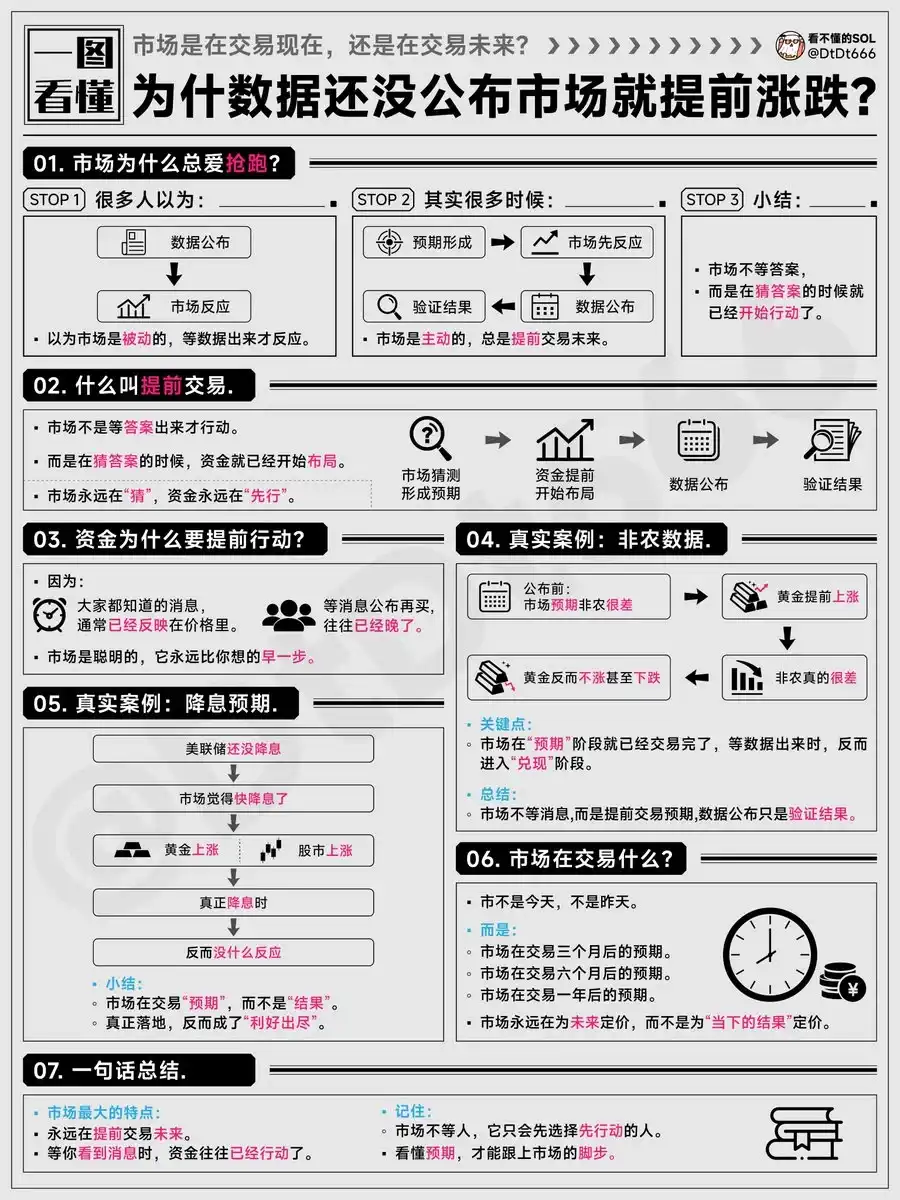
Pourquoi, bien souvent, les marchés fluctuent-ils avant même la publication des données ?

Parce que les marchés ne tradent jamais uniquement le « résultat » ; la plupart du temps, ils tradent l'« anticipation ».

Beaucoup de gens comprennent le marché ainsi :

Les données sont publiées, le marché les voit, puis commence à réagir.

Mais le véritable marché fonctionne rarement ainsi.

Les capitaux vraiment sensibles agissent rarement en attendant la réponse. Ils évaluent d'abord : comment la politique pourrait évoluer, où les capitaux pourraient se diriger, comment l'ambiance risque de tourner.

Une fois l'anticipation formée, les prix bougent en premier.

Par exemple, si le marché pense que la Fed va bientôt baisser ses taux, l'or, les actions de croissance, le BTC pourraient anticiper ce mouvement. Mais le jour où la baisse effective des taux a lieu, le marché peut être plat, voire corriger.

Ce n'est pas que la bonne nouvelle est inutile.

C'est que cette bonne nouvelle a déjà été tradée dans la phase de hausse précédente.

Il en va de même pour les chiffres de l'emploi américain (NFP).

Si, avant la publication, le marché anticipe déjà une détérioration de l'emploi, l'or et les obligations peuvent monter par anticipation. Si les NFP sont effectivement mauvais, l'or ne continuera pas forcément de grimper.

Car pour le marché, ce n'est pas une « nouvelle information », mais simplement une « confirmation ».

C'est pourquoi on voit souvent :

Une bonne nouvelle sort, pas de hausse.

Une mauvaise nouvelle sort, pas de baisse.

Beaucoup pensent alors que le marché est irrationnel.

En réalité, le marché n'est pas fou, il a simplement pris de l'avance sur l'information.

L'endroit où les investisseurs particuliers perdent le plus facilement de l'argent, c'est quand ils ne regardent que les titres des actualités.

Ils achètent à la bonne nouvelle, vendent à la mauvaise.

Mais la vraie question à se poser est :

Le marché avait-il anticipé cette nouvelle ?

Les capitaux l'avaient-ils déjà tradée par anticipation ?

Est-on au début de la valorisation, ou déjà en phase de réalisation des gains ?

Le marché ne trade pas aujourd'hui, il trade toujours l'avenir.

Derrière les hausses et les baisses des prix, il y a des capitaux qui parient en permanence sur ce qui va se passer ensuite.

Pour observer le marché, il ne faut donc pas se contenter de regarder « ce qui s'est passé ».

Il faut surtout regarder :

Ce que les gens pensaient qu'il allait se passer.

Si le résultat est supérieur ou inférieur à ces attentes.

Si les capitaux continuent de valoriser cette anticipation, ou commencent à prendre leurs bénéfices.

Beaucoup de mouvements de marché semblent irrationnels parce que vous regardez le résultat, alors que le marché trade l'écart par rapport aux anticipations.

En résumé :

Le marché n'attend pas la réponse.

Le marché choisit par avance l'avenir auquel il croit.

Quand vous voyez l'information, les capitaux agissent souvent depuis longtemps.
Trending Cryptos

Related Questions

QPourquoi les marchés financiers réagissent-ils souvent avant la publication des données officielles ?

AParce que les marchés ne tradent pas seulement les "résultats", mais principalement les "anticipations". Les capitaux sensibles agissent en fonction de ce qu'ils pensent qu'il va se passer, comme des changements de politique ou des flux de capitaux, ce qui fait bouger les prix avant même l'annonce.

QQuel est un exemple concret d'un actif réagissant à des anticipations ?

APar exemple, si le marché anticipe une baisse des taux de la Fed, l'or, les actions de croissance et le BTC peuvent monter en anticipation. Le jour où la baisse est annoncée, le marché peut stagner ou corriger, car la nouvelle a déjà été "tradée".

QComment expliquer qu'une bonne nouvelle puisse ne pas faire monter les prix ?

ASi une bonne nouvelle était largement anticipée par le marché, elle a déjà été intégrée dans les prix. À son annonce, il n'y a pas de "nouvelle" surprise pour déclencher un mouvement, c'est simplement une confirmation. Les investisseurs peuvent même vendre pour réaliser leurs bénéfices.

QQuelle erreur les investisseurs débutants commettent-ils souvent face aux nouvelles ?

AIls ont tendance à réagir uniquement aux titres des actualités, en achetant à la bonne nouvelle et en vendant à la mauvaise. Ils ne se demandent pas si cette information était déjà attendue et si le marché l'avait déjà anticipée dans les prix.

QSur quoi doit se concentrer un investisseur pour mieux comprendre les mouvements du marché ?

AIl doit se concentrer sur l'"écart d'anticipation" : évaluer ce que le marché anticipait, si les résultats sont meilleurs ou pires que prévu, et si les capitaux sont en train de continuer à intégrer cette nouvelle ou s'ils commencent à prendre leurs bénéfices.

Related Reads

Reviewing 8 'Cash Cow' Projects in the Bear Market: The Leader Repurchased $283 Million Worth This Year

This article highlights eight cryptocurrency projects that have demonstrated strong cash-generating capabilities and implemented significant token buyback programs during the bear market of 2026. These projects, dubbed "cash cows," are repurchasing their own tokens, often reducing supply. According to data from Tokenomist, the projects with notable buyback activity from January 1st to June 30th are: Meteora (MET), Pump.fun (PUMP), GMX, Rollbit (RLB), Metaplex (MPLX), Hyperliquid (HYPE), Lighter (LIT), and Aave. Notably, MET's buybacks equaled 71% of its January token supply, while HYPE executed the largest buyback by value at $283 million. Key project summaries include: - **Hyperliquid (HYPE):** The leader by dollar value, its perpetual DEX protocol has repurchased and burned 44 million HYPE tokens (approx. 4.4% of supply) using a significant portion of trading fees, with total buybacks exceeding $1.1 billion since March 2025. - **Meteora (MET):** Its buyback of 336.2 million MET tokens had the greatest proportional impact on its circulating supply, equivalent to 71% of its supply at the start of the year. - **Pump.fun (PUMP):** The popular memecoin launchpad has cumulatively bought back over $400 million worth of PUMP since July 2025, using 50% of net revenue for buybacks and burns since April. - **Aave (AAVE):** Despite facing a major security incident earlier in the year, the lending protocol has continued its buyback program, repurchasing over 200,000 AAVE tokens. Its team is designing a new automated buyback mechanism. - **GMX, Lighter (LIT), Rollbit (RLB), and Metaplex (MPLX)** also have active buyback mechanisms funded by protocol fees or revenues. The article concludes that while token buybacks and burns do not guarantee price appreciation—as market conditions, news, and other factors play a role—these projects stand out for their ability to generate consistent cash flow in a challenging market environment.

marsbit19m ago

Reviewing 8 'Cash Cow' Projects in the Bear Market: The Leader Repurchased $283 Million Worth This Year

marsbit19m ago

Ethereum Sheds Its Load? What Ethereum Supporters Think About the Lean Ethereum Upgrade and the Future Market

Ethereum is back in focus with the announcement of the "Lean Ethereum" upgrade roadmap, described by Vitalik Buterin as Ethereum's third major update. This proposal aims to fundamentally redesign the consensus, data, and execution layers from first principles, striving to make Ethereum **simpler, more secure (quantum-resistant), more verifiable, and more scalable.** The announcement comes amidst a broader restructuring within the ecosystem, including a 20% staff reduction at the Ethereum Foundation and the emergence of new organizations like EthLabs. This has sparked a debate among Ethereum supporters ("E-bizens"). **Optimists** view Lean Ethereum as a critical refocusing on core protocol fundamentals: * **sassal.eth** calls it the ultimate bullish catalyst, envisioning a future where running a node is so lightweight it could be done on a smartwatch, greatly enhancing decentralization. * **Ryan Sean Adams** sees it as Ethereum moving from "narrative expansion" to "protocol hardening," addressing long-term foundational issues like security and scalability. * Analysts like **BITWU** and **蓝狐 (Blue Fox)** frame it as a third-phase evolution towards a "minimal, durable, and credible base layer" designed for the next decade. * **gigi发财猪** interprets the organizational changes as Ethereum "shedding old baggage and forming new teams" for a lighter, more agile approach. * **Xiyu** notes that the roadmap itself provides a much-needed new narrative for market sentiment recovery. **Cautious voices** acknowledge the vision but emphasize execution and market timing: * **Ignas** warns that while the roadmap addresses key community requests, it overlooks tokenomics, and competitors are gaining ground in areas like RWA. Timely delivery is crucial; delays could be bearish. * **Dankrad Feist**, a former Ethereum Foundation researcher, agrees on direction but criticizes the proposed 3-4 year timeline as too slow for the current market pace, especially with AI-aided development available. **In summary,** optimists believe Lean Ethereum reaffirms Ethereum's long-term value proposition as a decentralized world computer, while the cautious argue that its success hinges on faster delivery and tangible results to maintain market relevance. Despite ongoing criticism, the move signals Ethereum's effort to regroup and reclaim initiative at the protocol level.

marsbit1h ago

Ethereum Sheds Its Load? What Ethereum Supporters Think About the Lean Ethereum Upgrade and the Future Market

marsbit1h ago

AI Folding: Fable 5 and GPT-5.6 Are Becoming the Privilege of a Few

【AI Accessibility Gap Widens: Elite Tools Like Fable 5 and GPT-5.6 Are Becoming Privileged】 We are witnessing a growing "AI divide." A stark reality is emerging: a tiny fraction of elites, primarily in tech, are using powerful next-generation models like Fable 5 or the upcoming GPT-5.6, while the vast majority of the public only has access to "toys" - free, limited models equivalent to ChatGPT's basic versions (8B to 30B parameters). This creates a massive experiential chasm and cognitive dissonance. Industry outsiders see AI as overhyped and ineffective, unable to grasp its transformative potential, while insiders leverage these advanced models for a decisive competitive edge. The gap isn't just about model quality but product functionality. Free users get a simple chatbot. Paying elites get integrated workflow systems—capable of creating specialized agents, processing complex data, and handling real-world tasks like management, coding, and planning. Demos showcasing AI planning weddings or building apps feel disconnected from everyday needs like managing bills, groceries, or health. The cost barrier is immense, with reports of engineers spending $1000 daily on Fable 5 inference. Elite users employ sophisticated multi-model workflows, combining different AIs for ideation, architecture, execution, and review, completing complex projects in minutes instead of weeks. This divide extends to critical areas like healthcare, where free models are dangerously unreliable for medical queries. However, some argue that for 90% of common business tasks, mid-tier models like GPT-5.5 are sufficient; the perceived limitation often stems from poor integration and lack of context, not model intelligence. Ultimately, unequal access to cutting-edge AI is creating a new form of social stratification, where the most powerful tools are becoming the exclusive privilege of a few.

marsbit1h ago

AI Folding: Fable 5 and GPT-5.6 Are Becoming the Privilege of a Few

marsbit1h ago

Cathie Wood's June $77M Investment: Are Crypto Stocks a True 'Substitute' for Bitcoin?

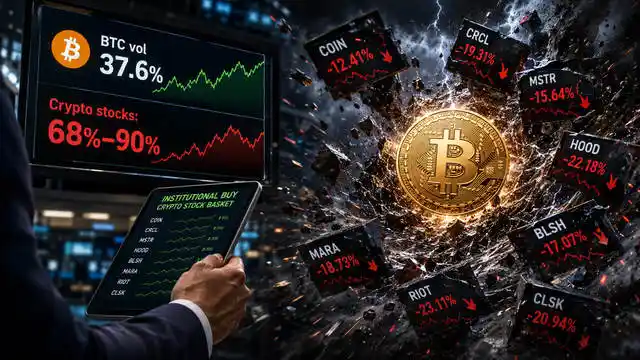
In June, Cathie Wood's ARK Invest purchased $77 million worth of publicly traded crypto-related stocks, including Coinbase, Circle, and Bullish, during Bitcoin's worst monthly performance in four years. This aligns with the investment thesis that such stocks offer a compliant way to gain exposure to the crypto cycle without directly holding Bitcoin. However, data analysis reveals significant drawbacks. A group of nine U.S.-listed crypto companies showed 30-day annualized realized volatility between 68% and 90%, nearly double Bitcoin's 37.6%. Over 90 days, Circle's volatility reached 103.6% versus Bitcoin's 37.8%. Drawdowns were also more severe for stocks like Circle (-51.4%) and MicroStrategy (-48.6%) compared to Bitcoin's -36.4% from its January high. Correlation analysis shows most stocks share only a moderate link to Bitcoin. For example, Circle, Robinhood, and Bullish have a 90-day correlation coefficient of just 0.55–0.58 with BTC, meaning only about one-third of their price movement is explained by Bitcoin's action. The rest stems from company-specific risks: earnings, competition, fundraising, and equity dilution. MicroStrategy (MSTR) is the notable exception, acting as a leveraged Bitcoin proxy with a beta of 1.59 and 0.85 correlation. Coinbase offers relatively balanced exposure. Circle exemplifies "crypto-wrapped" corporate risk, with its recent crash tied to stablecoin competition, not Bitcoin. Robinhood's diversified business insulates it from crypto downturns but also limits upside. Bitcoin miners like RIOT and MARA have posted significant gains year-to-date, driven primarily by their pivot to AI compute services, not Bitcoin's price. The article highlights that investing in crypto stocks often means accepting amplified volatility or layering on business-specific risks absent from direct Bitcoin ownership. For instance, MicroStrategy's recent challenges—its market value falling below its Bitcoin holdings (mNAV <1) and facing potential Bitcoin sales for liquidity—demonstrate equity-specific hazards like dilution and financing pressures not faced by a direct Bitcoin holder. ARK's buying spree represents a bet on a basket of different business models with varying crypto exposure, not a simple, lower-risk substitute for holding Bitcoin.

marsbit1h ago

Cathie Wood's June $77M Investment: Are Crypto Stocks a True 'Substitute' for Bitcoin?

marsbit1h ago

Trading

Spot

Hot Articles

Discussions

Welcome to the HTX Community. Here, you can stay informed about the latest platform developments and gain access to professional market insights. Users' opinions on the price of SOL (SOL) are presented below.

活动图片