¿Alcanzará el precio de JUP los 0,28 dólares impulsado por estos TRES catalizadores?

ambcryptoPublished on 2026-07-02Last updated on 2026-07-02

Abstract

Jupiter (JUP) ha subido más de un 15% en 24 horas, superando a Bitcoin y al mercado general, con un volumen de trading diario que aumentó un 72% hasta los 48 millones de dólares. Este repunte se debe principalmente a tres factores clave: la integración de su stablecoin, JupUSD, como activo custodiado en Jupiter Liquidity Provider (JLP), lo que facilita una transición planificada de 500 millones de USDC; los rumores sobre el desarrollo de su propio "Omnichain Ledger"; y las compras acumulativas de su fondo de reserva estratégico, que ha adquirido millones de tokens JUP, reduciendo la oferta en circulación tras varias quemas de tokens. En el análisis técnico, JUP intenta recuperar un nivel de soporte clave en la línea de tendencia, cotizando actualmente por encima de 0,24 dólares. Para confirmar un cambio de tendencia alcista a corto plazo, el precio necesita establecer una base sólida por encima de este nivel y superar la resistencia en 0,28 dólares, un movimiento que podría verse apoyado por la presión compradora actual en el mercado.

Jupiter [JUP] está en las noticias hoy tras subir más de un 15% en las últimas 24 horas, superando tanto a Bitcoin [BTC] como al mercado cripto en general. Su volumen diario de negociación también se disparó un 72%, alcanzando los 48 millones de dólares.

Pero eso no es todo, ya que el agregador de DEX de Solana [SOL] parecía estar al alza por este margen debido también a un par de factores. Por lo tanto, vale la pena examinar los detalles más finos aquí.

3 catalizadores detrás del rally de dos dígitos de Jupiter

Para empezar, Jupiter añadió su propia stablecoin, JupUSD, a Jupiter Liquidity Provider (JLP) como activo en custodia. Este paso hace posible la transición planificada de 500 millones de dólares de USDC a JupUSD dentro del pool de perps de Jupiter.

JupUSD es ahora el sexto activo después de Solana [SOL], Bitcoin [BTC], Ethereum [ETH], USDC y USDT. Como tal, la adición de la stablecoin significa más liquidez en el exchange.

Esto ha reavivado aún más las conversaciones sobre que Jupiter está construyendo su propio Libro Mayor Omnicadena (Omnichain Ledger). Este movimiento refleja el crecimiento de Jupiter desde 2021, pasando de ser un agregador de swaps a un sistema completo de finanzas on-chain. De hecho, Jupiter impulsa más del 80% de la liquidez minorista total en movimiento en Solana.

Aunque eso no es todo. El Fondo de Reserva Estratégico de Jupiter, Litterbox Trust, está creando presión compradora en el mercado y reduciendo la oferta.

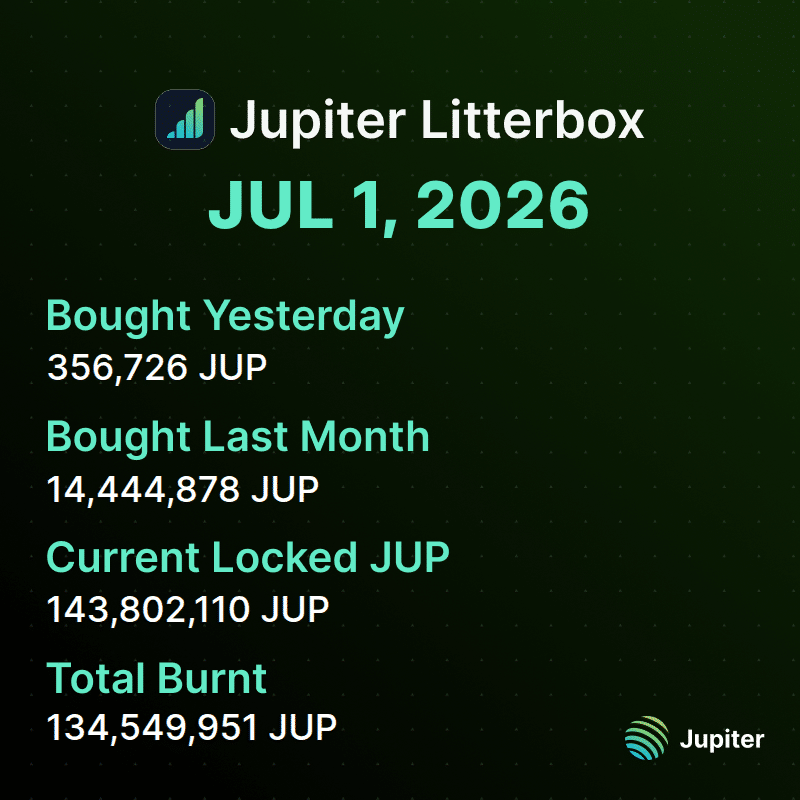
Solo en las últimas 24 horas, la reserva estratégica añadió 356.726 JUP. Esto, además de los 14,44 millones de JUP comprados el mes pasado, lleva el total de tokens JUP bloqueados a 143,8 millones.
Fuente: X

En cuanto a la tokenómica de la oferta, se han quemado aproximadamente 134,55 millones de JUP en total como resultado de los esfuerzos de la reserva.

Este es un gran paso hacia la reducción de la oferta total del token después de que se quemaran 3.000 millones de tokens en enero de 2025. La oferta total de la altcoin ahora está por debajo de los 7.000 millones, frente a los 10.000 millones anteriores.

¿Ha recuperado JUP el nivel de soporte de línea de tendencia perdido?

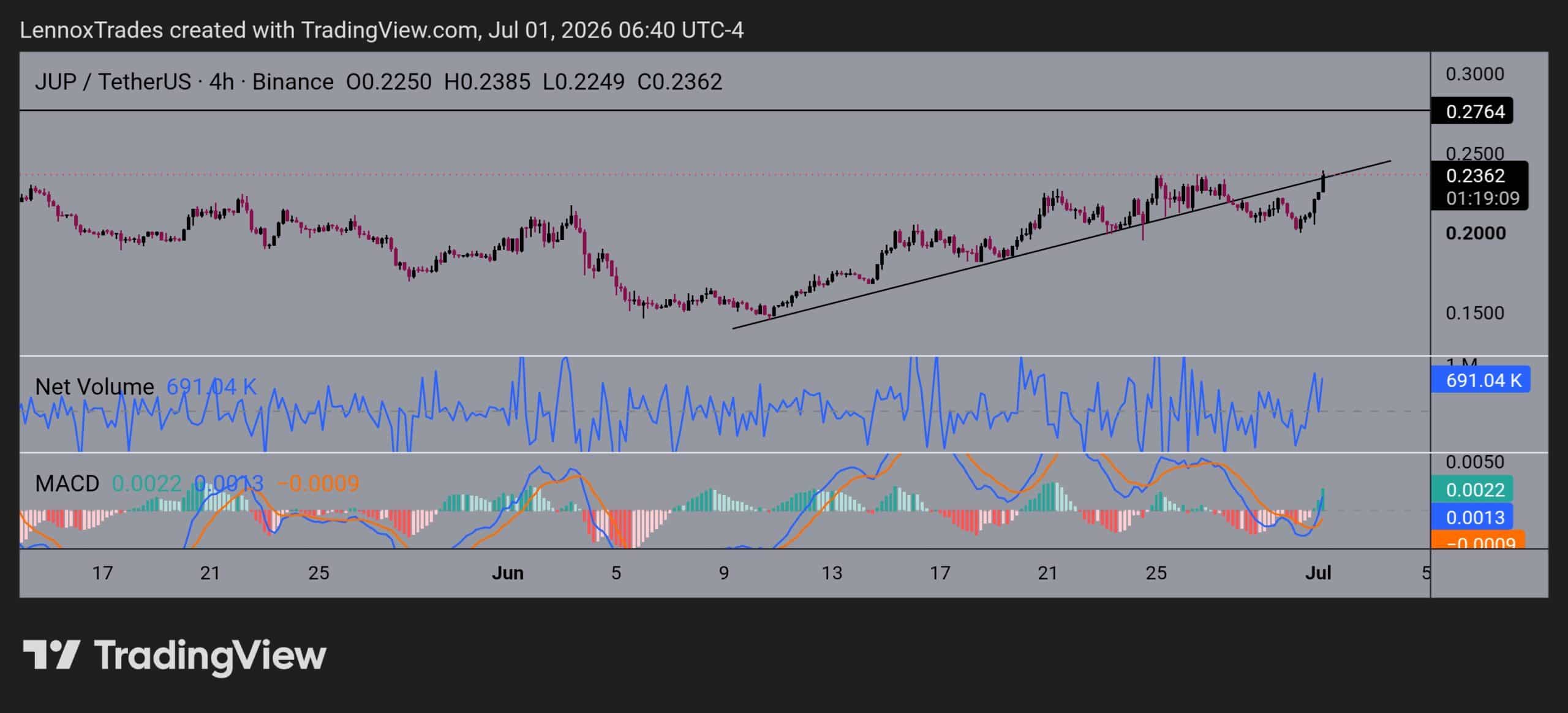
JUP mostró una fuerza similar en el gráfico de 4 horas, al intentar recuperar el nivel de soporte de línea de tendencia perdido. La altcoin ha cotizado por encima de la línea de tendencia durante la mayor parte de junio, pero se perdió en los últimos cinco días del mes.

Al cierre de esta edición, el precio de JUP estaba por encima de este nivel. Sin embargo, aún no había creado una base por encima de él para confirmar un cambio real. Si el precio se mantiene por encima de la resistencia menor en 0,24 dólares, podría significar que la altcoin podría avanzar hacia los 0,28 dólares.

Este escenario probablemente también pueda ser respaldado por la presión compradora del mercado. De hecho, el Volumen Neto reveló que se compraron más de 800.000 JUP en el día mientras los toros recuperaban el impulso del mercado.
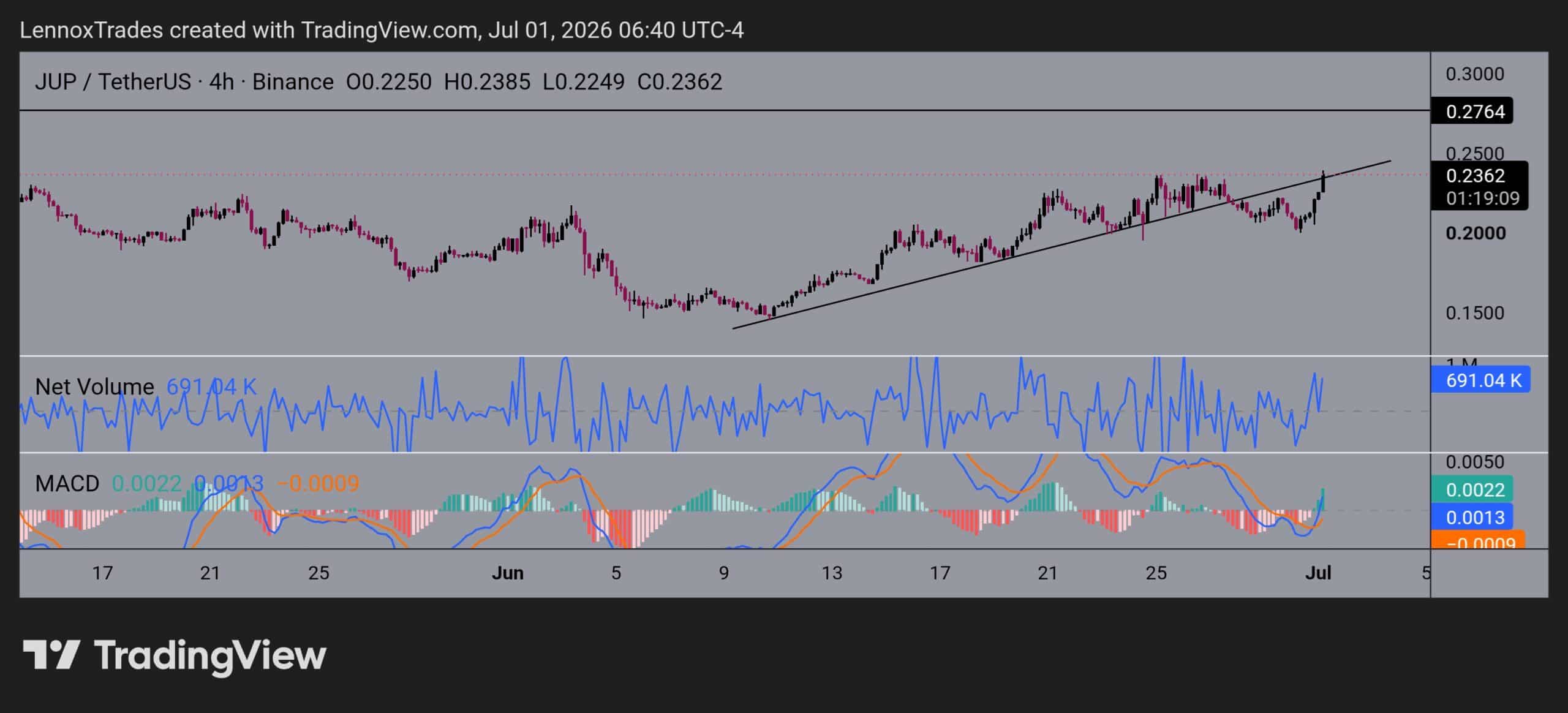
Fuente: JUP/USDT en TradingView

En resumen, convertir la resistencia en soporte significaría un cambio de tendencia a corto plazo. De lo contrario, el fracaso extendería la estructura bajista que había comenzado a formarse.


Resumen Final

  • Jupiter subió más de un 15% tras la integración de JupUSD en JLP, las conversaciones sobre su propio Libro Mayor Omnicadena y la acumulación de su reserva estratégica.
  • La acción del precio de JUP recuperó su nivel de soporte de línea de tendencia perdido, pero al cierre de esta edición aún no había formado un nivel base.


Trending Cryptos

Related Questions

Q¿Cuáles son los tres factores (catalizadores) principales que impulsaron el fuerte repunte de JUP según el artículo?

ASegún el artículo, los tres catalizadores son: 1) La adición de su stablecoin JupUSD al grupo de activos de custodia de Jupiter Liquidity Provider (JLP), lo que facilita la transición planificada de 500 millones de USDC a JupUSD. 2) Las conversaciones sobre el desarrollo de su propio "Omnichain Ledger", reflejando su expansión desde un agregador de swaps. 3) La acumulación de tokens JUP por parte del fondo de reserva estratégica "Litterbox Trust", lo que crea presión compradora y reduce la oferta circulante.

Q¿Qué impacto ha tenido la reserva estratégica de Jupiter (Litterbox Trust) en la oferta de tokens JUP?

ALa reserva estratégica Litterbox Trust ha creado presión compradora y ha reducido la oferta de JUP. Solo en las últimas 24 horas analizadas, añadió 356,726 JUP, sumándose a los 14.44 millones comprados el mes anterior, con un total de 143.8 millones de tokens JUP bloqueados. Además, sus esfuerzos han contribuido a la quema de aproximadamente 134.55 millones de JUP, reduciendo aún más la oferta total por debajo de los 7 mil millones de tokens.

Q¿Cómo se comportó JUP en términos de precio y volumen en las últimas 24 horas mencionadas en el artículo?

AEn las últimas 24 horas analizadas por el artículo, el precio de JUP subió más de un 15%, superando el rendimiento tanto de Bitcoin (BTC) como del mercado de criptomonedas en general. Además, su volumen de negociación diario aumentó un 72%, alcanzando los 48 millones de dólares.

Q¿Cuál es el nivel de precio clave que JUP necesita mantener para que el artículo considere posible un movimiento hacia 0.28 dólares?

AEl artículo señala que, en el momento de su publicación, JUP necesitaba mantener su precio por encima del nivel de resistencia menor de 0.24 dólares. Si lograba convertir esa resistencia en soporte, podría significar un cambio de tendencia que abriría la puerta a un posible impulso hacia el nivel de 0.28 dólares.

Q¿Qué papel desempeña JupUSD dentro del ecosistema de Jupiter según la información proporcionada?

AJupUSD es el stablecoin nativo de Jupiter. Su reciente integración como un activo de custodia en Jupiter Liquidity Provider (JLP) es un paso clave para permitir la transición planificada de 500 millones de USDC a JupUSD dentro del grupo de perps (contratos perpetuos) de Jupiter. Como el sexto activo en JLP (después de SOL, BTC, ETH, USDC y USDT), su adición aporta más liquidez al intercambio.

Related Reads

Grayscale: Zcash, Financial Privacy in the Age of AI

Grayscale Research suggests a third wave of public focus on financial privacy is approaching, driven by stablecoin/blockchain adoption and new AI-powered surveillance tools. In this context, Zcash emerges as a decentralized digital currency, similar to Bitcoin but with built-in, robust privacy mechanisms via its "shielded" transactions that conceal sender, receiver, and amount using zero-knowledge proofs. While privacy is often seen as a niche feature, it is argued to be a core requirement for functional money, needed by individuals and businesses alike. Zcash's optional privacy is distinct from mixers or default-private chains like Monero. After years of development (Sapling, Orchard/NU5, Ironwood upgrades) to improve usability, key metrics show growing adoption: shielded transactions comprise ~90% of network activity, and ~25% of circulating ZEC is in shielded pools—a historical high. Despite this, ZEC's market valuation remains low (~0.6% of the "digital currency" sector), implying the market prices privacy as a marginal concern. The investment thesis hinges on a potential re-rating if the value of financial privacy is recognized more broadly. Risks include regulatory challenges around shielded transactions, legacy trusted setup pools, quantum computing threats, and execution risks for upcoming upgrades like Tachyon for scaling. In summary, Zcash represents a significant, technologically mature option in the privacy currency space, with current valuation offering potential upside if privacy demand grows.

marsbit38m ago

Grayscale: Zcash, Financial Privacy in the Age of AI

marsbit38m ago

The Bear Market Has Ended, A New Bull Cycle Has Begun

**Title: Bear Market Over, New Bull Cycle Begins** Bitcoin surged over 20% in just three days, from a low of $64,100 on August 19th to a high of $79,500 by August 21st, marking a dramatic shift in market sentiment. This rapid rise triggered massive liquidations exceeding $4 billion, with short positions accounting for $3.7 billion—the largest short squeeze since 2021. The rally was fueled by several key factors. Macroeconomic conditions improved as the US Treasury doubled its long-term bond buyback size, easing pressure. Significant regulatory developments included a White House meeting where former President Trump urged Senate action on the CLARITY Act and hinted at potential US Bitcoin reserves, followed by the CFTC Chairman stating the agency would establish crypto market rules if the bill stalls. On-chain data revealed a fierce battle: large whales faced substantial liquidations on short positions, while others took profits or doubled down on longs. Major altcoins like ETH and XRP also saw impressive gains. Analysts are divided but increasingly bullish. Many, including CryptoQuant's founder, declare the bear market over and a new bull cycle begun. Price targets range from $100k by year-end to ambitious long-term projections of $200k. However, some caution against immediate chasing, noting overbought conditions and viewing the move as a potential "trap" ahead of the crucial September 15th Senate vote on the CLARITY Act. The market's next test is sustaining the momentum with real buying pressure, holding above key resistance near $78k-$80k, and watching ETF inflows and the upcoming regulatory vote.

marsbit43m ago

The Bear Market Has Ended, A New Bull Cycle Has Begun

marsbit43m ago

Xiaomi Defended Its Smartphone Gross Margin, Yet to Find a Profit Successor

Xiaomi's Q2 2026 financial report reveals a company navigating a complex transition. While smartphone gross margin held steady at 8.5% through strategic product mix and a record-high average selling price (ASP), this came at the cost of a 26.5% year-over-year decline in global shipments, pressuring its core user acquisition engine. This illustrates Xiaomi's central challenge: managing the "timing gap" between its established and emerging growth engines. Its smartphone business is pivoting from scale to premiumization, but it's unclear if high-end models can fully offset the volume loss from more price-sensitive segments, especially in markets like India and Africa. Meanwhile, the electric vehicle segment has become a significant revenue contributor, delivering 104,200 units and generating ¥23.9 billion. However, its profit contribution remains unclear as it, along with AI investments, is still in a scaling and investment phase. The AI and humanoid robot initiatives, though strategically prioritized and tested in Xiaomi's own factories, are in early-stage validation with no near-term commercialization timeline. Financially, the company remains stable, supported by a robust cash position and its high-margin internet services business, which hit a new high in monthly active users. Management emphasized continued heavy investment in AI, chips, and robotics to fuel the next growth cycle. The key question is whether these new engines—cars, AI, robotics—can achieve commercial scale and profitability before the smartphone engine's growth slows further.

marsbit43m ago

Xiaomi Defended Its Smartphone Gross Margin, Yet to Find a Profit Successor

marsbit43m ago

Is RWA Still Meaningful Without DeFi?

The article "Would RWA Still Matter Without DeFi?" argues that tokenizing real-world assets (RWA) alone, like putting a barcode on a container, is not transformative. True value emerges when these tokenized assets are integrated into decentralized finance (DeFi) ecosystems, enabling valuation, financing, hedging, trading, and loss management in a programmable, automated manner. Tokenization provides digital representation, but DeFi provides utility through leverage, liquidity, and composability. The core challenge lies in aligning the different "time clocks" of blockchain (fast, 24/7), traditional markets (limited hours), and asset redemption (slow processes), which creates liquidation risks and gaps. Effective RWA integration requires more than a token; it needs a full stack: legally enforceable rights, reliable data oracles, clear transfer rules, executable secondary liquidity, appropriate collateral parameters, and credible loss resolution paths. Liquidity is defined not by total value locked (TVL) but by the ability to exit a position under stress within a required timeframe. Risk management for RWAs must be modeled as a dependency graph, monitoring interconnected nodes like issuers, custodians, oracles, and liquidity pools for early warning signs beyond just price data. While tokenized government bonds serve as an initial "ping test," the future lies in more complex assets like computing power and energy, which require bespoke risk models. Tokenized stocks paired with perpetual futures present a major test, combining global equity ownership with crypto-native leverage, necessitating robust architectural safeguards like isolation and dynamic collateral rules. The conclusion is that without DeFi, RWA tokenization offers limited value—improving distribution and transparency. The significant opportunity arises when tokenized assets become functional components within open, programmable capital markets, where they can be used as collateral and facilitate complex financial strategies. The token is merely the barcode; the market operating system is the real machine.

marsbit1h ago

Is RWA Still Meaningful Without DeFi?

marsbit1h ago

Trading

Spot

Hot Articles

How to Buy JUP

Welcome to HTX.com! We've made purchasing Jupiter (JUP) simple and convenient. Follow our step-by-step guide to embark on your crypto journey.Step 1: Create Your HTX AccountUse your email or phone number to sign up for a free account on HTX. Experience a hassle-free registration journey and unlock all features.Get My AccountStep 2: Go to Buy Crypto and Choose Your Payment MethodCredit/Debit Card: Use your Visa or Mastercard to buy Jupiter (JUP) instantly.Balance: Use funds from your HTX account balance to trade seamlessly.Third Parties: We've added popular payment methods such as Google Pay and Apple Pay to enhance convenience.P2P: Trade directly with other users on HTX.Over-the-Counter (OTC): We offer tailor-made services and competitive exchange rates for traders.Step 3: Store Your Jupiter (JUP)After purchasing your Jupiter (JUP), store it in your HTX account. Alternatively, you can send it elsewhere via blockchain transfer or use it to trade other cryptocurrencies.Step 4: Trade Jupiter (JUP)Easily trade Jupiter (JUP) on HTX's spot market. Simply access your account, select your trading pair, execute your trades, and monitor in real-time. We offer a user-friendly experience for both beginners and seasoned traders.

3.8k Total ViewsPublished 2024.03.29Updated 2026.06.02

How to Buy JUP

Discussions

Welcome to the HTX Community. Here, you can stay informed about the latest platform developments and gain access to professional market insights. Users' opinions on the price of JUP (JUP) are presented below.

活动图片