Karpathy vuelve a ser un dios, revoluciona el RAG y convierte tus notas en un segundo cerebro

marsbitPublished on 2026-07-01Last updated on 2026-07-01

Abstract

Karpathy ha lanzado una idea revolucionaria: tratar tus notas como código fuente inmutable y dejar que un LLM actúe como compilador. Su propuesta, LLM-WIKI, cambia radicalmente la gestión del conocimiento personal. Mientras que RAG (Recuperación Aumentada por Generación) solo busca fragmentos y produce respuestas inconsistentes, el método de Karpathy "compila" toda la información en un Wiki estructurado y coherente. El sistema se organiza en tres capas: 1. **Raw (Material crudo):** Notas originales e inmutables. 2. **Schema (Constitución del conocimiento):** Reglas definidas por el usuario (ej: cómo estructurar una entrada). 3. **Wiki (Producto compilado):** Base de conocimiento mantenida automáticamente por la IA. El proceso implica **Ingerir** nuevo contenido (actualizando múltiples páginas relacionadas), **Consultar** el Wiki compilado y realizar **Revisiones** periódicas para detectar contradicciones. Esto libera a las personas del agotador trabajo de mantener enlaces y consistencia, tareas que la IA realiza de forma impecable. Karpathy conecta esta idea con el "Memex" de Vannevar Bush (1945), una máquina para gestionar conocimiento mediante asociaciones. El obstáculo durante 80 años fue el costoso mantenimiento manual, un problema que los LLM resuelven ahora. Este enfoque representa la tercera pieza de la visión de Karpathy sobre colaboración humano-IA, liberando la atención humana para lo esencial: decidir qué aprender y dar significado al conocimiento. Tu cerebr...

Guardar no significa poseer, resaltar no significa comprender.

Esos profundos artículos que te emocionaron a las dos de la madrugada, esos enlaces bidireccionales densos que creaste en Obsidian, esas bases de datos cuidadosamente formateadas en Notion, todos son «momias cibernéticas» que yacen en las aplicaciones de notas.

Los gráficos de conocimiento parecen impresionantes, pero en realidad están podridos.

Este es el fracaso sistémico de toda la era de la sobrecarga de información.

El ingeniero actual de Anthropic, ex cofundador de OpenAI y ex director de IA de Tesla, Karpathy, no pudo soportarlo más y lanzó una bomba.
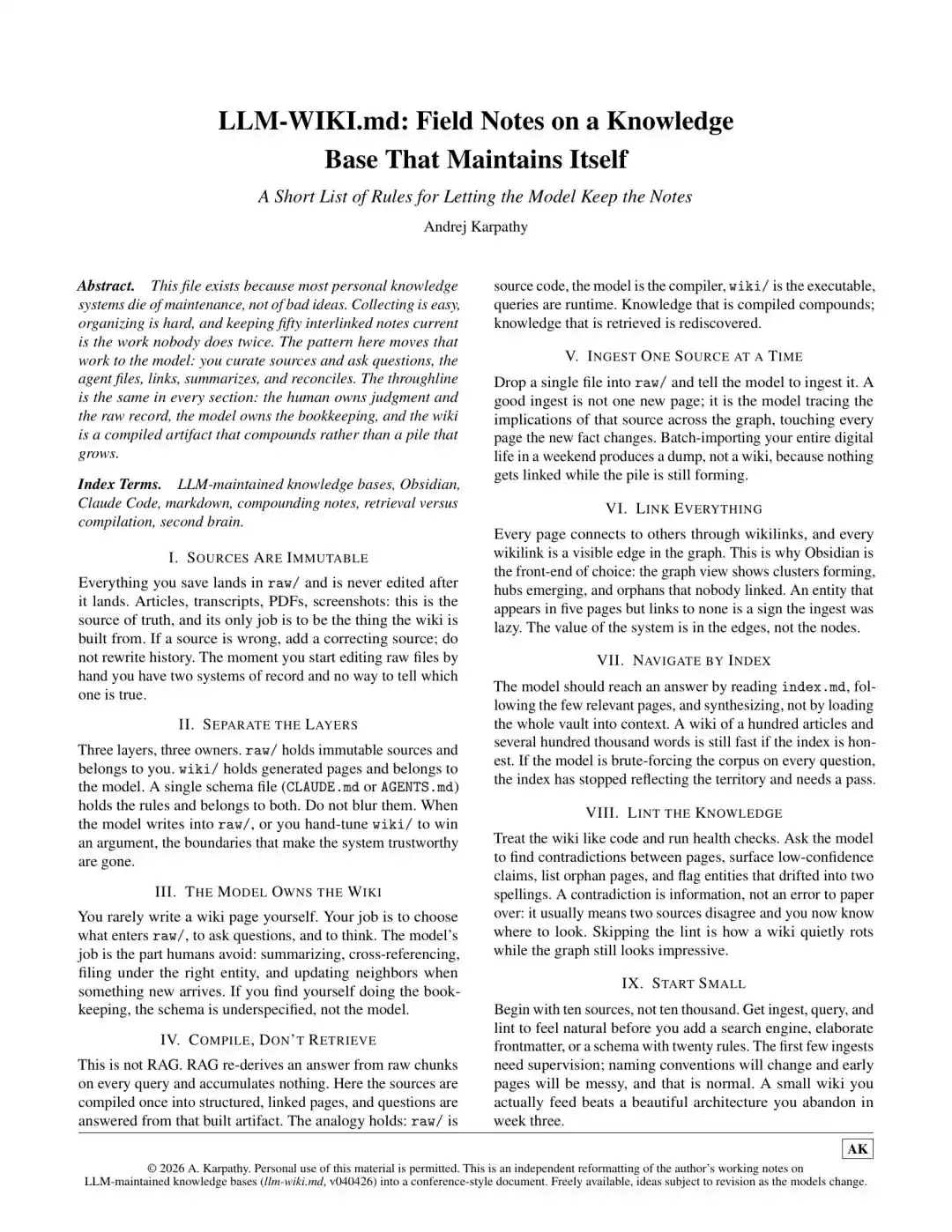
Portal: https://gist.github.com/karpathy/442a6bf555914893e9891c11519de94f

No anunció un nuevo modelo, ni publicó un nuevo framework. Simplemente dijo: trata tus notas como código fuente inmutable, deja que el LLM sea el compilador.

Dos meses después, este documento ha desencadenado una migración silenciosa pero intensa en las comunidades de Obsidian, Claude y Cursor.

Algunos ya han expandido su Wiki a cientos de páginas y cientos de miles de palabras.

Han comenzado a aparecer complementos de automatización. Investigadores académicos, emprendedores independientes y aprendices de por vida están cambiando colectivamente a una nueva forma de producción de conocimiento.

El ocaso del RAG, transportar información no salvará tu pensamiento

Antes de la aparición de LLM-WIKI, la solución principal era RAG (Generación Aumentada por Recuperación).

En pocas palabras, es darle al modelo grande un «buscador»: cuando haces una pregunta, busca algunos fragmentos en tus notas y luego los junta para dar una respuesta.
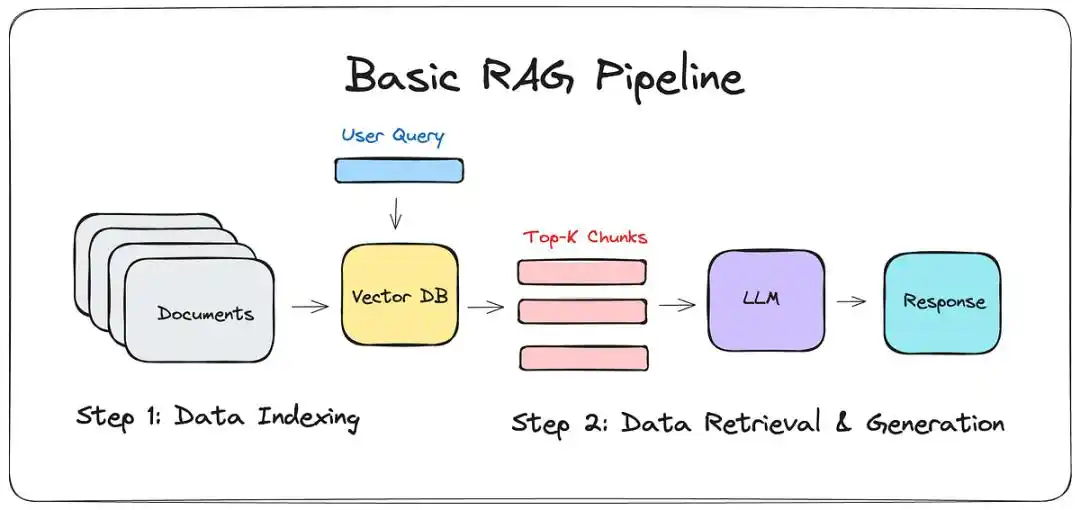
Suena hermoso, pero cualquiera que lo haya usado conoce la brecha entre la «muestra del vendedor» y lo que realmente recibe.

Es solo un transportista: RAG solo puede manejar partes, no puede entender el todo.

Puede decirte que la quinta nota menciona A, pero no puede decirte la lógica subyacente a la que apuntan estas 500 notas.

Sufre de «desdoblamiento de personalidad»: si hace seis meses creías que A era correcto, pero ayer escribiste una nota refutando A, RAG a menudo cae en contradicciones y produce un montón de tonterías lógicamente confusas.

Gráfico podrido: los enlaces de conocimiento mantenidos manualmente son como código sin limpieza automática. Con el tiempo, los enlaces rotos están por todas partes y la eficiencia de la recuperación disminuye exponencialmente.

La intuición de Karpathy es muy aguda: buscar y recuperar son manifestaciones de la incapacidad humana. Necesitamos «consenso», «estructura», «verdad».

Tratar el conocimiento como código fuente, dejar que el LLM sea el compilador

La respuesta de Karpathy proviene de una acción que un programador hace todos los días, pero nunca pensó aplicarla al conocimiento: compilar.

Escribes un código fuente, no lo relees cada vez que ejecutas el programa.

Lo compilas en un archivo binario. Compilar cuesta mucho una vez, pero cada ejecución posterior es extremadamente rápida. El costo de la compilación se distribuye entre miles de usos posteriores.

¿Por qué el conocimiento no puede funcionar así?

Karpathy dice: trata tus notas originales como código fuente inmodificable, deja que el LLM sea el compilador, y que «compile» de una vez todo ese material desordenado en una Wiki estructurada e interconectada.
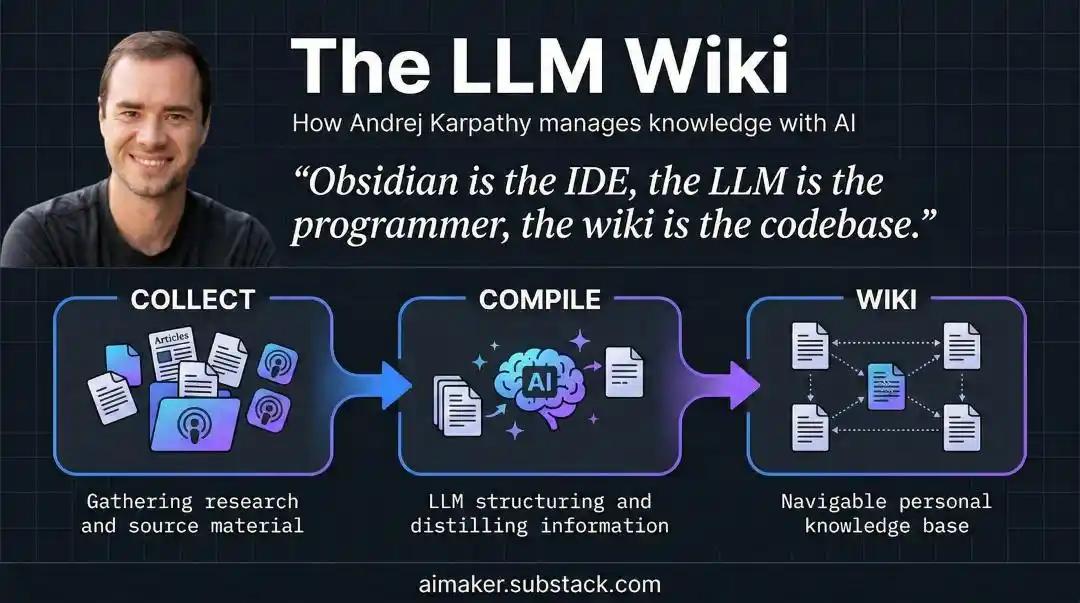
Cada vez que se agrega nuevo material, la IA realiza una fusión: actualiza las páginas de entradas relevantes, revisa las síntesis, marca los lugares donde los nuevos datos contradicen las conclusiones antiguas, y fortalece o desafía los juicios existentes.
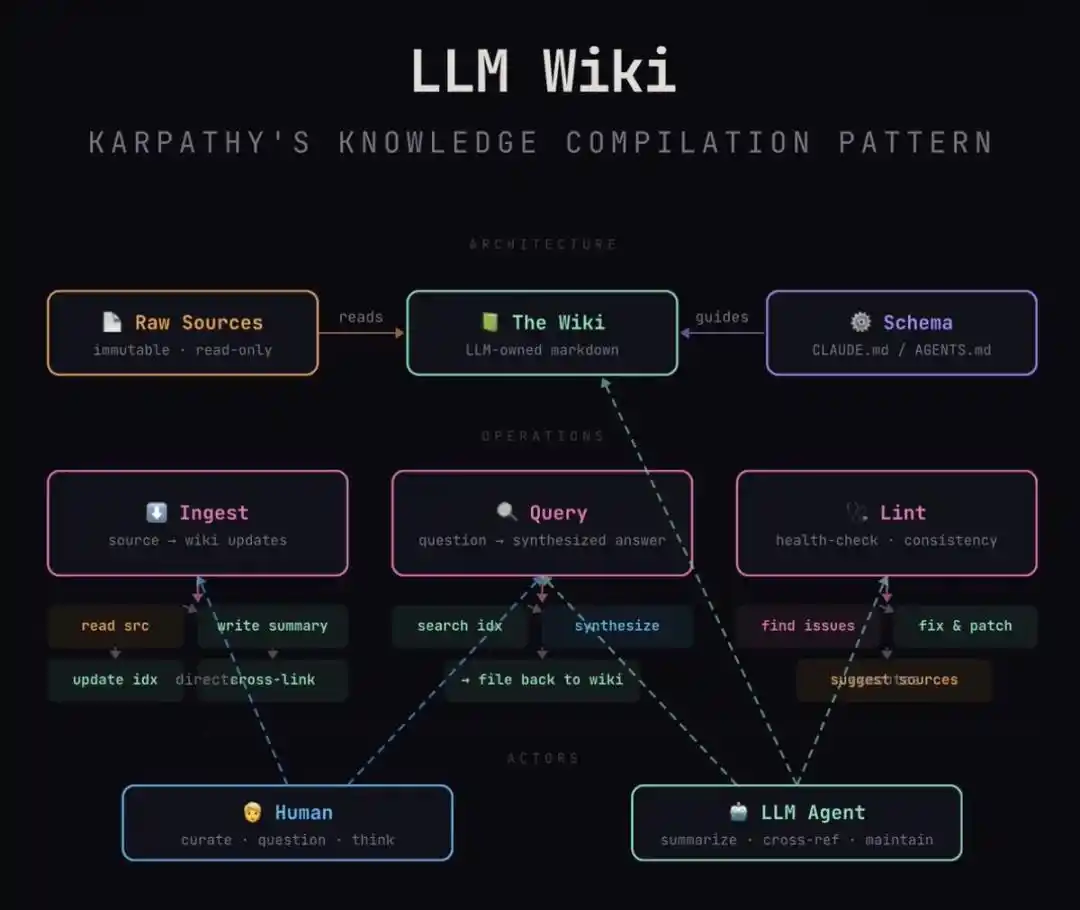
La diferencia clave está aquí: el conocimiento se compila una vez y luego se mantiene fresco continuamente, en lugar de reconstruirse temporalmente en cada consulta.

Cuando llegues con una pregunta, las referencias cruzadas ya estarán allí, las contradicciones ya habrán sido marcadas, las síntesis ya reflejarán todo lo que has leído.

No vuelves a compilar el código fuente cada vez que ejecutas el programa. Entonces, ¿por qué hacer que la IA relea todas tus notas cada vez que haces una pregunta?

La transferencia fundamental de la relación de producción cognitiva

En su framework LLM-WIKI, las notas ya no son texto muerto, sino «código fuente».

El modelo grande ya no es un traductor que busca en el diccionario, sino el «compilador».

Esta arquitectura logra ingeniosamente un desacoplamiento en tres capas:

1. Capa Raw (Material crudo): Este es tu mina de inspiración original. Las ideas que anotas al azar, los artículos recortados, las actas de reuniones. Es «inmutable», manteniendo la crudeza y desorden original de la entrada humana.

2. Capa Schema (Constitución del conocimiento): Estas son las «reglas» que le das a la IA. Por ejemplo, especificas: cada entrada de persona debe contener «motivación, limitaciones, logros clave»; cada stack tecnológico debe explicar «ventajas y desventajas».

3. Capa Wiki (Producto compilado): Esta es el área mantenida completamente por la IA. Según tu Schema, compila ese montón de Raw desordenado en páginas de enciclopedia estructuradas, con enlaces cruzados y lógicamente coherentes.
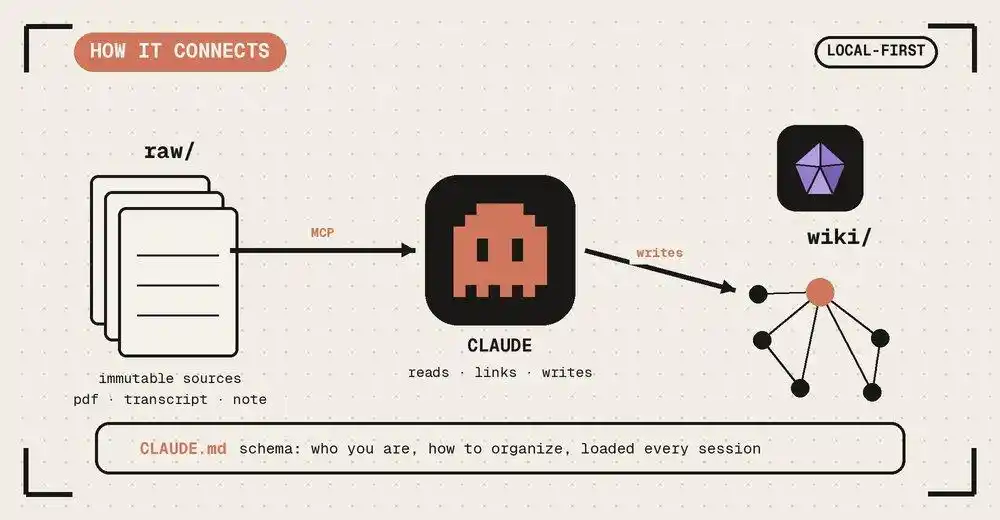
La rutina consta de tres acciones:

1. Ingesta: Lanza un nuevo material, la IA lo lee, repasa los puntos clave contigo, escribe un resumen, barre toda la base de datos actualizando las páginas relacionadas —una sola fuente puede afectar a una docena de páginas.

2. Consulta: Pregunta directamente a la Wiki compilada, responde con citas. Lo más ingenioso: las buenas respuestas pueden archivarse directamente como nuevas páginas, cada exploración también genera interés compuesto.

3. Lint (Revisión): Periódicamente, haz que la IA se autoinspeccione como en una revisión de código — busca contradicciones, afirmaciones obsoletas, páginas aisladas sin enlaces, lagunas que llenar. Límpialo temprano, no dejes que la base se pudra al crecer.

Ya no eres el transportista del conocimiento, sino el arquitecto de este imperio de sabiduría.

Solo te encargas de la entrada y la revisión final, la IA se encarga de todo el «trabajo pesado»: organizar, alinear, enlazar cruzadamente, detectar contradicciones.

Esta es la transferencia fundamental de la relación de producción cognitiva.

No es otro chatbot. ChatGPT conoce internet, LLM-Wiki te conoce a ti —o más precisamente, lo que le has enseñado.

Cada respuesta viene con [wiki-links] que te llevan de vuelta a tu gráfico de conocimiento. Cada respuesta es el inicio de una ruta de exploración, no el final.

Un invento con 80 años de retraso

Hasta aquí, podrías pensar que esto es solo un flujo de trabajo inteligente.

Es más que eso.

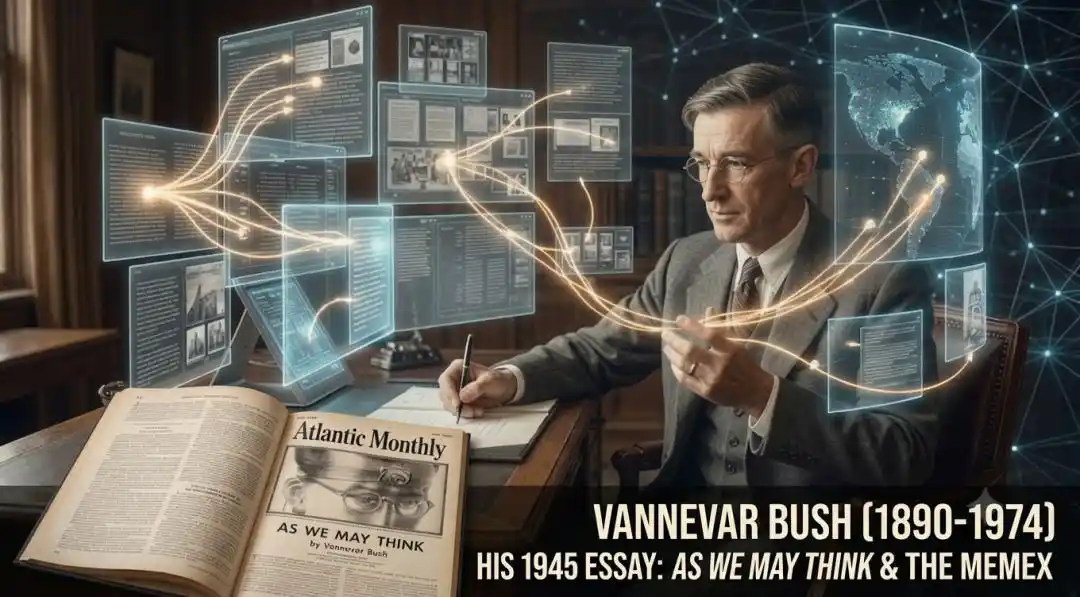
Al final del gist, Karpathy menciona ligeramente un nombre: Vannevar Bush, y su artículo de 1945 «As We May Think».
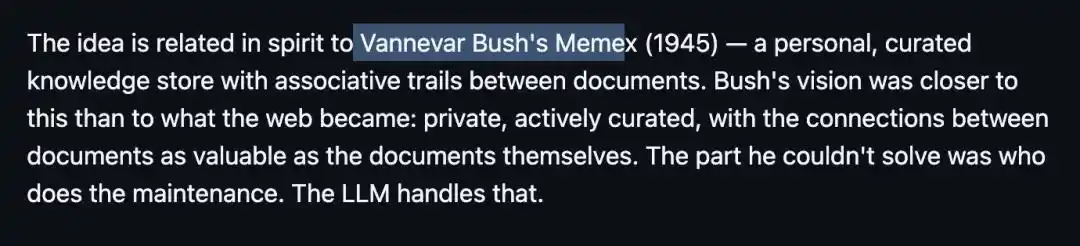
En 1945, justo después de la Segunda Guerra Mundial, este destacado científico estadounidense imaginó una máquina llamada «Memex»:

Un escritorio mecánico que podía almacenar todos tus libros, registros, correspondencia, y establecer «senderos asociativos» entre entradas relevantes — las conexiones entre documentos eran tan valiosas como los documentos mismos.
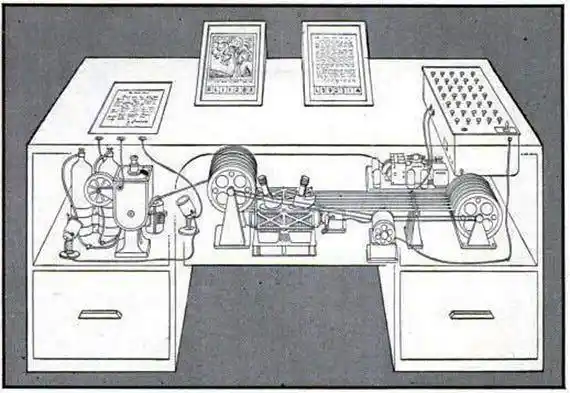
¿Suena familiar? Es casi una descripción palabra por palabra de LLM-Wiki.

La visión de Bush, de hecho, se acerca más a esto que a la posterior World Wide Web: una red de conocimiento privada, curada personalmente, donde la conexión es el valor.
¿Por qué Memex no se construyó en ochenta años?

Porque Bush se atascó en un problema que no pudo resolver —¿quién lo mantiene?

Cada sendero asociativo tenía que establecerse manualmente. Cada referencia cruzada tenía que ser enlazada por alguien.

Bush imaginaba «operadores» especializados que trazaran caminos en el conocimiento para ti.

Pero la realidad es que nadie puede persistir en hacer esta tarea aburrida y pesada a gran escala. Los humanos abandonarían el mantenimiento porque su costo siempre crece más rápido que el valor que aporta.

Esta frase de Karpathy es la clave de todo el paradigma: la parte más agotadora de mantener una base de conocimiento nunca es leer, es llevar las cuentas.

Actualizar referencias cruzadas, mantener frescos los resúmenes, marcar conflictos entre datos nuevos y conclusiones antiguas, mantener la coherencia entre docenas de páginas. Esta monotonía es suficiente para disuadir a cualquiera.

Y un modelo grande no olvidará actualizar una referencia cruzada, puede modificar 15 archivos de una vez.

No se cansa. No se aburre. No se agota por las noches. El costo de mantenimiento se reduce a casi cero.

Así, la máquina que detuvo a la humanidad durante ochenta años, de repente, empieza a funcionar.

Lo que se libera es la atención humana

Mirando atrás, LLM-Wiki es la tercera pieza del rompecabezas de Karpathy sobre «colaboración humano-máquina», y también la más sobria.

Primera pieza, Vibe Coding (febrero 2025): aceptar el código escrito por la IA, no revisarlo línea por línea, confiar en el modelo, probar los resultados.

Segunda pieza, Ingeniería Agéntica (enero 2026): los humanos orquestan agentes de IA, en lugar de escribir código ellos mismos.

Tercera pieza, Bases de Conocimiento LLM (abril 2026): lo que la IA gestiona ya no es solo código, sino el conocimiento mismo.
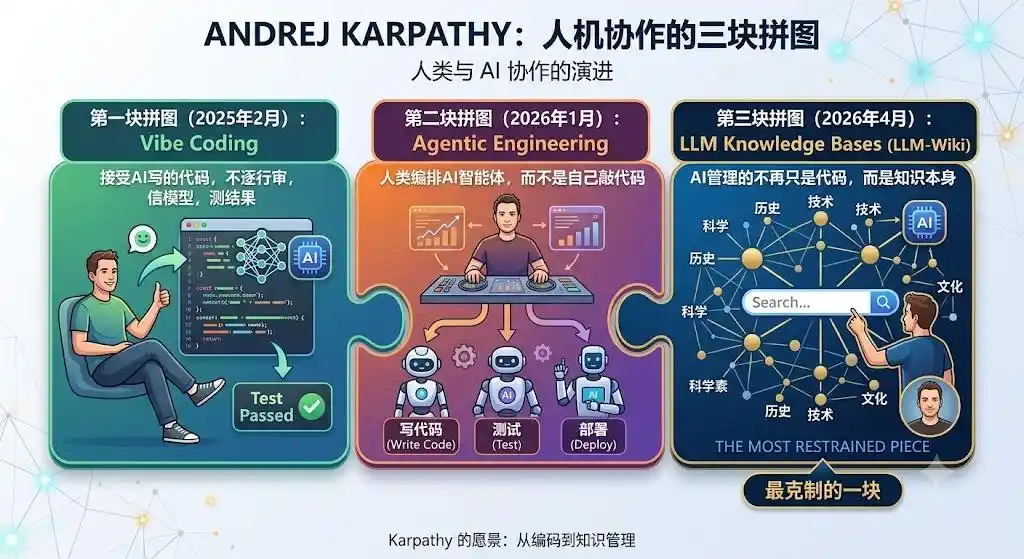
En este nuevo paradigma, a los humanos se les quita el trabajo pesado que a nadie le gusta hacer: guardar, organizar, enlazar, llevar cuentas.

A los humanos solo les quedan dos cosas: decidir qué leer y, pensar claramente qué significa todo esto. Precisamente las dos cosas que las máquinas aún no pueden hacer por ti, y que menos deberían hacer.

Esta es la historia de una herramienta que evoluciona hasta el extremo y, finalmente, da la vuelta para devolverle la atención al ser humano.

Ese sencillo y casi descarado archivo markdown, no publicó un modelo, no encabezó listas.

Solo recordó silenciosamente: tu cerebro nunca debió usarse para llevar cuentas.

Este artículo proviene del WeChat public account "New Zhiyuan", autor: ASI Apocalipsis

Trending Cryptos

Related Questions

Q¿Qué crítica principal hace Karpathy sobre los sistemas de notas y RAG en el artículo?

AKarpathy critica que los sistemas de notas actuales, como los basados en RAG (Recuperación Aumentada de Generación), actúan como simples "transportadores de información". No comprenden el contexto global, pueden generar contradicciones internas ("esquizofrenia") y los enlaces manuales en los grafos de conocimiento terminan corrompiéndose con el tiempo, lo que lleva a una pérdida de eficiencia. Él argumenta que el problema fundamental es que los humanos están haciendo el trabajo tedioso de "contabilidad" (mantenimiento de enlaces, resúmenes, coherencia), en lugar de enfocarse en la comprensión y el significado.

QSegún el artículo, ¿cuál es la analogía central que propone Karpathy para su método LLM-WIKI?

AKarpathy propone la analogía de la compilación de código. Sugiere tratar las notas en bruto como el "código fuente inmutable" y al modelo de lenguaje grande (LLM) como el "compilador". El LLM 'compila' una vez todo el material desorganizado en una Wiki estructurada, interconectada y lógicamente coherente. Así como un programa compilado se ejecuta rápidamente muchas veces sin recompliar, el conocimiento 'compilado' en la Wiki está listo para ser consultado de forma inmediata y consistente, sin necesidad de que la IA relea y reconstruya la respuesta desde cero en cada pregunta.

Q¿Cuáles son las tres capas de la arquitectura LLM-WIKI descrita en el texto?

ALa arquitectura LLM-WIKI se desacopla en tres capas: 1) **Capa Raw (Material en bruto)**: Son las notas originales, ideas y materiales sin procesar. Es inmutable y mantiene la entrada humana original. 2) **Capa Schema (Constitución del conocimiento)**: Son las reglas o 'reglamento' que el humano define para la IA. Especifica cómo debe estructurarse el conocimiento (por ejemplo, qué campos debe tener una entrada sobre una persona). 3) **Capa Wiki (Producto compilado)**: Es el área mantenida completamente por la IA. Aquí, el LLM organiza, enlaza y sintetiza la información de la capa Raw según el Schema, creando páginas de wiki coherentes y con referencias cruzadas.

Q¿Cómo resuelve el enfoque de Karpathy el problema que impidió la realización de la visión de Vannevar Bush y su "Memex" durante 80 años?

ALa visión de Vannevar Bush de una máquina "Memex" que creara y mantuviera conexiones asociativas entre el conocimiento personal fracasó porque el costo de mantenimiento manual (crear cada enlace, actualizar referencias) era demasiado alto y superaba rápidamente el valor obtenido. Karpathy resuelve este problema con los LLMs. El modelo de lenguaje actúa como el "operador" incansable que Bush imaginó, encargándose automáticamente de la tediosa "contabilidad": actualizar enlaces cruzados, revisar coherencia, señalar contradicciones y modificar múltiples páginas a la vez. Al reducir el costo de mantenimiento a casi cero, la visión se vuelve viable.

Q¿Qué tres piezas o etapas en la visión de Karpathy sobre la colaboración humano-IA se mencionan al final del artículo?

AEl artículo presenta el LLM-WIKI como la tercera pieza en la visión de Karpathy sobre la colaboración humano-IA: 1) **Vibe Coding (Codificación por Vibra, febrero 2025)**: Confiar en el código escrito por IA, revisando por resultados en lugar de línea por línea. 2) **Agentic Engineering (Ingeniería de Agentes, enero 2026)**: Los humanos orquestan agentes de IA en lugar de escribir código directamente. 3) **LLM Knowledge Bases (Bases de Conocimiento con LLM, abril 2026)**: La IA gestiona el conocimiento mismo, no solo el código, liberando a los humanos del trabajo de mantenimiento y organización.

Related Reads

Trading

Spot

Hot Articles

What is SONIC

Sonic: Pioneering the Future of Gaming in Web3 Introduction to Sonic In the ever-evolving landscape of Web3, the gaming industry stands out as one of the most dynamic and promising sectors. At the forefront of this revolution is Sonic, a project designed to amplify the gaming ecosystem on the Solana blockchain. Leveraging cutting-edge technology, Sonic aims to deliver an unparalleled gaming experience by efficiently processing millions of requests per second, ensuring that players enjoy seamless gameplay while maintaining low transaction costs. This article delves into the intricate details of Sonic, exploring its creators, funding sources, operational mechanics, and the timeline of significant events that have shaped its journey. What is Sonic? Sonic is an innovative layer-2 network that operates atop the Solana blockchain, specifically tailored to enhance the existing Solana gaming ecosystem. It accomplishes this through a customised, VM-agnostic game engine paired with a HyperGrid interpreter, facilitating sovereign game economies that roll up back to the Solana platform. The primary goals of Sonic include: Enhanced Gaming Experiences: Sonic is committed to offering lightning-fast on-chain gameplay, allowing players and developers to engage with games at previously unattainable speeds. Atomic Interoperability: This feature enables transactions to be executed within Sonic without the need to redeploy Solana programmes and accounts. This makes the process more efficient and directly benefits from Solana Layer1 services and liquidity. Seamless Deployment: Sonic allows developers to write for Ethereum Virtual Machine (EVM) based systems and execute them on Solana’s SVM infrastructure. This interoperability is crucial for attracting a broader range of dApps and decentralised applications to the platform. Support for Developers: By offering native composable gaming primitives and extensible data types - dining within the Entity-Component-System (ECS) framework - game creators can craft intricate business logic with ease. Overall, Sonic's unique approach not only caters to players but also provides an accessible and low-cost environment for developers to innovate and thrive. Creator of Sonic The information regarding the creator of Sonic is somewhat ambiguous. However, it is known that Sonic's SVM is owned by the company Mirror World. The absence of detailed information about the individuals behind Sonic reflects a common trend in several Web3 projects, where collective efforts and partnerships often overshadow individual contributions. Investors of Sonic Sonic has garnered considerable attention and support from various investors within the crypto and gaming sectors. Notably, the project raised an impressive $12 million during its Series A funding round. The round was led by BITKRAFT Ventures, with other notable investors including Galaxy, Okx Ventures, Interactive, Big Brain Holdings, and Mirana. This financial backing signifies the confidence that investment foundations have in Sonic’s potential to revolutionise the Web3 gaming landscape, further validating its innovative approaches and technologies. How Does Sonic Work? Sonic utilises the HyperGrid framework, a sophisticated parallel processing mechanism that enhances its scalability and customisability. Here are the core features that set Sonic apart: Lightning Speed at Low Costs: Sonic offers one of the fastest on-chain gaming experiences compared to other Layer-1 solutions, powered by the scalability of Solana’s virtual machine (SVM). Atomic Interoperability: Sonic enables transaction execution without redeployment of Solana programmes and accounts, effectively streamlining the interaction between users and the blockchain. EVM Compatibility: Developers can effortlessly migrate decentralised applications from EVM chains to the Solana environment using Sonic’s HyperGrid interpreter, increasing the accessibility and integration of various dApps. Ecosystem Support for Developers: By exposing native composable gaming primitives, Sonic facilitates a sandbox-like environment where developers can experiment and implement business logic, greatly enhancing the overall development experience. Monetisation Infrastructure: Sonic natively supports growth and monetisation efforts, providing frameworks for traffic generation, payments, and settlements, thereby ensuring that gaming projects are not only viable but also sustainable financially. Timeline of Sonic The evolution of Sonic has been marked by several key milestones. Below is a brief timeline highlighting critical events in the project's history: 2022: The Sonic cryptocurrency was officially launched, marking the beginning of its journey in the Web3 gaming arena. 2024: June: Sonic SVM successfully raised $12 million in a Series A funding round. This investment allowed Sonic to further develop its platform and expand its offerings. August: The launch of the Sonic Odyssey testnet provided users with the first opportunity to engage with the platform, offering interactive activities such as collecting rings—a nod to gaming nostalgia. October: SonicX, an innovative crypto game integrated with Solana, made its debut on TikTok, capturing the attention of over 120,000 users within a short span. This integration illustrated Sonic’s commitment to reaching a broader, global audience and showcased the potential of blockchain gaming. Key Points Sonic SVM is a revolutionary layer-2 network on Solana explicitly designed to enhance the GameFi landscape, demonstrating great potential for future development. HyperGrid Framework empowers Sonic by introducing horizontal scaling capabilities, ensuring that the network can handle the demands of Web3 gaming. Integration with Social Platforms: The successful launch of SonicX on TikTok displays Sonic’s strategy to leverage social media platforms to engage users, exponentially increasing the exposure and reach of its projects. Investment Confidence: The substantial funding from BITKRAFT Ventures, among others, emphasizes the robust backing Sonic has, paving the way for its ambitious future. In conclusion, Sonic encapsulates the essence of Web3 gaming innovation, striking a balance between cutting-edge technology, developer-centric tools, and community engagement. As the project continues to evolve, it is poised to redefine the gaming landscape, making it a notable entity for gamers and developers alike. As Sonic moves forward, it will undoubtedly attract greater interest and participation, solidifying its place within the broader narrative of blockchain gaming.

1.8k Total ViewsPublished 2024.04.04Updated 2024.12.03

What is SONIC

What is $S$

Understanding SPERO: A Comprehensive Overview Introduction to SPERO As the landscape of innovation continues to evolve, the emergence of web3 technologies and cryptocurrency projects plays a pivotal role in shaping the digital future. One project that has garnered attention in this dynamic field is SPERO, denoted as SPERO,$$s$. This article aims to gather and present detailed information about SPERO, to help enthusiasts and investors understand its foundations, objectives, and innovations within the web3 and crypto domains. What is SPERO,$$s$? SPERO,$$s$ is a unique project within the crypto space that seeks to leverage the principles of decentralisation and blockchain technology to create an ecosystem that promotes engagement, utility, and financial inclusion. The project is tailored to facilitate peer-to-peer interactions in new ways, providing users with innovative financial solutions and services. At its core, SPERO,$$s$ aims to empower individuals by providing tools and platforms that enhance user experience in the cryptocurrency space. This includes enabling more flexible transaction methods, fostering community-driven initiatives, and creating pathways for financial opportunities through decentralised applications (dApps). The underlying vision of SPERO,$$s$ revolves around inclusiveness, aiming to bridge gaps within traditional finance while harnessing the benefits of blockchain technology. Who is the Creator of SPERO,$$s$? The identity of the creator of SPERO,$$s$ remains somewhat obscure, as there are limited publicly available resources providing detailed background information on its founder(s). This lack of transparency can stem from the project's commitment to decentralisation—an ethos that many web3 projects share, prioritising collective contributions over individual recognition. By centring discussions around the community and its collective goals, SPERO,$$s$ embodies the essence of empowerment without singling out specific individuals. As such, understanding the ethos and mission of SPERO remains more important than identifying a singular creator. Who are the Investors of SPERO,$$s$? SPERO,$$s$ is supported by a diverse array of investors ranging from venture capitalists to angel investors dedicated to fostering innovation in the crypto sector. The focus of these investors generally aligns with SPERO's mission—prioritising projects that promise societal technological advancement, financial inclusivity, and decentralised governance. These investor foundations are typically interested in projects that not only offer innovative products but also contribute positively to the blockchain community and its ecosystems. The backing from these investors reinforces SPERO,$$s$ as a noteworthy contender in the rapidly evolving domain of crypto projects. How Does SPERO,$$s$ Work? SPERO,$$s$ employs a multi-faceted framework that distinguishes it from conventional cryptocurrency projects. Here are some of the key features that underline its uniqueness and innovation: Decentralised Governance: SPERO,$$s$ integrates decentralised governance models, empowering users to participate actively in decision-making processes regarding the project’s future. This approach fosters a sense of ownership and accountability among community members. Token Utility: SPERO,$$s$ utilises its own cryptocurrency token, designed to serve various functions within the ecosystem. These tokens enable transactions, rewards, and the facilitation of services offered on the platform, enhancing overall engagement and utility. Layered Architecture: The technical architecture of SPERO,$$s$ supports modularity and scalability, allowing for seamless integration of additional features and applications as the project evolves. This adaptability is paramount for sustaining relevance in the ever-changing crypto landscape. Community Engagement: The project emphasises community-driven initiatives, employing mechanisms that incentivise collaboration and feedback. By nurturing a strong community, SPERO,$$s$ can better address user needs and adapt to market trends. Focus on Inclusion: By offering low transaction fees and user-friendly interfaces, SPERO,$$s$ aims to attract a diverse user base, including individuals who may not previously have engaged in the crypto space. This commitment to inclusion aligns with its overarching mission of empowerment through accessibility. Timeline of SPERO,$$s$ Understanding a project's history provides crucial insights into its development trajectory and milestones. Below is a suggested timeline mapping significant events in the evolution of SPERO,$$s$: Conceptualisation and Ideation Phase: The initial ideas forming the basis of SPERO,$$s$ were conceived, aligning closely with the principles of decentralisation and community focus within the blockchain industry. Launch of Project Whitepaper: Following the conceptual phase, a comprehensive whitepaper detailing the vision, goals, and technological infrastructure of SPERO,$$s$ was released to garner community interest and feedback. Community Building and Early Engagements: Active outreach efforts were made to build a community of early adopters and potential investors, facilitating discussions around the project’s goals and garnering support. Token Generation Event: SPERO,$$s$ conducted a token generation event (TGE) to distribute its native tokens to early supporters and establish initial liquidity within the ecosystem. Launch of Initial dApp: The first decentralised application (dApp) associated with SPERO,$$s$ went live, allowing users to engage with the platform's core functionalities. Ongoing Development and Partnerships: Continuous updates and enhancements to the project's offerings, including strategic partnerships with other players in the blockchain space, have shaped SPERO,$$s$ into a competitive and evolving player in the crypto market. Conclusion SPERO,$$s$ stands as a testament to the potential of web3 and cryptocurrency to revolutionise financial systems and empower individuals. With a commitment to decentralised governance, community engagement, and innovatively designed functionalities, it paves the way toward a more inclusive financial landscape. As with any investment in the rapidly evolving crypto space, potential investors and users are encouraged to research thoroughly and engage thoughtfully with the ongoing developments within SPERO,$$s$. The project showcases the innovative spirit of the crypto industry, inviting further exploration into its myriad possibilities. While the journey of SPERO,$$s$ is still unfolding, its foundational principles may indeed influence the future of how we interact with technology, finance, and each other in interconnected digital ecosystems.

101 Total ViewsPublished 2024.12.17Updated 2024.12.17

What is $S$

What is AGENT S

Agent S: The Future of Autonomous Interaction in Web3 Introduction In the ever-evolving landscape of Web3 and cryptocurrency, innovations are constantly redefining how individuals interact with digital platforms. One such pioneering project, Agent S, promises to revolutionise human-computer interaction through its open agentic framework. By paving the way for autonomous interactions, Agent S aims to simplify complex tasks, offering transformative applications in artificial intelligence (AI). This detailed exploration will delve into the project's intricacies, its unique features, and the implications for the cryptocurrency domain. What is Agent S? Agent S stands as a groundbreaking open agentic framework, specifically designed to tackle three fundamental challenges in the automation of computer tasks: Acquiring Domain-Specific Knowledge: The framework intelligently learns from various external knowledge sources and internal experiences. This dual approach empowers it to build a rich repository of domain-specific knowledge, enhancing its performance in task execution. Planning Over Long Task Horizons: Agent S employs experience-augmented hierarchical planning, a strategic approach that facilitates efficient breakdown and execution of intricate tasks. This feature significantly enhances its ability to manage multiple subtasks efficiently and effectively. Handling Dynamic, Non-Uniform Interfaces: The project introduces the Agent-Computer Interface (ACI), an innovative solution that enhances the interaction between agents and users. Utilizing Multimodal Large Language Models (MLLMs), Agent S can navigate and manipulate diverse graphical user interfaces seamlessly. Through these pioneering features, Agent S provides a robust framework that addresses the complexities involved in automating human interaction with machines, setting the stage for myriad applications in AI and beyond. Who is the Creator of Agent S? While the concept of Agent S is fundamentally innovative, specific information about its creator remains elusive. The creator is currently unknown, which highlights either the nascent stage of the project or the strategic choice to keep founding members under wraps. Regardless of anonymity, the focus remains on the framework's capabilities and potential. Who are the Investors of Agent S? As Agent S is relatively new in the cryptographic ecosystem, detailed information regarding its investors and financial backers is not explicitly documented. The lack of publicly available insights into the investment foundations or organisations supporting the project raises questions about its funding structure and development roadmap. Understanding the backing is crucial for gauging the project's sustainability and potential market impact. How Does Agent S Work? At the core of Agent S lies cutting-edge technology that enables it to function effectively in diverse settings. Its operational model is built around several key features: Human-like Computer Interaction: The framework offers advanced AI planning, striving to make interactions with computers more intuitive. By mimicking human behaviour in tasks execution, it promises to elevate user experiences. Narrative Memory: Employed to leverage high-level experiences, Agent S utilises narrative memory to keep track of task histories, thereby enhancing its decision-making processes. Episodic Memory: This feature provides users with step-by-step guidance, allowing the framework to offer contextual support as tasks unfold. Support for OpenACI: With the ability to run locally, Agent S allows users to maintain control over their interactions and workflows, aligning with the decentralised ethos of Web3. Easy Integration with External APIs: Its versatility and compatibility with various AI platforms ensure that Agent S can fit seamlessly into existing technological ecosystems, making it an appealing choice for developers and organisations. These functionalities collectively contribute to Agent S's unique position within the crypto space, as it automates complex, multi-step tasks with minimal human intervention. As the project evolves, its potential applications in Web3 could redefine how digital interactions unfold. Timeline of Agent S The development and milestones of Agent S can be encapsulated in a timeline that highlights its significant events: September 27, 2024: The concept of Agent S was launched in a comprehensive research paper titled “An Open Agentic Framework that Uses Computers Like a Human,” showcasing the groundwork for the project. October 10, 2024: The research paper was made publicly available on arXiv, offering an in-depth exploration of the framework and its performance evaluation based on the OSWorld benchmark. October 12, 2024: A video presentation was released, providing a visual insight into the capabilities and features of Agent S, further engaging potential users and investors. These markers in the timeline not only illustrate the progress of Agent S but also indicate its commitment to transparency and community engagement. Key Points About Agent S As the Agent S framework continues to evolve, several key attributes stand out, underscoring its innovative nature and potential: Innovative Framework: Designed to provide an intuitive use of computers akin to human interaction, Agent S brings a novel approach to task automation. Autonomous Interaction: The ability to interact autonomously with computers through GUI signifies a leap towards more intelligent and efficient computing solutions. Complex Task Automation: With its robust methodology, it can automate complex, multi-step tasks, making processes faster and less error-prone. Continuous Improvement: The learning mechanisms enable Agent S to improve from past experiences, continually enhancing its performance and efficacy. Versatility: Its adaptability across different operating environments like OSWorld and WindowsAgentArena ensures that it can serve a broad range of applications. As Agent S positions itself in the Web3 and crypto landscape, its potential to enhance interaction capabilities and automate processes signifies a significant advancement in AI technologies. Through its innovative framework, Agent S exemplifies the future of digital interactions, promising a more seamless and efficient experience for users across various industries. Conclusion Agent S represents a bold leap forward in the marriage of AI and Web3, with the capacity to redefine how we interact with technology. While still in its early stages, the possibilities for its application are vast and compelling. Through its comprehensive framework addressing critical challenges, Agent S aims to bring autonomous interactions to the forefront of the digital experience. As we move deeper into the realms of cryptocurrency and decentralisation, projects like Agent S will undoubtedly play a crucial role in shaping the future of technology and human-computer collaboration.

770 Total ViewsPublished 2025.01.14Updated 2025.01.14

What is AGENT S

Discussions

Welcome to the HTX Community. Here, you can stay informed about the latest platform developments and gain access to professional market insights. Users' opinions on the price of S (S) are presented below.

活动图片