Bitcoin se enfrenta a la prueba de los 58.000 dólares mientras la demanda de EE.UU. se resquebraja – ¿Qué le espera a BTC?

ambcryptoPublished on 2026-07-01Last updated on 2026-07-01

Abstract

El impulso de Bitcoin [BTC] está perdiendo fuerza, enfrentando una prueba crítica en el soporte de $58,000. Una causa clave es la notable disminución de la demanda estadounidense, históricamente un gran motor del mercado. El "U.S. to The Rest Reserve Ratio", que compara las tenencias de BTC en EE.UU. con el resto del mundo, ha caído de su pico de 1.79 a 1.59, indicando un retroceso del capital estadounidense. Esto se confirma con los flujos de los ETF de Bitcoin. Tras meses de entradas, la tendencia se ha invertido, registrando una salida neta mensual de aproximadamente $4.29 mil millones, lo que señala una reducida confianza institucional. Técnicamente, BTC cotiza cerca de $58,500, con vendedores en control y el RSI acercándose a zonas de sobreventa. Aunque un pequeño rebote de alivio es posible, la presión bajista persiste. Para evitar una caída mayor hacia niveles de soporte inferiores, Bitcoin necesita recuperar y sostenerse en el rango de $60,000 a $62,000. En resumen, el debilitamiento de la demanda en EE.UU. y las salidas de los ETF refuerzan los riesgos a la baja para el precio de BTC.

El impulso alcista de Bitcoin [BTC] se está debilitando. Durante gran parte de su historia, el capital estadounidense ha sido uno de los principales motores del BTC; ahora, ya no es así.

Con los ETF además registrando salidas de capital, ¿está el mercado abocado al caos?

La demanda de Bitcoin en EE.UU. pierde fuerza

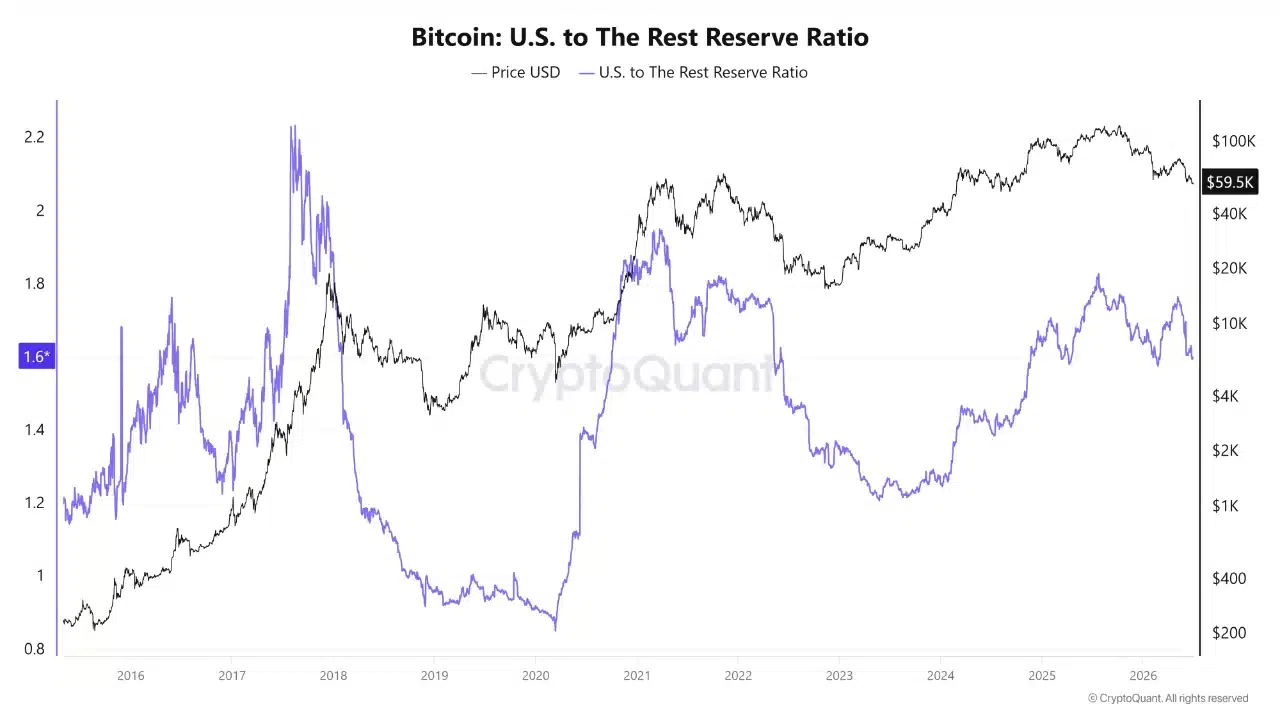
Una métrica clave a seguir es la Ratio de Reservas de EE.UU. frente al Resto del Mundo, que compara el Bitcoin en manos de entidades estadounidenses con el del resto del mundo. Tras fortalecerse durante este ciclo, la ratio ha caído desde su máximo reciente cercano a 1,79 hasta aproximadamente 1,59.

Dado que el capital estadounidense es una fuerza principal detrás del repunte del Bitcoin, al BTC le cuesta mantenerse cuando esta demanda cae. Curiosamente, esta ratio comenzó a debilitarse antes de que lo hiciera el precio del BTC.
Fuente: CryptoQuant

La primera criptomoneda se enfrentará casi con toda seguridad a resistencia y a más presión bajista, a menos que la demanda estadounidense empiece a recuperarse.

Las salidas de los ETF spot confirman la caída

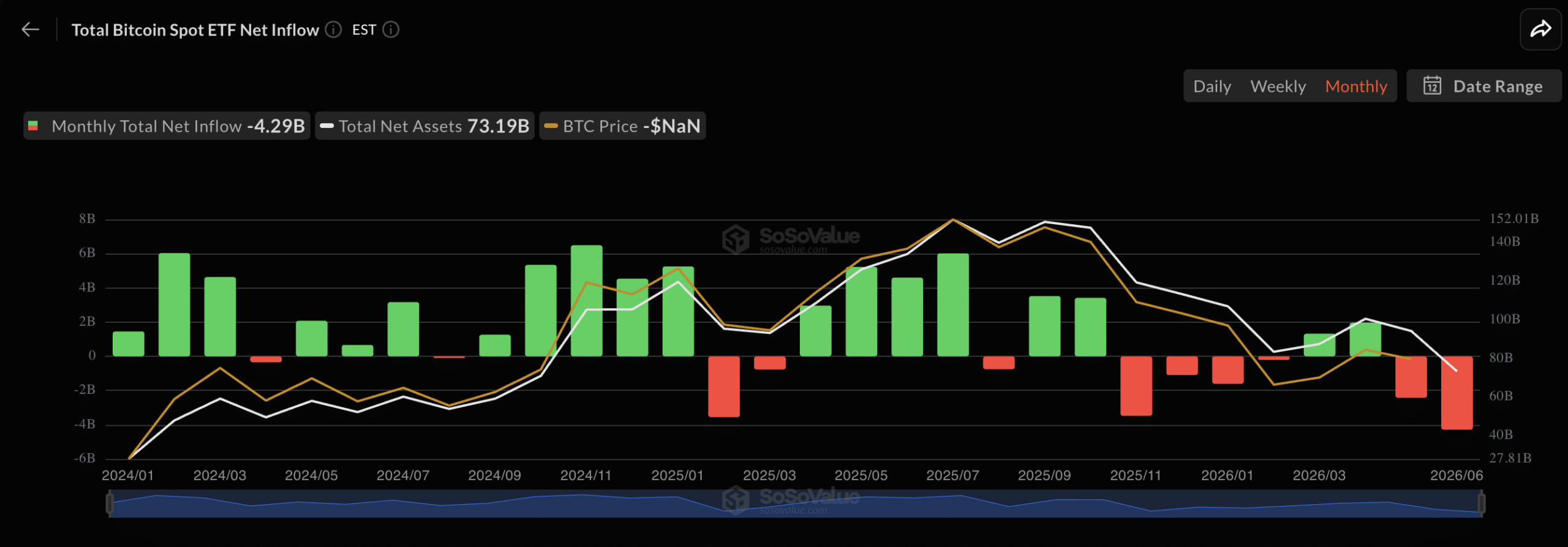
Tras meses en verde, la tendencia de los ETF ahora se ha invertido. El último flujo neto mensual registró una enorme salida de aproximadamente 4.290 millones de dólares. Teniendo en cuenta que los ETF fueron una de las señales más claras de compra institucional durante los repuntes, esto es preocupante.
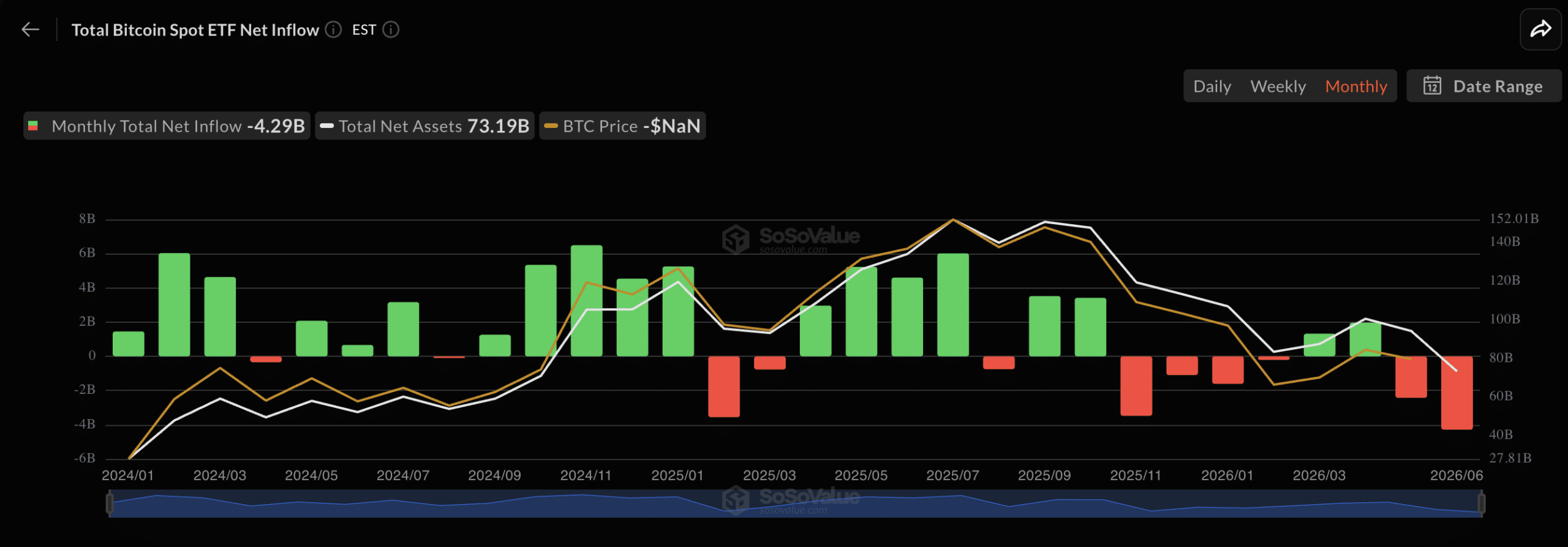
Fuente: SoSoValue

Cuando la demanda de ETF era fuerte, el BTC encontraba un soporte firme. Pero ahora, con dos meses débiles, el mercado parece nervioso.

El precio prueba el soporte de 58.000 dólares

El Bitcoin cayó por debajo de la zona de los 60.000 dólares y cotizaba cerca de los 58.500 dólares en el momento de redactar este artículo. Los vendedores seguían claramente al mando. El RSI estaba cerca de la zona de sobreventa, por lo que el mercado está bajo presión. Sin embargo, aún no estamos preparados para un gran rebote.
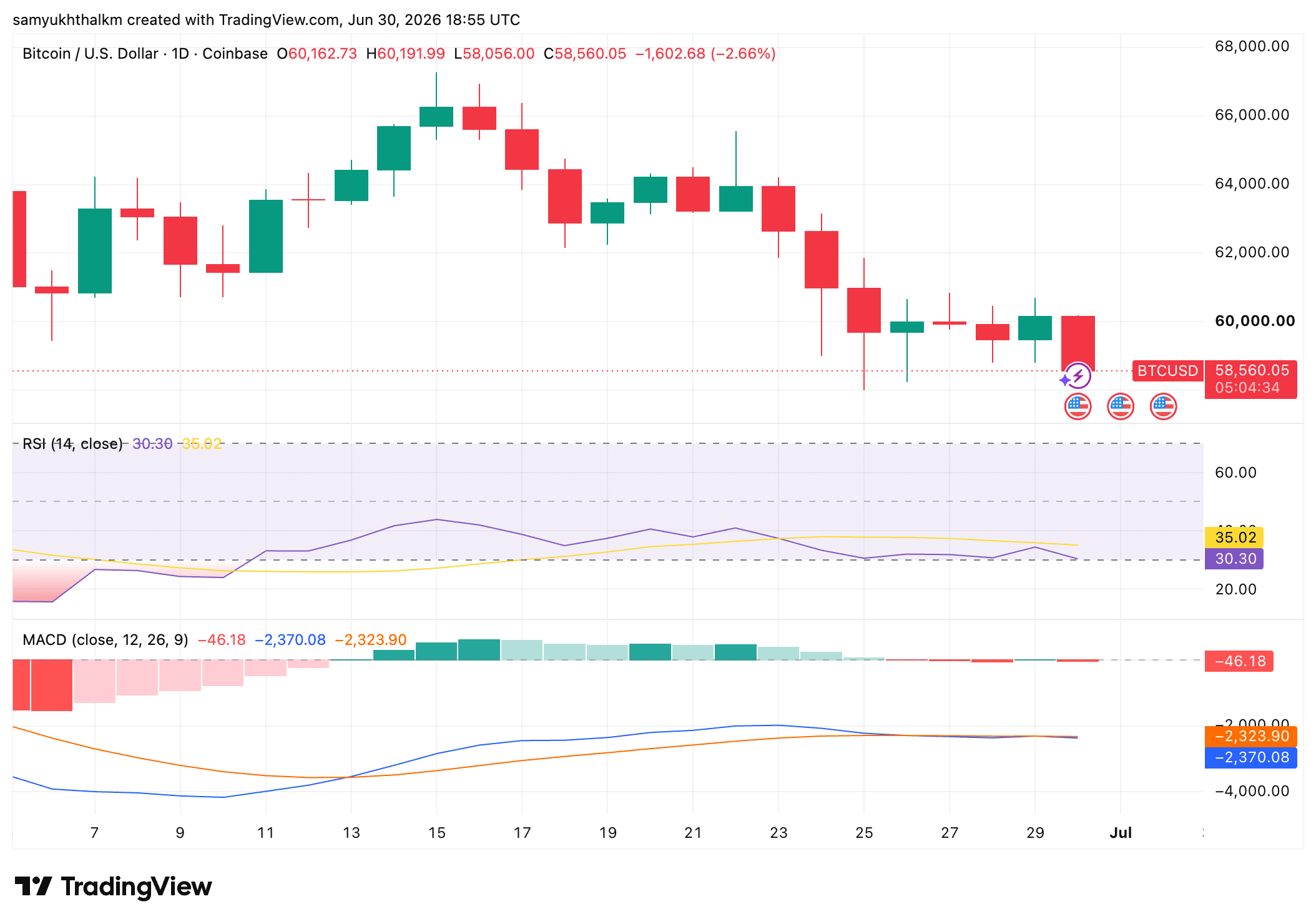
Fuente: TradingView

El ritmo aún no ha vuelto a favor de los compradores. Es posible un breve movimiento de alivio tras este descenso, pero el panorama general sigue siendo incierto. A menos que el BTC regrese al rango de 60.000-62.000 dólares, es posible una mayor caída hacia niveles de soporte inferiores.


Resumen Final

  • La demanda de Bitcoin en EE.UU. se está debilitando, con salidas de los ETF Spot que alcanzan los 4.290 millones de dólares. Esto señala una reducción de la confianza de los inversores.
  • El Bitcoin lucha por mantener la zona de soporte de los 58.000 dólares, mientras que la ratio de reservas de EE.UU. ha caído a 1,59, lo que refuerza los riesgos bajistas.


Trending Cryptos

Related Questions

Q¿Cuál es el principal factor que está perdiendo fuerza y afectando al precio de Bitcoin según el artículo?

ALa demanda estadounidense de Bitcoin está perdiendo fuerza. La métrica clave, el índice de reservas de EE.UU. frente al resto del mundo, ha caído de un pico de 1.79 a alrededor de 1.59.

Q¿Qué confirma la tendencia de flujos negativos en los ETFs de Bitcoin spot mencionada en el texto?

ALa tendencia de flujos negativos en los ETFs de Bitcoin spot, con una salida neta de aproximadamente 4.290 millones de dólares en el último mes, confirma la caída de la demanda institucional y el debilitamiento general del mercado.

Q¿En qué nivel de soporte clave se estaba probando el precio de Bitcoin al momento de escribir el artículo?

AAl momento de escribir el artículo, Bitcoin había caído por debajo de los 60.000 dólares y se estaba probando alrededor del nivel de soporte de 58.500 dólares.

QSegún el análisis del artículo, ¿qué necesita suceder para que Bitcoin evite una mayor presión a la baja?

APara evitar una mayor presión a la baja y caer a niveles de soporte más bajos, Bitcoin necesita que la demanda estadounidense se recupere y que el precio logre regresar al rango de 60.000 a 62.000 dólares.

Q¿Qué dos indicadores técnicos o de mercado se mencionan como señales de debilidad y presión vendedora actual?

ASe mencionan dos indicadores clave de debilidad: 1) El Índice de Fuerza Relativa (RSI) cerca de la zona de sobreventa, indicando presión vendedora. 2) El cambio en los flujos mensuales de los ETFs, que pasaron de positivos (entradas) a negativos (salidas masivas).

Related Reads

Google Shaken, Market Cap Evaporates Hundreds of Billions. Can Gemini Spark Save the Day?

Google is facing a turbulent period marked by a significant brain drain of top AI talent. Key figures like Noam Shazeer, John Jumper, Jonas Adler, and Alexander Pritzel have recently left for competitors OpenAI and Anthropic, causing investor concern and a sharp stock decline wiping hundreds of billions from Alphabet's market cap. Amidst this talent exodus and the delayed launch of the anticipated Gemini 3.5 Pro model, Google has unveiled its major new offering: Gemini Spark. This is not a standard chatbot but a persistent, cloud-based AI agent designed to automate multi-step workflows across Google's ecosystem (Gmail, Calendar, Docs, Drive, etc.) and some third-party apps. Powered by the Antigravity framework with Tasks, Skills, and Schedules, it aims to function as a continuous digital assistant. However, its high price point—exclusive to the $100/month AI Ultra tier—has drawn criticism. The article positions Spark as Google's critical, albeit late, move into the AI agent arena, where AI transitions from a tool to an autonomous workforce. While competitors and startups are already advancing in this space, Google's vast integration with Workspace gives it a potential edge, though its historical caution due to scale and risk may have cost it the lead. Ultimately, Spark represents a necessary shift for Google, but the question remains whether this "digital employee" can compensate for the loss of foundational talent and restore investor confidence in the company's future.

marsbit23m ago

Google Shaken, Market Cap Evaporates Hundreds of Billions. Can Gemini Spark Save the Day?

marsbit23m ago

24/5 Settlement Is Here for US Stocks, but Cryptocurrency Didn't Get a Ticket

The U.S. National Securities Clearing Corporation (NSCC), a subsidiary of the Depository Trust & Clearing Corporation (DTCC), has announced the implementation of 24-hour clearing operations on weekdays. This move, approved by the SEC and being rolled out in phases, fundamentally challenges a core narrative of the cryptocurrency industry: that digital assets offer a unique advantage with their 7x24 trading availability, unlike traditional markets that close at 4 p.m. The transition to near-continuous clearing for stocks and other traditional assets diminishes this perceived crypto edge. While crypto markets still operate on weekends, the article notes that DTCC could potentially expand to weekend clearing in the future if demand warrants. The development is presented as another instance where DTCC has disappointed crypto enthusiasts. Despite frequent speculation from communities supporting Ethereum, XRP Ledger, and others that DTCC would integrate public blockchains, the clearing giant consistently opts for private, permissioned distributed ledger solutions for its projects, such as its Ion platform and a recent U.S. Treasury tokenization initiative on the Canton network. The article concludes that the successful launch of this traditional finance "always-on" market relied entirely on existing mature infrastructure, with the cryptocurrency industry failing to secure a role or "admission ticket" in its implementation.

Foresight News38m ago

24/5 Settlement Is Here for US Stocks, but Cryptocurrency Didn't Get a Ticket

Foresight News38m ago

Karpathy's Genius Strikes Again, Challenging RAG, Turning Your Notes into a Second Brain

Andrej Karpathy has proposed a revolutionary concept for managing personal knowledge: treating notes as immutable "source code" and using LLMs as "compilers" to build a structured, interlinked wiki. This approach fundamentally shifts the cognitive workflow away from the limitations of RAG (Retrieval-Augmented Generation), which merely retrieves and pieces together fragments, leading to contradictions and "digital mummies"—unused, decaying notes. The LLM-Wiki framework introduces a three-layer architecture: the **Raw Layer** for original, immutable notes; the **Schema Layer** defining rules for structuring knowledge; and the **Wiki Layer**, where the LLM continuously compiles and maintains a coherent, cross-referenced knowledge base. Key operations are **Ingest** (adding new material, which triggers updates across related pages), **Query** (asking the compiled wiki, with answers that can become new pages), and **Lint** (periodic AI audits to find contradictions, outdated claims, or gaps). This system automates the tedious maintenance—updating links, resolving conflicts, keeping summaries fresh—that has historically made large-scale personal knowledge management unsustainable. It realizes Vannevar Bush's 1945 "Memex" vision by finally solving the maintenance problem. Karpathy's proposal represents a third piece in human-AI collaboration, following "Vibe Coding" and "Agentic Engineering." It liberates human attention from organizational drudgery, refocusing it on what matters: deciding what to read and deriving meaning.

marsbit48m ago

Karpathy's Genius Strikes Again, Challenging RAG, Turning Your Notes into a Second Brain

marsbit48m ago

Claude Science Completes Two Years' Work in a Few Weeks, Is 10x Research Acceleration Really Here?

Claude Science, a new AI workbench from Anthropic, is being tested by scientists, reportedly accelerating specific research workflows by up to 10x. A neuro-scientist at the Allen Institute completed a lengthy literature review in weeks instead of nearly two years using the tool, which automates tasks like citation verification. The platform is an integrated environment for macOS and Linux, connecting to local or remote computing resources. It streamlines the fragmented research process—literature analysis, computation, visualization, and drafting—into a single, auditable workflow. A key feature is its emphasis on reproducibility: every chart generated includes the exact code, environment, and history used to create it. Claude Science uses a multi-agent system. A coordinator manages over 60 pre-configured skills for life sciences (genomics, proteomics, etc.) and can spawn specialized agents. A dedicated reviewer agent checks citations and calculations for accuracy, creating a form of internal AI peer review. The system operates with a human-in-the-loop, requiring user approval for major steps. Initial applications are in life sciences. Examples include target identification for biotech company Manifold Bio and germline variant analysis for glioma research at UCSF, completing analyses in roughly one-tenth the previous time. The approach contrasts with competitors: Google focuses on proprietary models like AlphaFold, while OpenAI is advancing models' scientific reasoning with benchmarks like GeneBench-Pro. Claude Science differentiates by automating and integrating the practical research pipeline, not just the model's intelligence, aiming to make AI-aided science more reproducible and integrated into daily lab work.

marsbit51m ago

Claude Science Completes Two Years' Work in a Few Weeks, Is 10x Research Acceleration Really Here?

marsbit51m ago

Trading

Spot

Hot Articles

What is $BITCOIN

DIGITAL GOLD ($BITCOIN): A Comprehensive Analysis Introduction to DIGITAL GOLD ($BITCOIN) DIGITAL GOLD ($BITCOIN) is a blockchain-based project operating on the Solana network, which aims to combine the characteristics of traditional precious metals with the innovation of decentralized technologies. While it shares a name with Bitcoin, often referred to as “digital gold” due to its perception as a store of value, DIGITAL GOLD is a separate token designed to create a unique ecosystem within the Web3 landscape. Its goal is to position itself as a viable alternative digital asset, although specifics regarding its applications and functionalities are still developing. What is DIGITAL GOLD ($BITCOIN)? DIGITAL GOLD ($BITCOIN) is a cryptocurrency token explicitly designed for use on the Solana blockchain. In contrast to Bitcoin, which provides a widely recognized value storage role, this token appears to focus on broader applications and characteristics. Notable aspects include: Blockchain Infrastructure: The token is built on the Solana blockchain, known for its capacity to handle high-speed and low-cost transactions. Supply Dynamics: DIGITAL GOLD has a maximum supply capped at 100 quadrillion tokens (100P $BITCOIN), although details regarding its circulating supply are currently undisclosed. Utility: While precise functionalities are not explicitly outlined, there are indications that the token could be utilized for various applications, potentially involving decentralized applications (dApps) or asset tokenization strategies. Who is the Creator of DIGITAL GOLD ($BITCOIN)? At present, the identity of the creators and development team behind DIGITAL GOLD ($BITCOIN) remains unknown. This situation is typical among many innovative projects within the blockchain space, particularly those aligning with decentralized finance and meme coin phenomena. While such anonymity may foster a community-driven culture, it intensifies concerns about governance and accountability. Who are the Investors of DIGITAL GOLD ($BITCOIN)? The available information indicates that DIGITAL GOLD ($BITCOIN) does not have any known institutional backers or prominent venture capital investments. The project seems to operate on a peer-to-peer model focused on community support and adoption rather than traditional funding routes. Its activity and liquidity are primarily situated on decentralized exchanges (DEXs), such as PumpSwap, rather than established centralized trading platforms, further highlighting its grassroots approach. How DIGITAL GOLD ($BITCOIN) Works The operational mechanics of DIGITAL GOLD ($BITCOIN) can be elaborated on based on its blockchain design and network attributes: Consensus Mechanism: By leveraging Solana’s unique proof-of-history (PoH) combined with a proof-of-stake (PoS) model, the project ensures efficient transaction validation contributing to the network's high performance. Tokenomics: While specific deflationary mechanisms have not been extensively detailed, the vast maximum token supply implies that it may cater to microtransactions or niche use cases that are still to be defined. Interoperability: There exists the potential for integration with Solana’s broader ecosystem, including various decentralized finance (DeFi) platforms. However, the details regarding specific integrations remain unspecified. Timeline of Key Events Here is a timeline that highlights significant milestones concerning DIGITAL GOLD ($BITCOIN): 2023: The initial deployment of the token occurs on the Solana blockchain, marked by its contract address. 2024: DIGITAL GOLD gains visibility as it becomes available for trading on decentralized exchanges like PumpSwap, allowing users to trade it against SOL. 2025: The project witnesses sporadic trading activity and potential interest in community-led engagements, although no noteworthy partnerships or technical advancements have been documented as of yet. Critical Analysis Strengths Scalability: The underlying Solana infrastructure supports high transaction volumes, which could enhance the utility of $BITCOIN in various transaction scenarios. Accessibility: The potential low trading price per token could attract retail investors, facilitating wider participation due to fractional ownership opportunities. Risks Lack of Transparency: The absence of publicly known backers, developers, or an audit process may yield skepticism regarding the project's sustainability and trustworthiness. Market Volatility: The trading activity is heavily reliant on speculative behavior, which can result in significant price volatility and uncertainty for investors. Conclusion DIGITAL GOLD ($BITCOIN) emerges as an intriguing yet ambiguous project within the rapidly evolving Solana ecosystem. While it attempts to leverage the “digital gold” narrative, its departure from Bitcoin's established role as a store of value underscores the need for a clearer differentiation of its intended utility and governance structure. Future acceptance and adoption will likely depend on addressing the current opacity and defining its operational and economic strategies more explicitly. Note: This report encompasses synthesised information available as of October 2023, and developments may have transpired beyond the research period.

538 Total ViewsPublished 2025.05.13Updated 2025.05.13

What is $BITCOIN

Discussions

Welcome to the HTX Community. Here, you can stay informed about the latest platform developments and gain access to professional market insights. Users' opinions on the price of BTC (BTC) are presented below.

活动图片