BTC Hits Its Lowest Point Since 2024, But Is It Still Not the Right Time to Buy the Dip?

Foresight NewsPublished on 2026-07-01Last updated on 2026-07-01

Abstract

**Summary:** Bitcoin (BTC) has plunged to new lows in 2024, dropping over 50% from its all-time high to around $57,800, while Ethereum and Solana also show significant weakness. The market sentiment is at "extreme fear." The primary headwinds are identified as massive and sustained net outflows from US spot Bitcoin ETFs since May 2026, creating significant selling pressure, and the evaporation of expectations for a US Federal Reserve interest rate cut in 2026, which makes holding cash and bonds more attractive than risk assets like crypto. Analysts are actively debating the potential bottom. Key predictions include: * **glassnode's Rafael:** Suggests a bottom between $46,000 and $54,000, based on on-chain metrics like Realized Price and CVDD. He notes that institutional demand (via ETFs) is currently a net seller, not a buyer. * **BIT Analysis:** Argues the bear market is in its final stage, with a potential bottoming zone between $50,000 and $55,000, possibly aligning with the 2026 FIFA World Cup period (June-July). * **Wintermute:** Believes the market is in the late stages of a bear market but cautions the true bottom may not arrive until September-October 2026, contingent on renewed capital inflows. * **Liquid Capital's JackYi:** Posits that July-August 2026 could be the final capitulation and the best accumulation window, with potential bottom prices ranging from $51,000 to $43,000. * **Jiang Zhuo'er (BTC.TOP):** Predicts a bottom between $42,000 and $44,000 ...


Author: Ma He, Foresight News


On July 1, the price of BTC once fell to $57,800, marking a cumulative decline of over 50% from its historical high of approximately $126,000, and also hitting its lowest level since October 2024. Meanwhile, ETH continues to hover around the low of $1,600, and SOL has recorded a rare 10 consecutive monthly declines on its monthly chart. The current market fear and greed index stands at 17, indicating extreme fear.
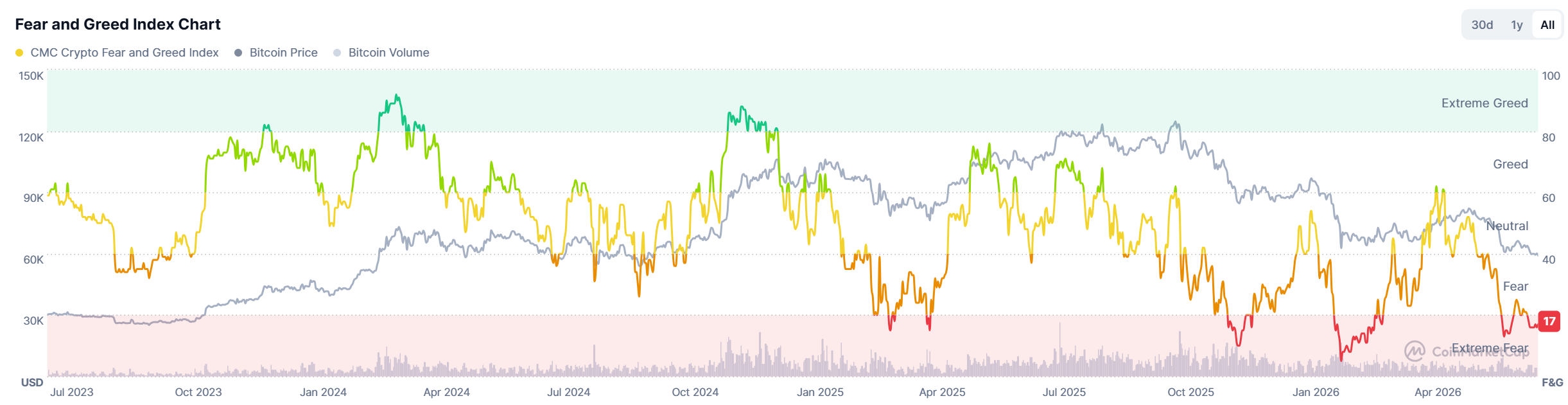


In terms of the broader macro market, the Nasdaq is still fluctuating at a high level of 26,200, and the S&P 500 remains at a high level of 7,500. Since October 2025, Bitcoin has been in a correction for nearly a year. Why has BTC performed so poorly? Perhaps it is facing two major headwinds: significant net outflows from spot ETFs and unmet expectations for interest rate cuts.


From mid-May to June 2026, Bitcoin spot ETFs experienced an unprecedented wave of capital outflows. Since May 1, Bitcoin spot ETFs have unusually recorded only 9 days of net inflows, with the amounts generally being small. No single day's net inflow has exceeded $140 million since early May. In terms of net outflows, however, there were 4 days with net outflows exceeding $600 million in a single day since May, along with consecutive days of significant net outflows.
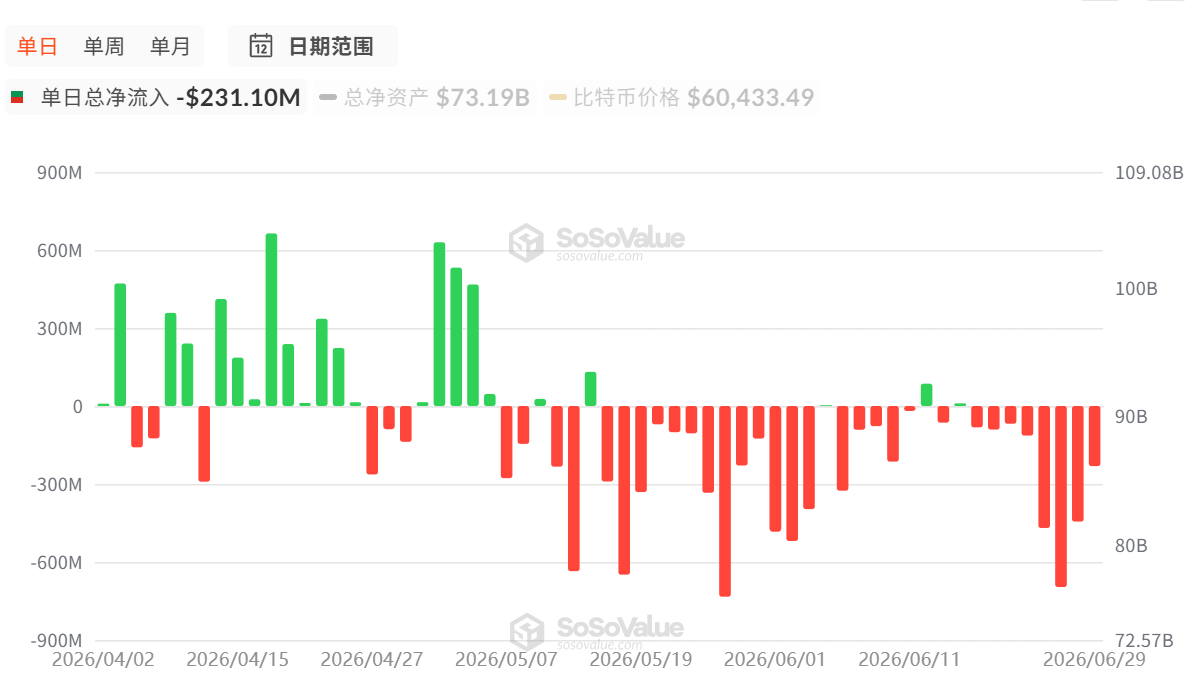


It is evident that a large number of institutions and retail investors are reducing their Bitcoin holdings through the ETF channel, further amplifying selling pressure in the spot market and making it difficult for prices to hold key support levels. Compared to the peak inflow period in 2025, this structural reversal in capital flows has become the most direct reason for the current BTC adjustment.


Expectations for Federal Reserve interest rate cuts have also been dashed. According to Kalshi data, the market currently places a 77.8% probability on the Fed keeping rates unchanged this year, with only a 19.6% probability of one rate cut (25 basis points).
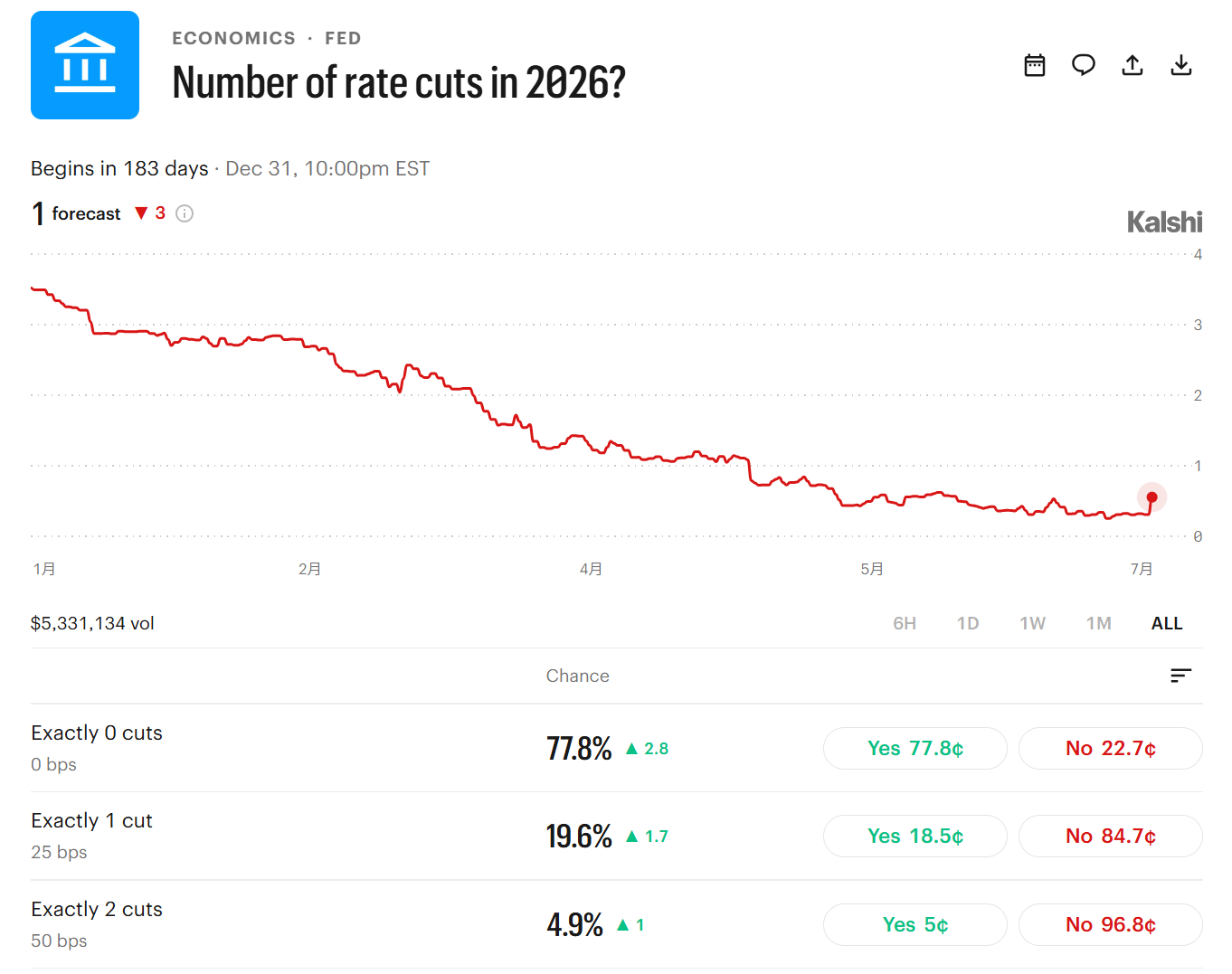


Amid persistent inflationary pressures and geopolitical disruptions, market expectations are heating up for the Fed to maintain high interest rates or even raise them further. The high real yield environment has significantly increased the attractiveness of holding cash or bonds, putting high-risk assets like Bitcoin in competition for capital.


The 10-year U.S. Treasury yield is hovering in a high range, coupled with macroeconomic uncertainty, further suppressing leveraged funds and risk appetite. Investors worry that if the Fed delays rate cuts or adopts a hawkish policy shift, it will prolong the adjustment cycle for risk assets.


Where is BTC's Bottom Range Exactly?


As BTC continues to fall, the market is beginning to predict its bottom price. In the 2018 Bitcoin bear market, the bottom price (monthly average) fell approximately 77% from the top (monthly average). In 2022, the bear market bottom price retraced about 73% from the top. Assuming BTC retraces 60% from $116,600 in this cycle, the bottom could potentially fall to around $46,000.
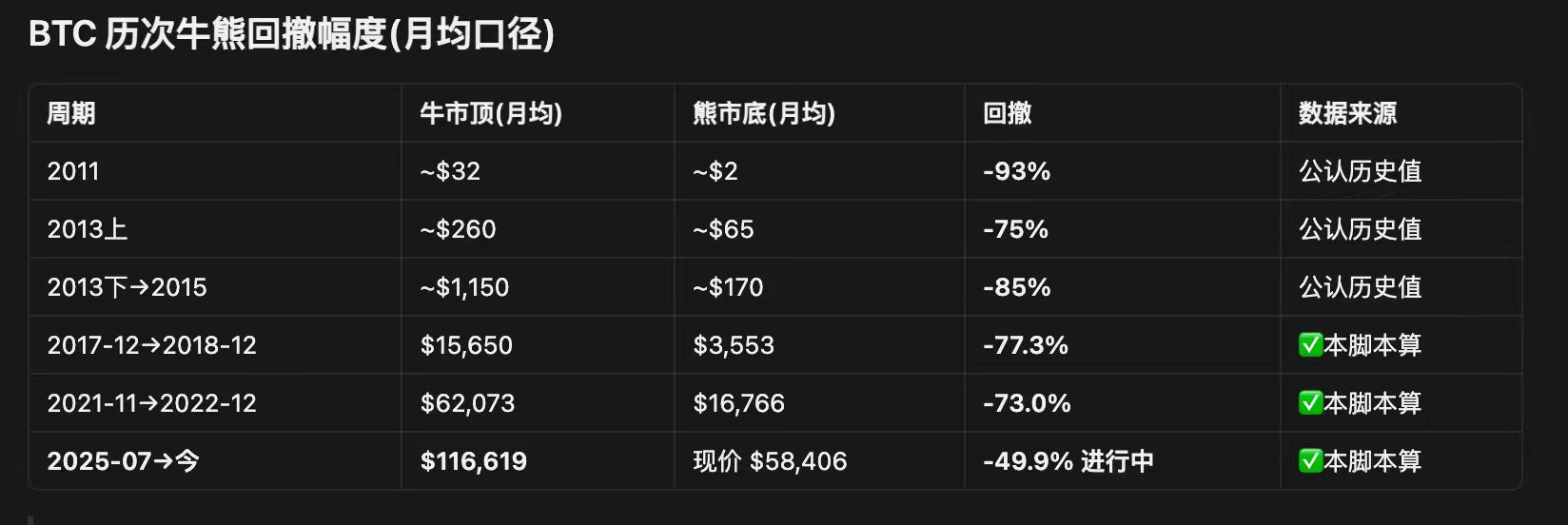


Glassnode Co-founder: This Cycle's BTC Bottom Likely Around $46,000 to $54,000 Range


Glassnode co-founder Rafael posted on X, stating that current institutional demand is not effectively absorbing the new supply of Bitcoin but is instead increasing selling pressure. Data shows that ETFs have seen a net outflow of 71,600 BTC over the past month, while Digital Asset Treasury companies only added 7,500 BTC. After deducting issuance, the combined net outflow from ETFs and DATs reached 77,000 BTC. Until this net outflow turns positive, any price rebound will face continuous selling pressure.
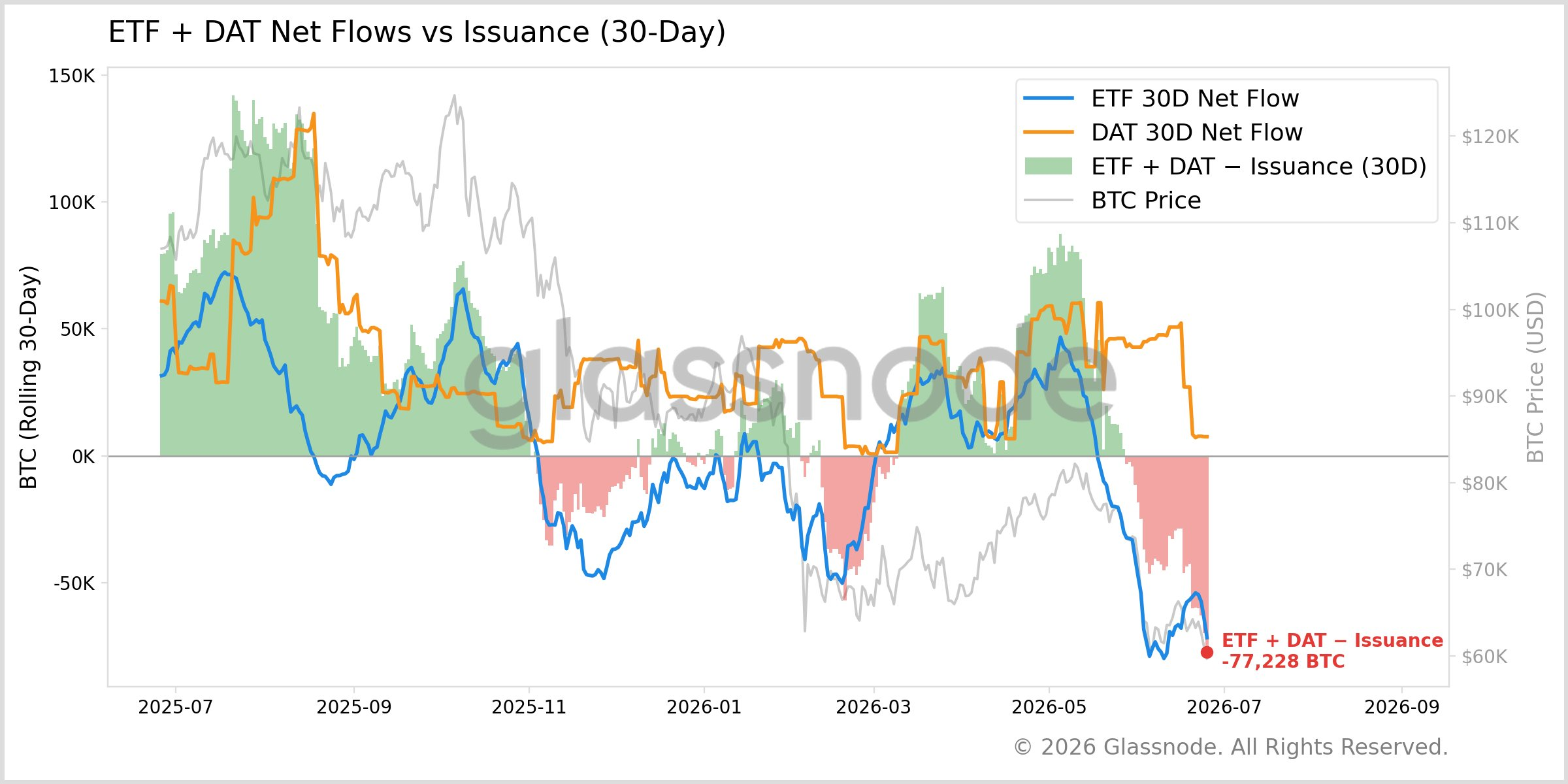


Rafael pointed out on June 5th (when BTC price was around $62,000) that the bottom for this cycle's BTC is likely in the range of $46,000 to $54,000.
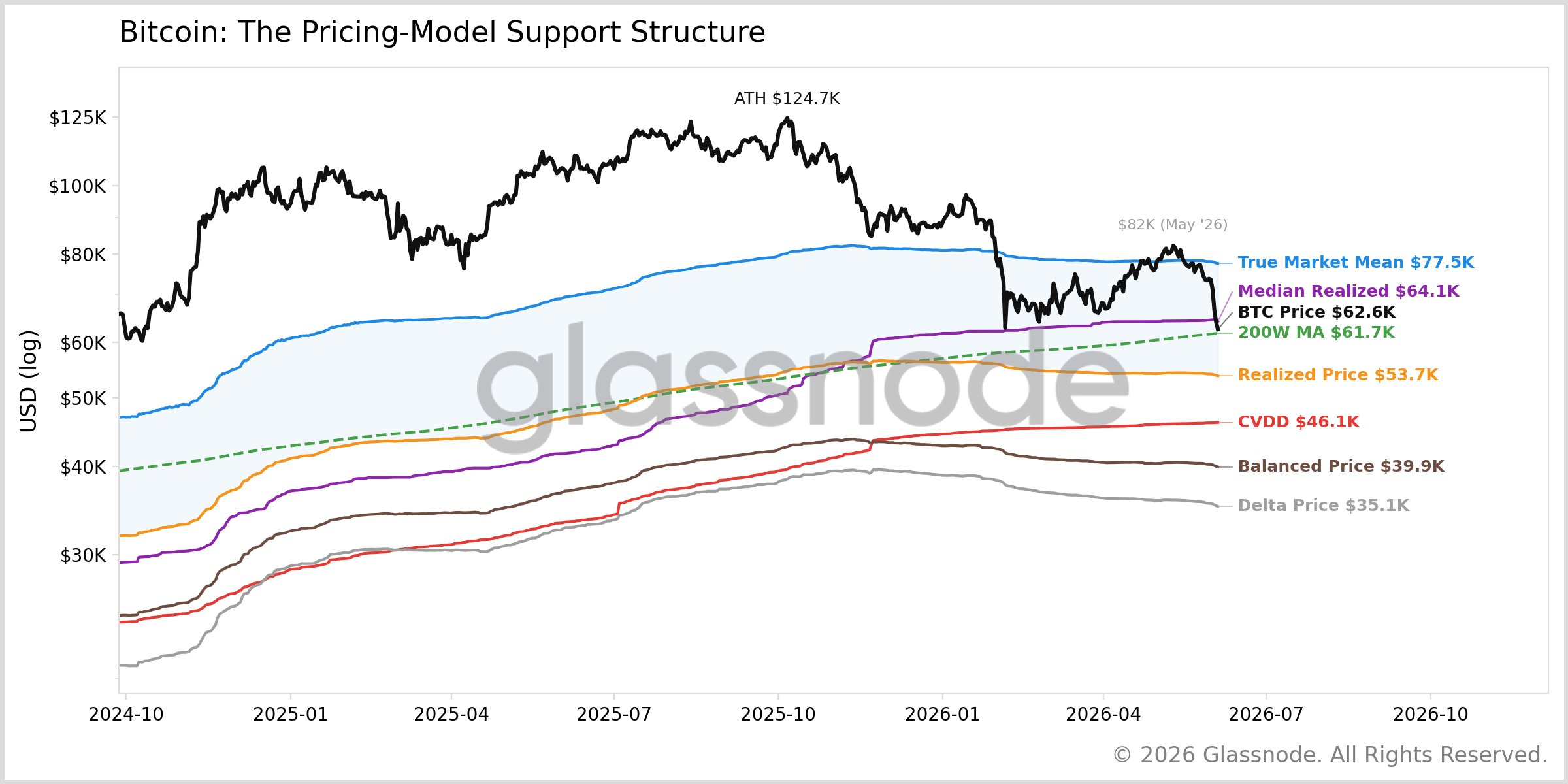

This range is primarily based on two key on-chain indicators:

Realized Price ≈ $54,000, serving as a crucial support level representing the market's overall cost basis.

Cycle Value Day Destroyed (CVDD) ≈ $46,200, where historical lows often form within 5%-18% above this level.


BIT: Bear Market Enters Final Stage, $50k~$55k May Become Key Range


In mid-June, BIT published an article stating that from a technical structure perspective, the top formation in 2025 highly resembles that of 2021. Both cycles experienced rapid surges, breaking below the 21-week moving average, followed by a staged rebound before turning weak again. Historical experience suggests that true bottoms are often accompanied by declining volume and narrowing consolidation ranges, rather than rapid reversals. Currently, the Fear and Greed Index is at historically low levels, and the stochastic indicator is in deeply oversold territory.
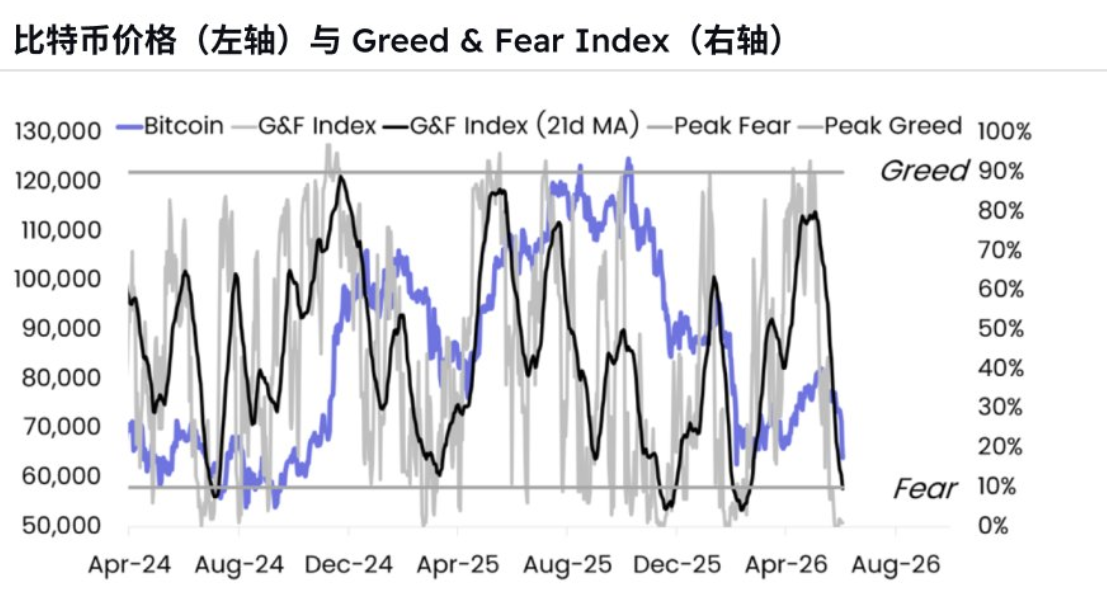


Combined with Elliott Wave Theory, Bitcoin has entered a typical A-B-C correction structure since the bear market began in October 2025. As the B-wave rally ended after rising to $83,000 in mid-May, the current C-wave decline is unfolding, potentially targeting the $50,000 area. The low point is expected to appear around the period of the FIFA World Cup (June 11 to July 19, 2026). Overall, this bear market is nearing its end, and the $50,000–$55,000 range may become the core bottom area for this cycle.


Wintermute: Crypto Market Has Entered Late Bear Market Phase, But True Bottom May Not Have Arrived Yet


Wintermute recently released a report suggesting that current market sentiment has entered an extreme fear range, with the Fear and Greed Index remaining between 18 and 24. Approximately half of Bitcoin's circulating supply is in a state of unrealized loss, both characteristics approaching historical bear market bottoms. However, the report points out that what is currently lacking is a renewed inflow of funds. Spot ETFs have seen net outflows of about $1.8 billion recently, and stablecoin and other liquidity indicators have yet to show improvement. The report also notes that Bitcoin reserve companies are beginning to retain the right to sell BTC to pay dividends, implying that the long-standing "permanent buy-side" in the market is gradually turning into a "conditional buy-side."


Wintermute expects that, influenced by historical seasonal patterns, the crypto market is unlikely to complete its bottoming process during the summer. A true bottom is more likely to arrive around September to October. Subsequent trends will still depend on the macro environment, the cooling of the AI sector, and the return of capital flows to the crypto market.


JackYi: July to August May Be Bitcoin's Final Bottoming Time, Also the Best Time to Buy the Dip


Liquid Capital founder JackYi posted on X, stating, "This is the third wave of decline since October 11. According to wave theory and cycle patterns, this should be the last major drop for Bitcoin. What everyone cares most about is the bottom price this time for Bitcoin, with the main factors being U.S. stocks and MicroStrategy. It's unclear whether the Fed's concerns about CPI will trigger changes in rate cut or even rate hike expectations, leading to a sustained correction in U.S. stocks. Secondly, past bear market tails often witness black swan events or explosions; we haven't seen that yet and need to observe closely. Calculating from Bitcoin's peak of $126k, a 60% drop would be $51k, and a 66% drop would be $43k. Regardless, July to August should be the final period and also the best time to buy the dip, potentially the most opportune operation for the next three years."


Jiang Zhuo'er: This Cycle's BTC Bear Market May Bottom Between October and December This Year, Price Around $42k to $44k


BTC.TOP founder and CEO Jiang Zhuo'er (Jiang Zhuo'er) posted on X on June 25th, stating that MSTR's mNAV has now fallen to 0.72, close to the historical low of 0.7 from May 2022, placing it in the trough region of this cycle's mNAV. However, mNAV bottoming typically leads BTC price bottoming by about 6 months. In the last cycle, the mNAV low corresponded to BTC around $31,000, while BTC's true bottom appeared at $15,500 in November 2022. Based on the four-year cycle and mathematical models, he predicts this cycle's BTC bear market will bottom between October and December this year, with a price range of approximately $42,000 to $44,000.


Polymarket Data: 30% Probability BTC Falls Below $40k This Year
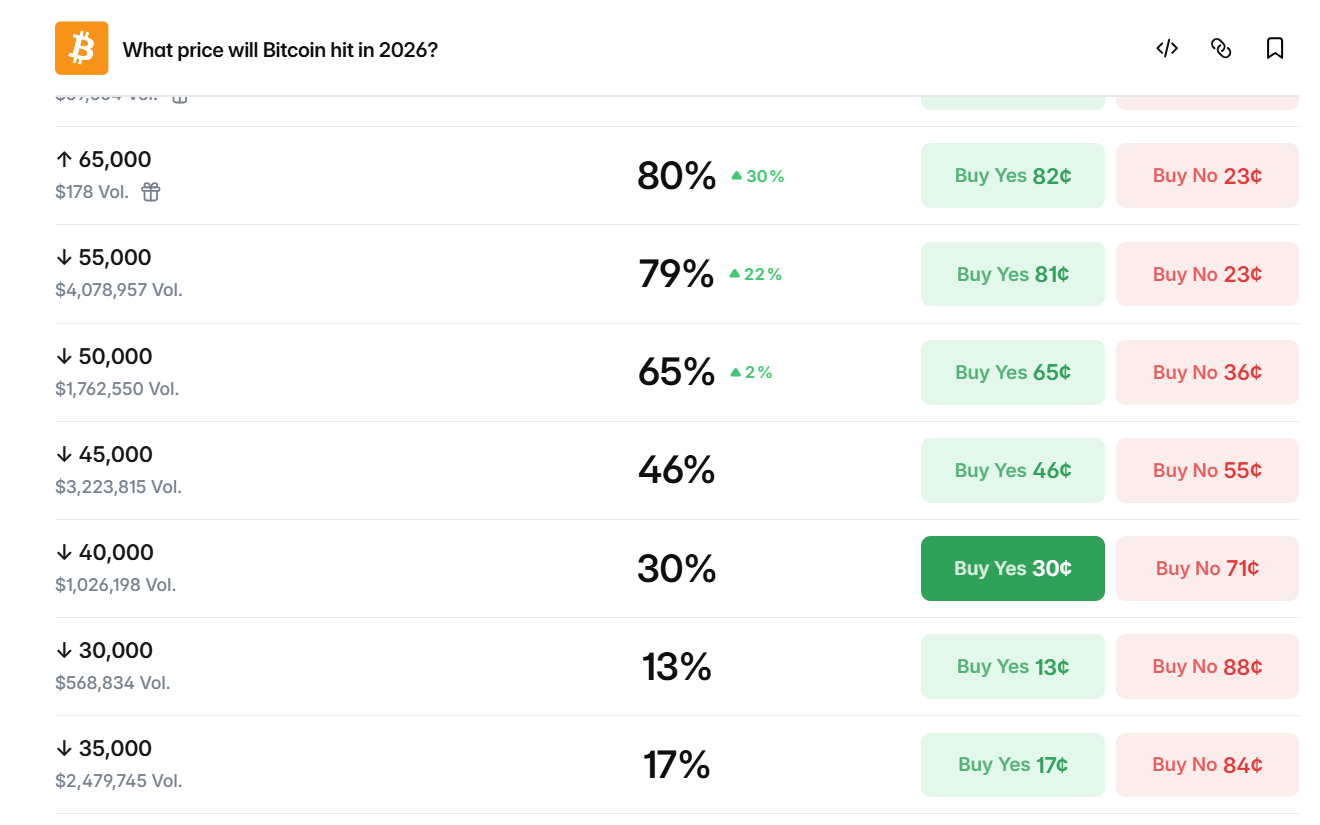


Latest Polymarket data shows the market currently places a 79% probability on BTC falling below $55k this year, a 65% probability on falling below $50k, a 30% probability on falling below $40k, a 17% probability on falling below $35k, and a 13% probability on falling below $30k. The trading volume on this prediction market has now exceeded $45.42 million.


Trending Cryptos

Related Questions

QAccording to the article, what are the two main headwinds Bitcoin is currently facing?

ABitcoin is currently facing two major headwinds: unprecedented net outflows from spot ETFs (a structural reversal from the high inflows of 2025) and dashed expectations for Federal Reserve interest rate cuts.

QWhat is the estimated bottom price range for Bitcoin according to glassnode's co-founder?

AAccording to glassnode co-founder Rafael, the estimated bottom price range for Bitcoin is between $46,000 and $54,000, based on key on-chain metrics: the Realized Price (~$54,000) and the Cycle Value Date Destroyed (CVDD, ~$46,200).

QBased on historical bear market drawdowns cited in the article, what is a potential bottom price if Bitcoin retraces 60% from its all-time high?

AIf Bitcoin retraces 60% from its all-time high of approximately $126,000, a potential bottom price would be around $46,000 (calculated as $126,000 * 0.40 = $50,400, but the article specifically states the result is near $46,000).

QWhat does the Polymarket prediction data indicate about the probability of Bitcoin falling below $40,000 this year?

AAccording to Polymarket prediction data cited in the article, the market currently assigns a 30% probability that Bitcoin will fall below $40,000 this year.

QWhich two analysts mentioned in the article suggest that July-August 2026 could be a key time for a market bottom or a buying opportunity?

ATwo analysts suggesting July-August 2026 as a key time are: BIT, which indicated the low might occur around the FIFA World Cup period (June 11 - July 19), and Liquid Capital founder JackYi, who stated that July-August should be the final bottoming time and the best time to buy.

Related Reads

The Largest Upgrade Since The Merge? How Glamsterdam Will Affect Ethereum and Regular Users?

The upcoming Glamsterdam upgrade, scheduled for late 2026, is considered Ethereum's most significant change since The Merge. It focuses on fundamentally restructuring Ethereum's block production, transaction execution, and gas pricing to enable major scalability improvements while preserving decentralization. The upgrade centers on three key innovations: * **Enshrined PBS (ePBS)**: Moves the Proposer-Builder Separation mechanism into the protocol's core, eliminating reliance on external relays. This reorganizes the block pipeline, extending the time window for processing execution payloads, which is crucial for safely increasing block capacity. * **Block-Level Access Lists (BALs)**: Attaches a "map" to each block, declaring in advance which state data its transactions will access. This enables potential parallel transaction processing and faster node synchronization, breaking a key performance bottleneck. * **Gas Repricing**: Introduces a more accurate resource pricing model by separating computation costs from state storage costs. This discourages uncontrolled state growth by making operations that create permanent data (like new accounts) more accurately reflect their long-term network burden. Together, these changes aim to solve the core challenges of increasing Ethereum's throughput (e.g., raising the Gas Limit) without overburdening node hardware or increasing centralization risks. They prepare the infrastructure for higher capacity, targeting a credible post-upgrade capacity of up to 200 million Gas. For users, the impact will be nuanced: * General transaction fees may become lower and more stable as block space increases. * Simple transfers could see cost reductions, while state-intensive operations (like contract deployment) may become relatively more expensive due to the new gas model. * Gas fee estimations by wallets will become more accurate. * L2 networks could benefit long-term from increased data blob capacity. * Standardized logs for all ETH transfers (EIP-7708) will improve tracking for wallets and exchanges. Ultimately, Glamsterdam represents a foundational shift, not a simple block size increase. It seeks to expand Ethereum's capacity by re-engineering its underlying mechanics, maintaining its commitment to decentralization while enabling significant performance gains.

marsbit1h ago

The Largest Upgrade Since The Merge? How Glamsterdam Will Affect Ethereum and Regular Users?

marsbit1h ago

Circle CEO Responds to the OUSD Challenge: Stablecoin is a Winner-Takes-All Business, and We Won't Slow Down

In response to questions about the OUSD stablecoin initiative, Circle CEO Jeremy Allaire argues that the stablecoin market is a "winner-take-most" platform business driven by powerful network effects, and Circle has no plans to slow down. He outlines three key drivers behind USDC's dominant position: 1. **Protocol/Software Layer Network Effects**: The value of a stablecoin network grows as more developers and services integrate it, creating compounding utility and user preference. Circle has spent nearly a decade building this ecosystem with USDC, now accelerated by mainstream adoption and enhanced by software stacks like CCTP and Gateway for interoperability. 2. **Liquidity Network Effects**: Liquidity begets more liquidity. USDC has achieved top-tier global liquidity—ranking among the top three digital assets alongside BTC and USDT—through nearly a decade of building deep primary and secondary market access across regions and venues. 3. **Regulatory and Policy Integration**: Establishing a global stablecoin requires deep regulatory engagement, licensing, and compliance across key markets—a significant, long-term investment where Circle is a leader. Allaire cites Artemis data showing USDC facilitated 80% of all dollar stablecoin on-chain transaction volume in Q1 2026, with USDT at 20% and all others negligible. He addresses OUSD's purported advantages: "free" minting/burning is often not sustainable in practice; redistributing all revenue can starve essential infrastructure investment; and large consortium models historically struggle with inefficiency and slow execution, unlike focused strategic partnerships. He reaffirms Circle's strong ongoing partnership with Coinbase on USDC and notes Circle collaborates with dozens of other stablecoin issuers through its expanding platform (Arc, CCTP, CPN, etc.). While welcoming OUSD to the ecosystem, Allaire asserts that Circle's vast, trusted network and continued investment make USDC the foundational digital dollar infrastructure for the world.

链捕手1h ago

Circle CEO Responds to the OUSD Challenge: Stablecoin is a Winner-Takes-All Business, and We Won't Slow Down

链捕手1h ago

Q2 Crypto Market Review: Did Bitcoin Rise for 'Nothing'? Did Money Flow to AI and On-Chain?

Q2 2026 Crypto Market Recap: Bitcoin's Gains Erased Amid Shift to AI and On-Chain Activity The second quarter of 2026 saw a significant reversal for the cryptocurrency market. Bitcoin gave back all its April gains, ending Q2 down approximately 11%, while major stock indices posted strong gains. This divergence was driven by a hawkish shift in Fed rate expectations, capital rotation into AI stocks, and weakening liquidity channels into crypto. Key demand pillars deteriorated simultaneously. Spot Bitcoin ETFs recorded net outflows of $4.08 billion for the quarter, with outflows dominating June. Crypto treasury entity Strategy's bitcoin accumulation slowed markedly, and the total stablecoin market cap contracted by ~$4.2 billion. This created a tighter liquidity environment. Exchange data reflected the downturn. Spot trading volumes fell 28% quarter-over-quarter. The market underwent significant deleveraging, with $8.35 billion in long liquidations for BTC and ETH, primarily in late May/early June. Open interest and order book liquidity also declined. Despite the bearish price action, structural developments point to an expanding on-chain ecosystem. These include the rise of tokenized stocks with full legal rights, the growth of RWA (real-world asset) perpetual contracts for trading stocks and commodities 24/7, and the use of crypto markets for price discovery ahead of major events like the SpaceX IPO. On-chain vaults are also emerging as a core layer for institutional capital allocation.

Foresight News1h ago

Q2 Crypto Market Review: Did Bitcoin Rise for 'Nothing'? Did Money Flow to AI and On-Chain?

Foresight News1h ago

Trading

Spot

Hot Articles

What is $BITCOIN

DIGITAL GOLD ($BITCOIN): A Comprehensive Analysis Introduction to DIGITAL GOLD ($BITCOIN) DIGITAL GOLD ($BITCOIN) is a blockchain-based project operating on the Solana network, which aims to combine the characteristics of traditional precious metals with the innovation of decentralized technologies. While it shares a name with Bitcoin, often referred to as “digital gold” due to its perception as a store of value, DIGITAL GOLD is a separate token designed to create a unique ecosystem within the Web3 landscape. Its goal is to position itself as a viable alternative digital asset, although specifics regarding its applications and functionalities are still developing. What is DIGITAL GOLD ($BITCOIN)? DIGITAL GOLD ($BITCOIN) is a cryptocurrency token explicitly designed for use on the Solana blockchain. In contrast to Bitcoin, which provides a widely recognized value storage role, this token appears to focus on broader applications and characteristics. Notable aspects include: Blockchain Infrastructure: The token is built on the Solana blockchain, known for its capacity to handle high-speed and low-cost transactions. Supply Dynamics: DIGITAL GOLD has a maximum supply capped at 100 quadrillion tokens (100P $BITCOIN), although details regarding its circulating supply are currently undisclosed. Utility: While precise functionalities are not explicitly outlined, there are indications that the token could be utilized for various applications, potentially involving decentralized applications (dApps) or asset tokenization strategies. Who is the Creator of DIGITAL GOLD ($BITCOIN)? At present, the identity of the creators and development team behind DIGITAL GOLD ($BITCOIN) remains unknown. This situation is typical among many innovative projects within the blockchain space, particularly those aligning with decentralized finance and meme coin phenomena. While such anonymity may foster a community-driven culture, it intensifies concerns about governance and accountability. Who are the Investors of DIGITAL GOLD ($BITCOIN)? The available information indicates that DIGITAL GOLD ($BITCOIN) does not have any known institutional backers or prominent venture capital investments. The project seems to operate on a peer-to-peer model focused on community support and adoption rather than traditional funding routes. Its activity and liquidity are primarily situated on decentralized exchanges (DEXs), such as PumpSwap, rather than established centralized trading platforms, further highlighting its grassroots approach. How DIGITAL GOLD ($BITCOIN) Works The operational mechanics of DIGITAL GOLD ($BITCOIN) can be elaborated on based on its blockchain design and network attributes: Consensus Mechanism: By leveraging Solana’s unique proof-of-history (PoH) combined with a proof-of-stake (PoS) model, the project ensures efficient transaction validation contributing to the network's high performance. Tokenomics: While specific deflationary mechanisms have not been extensively detailed, the vast maximum token supply implies that it may cater to microtransactions or niche use cases that are still to be defined. Interoperability: There exists the potential for integration with Solana’s broader ecosystem, including various decentralized finance (DeFi) platforms. However, the details regarding specific integrations remain unspecified. Timeline of Key Events Here is a timeline that highlights significant milestones concerning DIGITAL GOLD ($BITCOIN): 2023: The initial deployment of the token occurs on the Solana blockchain, marked by its contract address. 2024: DIGITAL GOLD gains visibility as it becomes available for trading on decentralized exchanges like PumpSwap, allowing users to trade it against SOL. 2025: The project witnesses sporadic trading activity and potential interest in community-led engagements, although no noteworthy partnerships or technical advancements have been documented as of yet. Critical Analysis Strengths Scalability: The underlying Solana infrastructure supports high transaction volumes, which could enhance the utility of $BITCOIN in various transaction scenarios. Accessibility: The potential low trading price per token could attract retail investors, facilitating wider participation due to fractional ownership opportunities. Risks Lack of Transparency: The absence of publicly known backers, developers, or an audit process may yield skepticism regarding the project's sustainability and trustworthiness. Market Volatility: The trading activity is heavily reliant on speculative behavior, which can result in significant price volatility and uncertainty for investors. Conclusion DIGITAL GOLD ($BITCOIN) emerges as an intriguing yet ambiguous project within the rapidly evolving Solana ecosystem. While it attempts to leverage the “digital gold” narrative, its departure from Bitcoin's established role as a store of value underscores the need for a clearer differentiation of its intended utility and governance structure. Future acceptance and adoption will likely depend on addressing the current opacity and defining its operational and economic strategies more explicitly. Note: This report encompasses synthesised information available as of October 2023, and developments may have transpired beyond the research period.

539 Total ViewsPublished 2025.05.13Updated 2025.05.13

What is $BITCOIN

Discussions

Welcome to the HTX Community. Here, you can stay informed about the latest platform developments and gain access to professional market insights. Users' opinions on the price of BTC (BTC) are presented below.

活动图片