AAVE Rallies 30% in a Week, Is It Back on Track?

Foresight NewsPublished on 2026-06-30Last updated on 2026-06-30

Abstract

Over the past week, the price of AAVE surged from around $70 to nearly $100, a rebound exceeding 30%. This occurred despite Aave's TVL continuing to decline following the Kelp DAO security incident. The price movement was partly driven by market rumors, first reported by CoinDesk, that Kraken was negotiating to acquire a stake in Aave. While Aave founder Stani Kulechov denied the specific terms, he confirmed discussions with multiple parties about purchasing Aave Labs' AAVE tokens. He also revealed ongoing work on Tokenomics 3.0, featuring an automated buyback mechanism, and plans to expand into securities-backed lending. Analysts remain optimistic about Aave's long-term prospects. Standard Chartered gave an extremely bullish $3,500 price target for 2030, citing DeFi revival and RWA tokenization. Grayscale offered a more conservative one-year target of $175. However, competitors like Morpho are gaining traction, with recent reports highlighting its advantages in capital efficiency and customization. Morpho also secured a massive $175 million funding round. Fundamentally, Aave maintains its dominance as the leading DeFi lending protocol. Its TVL is nearly double that of second-place Morpho and rivals the combined total of the next several competitors. Key metrics like active borrowing, total supply, and revenue significantly outpace rivals. While Aave faces challenges from newer, more flexible protocols, its deep liquidity and established position make it a preferred choice ...


Written by: Eric, Foresight News


In the past week, the price of AAVE surged from around $70 to nearly $100, marking a rebound of over 30%.
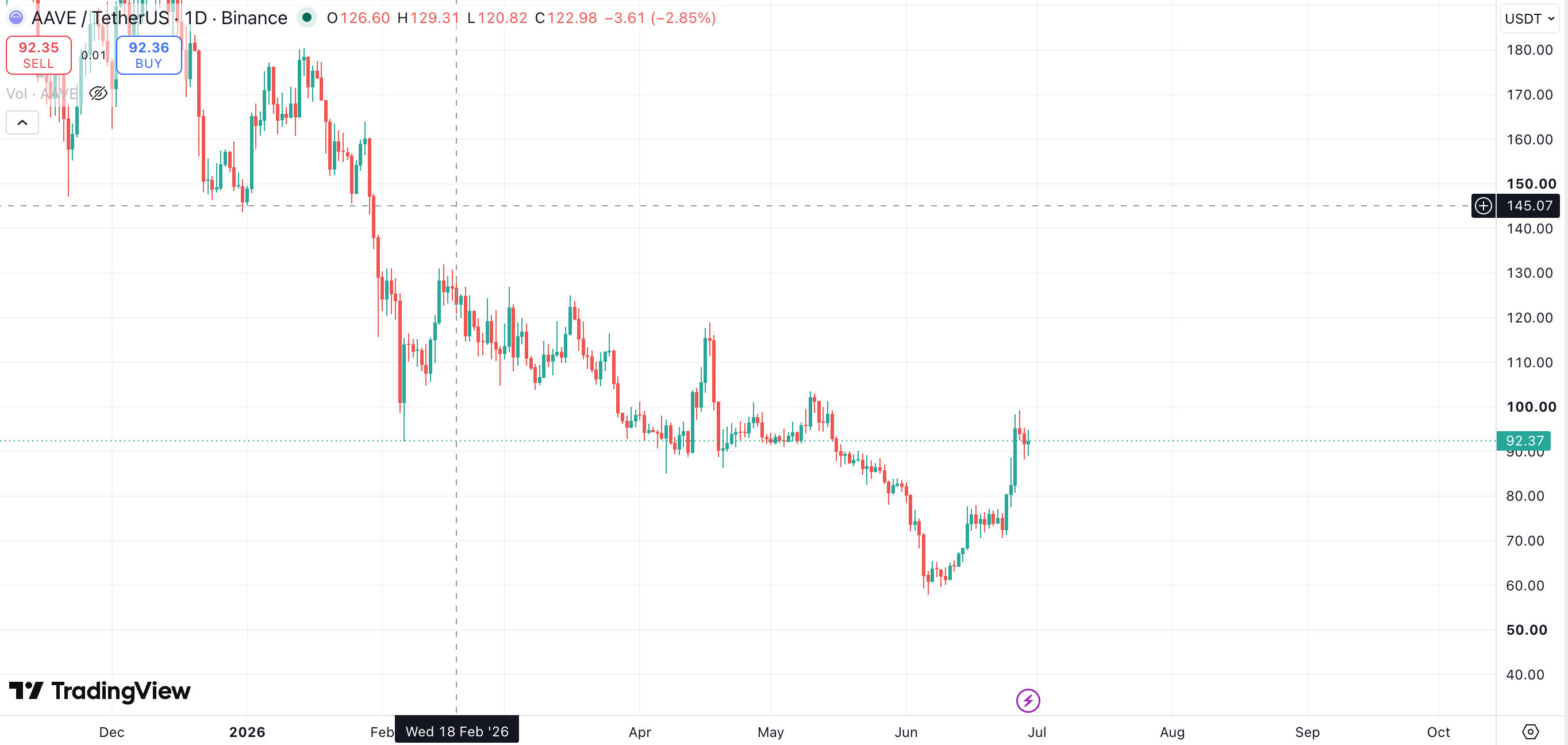


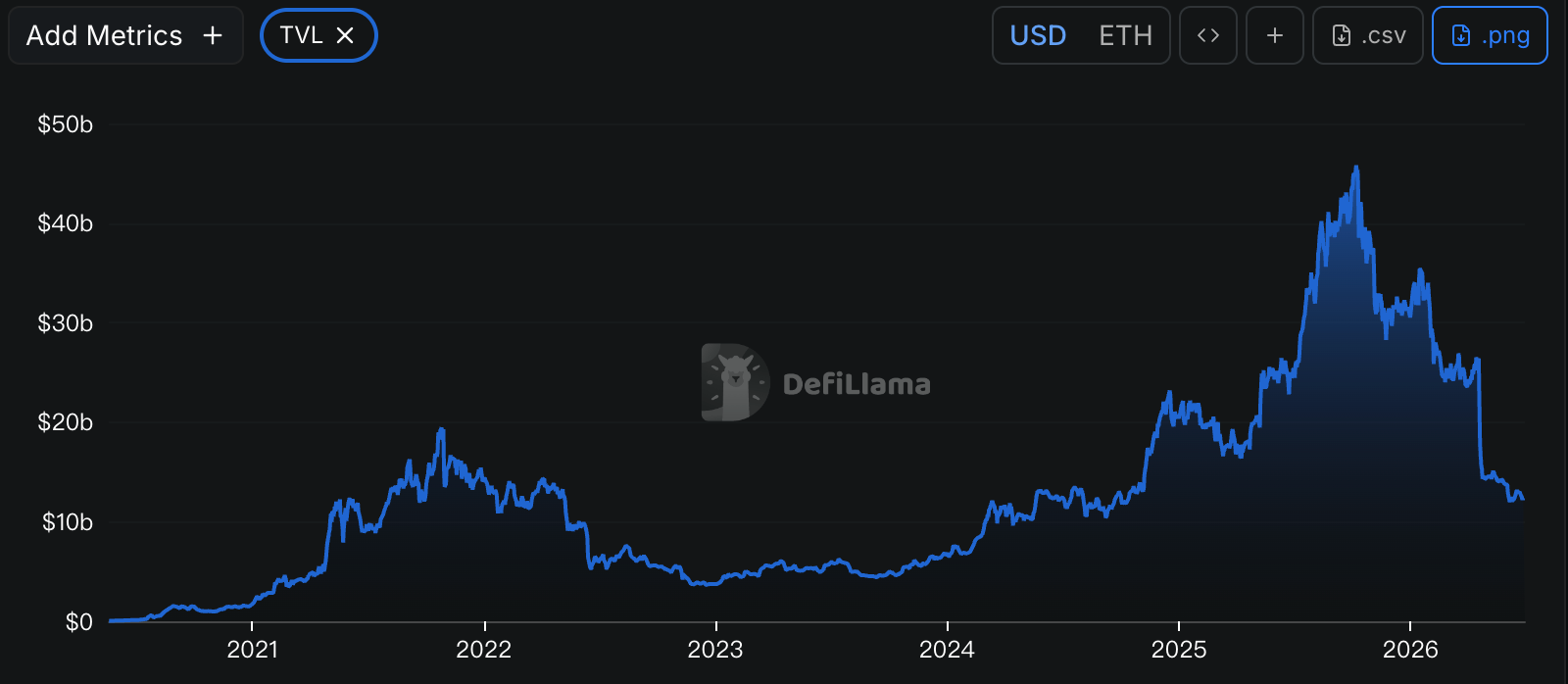
Looking solely at the TVL data, Aave still hasn't recovered from the Kelp DAO attack incident. In fact, its TVL has declined further compared to the panic-driven levels seen during that period.


Despite the underwhelming data, Aave continues to attract capital interest. In the early hours of June 26, CoinDesk, citing sources, reported that Kraken was in talks to acquire a stake in Aave. The potential deal involved exchanging 35,000 ETH for 250,000 AAVE tokens and 15% equity in Aave Group, valuing the entire transaction at $71 million.


This report from sources was quickly refuted by Aave founder Stani Kulechov, as the reported valuation would imply Kraken valuing Aave at less than one-third of its token's market capitalization. Stani denied any intention to "sell tokens at a 70% discount" but acknowledged that "multiple market participants have discussed directly or indirectly purchasing AAVE tokens held by Aave Labs through deeper, long-term partnerships."


The prospect of someone buying the dip naturally spurred others to front-run. Aave's price rose for three consecutive days on June 24, 25, and 26, with the peak gain on the 26th exceeding 20%. Beyond the acquisition rumors, Stani also revealed, while refuting the report, that research is underway for Tokenomics 3.0, which would introduce an automated buyback mechanism. Furthermore, on the evening of the 26th, he stated that Aave is expanding its target market from crypto assets to all asset classes through securities-backed lending and securities lending operations.


Standard Chartered Bank has given an extremely optimistic price prediction of $3,500 for Aave by 2030, citing bullishness on a future DeFi revival and the development of RWA tokenization. While more conservative, Grayscale also believes that, catalyzed by RWA tokenization, AAVE's price could reach $175 within a year.


Explicitly bearish views on Aave in the market are relatively few. However, reports released this year by Eco, Fensory, Coinstancy, among others, have pointed out that Morpho Blue surpasses Aave in rate optimization, capital efficiency, and custom market creation. Tiger Research went even further, suggesting that Morpho represents the "modular" trend, while Aave resembles a "traditional unified pool," lagging in flexibility.


From the initial source leak, to implicitly confirming the existence of potential AAVE token investors during the refutation, followed by successive revelations of protocol developments, the sequence carries a sense of strategic pacing. Setting these aside and looking purely at fundamentals, despite experiencing community division, security concerns, capital outflows, and other setbacks, Aave's TVL still firmly holds the top position among DeFi lending protocols. It is not only nearly double that of the second-place Morpho but also almost equal to the combined TVL of the 2nd, 3rd, and 4th place protocols.
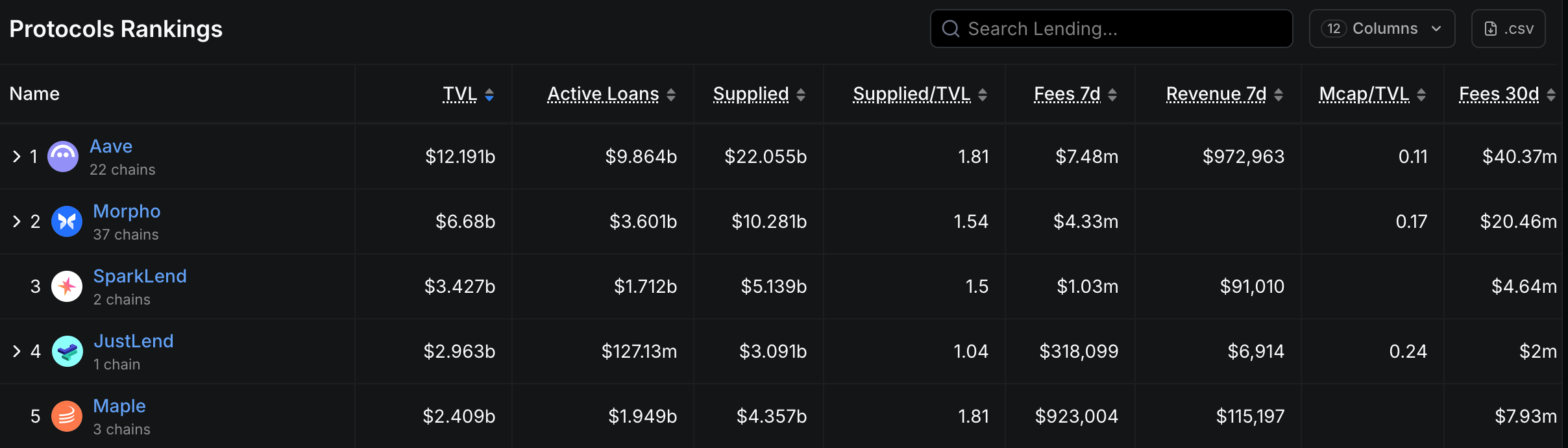


It's not just TVL; metrics like active borrowing, total supply, revenue, and fees also show significant leads. It has been nearly 9 years since ETHLend launched. Conflicts within the team and community, along with protocol risks, are not unforeseen, especially during an overall industry downturn. For a protocol whose code is immutable on-chain, as long as the protocol's core fundamentals haven't suffered a severe decline, the advantages accumulated over years are difficult to be fully eroded in a short period.


On the other hand, Morpho indeed shows a rising momentum. On June 9th, Morpho raised $175 million in a funding round led by Paradigm, Ribbit Capital, and a16z crypto, valuing the project at $2 billion, making it one of the largest single fundraising events in DeFi history. However, some also argue that Morpho and Aave have taken different paths, not competing directly on the same dimension, as each possesses core strengths that are difficult for the other to challenge.


Aave's lending depth makes it the preferred choice for whale users, and its not-high-but-stable yields are favored by many stablecoin holders—at least, this remained true before the Kelp DAO incident. Projects inevitably encounter bumps along the road. In a cryptocurrency market where quality investment targets are becoming increasingly scarce, projects that have withstood the test of time deserve sustained attention.


Trending Cryptos

Related Questions

QWhat is the main reason for the recent 30% price surge of AAVE, according to the article?

AThe main reason for the surge is reportedly a combination of rumors about a potential investment from Kraken and strategic announcements from the Aave team, such as working on Tokenomics 3.0 and expanding into securities-backed lending.

QWhat event significantly impacted Aave's TVL, and how is its TVL currently positioned compared to competitors?

AAave's TVL was significantly impacted by the Kelp DAO hack. Despite this, it remains the top DeFi lending protocol by TVL, holding nearly double the TVL of its closest competitor (Morpho) and almost the combined total of the second, third, and fourth places.

QHow did Aave founder Stani Kulechov respond to the Kraken acquisition rumors, and what key information did he confirm?

AStani Kulechov denied the specific details of the Kraken acquisition rumor, particularly the valuation at a 70% discount. However, he confirmed that discussions have been held with multiple market participants regarding potential long-term partnerships involving the purchase of AAVE tokens held by Aave Labs.

QWhat are the key future catalysts for AAVE's price mentioned by financial institutions in the article?

AFinancial institutions like Standard Chartered and Grayscale cite the revival of DeFi and the growth of Real World Asset (RWA) tokenization as key future catalysts for AAVE's price. Standard Chartered gave an extremely optimistic long-term target, while Grayscale provided a more conservative one-year target.

QWhat is the primary competitive challenge to Aave mentioned in the article, and how do their approaches differ?

AThe primary competitive challenge mentioned is Morpho. The article notes that reports highlight Morpho's advantages in interest rate optimization, capital efficiency, and custom markets. However, it also presents a view that Aave and Morpho operate on different dimensions: Aave excels in liquidity depth for large users, while Morpho represents a more flexible, 'modular' trend.

Related Reads

Can Open USD Support Stripe's Ambitions?

Can Open USD support Stripe's ambition? The article argues that OUSD represents a pivotal strategic move for Stripe, shifting its narrative from being a superior payments API company to becoming a "money movement network." Unlike simply facilitating payments, this new model aims to organize and define the settlement layer, default assets, and economic distribution rules for future commerce. The analysis highlights OUSD's role in giving Stripe a potential default settlement asset, enabling deeper economics through reserve earnings, and providing a programmable money layer for emerging use cases like AI agentic commerce. Crucially, OUSD is presented not as a direct "USDC killer" but as an attempt to redefine the business model of stablecoins, proposing a collaborative governance structure where contributing partners share in the network's economic benefits and governance. For Stripe, this is about evolving from a powerful "abstraction layer" over traditional financial rails into an active participant and potential architect of the next-generation global settlement network. While OUSD alone cannot immediately realize this ambition, it signals Stripe's intent to move closer to the money layer itself, positioning itself at the center of future money flows in an increasingly automated, platform-driven, and AI-powered economy. The ultimate question is whether Stripe can transition from being a best-in-class payment processor to becoming the foundational infrastructure for internet-native money movement.

marsbit6m ago

Can Open USD Support Stripe's Ambitions?

marsbit6m ago

This Week's Crypto Watchlist|Jupiter, NEAR, Jito, and 7 Other Projects are Active. Understand Who's Worth Monitoring with a 'Catalyst Calendar'

This week brings a concentrated wave of catalysts for several crypto projects, based on a schedule compiled by an analyst. Jupiter (JUP) leads by launching a private testnet for its GUM unified market on July 6th, aiming to aggregate diverse assets on Solana. On July 7th, NEAR hosts a major livestream reveal focused on enterprise "black box" tech, likely detailing its SPICE upgrade. Also on July 7th-8th, Berachain executes its largest mainnet upgrade, "PoL Next," simplifying its tokenomics by retiring the BGT token and consolidating value into BERA. Zcash (ZEC) eyes recovery with its critical Ironwood network upgrade slated for July 21st, designed to restore trust after a recent privacy vulnerability scare. Looking ahead, Lighter (LIT) plans to launch tokenized stocks next week, leveraging its key position as the default perpetual DEX on the new Robinhood Chain. Jito (JTO) is rumored to launch its JTX trading platform in mid-July, targeting professional traders and promising substantial protocol revenue sharing. Lastly, Ether.fi (ETHFI) has proposed deploying a dedicated Aave V4 instance to power its EtherFi Cash Visa card, though this remains in the early governance stage. The week presents a mix of product launches, major upgrades, and strategic expansions, each carrying its own potential for momentum and associated risks like token unlocks or execution challenges.

marsbit19m ago

This Week's Crypto Watchlist|Jupiter, NEAR, Jito, and 7 Other Projects are Active. Understand Who's Worth Monitoring with a 'Catalyst Calendar'

marsbit19m ago

Trading

Spot

Hot Articles

How to Buy AAVE

Welcome to HTX.com! We've made purchasing Aave Protocol (AAVE) simple and convenient. Follow our step-by-step guide to embark on your crypto journey.Step 1: Create Your HTX AccountUse your email or phone number to sign up for a free account on HTX. Experience a hassle-free registration journey and unlock all features.Get My AccountStep 2: Go to Buy Crypto and Choose Your Payment MethodCredit/Debit Card: Use your Visa or Mastercard to buy Aave Protocol (AAVE) instantly.Balance: Use funds from your HTX account balance to trade seamlessly.Third Parties: We've added popular payment methods such as Google Pay and Apple Pay to enhance convenience.P2P: Trade directly with other users on HTX.Over-the-Counter (OTC): We offer tailor-made services and competitive exchange rates for traders.Step 3: Store Your Aave Protocol (AAVE)After purchasing your Aave Protocol (AAVE), store it in your HTX account. Alternatively, you can send it elsewhere via blockchain transfer or use it to trade other cryptocurrencies.Step 4: Trade Aave Protocol (AAVE)Easily trade Aave Protocol (AAVE) on HTX's spot market. Simply access your account, select your trading pair, execute your trades, and monitor in real-time. We offer a user-friendly experience for both beginners and seasoned traders.

5.7k Total ViewsPublished 2024.03.29Updated 2026.06.02

How to Buy AAVE

Discussions

Welcome to the HTX Community. Here, you can stay informed about the latest platform developments and gain access to professional market insights. Users' opinions on the price of AAVE (AAVE) are presented below.

活动图片