JD.com y Mira Murati, ex CTO de Open AI, apuestan por la misma pista de IA

marsbitPublished on 2026-06-24Last updated on 2026-06-24

Abstract

Imagina que una persona mayor que vive sola se cae en casa y no puede pedir ayuda. Su dispositivo inteligente o una cámara, impulsado por IA, detecta la situación de forma autónoma y alerta a emergencias. Este no es un escenario futurista, sino el tipo de problema que busca resolver **JoyAI-VL-Interaction**, el primer modelo de interacción visiolingüística de código abierto del mundo, presentado por JD.com. En la industria de la IA, la interacción ha estado dominada por un formato de turnos: el usuario pregunta, el modelo responde. JD.com y otros, como Thinking Machines Lab de Mira Murati, identificaron la misma limitación y convergieron en una idea: la IA debe evolucionar de ser un procesador pasivo de información a un **participante activo** que "prediga el siguiente estado físico". JoyAI-VL-Interaction observa el flujo continuo de video de una cámara y decide *autónomamente* cuándo responder, cuándo guardar silencio y cuándo derivar tareas complejas a otros modelos. Su ventaja clave es colocar al **lenguaje visual como el motor principal** para la toma de decisiones, desacoplándolo del audio. Esto lo hace ideal para aplicaciones como asistencia a personas mayores o con discapacidad visual, comentarios automáticos en eventos deportivos, inspección de almacenes o robots colaborativos, donde los eventos ocurren demasiado rápido para una orden verbal. JD.com ha optado por una estrategia de **cód abierto integral** y un diseño ligero (8B parámetros), que permite ejecutar el ...

Imagina una escena:

Una persona mayor que vive sola se resbala en la sala de estar, y el dolor le impide pedir ayuda. En ese momento, el dispositivo inteligente que lleva puesto o la cámara de su casa "ve" la anomalía, y la IA, sin esperar ninguna orden de voz, emite activamente una alerta y contacta rápidamente con familiares o servicios de emergencia.

O estás viendo un partido de fútbol intenso, en el instante en que se produce el gol clave, antes de que puedas retroceder y preguntar, las gafas de IA te proporcionan automáticamente un análisis a cámara lenta y una explicación táctica.

Estas escenas ya no son fantasías del futuro, sino los problemas reales que el primer modelo de interacción visual-lingüística de pila completa de código abierto a nivel mundial de JD.com, JoyAI-VL-Interaction, intenta resolver.
En los últimos dos años, los límites de capacidad de los modelos grandes se han ido ampliando constantemente, pero la forma de interacción principal sigue siendo la lógica de "turnos": "el usuario pregunta, el modelo responde". Es eficiente, pero en muchos escenarios no es razonable. Muchos eventos importantes ocurren demasiado rápido para que el usuario formule una pregunta; en muchos casos, ni siquiera hay instrucciones de voz.

Este año, un juicio se está convirtiendo en consenso de la industria: la IA está pasando de "predecir el siguiente token" a "predecir el siguiente estado físico". Esto también significa que la IA debe evolucionar de ser un procesador de información pasivo a un participante activo.

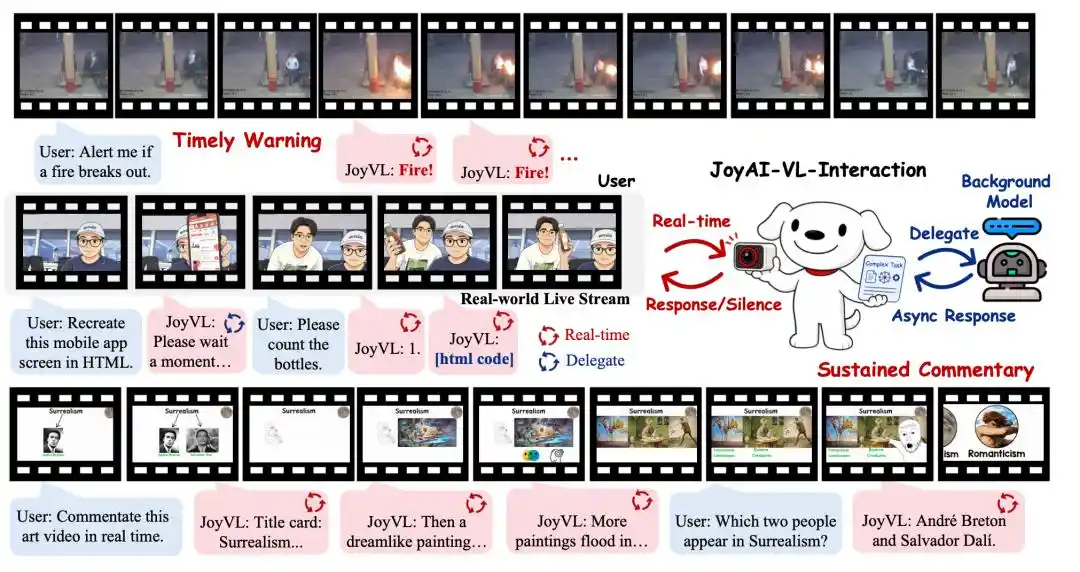
Precisamente en este momento, JD.com ha publicado como código abierto JoyAI-VL-Interaction, el primer modelo de interacción visual-lingüística en tiempo real de pila completa de código abierto a nivel mundial, capaz de juzgar de forma autónoma cuándo responder, cuándo guardar silencio y cuándo delegar tareas complejas en modelos de back-end dentro de un flujo de vídeo continuo.

Lo que JoyAI-VL-Interaction quiere demostrar es: una IA que realmente entra en el mundo físico no debería esperar siempre a que le pregunten, debería aprender a ver, juzgar de forma proactiva y ofrecer ayuda en el momento adecuado.

Esta es también la señal más amplia que JD.com AI está enviando: desde la capacidad del modelo hasta los escenarios industriales, la competencia en IA está pasando del interrogatorio dentro de la pantalla al mundo real.

¿Por qué la interacción visual-lingüística?

En el mundo físico real, una gran cantidad de información crítica ocurre en momentos en los que el usuario no tiene tiempo de plantear una pregunta. Lo que hace sentir que "no hay tiempo" es a veces un problema de experiencia, pero más a menudo es un límite de capacidad causado por el paradigma del modelo.

La industria no es ajena a esta limitación.

En la primera mitad de 2026, la interacción en tiempo real se convirtió en la palabra clave más candente de la IA multimodal. La industria avanzó principalmente por dos vías: una fue hacer la conversación por turnos más rápida, la otra fue hacer las conversaciones de voz más naturales.

La primera enfatiza la baja latencia o la entrada/salida arbitraria, pero su núcleo sigue siendo "responde solo si preguntas"; la segunda permite al modelo escuchar y hablar simultáneamente, ser interrumpido en cualquier momento, acercando la experiencia a una llamada telefónica real, pero el foco sigue estando en los escenarios de voz.

El problema es que muchos cambios en el mundo real no se convierten primero en una frase. Incendios, caídas, aproximación de vehículos, cambios en el contenido de la pantalla, anomalías en la línea de producción: todos son imágenes que aparecen antes que el lenguaje. Si la IA solo puede esperar a que la gente hable, le costará estar realmente "presente".

Quien realmente llegó a la misma conclusión que JD.com al mismo tiempo fue Thinking Machines Lab, fundada por Mira Murati. El 11 de mayo, esta empresa propuso el concepto de "modelos de interacción" (interaction models) y publicó algunas vistas previas de investigación, señalando que el paradigma de respuesta autónoma de los modelos de interacción, en comparación con el paradigma tradicional de pregunta-respuesta, presenta un espacio de imaginación mayor para la colaboración Humano-IA.

Que dos equipos convergieran en la misma idea casi al mismo tiempo es en sí misma una señal: hacer de la interactividad una capacidad del propio modelo y escalarla es una dirección inevitable para la industria en los próximos años.

La diferencia radica en que JD.com coloca el lenguaje visual en una posición más central, desacoplando el lenguaje oral como una E/S desmontable, haciendo del lenguaje visual la "modalidad de conducción principal" para la toma de decisiones autónomas del modelo.

Es decir, desde el momento en que se enciende la cámara, JoyAI-VL-Interaction "observará" continuamente los cambios visuales en el mundo físico y juzgará de forma autónoma si debe hablar, qué decir y si debe delegar la tarea.

Aquí reside también la imaginación de la interacción visual: se puede utilizar en escenarios como el cuidado de ancianos y niños, asistencia para invidentes, gafas de IA, comentarios deportivos, inspección de tiendas, logística de almacenes, colaboración con robots, etc. El usuario no necesita primero formular la pregunta en una frase; la IA puede captar la necesidad a partir de los cambios en el entorno.
Por lo tanto, la visión no es solo otra forma de entrada, sino un canal de percepción insustituible para que la IA avance hacia "predecir el siguiente estado físico".

El informe técnico de JoyAI-VL-Interaction de JD.com también refuerza este punto, mostrando que en seis escenarios de flujo real, JoyAI-VL-Interaction alcanzó una tasa de victoria del 77.6% frente a los principales modelos nacionales y del 87.9% frente a modelos internacionales; en el escenario de alerta por monitorización, que más pone a prueba la capacidad de captura de eventos, la tasa de victoria alcanzó el 100%. El informe considera que la diferencia no es solo la calidad de la respuesta, sino la capacidad de actuar en el momento correcto.

Sin embargo, lograr una interacción visual proactiva es ciertamente más difícil.

La adquisición de datos para la interacción por voz es relativamente directa; grandes conjuntos de datos de comandos de voz permiten al modelo aprender cuándo hablan los humanos, cómo interrumpir, cómo continuar. Los datos necesarios para la interacción visual son completamente diferentes. El modelo debe aprender, en un flujo continuo de imágenes cambiantes, qué señal merece una respuesta y qué señal debe ser silenciada.

Una barrera más profunda es la capacidad de definición del escenario. En la interacción por voz existe un límite de activación natural: que el usuario hable marca el inicio de la interacción. La interacción visual no tiene un inicio y un final claros; el modelo debe juzgar los límites por sí mismo dentro de un flujo de información sin fronteras.

La singularidad de JD.com reside precisamente aquí: esta empresa no busca escenarios desde un laboratorio abstracto, sino que opera naturalmente dentro de redes empresariales reales como comercio minorista, logística, salud e industria.

Esto significa que la IA de JD.com no se enfrenta a una única entrada de chat, sino a una multitud de tareas reales: cómo fluyen las mercancías, cómo colaboran los dispositivos, cómo cooperan los robots con las personas, cómo se detectan las anomalías con antelación. El modelo puede aprender de las necesidades reales e iterar a partir de los comentarios reales.

Aunque hay compensaciones en la ruta tecnológica, la forma de interacción futura para la AGI general debe ser la inteligencia activa. Los agentes inteligentes deben poseer el ciclo completo de percepción del entorno, toma de decisiones autónoma y respuesta en tiempo real. Por lo tanto, muchas empresas no es que no quieran hacer modelos grandes de interacción visual, sino que actualmente carecen del terreno fértil para que surja la interacción visual. Esta es también la razón por la que el capital y la potencia computacional han fluido primero hacia la pista de la interacción por voz.

Así que la elección de JD.com de empezar por la visión no es solo una elección técnica, sino también una decisión determinada por su posición estratégica. En comparación con muchos actores de modelos grandes, JD.com está más cerca de la operativa del mundo físico y también necesita más una IA capaz de percibir proactivamente y responder en tiempo real.

Para que ese día llegue más rápido, alguien tiene que empezar antes.

Ligero, de código abierto, desplegable

¿Qué significa ser el primero de pila completa y de código abierto a nivel mundial?

Redefinir el paradigma de interacción suena grandioso, pero cuando se aplica a aplicaciones reales, el primer obstáculo es muy simple: la IA no puede estar siempre molestando a las personas, ni permanecer en silencio cuando debería alertar.

Normalmente se espera que la IA hable cuanto más mejor, pero en escenarios de interacción visual en tiempo real, un modelo que no para de interrumpir no es inteligente. La capacidad verdaderamente valiosa es aparecer proactivamente en momentos clave y permanecer en silencio en momentos irrelevantes.

Por lo tanto, JoyAI-VL-Interaction entrena el "silencio" también como una capacidad. El modelo necesita dominar tres niveles de juicio: en qué escenarios debe responder proactivamente, en cuáles debe guardar silencio y en cuáles debe delegar la tarea, pasándola a otros modelos.

Si esta capacidad solo pudiera quedarse en los artículos de investigación, su valor sería limitado. El énfasis de JD.com en "pila completa de código abierto" radica precisamente en abrir simultáneamente el modelo, el sistema de inferencia y la ruta de construcción de aplicaciones, permitiendo a los desarrolladores ejecutarlo, modificarlo y utilizarlo de verdad.

JD.com ha elegido una ruta de ingeniería más fácil de difundir: un modelo de 8B de parámetros, desplegable con una sola tarjeta gráfica 3090. Con estos parámetros, los desarrolladores individuales pueden ejecutarlo, el hardware de consumo puede soportarlo y los dispositivos del lado del cliente pueden implementarlo.

Para la interacción visual en tiempo real, esta ligereza no significa una reducción de capacidad, sino una división del trabajo más clara.

JoyAI-VL-Interaction se asemeja más a una capa de interacción frontal, responsable de ver el entorno, juzgar el momento y realizar una comunicación breve. Cuando encuentra tareas complejas que requieren un razonamiento profundo, las delega automáticamente a agentes de back-end elegidos por el usuario, como OpenClaw, Codex, Claude Code, etc. Por lo tanto, un modelo de 8B es suficiente.

Por ejemplo, el modelo puede primero decirle al usuario "Déjame pensarlo", luego pasar el problema difícil al back-end y mantenerse presente; cuando el back-end devuelva el resultado, puede sincronizar la respuesta con el usuario. Durante este proceso, también puede continuar ayudando al usuario con otras interacciones inmediatas.

JD.com también ha diseñado el sistema subyacente para ser ligero: mediante codificación de vídeo, memoria de largo alcance y compresión de contexto, el modelo puede observar continuamente flujos de vídeo largos a un costo relativamente bajo, manteniendo la latencia de extremo a extremo en el nivel sub-segundo. Para el lector común, lo importante no son estos términos técnicos, sino el resultado: la IA puede permanecer en escenarios reales durante más tiempo y con un umbral de acceso más bajo.
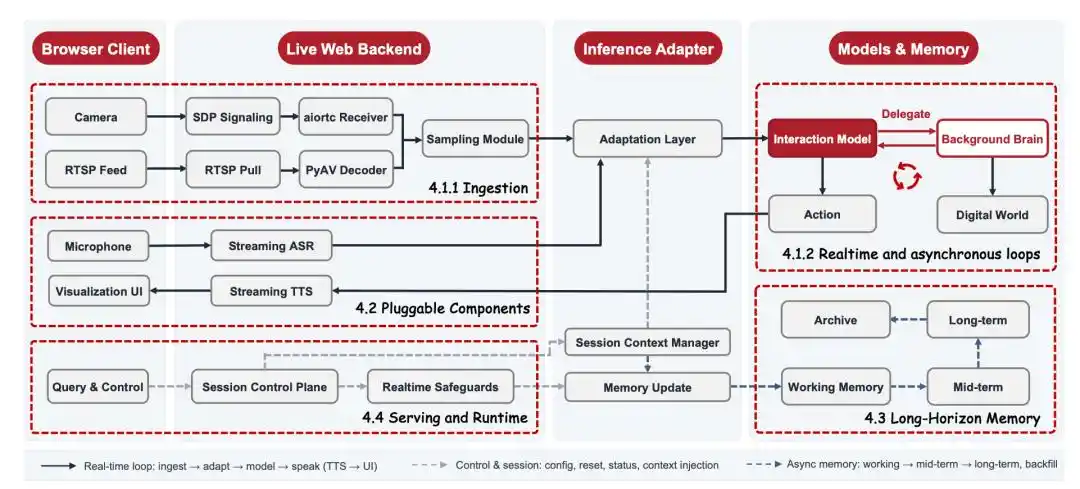
La elección rentable y desplegable también conduce directamente a la estrategia de código abierto de JD.com. Solo si el modelo es lo suficientemente ligero, el sistema lo suficientemente completo y el umbral de despliegue lo suficientemente bajo, la interacción visual en tiempo real puede pasar de ser un experimento de unos pocos equipos a convertirse en un ecosistema de aplicaciones explorado conjuntamente por más desarrolladores y empresas.

JD.com ya ha publicado como código abierto este sistema de inferencia, con un objetivo claro: permitir que cualquier persona con una tarjeta gráfica 3090 o superior y una cámara pueda configurar rápidamente su propia aplicación de interacción visual en tiempo real.

JoyAI-VL-Interaction ha obtenido soporte day-0 de vLLM-Omni y ya se ha integrado de forma nativa en la rama principal de vLLM-Omni.

Devolver la IA al mundo físico

El propósito del código abierto es entregar la imaginación aplicada a un mercado más amplio. Porque el valor del avance tecnológico finalmente debe ser verificado por el mundo real.

La primera ola de imaginación aplicada para JoyAI-VL-Interaction ya es muy intuitiva: en retransmisiones deportivas, la IA puede comentar automáticamente en el instante de un gol clave o decisivo; al monitorear el mercado de valores, puede observar continuamente los cambios en la pantalla y alertar sobre anomalías; en el cuidado familiar, puede alertar proactivamente cuando una persona mayor se cae o un niño se acerca a una zona peligrosa; combinado con gafas de IA, puede ayudar al usuario a reconocer calles, productos, pantallas y el entorno circundante; al servir a personas invidentes, puede convertir la información visual en asistencia en tiempo real.

Para JD.com, lo que más espera es que se pueda integrar en robots: un modelo que sabe cuándo hablar, cuándo callar y cuándo pedir ayuda al sistema de back-end puede hacer que los robots sean más eficientes y se acerquen más al asistente inteligente "con tacto" que la gente espera.

La razón fundamental por la que JD.com se atreve a "agitar" este campo en este momento es porque posee activos de datos del mundo físico que otros actores de modelos grandes no tienen.

Situado en las coordenadas de la industria de 2026, el peso de los activos de datos del mundo físico es especialmente significativo.

2026 ha sido llamado por la industria el "Año Cero de los Datos de Inteligencia Encarnada", y en este contexto generalizado, existe una contradicción aguda: los datos de interacción física de alta calidad son extremadamente escasos, muy lejos de satisfacer las necesidades de entrenamiento a gran escala. El cuello de botella de la iteración algorítmica se está trasladando completamente del lado del modelo al lado de los datos.

En este punto temporal, JD.com anunció su intención de acumular 10 millones de horas de datos de vídeo de alta calidad de escenarios reales en dos años, movilizando a 600,000 personas para participar en la recolección.

JD.com tiene más de 3,000 escenarios empresariales reales, cubriendo áreas como comercio minorista, logística, salud e industria. Este año, además, ha innovado en Suqian con un modelo de recolección comunitaria por cuadrículas, desplegando de forma masiva sus terminales de cabeza JoyEgoCam de desarrollo propio, movilizando a pequeñas y medianas empresas y residentes de los alrededores para recolectar datos en escenarios de trabajo reales.

La velocidad de despliegue es rápida. En marzo, JD.com anunció la finalización del primer centro de recolección de datos de inteligencia encarnada del mundo en Suqian; en abril, publicó la primera infraestructura de datos encarnados de la industria que cubre toda la cadena de recolección, almacenamiento, etiquetado, entrenamiento, evaluación, simulación y prueba; en mayo, JoyEgoCam entró en producción masiva, recolectando continuamente datos en primera persona.

Estos datos son el combustible más escaso para entrenar modelos encarnados y modelos de interacción visual. A medida que los datos encarnados se incorporen al entrenamiento, el valor de JoyAI-VL-Interaction también pasará de "un modelo que puede ver proactivamente" a integrarse aún más en espacios físicos más concretos como robots, vehículos no tripulados, almacenes, tiendas y hogares.

Entre el modelo y la aplicación, JoyAI-Echo, también publicado como código abierto por JD.com el 3 de junio, juega un papel igualmente clave. Echo se especializa en la generación en tiempo real de vídeos largos, e Interaction se especializa en la comprensión e interacción en tiempo real. La publicación como código abierto de dos modelos en un mes significa que JD.com ya ha conectado los extremos de entrada y salida de la multimodalidad de vídeo, y ha colocado el avance de la IA hacia el mundo físico en una posición más a largo plazo.

En la conferencia de lanzamiento del 618 de este año, JD.com dijo que quiere convertirse en el "centro operativo del mundo físico más grande del mundo".

En la era de la interacción humano-máquina, la industria está prestando cada vez más atención a cómo la IA comprende el mundo físico, pero la lógica de solución de JD.com es diferente a la de la mayoría de los actores de modelos grandes: esta empresa ya opera dentro del mundo físico.

Almacenes, distribución, comercio minorista, salud, industria: todos son campos de entrenamiento y pruebas para la IA y la inteligencia encarnada. Solo en la logística de JD.com, se planea invertir en 3 millones de robots, 1 millón de vehículos no tripulados y 100,000 drones en cinco años. Estos dispositivos de hardware también serán el campo de aplicación para JoyAI-VL-Interaction.

Ya sea por voz o por visión, los modelos de interacción esencialmente existen para conectar el mundo físico y el digital, comprender el mundo físico y orquestar el mundo digital.

El código abierto es la primera ventana que JD.com abre hacia afuera. En esta pista donde la demanda impulsa la tecnología, JD.com libera el modelo, los datos de entrenamiento y el sistema completo, apostando por algo a más largo plazo: hacer que la interacción activa pase de ser un juicio de unos pocos equipos a convertirse en una de las principales vías para que la IA avance hacia el mundo físico.

Bienvenido a activar el servicio con un clic en vLLM-Omni para experimentar, o iniciar con un clic en el repositorio:

Dirección del código: https://github.com/jd-opensource/JoyAI-VL-Interaction

Dirección del modelo: https://huggingface.co/jdopensource/JoyAI-VL-Interaction-Preview

Dirección del conjunto de datos: https://huggingface.co/datasets/jdopensource/JoyAI-VL-Interaction

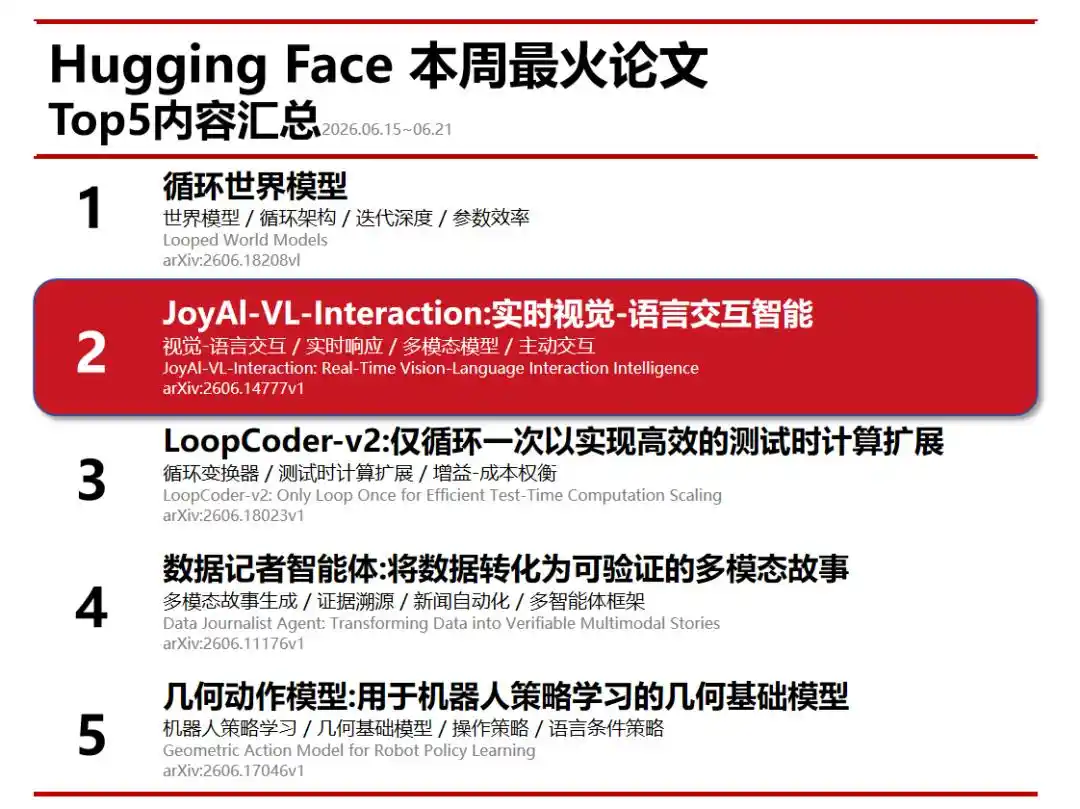
Dirección del informe técnico: https://huggingface.co/papers/2606.14777

Trending Cryptos

Related Questions

Q¿Qué es JoyAI-VL-Interaction y qué busca lograr según el artículo?

AJoyAI-VL-Interaction es el primer modelo de interacción visual-lingüística de pila completa y de código abierto del mundo, desarrollado por JD.com. Busca cambiar el paradigma de interacción de la IA, pasando de un modelo reactivo de 'pregunta-respuesta' a uno activo y predictivo. Su objetivo es que la IA pueda percibir el entorno físico a través de flujos de video continuos, juzgar de forma autónoma cuándo responder, cuándo guardar silencio y cuándo delegar tareas complejas, todo para ofrecer ayuda en el momento adecuado sin esperar instrucciones explícitas del usuario.

Q¿En qué se diferencian los 'modelos de interacción' como JoyAI-VL-Interaction de los modelos de IA conversacional tradicionales?

ALa diferencia principal radica en el paradigma de interacción. Los modelos tradicionales operan en un modo de 'turnos' o 'pregunta-respuesta', donde la IA responde solo después de que el usuario formula una consulta. En cambio, modelos de interacción como JoyAI-VL-Interaction son activos y predictivos. Utilizan la visión como modalidad principal para percibir cambios en el entorno físico en tiempo real y toman la iniciativa para interactuar o intervenir cuando detectan una situación que lo requiere, como una caída, un evento deportivo clave o una anomalía, sin necesidad de un comando verbal previo.

Q¿Por qué JD.com y Mira Murati con su Thinking Machines Lab consideran crucial el desarrollo de la interacción visual?

AAmbas entidades convergieron en la idea de que gran parte de la información crítica en el mundo físico ocurre demasiado rápido o en contextos donde no hay una instrucción verbal. Incendios, caídas, cambios en una pantalla o anomalías en una línea de producción son eventos visuales. Si la IA espera a que alguien hable, pierde su capacidad de estar verdaderamente 'presente' y de prevenir o asistir de manera proactiva. La interacción visual permite a la IA capturar necesidades directamente desde los cambios ambientales, siendo un canal de percepción indispensable para que la IA 'prediga el siguiente estado físico' y sea un participante activo.

Q¿Qué ventajas prácticas ofrece que JoyAI-VL-Interaction sea un modelo ligero y de código abierto?

ASer un modelo ligero (8B de parámetros) y de 'pila completa' de código abierto presenta varias ventajas prácticas: 1) **Accesibilidad**: Puede desplegarse en una sola GPU como una 3090, permitiendo a desarrolladores individuales y empresas con hardware de consumo experimentar y usarlo. 2) **Difusión**: Reduce enormemente la barrera de entrada, fomentando un ecosistema de aplicaciones más amplio. 3) **Arquitectura eficiente**: Actúa como una capa de interacción frontal que maneja la percepción y respuesta inmediata, delegando tareas complejas a modelos backend más grandes. 4) **Transparencia y colaboración**: Al abrir el modelo, el código, los datos y el sistema de inferencia, JD.com permite a la comunidad examinar, mejorar y construir sobre él, acelerando la innovación en interacción visual activa.

QSegún el artículo, ¿cómo se relaciona la estrategia de JD.com con el 'mundo físico' y los datos de interacción?

ALa estrategia de JD.com está profundamente arraigada en el mundo físico. La compañía opera en miles de escenarios reales (logística, venta minorista, salud, industria), lo que le proporciona una ventaja única: acceso a flujos de datos visuales y de interacción de alta calidad del mundo real. Para superar la escasez de datos de interacción física de calidad, JD.com está invirtiendo en una infraestructura masiva de recopilación de datos, con el objetivo de acumular 10 millones de horas de video en escenarios reales. Estos datos son el 'combustible' esencial para entrenar modelos de interacción visual y de inteligencia incorporada (embodied AI), permitiendo que modelos como JoyAI-VL-Interaction evolucionen y se apliquen de manera efectiva en robots, vehículos autónomos, almacenes y entornos domésticos, cumpliendo su visión de ser un 'centro de operaciones del mundo físico'.

Related Reads

Weng Li's New Blog Proposes 'Self-Evolution Should Start from Harness', DeepSeek's Cui Tianyi Endorses with Repost

Lilian Weng, former OpenAI security VP and co-founder of Thinking Machines Lab, has published a new blog post titled "Harness Engineering for Self-Improvement," proposing a pragmatic path for AI self-evolution. She argues that Recursive Self-Improvement (RSI) may practically begin at the "Harness" layer—the external runtime system governing how models use tools, manage context, and execute tasks—rather than directly from the model rewriting its own weights. The blog outlines a progression from optimizing prompts (Context Engineering) to designing workflows, and ultimately to Self-Improving Harness systems. These systems can identify their own weaknesses, propose targeted, verifiable modifications to the harness code, and validate improvements. Works like Self-Harness and Darwin Gödel Machine (DGM) demonstrate significant performance gains on benchmarks like SWE-bench through such automated harness evolution, rivaling handcrafted agents. DeepSeek researcher Tianyi Cui endorsed the view, noting harness-based self-evolution is as promising as model-based approaches. Weng emphasizes this is complementary to model training, with both reinforcing each other. However, key challenges remain: weak evaluators for subjective tasks, reward hacking, diversity collapse, managing long-term system health versus short-term success, and defining the human oversight role. The consensus is growing: the harness is a critical variable, as the same model can exhibit vastly different capabilities within different harness systems.

marsbit49m ago

Weng Li's New Blog Proposes 'Self-Evolution Should Start from Harness', DeepSeek's Cui Tianyi Endorses with Repost

marsbit49m ago

Odaily Editorial Department Tea Party (July 8)

Odaily Editorial Team Casual Chat (July 8) This is an informal column from Odaily's editorial team, sharing immediate thoughts on industry news, data, and hot topics from various angles. It presents investment ideas and opportunity hypotheses still under verification—which may not be direct wealth codes but questions in themselves—alongside observations from industry interactions and materials that genuinely enhance the team's understanding. The content is based on real investment and observation experiences, carries no advertising, and does not constitute investment advice. Its purpose is to broaden perspectives and supplement information sources, not to create consensus. Team Member Shares: * **Wenser (@wenser2010):** Noted a deeper correction (nearly 30%) in US and Korean stocks, including memory stocks, but remains bullish on DRAM due to perceived supply shortages. In prediction markets, personal small bets outperformed blind copying; favors France to win the World Cup. Views crypto-related stocks like STRK as bearish for now, while seeing Circle and Coinbase as potential rebound plays. Observes recent strength in software stocks like Microsoft but is unsure if it's a sustained recovery. * **Bcxiongdi (@bcxiongdi):** Discusses the recent "recovery training" in meme coin markets on Solana and BSC, characterized by small-scale PVP opportunities, admitting to having sold many assets too early. Suggests also watching the Robinhood chain. Found World Cup prediction markets challenging, advising to consider buying during matches rather than only before. * **Azuma (@azuma_eth):** Focuses on the US stock market, particularly the significant semiconductor correction. Believes demand fundamentals remain and considers buying the dip in DRAM stocks. Notes a potential rotation signal as hedge funds have recently concentrated buying in tech stocks. Plans to continue adding to RKLB (Rocket Lab) stock, seeing limited downside and high upside potential at current levels after its founder's share sale window closed.

Odaily星球日报1h ago

Odaily Editorial Department Tea Party (July 8)

Odaily星球日报1h ago

Trading

Spot

Hot Articles

What is LINON

Linde plc Tokenized Stock (Ondo): Revolutionizing Traditional Equity Access Through Blockchain Innovation The emergence of Linde plc Tokenized Stock (Ondo), represented by the ticker $LINON, signifies a monumental shift in the fusion of traditional financial structures and decentralized finance (DeFi). This innovative financial instrument showcases the tremendous potential of blockchain technology to democratize access to traditional equity markets while ensuring the security and regulatory compliance necessary for institutional-grade financial products. Through Ondo Finance's pioneering tokenization platform, $LINON provides a seamless pathway for global investors to engage with one of the world's leading industrial gas companies, Linde plc, creating a blockchain-native representation of the underlying equity. Introduction to Linde plc Tokenized Stock The landscape of financial markets is witnessing a groundbreaking transformation through the tokenization of real-world assets. Linde plc Tokenized Stock (Ondo) epitomizes this revolutionary approach by bridging the gap between conventional stock ownership and blockchain-enabled financial infrastructure. The $LINON token allows investors to gain exposure to one of the prominent industrial companies worldwide through decentralized technology. Operating within Ondo Finance's comprehensive ecosystem, $LINON symbolizes a practical application of tokenization technology that enhances accessibility, efficiency, and global connectivity in traditional financial markets. By leveraging blockchain infrastructure, this tokenized stock enables international investors to participate in U.S. equity markets, overcoming traditional barriers associated with cross-border investing. The significance of $LINON goes beyond technological innovation; it represents a fundamental shift in asset structuring, distribution, and trading in the digital age. This tokenized stock maintains all the economic benefits associated with traditional Linde plc shares while offering improved liquidity, programmable compliance features, and seamless integration with decentralized finance protocols. The development of $LINON indicates a growing acceptance of blockchain technology as a viable means for traditional finance, exemplifying how even well-established assets like Linde plc can integrate into blockchain systems. This approach preserves the core attributes that appeal to investors while introducing advanced capabilities that enhance the overall investment proposition. Project Overview and Objectives Linde plc Tokenized Stock (Ondo) encapsulates a strategic effort to democratize access to traditional equity markets through advanced blockchain technologies. The primary objective of $LINON is to provide approved global investors seamless access to the economic exposure associated with Linde plc shares, furthering an effort to create a more inclusive financial ecosystem. Beyond the digital representation of traditional assets, $LINON endeavors to eliminate barriers of geography and time zones that limit investor participation. Its design ensures that blockchain technology can elevate traditional investment vehicles without undermining the security or compliance requirements expected by investors. Key goals of the project include enhanced liquidity provision, programmable compliance mechanisms, and interoperability with other blockchain networks. Each $LINON token is fortified by actual Linde plc securities housed at U.S.-registered broker-dealers, allowing holders to reap economic advantages akin to traditional stockholders, such as dividend reinvestment. Furthermore, $LINON aims to establish new industry standards for institutional-grade tokenized securities, paving the way for traditional assets to embrace blockchain technology while remaining compliant with regulatory frameworks. By associating itself with a company as reputable as Linde plc, the project opens avenues for exploring tokenized equities catering to both conservative institutional players and daring retail investors. Project Creator and Development Team The vision for Linde plc Tokenized Stock (Ondo) comes from Nathan Allman, founder and CEO of Ondo Finance. His background in traditional finance coupled with expertise in blockchain technology positions him uniquely to navigate the complexities of asset tokenization. Allman's academic journey began at Brown University, focusing on Economics and Biology, equipping him with valuable analytical skills. His time at Goldman Sachs in the Digital Assets division strengthened his understanding of the interplay between financial institutions and emerging technologies, laying the groundwork for his later endeavors in alternative investment strategies. Under Allman's guidance, Ondo Finance has emerged as a leader in asset tokenization, launching $LINON as a flagship example of the company's larger mission towards revolutionizing traditional financial systems using blockchain technology. His commitment to leveraging blockchain for creating institutional-grade financial products has shaped the landscape of real-world asset tokenization. Investment and Funding Structure The growth of Ondo Finance, the platform powering Linde plc Tokenized Stock (Ondo), is bolstered by robust financial backing from prestigious venture capital firms and strategic investors. This strong investment foundation underpins the development of the key infrastructure essential for compliant tokenized securities like $LINON. In August 2021, Ondo Finance secured $4 million in seed funding led by a major venture capital firm, which enabled the company to commence platform development and establish the necessary regulatory processes for tokenizing real-world assets. This early investment cemented Ondo Finance's credibility within the industry. The Series A funding round followed, garnering $20 million with participation from renowned firms committed to transformative technology companies. This backing demonstrated substantial institutional confidence in Ondo Finance's vision, allowing it to hone its approach to asset tokenization through mechanisms that ensure compliance and accessibility. Noteworthy contributors, including institutional investors and experienced partners, have added significant value to Ondo Finance’s development efforts. Their involvement underscores the confidence across sectors in Ondo Finance's approach to bridging traditional finance with blockchain innovations. Technical Infrastructure and Innovation The technical architecture that underpins Linde plc Tokenized Stock (Ondo) represents a sophisticated melding of traditional finance systems and cutting-edge blockchain technology. The architecture's foundation is built on the Ethereum network, renowned for its security and programmability—both critical for intricate financial instruments. The $LINON tokenization process comprises creating a blockchain-native representation of Linde plc shares that preserves economic benefits while augmenting investor capabilities. Each token corresponds to actual shares held at U.S.-registered broker-dealers, creating a compliant custody structure that legitimizes the asset's existence and value. Automated compliance systems are integrated into the tokenization process, managing critical components such as know-your-customer (KYC) verification and anti-money laundering (AML) protocols. This incorporation of programmable compliance empowers $LINON to uphold regulatory standards essential for institutional proliferation. Cross-chain interoperability characterizes the advanced technical features of $LINON. While initially deployed on Ethereum, the framework is designed for expansion to other networks such as Solana and BNB Chain. This adaptability enhances liquidity and accessibility, allowing investors to select their preferred blockchain ecosystems. Historical Timeline and Development Crafting the history of Linde plc Tokenized Stock (Ondo) unfolds in parallel with the evolution of Ondo Finance's tokenization platform. The timeline's inception dates back to March 2021 when Nathan Allman laid the foundations for creating institutional-grade financial products on blockchain infrastructure. The initial funding round in August 2021 provided crucial resources for developing the platform and establishing partnerships necessary for effective tokenization. By January 2023, Ondo Finance launched its tokenized treasury products, establishing mechanisms that would facilitate future tokenized equities such as $LINON. A pivotal milestone arose in February 2025 when Ondo Chain—a Layer 1 blockchain designed specifically for asset tokenization—was introduced. This infrastructure enhances capabilities vital for institutional markets, demonstrating Ondo Finance's long-term commitment to tokenization. Subsequently, the launch of Ondo Global Markets in September 2025 marked the official debut of $LINON. This milestone showcased the successful transition from development to active trading, enabling investors around the world to access American financial markets seamlessly. Ongoing development plans include a targeted expansion of available tokenized assets to over 1,000 by the end of 2025, pointing to a bright future for Ondo Finance's ecosystem and its mission to broaden tokenized equity accessibility. Regulatory Compliance and Legal Framework The legal architecture governing Linde plc Tokenized Stock (Ondo) emphasizes a sophisticated approach to regulatory compliance, allowing tokenized securities to be implemented within a blockchain-based framework. The legal structure governing $LINON spans multiple jurisdictions while maintaining a robust legal footing. Compliance systems ensure that only eligible investors can access the token, enforced through automated verification that aligns with international regulations. This innovative regulatory technology promises real-time enforcement of complex requirements, considerably enhancing efficiency in operating within the regulatory landscape. The custody framework undergirding $LINON ensures that the underlying shares are securely held at U.S.-registered broker-dealers, complying with necessary regulations while delivering blockchain-driven access to investors. The token maintains its economic equivalency and security through this carefully structured custody arrangement. KYC and AML compliance systems are embedded within the smart contract architecture, ensuring integrity and adherence to regulatory practices while fostering transparency for investors. The jurisdictional restrictions mark a commitment to navigating the evolving landscape of international securities laws. Market Impact and Industry Significance The advent of Linde plc Tokenized Stock (Ondo) holds profound implications for the broader financial landscape, symbolizing a clear shift towards blockchain-enabled markets. $LINON serves as a proof-of-concept for integrating traditional companies into blockchain ecosystems, showcasing the potential benefits such as broader accessibility and improved efficiency. The market's response to $LINON indicates a growing acceptance of tokenization among institutional investors, contributing to the emergence of an expanding sector wherein traditional assets can be interconnected with blockchain innovations. The success of $LINON further solidifies market confidence, indicating an overarching shift towards recognizing asset tokenization as a transformative force in finance. Future Development and Expansion Plans The future trajectory for Linde plc Tokenized Stock (Ondo) centers around the expansion of the tokenization ecosystem and enhanced infrastructure supporting blockchain-enabled financial services. Plans for cross-chain integration usher in new opportunities for liquidity and flexibility within the investment framework, with existing capabilities poised for continuous enhancement. With the introduction of Ondo Chain, Ondo Finance aims to transition $LINON to an optimized blockchain environment specifically designed for asset tokenization. This new infrastructure heralds exciting prospects for the development of institutional-grade financial products, ensuring ongoing compatibility with contemporary investment strategies. Further integration with decentralized finance protocols signifies a commitment to empowering $LINON holders through advanced financial strategies. The anticipated expansion of available tokenized assets promises to broaden investor access, enhancing the utility and appeal of the platform. In alignment with ambitions for regulatory expansion, ongoing efforts to secure approvals for new jurisdictions will enhance investor access, further positioning $LINON at the forefront of the burgeoning tokenization market. Conclusion Linde plc Tokenized Stock (Ondo), as represented by the $LINON token, stands at the intersection of traditional finance and blockchain innovation. It embodies a transformative milestone in how financial assets are structured, distributed, and engaged within modern investment ecosystems. The technical sophistication behind $LINON, combined with its regulatory compliance framework, illustrates that asset tokenization can improve financial infrastructure rather than simply digitizing existing products. This pioneering effort not only enhances investor access to U.S. equity markets but also signifies an evolution of how traditional financial services can integrate blockchain technology. As the asset tokenization market grows exponentially, with prospects suggesting significant valuation increases, $LINON paves the way for a future where tokenized securities become standard fixtures in the financial landscape. The trajectory of $LINON will undoubtedly influence how traditional finance adapts to a transformed, blockchain-powered world.

3.4k Total ViewsPublished 2025.12.05Updated 2025.12.05

What is LINON

What is CRMON

Salesforce Tokenized Stock (Ondo): Revolutionising Traditional Equity Access Through Blockchain Innovation The emergence of Salesforce Tokenized Stock (CRMON) marks a pivotal advancement in integrating traditional financial markets with blockchain technology. This innovative approach offers investors unprecedented access to equity exposure through tokenisation. Developed by Ondo Finance, CRMON provides tokenholders with economic exposure equivalent to holding Salesforce stock (CRM) while automatically reinvesting dividends. This effectively bridges the gap between conventional equity markets and decentralised finance (DeFi). Introduction and Comprehensive Overview of Salesforce Tokenized Stock In recent years, the financial landscape has dramatically transformed due to blockchain technology, fundamentally altering how investors access and interact with traditional assets. The development of Salesforce Tokenized Stock (CRMON) is a prime example of this evolution, representing a sophisticated fusion of conventional equity markets with cutting-edge distributed ledger technology. CRMON is a tokenised version of Salesforce stock, emerging from the innovative work of Ondo Finance, a leading platform in the real-world asset tokenisation sector that positions itself as a bridge between traditional finance and decentralised systems. Designed to provide tokenholders with economic exposure that mirrors the performance of the underlying Salesforce stock, CRMON incorporates automatic dividend reinvestment mechanisms. This eliminates many traditional barriers associated with international equity investment, such as complex brokerage relationships, currency conversion challenges, and restricted trading hours. The tokenisation process reimagines stock ownership as a blockchain-native asset while maintaining its economic equivalence with the underlying security, offering enhanced portability and integration capabilities within decentralised finance ecosystems. CRMON transcends its individual utility as an investment instrument to represent a fundamental shift in how financial markets can operate in an increasingly digital world. By maintaining full backing through U.S.-registered broker-dealers and implementing robust compliance frameworks, CRMON demonstrates that tokenised securities can achieve the regulatory standards necessary for institutional adoption while delivering the technological advantages of blockchain infrastructure. Understanding Tokenized Real-World Assets and CRMON's Strategic Position Tokenised real-world assets signify one of the most significant innovations in modern finance, fundamentally reimagining how traditional securities are represented, traded, and utilised within digital ecosystems. CRMON operates as a tokenised equity instrument correlating directly with Salesforce stock while optimising accessibility and efficiency. This aligns with Ondo Finance's broader mission to democratise access to institutional-grade financial products through innovative tokenisation strategies. The tokenisation process guarantees complete economic equivalence with the underlying Salesforce equity. Each CRMON token represents a proportional claim on Salesforce stock held by qualified custodians, with dividend payments automatically reinvested to maintain continuous exposure to total return performance. This structure simplifies dividend management and ensures that tokenholders receive the full economic benefit of their equity exposure, encompassing both capital appreciation and income generation. Ondo Finance's strategy in tokenising Salesforce stock demonstrates its expertise in creating compliant, institutional-grade products that meet traditional financial markets' stringent requirements. The platform’s focus on merging regulatory compliance with blockchain benefits positions it at the forefront of decentralised finance, captivating both institutional and retail investors seeking blockchain-native solutions. The Technology and Innovation Framework Behind CRMON The technological infrastructure supporting CRMON integrates blockchain technology with traditional financial mechanisms, delivering institutional-grade security and compliance while maintaining the operational advantages of decentralised systems. Built on the Ethereum blockchain, CRMON utilises robust smart contract capabilities to ensure transparent, secure operations. The smart contract architecture incorporates layered security and compliance mechanisms, enabling automated compliance checks and real-time asset backing verification. Integration with oracle services maintains accurate pricing and dividend information, ensuring CRMON reflects the underlying Salesforce stock's accurate performance. This architecture delivers automated dividend reinvestments and other corporate actions, eliminating manual processing requirements and directly enhancing tokenholder benefits. Ondo Finance ensures CRMON's security structure includes daily third-party verification of holdings, independent collateral agents, and a multiple-layer custody system through partnerships with established financial institutions. This framework safeguards tokenholder interests against operational risks while providing robust asset backing. The user interface enhances integration capabilities, allowing seamless interaction between CRMON and various decentralised finance protocols, as well as cryptocurrency exchanges. This interoperability enables users to leverage their tokenised equity across multiple platforms, creating sophisticated investment strategies that marry traditional equity characteristics with blockchain-native innovation. Leadership and Corporate Structure of Ondo Finance The leadership team behind CRMON and Ondo Finance blends expertise from traditional finance and blockchain technology, presenting a robust combination of skills essential for successfully bridging conventional markets with decentralised finance. Nathan Allman, the founder and CEO, emerged from a distinguished financial background before establishing Ondo Finance in 2021. Allman's experience includes notable roles at major financial institutions, including significant contributions to developing cryptocurrency market services. His insights into regulatory compliance were paramount in developing products like CRMON that successfully unify traditional securities with blockchain technology. With a team of professionals boasting substantial experience in both conventional finance and blockchain sectors, Ondo Finance's leadership comprises diverse expertise that covers every aspect of tokenised asset development. Justin Schmidt serves as President and COO, contributing unique operational expertise, while Chris Tyrell brings essential compliance knowledge. Investment Landscape and Funding History The investment landscape surrounding Ondo Finance reflects significant institutional confidence in its mission to tokenise real-world assets. The company has raised substantial funds through various investment rounds, attracting leading venture capital firms and strategic investors that recognise the transformative potential of tokenised securities like CRMON. Notably, Ondo Finance completed a successful Series A funding round in 2022, led by well-known venture capital firms. This funding success validates Ondo Finance's innovative approach to creating compliant, institutional-grade tokenised products. In total, Ondo Finance has successfully secured substantial funding, raising significant capital for product development and market expansion, including a noteworthy token sale that reinforced its governance structure through the establishment of the ONDO token. The diverse composition of investors reflects broad market confidence in Ondo Finance's business model, demonstrating support from both traditional and blockchain-native organisations. Operational Mechanics and Technical Implementation The operational framework supporting CRMON exemplifies sophisticated integration of traditional financial mechanisms with blockchain technology. The technical implementation introduces multiple layers of security, compliance, and operational efficiency to meet institutional standards while enhancing accessibility. The tokenisation process begins by acquiring actual Salesforce stock through U.S.-registered broker-dealers, ensuring each CRMON token maintains direct correlation with the underlying equity performance. Smart contracts automate operational processes, including dividend reinvestment and corporate action processing, facilitating a streamlined user experience. The Minting and redemption processes allow authorised participants to manage CRMON tokens effectively. During U.S. trading hours, institutions can mint new tokens by depositing stablecoins that are used to purchase corresponding Salesforce equity. This structure maintains a tight correlation with underlying assets, enhancing liquidity and price discovery. Additionally, the infrastructure supports twenty-four-hour token transfer capabilities, providing CRMON holders with operations outside traditional market hours. This represents a significant advantage over conventional securities ownership, thus promoting integration with decentralised finance applications. Plans for cross-chain compatibility through partnerships signal further ambitions for CRMON's market reach. By expanding to other blockchain networks, Ondo Finance aims to enhance accessibility and user engagement with tokenised equity products. Timeline and Historical Development of Tokenized Equity Innovation The timeline of CRMON's development and Ondo Finance's broader tokenised capabilities demonstrates a systematic innovation process beginning with the company's founding in 2021. 2021: Ondo Finance is founded by Nathan Allman and co-founders, launching initial products focused on structured vault offerings on the Ethereum blockchain. 2022: The company completes substantial funding rounds—both equity and token sales—totaling significant capital and launching initial tokenised U.S. Treasury products. 2023-2024: Ondo Finance experiences substantial growth, establishing partnerships with major financial institutions while expanding its product offerings beyond fixed-income securities. February 2025: Ondo Global Markets is announced, marking the transition into equity tokenisation with plans for accessing over one hundred U.S. stocks and ETFs. September 2025: The official launch of Ondo Global Markets includes CRMON alongside other tokenised equity offerings, marking a significant evolution in Ondo Finance's product ecosystem. This timeline highlights the organisation's rapid growth and its capability to adapt its technological and compliance frameworks to accommodate different asset classes effectively while maintaining security and regulatory integrity. Regulatory Framework and Compliance Approach Ondo Finance's regulatory framework showcases a sophisticated compliance strategy, essential for achieving institutional adoption in the tokenised securities market. The company's strong partnerships with U.S.-registered broker-dealers promote adherence to Securities and Exchange Commission regulations and apply robust investor protections. Acquisitions, such as Oasis Pro—a registered broker-dealer—significantly enhance Ondo Finance's compliance capabilities, ensuring thorough alignment with existing regulatory structures. The company employs independent verification procedures that foster transparency, aiming for a solid performance standards reputation. Furthermore, Ondo Finance's commitment extends to international regulatory compliance, ensuring token access remains restricted to eligible investors while adhering to pertinent cross-border securities regulations. Comprehensive attention to tax implications and reporting requirements fortifies the security and compliance landscape of CRMON, ensuring that investor obligations remain manageable. Future Prospects and Market Positioning The forward-looking landscape for CRMON and Ondo Finance illustrates substantial growth opportunities driven by institutional adoption of blockchain technology and escalating demand for efficient alternatives to conventional securities ownership. Market projections indicate the tokenised asset sector could value multiple trillion dollars by 2030. With plans to scale CRMON offerings significantly and integrate it with a dedicated blockchain infrastructure—Ondo Chain—Ondo Finance aims to elevate its institutional-grade tokenised asset operations. Additionally, the development of strategic partnerships enhances distribution capabilities while establishing the company's credibility in the financial market. Furthermore, the integration of tokenised equity with decentralised finance protocols offers new potential for innovative financial products and strategies previously impossible with traditional securities. These factors underscore CRMON's positioning to effectively capture increased market share and deliver innovative solutions for international investment exposure. Conclusion Salesforce Tokenized Stock (CRMON) symbolises a transformative development within financial markets, successfully bridging traditional equity ownership with blockchain technology to create unprecedented accessibility for global investors. Through Ondo Finance's sophisticated tokenisation framework, CRMON provides complete economic exposure to Salesforce equity performance while enhancing operational advantages that exceed traditional ownership. The launch of CRMON reflects the broader evolution of financial markets towards blockchain infrastructures that maintain regulatory compliance while delivering increased efficiency. Ondo Finance's extensive approach to regulatory adherence, institutional-grade security, and technological innovation solidifies CRMON as a model for future tokenised securities, delivering access previously unattainable in conventional brokerage structures. As the tokenised asset sector continues to develop, CRMON is well-positioned to address historical inefficiencies in capital markets while providing investors with innovative solutions for accessing traditional securities. The outlook for CRMON looks exceptionally promising, supported by ambitious expansion plans, technological innovations, and strategic partnerships, thereby representing a pioneering model of modern financial infrastructure evolving through blockchain integration.

3.5k Total ViewsPublished 2025.12.05Updated 2025.12.05

What is CRMON

What is SHOPON

Shopify Tokenized Stock (Ondo): A Comprehensive Analysis of Real-World Asset Tokenization in Web3 This article delves into the Shopify Tokenized Stock (Ondo), recognised by its ticker symbol $SHOPON, exploring its implications at the intersection of traditional finance and blockchain technology. As a part of Ondo Finance's tokenized securities platform, Shopify’s tokenized stock exemplifies advancements in democratizing access to global capital markets through innovative digital assets. Introduction and Overview of Shopify Tokenized Stock (Ondo) Shopify Tokenized Stock (Ondo), or $SHOPON, portrays a pivotal innovation in the realm of tokenized securities, allowing investors to gain economic exposure akin to directly owning shares of Shopify Inc. This token, developed under the umbrella of Ondo Finance, not only provides investors with the ability to hold digital representations of the company’s stock but also integrates features such as automatic reinvestment of dividends. This advancement represents a substantial shift in the landscape of decentralized finance (DeFi), linking conventional equity markets with blockchain solutions designed to enhance accessibility, transparency, and liquidity. By eliminating geographical barriers and enabling 24/7 trading capabilities, $SHOPON is positioned as a bridge connecting traditional financial instruments and the emerging Web3 ecosystem. What is Shopify Tokenized Stock (Ondo), $SHOPON? The $SHOPON token serves as a digital manifestation of Shopify Inc.'s shares, engineered to provide a direct correlation to the underlying asset's performance. Through the utilization of blockchain technology, the token gives holders a mechanism to participate in the economic benefits associated with equity ownership, including capital appreciation and dividend distribution. The unique aspect of $SHOPON lies in its automatic dividend reinvestment mechanism, which allows returns to compound without necessitating active management by the investor. This feature inherently enhances its attractiveness as an investment vehicle, particularly for individuals seeking passive income growth alongside exposure to high-performing equities. The tokenization process is facilitated by the custody of actual Shopify shares through regulated intermediaries, ensuring that every $SHOPON token is verifiably backed by real equity. This structure empowers investors with the dual advantages of both traditional financial characteristics and the innovative benefits tied to blockchain technology. Who is the Creator of Shopify Tokenized Stock (Ondo)? The creator of Shopify Tokenized Stock (Ondo), Nathan Allman, is an experienced figure in the finance sector, formerly associated with Goldman Sachs. His rich background includes significant expertise in digital asset development, bridging the gap between traditional finance and cryptocurrencies. Allman’s educational journey, marked by studies at Brown University, provided him with a deep understanding of economics and biology, equipping him with analytical skills that inform his strategic vision. In 2021, he founded Ondo Finance, committing to developing tokenized securities that meet institutional-grade standards while leveraging blockchain's transformative capabilities. Under Allman's leadership, Ondo Finance has focused on creating compliant and innovative financial products that empower a diverse investor base. Who are the Investors of Shopify Tokenized Stock (Ondo)? The investment landscape surrounding Shopify Tokenized Stock (Ondo) is notably robust, underpinned by significant institutional support. Primarily, Pantera Capital stands out as a strategic partner through the Ondo Catalyst initiative, a $250 million commitment aimed at accelerating the development of on-chain capital markets. This partnership not only signifies institutional confidence in the potential of tokenized assets but also reinforces Ondo Finance's operational capabilities and market positioning. The funding pathways have included earlier rounds that amassed millions in seed funding and further structural investments, solidifying relationships with both venture capital firms and private investors. Moreover, the financial framework is complemented by strategic partnerships with established financial institutions and technology companies, enhancing Ondo’s infrastructure and operational expertise. How Does Shopify Tokenized Stock (Ondo), $SHOPON Work? At the core of $SHOPON's operational framework is a sophisticated system integrating traditional finance mechanisms with blockchain technology. The custody of actual Shopify shares ensures that token holders retain authentic economic exposure, safeguarding their investments in line with recognized legal structures. The smart contracts employed in managing $SHOPON handle various functions, including automatic dividend reinvestment and ownership transfer, offering instant settlement and increased liquidity, marking a significant departure from conventional trading systems plagued by multi-day settlement delays. By providing interoperability with other decentralized finance applications, $SHOPON empowers holders with potentially lucrative opportunities for advanced investment strategies, including lending and automated market making. This complex integration presents a unique value proposition, catering to both traditional and crypto-native investors. The innovative structure of $SHOPON also allows for real-time settlements and transactions documented on the blockchain, delivering unparalleled transparency and security—a major advancement over standard equity trading practices. Timeline of Shopify Tokenized Stock (Ondo) March 2021: Nathan Allman establishes Ondo Finance, initially focusing on decentralized finance yield optimization. August 2021: Completion of a $4 million seed funding round led by Pantera Capital. January 2023: Launch of initial tokenized treasury security products, laying the groundwork for future equity tokenization. July 2025: Announcement of the Ondo Catalyst initiative, a strategic investment program valued at $250 million, aimed at propelling the development of tokenization in capital markets. September 3, 2025: Launch of Ondo Global Markets featuring over 100 tokenized U.S. stocks and ETFs, including $SHOPON. Technical Implementation and Blockchain Infrastructure Shopify Tokenized Stock (Ondo) operates on a technical architectural framework that marries blockchain protocols with traditional financial custody arrangements. The ecosystem leverages Ethereum's smart contract capabilities, providing seamless transaction management while ensuring compliance with regulatory standards through established financial custodians. Central to this architecture are security measures and transparent transaction records that affirm the legitimacy of each tokenholder's economic stake. With automated features managed by intricate smart contracts, $SHOPON not only streamlines ownership transfers but also allows for the tactical reinvestment of dividends—a hallmark of modern investment strategies. Moreover, the incorporation of LayerZero technology facilitates cross-chain interoperability, making $SHOPON accessible across multiple blockchain environments while preserving its functional robustness. This forward-thinking technical design positions $SHOPON as an adaptable asset within the larger DeFi milieu. Regulatory Framework and Compliance Architecture $SHOPON's regulatory framework is built upon the meticulous navigation of existing financial regulations that govern securities. The custody arrangements for the underlying Shopify shares are managed by U.S.-regulated broker-dealers, ensuring compliance and protection for investors. By maintaining a separation between the blockchain tokenization process and traditional custody, $SHOPON adheres to legal requirements while offering innovative functionalities that challenge conventional constraints. This dual-layered compliance approach enhances investor confidence and underscores Ondo Finance's commitment to regulatory integrity. Notably, the availability of $SHOPON is tailored to international investors from regions such as Asia-Pacific, Europe, and Africa, as regulatory parameters in the U.S. and U.K. present challenges in accessing tokenized securities. Market Access and Global Distribution Strategy The distribution strategy of $SHOPON is keenly designed to optimize global access while conforming to regulatory standards. The platform aims to establish comprehensive coverage for eligible investors across multiple regions, effectively dismantling traditional barriers through the implementation of blockchain technology. Integration with various cryptocurrency wallets and exchanges also promotes user-friendliness and accessibility, establishing a streamlined experience for investors to manage their holdings. Moreover, the 24/7 trading capabilities afforded by the tokenized model allow participants to react promptly to market shifts, fundamentally transforming how global equities are accessed and traded. Technology Integration and Cross-Chain Functionality The remarkable technological underpinnings of $SHOPON propagate its multi-chain functionality, set to expand its reach beyond Ethereum to networks such as Solana and BNB Chain. Such cross-chain capabilities allow users flexibility when navigating between blockchains, concurrently leveraging distinct network attributes to optimize their trading experience. LayerZero serves as the backbone for ensuring decentralized transfers between networks while providing the requisite security and speed, quintessential for maintaining investor trust. This comprehensive interoperability illustrates $SHOPON's commitment to being a versatile, user-centric asset in the evolving investment landscape. Ecosystem Integration and DeFi Compatibility Incorporating $SHOPON into broader DeFi protocols signifies its potential beyond traditional stock ownership. Token holders can leverage their holdings for various sophisticated strategies and applications, enhancing investment returns and liquidity management. By establishing a presence in lending protocols and automated trading systems, $SHOPON effectively democratizes access to advanced financial strategies previously limited to institutional investors. Such integration contributes to a more competitive and dynamic financial landscape, where individual investors can capitalize on tools typically reserved for larger entities. Risk Management and Security Framework Security remains paramount in the operational infrastructure of $SHOPON. The tokenization framework employs multiple layers of protection—beginning with regulated custody of the underlying Shopify shares. The operational protocols establish rigorous auditing, key management, and transaction monitoring standards, thus safeguarding against potential vulnerabilities. Moreover, meticulous adherence to evolving regulatory requirements provides an extra layer of security, fortifying investor protections and institutional compliance. Market Impact and Industry Implications The introduction of Shopify Tokenized Stock (Ondo) heralds a transformative shift in how financial markets operate, emphasizing the potential of tokenized securities to reshape traditional investment paradigms. The successful integration of $SHOPON encapsulates the efficiencies inherent in blockchain technology and opens avenues for new user demographics previously barred from extensive market participation. The impact extends beyond the immediate benefits to token holders, indicating broader trends that may challenge the status quo of investment services, particularly in addressing geographic restrictions and operational costs typically associated with traditional brokerage platforms. Undeniably, $SHOPON encapsulates the potential for traditional institutions to innovate further, leveraging the increasing demand for seamless blockchain access to complement existing financial infrastructure. Future Development Roadmap and Strategic Vision As Ondo Finance looks forward, the trajectory of $SHOPON rests on ambitious goals aimed at broadening the spectrum of available tokenized assets significantly. Over the next few years, plans are in place to expand to more than 1,000 tokenized securities, further enhancing market participation and investment options for individuals worldwide. Continued integration with traditional financial actors, development of specialized institutional products, and enhancements in automated trading capabilities will ensure that $SHOPON maintains its position at the forefront of financial innovation. Regulatory collaboration will also remain a focal point, establishing a framework that not only supports the compliance requirements but also promotes a healthy environment for tokenized asset proliferation. Conclusion and Market Significance In summary, Shopify Tokenized Stock (Ondo), represented by the ticker $SHOPON, is more than merely a tokenized equity offering; it embodies the innovation possible when traditional finance collides with modern blockchain applications. With a robust technical architecture, a commitment to compliance, and a clear strategic vision, $SHOPON exemplifies the potential for tokenized assets to enhance liquidity, accessibility, and functionality in capital markets. As the global investment landscape evolves, the transformative implications of $SHOPON extend beyond individual investors to revolutionize how financial instruments are perceived, traded, and utilized within both traditional and decentralized frameworks.

3.4k Total ViewsPublished 2025.12.05Updated 2025.12.05

What is SHOPON

Discussions

Welcome to the HTX Community. Here, you can stay informed about the latest platform developments and gain access to professional market insights. Users' opinions on the price of MIRA (MIRA) are presented below.

活动图片