SpaceX, AI, and XRP: Why the Next Wealth Transfer Might Be Different?

marsbitPublished on 2026-06-21Last updated on 2026-06-21

Abstract

The article posits that the global economy is transitioning into a new phase of infrastructure investment. Capital, facing slowing traditional growth engines, is flowing towards emerging foundational systems. This includes space infrastructure (exemplified by SpaceX), AI computing power, satellite networks, data centers, and global payment systems. A key driver is a potential new commodity supercycle fueled by industrial demand from these sectors. Concurrently, the role of blockchain is evolving from speculative assets to a critical settlement layer for the future economy. Digital assets like XRP and XLM, focused on payments and interoperability, are highlighted as potential rails for cross-border settlement, tokenized assets, and machine-to-machine (AI Agent) transactions. The narrative connects figures like Ripple's Jed McCaleb to space ventures, suggesting convergence. The argument emphasizes a shift from speculative narratives to utility-driven value. As AI and space commerce generate new economic activity, and regulatory clarity improves, blockchain networks may underpin real-time value transfer. The conclusion urges investors to consider which networks will form the backbone of this integrated next-generation economic infrastructure.

Editor's Note: This article attempts to understand SpaceX's IPO expectations, AI Agents, blockchain settlement networks, commodity demand, and digital asset regulation within the same overarching narrative: global capital may be shifting from purely chasing speculative growth to betting on the next generation of economic infrastructure.

The author's core argument is that as traditional growth engines slow, capital requires new vessels. Space infrastructure, AI computing power, satellite networks, data centers, and cross-border payment systems may collectively constitute the next cycle of infrastructure investment. Within this framework, commodities are no longer just cyclical goods but become the foundational inputs for AI, communications, orbital manufacturing, and energy systems; blockchain is not merely about trading assets but could become the financial rails for tokenized assets, AI Agent payments, and global real-time settlement.

The article particularly emphasizes the potential role of payment-oriented digital assets like XRP and XLM in cross-border settlement, interoperability, and machine-to-machine payments. It connects threads such as Ripple, Jed McCaleb, Vast, and SpaceX to paint a picture of a converging landscape of "space commerce + AI + blockchain settlement layer".

It is important to note that such narratives still carry a strong speculative element, especially when tying specific digital assets to future infrastructure cycles. The distance between long-term trends, commercial implementation, and market pricing must still be distinguished. However, the question it raises is worth attention: If AI is creating new economic actors, and space and data centers are creating new capital expenditure cycles, who will handle value transfer, identity management, and instant settlement between these systems? This may be the key for digital assets to move from a speculative narrative to an infrastructure narrative.

Below is the original article:

The financial world may be entering a new phase. This phase is not merely a continuation of traditional market cycles but a progression towards the construction of a completely new set of economic infrastructure. Recent developments around SpaceX, artificial intelligence, blockchain technology, and the clarification of digital asset regulations suggest that capital is starting to flow towards systems that could define the next generation of global commerce.

Behind the SpaceX IPO Expectations: Capital is Searching for New Infrastructure

The highly anticipated IPO of SpaceX has garnered immense attention, not just because of SpaceX itself, but because it represents a broader trend. As debt markets tighten and economic growth slows, governments and financial institutions are seeking new frontiers that can both absorb capital and justify sustained investment.

Space infrastructure, orbital manufacturing, satellite networks, data centers, and advanced communications systems are increasingly being viewed as trillion-dollar opportunities. These fields require massive physical capital, commodities, financing support, and technological synergy.

The logic is simple: when traditional growth engines mature, capital seeks new domains to support further expansion. Space might become one such frontier, even if the narrative itself is built on lies and deception.

A New Commodity Cycle: Both AI and Space Depend on Raw Materials

Large-scale infrastructure projects are inseparable from raw materials.

The expansion of data centers, satellite networks, AI computing facilities, and future space infrastructure will generate enormous demand for key commodities. Metals like gold, silver, platinum, copper, and rare earths will become indispensable inputs in the next generation of technological systems.

The world may be in the early stages of a structural commodity supercycle. This means demand will rise consistently over a longer period, driven by infrastructure investment and technological change.

Unlike previous cycles centered primarily on consumer demand, this one will be driven by industrial and technological needs.

Blockchain's New Role: Not Just Tokens, But a Real-Time Settlement Layer

As new industries emerge, capital must be able to flow efficiently within global markets.

The traditional banking system was designed for a slower world. The infrastructure of the future will involve tokenized assets, AI-driven transactions, international payments, and even potential space commerce, all requiring settlement systems that operate continuously and process at high speed.

This is where blockchain technology enters the conversation.

As highlighted in our podcast yesterday, as financial infrastructure evolves, digital assets focused on payments and interoperability may become increasingly important. Networks capable of settling transactions quickly and efficiently will benefit from the growing need for real-time value transfer.

Digital assets like XRP and XLM are notable in this context, as they focus on payments, interoperability, and cross-border settlement.

It is worth noting the existing connections between Ripple co-founder and XRP Ledger architect Jed McCaleb and commercial space projects. His company, Vast, has partnership connections to SpaceX and Starlink-related plans.
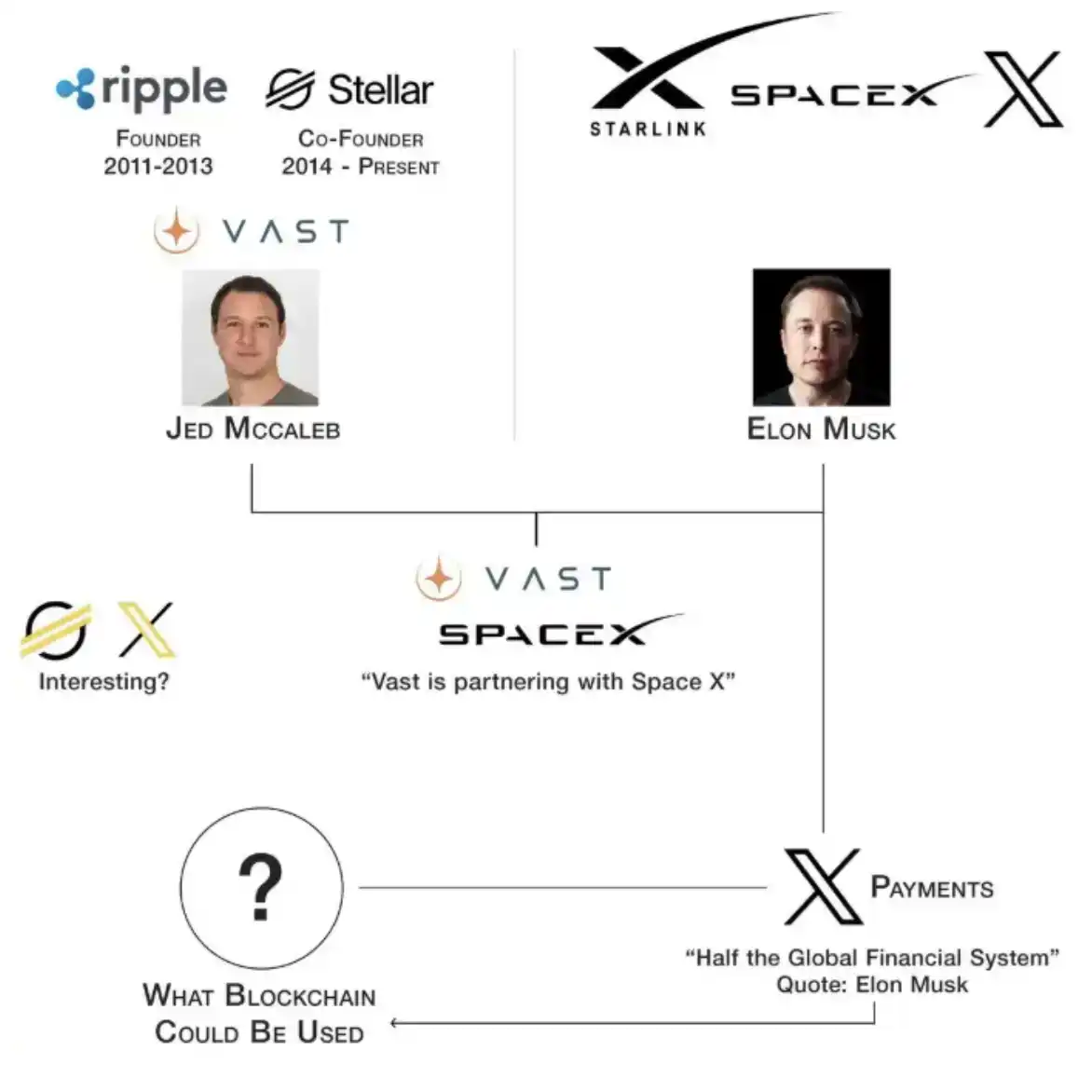
This suggests that blockchain and emerging infrastructure industries may see increasing intersections in the future.

The Convergence of Artificial Intelligence and Blockchain

One of the most overlooked points in current technological innovation might be the convergence of artificial intelligence and blockchain technology.

Ripple CEO Brad Garlinghouse recently mentioned that the company is advancing AI-related initiatives and developing tools to allow AI Agents to interact with the XRP Ledger. This reflects a broader trend taking shape across the tech industry.

AI systems are rapidly evolving from information-processing tools into autonomous agents capable of making decisions, executing transactions, and interacting with digital services.

For these agents to operate meaningfully in an economic sense, they require infrastructure that can support functions such as: sending payments; settling transactions instantly; managing digital identity; executing agreements; transferring value across different networks.

Blockchain technology provides many of these capabilities. As AI adoption accelerates, demand for payment rails capable of supporting large-scale machine-to-machine transactions may grow. This creates a potential fusion: AI generates economic activity, and blockchain networks provide the settlement layer that supports it.

Regulatory Clarity and Institutional Adoption

Another crucial topic is the increasing momentum towards digital asset regulation in the United States. Ripple's management has consistently argued that regulatory clarity is the single most important factor holding back broader institutional adoption. Banks, payment providers, corporate treasuries, and financial institutions typically require clear legal frameworks before committing significant capital to new technologies.

As regulatory certainty improves, institutions may become more willing to integrate blockchain-based systems into their existing business processes.

According to Garlinghouse, Ripple is expected to reach a revenue run-rate in the billions of dollars annually while continuing its global expansion. This indicates that demand for enterprise blockchain solutions continues to grow.

The importance of regulation is not merely legal. It reduces uncertainty and allows businesses and financial institutions to plan long-term.

From Speculative Narrative to Infrastructure Narrative

One of the strongest conclusions this month is that markets might be shifting from a speculative cycle to an infrastructure cycle. Historically, the crypto market has been largely driven by retail speculation and narrative-fueled investment. The next phase could be different.

If AI, tokenization, digital payments, commodity infrastructure, and global settlement systems continue to mature, the value of digital assets may increasingly come from actual utility, not just speculation.

This would represent a significant shift in how investors evaluate blockchain networks.

Market focus will shift away from being solely concentrated on price action, moving increasingly towards metrics like transaction volume, settlement activity, institutional adoption, growth in tokenization, and integration with emerging technologies.

Conclusion

The convergence of SpaceX, artificial intelligence, blockchain infrastructure, commodities, and regulatory clarity paints a picture of an economy undergoing structural transformation.

Space infrastructure is attracting capital, artificial intelligence is rapidly accelerating, and regulators are moving towards clearer digital asset frameworks.

Simultaneously, blockchain networks are increasingly being positioned as the settlement layer connecting these emerging systems.

For investors, the question may no longer be whether these technologies will converge, but how quickly this convergence will happen, and which networks will ultimately become the foundational backbone of the global economy's next phase.

Those who truly accumulate wealth have never been the late adopters. You must position yourself as an early investor in tomorrow's economic infrastructure, before mass adoption arrives.


Trending Cryptos

Related Questions

QAccording to the article, what is the core shift in the global capital investment trend?

AThe core shift is from chasing speculative growth to investing in the next generation of economic infrastructure, including space infrastructure, AI computing power, satellite networks, data centers, and cross-border payment systems.

QWhat role does the article suggest for specific digital assets like XRP and XLM in the emerging economic framework?

AThe article suggests they could play a crucial role as payment-focused digital assets for facilitating cross-border settlement, interoperability, and machine-to-machine payments, potentially forming the settlement layer for new economic activities driven by AI and space commerce.

QHow does the article connect the rise of AI Agents to blockchain technology?

AIt connects them by stating that as AI Agents evolve to make decisions and execute transactions, they will need an infrastructure for payments, instant settlement, and value transfer. Blockchain technology is positioned to provide this essential settlement layer for large-scale machine-to-machine economic activity.

QWhat is identified as a key factor for broader institutional adoption of blockchain-based systems?

ARegulatory clarity is identified as the most important factor. Clear legal frameworks reduce uncertainty and allow institutions like banks and payment providers to confidently integrate blockchain solutions into their long-term business planning.

QWhat major transition in market narrative does the article predict for the digital asset space?

AThe article predicts a transition from a speculative narrative, driven by retail investment and hype, to an infrastructure narrative, where the value of digital assets is increasingly derived from practical utility, transaction volume, institutional adoption, and integration with other emerging technologies like AI.

Related Reads

TechFlow Intelligence Bureau: Anthropic IPO Odds Exceed 80%, Iran Closes Strait of Hormuz Again, Triggering Oil Price Volatility

**Market Digest** **AI & Tech:** Anthropic is widely expected to announce an IPO before November 2026, raising questions about balancing its trillion-dollar valuation ambitions with its core "AI safety" mission. Brands are increasingly adopting AI-generated virtual influencers for marketing. Cloudflare introduced temporary accounts for AI agents to ease automation workflows. **Infrastructure & Hardware:** Google's IPv6 traffic surpassed 50%, marking a major internet milestone. Goldman Sachs warned that massive projected AI capital expenditure ($5.3T) is approaching credit saturation limits, potentially curbing the "AI arms race." **Space & Robotics:** SpaceX's IPO saw a historic $370M retail buying frenzy in three days. Hyundai Motor Group plans to acquire full ownership of Boston Dynamics. Elon Musk speculated about future "septillion-dollar" investments in antimatter for interstellar travel. **Energy & Geopolitics:** Iran's military announced another closure of the strategic Strait of Hormuz, accusing Israel of violating a ceasefire, causing oil market volatility. However, ship-tracking data indicated some traffic continued. Concurrently, Iran resumed crude loadings at Kharg Island, potentially releasing up to 20 million barrels to the market. **Finance & Macro:** A European CLO (collateralized loan obligation) experienced its first post-2008-crisis-era equity tranche default, raising alarms in credit markets. Nomura warned that new Federal Reserve Chair Wash's perceived hawkish debut speech could signal a significant policy shift. **The Undercurrent:** Seemingly disparate events—the Strait of Hormuz tension, the European CLO default, and warnings on AI spending—point to a tightening of global liquidity and rising marginal costs across energy, credit, and tech investment. Meanwhile, capital continues chasing grand narratives like space exploration and advanced AI, highlighting a divergence where old-world leverage frays as new-world stories grow more ambitious.

marsbit4h ago

TechFlow Intelligence Bureau: Anthropic IPO Odds Exceed 80%, Iran Closes Strait of Hormuz Again, Triggering Oil Price Volatility

marsbit4h ago

Trading

Spot
Futures

Hot Articles

What is XRP 2.0

XRP 2.0: A New Frontier in the Cryptocurrency Landscape Introduction to XRP 2.0 In the ever-evolving realm of cryptocurrency, new projects continuously emerge, vying for attention and adoption. One such promising initiative is XRP 2.0, a novel cryptocurrency project designed to leverage advanced blockchain technology and robust encryption methodologies. While the name draws parallels with Ripple’s XRP, it’s crucial to note that XRP 2.0 operates independently, focusing on enhancing transaction security, privacy, and scalability. As the digital financial landscape increasingly embraces decentralized solutions, XRP 2.0 aims to contribute meaningfully to web3 and the overall expansion of crypto projects. What is XRP 2.0? At its core, XRP 2.0 is a cryptocurrency project that aims to create a secure and decentralized digital currency ecosystem. Its foundational technology integrates sophisticated blockchain principles with cutting-edge encryption techniques. The overarching goal of XRP 2.0 is to establish itself as a reliable and efficient platform enabling swift transaction execution while prioritizing enhanced privacy protections for its users. The project is promoted as a solution to many limitations faced by existing cryptocurrencies, proposing a system that can handle a higher volume of transactions with improved speed and privacy. This versatility positions XRP 2.0 as a significant contender in a marketplace riddled with various digital currencies. Who is the Creator of XRP 2.0? The identity of the creator behind XRP 2.0 has been flagged as ‘Wilbur.’ However, comprehensive details regarding Wilbur or their associated entity remain elusive. The anonymity of many cryptocurrency creators is not an uncommon phenomenon in the industry, often designed to maintain a degree of privacy and security. Who are the Investors of XRP 2.0? As of now, specific information related to the investment foundations or organizations supporting XRP 2.0 is not publicly available. In the cryptocurrency sector, the backing by reputed investors can significantly influence a project's credibility and success, yet the transparency regarding the financial supporters of XRP 2.0 has not been established. How Does XRP 2.0 Work? XRP 2.0 stands out by employing a combination of blockchain technology and advanced encryption algorithms that ensures secure and decentralized transactions. Its innovative structure includes unique features designed to foster user engagement and broaden functionalities beyond conventional cryptocurrency transactions. Among these features, XRP 2.0 incorporates AI-powered capabilities, such as text-to-image and text-to-speech functionalities. These additions are designed to enhance the interactive experience for users, promoting broader applicability across various sectors. By bridging technological advancements with user-centered design, XRP 2.0 aims to capture the attention of a diverse range of individuals and enterprises looking to integrate cryptocurrency solutions into their operational frameworks. Timeline of XRP 2.0 Understanding XRP 2.0 requires examining the milestones that have defined its journey thus far: July 23, 2023: XRP 2.0 is introduced as a novel cryptocurrency project, aiming to revolutionize secure and decentralized transaction capabilities in the blockchain domain. September 8, 2023: The launching of another project, XRP20, occurs, marking the emergence of an ERC-20 token on the Ethereum blockchain that remains unrelated to XRP 2.0. November 13, 2023: The XRP Ledger undergoes a significant update with the release of rippled server software version 2.0.0. It is essential to note that this development is disconnected from the XRP 2.0 cryptocurrency project. Key Points About XRP 2.0 To distill the essence of XRP 2.0, several critical factors emerge: Unique Features: The inclusion of features like AI-powered text-to-image and text-to-speech further diversifies the potential applications of XRP 2.0. Blockchain Technology: The framework utilizes advanced blockchain mechanisms and encryption protocols, ensuring a secure and decentralized environment for transactions. Scalability and Privacy: XRP 2.0 prioritizes enhanced privacy protections in transaction processes and the scalability necessary to accommodate a growing user base. No Affiliation with Ripple: Importantly, despite its name, XRP 2.0 does not have any allegiance or collaboration with Ripple’s XRP, distinguishing its operational framework and objectives within the cryptocurrency ecosystem. Conclusion XRP 2.0 represents an ambitious venture into the cryptocurrency sphere, aiming to offer a combination of security, privacy, and efficiency in digital transactions. By integrating sophisticated technologies and user-friendly features, the project sets out to broaden the horizons of what cryptocurrency can achieve in today's digital economy. While the anonymity of its creator and lack of disclosed investors might raise questions for some, XRP 2.0's focus on advanced functionalities and decentralisation enhances its appeal amidst an increasingly crowded crypto market. As the cryptocurrency landscape continues to evolve, XRP 2.0 may yet emerge as a pivotal player in the expansion of secure and scalable blockchain solutions.

979 Total ViewsPublished 2024.04.01Updated 2024.12.03

What is XRP 2.0

Discussions

Welcome to the HTX Community. Here, you can stay informed about the latest platform developments and gain access to professional market insights. Users' opinions on the price of XRP (XRP) are presented below.

活动图片