Bittensor se dispara un 28% mientras las restricciones de Anthropic impulsan la prueba de TAO en los 300 dólares

ambcryptoPublished on 2026-06-15Last updated on 2026-06-15

Abstract

Bittensor (TAO) ha subido un 28% semanal, recuperándose desde el soporte clave de $180,9. El impulso se aceleró tras superar la media móvil de 20 días y una zona de resistencia, con volumen fuerte y mejoras en RSI y MACD. El anuncio de Anthropic de restringir el acceso a ciertos modelos de IA para extranjeros, por directiva estadounidense, impulsó la demanda de proyectos de IA descentralizados como Bittensor. Esto ayudó a que TAO alcanzara la zona de $272-$279. Ahora, la atención se centra en si los compradores pueden mantener el precio por encima del nuevo soporte ($244,7-$255) y superar la resistencia clave de $300. Perder ese soporte podría llevar a una corrección hacia $210-$220.

Bittensor [TAO] ganó un 9% en las últimas 24 horas, extendiendo su ganancia semanal al 28% mientras los compradores continuaban reconstruyendo el impulso. La recuperación comenzó cerca de la zona de soporte clave de 180.9 dólares.

Allí, los repetidos intentos de venta no lograron generar una presión bajista fresca.

A medida que los vendedores perdían el control, los compradores fueron absorbiendo gradualmente la oferta disponible y estabilizaron la acción del precio. Esta transición fue seguida por una breve fase de consolidación, que sugirió acumulación en lugar de distribución continuada.
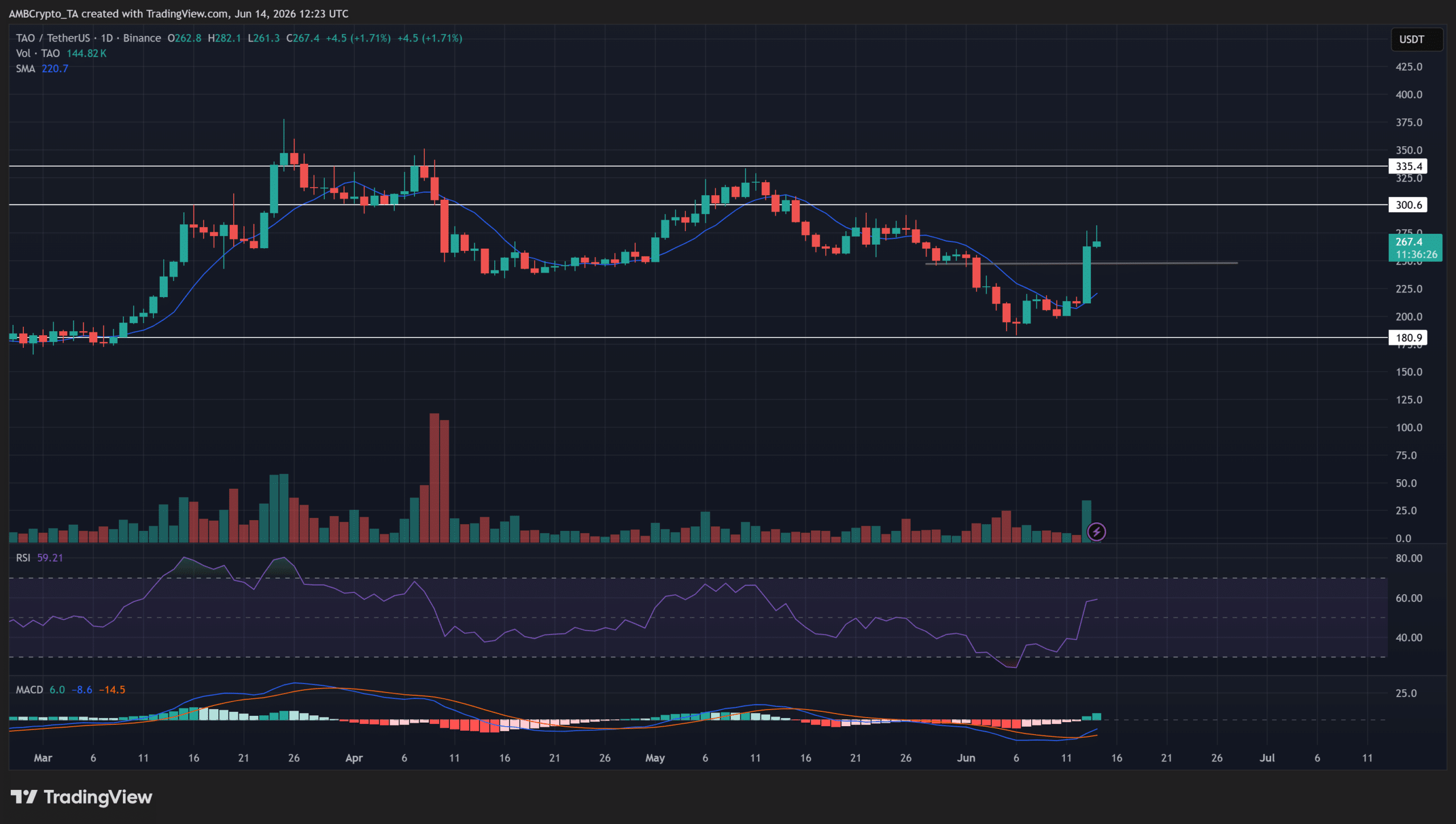
Fuente: TAO/USDT en TradingView

El impulso se aceleró entonces bruscamente, elevando TAO desde aproximadamente 215 dólares hasta 267.4 dólares en dos sesiones. En el proceso, el precio recuperó la SMA de 20 días en 220.70 dólares y superó un área de resistencia que había limitado los avances durante semanas.

El volumen se expandió agresivamente durante la ruptura, produciendo su lectura positiva más fuerte en casi dos meses.

Mientras tanto, el RSI subió a 59.2 desde menos de 40, y el MACD continuó fortaleciéndose. La atención se centra ahora en la región de 280 a 300.6 dólares, donde compradores y vendedores probablemente disputarán la fuerza de la recuperación.

El movimiento de Anthropic alimenta la demanda de TAO

El rally de Bittensor no surgió de forma aislada. Anthropic anunció que el acceso a Fable 5 y Mythos 5 sería suspendido para nacionales extranjeros tras una directiva del gobierno de Estados Unidos. La decisión puso de inmediato de relieve una debilidad clave de los sistemas de IA centralizados.
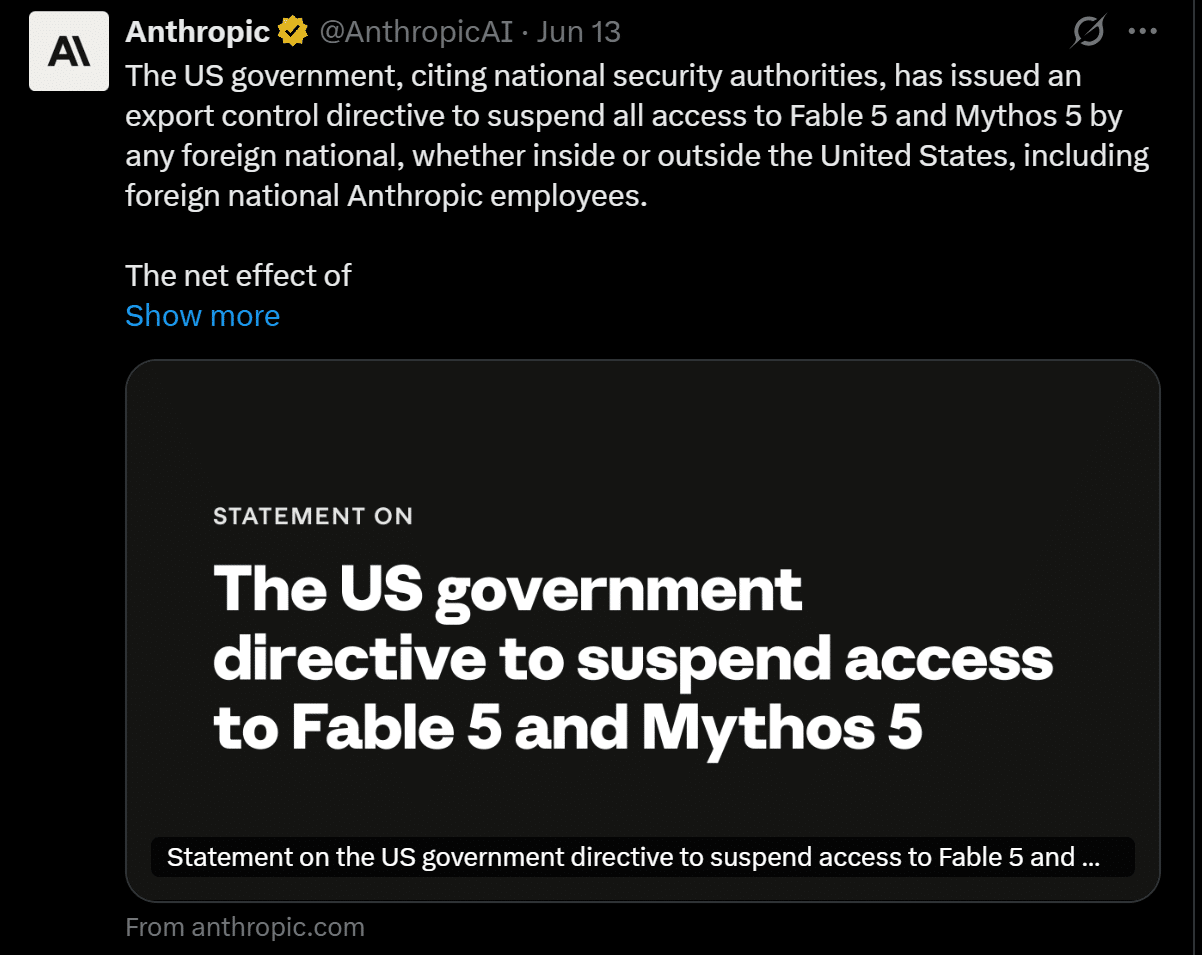
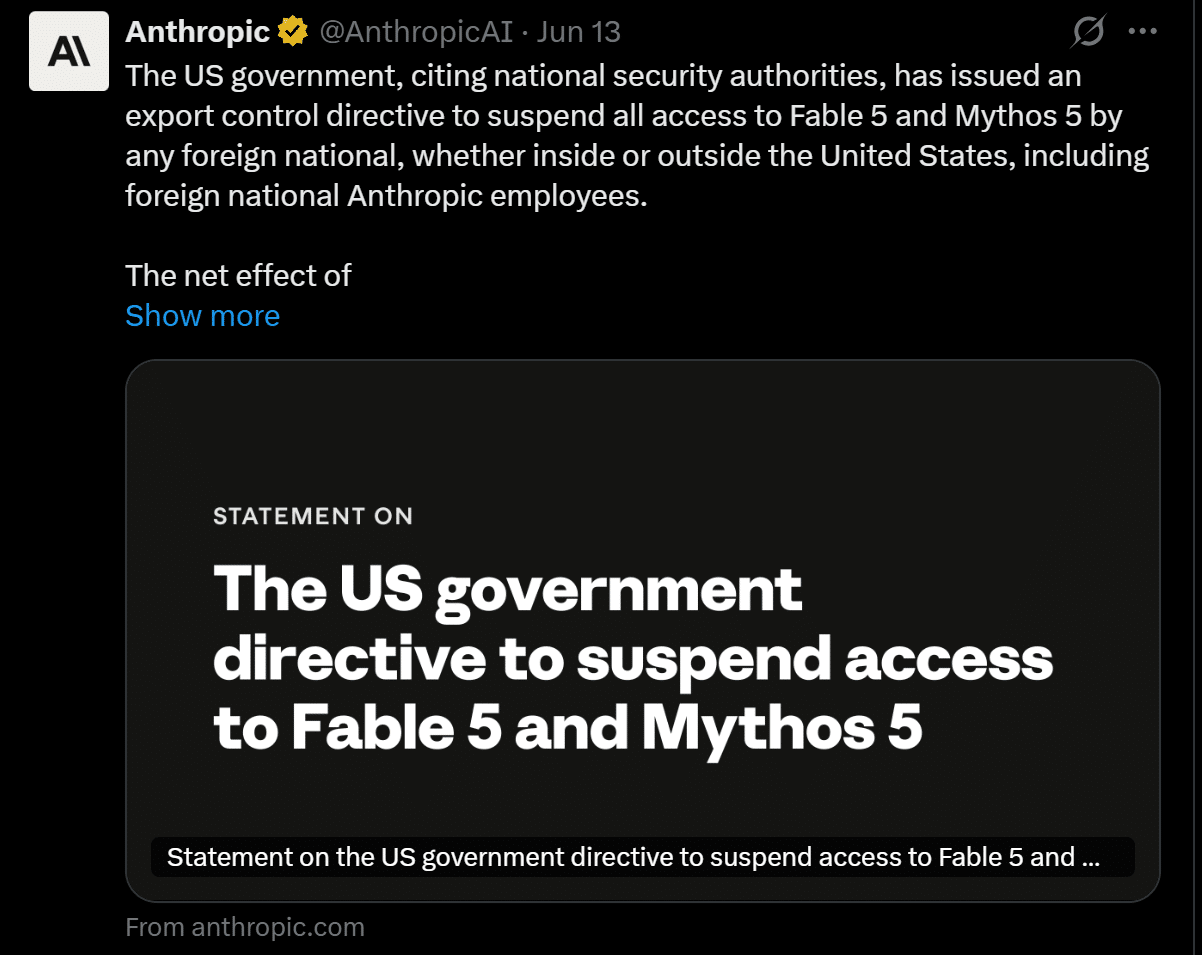
Fuente: X

El acceso podría verse restringido por regulaciones, independientemente de la demanda. Esa narrativa se extendió rápidamente a los mercados cripto. Como resultado, los traders rotaron hacia proyectos de IA descentralizados, ayudando a TAO a extender su avance hacia el rango de 272 a 279 dólares.

El volumen superó los 560 millones de dólares, reforzando la fuerza del movimiento. Esta reacción sugiere que los compradores respondían a algo más que al impulso técnico únicamente.

Sin embargo, la durabilidad del rally ahora depende de si la demanda continúa después de que el impacto de los titulares se desvanezca.

¿Pueden los alcistas forzar una ruptura por encima de 300 dólares?

El fuerte rebote de TAO ha desplazado la atención hacia si los compradores pueden mantener el control por encima de los niveles recién recuperados. Después de subir desde el barrido de liquidez en 182.5 dólares hasta 292.2 dólares, el precio encontró resistencia cerca de una zona de oferta clave de mayo y comenzó a retroceder.
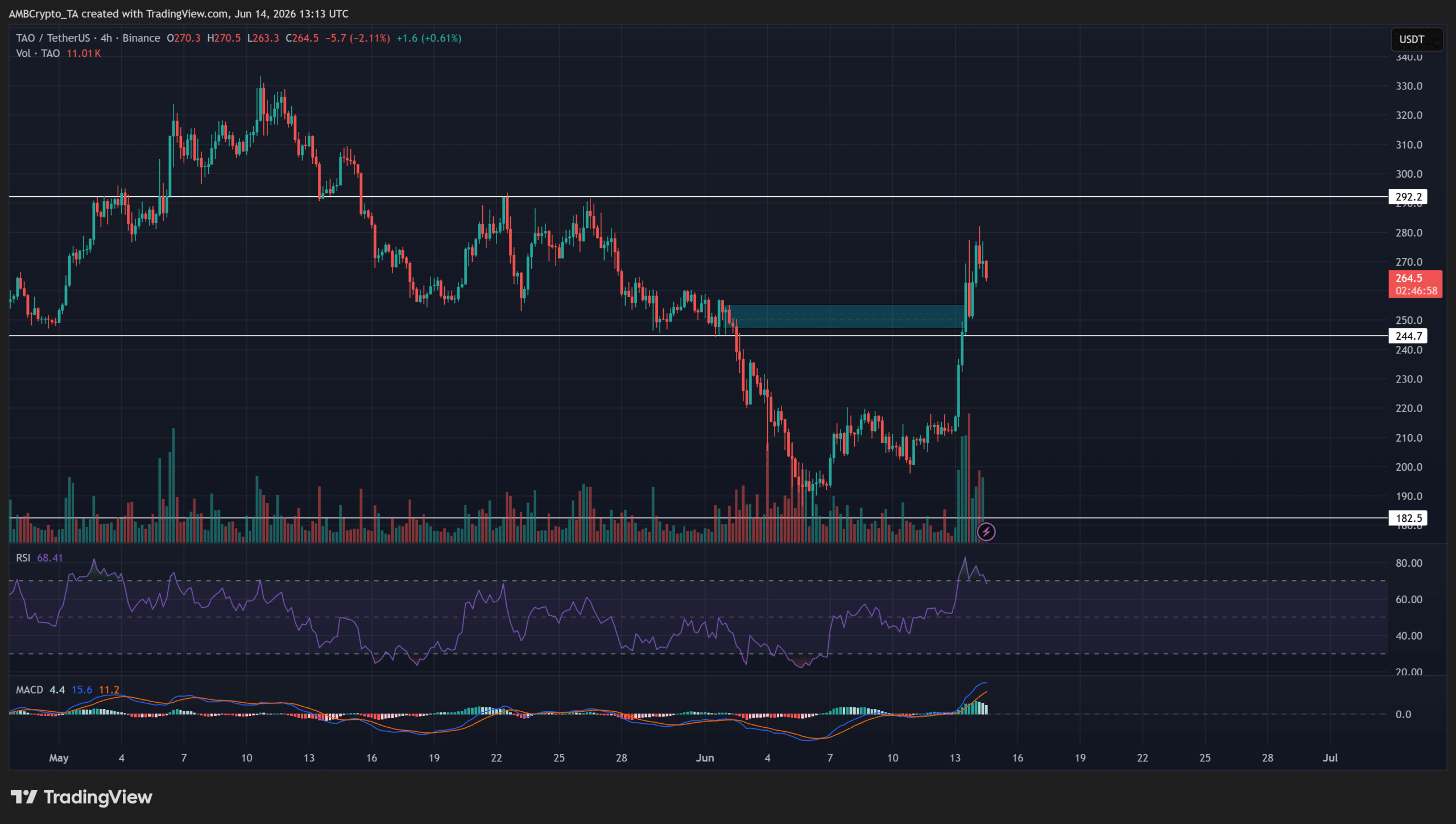
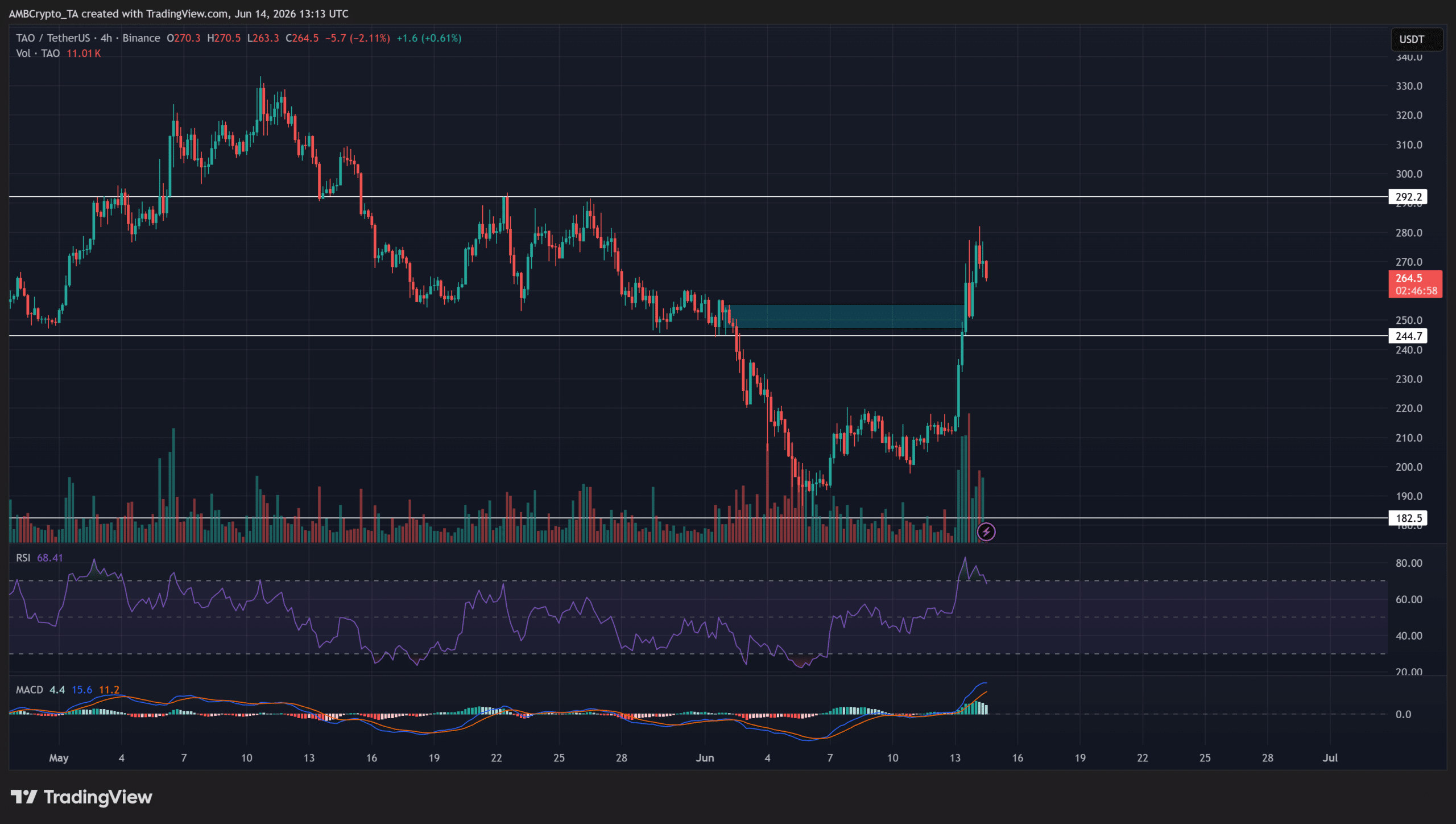
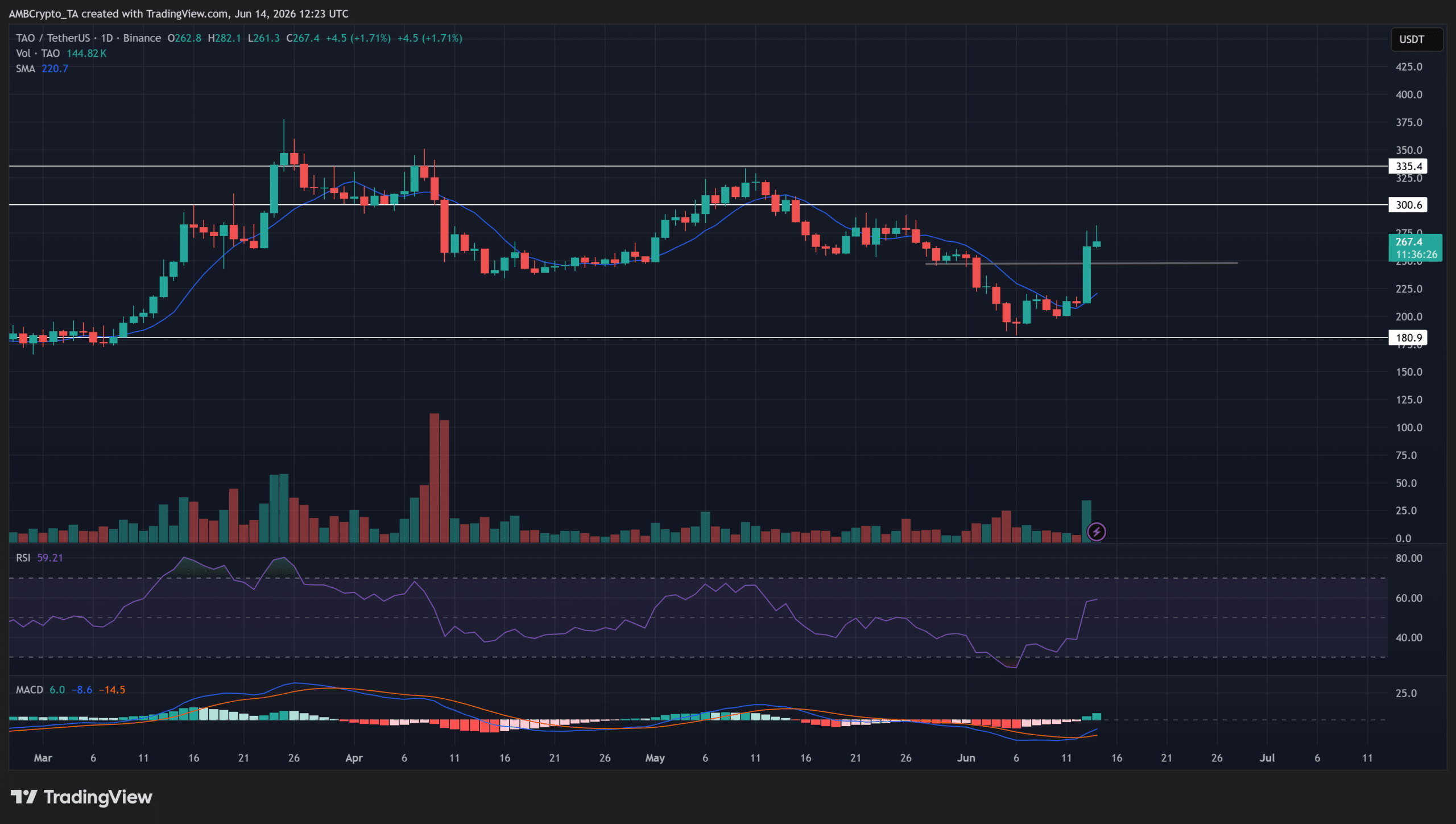
Fuente: TAO/USDT en TradingView

Esa reacción coloca el antiguo rango de consolidación de 244.7 a 255 dólares en el foco. El área actuó anteriormente como resistencia antes de la ruptura y ahora sirve como la zona de soporte más importante del mercado.

Mantenerse por encima de ella preservaría la estructura de recuperación y mantendría los 300 dólares al alcance. Perderla expondría a TAO a un retroceso más profundo hacia el soporte de 210 a 220 dólares.


Resumen Final

  • Bittensor [TAO] recuperó niveles de resistencia clave a medida que el volumen creciente y la demanda impulsada por la IA fortalecieron la estructura de recuperación.
  • TAO se enfrenta ahora a una prueba decisiva de 300 dólares, siendo la contención del soporte crítica para preservar las ganancias recientes.


Trending Cryptos

Related Questions

Q¿Cuál fue el porcentaje de ganancia semanal de Bittensor (TAO) y a qué zona de soporte clave se acercó antes de comenzar su recuperación?

ABittensor (TAO) ganó un 28% semanal. La recuperación comenzó cerca de la zona de soporte clave de 180,9 dólares.

Q¿Qué evento relacionado con Anthropic impulsó la demanda de TAO y por qué benefició a proyectos de IA descentralizada?

AAnthropic anunció la suspensión del acceso a Fable 5 y Mythos 5 para nacionales extranjeros por una directiva del gobierno estadounidense. Esto destacó una debilidad clave de los sistemas de IA centralizados (el acceso puede restringirse por regulación), lo que llevó a los traders a rotar hacia proyectos de IA descentralizados como Bittensor.

QSegún el análisis técnico, ¿qué indicadores como RSI y MACD mostraron durante el avance del precio de TAO?

ADurante el avance, el RSI subió a 59,2 desde un nivel por debajo de 40, y el MACD continuó fortaleciéndose, lo que indica un impulso alcista creciente.

Q¿Cuál es el rango de resistencia clave ($280-$300,6) que el artículo identifica como la próxima prueba importante para los compradores de TAO?

AEl artículo identifica la región de 280 a 300,6 dólares como el área donde compradores y vendedores probablemente disputarán la fuerza de la recuperación. Superarla es el próximo gran desafío para los alcistas.

Q¿Qué rango de precios ($244,7-$255) se menciona como el soporte más importante que TAO debe mantener para preservar su estructura de recuperación?

AEl rango de 244,7 a 255 dólares, que antes actuaba como resistencia, ahora es mencionado como la zona de soporte más importante. Mantenerse por encima de él es crucial para preservar la estructura de recuperación y mantener el objetivo de 300 dólares al alcance.

Related Reads

Goldman Sachs: July Smashes Through Crowded Trades, U.S. Stock Bull Market Not Broken but Harder to Navigate

Goldman Sachs: July Sees Crowded Trades Unwound, U.S. Bull Market Intact but Getting Tougher. The U.S. stock market in July did not see an index-level crash, but rather a significant unwinding of speculative positions. While the S&P 500 remained stable—trading within a narrow 3.5% range and staying within 2% of its high—underlying market dynamics were volatile. Heavily crowded trades, particularly in high-momentum tech, AI-linked stocks, and Asian strategies, faced severe pressure and forced deleveraging. Data indicates this was a meaningful cleanse, not a minor adjustment. Global tech exposure saw its largest sell-off in over five years, leverage in Korean equity ETFs plummeted, and Goldman's prime brokerage recorded the largest gross exposure reduction since late 2022. Leverage on momentum factors among fundamental long/short clients fell to the 28th percentile of its one-year range. The AI trade narrative shifted from pure potential to a focus on tangible returns. While Meta failed to show clear AI monetization, Microsoft and Amazon provided evidence that massive capital expenditure is translating into scalable revenue and product growth, preventing a blanket sell-off of the AI sector. The Federal Reserve's more opaque communication style and volatility in long-end Treasury yields have introduced new friction, particularly for rate-sensitive growth and tech stocks. The broader outlook for U.S. equities remains favorable, supported by a strong economy, robust earnings, and substantial AI capital expenditure. However, risk/reward is no longer cheap, and the market's upward elasticity has weakened. The Nasdaq 100's trajectory—up 12% year-to-date despite significant pullbacks—illustrates that the bull trend persists but the path is becoming more difficult. The key lesson from July is that the market no longer rewards crowded, highly leveraged trades, requiring more disciplined and liquid portfolio approaches.

marsbit56m ago

Goldman Sachs: July Smashes Through Crowded Trades, U.S. Stock Bull Market Not Broken but Harder to Navigate

marsbit56m ago

Interview with Robinhood Executive: Meme + Tokenized US Stocks as "Barbell" Customer Acquisition Strategy, All Business Lines Achieve Hundreds of Millions in Revenue

Interview with Robinhood executive Johann Kerbrat reveals the company's "barbell" customer acquisition strategy for its new Robinhood Chain, combining meme tokens with tokenized stocks. Three weeks after mainnet launch, the chain has seen over $3B in weekly DEX volume and 105M transactions. Kerbrat explains the logic behind the permissionless chain: meme tokens attract DeFi users, while tokenized real-world assets (RWA), currently over 90 US stocks and ETFs accessible in 120+ countries, serve global users. The goal is to bring Robinhood's 27 million funded accounts on-chain by simplifying DeFi with a user-friendly interface, exemplified by features like Robinhood Earn which offers yield without requiring wallet management. Built on Arbitrum's technology stack for its speed, low cost, and Ethereum's security, the chain focuses on financial products like Earn, spot trading, and perpetuals. Kerbrat downplays direct competition with platforms like Base, emphasizing the goal of expanding the overall market for on-chain assets. He details selective partnerships (e.g., Morpho, Lighter) based on compliance, unique UX, and differentiation. While regulatory clarity is pending for US perpetuals, the expansion continues via Bitstamp in Europe. Finally, Kerbrat positions Robinhood as a "super app" integrating stocks, options, crypto, banking, and AI trading, with all major business lines generating hundreds of millions in revenue. For the chain, current priority is driving adoption over maximizing gas fee revenue.

marsbit3h ago

Interview with Robinhood Executive: Meme + Tokenized US Stocks as "Barbell" Customer Acquisition Strategy, All Business Lines Achieve Hundreds of Millions in Revenue

marsbit3h ago

Fidelity Q3 Report: BTC, ETH, and SOL Continue to Build Bottoms; How Much Further Will This Crypto Bear Market Go?

Fidelity's Q3 Crypto Signal Report analyzes the current bear market, noting Bitcoin (BTC), Ethereum (ETH), and Solana (SOL) are in a prolonged bottoming phase. Key indicators like the weighted Net Unrealized Profit/Loss (NUPL) have turned negative (-0.01), signaling the market is slightly below its aggregate cost basis, with BTC acting as the primary stabilizing asset. BTC's dominance has risen to 68%, indicating a lack of capital rotation to other digital assets. Performance has been weak across the board, with BTC, ETH, and SOL down significantly year-to-date. Market sentiment is depressed, exacerbated by substantial outflows from spot ETPs and a challenging macro environment. The report compares the current ~203-day downtrend to historical ~300-day bottoming cycles, suggesting the process may be two-thirds complete, with late 2026 as a potential timeframe to monitor. For Bitcoin, NUPL at 0.09 indicates cautious sentiment, while momentum signals remain negative. The Yardstick metric points to potential undervaluation relative to network security (hashrate). Ethereum's NUPL is deep in the "capitulation" zone at -0.43, a historically positive signal for future returns, though its momentum and network fee revenue are negative. Solana shows the deepest NUPL at -0.72 but demonstrates relative resilience in on-chain activity and stablecoin transfer volume. The report concludes that while several metrics are near historical capitulation levels, a definitive market bottom has not yet been established. The path forward likely involves continued consolidation, with BTC's relative strength and fundamental on-chain usage for ETH and SOL providing key areas for investor observation.

marsbit3h ago

Fidelity Q3 Report: BTC, ETH, and SOL Continue to Build Bottoms; How Much Further Will This Crypto Bear Market Go?

marsbit3h ago

Trading

Spot

Hot Articles

How to Buy GAIN

Welcome to HTX.com! We've made purchasing GriffinAI (GAIN) simple and convenient. Follow our step-by-step guide to embark on your crypto journey.Step 1: Create Your HTX AccountUse your email or phone number to sign up for a free account on HTX. Experience a hassle-free registration journey and unlock all features.Get My AccountStep 2: Go to Buy Crypto and Choose Your Payment MethodCredit/Debit Card: Use your Visa or Mastercard to buy GriffinAI (GAIN) instantly.Balance: Use funds from your HTX account balance to trade seamlessly.Third Parties: We've added popular payment methods such as Google Pay and Apple Pay to enhance convenience.P2P: Trade directly with other users on HTX.Over-the-Counter (OTC): We offer tailor-made services and competitive exchange rates for traders.Step 3: Store Your GriffinAI (GAIN)After purchasing your GriffinAI (GAIN), store it in your HTX account. Alternatively, you can send it elsewhere via blockchain transfer or use it to trade other cryptocurrencies.Step 4: Trade GriffinAI (GAIN)Easily trade GriffinAI (GAIN) on HTX's spot market. Simply access your account, select your trading pair, execute your trades, and monitor in real-time. We offer a user-friendly experience for both beginners and seasoned traders.

4.3k Total ViewsPublished 2025.09.24Updated 2026.06.02

How to Buy GAIN

Discussions

Welcome to the HTX Community. Here, you can stay informed about the latest platform developments and gain access to professional market insights. Users' opinions on the price of GAIN (GAIN) are presented below.

活动图片