Bitcoin Puell Multiple Falls To 0.74 As Miner Revenue Slides

bitcoinistPublished on 2026-06-12Last updated on 2026-06-12

Abstract

The Bitcoin Puell Multiple, an on-chain indicator that measures the ratio of daily miner revenue in USD to its 365-day moving average, has declined to a recent value of 0.74. This drop suggests that Bitcoin miners are currently earning less than 75% of their average income over the past year, primarily due to a bearish shift in the cryptocurrency's price. Historically, Bitcoin has tended to find market bottoms when miner stress is high, though the current Puell Multiple level remains above those seen at the lows of the last two major bear markets. This implies that further price declines could be necessary for a bottom to form, assuming past patterns repeat. The indicator also shows characteristic sharp drops coinciding with Bitcoin Halving events, which cut the block subsidy in half. Concurrently, Bitcoin's price has been trading sideways around $62,800.

Bitcoin on-chain data shows the Puell Multiple indicator has observed a decline recently. Here’s what this could imply for the network.

Bitcoin Puell Multiple Has Dropped To The 0.74 Mark

As highlighted by CryptoQuant author Axel Adler Jr in an X post, the Bitcoin Puell Multiple has gone down recently. The “Puell Multiple” is a popular on-chain indicator that measures the ratio between the daily USD value of newly minted tokens and the 365-day moving average (MA) of the same.

Supply is “minted” on the blockchain when miners add a block and claim the corresponding block reward. This newly issued supply makes up for the majority of the BTC miner revenue, so the Puell Multiple is closely related to the income level of these chain validators.

When the value of the indicator is above 1, it means miners today are earning a higher amount of block subsidy revenue as compared to the average for the past year. On the other hand, the metric’s value being below the threshold suggests the validators are earning less than the norm.

Now, here is the chart shared by Adler Jr that shows the trend in the 30-day MA of the Bitcoin Puell Multiple over the past decade:
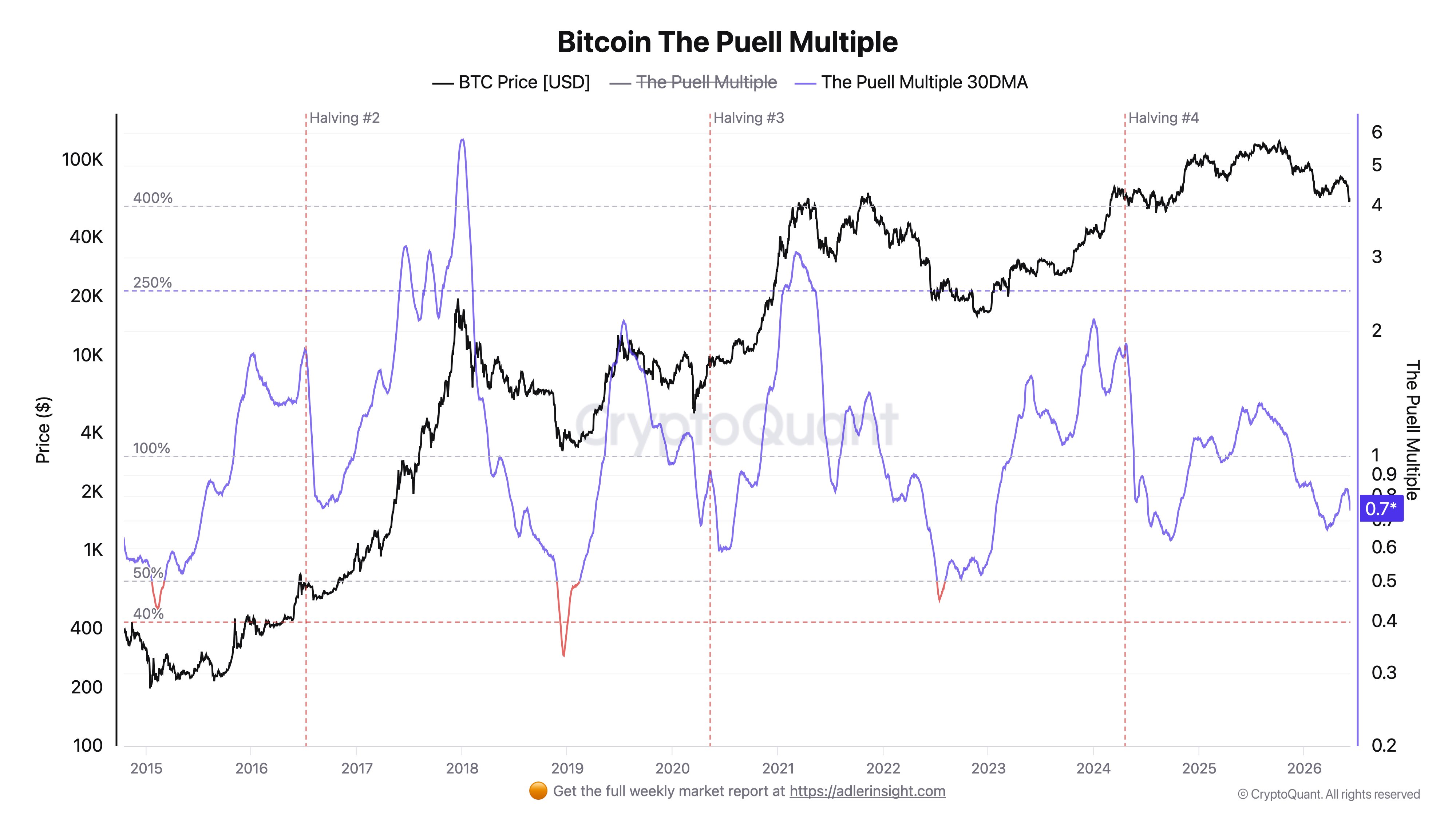
The value of the metric appears to have been heading down in recent months | Source: @AxelAdlerJr on X

As displayed in the above graph, the Bitcoin Puell Multiple shot up to a high in mid-2025, but the metric has been going down. This suggests that miner income has been on the decline.

The reason behind the metric’s trajectory is simple: the cryptocurrency’s price itself has suffered a bearish shift during this period. The block subsidy involves a fixed BTC value and is distributed at a more or less equal rate over time. As such, the only real variable related to it is the USD price of the asset.

After the latest market drawdown, the Puell Multiple has dropped to a value of 0.74. This means that miners today are making less than 75% of their normal income level for the last 365 days.

Historically, Bitcoin has often tended to approach bottoms when miners have been under a particularly high degree of stress. The current value, however, is still not as low as that observed at the lows of the last two bear markets. As such, it’s possible that BTC might have to see a further drop before a bottom can form, if the same pattern from before will play out this time as well.

An interesting feature in the chart is that the Puell Multiple abruptly drops off on a few occasions despite the price moving flat or even rising. These points correspond to the Bitcoin Halving, a periodic event that happens about every four years and permanently slashes the block subsidy exactly in half, serving as the sole moment where the block subsidy doesn’t have a fixed value.

BTC Price

Bitcoin has been stuck in sideways movement recently as its price is still trading around $62,800.

The trend in the price of the coin over the last five days | Source: BTCUSDT on TradingView


Trending Cryptos

Related Questions

QWhat is the Bitcoin Puell Multiple indicator, and what does it measure?

AThe Bitcoin Puell Multiple is an on-chain indicator that measures the ratio between the daily USD value of newly minted tokens and the 365-day moving average of that same value.

QWhat does a Puell Multiple value below 1 imply about miner revenue?

AA Puell Multiple value below 1 indicates that miners are earning less USD-denominated block subsidy revenue than their average over the past year.

QTo what level has the Bitcoin Puell Multiple declined recently according to the article?

AThe Bitcoin Puell Multiple has declined to a value of 0.74.

QWhat historical pattern does the article mention regarding the Puell Multiple and Bitcoin price bottoms?

AHistorically, Bitcoin has often tended to approach price bottoms when miners have been under particularly high stress, as indicated by low Puell Multiple values. However, the current level is still higher than at the lows of the previous two bear markets.

QWhat event causes the abrupt drops in the Puell Multiple that are not directly tied to price movement?

AThe Bitcoin Halving, a periodic event that happens roughly every four years and cuts the block subsidy in half, causes these abrupt drops in the Puell Multiple.

Related Reads

No Sales Team, $20 Million in Revenue: How Did AI Employee Viktor Win Over 30,000 Companies?

The AI employee Viktor, developed by a team with DeepMind background, has achieved $20 million in annual revenue without a traditional sales team, serving over 30,000 companies. Its core innovation lies in positioning itself as a "Tier 3 AI Coworker" capable of "end-to-end execution and delivery of results," moving beyond the "draft and wait for human completion" model of typical AI assistants. Users can simply mention Viktor in Slack or Microsoft Teams using natural language commands, and it autonomously performs tasks like pulling sales data from a CRM, generating reports, or even cross-tool operations like creating board meeting PPTs by aggregating data from six different sources. Key to its growth is a pure Product-Led Growth (PLG) model, eliminating complex implementation cycles and per-seat licensing. Instead, it charges based on task credits or consumption, lowering the trial barrier with a $100 free credit offer and no credit card required. This enabled viral, bottom-up adoption within organizations. Viktor's interaction paradigm removes the barrier of prompt engineering, allowing non-technical employees to delegate complex workflows seamlessly. It also features proactive, automated task execution (e.g., overnight bookkeeping, scheduled reports) based on triggers, effectively embedding AI as an automated "process layer" within business operations. However, its expansion into Microsoft Teams—a platform with 320 million users—highlights challenges. Large enterprises require stringent IT compliance, security reviews (e.g., SOC 2), and governance, potentially hindering the frictionless, user-driven adoption that succeeded in Slack. Additionally, the "black box" nature of its autonomous decision-making raises concerns about operational risks, data integrity, and the need for robust audit logs and permission controls. Balancing efficiency gains with security and trust remains a critical hurdle for Viktor and similar AI agents aiming to become core enterprise infrastructure.

marsbit51m ago

No Sales Team, $20 Million in Revenue: How Did AI Employee Viktor Win Over 30,000 Companies?

marsbit51m ago

Manus Buyback Plan Emerges: Chinese Investors Plan to Repurchase Equity with $2 Billion, Path to Hong Kong IPO Becomes Clearer

According to a report by The Information, early Chinese investors of Manus, including Tencent, Sequoia Capital China, and ZhenFund, are planning to repurchase the company from Meta for $2 billion—the same price Meta paid in its acquisition last December. This move is a direct response to the Chinese government's prohibition of the foreign acquisition in April. As part of the repurchase plan, Manus is considering establishing a Sino-foreign joint venture within China. This structure is seen as a way to ensure regulatory compliance for its Chinese investors and to pave the way for a future IPO in Hong Kong. Notably, U.S. investor Benchmark will not participate in the buyback, which will concentrate ownership even more among Chinese capital. Since its acquisition by Meta, Manus's business has grown rapidly, with its annualized revenue run rate reportedly increasing four-to-fivefold to $400-$500 million in roughly six months. This strong growth underpins the investors' willingness to repurchase at the original price. Financially, the forced unwinding of the deal may benefit the early investors, allowing them to regain equity at a cost far below the company's current implied valuation, with the added prospect of an independent future listing. However, specific terms of the repurchase, including funding proportions and the joint venture's equity structure, are still under negotiation. This "repurchase-joint venture-Hong Kong IPO" approach could serve as a reference model for other Chinese AI startups navigating cross-border M&A regulations.

marsbit1h ago

Manus Buyback Plan Emerges: Chinese Investors Plan to Repurchase Equity with $2 Billion, Path to Hong Kong IPO Becomes Clearer

marsbit1h ago

STRC Loses Peg by 11%, Can Strategy's Perpetual Motion Machine Keep Running?

The article discusses the significant and concerning depegging of MicroStrategy's (MSTR) preferred stock, STRC. Designed to trade near its $100 target par value, STRC has recently fallen sharply, reaching a low of $83.26 and closing at $88.59, representing an over 11% discount. STRC is a core component of MicroStrategy's financial strategy. As a perpetual preferred stock, it allows the company to raise capital through an "at-the-market" (ATM) issuance program without diluting common shareholders (MSTR). This capital is primarily used to purchase Bitcoin, creating a "capital flywheel": issuing STRC → raising cash → buying BTC → increasing net assets → supporting STRC's value. The flywheel's operation depends on STRC maintaining its $100 price. To enforce this, MicroStrategy employs a dynamic dividend mechanism, recently raising the rate to 11.5% and increasing payout frequency. However, this has failed to halt the depegging, indicating market concerns extend beyond yield. Analysts cite two main reasons. First, technical factors like forced liquidations from leveraged arbitrage trades may have exacerbated the sell-off. Second, and more fundamentally, is waning confidence in MicroStrategy's financial resilience. A JPMorgan report highlighted the company's limited cash relative to its ~$1.7 billion annual dividend obligation, raising liquidity concerns. While MicroStrategy counters that its massive Bitcoin holdings provide decades of coverage, this argument relies on the potential need to sell BTC—a departure from its long-standing "never sell" narrative. The company's recent sale of a small amount of Bitcoin for "testing," despite being framed as minor, has intensified these fears. The persistent depegging threatens to cripple MicroStrategy's primary funding channel. If STRC remains discounted, the company's ability to fund further Bitcoin purchases weakens. Should cash reserves dwindle while financing is constrained, the market may increasingly price in the risk of MicroStrategy becoming a forced seller of Bitcoin to meet obligations. This shift from a major marginal buyer to a potential seller could pose significant downside risk to the broader Bitcoin market.

链捕手1h ago

STRC Loses Peg by 11%, Can Strategy's Perpetual Motion Machine Keep Running?

链捕手1h ago

Trading

Spot
Futures

Hot Articles

What is $BITCOIN

DIGITAL GOLD ($BITCOIN): A Comprehensive Analysis Introduction to DIGITAL GOLD ($BITCOIN) DIGITAL GOLD ($BITCOIN) is a blockchain-based project operating on the Solana network, which aims to combine the characteristics of traditional precious metals with the innovation of decentralized technologies. While it shares a name with Bitcoin, often referred to as “digital gold” due to its perception as a store of value, DIGITAL GOLD is a separate token designed to create a unique ecosystem within the Web3 landscape. Its goal is to position itself as a viable alternative digital asset, although specifics regarding its applications and functionalities are still developing. What is DIGITAL GOLD ($BITCOIN)? DIGITAL GOLD ($BITCOIN) is a cryptocurrency token explicitly designed for use on the Solana blockchain. In contrast to Bitcoin, which provides a widely recognized value storage role, this token appears to focus on broader applications and characteristics. Notable aspects include: Blockchain Infrastructure: The token is built on the Solana blockchain, known for its capacity to handle high-speed and low-cost transactions. Supply Dynamics: DIGITAL GOLD has a maximum supply capped at 100 quadrillion tokens (100P $BITCOIN), although details regarding its circulating supply are currently undisclosed. Utility: While precise functionalities are not explicitly outlined, there are indications that the token could be utilized for various applications, potentially involving decentralized applications (dApps) or asset tokenization strategies. Who is the Creator of DIGITAL GOLD ($BITCOIN)? At present, the identity of the creators and development team behind DIGITAL GOLD ($BITCOIN) remains unknown. This situation is typical among many innovative projects within the blockchain space, particularly those aligning with decentralized finance and meme coin phenomena. While such anonymity may foster a community-driven culture, it intensifies concerns about governance and accountability. Who are the Investors of DIGITAL GOLD ($BITCOIN)? The available information indicates that DIGITAL GOLD ($BITCOIN) does not have any known institutional backers or prominent venture capital investments. The project seems to operate on a peer-to-peer model focused on community support and adoption rather than traditional funding routes. Its activity and liquidity are primarily situated on decentralized exchanges (DEXs), such as PumpSwap, rather than established centralized trading platforms, further highlighting its grassroots approach. How DIGITAL GOLD ($BITCOIN) Works The operational mechanics of DIGITAL GOLD ($BITCOIN) can be elaborated on based on its blockchain design and network attributes: Consensus Mechanism: By leveraging Solana’s unique proof-of-history (PoH) combined with a proof-of-stake (PoS) model, the project ensures efficient transaction validation contributing to the network's high performance. Tokenomics: While specific deflationary mechanisms have not been extensively detailed, the vast maximum token supply implies that it may cater to microtransactions or niche use cases that are still to be defined. Interoperability: There exists the potential for integration with Solana’s broader ecosystem, including various decentralized finance (DeFi) platforms. However, the details regarding specific integrations remain unspecified. Timeline of Key Events Here is a timeline that highlights significant milestones concerning DIGITAL GOLD ($BITCOIN): 2023: The initial deployment of the token occurs on the Solana blockchain, marked by its contract address. 2024: DIGITAL GOLD gains visibility as it becomes available for trading on decentralized exchanges like PumpSwap, allowing users to trade it against SOL. 2025: The project witnesses sporadic trading activity and potential interest in community-led engagements, although no noteworthy partnerships or technical advancements have been documented as of yet. Critical Analysis Strengths Scalability: The underlying Solana infrastructure supports high transaction volumes, which could enhance the utility of $BITCOIN in various transaction scenarios. Accessibility: The potential low trading price per token could attract retail investors, facilitating wider participation due to fractional ownership opportunities. Risks Lack of Transparency: The absence of publicly known backers, developers, or an audit process may yield skepticism regarding the project's sustainability and trustworthiness. Market Volatility: The trading activity is heavily reliant on speculative behavior, which can result in significant price volatility and uncertainty for investors. Conclusion DIGITAL GOLD ($BITCOIN) emerges as an intriguing yet ambiguous project within the rapidly evolving Solana ecosystem. While it attempts to leverage the “digital gold” narrative, its departure from Bitcoin's established role as a store of value underscores the need for a clearer differentiation of its intended utility and governance structure. Future acceptance and adoption will likely depend on addressing the current opacity and defining its operational and economic strategies more explicitly. Note: This report encompasses synthesised information available as of October 2023, and developments may have transpired beyond the research period.

396 Total ViewsPublished 2025.05.13Updated 2025.05.13

What is $BITCOIN

Discussions

Welcome to the HTX Community. Here, you can stay informed about the latest platform developments and gain access to professional market insights. Users' opinions on the price of BTC (BTC) are presented below.

活动图片