一张图了解为什么我看好 NFTFi 夏季即将来临

元宇宙之道Published on 2022-08-27Last updated on 2022-08-27

Abstract

我对未来的 NFTFi 行业感到非常看好。

NFTFi 夏季即将来临。基于 @alexgedevani 之前所做的工作,我为 NFTFi 生态系统创建了一张地图,收集了 300 多个项目,涉及不同的 L1/L2 和 NFT 垂直领域,当然还有很多我没有涉及的项目。我对未来的 NFTFi 行业感到非常看好。
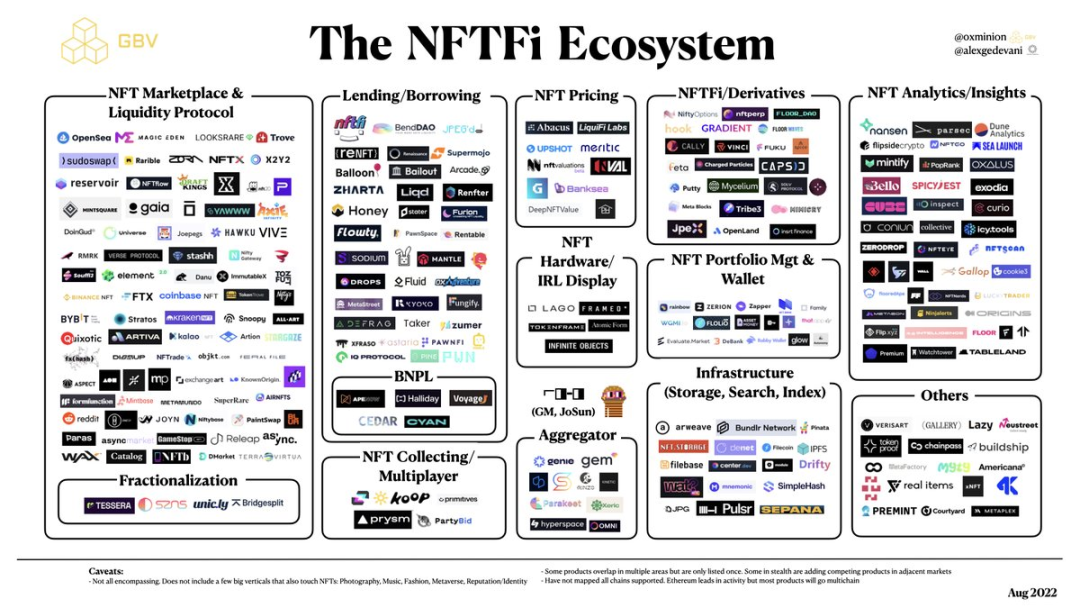
首先,用一些数字来描述。在样本量内,NFT 市场和流动性协议占比 26%(包括碎片化协议)。其次是 NFT 数据分析和洞察项目占~14.5%,其次是 NFT 借贷项目~14%(包括先买后付 BNPL),NFTFi/衍生品 项目占~7.1%。

其他垂直领域,例如 #NFT 投资组合管理和钱包、聚合器、NFT 硬件/IRL 显示、NFT 定价、基础设施(存储、搜索、索引)、NFT 策展/画廊、内容创建、NFT 收集/多人游戏构成了其余部分。

流动性因存在许多不同的实施而呈现碎片化,但当前 NFT 市场的 TAM 仍然相对较小,但增长迅速。

#NFT 借贷是一个完全有意义的发展方向,但当前的 TAM 相对较小,因为从流动性/交易方面来看,它们可以被视为普通的长尾代币,而不是全新的资产类别。但从根本上说,NFT 与代币不同。

我们经历了 #DeFi 夏季,在那里我们看到了凭借更好的退出定价和潜在的市场退出意图,degens 鲸鱼如何使用长尾资产借贷协议来退出头寸。

但是如何释放资本并创建 #NFT 货币市场乐高?当然它是必要的,但是,我更感兴趣的是看到 NFT 借贷协议扩展与其他协议的可组合性,而不是旨在释放资本。

归根结底,为了引导流动性,仍然需要激励措施,特别是对于长尾资产,我确实希望看到我们可能会在 NFT 借贷协议上恢复收益耕种(或流动性挖矿)活动。

链上先买后付(Onchain BNPL) 作为一种独立的协议很难生存,而且目标市场有点太小众了,尤其是没有一个全面的信用评级基础设施,但我确实认为这可能是一个有趣的增值案例,例如灵魂绑定代币。

然而,我今天在 Linkedin 上看到的一些垃圾帖子,“推出一家名为 Afterafterpay 的新创业公司,解决 BNPL 债务问题,您可以现在购买,以后再付款”,总体上确实提供了一些关于 BNPL 计划的相关方面。

有一些 PMF 不匹配,Degens 需要链上 BNPL,否则将被用于套利/清算或被视为 NFT 上的看涨期权。非加密人群首先需要加入 DeFi/NFTFi;成本一般太高。

然而,中心化 BNPL 或 BNPL 作为更大产品供应的一部分可能是有意义的。例如,@Shopify 已经集成了 NFT 门控功能;是什么阻止他们整合 NFT BNPL 方案并将这些方案提供给非加密的本地人?

为了让借贷协议运行良好,我们还需要一个运行良好的预言机。我们已经看到诸如 NFTX 和 sudoswap 等流动性协议利用 AMM 联合曲线设计来推动生态系统中更有效的定价。

或者,我最近看到 AI/统计/ML 分析定价模型在上升。我当然可以看到,例如 Opensea 和 Magic Eden 和拍卖行进行整合以进行分析,并为市场参与者提供一些参考点。

这些可以帮助改善蓝筹 NFT 的价格估计,但是,由于 NFT 市场仍在迅速发展,后端算法需要不断调整以寻找更好的模型拟合。

我会谨慎使用 AI/统计/ML 分析定价模型作为主要预言机之一。估计的产出很容易被未来的收益耕种活动和作为退出策略的清算所扭曲。充足的 NFT 现货流动性 > 准确的长尾定价。

我认为 NFT 碎片化的方式是它确实有它的位置;然而相当利基。一般来说,如果您通过碎片化来引导流动性,这可能会导致该特定收藏品/项目的 FDV 膨胀。这是一个流通 + 锁定的游戏。

也有建设者在构建 NFT 衍生品,例如永续或期权产品。但是,我通常对链上衍生品持观望态度,并不是说我们不需要这些,而是要让它运作良好,我们首先需要有足够的现货流动性。

NFT 期权产品现在说还为时过早,但一些有趣的想法在流传,我可以看到业界更多地探索 NFTFi 原语并可能集成到后端等,即与金库。流动性引导将是困难的。

很高兴看到围绕 NFTFi 的更多不同设计、实现和想法。还有很多要发现的,本文还没有谈到策展、音乐、摄影、元宇宙、声誉/身份或辩论,例如创造者优先 vs 流动性优先。

Trending Cryptos

Related Reads

GPT Designs GPT

OpenAI has unveiled its first custom AI chip, Jalapeño, a move signaling a strategic shift beyond being a mere model company. While many see it as a challenge to NVIDIA, its core aim is to control the entire intelligent production pipeline—from models and chips to data centers and energy. The key driver is the evolving competitive landscape: model advantages are shrinking, while the computational gap in areas like cost-per-token, system throughput, and energy efficiency is becoming the true long-term barrier. Jalapeño is primarily an inference chip, targeting the massive and growing "inference tax"—the daily operational cost of generating tokens for services like ChatGPT and APIs. By designing its own hardware optimized for its specific workloads and future product roadmaps (even using AI to aid the chip design process), OpenAI aims to drastically reduce token generation costs and improve system efficiency. This creates a potential flywheel: better models help design better chips, which lower costs for running next-generation models, supporting more users and products, which in turn provides more data to refine future chips. The strategy mirrors Apple’s integrated approach, building a closed loop where hardware, software, and applications are co-optimized. In the long term, OpenAI is not trying to become the next NVIDIA (a supplier of "shovels" to all AI companies) but to own and operate the entire "mine"—selling the end product of intelligence itself. This move marks OpenAI's ambition to evolve from creating the smartest models to controlling the foundational infrastructure of AI production.

marsbit15m ago

GPT Designs GPT

marsbit15m ago

Ethereum Foundation Interim Executive Director Speaks Out: What Is Our Mission?

The Ethereum Foundation's core mission is to ensure Ethereum remains a truly permissionless, censorship-resistant, private, and open infrastructure for large-scale, sovereign coordination. The article clarifies the EF's focus and dismisses irrelevant objectives, such as pursuing institutional popularity or short-term speculation. Its core work centers on eliminating systemic weaknesses. This involves fortifying Ethereum across multiple layers—protocol, access, user, and institutional—against exploitation, control, or surveillance. Key initiatives include minimizing harmful MEV and preventing privileged control over transaction flow, making unconditional privacy a foundational default, ensuring staking remains permissionless and decentralized, and strengthening user-facing access points to uphold autonomy. Concurrently, the EF aims to seize strategic opportunities. These include leading the transition to post-quantum cryptography, achieving a fully verifiable protocol stack, establishing Ethereum as private digital cash, integrating user-owned AI agents with personal wallets, and demonstrating that trusted-neutral infrastructure can competitively handle disintermediated coordination at an institutional scale. The article also addresses recent organizational changes, stating that personnel departures were due to strategic realignment, role fit, or natural evolution. It clarifies the approach to spin-outs, emphasizing that external funding will be provided only for work critical to the EF's mission that reduces Ethereum's dependency without creating new risks or mission drift. Ultimately, the EF is committed to building an enduring, neutral system that reshapes global coordination, focusing relentlessly on the principles of censorship resistance, openness, privacy, and sovereignty (CROP).

链捕手58m ago

Ethereum Foundation Interim Executive Director Speaks Out: What Is Our Mission?

链捕手58m ago

Trading

Spot
Futures

Hot Articles

Discussions

Welcome to the HTX Community. Here, you can stay informed about the latest platform developments and gain access to professional market insights. Users' opinions on the price of ETH (ETH) are presented below.

活动图片