Newbie Bitcoin Whales Took $1.77 Billion In Loss During Price Crash: Data

bitcoinistPublished on 2026-06-09Last updated on 2026-06-09

Abstract

New Bitcoin whales, defined as holders of over 1,000 BTC acquired within the last 155 days, realized approximately $1.77 billion in losses during the recent price crash, according to on-chain data. These short-term holder whales, considered the market's "weak-minded" side, panic-sold as Bitcoin's price dropped to around $59,000. In contrast, long-term holder whales minimized their loss-taking. Analyst Maartunn notes Bitcoin's price has yet to fall below its current Realized Price of $53,630 this cycle, a level historically seen as a buying opportunity. At publication, Bitcoin trades near $63,300, down over 13% for the week.

On-chain data shows the new Bitcoin whales realized a massive amount of loss during the past week as BTC has gone through its drawdown.

New Bitcoin Whales Have Harvested Massive Losses Recently

As pointed out by CryptoQuant analyst Maartunn in a new post on X, New Whales on the Bitcoin blockchain have been participating in loss-taking recently. “Whales” are broadly defined as investors holding more than 1,000 BTC in their wallets, excluding entities such as miners and exchanges.

Whales can be divided into two cohorts on the basis of holding time: New Whales and Old Whales. The former, also known as Short-Term Holder (STH) Whales, include all whale-sized addresses that purchased their coins within the past 155 days. Similarly, the Old or Long-Term Holder (LTH) Whales are made up of the large investors who have held past the five-month cutoff.

Statistically, the longer an investor holds onto their coins, the less likely they are to sell them in the future. As such, the New Whales with their relatively short holding time are considered to represent the weak-minded side of the market, while the Old Whales represent the resolute side.

The behavior of these investors has been in line with their reputation during the recent price plunge, as the chart for the Bitcoin realized profit/loss shared by Maartunn shows.
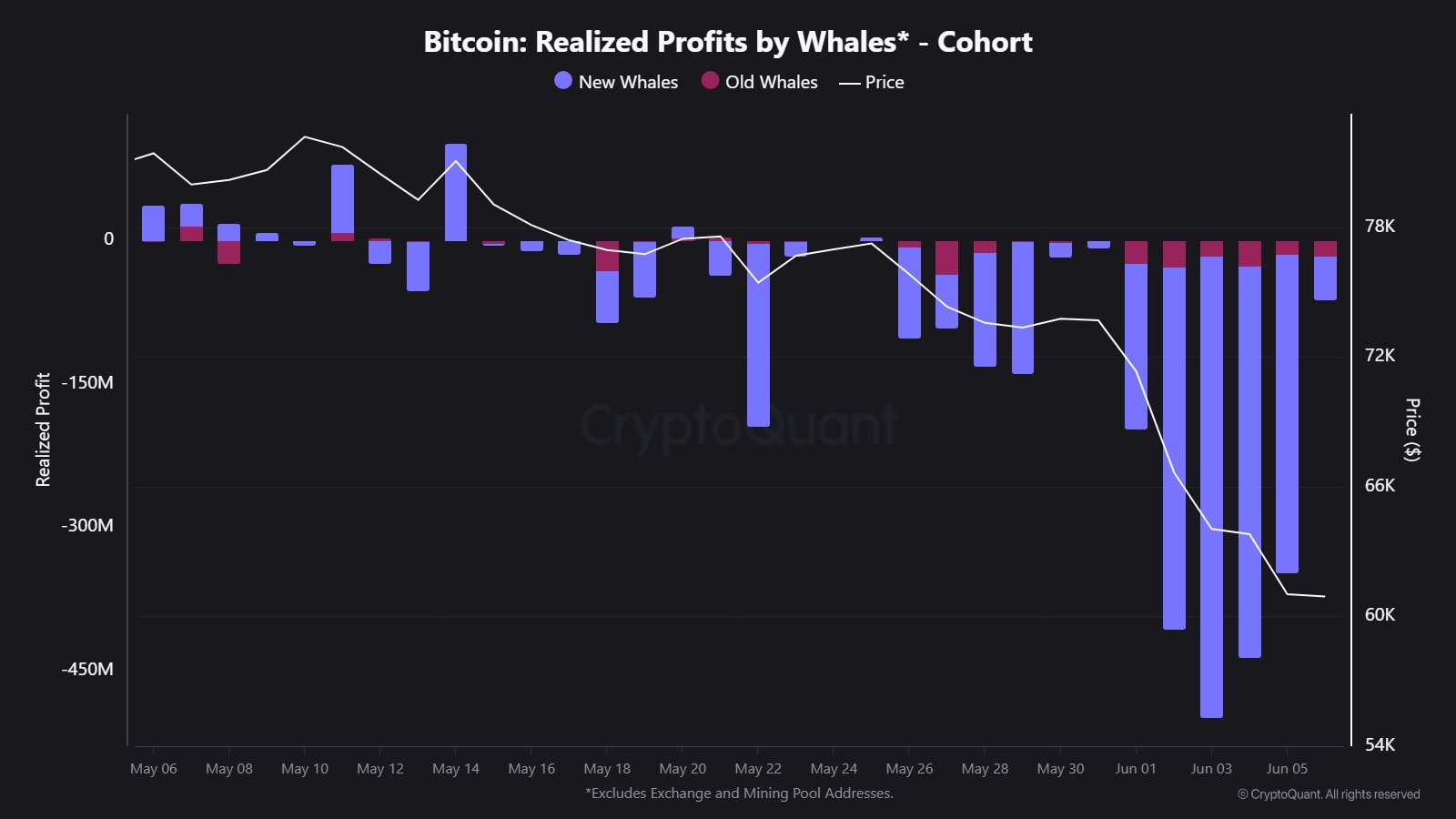
The value of the metric appears to have been negative in recent days | Source: @JA_Maartun on X

From the graph, it’s apparent that the whales as a whole have realized a significant amount of losses in response to the bearish price action. The distribution of the realized loss, however, has heavily skewed toward the New Whales (shaded in blue in the chart).

In total, the STH Whales took $1.77 billion in losses during the past week. This is a notable amount and suggests that the big-money investors who entered the market recently have panic-capitulated in the crash. Meanwhile, the LTH Whales have kept their loss-taking contained, at least for now.

It only remains to be seen how the Bitcoin price will develop in the near future and how these whales will react to it. The price drawdown so far took the cryptocurrency to a low of $59,000, which isn’t at too much of a distance from the Realized Price, a metric tracking the cost basis of the average investor on the network.

As the analyst pointed out in another X post, BTC’s Realized Price is currently located at $53,630.
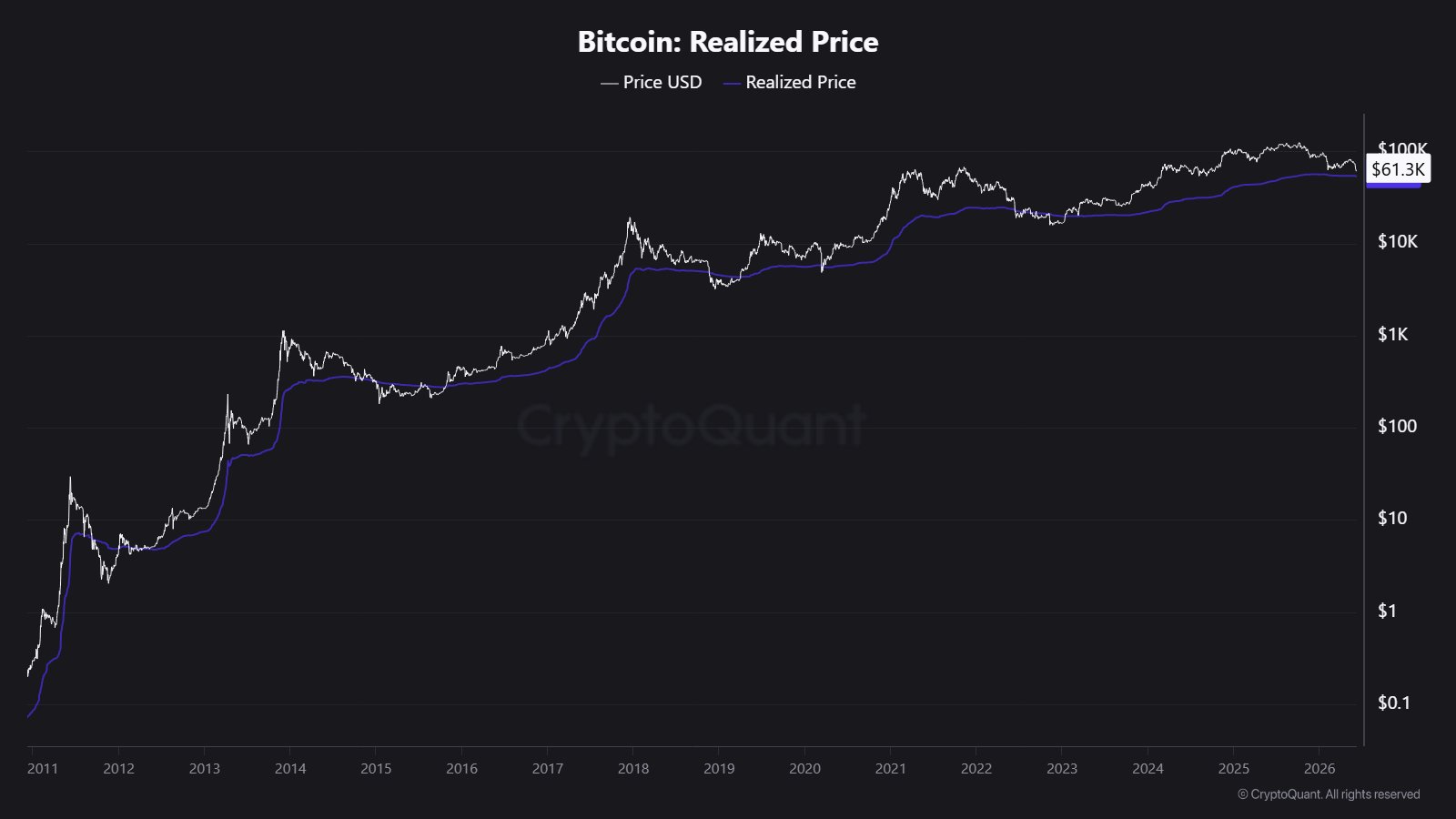
The trend in the Realized Price over the history of the asset | Source: @JA_Maartun on X

Bitcoin hasn’t gone below the Realized Price in this cycle even once, but it’s possible that if the current bearish trajectory continues, a retest could occur. “Every dip below that level has historically been a no-brainer DCA zone for long-term investors,” noted Maartunn.

BTC Price

At the time of writing, Bitcoin is trading around $63,300, down more than 13% over the past week.

Looks like the price of the coin has been moving sideways recently | Source: BTCUSDT on TradingView


Trending Cryptos

Related Questions

QWhat is the main finding from the on-chain data regarding new Bitcoin whales?

AThe main finding is that new Bitcoin whales (Short-Term Holder Whales) realized massive losses totaling $1.77 billion during the past week's price crash, indicating panic capitulation.

QHow are 'New Whales' and 'Old Whales' defined in the context of this article?

ANew Whales, or Short-Term Holder (STH) Whales, are addresses holding over 1,000 BTC that acquired them within the last 155 days. Old Whales, or Long-Term Holder (LTH) Whales, are those who have held their coins for longer than that five-month cutoff.

QAccording to the analyst, what is the current level of Bitcoin's Realized Price and its significance?

AThe current Bitcoin Realized Price is $53,630. The analyst notes that historically, dips below this level have been a 'no-brainer DCA zone' for long-term investors, as it represents the average cost basis across the network.

QWhat was the lowest price Bitcoin reached during the recent drawdown mentioned in the article?

ADuring the recent drawdown, Bitcoin reached a low of $59,000.

QWhat does the behavior of the New Whales during the crash suggest about their mindset, according to the article?

ATheir behavior suggests they represent the 'weak-minded side of the market,' as they engaged in significant panic selling and realized heavy losses shortly after entering the market.

Related Reads

Why Is the World Nervous About Japan Raising Interest Rates?

In June 2026, the Bank of Japan raised its policy rate to 1%, marking its first hike to this level since 1995. While this rate remains low compared to global peers like the US and Europe, the move signals a profound shift for a nation that has been a global source of ultra-cheap funding for decades. Japan's long-standing near-zero or negative interest rates had facilitated massive "yen carry trades," where international investors borrowed low-cost yen to invest in higher-yielding assets worldwide, such as US tech stocks and emerging market bonds. This made Japan a critical, often overlooked, source of global liquidity. Japan's ultra-loose policy stemmed from structural challenges post-1990s asset bubble: aging demographics, chronic low inflation/deflation, and high public debt. Recent shifts, including sustained wage growth (exceeding 5% in recent years) and inflation consistently above the 2% target, have created a "wage-price spiral" possibility, prompting the policy normalization. The global market's concern lies not in the absolute rate but in the potential unwinding of the yen carry trade. As Japanese borrowing costs rise, the economics of these leveraged global investments change, potentially triggering deleveraging and capital outflows from risk assets. Market anxiety focuses on the end of a thirty-year consensus that Japan would perpetually provide cheap funding. Ultimately, the global impact will depend on the interplay with US monetary policy. While Japan is tightening, the significant interest rate differential with the US remains. The key future dynamic is whether simultaneous Japanese hikes and eventual US rate cuts will narrow this gap, forcing a major recalibration of global capital flows and asset pricing built on an era of abundant, cheap yen liquidity.

marsbit11h ago

Why Is the World Nervous About Japan Raising Interest Rates?

marsbit11h ago

Trading

Spot
Futures

Hot Articles

What is $BITCOIN

DIGITAL GOLD ($BITCOIN): A Comprehensive Analysis Introduction to DIGITAL GOLD ($BITCOIN) DIGITAL GOLD ($BITCOIN) is a blockchain-based project operating on the Solana network, which aims to combine the characteristics of traditional precious metals with the innovation of decentralized technologies. While it shares a name with Bitcoin, often referred to as “digital gold” due to its perception as a store of value, DIGITAL GOLD is a separate token designed to create a unique ecosystem within the Web3 landscape. Its goal is to position itself as a viable alternative digital asset, although specifics regarding its applications and functionalities are still developing. What is DIGITAL GOLD ($BITCOIN)? DIGITAL GOLD ($BITCOIN) is a cryptocurrency token explicitly designed for use on the Solana blockchain. In contrast to Bitcoin, which provides a widely recognized value storage role, this token appears to focus on broader applications and characteristics. Notable aspects include: Blockchain Infrastructure: The token is built on the Solana blockchain, known for its capacity to handle high-speed and low-cost transactions. Supply Dynamics: DIGITAL GOLD has a maximum supply capped at 100 quadrillion tokens (100P $BITCOIN), although details regarding its circulating supply are currently undisclosed. Utility: While precise functionalities are not explicitly outlined, there are indications that the token could be utilized for various applications, potentially involving decentralized applications (dApps) or asset tokenization strategies. Who is the Creator of DIGITAL GOLD ($BITCOIN)? At present, the identity of the creators and development team behind DIGITAL GOLD ($BITCOIN) remains unknown. This situation is typical among many innovative projects within the blockchain space, particularly those aligning with decentralized finance and meme coin phenomena. While such anonymity may foster a community-driven culture, it intensifies concerns about governance and accountability. Who are the Investors of DIGITAL GOLD ($BITCOIN)? The available information indicates that DIGITAL GOLD ($BITCOIN) does not have any known institutional backers or prominent venture capital investments. The project seems to operate on a peer-to-peer model focused on community support and adoption rather than traditional funding routes. Its activity and liquidity are primarily situated on decentralized exchanges (DEXs), such as PumpSwap, rather than established centralized trading platforms, further highlighting its grassroots approach. How DIGITAL GOLD ($BITCOIN) Works The operational mechanics of DIGITAL GOLD ($BITCOIN) can be elaborated on based on its blockchain design and network attributes: Consensus Mechanism: By leveraging Solana’s unique proof-of-history (PoH) combined with a proof-of-stake (PoS) model, the project ensures efficient transaction validation contributing to the network's high performance. Tokenomics: While specific deflationary mechanisms have not been extensively detailed, the vast maximum token supply implies that it may cater to microtransactions or niche use cases that are still to be defined. Interoperability: There exists the potential for integration with Solana’s broader ecosystem, including various decentralized finance (DeFi) platforms. However, the details regarding specific integrations remain unspecified. Timeline of Key Events Here is a timeline that highlights significant milestones concerning DIGITAL GOLD ($BITCOIN): 2023: The initial deployment of the token occurs on the Solana blockchain, marked by its contract address. 2024: DIGITAL GOLD gains visibility as it becomes available for trading on decentralized exchanges like PumpSwap, allowing users to trade it against SOL. 2025: The project witnesses sporadic trading activity and potential interest in community-led engagements, although no noteworthy partnerships or technical advancements have been documented as of yet. Critical Analysis Strengths Scalability: The underlying Solana infrastructure supports high transaction volumes, which could enhance the utility of $BITCOIN in various transaction scenarios. Accessibility: The potential low trading price per token could attract retail investors, facilitating wider participation due to fractional ownership opportunities. Risks Lack of Transparency: The absence of publicly known backers, developers, or an audit process may yield skepticism regarding the project's sustainability and trustworthiness. Market Volatility: The trading activity is heavily reliant on speculative behavior, which can result in significant price volatility and uncertainty for investors. Conclusion DIGITAL GOLD ($BITCOIN) emerges as an intriguing yet ambiguous project within the rapidly evolving Solana ecosystem. While it attempts to leverage the “digital gold” narrative, its departure from Bitcoin's established role as a store of value underscores the need for a clearer differentiation of its intended utility and governance structure. Future acceptance and adoption will likely depend on addressing the current opacity and defining its operational and economic strategies more explicitly. Note: This report encompasses synthesised information available as of October 2023, and developments may have transpired beyond the research period.

384 Total ViewsPublished 2025.05.13Updated 2025.05.13

What is $BITCOIN

Discussions

Welcome to the HTX Community. Here, you can stay informed about the latest platform developments and gain access to professional market insights. Users' opinions on the price of BTC (BTC) are presented below.

活动图片